Free original lessons
Cartoon Spaceship Drawing: Hull, Fins, and Cockpit
Learn to draw a cartoon spaceship with a clear hull shape, balanced fins, and a cockpit bubble. Includes steps, checks, and practice tasks.
Free lesson
Four exercises
Worked answers
Object Drawing Lessons
This lesson teaches a repeatable method for drawing a cartoon spaceship. You will build the hull as a simple tapered body, place three fins at useful attachment points, and add a cockpit bubble that reads clearly against the hull. The convention is deliberately simple: the hull is a rounded wedge, fins are triangular or rounded tabs, and the cockpit is an ellipse with a highlight. Because cartoon styles vary, the rubric rewards clear shape relationships and consistent line weight rather than one exact outline. All measurements below are hypothetical examples; measure your own paper and tools before setting sizes.
Practice materials: Printable downloads are not available for this lesson yet. Use the instructions and four exercises below.
Reference illustration
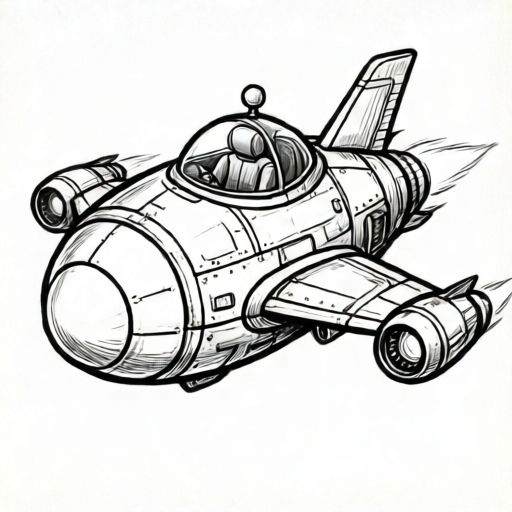
Use the stated measurements and conventions for each exercise.
Build the hull as a tapered body
Start with a light construction line for the ship's long axis. Mark a nose point and a tail point. The hull is a rounded wedge: wider near the tail, narrowing toward the nose, with a soft curve rather than a sharp point. A simple approach is to draw two gentle arcs from the nose to the tail, then close the tail with a shallow curve.
Keep the hull symmetrical about the long axis. If you want a friendlier cartoon look, make the nose slightly blunt and the tail slightly rounded. The hull should occupy most of the drawing area so fins and cockpit have room. Use a light pencil for construction and a darker line for the final outline.
- Draw a horizontal construction line and mark nose and tail points.
- Sketch two gentle arcs from nose to tail to form the hull sides.
- Close the tail with a shallow curve and check symmetry.
- Darken the hull outline with a consistent line weight.
Place fins at clear attachment points
Fins help the cartoon read as a spaceship. Use three fins: one on top near the tail, one on the bottom near the tail, and one at the back as a tail fin. Attachment points should sit on the hull outline, not float away from it. Each fin is a triangular or rounded tab that extends outward and slightly backward.
Keep fin sizes related: the top and bottom fins can be similar, while the tail fin may be slightly larger. Avoid crossing fin lines through the cockpit area. If a fin overlaps the hull, erase the hidden hull line so the fin appears attached. Consistent angles make the ship look stable.
- Mark three attachment points: top tail, bottom tail, and back center.
- Draw each fin as a tab extending outward and backward.
- Erase hull lines hidden behind fins.
- Check that fins do not crowd the cockpit space.
Add the cockpit bubble
The cockpit is an ellipse placed on the upper front half of the hull. It should sit fully inside the hull outline, with a small margin. Draw the ellipse lightly, then add a smaller highlight ellipse near the top edge to suggest glass. A simple curved line inside the cockpit can suggest a seat or control panel, but keep it minimal.
The cockpit should not touch the hull edge or the fins. If the ellipse feels too large, reduce it slightly. The highlight should be on the same side for all similar drawings so the light direction stays consistent. Use a slightly thicker line for the cockpit rim to separate it from the hull.
- Lightly draw an ellipse on the upper front hull.
- Add a smaller highlight ellipse near the top edge.
- Draw one or two simple interior lines if desired.
- Thicken the cockpit rim and erase unnecessary construction lines.
Check proportions and line consistency
A finished cartoon spaceship should read clearly at a glance. Check that the hull is symmetrical, fins are attached, and the cockpit is inside the hull. Line weight should be consistent: a medium outline for the hull, similar weight for fins, and a slightly thicker rim for the cockpit. Avoid sketchy double lines in the final drawing.
Use a simple proportion check: the cockpit width should be roughly one-third of the hull width at its widest point. The top and bottom fins should not extend more than about half the hull width beyond the hull outline. These are hypothetical guidelines; adjust to your chosen cartoon style while keeping the relationships clear.
- Compare cockpit width to hull width at the same point.
- Check fin extension against hull width.
- Confirm symmetry by folding or measuring from the axis.
- Clean up stray construction lines and finalize line weight.
Worked example
Draw a cartoon spaceship on a 15 cm by 10 cm area. Use a hull that is 12 cm long and 6 cm wide at the tail, three fins, and a cockpit ellipse 2 cm wide. Describe the placement and checks.
Worked answer
Place the long axis horizontally. Mark nose at 1.5 cm from the left edge and tail at 13.5 cm. Draw gentle arcs to make a rounded wedge 6 cm wide at the tail. Mark top and bottom fin attachment points 2 cm from the tail, and a back fin at the tail center. Draw fins extending about 2 cm outward and 1 cm backward. Place the cockpit ellipse centered 4 cm from the nose, fully inside the hull. For this example, assume the hull is about 6 cm wide at the cockpit center, so a 2 cm cockpit is about one-third of the local hull width and leaves about 2 cm margin on each side (well above the 0.5 cm minimum). Add a highlight ellipse near the top. Check that fins do not cross the cockpit and line weights are consistent.
Four practice exercises
Exercise 1
On a 12 cm by 8 cm area, draw a hull 10 cm long and 5 cm wide at the tail. Add two side fins and one tail fin. Place a cockpit ellipse 1.5 cm wide. State where each fin attaches and check cockpit margin.
Show answer and check
Hull spans 1 cm to 11 cm on the long axis. Tail width 5 cm. Top and bottom fins attach 1.5 cm from the tail, extending 1.5 cm outward and 0.8 cm backward. Tail fin attaches at the tail center, extending 1.5 cm backward. Cockpit ellipse centered 3 cm from the nose (at x = 4 cm), fully inside hull. For this example, assume the hull is 3.5 cm wide at the cockpit center; a 1.5 cm cockpit then leaves (3.5 - 1.5) / 2 = 1.0 cm margin on each side, well above 0.4 cm.
Why: The hull is long enough to separate cockpit and fins. Fin attachment points are on the hull outline. Cockpit width is about one-third of hull width at that point, keeping it readable.
Check: Measure cockpit margin from ellipse edge to hull edge at four points; confirm at least 0.4 cm. Check fin attachment points lie on the hull outline and no fin line crosses the cockpit.
Exercise 2
Draw a cartoon spaceship with a blunt nose and rounded tail. Use a hull 9 cm long and 6 cm wide at the tail. Place the cockpit ellipse 2 cm wide on the upper front half. Add three fins. Describe how you keep the cockpit clear of fins.
Show answer and check
Hull spans 1 cm to 10 cm. Blunt nose with a shallow curve; rounded tail. Cockpit centered 3 cm from the nose (at x = 4 cm), 2 cm wide, fully inside hull. For this example, assume the hull is 4.5 cm wide at the cockpit center; the margin on each side is (4.5 - 2) / 2 = 1.25 cm. Top and bottom fins attach 2 cm from tail; tail fin at back center. Fins extend outward and backward, staying behind the cockpit area.
Why: A wider tail supports three fins without crowding. Placing the cockpit forward and fins rearward keeps clear separation. The blunt nose and rounded tail give a friendly cartoon look.
Check: Measure distance from cockpit edge to nearest fin attachment point; confirm at least 1 cm. Check cockpit ellipse is inside hull with margin. Confirm hull symmetry by measuring from axis at three points.
Exercise 3
Create a spaceship drawing where the cockpit is a circle 1.8 cm in diameter. Hull is 11 cm long and 5.5 cm wide at the tail. Use two fins only. Explain why two fins still read clearly.
Show answer and check
Hull spans 1 cm to 12 cm. Cockpit circle centered 3.5 cm from the nose (at x = 4.5 cm), fully inside hull. For this example, assume the hull is 4 cm wide at the cockpit center; the margin on each side is (4 - 1.8) / 2 = 1.1 cm. Two fins attach at top tail and bottom tail, extending 1.5 cm outward and 1 cm backward. No tail fin. The two fins balance the ship and leave the cockpit unobstructed.
Why: Two fins can read clearly if they are placed symmetrically and sized similarly. The circle cockpit is a valid cartoon variation. Keeping fins rearward avoids crowding.
Check: Check circle margin to hull edge at four points; confirm at least 0.4 cm. Verify fins are symmetric about the long axis. Confirm no fin line enters the cockpit area.
Exercise 4
Draw a spaceship with a hull 13 cm long and 7 cm wide at the tail. Place a cockpit ellipse 2.5 cm wide. Add three fins, but make the top fin slightly larger than the bottom fin. Describe a proportion check and a line-weight check.
Show answer and check
Hull spans 1 cm to 14 cm. Cockpit centered 4 cm from the nose (at x = 5 cm), 2.5 cm wide, inside hull with margin. For this example, assume the hull is 5 cm wide at the cockpit center. Proportion check: one-third of 5 cm is about 1.7 cm, so a 2.5 cm cockpit is about one-half of the local hull width and is a deliberate deviation from the roughly one-third guideline; either reduce the cockpit to about 1.7 cm or accept the larger bubble as a chosen cartoon style. Top fin attaches 2 cm from tail, extends 2.5 cm outward; bottom fin extends 2 cm outward; tail fin extends 2 cm backward. Line-weight check: hull and fins use medium line; cockpit rim slightly thicker.
Why: A larger top fin can add character while the bottom fin keeps balance. The cockpit remains forward and clear. The proportion check keeps the cockpit readable against the hull.
Check: Measure cockpit width and hull width at the cockpit center; compare the ratio to the roughly one-third guideline, allowing a tolerance of about 0.5 cm in cockpit width. Check fin attachment points on hull outline. Compare line weights visually and confirm cockpit rim is slightly thicker.
Common mistakes
- Drawing the cockpit ellipse touching or crossing the hull outline. Redraw the ellipse smaller and move it inward so a clear margin remains.
- Letting fins float away from the hull or cross through the cockpit. Attach each fin at a marked point on the hull outline and erase hidden hull lines.
- Making the hull too narrow so fins and cockpit crowd together. Widen the hull near the tail and shorten fin extension to keep clear spacing.
- Using inconsistent line weights that make the ship look messy. Choose one medium weight for hull and fins, and a slightly thicker rim for the cockpit.
Self-check rubric
- Hull is a clear tapered body with a closed outline and reasonable symmetry.
- Three fins are attached at marked points and do not cross the cockpit.
- Cockpit ellipse sits fully inside the hull with a visible margin.
- Line weight is consistent, with a slightly thicker cockpit rim.
- Construction lines are cleaned up and the ship reads clearly as a cartoon spaceship.
Questions and answers
Do I need to use exactly three fins?
Three fins are a clear default, but two or four can work if attachment points remain clear and the cockpit stays unobstructed. The rubric rewards readable placement, not a fixed count.
Can the cockpit be a circle instead of an ellipse?
Yes. A circle is a valid cartoon choice if it sits inside the hull with a margin. The key is that the cockpit reads as a separate bubble against the hull.
How do I know if my hull is symmetrical?
Measure from the long axis to each side at several points. Small differences are acceptable in cartoon style, but large differences make the ship look unstable.
What if my fin lines overlap the hull outline?
Erase the hull line behind the fin so the fin appears attached. Keep the fin outline continuous and the hull outline clean around it.