Free original lessons
Contour Line Landscape Drawing: Ridge Lines and Horizon Layering
Learn to draw a landscape using contour lines only. Plan ridge lines, layer horizon bands, and practice foreground, midground, and background edges with clear checks.
Free lesson
Four exercises
Worked answers
Object Drawing Lessons
Contour line drawing describes a landscape using single, unbroken lines that follow visible edges and changes in surface direction. This lesson focuses on ridge lines and horizon layering: you will separate background, midground, and foreground by drawing the top edge of each landform and the lines where slopes meet. No shading or perspective construction is required. Work with a pencil and paper, and use a simple convention: every contour line is a thin, continuous stroke that closes or exits the page edge. Because letter styles and hand pressure vary, the rubric rewards clear edge decisions and consistent line quality rather than one exact shape.
Practice materials: Printable downloads are not available for this lesson yet. Use the instructions and four exercises below.
Reference illustration
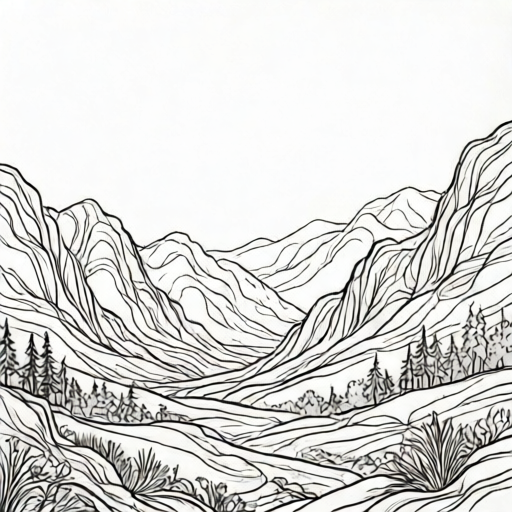
Use the stated measurements and conventions for each exercise.
Plan the horizon and ridge lines before drawing
Start by deciding where the horizon sits on your page. The horizon is the line where distant land meets sky; it is not automatically the middle of the page. A low horizon gives more room to layered ridges, while a high horizon emphasizes foreground detail. Mark the horizon lightly with a single line. Then place two or three ridge lines above it to represent distant landforms silhouetted against the sky, and one or two edges below it to represent nearer land. Each ridge line is the top edge of a landform, and each should overlap the one behind it.
Use a simple convention for line weight: keep all contour lines the same thin weight unless you deliberately choose a slightly heavier line for the nearest ridge. If you vary weight, state your rule before drawing and apply it consistently. This keeps the drawing checkable without requiring a single correct style.
- Draw a light horizontal horizon line across the page.
- Above the horizon, draw two ridge lines that represent distant landforms silhouetted against the sky; each line should either close cleanly or exit at a page edge.
- Below the horizon, draw one midground ridge line and one foreground edge that cross the page edges.
- Label each layer lightly in pencil: background, midground, foreground.
Draw contour edges that follow surface direction
A contour line follows an edge where the surface turns away from you or where two surfaces meet. For a ridge, draw the top edge as one continuous line, then add a second line only where a slope changes direction, such as a shoulder or a gully. Avoid drawing every texture; choose edges that explain the landform. If a line would close into a loop, let it close cleanly rather than leaving a gap. If it exits the page, let it exit at the page edge without stopping short.
Keep your hand relaxed and rotate the paper rather than forcing an awkward wrist angle. If a line wobbles, continue the same line instead of erasing and restarting; a continuous wobble is easier to check than a broken edge. Use an eraser only to remove planning marks, not to redraw contour lines repeatedly.
- Trace the top edge of the farthest ridge with one continuous line.
- Add one shoulder line on that ridge where the slope changes direction.
- Repeat for the midground ridge, then the foreground edge.
- Check that every contour line either closes or reaches a page edge.
Layer foreground, midground, and background with overlap
Layering works when nearer lines interrupt farther lines. Draw the background ridge first, then the midground ridge so its top edge crosses in front of the background line. Finally draw the foreground edge so it crosses the midground line. At each crossing, stop the farther line at the nearer line rather than drawing through it. This single rule creates depth without shading or perspective construction.
Use spacing to separate layers: background ridges can be closer together, while foreground edges can be farther apart. These are drawing choices, not measured standards. If you choose numerical spacing, treat the values as hypothetical examples and measure your own paper to confirm they fit.
- Draw the background ridge line first.
- Draw the midground ridge so it overlaps and interrupts the background line.
- Draw the foreground edge so it overlaps and interrupts the midground line.
- Check that no farther line continues through a nearer line.
Review the contour landscape with a simple checklist
Review by reading the drawing from background to foreground. Ask whether each layer has a clear top edge, whether overlaps are consistent, and whether every contour line is continuous. A valid alternative is to draw the foreground first and then add farther layers behind it, as long as the overlap rule is still followed. The checklist below is designed to accept different line styles and hand pressures while still catching unclear edges.
If a line is ambiguous, redraw only that segment as one continuous stroke. Do not add shading to fix depth; contour line drawing relies on edge placement and overlap. Keep your planning marks light so the final contour lines remain readable.
- Confirm the horizon line is present and distinct from ridge lines.
- Confirm at least three layers are visible and overlap in a consistent order.
- Confirm every contour line is continuous or exits a page edge.
- Confirm no shading or perspective construction lines were used.
Worked example
On a page 20 cm wide and 15 cm high, place a horizon line 8 cm from the top. Draw two background ridge lines above the horizon, one midground ridge below it, and one foreground edge below the midground. Use the overlap rule and keep all lines continuous or exiting the page.
Worked answer
A valid drawing shows a light horizon line at 8 cm from the top. Above it, two background ridge lines represent distant landforms silhouetted against the sky and overlap, with the nearer ridge interrupting the farther one. Below the horizon, the midground ridge interrupts the background lines where they meet, and the foreground edge interrupts the midground ridge. Every contour line either closes or reaches a page edge. Line weight may be uniform or follow a stated rule. The exact shapes are open; the check is the overlap order and line continuity.
Four practice exercises
Exercise 1
On a 15 cm by 10 cm page, draw a horizon line 4 cm from the top. Add one background ridge above the horizon and one foreground edge below it. Make the foreground edge interrupt the background ridge where they cross. Keep both contour lines continuous or exiting the page.
Show answer and check
A valid drawing has a horizon line at 4 cm from the top, one background ridge above it representing a distant landform silhouetted against the sky, and one foreground edge below it. The foreground edge stops the background ridge at the crossing. Both lines are continuous or reach a page edge. Shapes may differ.
Why: The task checks horizon placement, two layers, and the overlap rule. The numerical value is a hypothetical example measured on the stated page size.
Check: Measure 4 cm from the top for the horizon. Trace each contour line to confirm it is continuous or exits a page edge. Confirm the foreground line interrupts the background line at the crossing.
Exercise 2
Draw three overlapping ridge lines on a page. Label them background, midground, and foreground. Use a consistent line weight rule: either all lines the same weight or heavier lines for nearer layers. Do not use shading.
Show answer and check
A valid drawing shows three ridge lines with consistent overlap: midground interrupts background, foreground interrupts midground. Labels match the layers. Line weight follows one stated rule. No shading is present.
Why: This exercise checks layering order and a consistent line-weight convention. Different shapes and hand pressures are acceptable.
Check: Read from background to foreground and confirm each nearer line interrupts the farther line. Check that labels match the overlap order. Confirm the line-weight rule is applied to all three lines.
Exercise 3
Draw a contour landscape with a horizon line and two ridge lines above it. Make one ridge line close into a loop and the other exit the page edge. Add one shoulder line on the looping ridge. Keep all lines continuous.
Show answer and check
A valid drawing has a horizon line, two ridge lines above it representing distant landforms silhouetted against the sky, one closed loop, one line exiting the page, and one shoulder line on the loop. All lines are continuous. The shoulder line follows a change in surface direction.
Why: The exercise checks closed versus exiting lines and a shoulder line that explains a slope change. The loop shape is open.
Check: Trace the loop to confirm it closes cleanly. Trace the exiting line to a page edge. Confirm the shoulder line starts and ends on the ridge or exits the page without breaking.
Exercise 4
Create a contour landscape with background, midground, and foreground layers. Draw the foreground first, then add the midground and background behind it, stopping farther lines at nearer ones. State your line-weight rule in one sentence. Use no shading.
Show answer and check
A valid drawing shows three layers with consistent overlap even though the foreground was drawn first. Farther lines stop at nearer lines. A one-sentence line-weight rule is stated and followed. No shading is present.
Why: This exercise accepts the valid alternative of drawing foreground first while still requiring the overlap rule. The stated rule makes line weight checkable.
Check: Confirm the overlap order is consistent despite the drawing order. Read the stated line-weight rule and check it against all contour lines. Confirm no shading is used.
Common mistakes
- Drawing ridge lines that stop in the middle of the page without closing or exiting. Continue each ridge line until it closes into a shape or reaches a page edge.
- Letting a background line pass through a foreground line. Stop the farther line at the nearer line so the overlap reads clearly.
- Adding shading to create depth instead of using overlap. Remove shading and separate layers by interrupting farther lines with nearer ones.
- Treating the horizon as a ridge line. Keep the horizon as a single reference line and draw ridge lines above or below it as separate edges.
Self-check rubric
- Horizon line is present and clearly separate from ridge lines.
- At least three layers are visible and labeled or distinguishable as background, midground, and foreground.
- Overlap rule is consistent: nearer lines interrupt farther lines.
- Every contour line is continuous or exits a page edge.
- No shading or perspective construction is used.
- Line weight, if varied, follows a stated and consistent rule.
- Valid alternatives, such as drawing foreground first, are accepted if the overlap rule and continuity are maintained.
Questions and answers
Do I need to use a ruler for the horizon line?
No. A freehand horizon line is acceptable if it is clearly distinct from ridge lines. If you use a ruler, keep the line light so it does not dominate the contour drawing.
How many ridge lines should I draw?
Three layers are enough to show background, midground, and foreground. You may add one extra ridge if it helps explain the landform, but keep each layer readable.
Can I vary line weight?
Yes, if you state a consistent rule, such as heavier lines for nearer edges. The rubric checks consistency, not a single required weight.
What if my hand wobbles?
Keep the line continuous rather than breaking it. A continuous wobble is a valid contour line; a broken edge is harder to read.