Free original lessons
Simple Corgi Drawing: Body Proportion, Ears, and Short-Leg Construction
Learn to draw a corgi with correct body proportion, distinctive ear shape, and short-leg construction using box guides and simple checks.
Free lesson
Four exercises
Worked answers
Object Drawing Lessons
This lesson teaches a reliable way to draw a simple corgi by focusing on three structural features: the long, low body; the large, rounded ears; and the short legs. You will use a box-based proportion method, an ear-shape guide, and a short-leg panel to build standing and sitting poses. The goal is not fur texture or breed-specific detail beyond proportion, but a clear, recognizable corgi silhouette. All measurements are relative to your own drawing, so you can scale the corgi to any size. Use a pencil and paper; no special tools are required.
Practice materials: Printable downloads are not available for this lesson yet. Use the instructions and four exercises below.
Reference illustration
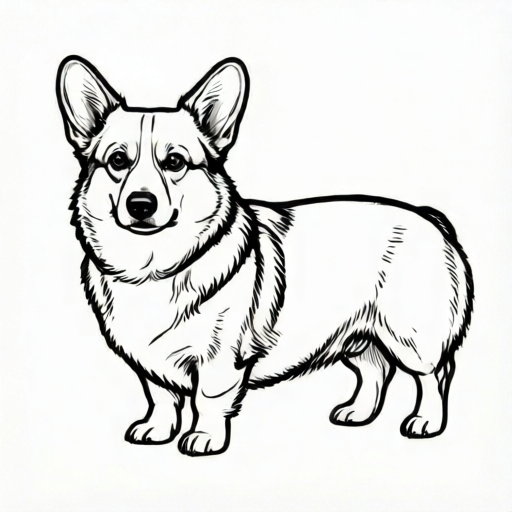
Use the stated measurements and conventions for each exercise.
Body Proportion: The Long, Low Box
A corgi body reads as a long horizontal box that is roughly twice as long as it is tall. The chest is deep, and the back line stays fairly level from shoulders to hips. The belly line is higher than the chest bottom, creating a visible tuck. Think of the body as two connected boxes: a larger chest box and a slightly smaller hip box, joined by a short middle section.
To set proportion, draw a light horizontal line for the back. Mark a shoulder point and a hip point. The distance between them is the body length. Make the body height about half that length. This ratio is a guide, not a fixed rule; adjust slightly for a rounder or leaner corgi while keeping the long-low impression.
- Draw a light horizontal back line and mark shoulder and hip points.
- Set body height to about half the shoulder-to-hip distance.
- Sketch a chest box and a hip box, leaving a short gap between them.
- Connect the boxes with a gentle belly tuck line.
- Check that the back line is level and the body is clearly longer than tall.
Ear Shape: Rounded Triangles with a Wide Base
Corgi ears are large, upright, and rounded at the tips. They sit wide on the head and angle slightly outward. A common mistake is drawing small, pointed ears like a fox. Instead, start with a wide base and taper to a rounded tip. The ear height is roughly equal to the head height, and the base width is about half the head width.
Use a simple convention: draw each ear as a rounded triangle. The outer edge curves gently outward, and the inner edge is slightly concave. The tip is a soft curve, not a sharp point. Ear placement matters: the base sits near the top corners of the head, not on the crown.
- Draw the head as a rounded box or circle.
- Mark ear bases at the top corners of the head.
- Sketch each ear as a wide triangle with a rounded tip.
- Check that ear height is about equal to head height.
- Adjust the angle so ears point slightly outward, not straight up.
Short-Leg Construction: Columns Under a Low Body
Short legs are a defining corgi feature. Draw them as short, sturdy columns rather than thin sticks. The front legs attach under the chest box, and the back legs attach under the hip box. Leg length is roughly one-third of body length. Keep the legs vertical in a standing pose, with small oval paws.
For a sitting pose, the front legs remain vertical while the back legs fold. The body tilts back, and the hip box lowers toward the ground. The short-leg proportion still applies: the visible front leg length stays short relative to the body.
- Mark leg attachment points under the chest and hip boxes.
- Draw front legs as short vertical columns with oval paws.
- Draw back legs with a slight bend at the hock, still short.
- Check leg length against body length: about one-third.
- For sitting, tilt the body back and fold the back legs under the hips.
Standing and Sitting Poses on a Practice Strip
A practice strip is a row of small boxes where you sketch quick pose variations. Use the same proportion rules in each box. In the standing pose, the back line is level and all four legs are visible. In the sitting pose, the front legs stay vertical, the back legs fold, and the body angles back. Keep the ear shape consistent in both poses.
Compare the two poses side by side. The standing corgi should look long and low; the sitting corgi should look compact but still show short front legs and large ears. Use light construction lines first, then darken the final outline.
- Draw two boxes side by side on your practice strip.
- In the first box, sketch a standing corgi using the body, ear, and leg guides.
- In the second box, sketch a sitting corgi with a tilted body and folded back legs.
- Check that both poses share the same ear size and short-leg proportion.
- Darken the final outlines and erase construction lines.
Worked example
Draw a standing corgi using a body length of 10 units. Determine body height, ear height relative to a 4-unit head, and leg length. Then describe the construction order.
Worked answer
Body height is about 5 units (half of 10). Head height is 4 units, so ear height is about 4 units. Leg length is about 3.3 units (one-third of 10). Construction order: draw the back line and mark shoulder and hip points 10 units apart; set body height at 5 units; sketch chest and hip boxes; add a rounded head 4 units tall; place ears at the top corners with 4-unit height and rounded tips; draw short legs about 3.3 units long with oval paws; check that the body is twice as long as tall and legs are short.
Four practice exercises
Exercise 1
A corgi drawing has a body length of 12 units. What should the body height be if you follow the half-length guide? What is the suggested leg length?
Show answer and check
Body height is about 6 units. Leg length is about 4 units.
Why: Body height is half of body length: 12 ÷ 2 = 6. Leg length is one-third of body length: 12 ÷ 3 = 4.
Check: Verify that 6 is half of 12 and 4 is one-third of 12. Check that the body is clearly longer than tall.
Exercise 2
You draw a head 5 units tall. Using the ear guide, how tall should each ear be? Describe the ear shape in words.
Show answer and check
Each ear should be about 5 units tall. The shape is a wide-based triangle with a rounded tip, angled slightly outward.
Why: The ear height guide says ear height is roughly equal to head height. So 5 units. The shape convention is a rounded triangle with a wide base.
Check: Compare ear height to head height; they should look equal. Check that the tip is curved, not pointed.
Exercise 3
A sitting corgi has a body length of 9 units. The front legs are drawn 3 units long. Is this consistent with the short-leg guide? Explain.
Show answer and check
Yes. Leg length should be about one-third of body length: 9 ÷ 3 = 3 units. The front legs are correctly short.
Why: The short-leg guide sets leg length at about one-third of body length. 3 units matches that ratio.
Check: Divide body length by 3 and compare to the drawn leg length. Also check that the sitting pose tilts the body back and folds the back legs.
Exercise 4
In a standing corgi sketch, the body length is 14 units and the body height is drawn as 9 units. Identify the proportion mistake and give a corrected height.
Show answer and check
The body is too tall. The corrected body height is about 7 units.
Why: The guide says body height should be about half of body length. Half of 14 is 7. A height of 9 makes the body too square and less corgi-like.
Check: Check that body height is close to half of body length. If height is more than about 60% of length, lower the back or belly line.
Common mistakes
- Drawing the body too tall, making the corgi look like a generic dog. Set body height to about half the body length and keep the back line level.
- Drawing small, pointed ears instead of large rounded ones. Use a wide base and rounded tip; ear height should be about equal to head height.
- Making the legs too long or too thin. Draw short, sturdy columns about one-third of body length, with oval paws.
- Placing ears on top of the head instead of at the top corners. Mark ear bases near the top corners and angle them slightly outward.
Self-check rubric
- Body length is visibly about twice the body height.
- Back line is level and belly line shows a gentle tuck.
- Ears are large, wide-based, and rounded at the tips.
- Ear height is roughly equal to head height.
- Legs are short, sturdy columns about one-third of body length.
- Standing pose shows four short legs under a long, low body.
- Sitting pose keeps front legs short and folds back legs under the hips.
- Construction lines are light and final outline is clear.
Questions and answers
Do I need to measure exact centimeters?
No. Use relative proportions. For example, if your body length is 8 units, make body height about 4 units. Any consistent unit works.
Can I draw a corgi facing sideways?
Yes. The same box method applies. In profile, the body length is still about twice the height, and the ears remain large and rounded.
How do I check my ear shape?
Compare ear height to head height. They should be roughly equal. The tip should be rounded, not sharp.
What if my sitting pose looks too tall?
Lower the hip box toward the ground and keep the front legs short. The body should tilt back, not stand upright.