Free original lessons
Drawing a Falcon Head: Profile, Hooked Beak, and Eye Placement
Learn to construct a falcon head in profile with a hooked beak, correct eye position, and clean head contour using simple measured steps and a practice method.
Free lesson
Four exercises
Worked answers
Object Drawing Lessons
This lesson teaches a repeatable method for drawing a falcon head in profile. You will build the head from a few measured guide shapes, place the eye using a clear proportion rule, shape the hooked beak, and refine the head contour. The method works at any size because it relies on relative distances rather than fixed numbers. A convention is stated for judging line quality and proportion so that valid stylistic alternatives are accepted. All practice tasks are self-contained and can be solved from the text alone.
Practice materials: Printable downloads are not available for this lesson yet. Use the instructions and four exercises below.
Reference illustration
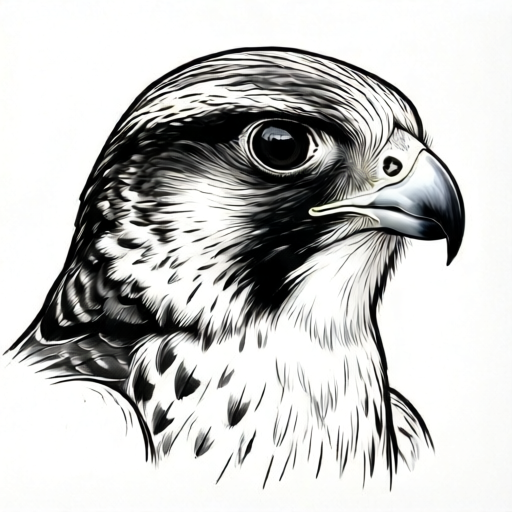
Use the stated measurements and conventions for each exercise.
Set up the profile guide
Begin with a light construction line for the head axis. In profile, the falcon head is longer than it is tall. Draw a soft oval for the skull and a smaller wedge in front for the face and beak base. Keep both shapes light so they can be adjusted.
Define the baseline as the bottom of the lower beak and the midline as the horizontal line through the center of the eye. The x-height convention for this lesson is the distance from baseline to midline; use it only as a relative unit, not a fixed measurement. Letter styles and feather edges vary, so treat the guide as a scaffold rather than a rigid template.
- Draw a horizontal axis line and mark a center point for the skull.
- Add a light oval for the skull, slightly longer than tall.
- Attach a forward wedge for the face and beak base.
- Mark the baseline at the bottom of the lower beak and the midline through the intended eye center.
Place the eye and shape the hooked beak
Place the eye on the midline, roughly one-third of the head length back from the front of the face. The eye sits behind the beak base, not on the beak. Draw a small circle for the eye and a thin ring for the eyelid ridge.
The hooked beak has three parts: a short upper base, a downward hook, and a lower edge that meets the mouth line. Draw the hook as a smooth curve that turns down and slightly back. The lower beak is shorter and sits under the hook. Keep the mouth line continuous from the face to the hook tip.
- Mark the eye center on the midline about one-third of the head length from the front.
- Draw a small circle for the eye and a light ring around it.
- Sketch the upper beak base, then curve the hook downward and slightly back.
- Add the lower beak under the hook and connect the mouth line.
- Check that the eye is behind the beak base and above the mouth line.
Refine the head contour and feather detail
Refine the skull contour so the back of the head curves smoothly into the neck. The forehead rises gently from the beak base to the crown. Avoid a flat forehead; a slight curve reads as a falcon rather than a generic bird.
Add feather detail only after the contour is stable. Use short overlapping strokes along the cheek and crown. Feather edges may be sharp or soft; both are valid if the overall head shape and eye placement remain clear. Keep detail light so the profile stays readable.
- Smooth the forehead curve from beak base to crown.
- Curve the back of the head into the neck line.
- Add short feather strokes on the cheek and crown.
- Erase construction lines and strengthen the final contour.
Check proportions and angle changes
Check the drawing by comparing three distances: head length, head height, and eye-to-beak distance. Head length should be greater than head height. The eye-to-beak distance should be about one-third of head length. These are relative checks, not fixed numbers.
When drawing the head at a varied angle, keep the eye on the midline and move the beak base forward or back slightly. The hook should still turn downward. A three-quarter view compresses the far side of the head; keep the near eye clear and the far eye hidden or minimal.
- Measure head length and head height with a light line; confirm length is greater.
- Check eye-to-beak distance against one-third of head length.
- For a varied angle, shift the beak base and keep the eye on the midline.
- Confirm the hook still turns downward in every angle.
Worked example
Construct a falcon head profile using a head length of 9 units. Place the eye and beak using the one-third rule, then check the proportions.
Worked answer
Draw a horizontal axis and a skull oval 9 units long and about 6 units tall. Mark the baseline at the bottom of the lower beak and the midline through the eye center. Place the eye on the midline 3 units back from the front of the face (one-third of 9). Draw the beak base in front of the eye, curve the hook downward and slightly back, and add the lower beak under the hook. Smooth the forehead and back of the head, then add light feather strokes. Check: head length 9 is greater than head height 6; eye-to-beak distance is 3, which is one-third of 9; the eye is behind the beak base and above the mouth line.
Four practice exercises
Exercise 1
A profile guide has head length 12 units and head height 8 units. The eye is placed 4 units back from the front. Check whether the eye placement follows the one-third rule and whether the head proportion is acceptable.
Show answer and check
The eye placement follows the rule because 4 is one-third of 12. The head proportion is acceptable because length 12 is greater than height 8.
Why: One-third of 12 is 4, so the eye is correctly placed. A falcon head in profile should be longer than tall, and 12 is greater than 8.
Check: Divide head length by 3 and compare with the eye distance; compare head length and head height directly.
Exercise 2
A drawing shows the eye on the beak base and the upper beak pointing straight forward. Identify two mistakes and state the fixes.
Show answer and check
Mistake one: eye on the beak base. Fix: move the eye back to the midline behind the beak base at about one-third of head length. Mistake two: straight beak. Fix: curve the upper beak downward and slightly back to form a hook, then add the lower beak.
Why: The eye must sit behind the beak base, not on it. A falcon beak in profile must hook downward, not point straight forward.
Check: Confirm the eye is behind the beak base and above the mouth line; confirm the upper beak turns downward.
Exercise 3
You are drawing a three-quarter view of a falcon head. The near eye is clear. Describe where to place the far eye and how to keep the hook visible.
Show answer and check
Keep the near eye on the midline behind the beak base. Hide or minimize the far eye because the far side is compressed. Shift the beak base slightly for the angle but keep the upper beak curving downward and slightly back so the hook remains visible.
Why: In a three-quarter view, the far side of the head is compressed, so the far eye is hidden or minimal. The hook must still turn downward to read as a falcon.
Check: Check that the near eye is on the midline and behind the beak base; check that the upper beak still turns downward.
Exercise 4
A student draws a falcon head with head length 10 units, head height 10 units, and eye distance 5 units. List the proportion errors and give corrected hypothetical values.
Show answer and check
Error one: head height equals head length, so the head is too tall. Corrected example: head length 10, head height 6. Error two: eye distance 5 is one-half of head length, not one-third. Corrected example: eye distance about 3.3 units, which is one-third of 10.
Why: A falcon head in profile should be longer than tall, so height should be less than length. The eye should be about one-third of head length from the front, not one-half.
Check: Compare head length and height; divide head length by 3 and compare with the eye distance.
Common mistakes
- Placing the eye on the beak or too far forward. Move the eye back until it sits behind the beak base on the midline, about one-third of head length from the front.
- Drawing a straight or upward beak instead of a hook. Curve the upper beak downward and slightly back, then add the lower beak under the hook.
- Making the head taller than it is long. Lengthen the skull oval and reduce its height; check that head length is greater than head height.
- Adding feather detail before the contour is stable. Refine the head contour first, then add short feather strokes on the cheek and crown.
Self-check rubric
- Head length is clearly greater than head height.
- Eye sits on the midline behind the beak base at about one-third of head length from the front.
- Upper beak forms a downward hook and the lower beak sits under it.
- Mouth line is continuous from face to hook tip.
- Forehead curves gently from beak base to crown; back of head curves into the neck.
- Feather detail is light and does not obscure the profile.
- Valid alternatives in feather edge style and line weight are accepted if proportion and eye placement remain clear.
Questions and answers
Where exactly should the eye go?
On the midline, behind the beak base, about one-third of the head length back from the front of the face.
How do I keep the beak hooked at different angles?
Keep the upper beak curve turning downward and slightly back. Shift the beak base for the angle, but preserve the downward hook.
Can feather edges be soft instead of sharp?
Yes. The convention allows soft or sharp feather edges as long as the head contour and eye placement remain clear.
Do I need exact measurements?
No. Use relative distances such as one-third of head length. Any numerical values in this lesson are hypothetical examples, not standards.