Free original lessons
Half-Elf Face on Grid Paper: Mirrored Drawing Guide
Learn to draw a half-elf face on a grid by mirroring features across a marked axis, with ear shape, proportions, and self-checks.
Free lesson
Four exercises
Worked answers
Object Drawing Lessons
This guide teaches a reliable method for drawing a half-elf face on grid paper using a vertical mirror axis. You will place features on one half, then reflect them to the other half while keeping the pointed ear shape consistent. The approach uses simple counting and measurement, so you can check your work without guessing. All measurements below are hypothetical examples; measure your own paper and grid spacing before drawing.
Practice materials: Printable downloads are not available for this lesson yet. Use the instructions and four exercises below.
Reference illustration
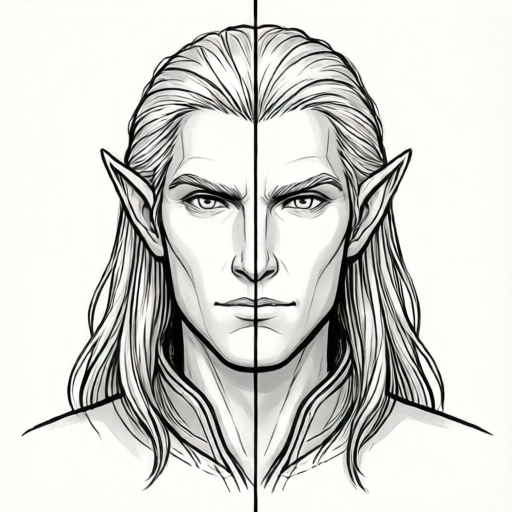
Use the stated measurements and conventions for each exercise.
Set Up the Grid and Mirror Axis
Choose a grid with equal square cells. Count the columns and rows and write the total at the top of the page. Mark a vertical mirror axis down the center column line. If the grid has an even number of columns, the axis runs between two columns; if odd, it runs through the middle column. Decide this before drawing so both halves use the same reference.
Label the axis clearly, for example with a light dashed line. Measure the actual cell size with a ruler and record it. For this guide, assume a hypothetical cell of 1 cm, but use your measured value in every calculation. The axis is the only line that does not get mirrored; everything else is reflected across it.
- Count columns and rows; record totals.
- Draw the vertical mirror axis on the center column line or between center columns.
- Measure one cell with a ruler and write the value down.
- Lightly number columns outward from the axis on both sides to support mirroring.
Place the Face Outline and Feature Landmarks
Work only on the left half first. Mark the top of the head, the chin, and the eye line using row counts from the top. A common proportion is to divide the face height into thirds: hairline to eye line, eye line to nose base, nose base to chin. These are guidelines, not fixed rules; adjust to your character.
Place the eye, nose, and mouth landmarks by counting cells from the axis. For example, if the eye center is 3 cells left of the axis, its mirror will be 3 cells right. Record each landmark as a column offset and a row number so you can reflect it exactly.
- Mark head top, chin, and eye line on the left half.
- Mark nose base and mouth line using row counts.
- Record each feature center as a column offset from the axis.
- Draw the left face outline from forehead to jaw to chin.
Draw and Mirror the Half-Elf Ear
The half-elf ear is pointed but still attached at the jaw line. On the left side, start the ear where the jaw meets the skull, then extend upward and outward to a point. Keep the point within a stated number of cells from the axis so the mirror stays balanced. For example, if the ear tip is 5 cells left of the axis and 2 rows above the eye line, the mirrored tip is 5 cells right and 2 rows above.
Ear style varies. You may choose a short point, a long swept point, or a gently curved point. Define your convention before drawing: for this guide, the ear tip must be at least 1 cell above the eye line and no more than 2 cells beyond the face outline. Valid alternatives include a sharper or softer curve as long as the tip position and attachment point mirror correctly.
- Mark the ear attachment point on the jaw line.
- Choose a tip position in column and row offsets from the axis.
- Draw the outer ear curve from attachment to tip.
- Draw the inner ear line, then mirror both lines to the right half.
Reflect Features and Check Symmetry
Mirror each landmark by counting the same number of cells on the opposite side of the axis. Draw the right eye, nose side, mouth corner, and ear using the recorded offsets. Keep the pencil light until the reflection is confirmed.
Check symmetry by measuring from the axis to each feature with a ruler or by counting cells. A feature is symmetric if its distance from the axis matches on both sides within one small grid unit. Because hand-drawn lines vary, allow a small tolerance and state it before checking. For this guide, a hypothetical tolerance of half a cell is acceptable for line placement.
- Reflect each recorded landmark across the axis.
- Draw the right-side features using the mirrored offsets.
- Measure or count from the axis to each feature on both sides.
- Adjust any feature that exceeds the stated tolerance.
Worked example
On a grid with a vertical axis between two center columns, the left eye center is 3 cells left of the axis and 4 rows below the top of the head. The left ear tip is 5 cells left of the axis and 2 rows above the eye line. State the mirrored positions and the check.
Worked answer
The right eye center is 3 cells right of the axis and 4 rows below the top of the head. The right ear tip is 5 cells right of the axis and 2 rows above the eye line. Check by counting from the axis: 3 cells each side for the eye and 5 cells each side for the ear tip, with matching row numbers.
Four practice exercises
Exercise 1
A grid axis runs between two center columns. The left mouth corner is 2 cells left of the axis and 7 rows below the top of the head. Where is the right mouth corner?
Show answer and check
2 cells right of the axis and 7 rows below the top of the head.
Why: Mirroring changes only the side of the axis; the row number stays the same and the column offset changes sign.
Check: Count 2 cells from the axis on each side and confirm both are on row 7.
Exercise 2
The left ear attachment is 4 cells left of the axis on the jaw line. The ear tip is 6 cells left of the axis and 3 rows above the attachment. State the mirrored attachment and tip.
Show answer and check
Attachment: 4 cells right of the axis on the jaw line. Tip: 6 cells right of the axis and 3 rows above the attachment.
Why: Both points are reflected by changing the column side while keeping row relationships.
Check: Count 4 cells and 6 cells from the axis on both sides; confirm the tip is 3 rows above the attachment on each side.
Exercise 3
A student draws the right eye 4 cells from the axis but the left eye 3 cells from the axis. The stated tolerance is half a cell. Does the drawing pass the symmetry check?
Show answer and check
No. The difference is 1 cell, which exceeds the half-cell tolerance.
Why: Symmetry requires matching distances within the stated tolerance; 4 minus 3 equals 1 cell.
Check: Subtract the two distances from the axis and compare the result with the tolerance.
Exercise 4
On a grid with a hypothetical cell size of 1 cm, the left ear tip is 5 cells from the axis. What is the total distance between the two ear tips if symmetry is correct?
Show answer and check
10 cm.
Why: Each tip is 5 cells from the axis, so the total is 5 plus 5 equals 10 cells; at 1 cm per cell this is 10 cm.
Check: Measure the actual cell size, multiply the cell count by that value, and compare with the ruler distance between tips.
Common mistakes
- Drawing the mirror axis through a column instead of between columns when the grid has an even number of columns. Decide the axis rule before drawing and mark it clearly; for even grids, place the axis between the two center columns.
- Making the pointed ear tip different distances from the axis on each side. Record the tip as a column offset and row number, then count the same offset on the opposite side.
- Changing the eye line or nose base row on the mirrored half. Keep row numbers identical on both halves; only the column offset changes sign.
- Ignoring the measured cell size and using assumed values. Measure your actual grid cell and use that value in all distance checks.
Self-check rubric
- Mirror axis is clearly marked and follows the stated even or odd column rule.
- Feature landmarks are recorded as column offsets and row numbers.
- Mirrored features match the recorded offsets within the stated tolerance.
- Half-elf ear has a defined tip position and attachment point that mirror correctly.
- Symmetry check is shown by counting or measuring from the axis.
- Valid alternative ear curves are accepted if tip position and attachment mirror correctly.
Questions and answers
Do both ears have to be identical?
For this mirrored exercise, yes: the ear tip and attachment point should match in column offset and row number. Style curves may differ slightly within the stated tolerance.
What if my grid has an odd number of columns?
Place the axis through the middle column. Count offsets from the center of that column and mirror to the matching column on the other side.
How do I check symmetry without a ruler?
Count grid cells from the axis to each feature on both sides. Matching counts within the stated tolerance indicate symmetry.
Can I change the face proportions?
Yes. The thirds guideline is a starting point. Record your chosen row numbers and mirror them exactly.