Free original lessons
Jackrabbit Drawing: Ear and Hind-Leg Proportion Guide
Learn to draw a jackrabbit by setting ear length and hind-leg angle with simple measured guides, then practice four self-contained proportion tasks.
Free lesson
Four exercises
Worked answers
Object Drawing Lessons
Jackrabbits are recognized by two proportion signals: very long ears and strongly angled hind legs. This lesson teaches a repeatable drawing method that fixes those proportions before adding any fur or detail. You will use a baseline-to-midline x-height convention for lettering labels, measure ear length against body height, and mark hind-leg angles with a simple protractor or folded-paper angle. All numerical values here are hypothetical examples for practice; measure your own paper and tools. The goal is not a single correct rabbit but a drawing whose ear and leg proportions are deliberate, checkable, and open to valid stylistic variation.
Practice materials: Printable downloads are not available for this lesson yet. Use the instructions and four exercises below.
Reference illustration
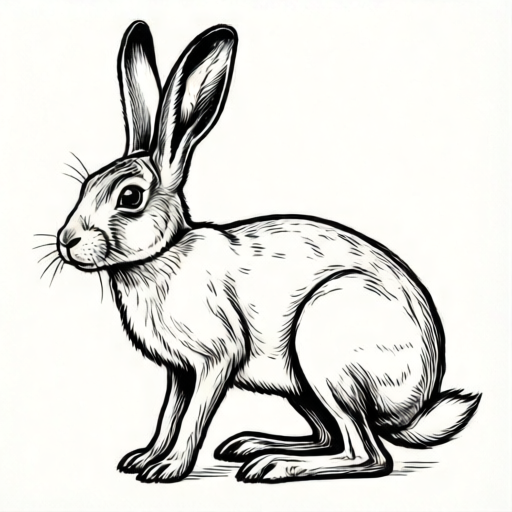
Use the stated measurements and conventions for each exercise.
Set the body box and ear-length unit
Begin with a light rectangular body box on your page. For practice, suppose the box is 12 cm tall and 8 cm wide. This is a hypothetical example, not a standard. The box represents the torso from shoulder to hip, not the whole animal.
Define one ear-length unit as the distance from the top of the head to the ear tip in your planned drawing. A useful jackrabbit starting proportion is an ear length roughly equal to the body-box height, so a 12 cm box pairs with a 12 cm ear. You may choose a different ratio, but write it down before drawing so your check is honest.
Mark the head circle above the box and draw a vertical guide line for each ear. Measure the ear guide with a ruler and label it using clear handwriting: keep lowercase letters between the baseline and midline (x-height), and let capitals and ascenders rise above the midline. This convention keeps labels readable without implying one universal letter style.
- Draw the 12 cm by 8 cm body box lightly.
- Mark a head circle centered above the box.
- Draw two vertical ear guides and measure each to your chosen ear length.
- Label the ear length and body height at the side using the baseline-to-midline x-height convention.
Angle the hind legs before adding shape
Jackrabbit hind legs read as folded, powerful zigzags. Place the hip joint near the lower rear corner of the body box. From the hip, draw a thigh line downward and slightly forward, then a shank line back toward the ground, then a foot line forward.
Use an angle mark at the knee. A hypothetical practice angle is 120 degrees between thigh and shank, measured on the inside of the fold. Measure the actual angle you draw with a protractor or by folding paper to match the lines, then label it. Do not assume a printer or paper tolerance; measure your own marks.
Keep the front legs shorter and straighter so the hind-leg angle stands out. The contrast is the proportion story.
- Mark the hip joint at the lower rear of the body box.
- Draw the thigh line and shank line as a clear zigzag.
- Measure the inside knee angle and write the value beside it.
- Add the foot line forward and compare hind-leg length to body-box height.
Check ear-to-body and leg-to-body ratios
Before adding ears' inner shape or leg fur, run two arithmetic checks. Ear ratio equals ear length divided by body-box height. With 12 cm and 12 cm, the ratio is 1.0. Hind-leg length ratio equals the straight-line distance from hip to ground divided by body-box height; if that distance is 9 cm and the box is 12 cm, the ratio is 0.75.
Write both ratios near the drawing. If a ratio is far from your plan, adjust the guide rather than hiding the error with detail. Valid stylistic alternatives include slightly shorter ears or a more open leg angle, provided the chosen ratio is recorded and the drawing remains internally consistent.
- Measure ear length and body-box height in the same unit.
- Divide ear length by body height and record the ratio.
- Measure hip-to-ground distance and divide by body height.
- Adjust guides if the recorded ratios do not match your stated plan.
Add minimal detail only after proportions pass
Once the ratios and angle are recorded, add a simple eye, nose, and tail. Keep fur marks sparse and directional so they do not obscure the ear and leg guides. If you erase guides, keep the written measurements visible in the margin.
For a final check, compare the ear tip height above the head to the body-box height, and compare the hind foot length to the head-circle diameter. These comparisons catch proportion drift that detail can disguise.
- Add eye, nose, and tail with light lines.
- Keep ear and leg guides visible or record their measurements.
- Compare ear tip height and hind foot length to reference measures.
- Sign or date the sheet and note any intentional style variation.
Worked example
A drawing has a body box 10 cm tall, ears 8 cm long, and a hip-to-ground distance of 7 cm. Compute the ear ratio and hind-leg ratio, and state whether the ear ratio matches a planned 0.8.
Worked answer
Ear ratio is 8 divided by 10, or 0.8. Hind-leg ratio is 7 divided by 10, or 0.7. The ear ratio matches the planned 0.8.
Why: Both measurements use centimeters, so division is direct. The ear ratio equals ear length over body height; the hind-leg ratio equals hip-to-ground distance over body height.
Check: Re-measure each length with the same ruler, recompute both divisions, and confirm the units are identical.
Four practice exercises
Exercise 1
A body box is 14 cm tall and each ear guide is 10.5 cm long. Compute the ear ratio and state whether it equals 0.75.
Show answer and check
10.5 divided by 14 equals 0.75, so yes, it equals 0.75.
Why: Ear ratio is ear length divided by body-box height, using the same unit.
Check: Multiply 0.75 by 14 to recover 10.5 cm, and confirm both measures are in centimeters.
Exercise 2
A hind leg has a hip-to-ground distance of 12 cm and a body box 16 cm tall. Compute the hind-leg ratio. Then state what the ratio becomes if the hip-to-ground distance is shortened to 10 cm.
Show answer and check
First ratio is 12 divided by 16, or 0.75. After shortening, 10 divided by 16 equals 0.625.
Why: The ratio uses hip-to-ground distance over body height; the body height stays fixed while the leg distance changes.
Check: Recompute both divisions and verify that 0.75 times 16 is 12 and 0.625 times 16 is 10.
Exercise 3
An ear guide is 9 cm and the body box is 12 cm. A second drawing has an ear guide of 6 cm and a body box of 8 cm. Compute both ear ratios and say which drawing has the larger ratio.
Show answer and check
First ratio is 9 divided by 12, or 0.75. Second ratio is 6 divided by 8, also 0.75. Neither is larger; they are equal.
Why: Both ratios simplify to three quarters, so different absolute sizes can produce the same proportion.
Check: Reduce each fraction and compare; also multiply each ratio by its body height to recover the ear length.
Exercise 4
A planned knee angle is 120 degrees. A drawn thigh-shank pair measures 95 degrees inside the fold. State the difference and one adjustment that would move the drawing toward the plan without claiming a universal correct angle.
Show answer and check
The difference is 25 degrees. One adjustment is to open the shank line away from the thigh until the measured inside angle is closer to the planned 120 degrees, then re-measure and record the new value.
Why: Subtract the smaller angle from the larger to find the gap. The planned angle is a chosen practice value, not a standard, so the adjustment is toward the plan rather than toward one universal answer.
Check: Re-measure the inside angle after adjustment and confirm the new difference is smaller; record both values.
Common mistakes
- Drawing ears shorter than the planned ear-length unit because the head circle looks large. Measure the ear guide against the written unit before shaping the ear, and adjust the guide rather than the plan.
- Making the hind leg a single straight line, which removes the jackrabbit's folded angle. Draw thigh, shank, and foot as three separate lines and measure the inside knee angle.
- Adding fur before checking ratios, so proportion errors become hard to see. Complete the ear ratio and hind-leg ratio checks first, then add minimal detail.
- Using different units for ear length and body height, making the ratio meaningless. Measure both in centimeters or both in the same ruler unit and label the unit.
Self-check rubric
- Ear length is measured and compared to body-box height with a recorded ratio.
- Hind leg is drawn as thigh, shank, and foot with a measured inside knee angle.
- Labels use the baseline-to-midline x-height convention and remain readable.
- At least one valid stylistic alternative is allowed if the recorded proportions stay consistent.
- Final drawing keeps ear and leg proportion checks visible or noted.
Questions and answers
Must every jackrabbit drawing use a 1.0 ear-to-body ratio?
No. The 1.0 ratio is a hypothetical starting example. Record your chosen ratio and keep the drawing consistent with it.
What handwriting convention should labels use?
Keep lowercase letters between the baseline and midline (x-height), and let capitals and ascenders rise above the midline. Letter styles may vary as long as the labels are readable.
How do I measure the hind-leg angle without special tools?
Use a protractor, or fold paper to match the thigh and shank lines and compare the fold to a known angle. Label the measured value.
Can I change the body box size?
Yes. Measure your actual box and recompute the ratios using the same unit. The numerical examples here are not standards.