Free original lessons
Longhorn Drawing: Horn Spread and Body Proportion Construction
Learn to draw a longhorn using measured horn spread, torso blocks, and leg placement. Includes tracing, outline practice, and a proportion checklist.
Free lesson
Four exercises
Worked answers
Object Drawing Lessons
This lesson teaches a repeatable construction for a longhorn: first set the horn spread and head position, then build the torso as a proportioned block, then place legs and refine the outline. You will use a simple convention: x-height means the distance from baseline to midline of a letter, and letter styles vary, so treat all letter-based measurements as relative guides rather than fixed units. Measure your own paper and tools, and label any numerical values you choose as hypothetical examples. The goal is a clear, balanced longhorn outline that you can check against a proportion checklist.
Practice materials: Printable downloads are not available for this lesson yet. Use the instructions and four exercises below.
Reference illustration
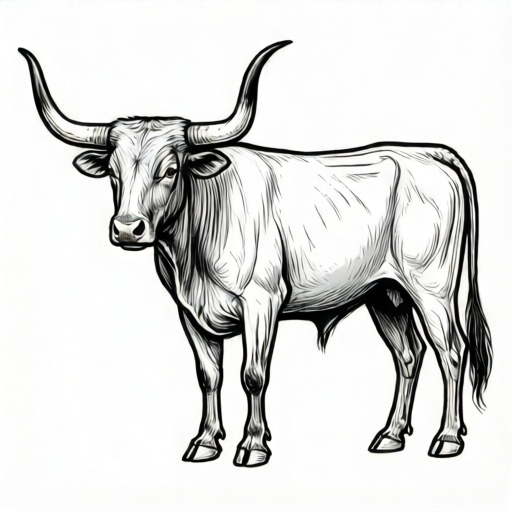
Use the stated measurements and conventions for each exercise.
Set the horn spread and head anchor
Begin by drawing a light horizontal baseline across the middle of your page. Mark a center point. The horn spread is the widest horizontal distance you want the horns to span. Choose a spread that fits your paper with margin; for example, a hypothetical spread of 12 cm on a 20 cm wide page leaves 2 cm on each side. Mark left and right horn-tip points at equal distances from center.
Place the head anchor slightly below the baseline center. The head is a small oval or rounded wedge. The horns emerge from the top sides of the head and curve outward and slightly upward to the tip marks. Keep the curve smooth: draw a light arc from each horn base to its tip, then check that both arcs mirror each other in height and width.
- Draw a light baseline and mark the center point.
- Choose a horn spread that fits your paper with margin; mark left and right tip points equally distant from center.
- Place the head anchor below center and sketch a small oval for the head.
- Draw a light arc from each horn base to its tip, checking mirror symmetry.
Build the torso as a proportioned block
The torso is the largest shape. Use the head height as a relative unit: for a typical longhorn construction, the torso length from chest to rump is about two and a half to three head heights, and the torso depth is about one and a half head heights. These are relative guides, not fixed rules. Sketch a rounded rectangle or oval for the torso, centered under the head and extending back.
Check the torso against the horn spread: the torso length should be visibly longer than the horn spread, but not more than about one and a half times the spread. If the torso looks too short or too long, adjust the block before adding details. Keep all lines light so you can revise.
- Measure the head height on your drawing and note it as one unit.
- Sketch a torso block about two and a half to three units long and one and a half units deep.
- Compare torso length to horn spread; adjust if the torso is shorter than the spread or more than one and a half times the spread.
- Keep lines light and revise the block before adding legs.
Place legs and refine the outline
Legs attach under the torso. Front legs sit near the chest, rear legs near the rump. Use the torso depth as a guide: leg length from body to ground is roughly equal to torso depth, though longhorns often appear longer-legged. Mark four leg lines as simple tapered rectangles, then check that the ground line is level and that the legs are spaced evenly.
Refine the outline by connecting head, horns, torso, and legs with smooth curves. Add a tail from the rump and a slight dewlap under the neck if desired. Finally, run the proportion checklist: horn spread fits with margin, torso length is longer than spread but not more than one and a half times, legs reach a level ground line, and the head is centered between horn tips.
- Mark four leg positions under the torso: two near chest, two near rump.
- Draw tapered leg rectangles and check the ground line is level.
- Connect head, horns, torso, and legs with smooth outline curves.
- Add tail and optional dewlap, then run the proportion checklist.
Worked example
A student draws a longhorn on a 20 cm wide page. They choose a hypothetical horn spread of 12 cm and a head height of 3 cm. The torso is drawn 8 cm long and 4.5 cm deep. Legs are 4 cm long. Check the proportions and state one adjustment.
Worked answer
Horn spread 12 cm leaves 2 cm margin on each side, which is acceptable. Torso length 8 cm is shorter than the 12 cm spread, so the torso is too short. Torso depth 4.5 cm equals one and a half head heights, which is acceptable. Legs 4 cm are close to torso depth, acceptable. Adjustment: extend torso length to more than 12 cm and no more than 18 cm (one and a half times the spread), then recheck leg placement.
Four practice exercises
Exercise 1
On a page 18 cm wide, choose a hypothetical horn spread of 10 cm and a head height of 2.5 cm. The torso is 7 cm long and 3.75 cm deep. Legs are 3.5 cm. Check the proportions and state whether the torso length is acceptable.
Show answer and check
Torso length 7 cm is shorter than the 10 cm spread, so it is not acceptable. Extend torso length to more than 10 cm and no more than 15 cm.
Why: The rule is torso length longer than spread but not more than one and a half times spread. 7 cm is less than 10 cm, so it fails. One and a half times 10 cm is 15 cm, so the acceptable range is above 10 cm and up to 15 cm.
Check: Compare torso length to spread: 7 < 10, so adjust. Then confirm the new length is greater than 10 cm and at most 15 cm.
Exercise 2
A drawing has horn tips at 6 cm left and 6 cm right of center. The head height is 3 cm. The torso is 14 cm long and 4.5 cm deep. Legs are 4 cm. Check horn symmetry and torso depth.
Show answer and check
Horn tips are symmetrical at 6 cm each side. Torso depth 4.5 cm equals one and a half head heights, so it is acceptable.
Why: Symmetry means equal distances from center. 6 cm equals 6 cm. Torso depth guide is one and a half head heights: 1.5 × 3 cm = 4.5 cm, which matches.
Check: Subtract left and right tip distances from center; if equal, symmetry holds. Multiply head height by 1.5 and compare to torso depth.
Exercise 3
A student draws four legs from the torso to a level ground line. The leg lengths are 5 cm, 4 cm, 5 cm, and 4 cm. The torso bottom edge is not level: the front attachment points are 1 cm higher than the rear attachment points. Explain why the legs may still look uneven and give one fix.
Show answer and check
Because the front leg tops start 1 cm higher than the rear leg tops, the front legs reach the ground with 1 cm more length than the rear legs even though the ground line is level. The animal looks uneven because the body underside slopes. Fix: redraw the torso bottom as a level line (or adjust leg lengths so each leg spans the same vertical distance from its attachment to the ground), then recheck that all four feet touch the level ground line.
Why: Leg length is measured from the torso attachment to the ground. If front attachments are 1 cm higher, a 5 cm front leg and a 4 cm rear leg both reach the same ground line, but the body underside is tilted, so the stance looks uneven. Equalizing the torso bottom or compensating leg lengths removes the tilt.
Check: Draw a light horizontal line along the torso bottom and measure each leg from that line to the ground line. All four vertical spans should be equal; if not, level the torso bottom or adjust the leg lengths and re-measure.
Exercise 4
A longhorn drawing has a horn spread of 9 cm, head height 2 cm, torso length 12 cm, torso depth 3 cm, and legs 3 cm. Run the proportion checklist and list any failed items.
Show answer and check
Horn spread 9 cm fits only if the page leaves at least one head height (2 cm) of margin on each side; page width is not given, so this item cannot be confirmed. Torso length 12 cm is longer than 9 cm and less than 13.5 cm, so acceptable. Torso depth 3 cm equals one and a half head heights, acceptable. Legs 3 cm equal torso depth, acceptable. Failed or unconfirmed items: horn-spread margin (needs page width to confirm).
Why: Check each rule: spread margin depends on page width, which is not given, so it is unconfirmed rather than passed. Torso length range is above 9 cm and up to 13.5 cm; 12 cm fits. Depth is 1.5 × 2 = 3 cm. Legs equal to torso depth is a reasonable guide.
Check: Multiply head height by 1.5 for depth; multiply spread by 1.5 for maximum torso length; compare each value. For margin, subtract half the spread from half the page width and compare to one head height.
Common mistakes
- Making the horn spread too wide for the page, causing horns to run off the edge. Choose the spread first and mark tip points with a margin of at least one head height on each side.
- Drawing the torso shorter than the horn spread, which makes the animal look front-heavy. Compare torso length to spread before adding legs; extend the torso block until it is visibly longer than the spread.
- Placing legs at uneven heights so the ground line slopes. Draw a light ground line first and attach all four leg ends to it.
- Making horns asymmetrical in height or curve. Check each horn arc against the opposite tip mark and adjust the curve height to match.
Self-check rubric
- Horn spread is marked with equal left and right distances from center and fits the page with margin.
- Torso length is visibly longer than horn spread but not more than one and a half times the spread.
- Torso depth is about one and a half head heights, or a clearly stated alternative with reasoning.
- Four legs attach under the torso and reach a level ground line.
- Outline connects head, horns, torso, and legs with smooth curves.
- Proportion checklist is completed and any adjustments are noted.
Questions and answers
Do I need to use exact centimeters?
No. Use relative units such as head height. If you choose centimeters, label them as hypothetical examples and measure your own paper.
How do I know if the horn spread is balanced?
The left and right tip marks should be equally distant from the center line, and the horn arcs should mirror in height.
Can I change the leg length?
Yes. Leg length is a style choice. Keep the ground line level and check that legs look stable under the torso.
What if my torso looks too deep?
Reduce torso depth to about one and a half head heights, then recheck that legs still reach the ground line.