Free original lessons
Maraca Drawing: Handle, Rounded Body, and Bead Detail
Learn to draw a maraca with a clear handle, rounded body, and decorative bead bands using simple construction steps and a checkable rubric.
Free lesson
Four exercises
Worked answers
Object Drawing Lessons
A maraca is a handheld percussion instrument with a rounded body attached to a straight handle. Drawing one well depends on getting the proportions and the join between handle and body right, then adding bead or band detail that follows the curve of the body. This lesson uses a pencil-and-paper convention: x-height means the distance from baseline to midline in your own handwriting, and all measurements are given in that unit so you can scale the drawing to your page. Letter styles vary, so treat the x-height as a personal ruler rather than a fixed size. Work lightly at first, then firm up the lines you keep.
Practice materials: Printable downloads are not available for this lesson yet. Use the instructions and four exercises below.
Reference illustration
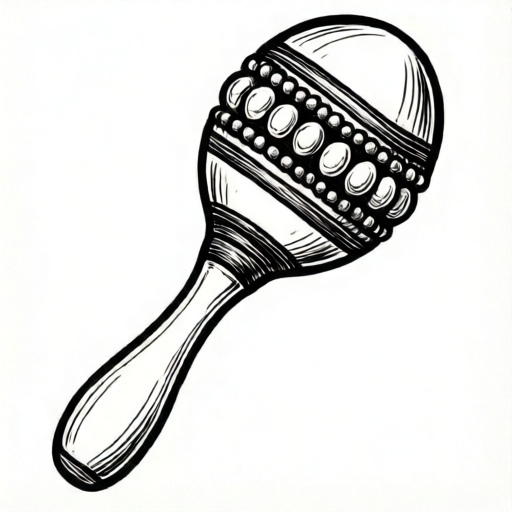
Use the stated measurements and conventions for each exercise.
Set up the page and choose a scale
Decide how tall the maraca will be on your page. A comfortable working height is about 12 x-heights from the bottom of the handle to the top of the body. Mark a light vertical line for the handle axis and a horizontal line near the top for the widest part of the body.
Keep the handle straight and centered on the axis. The body sits above the handle and is wider than the handle at every point. Leave space around the drawing for the decorative bands and for a second practice outline if you want one.
- Draw a light vertical axis about 12 x-heights long.
- Mark the handle length as 5 x-heights from the bottom.
- Mark the body height as 7 x-heights above the handle.
- Draw a horizontal guide at the body's widest point, about 4 x-heights above the handle top.
Build the handle and rounded body
The handle is a narrow rectangle or slightly tapered cylinder. Its width can be about 1 x-height at the bottom and 1.2 x-heights where it meets the body. The body is an egg-like oval: narrower at the join, widest near the middle, and rounded at the top.
Draw the body as a smooth closed curve that touches the handle join without a gap. The join should look like the handle enters the body, not like two separate shapes stacked. Check that the left and right sides of the body are roughly balanced around the axis.
- Draw two parallel lines for the handle sides, 1 to 1.2 x-heights apart.
- Close the bottom of the handle with a slight curve.
- Sketch the body oval from the handle join upward, widest at the middle guide.
- Round the top of the body and smooth the join line.
- Erase construction lines only after the outline looks balanced.
Add bead detail and decorative bands
Bead detail can be a row of small circles around the body or a set of curved bands that follow the body's surface. Bands should curve with the body, not run straight across like a stripe on a flat card. A simple pattern is one band near the join, one at the widest point, and one near the top.
Space the beads evenly along each band. If you draw circles, keep their size consistent, about 0.3 x-heights across. You may also draw short dashes or small ovals; the rubric accepts any repeated mark that follows the band curve and stays evenly spaced.
- Draw a curved band about 1 x-height above the handle join.
- Draw a second band at the widest point of the body.
- Draw a third band about 1 x-height below the top.
- Place small bead marks along each band, evenly spaced.
- Darken the final outline and bead marks, then label the handle, body, and bands lightly if needed.
Worked example
Using the 12 x-height scale, describe where to place the handle top, the widest body point, and the top of the body on the vertical axis.
Worked answer
Start at the bottom of the handle as 0. The handle top is at 5 x-heights. The widest body point is at 9 x-heights (5 + 4). The top of the body is at 12 x-heights (5 + 7). Check: 5 + 7 = 12, and 5 + 4 = 9, so the widest point sits 3 x-heights below the top.
Four practice exercises
Exercise 1
A maraca drawing uses a 10 x-height total height. The handle is 4 x-heights and the body is 6 x-heights. Where is the widest body point if it sits 3 x-heights above the handle top?
Show answer and check
At 7 x-heights from the bottom.
Why: Handle top is at 4. Add 3 x-heights for the widest point: 4 + 3 = 7. The body top is at 10, so the widest point is 3 x-heights below the top.
Check: Verify that 4 + 6 = 10 total, and that 7 is between 4 and 10.
Exercise 2
You draw three bands on a body that is 6 x-heights tall. Band one is 1 x-height above the join, band two is at the middle, and band three is 1 x-height below the top. Give the height of each band above the join.
Show answer and check
Band one: 1 x-height; band two: 3 x-heights; band three: 5 x-heights.
Why: The middle of a 6 x-height body is 3 x-heights above the join. The top is 6, so 1 x-height below the top is 6 - 1 = 5.
Check: Confirm the three values increase in order and stay within 0 to 6.
Exercise 3
A handle is 1.2 x-heights wide at the join. The body at the join is 2.4 x-heights wide. How much wider is the body than the handle at the join?
Show answer and check
1.2 x-heights wider.
Why: Subtract the handle width from the body width: 2.4 - 1.2 = 1.2.
Check: Add the difference back to the handle width: 1.2 + 1.2 = 2.4.
Exercise 4
You plan 8 bead marks along a band. Each mark is 0.3 x-heights across. If the marks are evenly spaced with no gaps counted, what total width do the marks cover?
Show answer and check
2.4 x-heights.
Why: Multiply the number of marks by the width of one mark: 8 × 0.3 = 2.4.
Check: Divide the total by 8 to return to 0.3: 2.4 ÷ 8 = 0.3.
Common mistakes
- The body is drawn as a circle instead of a rounded oval. Make the body taller than it is wide and widest near the middle, not at the join.
- The handle is wider than the body at the join. Keep the handle narrow, about 1 to 1.2 x-heights wide, and let the body widen above it.
- Decorative bands run straight across the body. Curve each band to follow the body's surface, as if it wraps around the oval.
- Bead marks are uneven or different sizes. Space marks evenly along the band and keep each mark about 0.3 x-heights across.
Self-check rubric
- Handle is straight, centered, and about 1 to 1.2 x-heights wide.
- Body is a rounded oval, taller than wide, and widest near the middle.
- Handle and body join without a gap or a step.
- At least two decorative bands curve with the body surface.
- Bead marks repeat evenly and stay about 0.3 x-heights across.
- Construction lines are light or erased, and the final outline is clear.
Questions and answers
How tall should the maraca be on the page?
About 12 x-heights total is a comfortable working size. You can scale it up or down as long as the handle-to-body ratio stays about 5 to 7.
Do I have to draw beads as circles?
No. Small ovals, dashes, or dots are acceptable if they repeat evenly and follow the band curve.
Where should the widest part of the body be?
Near the middle of the body, about 4 x-heights above the handle top in the suggested scale.
Can I use a ruler for the handle?
Yes, a ruler helps keep the handle straight, but the body and bands should still be drawn as smooth freehand curves.