Free original lessons
Easy Drawing of Pins: Safety Pin Clasp and Sewing Pin Head
Learn to draw a safety pin with a clear clasp and a sewing pin with a distinct head using simple shapes, measured steps, and a checkable rubric.
Free lesson
Four exercises
Worked answers
Object Drawing Lessons
This lesson teaches a reliable way to draw two common pins: the safety pin, with its coiled spring and clasp, and the sewing pin, with its round or flat head. You will use a simple convention: the x-height of your drawing is the distance from the baseline to the midline of the pin body. Letter styles vary, so treat all measurements as proportions you can scale. Work on plain paper with a pencil and eraser. The goal is a clear, recognizable shape with correct clasp and head detail, not photorealism. Each step gives a checkable proportion so you can verify your drawing as you go.
Practice materials: Printable downloads are not available for this lesson yet. Use the instructions and four exercises below.
Reference illustration
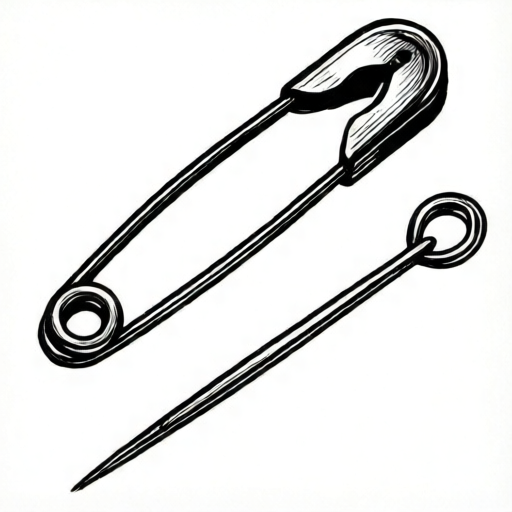
Use the stated measurements and conventions for each exercise.
Safety pin: body, coil, and clasp
A safety pin is a folded metal pin with a coiled spring at one end and a clasp at the other. Draw it as a long, narrow loop. The pin body is two parallel arms joined by a coil. The clasp is a small cup that captures the sharp point.
Use a proportion: the total length is about 6 x-heights. The coil sits at one end and is about 1 x-height wide. The clasp sits at the other end and is about 1.5 x-heights long. The two arms are separated by about 0.5 x-height at the middle.
- Draw a light baseline and a midline 1 x-height above it. This sets your scale.
- Mark two points 6 x-heights apart on the baseline. These are the coil end and the clasp end.
- At the coil end, draw a small circle about 1 x-height wide. This is the spring coil.
- From the top of the coil, draw a straight arm to the clasp end, staying about 0.5 x-height above the baseline.
- From the bottom of the coil, draw a second arm along the baseline to the clasp end.
- At the clasp end, draw a small cup shape about 1.5 x-heights long that opens toward the coil. The top arm ends inside this cup.
- Add the sharp point: a short taper from the top arm into the cup. Erase extra guide lines.
Sewing pin: shaft and head variants
A sewing pin is a straight shaft with a head at one end and a point at the other. The head can be round, flat, or slightly oval. Choose one variant and keep it consistent.
Use a proportion: the shaft is about 5 x-heights long. The head is about 1 x-height wide. The point tapers over the last 0.5 x-height.
- Draw a baseline and a midline 1 x-height above it.
- Mark a shaft 5 x-heights long along the baseline.
- At the head end, draw a circle or oval about 1 x-height wide, centered on the baseline.
- Draw the shaft as a thin rectangle from the head to the point end, about 0.2 x-height thick.
- Taper the last 0.5 x-height to a sharp point.
- If using a flat head, draw a short rectangle instead of a circle; keep its width about 1 x-height.
Checking proportions and clarity
Check that the safety pin clasp actually captures the point: the top arm should end inside the cup, not beside it. Check that the coil is a closed loop, not an open hook. For the sewing pin, check that the head is centered on the shaft and that the point is sharp.
Measure with a ruler if you like. Any consistent unit works. For example, if your x-height is 10 mm, the safety pin is about 60 mm long and the sewing pin shaft is about 50 mm long. These numbers are hypothetical examples; measure your own drawing.
- Compare the safety pin length to 6 x-heights. Adjust if it is far off.
- Confirm the clasp cup opens toward the coil and the point sits inside it.
- Confirm the sewing pin head is centered and the shaft is straight.
- Erase guide lines and darken the final outline.
Worked example
Draw a safety pin with a total length of 6 x-heights, a coil 1 x-height wide, and a clasp 1.5 x-heights long. Use an x-height of 10 mm for this example.
Worked answer
The safety pin is about 60 mm long. The coil is about 10 mm wide. The clasp is about 15 mm long. The two arms are separated by about 5 mm at the middle. The top arm ends inside the clasp cup, and the point tapers into the cup.
Four practice exercises
Exercise 1
Draw a safety pin with an x-height of 8 mm. Use a total length of 6 x-heights, a coil 1 x-height wide, and a clasp 1.5 x-heights long. State the length, coil width, and clasp length in millimeters.
Show answer and check
Length is 48 mm, coil width is 8 mm, clasp length is 12 mm.
Why: Multiply the x-height by the proportion: 6 × 8 = 48 mm; 1 × 8 = 8 mm; 1.5 × 8 = 12 mm.
Check: Measure your drawing with a ruler. The total length should be close to 48 mm, the coil close to 8 mm, and the clasp close to 12 mm.
Exercise 2
Draw a sewing pin with an x-height of 12 mm. The shaft is 5 x-heights long and the head is 1 x-height wide. State the shaft length and head width in millimeters.
Show answer and check
Shaft length is 60 mm and head width is 12 mm.
Why: 5 × 12 = 60 mm for the shaft; 1 × 12 = 12 mm for the head.
Check: Measure the shaft and head. The shaft should be close to 60 mm and the head close to 12 mm wide.
Exercise 3
A safety pin drawing has a coil 9 mm wide and a clasp 13.5 mm long. If the coil is 1 x-height wide, what is the x-height, and what should the total length be if it is 6 x-heights?
Show answer and check
The x-height is 9 mm, and the total length should be 54 mm.
Why: Coil width equals 1 x-height, so x-height = 9 mm. Total length = 6 × 9 = 54 mm. The clasp is 1.5 × 9 = 13.5 mm, which matches the given clasp length.
Check: Confirm that 13.5 ÷ 9 = 1.5, then measure the total length against 54 mm.
Exercise 4
Draw both pins using the same x-height of 10 mm. The safety pin is 6 x-heights long with a 1 x-height coil and a 1.5 x-height clasp. The sewing pin shaft is 5 x-heights long with a 1 x-height head. List the four key measurements in millimeters and check that the clasp captures the point.
Show answer and check
Safety pin length 60 mm, coil 10 mm, clasp 15 mm; sewing pin shaft 50 mm, head 10 mm. The clasp should be a cup that the point enters.
Why: Multiply each proportion by 10 mm: 6 × 10 = 60; 1 × 10 = 10; 1.5 × 10 = 15; 5 × 10 = 50.
Check: Measure each part with a ruler and visually confirm the top arm ends inside the clasp cup.
Common mistakes
- Drawing the safety pin clasp as a flat hook that does not capture the point. Draw a small cup shape and end the top arm inside it. The cup should open toward the coil.
- Making the coil an open spiral instead of a closed loop. Draw a complete small circle or oval at the coil end, then attach both arms to it.
- Placing the sewing pin head off-center on the shaft. Mark the shaft midline first, then center the head on that line.
- Using inconsistent x-height so the two pins look unrelated. Set one x-height at the start and use it for both drawings.
Self-check rubric
- Safety pin length is close to 6 x-heights (within about 1 x-height).
- Coil is a closed loop about 1 x-height wide.
- Clasp is a cup shape about 1.5 x-heights long that opens toward the coil.
- Top arm ends inside the clasp cup, and the point is visible.
- Sewing pin shaft is close to 5 x-heights long and straight.
- Sewing pin head is centered and about 1 x-height wide; round, flat, or oval heads are all acceptable.
- Point tapers over about 0.5 x-height.
- Guide lines are erased and the final outline is clear.
Questions and answers
Do I need special paper or tools?
No. Plain paper, a pencil, and an eraser are enough. A ruler helps with proportions but is optional.
Can I draw the sewing pin head as a flat rectangle instead of a circle?
Yes. The lesson allows round, flat, or oval heads. Keep the head centered and about 1 x-height wide.
How do I know my safety pin clasp is correct?
The clasp should look like a small cup that the sharp point enters. The top arm should end inside the cup, not outside it.
What if my drawing is larger or smaller than the example proportions?
That is fine. The proportions are relative. Keep the same ratios and label any numerical values as your own examples.