Free original lessons
Draw a Kneeling Person Praying: Clasped Hands and Posture
Learn to draw a kneeling figure with clasped hands using simple shapes, clear proportions, and a checkable convention for posture and hand placement.
Free lesson
Four exercises
Worked answers
Object Drawing Lessons
This lesson teaches a single, repeatable approach to drawing a person praying while kneeling. You will build the figure from a torso angle, a folded leg shape, and a clasped-hand block, then refine the outline. The convention used here is a side-front three-quarter view: the torso leans slightly forward, both knees rest on the ground, and the hands meet at the chest with fingers interlaced or palm-to-palm. Because drawing styles vary, the rubric accepts any clear clasp that reads as joined hands and any kneeling leg shape that shows both knees down and feet behind. Measure your own paper and pencil; any numbers below are hypothetical examples for practice, not manufacturing standards.
Practice materials: Printable downloads are not available for this lesson yet. Use the instructions and four exercises below.
Reference illustration
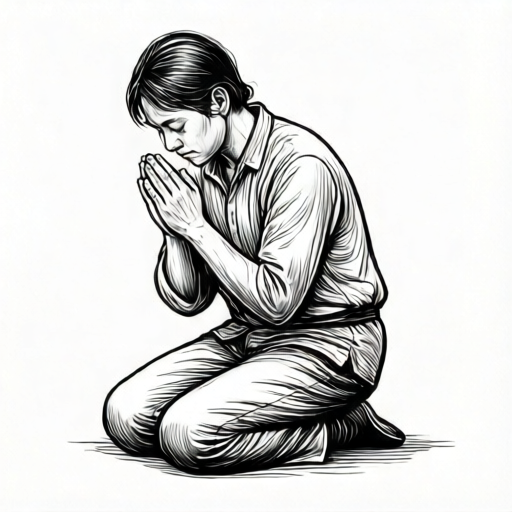
Use the stated measurements and conventions for each exercise.
Set the posture with three guide shapes
Begin with a light vertical midline for the body. Mark a ground line near the bottom of the page. Place an oval for the head above the midline, then a rounded rectangle for the torso tilted forward by about one head-height. Below the torso, draw a wide, low trapezoid for the folded legs so both knees sit on the ground line and the feet tuck behind.
The torso angle is the key to a prayer posture. A slight forward lean reads as reverence; an upright torso reads as standing or sitting. Keep the shoulders relaxed and slightly narrowed so the clasped hands become the focal point.
- Draw a ground line and a light vertical midline.
- Place a head oval and a forward-tilted torso rectangle.
- Add a low trapezoid for kneeling legs with both knees on the ground line.
- Check that the torso leans forward and the hips sit above the heels.
Build the clasped hands as a single block
Treat the clasped hands as one block rather than ten separate fingers. Draw a small rounded rectangle at chest height, centered on the midline, about half the width of the head. This block represents the joined hands. Add a short wrist line from each forearm into the block so the arms connect naturally.
Inside the block, draw two or three simple finger lines that cross or interlace. The convention is palm-to-palm with fingers overlapping; a clear overlap is enough to read as clasped hands. Avoid drawing every finger separately at this stage, because small finger details can make the clasp look like a fist or a random shape.
- Mark chest height on the midline.
- Draw a rounded rectangle for the joined hands.
- Connect both forearms to the block with short wrist lines.
- Add two or three overlapping finger lines inside the block.
Refine the outline and check the silhouette
Darken the final outline while keeping the guide lines light. The silhouette should show a forward-leaning torso, a low folded leg shape, and a compact hand block at the chest. If you cover the interior details, the outline alone should still read as a kneeling person praying.
Use the check method below to test your drawing. The check is arithmetic and visual: count the knees on the ground line, confirm the hand block sits between the shoulders, and confirm the torso tilt is visible. These checks are simple and do not require special tools.
- Trace the final outline over the guides.
- Erase or lighten the guide lines.
- Count two knees touching the ground line.
- Confirm the hand block is centered between the shoulders.
Worked example
A learner draws a head oval 3 cm tall, a torso rectangle tilted forward, a leg trapezoid with both knees on the ground line, and a hand block 1.5 cm wide at chest height. The hand block sits 1 cm left of the midline. Check the drawing against the convention.
Worked answer
The head and torso are acceptable because the torso tilts forward. The leg trapezoid is acceptable because both knees touch the ground line. The hand block is too far left: it should be centered on the midline. Move the block 1 cm right so it sits between the shoulders. The hand width of 1.5 cm is half the head height, which matches the convention.
Four practice exercises
Exercise 1
A drawing has a head oval 4 cm tall, a torso rectangle tilted forward, a leg trapezoid with both knees on the ground line, and a hand block 2 cm wide centered at chest height. The hand block has three overlapping finger lines. Check the drawing against the convention.
Show answer and check
The drawing passes. The torso tilts forward, both knees are on the ground line, and the hand block is 2 cm wide, which is half the 4 cm head height. The block is centered and has overlapping finger lines, so the clasp reads clearly.
Why: The convention requires a forward lean, two knees down, and a hand block about half the head width centered at chest height. Each measurement matches.
Check: Measure the head height and hand width; confirm the hand width is half the head height. Count the knees on the ground line and confirm the block is centered.
Exercise 2
A learner draws a kneeling figure but the hand block is 3 cm wide while the head is 4 cm tall. The block sits at waist height and has no finger lines. Identify the problems and state the fixes.
Show answer and check
The hand block is too wide: it should be about 2 cm, half the 4 cm head height. It sits too low: it should be at chest height. It has no finger lines: add two or three overlapping lines so the clasp reads as joined hands.
Why: The convention sets the hand block at half the head width, at chest height, with visible overlap lines. The drawing fails all three checks.
Check: Compare hand width to half the head height; mark chest height on the midline; count the overlapping finger lines.
Exercise 3
A drawing shows a figure with both knees on the ground line, but the torso is upright and the hips are at the same height as the knees. The hands are clasped at the chest. Does this read as kneeling prayer? Explain.
Show answer and check
No. The upright torso and hips at knee height read as sitting or standing, not kneeling prayer. Tilt the torso forward by about one head-height and lower the hips toward the heels so the figure reads as kneeling.
Why: The convention uses a forward lean and hips above the heels to distinguish kneeling from sitting. The hand clasp alone is not enough.
Check: Check the torso tilt against the midline and compare hip height to knee height; hips should sit above the heels.
Exercise 4
A learner draws a praying figure with a forward-leaning torso, both knees on the ground line, and a hand block centered at chest height. The hand block is 1.5 cm wide and the head is 3 cm tall. The block has one straight line across it. Is the clasp acceptable? State the fix if not.
Show answer and check
The proportions and placement are acceptable because 1.5 cm is half the 3 cm head height and the block is centered. The clasp is weak because one straight line does not clearly show joined hands. Add two or three overlapping finger lines so the overlap reads as a clasp.
Why: The convention accepts any clear clasp, but a single straight line is ambiguous. Overlapping lines make the joined hands readable.
Check: Measure hand width against half the head height; confirm centering; count overlapping finger lines inside the block.
Common mistakes
- Drawing the torso upright so the figure looks standing. Tilt the torso rectangle forward by about one head-height and lower the hips toward the heels.
- Drawing the hands as a fist or as separate floating fingers. Use one rounded rectangle for the joined hands and add only two or three overlapping finger lines.
- Placing only one knee on the ground line. Widen the leg trapezoid so both knees touch the ground line and the feet tuck behind.
- Making the hand block too large or too small. Keep the hand block about half the width of the head and centered on the midline.
Self-check rubric
- Torso leans forward by roughly one head-height, reading as a prayer posture.
- Both knees touch the ground line and the feet tuck behind the legs.
- Hands form one compact block at chest height, centered between the shoulders.
- The clasp shows at least two overlapping finger lines or a clear palm-to-palm join.
- The silhouette alone reads as a kneeling person praying without interior details.
- Valid alternatives are accepted: any clear clasp and any kneeling leg shape that shows both knees down.
Questions and answers
Do I need to draw every finger?
No. The convention uses a hand block with two or three overlapping finger lines. A clear overlap reads as clasped hands without drawing all ten fingers.
Can the figure face straight forward?
Yes, but this lesson uses a side-front three-quarter view because the forward lean and folded legs are easier to check. A front view is acceptable if both knees are on the ground line and the hands are joined at the chest.
How do I know the posture is kneeling and not sitting?
Both knees must touch the ground line and the hips must sit above the heels. If the hips are at the same height as the knees, the figure reads as sitting.
What if my hand clasp looks different from the example?
Any clear clasp that reads as joined hands is acceptable. The rubric checks that the hands form one compact block at chest height, not that they match a single universal shape.