Free original lessons
Realistic Tank Drawing: Tracks, Turret, Hull and Shading
Learn tank-specific geometry: track links, turret shape, hull proportions and shading. Includes a worked example, four practice tasks and a convention-based rubric.
Free lesson
Four exercises
Worked answers
Object Drawing Lessons
This lesson teaches a realistic tank drawing using a clear, repeatable convention: choose one unit (such as one track link) and measure hull, turret and track proportions against it, and use a single light direction for all shading. Any numerical values are hypothetical examples you can replace with measurements from your own reference. You will build the hull as a box with a sloped front, wrap the tracks around road wheels, set the turret on the hull ring, and shade consistently. The goal is believable structure, not a single universal answer.
Practice materials: Printable downloads are not available for this lesson yet. Use the instructions and four exercises below.
Reference illustration
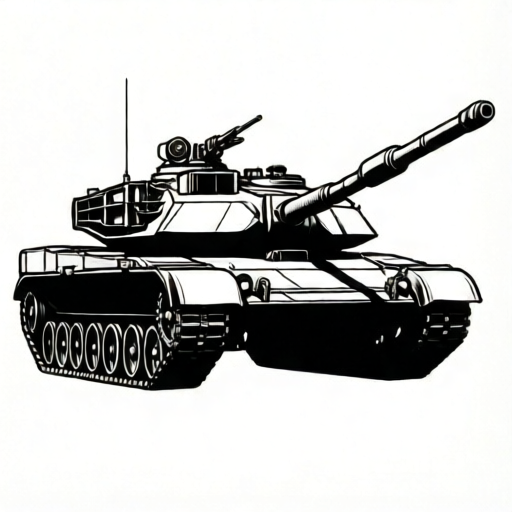
Use the stated measurements and conventions for each exercise.
Hull and Track Geometry
Start with a horizon line and a light direction. Draw the hull as a long box: front slope, flat top deck, rear plate. The track run is a loop around road wheels; the top run sits slightly above the wheels and the bottom run touches the ground line. Keep the two track loops parallel and equal in length.
Use a simple unit: let one track link equal one small rectangle. Keep two separate quantities: hull length measured in link-units, and the number of link marks along the track's top run. These are not the same number. As a hypothetical example, if the hull is 12 link-units long, the top run might carry about 14 link marks, which is roughly 1.2:1 when rounded (14 ÷ 12 ≈ 1.17). Count links along the top run and bottom run so both sides match, and label every chosen value as a hypothetical example. Measure your own reference or model and use the values you measure.
- Draw the ground line and a light arrow from upper left.
- Block the hull box with a sloped front and flat deck.
- Place road wheels evenly inside each track loop.
- Draw the track loop as two parallel lines with link marks.
- Check that both track loops have the same link count.
Turret and Hull Ring
The turret sits on a circular ring on the hull deck. Draw the ring as an ellipse; the turret base matches that ellipse. The turret is a rounded box with a mantlet at the front and a hatch on top. Keep the turret width about half the hull width and the height about one-third of the hull height.
Align the gun barrel with the mantlet center. The barrel is a cylinder; draw two parallel lines and an ellipse at the muzzle. Check that the barrel does not cross the turret ring ellipse.
- Draw the turret ring ellipse on the deck.
- Block the turret body over the ring.
- Add the mantlet and barrel with a muzzle ellipse.
- Place the hatch and a small antenna if desired.
- Check turret width and height ratios against the hull.
Shading with One Light Direction
Use one light direction for the whole drawing. Shade the underside of the hull, the lower half of the turret, and the inside of the track loop. Keep the top deck and the upper turret light. Use a mid tone on the front slope and a dark tone under the track fenders.
Shade track links with alternating light and dark marks to show depth. Do not shade every link the same; vary slightly to suggest wear. Check that the darkest areas face away from the light arrow.
- Mark the light arrow and keep it visible.
- Shade the track loop interior dark.
- Add mid tone to the front slope and lower turret.
- Leave the top deck and upper turret light.
- Check that all dark areas face away from the light.
Proportion and Alignment Checks
Before finalizing, check three ratios: hull length to height (about 3:1), turret width to hull width (about 1:2), and track loop length to hull length (about 1.2:1). These are hypothetical examples; adjust to your reference and label the chosen values.
Check alignment: the gun barrel center should pass through the mantlet center and the turret ring center. The road wheels should sit on the ground line. The two track loops should be parallel.
- Measure hull length and height with a ruler.
- Measure turret width and compare to hull width.
- Check barrel alignment through the ring center.
- Confirm road wheels touch the ground line.
- Confirm track loops are parallel.
Worked example
Draw a tank whose hull is 12 link-units long, with a top track run of about 14 link marks (roughly 1.2:1 when rounded), a turret width half the hull width, and light from upper left. Shade the lower turret and track interior dark. All numbers are hypothetical examples.
Worked answer
Hull box drawn with sloped front and flat deck, 12 link-units long; two parallel track loops with about 14 link marks on the top run (roughly 1.2:1 when rounded) and a matching count on the bottom run; road wheels on the ground line; turret ring ellipse on the deck; turret width half the hull width; barrel through the ring center; dark shading under the hull and inside the track loops, light on the top deck and upper turret.
Four practice exercises
Exercise 1
Draw a tank hull 9 link-units long and 3 link-units tall with a sloped front. Add two parallel track loops whose top runs each carry about 11 link marks (a hypothetical 1.2:1 ratio, since 11 ÷ 9 ≈ 1.2). Light from upper right.
Show answer and check
Hull box 9 by 3 link-units with a sloped front; two parallel loops with about 11 top link marks each and matching bottom counts; dark shading on the left underside and inside the loops.
Why: The 9:3 ratio is 3:1, matching the hypothetical proportion check. About 11 top link marks against a 9 link-unit hull follows the hypothetical 1.2:1 loop-to-hull ratio (11 ÷ 9 ≈ 1.2). Parallel loops and equal link counts keep the tracks believable. Light from upper right means dark areas on the left and underside.
Check: Measure hull length and height with a ruler and confirm the 3:1 ratio; count top link marks on both loops and confirm they match each other and are near 1.2 times the hull length in link-units; confirm dark areas face away from the upper-right light arrow.
Exercise 2
Draw a turret ring ellipse on a hull deck. Make the turret width half the hull width and place the barrel through the ring center. Add a hatch on top. Light from upper left.
Show answer and check
Ring ellipse centered on deck; turret base inside the ellipse; turret width half hull width; barrel center through ring center; hatch on top; lower turret shaded dark.
Why: The ring defines the turret seat. Half-width keeps the turret proportional. Barrel alignment through the ring center prevents a twisted look. Lower turret dark matches upper-left light.
Check: Check turret width against hull width with a ruler; confirm barrel center passes through ring center; confirm lower turret is darker than upper turret.
Exercise 3
Draw a complete tank with a hull 10 link-units long, about 12 top link marks per loop (a hypothetical 1.2:1 ratio, since 12 ÷ 10 = 1.2), a 3:1 hull ratio, and one light direction. Shade the track interior dark and the front slope mid tone.
Show answer and check
Complete tank with about 12 top link marks on both loops, hull 10 link-units long at a 3:1 ratio, light arrow marked, track interior dark, front slope mid tone, top deck light.
Why: Equal link counts and parallel loops support realism. The 3:1 hull ratio and the 1.2:1 loop-to-hull ratio (12 ÷ 10 = 1.2) are hypothetical checks. Mid tone on the front slope and dark track interior follow one light direction.
Check: Count top link marks on both loops and confirm they match; measure the hull ratio; confirm the top-run count is near 1.2 times the hull length in link-units (12 ÷ 10 = 1.2); confirm track interior is darkest and top deck is lightest; confirm only one light arrow is present.
Exercise 4
Draw a tank with a turret width one-third of the hull width and a barrel that does not cross the ring ellipse. Use light from upper left and add alternating light and dark marks on the track links.
Show answer and check
Turret width one-third hull width; barrel clear of ring ellipse; upper-left light arrow; alternating link marks; dark underside and lower turret.
Why: A narrower turret is a valid alternative if the ring and barrel alignment checks pass. Alternating link marks suggest depth. One light direction keeps shading consistent.
Check: Measure turret width against hull width; confirm barrel does not cross the ring ellipse; check alternating link marks are present; confirm dark areas face away from the light arrow.
Common mistakes
- Drawing tracks as a single thick line without links. Draw two parallel lines and add small link marks at equal spacing; count links on both sides.
- Placing the turret off the ring ellipse. Draw the ring first and keep the turret base inside the ellipse; check the barrel passes through the ring center.
- Using multiple light directions. Keep one light arrow and shade all dark areas away from it; check the underside and lower turret are darkest.
- Making the hull too tall or too short. Use a 3:1 length-to-height ratio as a hypothetical example, measure with a ruler, and adjust before shading.
Self-check rubric
- Hull has a sloped front, flat deck and rear plate with a length-to-height ratio near 3:1 (hypothetical example).
- Two parallel track loops with equal link counts and road wheels touching the ground line.
- Turret sits on the ring ellipse, width about half the hull width, barrel aligned through the ring center.
- One light direction is marked and all dark areas face away from it.
- Valid alternatives are accepted if proportions and alignment checks pass and the convention is stated.
Questions and answers
Do I need exact real tank measurements?
No. Use simple ratios and label any numerical values as hypothetical examples; measure your own reference if you have one.
How many track links should I draw?
Choose a count that fits your hull length, such as 12 links along the top run, and keep both sides equal. This is a hypothetical example.
Can I use a different light direction?
Yes, as long as you keep one direction for the whole drawing and shade consistently away from it.
What makes the drawing realistic?
Consistent proportions, parallel track loops, a turret seated on the ring, and shading that follows one light direction.