Free original lessons
Wolf Cub Drawing: Juvenile Proportion Construction Guide
Learn to draw a wolf cub with an oversized head and small body using a clear proportion guide, step-by-step construction, and practice exercises.
Free lesson
Four exercises
Worked answers
Object Drawing Lessons
Juvenile animal proportions differ from adult anatomy in predictable ways: the head is large relative to the body, the legs are short, and the torso is compact. This guide teaches a repeatable construction method for a wolf cub drawing that emphasizes those juvenile ratios without drifting into adult wolf anatomy or cartoon styling. You will use simple measured units, a defined drawing convention, and checkable arithmetic to build the cub from a proportion guide. All measurements are hypothetical examples; measure your own paper and tools to set real values.
Practice materials: Printable downloads are not available for this lesson yet. Use the instructions and four exercises below.
Reference illustration
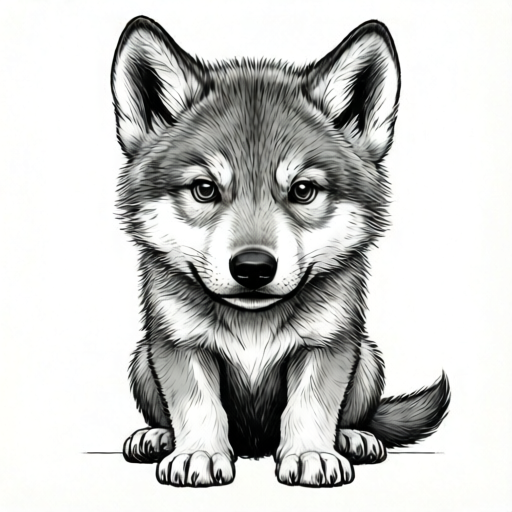
Use the stated measurements and conventions for each exercise.
Defining the Juvenile Proportion Convention
Use a head-height unit (HH) as your base measure. For this guide, one HH equals the vertical distance from the cub's chin to the top of the skull in your drawing. All other measurements are expressed in HH so the construction scales to any paper size.
The target ratio for a wolf cub is an oversized head and a small body: head height is about 1.5 times torso height, so torso height is about 0.67 HH (using 0.67 as a rounded value of 1 ÷ 1.5). Torso length is about 1.2 HH. Legs are short, about 0.8 HH from paw to shoulder. These are hypothetical example values chosen for clarity; adjust them to match your reference or your own observation, and label any changes.
X-height convention: for any lettering or labels on your worksheet, x-height is measured from baseline to midline. Letter styles vary, so do not force a single universal letter shape; instead, apply the convention consistently within your own drawing.
- Measure your paper and mark a baseline for the cub's paws.
- Draw a vertical guide for the head height (HH) and label it.
- Mark the torso height as 0.67 HH below the head top, then mark torso length as 1.2 HH horizontally.
- Mark leg length as 0.8 HH from paw baseline to shoulder line.
Constructing the Head and Body
Begin with a rounded rectangle for the skull, wider at the top than the jaw. The muzzle is short and blunt, about 0.4 HH long, set low on the face. Ears are large and rounded, each about 0.5 HH tall, placed high on the skull.
The torso is a compact oval, 1.2 HH long and 0.67 HH tall, attached directly beneath the head with almost no visible neck. This short neck is a key juvenile cue. The tail is bushy and about 1 HH long, curving slightly upward.
- Draw the skull as a rounded rectangle 1 HH tall and 0.9 HH wide.
- Add the muzzle as a short blunt shape 0.4 HH long at the lower face.
- Place two rounded ears 0.5 HH tall on the upper skull.
- Attach the torso oval 1.2 HH long and 0.67 HH tall directly under the head.
- Add four short legs 0.8 HH long from paw baseline to shoulder.
- Draw the bushy tail 1 HH long curving upward from the rear.
Refining Features and Checking Proportions
After construction, refine the eyes as large ovals set wide apart, about 0.2 HH across. The nose is a small rounded triangle at the muzzle tip. Fur direction follows the body contour: short strokes on the face, longer strokes on the tail and chest.
Check your proportions with simple arithmetic. If your head height is 4 cm, then torso height should be about 2.7 cm (0.67 × 4), torso length about 4.8 cm (1.2 × 4), and leg length about 3.2 cm (0.8 × 4). Keep units consistent and record your actual measurements.
- Measure head height and multiply by 0.67 to verify torso height.
- Multiply head height by 1.2 to verify torso length.
- Multiply head height by 0.8 to verify leg length.
- Adjust any shape that deviates by more than 10 percent from these targets.
Worked example
A learner measures a head height of 5 cm. Calculate the target torso height, torso length, and leg length using the guide ratios, then state one check.
Worked answer
Torso height = 0.67 × 5 ≈ 3.35 cm. Torso length = 1.2 × 5 = 6 cm. Leg length = 0.8 × 5 = 4 cm. Check: measure the drawn torso height; if it differs from 3.35 cm by more than 10 percent (about 0.34 cm), adjust the oval.
Four practice exercises
Exercise 1
A cub drawing has a head height of 3 cm. Using the guide ratios, calculate torso height, torso length, and leg length.
Show answer and check
Torso height ≈ 2.0 cm; torso length = 3.6 cm; leg length = 2.4 cm.
Why: Multiply head height by 0.67 for torso height, by 1.2 for torso length, and by 0.8 for leg length: 3 × 0.67 ≈ 2.0; 3 × 1.2 = 3.6; 3 × 0.8 = 2.4.
Check: Re-measure each drawn dimension and confirm it is within 10 percent of the calculated value; record units consistently.
Exercise 2
A learner draws a torso 8 cm tall and a head 4 cm tall. Is the head-to-torso ratio correct for the juvenile guide? Show the arithmetic.
Show answer and check
No. The target torso height is 0.67 × 4 ≈ 2.7 cm, but the drawn torso is 8 cm, which is far too tall (about 5.3 cm over, roughly 200 percent over).
Why: The guide ratio requires torso height to be about 0.67 times head height. 4 × 0.67 ≈ 2.7 cm. The drawn 8 cm greatly exceeds this.
Check: Divide drawn torso height by head height: 8 ÷ 4 = 2.0, which is far above the target 0.67; shorten the torso oval substantially.
Exercise 3
Describe how to place the ears and muzzle on a cub with head height 6 cm, using the guide proportions, and state the resulting measurements.
Show answer and check
Ears are about 3 cm tall (0.5 × 6) and placed high on the skull; muzzle is about 2.4 cm long (0.4 × 6) and set low on the face.
Why: Ear height is 0.5 HH and muzzle length is 0.4 HH; multiplying by 6 cm gives 3 cm and 2.4 cm respectively.
Check: Measure each ear and the muzzle against the calculated values; confirm placement high on skull and low on face by comparing to the head rectangle.
Exercise 4
A drawing has head height 5 cm, torso height 3.5 cm, torso length 6 cm, and leg length 4 cm. Identify which dimension deviates most from the guide and by how much.
Show answer and check
Torso height deviates most: target is about 3.35 cm, drawn is 3.5 cm, a difference of about 0.15 cm (roughly 4.5 percent).
Why: Targets: torso height ≈ 3.35 cm, torso length 6 cm, leg length 4 cm. Differences: torso height ≈ 0.15 cm; torso length 0 cm; leg length 0 cm. The largest difference is torso height.
Check: Compute each target by multiplication, subtract the drawn value, and compare absolute differences; confirm the largest difference matches the answer.
Common mistakes
- Drawing an adult wolf body with a large head attached. Shorten the torso to 0.67 HH tall and 1.2 HH long, and reduce leg length to 0.8 HH so the body reads as juvenile, not adult.
- Making the neck long and visible. Attach the head directly to the torso with almost no neck; the short neck is a juvenile cue.
- Using cartoon styling such as exaggerated eyes or unrealistic colors. Keep eyes about 0.2 HH across and use natural fur tones; the goal is juvenile proportion, not cartoon styling.
- Skipping measurement checks and relying on guesswork. Measure head height, then verify torso height, torso length, and leg length with the multiplication checks before refining.
Self-check rubric
- Head height is clearly larger than torso height, approximately 1.5 times, with measurements recorded.
- Torso height is approximately 0.67 HH and torso length is approximately 1.2 HH; the torso is compact, not elongated.
- Legs are short, approximately 0.8 HH from paw baseline to shoulder.
- Neck is nearly invisible; head attaches directly to torso.
- Ears are large and rounded, about 0.5 HH tall, placed high on the skull.
- Muzzle is short and blunt, about 0.4 HH long.
- Proportion checks are shown with consistent units and simple arithmetic.
- Valid alternative proportions are accepted if labeled and internally consistent.
Questions and answers
What ratio defines an oversized head on a wolf cub?
A practical starting ratio is head height about 1.5 times torso height, so torso height is about 0.67 HH, with torso length about 1.2 HH. These are hypothetical examples; measure your own drawing and adjust consistently.
How do I avoid adult wolf anatomy?
Keep the torso compact, the legs short, and the neck nearly invisible. Adult wolves have longer legs and a longer torso relative to the head.
Can I change the numerical values?
Yes. Label any chosen values as hypothetical examples and keep units consistent. The method matters more than the specific numbers.
How is x-height used in this guide?
X-height is baseline to midline for any labels you add. Letter styles vary, so apply the convention consistently rather than forcing one universal letter shape.