Free original lessons
Anime Dress Drawing: Exaggerated Skirt, Collar, and Fold Lines
Learn to draw an anime-style dress with a dramatic flared skirt, clear collar shape, and purposeful fold lines using a simple construction method.
Free lesson
Four exercises
Worked answers
Object Drawing Lessons
This lesson teaches a repeatable method for drawing an anime-style dress with three defining features: an exaggerated skirt flare, a distinct collar, and fold lines that suggest fabric movement. You will work from a simple silhouette guide, compare straight and flared skirt shapes, and place fold lines at labeled positions. The approach uses basic shapes and checkable proportions, so you can redraw the dress at different sizes. All measurements are hypothetical examples; measure your own paper and tools. The focus is dress construction only, not figure proportions or pose.
Practice materials: Printable downloads are not available for this lesson yet. Use the instructions and four exercises below.
Reference illustration
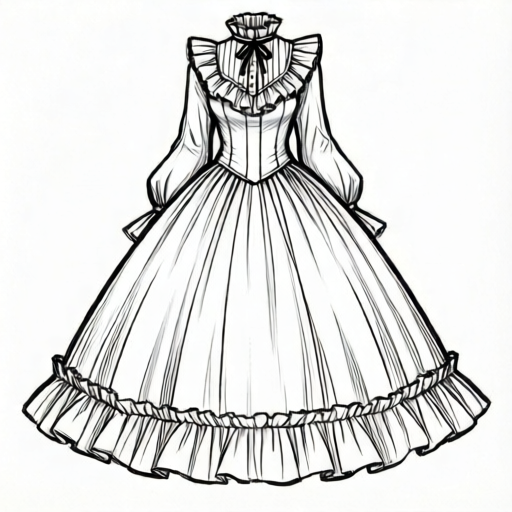
Use the stated measurements and conventions for each exercise.
Building the Dress Silhouette
Start with a vertical center line for the dress. Mark the shoulder line, waist line, and hem line. For an exaggerated skirt, make the hem width at least twice the waist width. For example, if the waist width is 4 cm on your paper, the hem width could be 8 cm or more. This is a hypothetical ratio; adjust to your paper size.
Draw the bodice as a tapered shape from shoulders to waist. Then draw the skirt from waist to hem using two curved side lines that flare outward. Keep the curves smooth and symmetric around the center line. The skirt should look like a bell or A-line shape, wider at the hem than at the waist.
- Draw a vertical center line about 15 cm long (hypothetical).
- Mark shoulder line near the top, waist line about one-third down, and hem line at the bottom.
- Draw the bodice: two side lines from shoulders tapering to waist.
- Draw the skirt: two curved lines from waist flaring outward to hem, with hem width at least twice waist width.
- Check symmetry by folding the paper along the center line or measuring distances from the center line to each side.
Shaping the Collar
The collar sits at the top of the bodice. Choose a collar style such as a pointed collar, rounded collar, or sailor collar. Draw the collar as a separate shape attached to the neckline. Keep the collar width consistent on both sides. For a pointed collar, draw two triangles meeting at the center front; for a rounded collar, draw two curved lobes.
The collar should be clearly visible and not hidden by the bodice lines. Use a slightly thicker line for the collar outline if you want it to stand out. Check that the collar sits symmetrically around the center line.
- Mark the neckline width on the shoulder line, centered on the center line.
- Draw the collar shape outward from the neckline, keeping left and right sides equal.
- Add a center front line if the collar opens at the front.
- Check collar symmetry by measuring from the center line to each collar tip.
Placing Fold Lines
Fold lines show where fabric bends or gathers. For an exaggerated skirt, place fold lines radiating from the waist toward the hem. Use three to five fold lines on each side of the center line. Fold lines should curve slightly to follow the skirt shape. Avoid crossing fold lines over each other unless you intend a pleat.
Label fold-line positions on your guide: near the center front, mid-side, and near the side seam. Draw fold lines as thin curves that start at the waist and end at the hem. The spacing between fold lines can vary, but keep them roughly parallel to the skirt side lines.
- Mark three fold-line start points on the waist line: center front, mid-side, and side.
- Draw a gentle curve from each start point down to the hem, following the skirt flare.
- Repeat on the opposite side, mirroring the curves.
- Check that fold lines do not cross and that they end at the hem line.
Comparing Straight and Flared Skirts
A straight skirt has side lines that drop nearly vertically from waist to hem, so hem width is close to waist width. A flared skirt has side lines that angle outward, so hem width is much larger. For anime style, exaggerate the flare by making the hem width at least twice the waist width. This contrast helps the dress read as dramatic and animated.
Use a small comparison panel: draw a straight skirt on the left and a flared skirt on the right, using the same waist width. Label the hem widths. This panel helps you see how much flare you are adding.
- Draw two waist lines of equal width side by side.
- On the left, draw straight side lines down to a hem of similar width.
- On the right, draw curved side lines flaring to a hem at least twice the waist width.
- Label the hem widths and compare.
Worked example
Draw an anime dress with a flared skirt, a pointed collar, and three fold lines per side. Use a shoulder width of 6 cm and a hem width of 14 cm (hypothetical values).
Worked answer
Draw a 15 cm vertical center line. Mark shoulder line at top, waist line 5 cm down, hem line at bottom. Draw bodice side lines from shoulders (6 cm apart) tapering to waist (4 cm apart). Draw skirt side lines from waist flaring to hem (14 cm apart). Add a pointed collar: two triangles from neckline meeting at center front, each tip 2 cm from center line. Add three fold lines per side: start at waist at center front, mid-side, and side; curve gently to hem without crossing. Check symmetry by measuring from center line to each side at waist and hem, and confirm hem width 14 cm is at least twice waist width 4 cm.
Four practice exercises
Exercise 1
Draw a dress with shoulder width 5 cm and hem width 12 cm. Add a rounded collar and three fold lines per side. Describe your steps and measurements.
Show answer and check
Center line 14 cm. Shoulder line at top, waist 4 cm down, hem at bottom. Bodice tapers from 5 cm to 3.5 cm. Skirt flares from 3.5 cm to 12 cm. Rounded collar: two curved lobes from neckline, each 1.5 cm from center line. Three fold lines per side from waist to hem, no crossing.
Why: Hem width 12 cm is more than twice waist width 3.5 cm, so flare is exaggerated. Rounded collar is symmetric. Three fold lines per side is within the lesson's 3-5 range.
Check: Measure hem width and waist width; confirm hem width is at least twice waist width. Measure collar lobes from center line; confirm equal. Check fold lines do not cross.
Exercise 2
Draw a dress with waist width 4 cm and hem width 7 cm. Is the flare exaggerated enough? Adjust if needed and explain.
Show answer and check
Original hem width 7 cm is less than twice waist width 4 cm (8 cm). Increase hem width to at least 8 cm, for example 9 cm. Redraw skirt side lines flaring to 9 cm. Keep collar and fold lines symmetric.
Why: Exaggerated flare requires hem width at least twice waist width. 7 cm is not enough, so adjust to 9 cm.
Check: Measure waist width and hem width; confirm hem width is at least twice waist width after adjustment.
Exercise 3
Draw a dress with a sailor collar and four fold lines per side. Use hypothetical shoulder width 6 cm and hem width 13 cm. Describe collar shape and fold-line placement.
Show answer and check
Center line 15 cm. Shoulder 6 cm, waist 4 cm, hem 13 cm. Sailor collar: wide rounded flap across back neckline and two front points meeting at center. Four fold lines per side start at waist at center front, quarter-side, mid-side, and side; curve to hem without crossing.
Why: Sailor collar is a valid alternative collar style. Four fold lines per side is within 3-5 range. Hem width 13 cm is more than twice waist width 4 cm.
Check: Check collar symmetry by measuring from center line to each front point. Check fold lines start at distinct waist points and end at hem without crossing.
Exercise 4
Draw a straight skirt and a flared skirt side by side using the same waist width of 4 cm. Make the flared hem 12 cm and the straight hem 5 cm. Label the hem widths and explain the difference.
Show answer and check
Draw two waist lines 4 cm wide. Left: straight side lines down to 5 cm hem. Right: curved side lines flaring to 12 cm hem. Label 5 cm and 12 cm. The flared skirt has hem width three times the waist width, while the straight skirt has hem width only slightly larger than waist.
Why: This comparison shows how flare changes silhouette. The flared skirt meets the exaggerated ratio (hem at least twice waist width); the straight skirt does not.
Check: Measure waist widths (both 4 cm) and hem widths (5 cm and 12 cm). Confirm flared hem is at least twice waist width and straight hem is close to waist width.
Common mistakes
- Making the skirt flare too small, so the dress looks like a straight skirt. Measure hem width and waist width; increase hem width until it is at least twice the waist width.
- Drawing collar sides unequal or off-center. Measure from the center line to each collar tip and adjust until distances match.
- Placing fold lines that cross or tangle. Start fold lines at separate waist points and curve them gently to the hem without crossing.
- Ignoring symmetry in the skirt side lines. Check distances from the center line to each side line at waist, mid-skirt, and hem.
Self-check rubric
- Skirt flare is exaggerated: hem width is at least twice waist width.
- Skirt side lines are smooth and symmetric around the center line.
- Collar is clearly drawn, symmetric, and attached to the neckline.
- Fold lines are placed at labeled positions and do not cross.
- Overall dress reads as anime-style with clear silhouette, collar, and fold lines.
- Valid alternatives: different collar styles, different fold-line counts within 3-5 per side, and different hypothetical measurements are acceptable if symmetry and flare ratio are maintained.
Questions and answers
How wide should the exaggerated skirt be?
A practical starting point is hem width at least twice the waist width. For example, if waist width is 4 cm, make hem width 8 cm or more. This is a hypothetical ratio; adjust to your paper.
How many fold lines should I draw?
Three to five fold lines per side of the center line is enough to suggest fabric movement without clutter.
Can I use a different collar style?
Yes. Pointed, rounded, and sailor collars all work. Keep the collar symmetric and clearly attached to the neckline.
Do I need to draw a character body first?
No. This lesson focuses on the dress only. You can draw the dress on its own using the center line and horizontal guides.