Free original lessons
Draw an Upside-Down Line Drawing
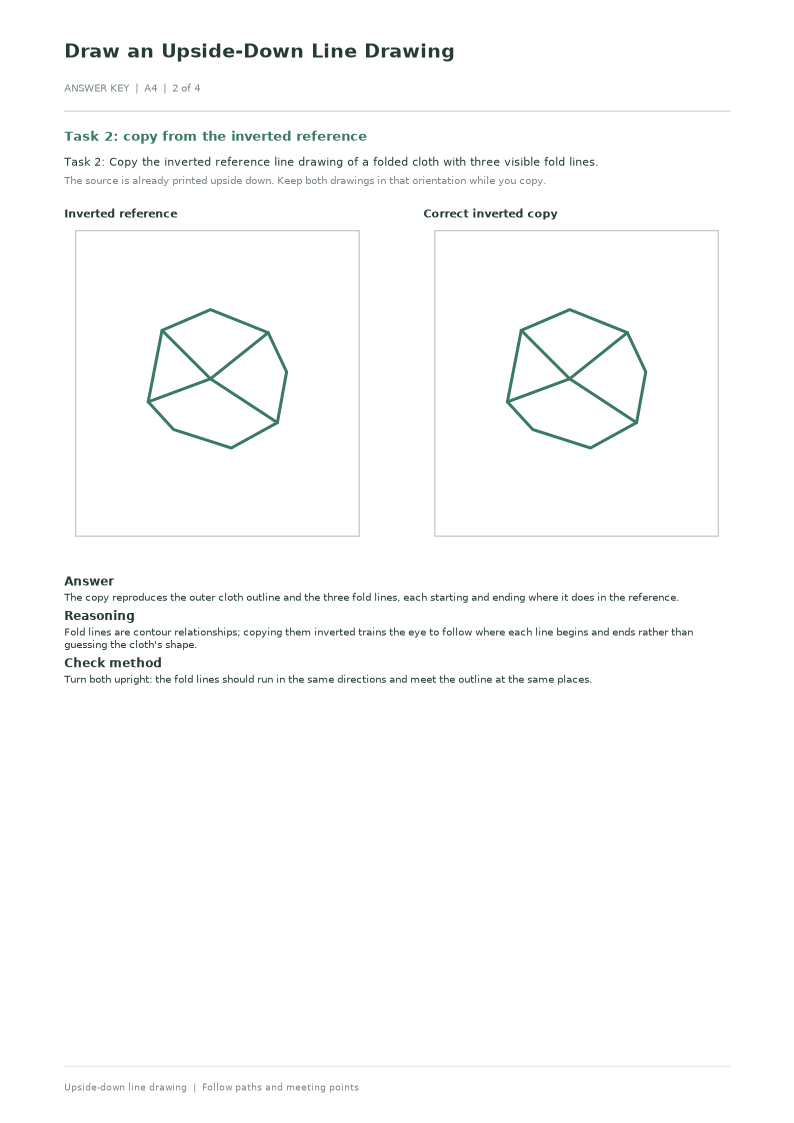
An upside-down line drawing is a copy made while the reference is turned upside down. The point is to stop naming parts (face, hand, chair) and instead follow the lines as shapes: where a line starts, how it curves, where it meets another line. Turn the reference upside down, draw what you actually see, then turn both the reference and your copy upright to check.
Letter & A4
PDF & SVG
What the task is
You are given a line reference. Turn it upside down. Copy it line by line onto blank paper, working from one contour to the next, without turning your paper or the reference back upright until the copy is finished. This is a contour-copy exercise, not a test of naming or shading.
How to work
First look at the inverted reference and find one clear starting line, such as an outer edge. Draw that line, then find the next line that touches or nearly touches it, and draw that. Keep asking where each new line begins and ends relative to lines already drawn. Ignore what the shapes mean; treat every line as a path with a direction and a meeting point.
How to check
When the copy is complete, turn both the reference and your copy upright. Compare the overall outline, the spacing between lines, and where lines meet. Then turn both upside down again and compare the same relationships. A useful copy keeps the same line relationships in both orientations; small differences in line weight or smoothness are acceptable.
Download the complete resource pack
All individual SVG pages (20)
- A4 reference page 1
- A4 reference page 2
- A4 student page 1
- A4 student page 2
- A4 student page 3
- A4 student page 4
- A4 answer page 1
- A4 answer page 2
- A4 answer page 3
- A4 answer page 4
- LETTER reference page 1
- LETTER reference page 2
- LETTER student page 1
- LETTER student page 2
- LETTER student page 3
- LETTER student page 4
- LETTER answer page 1
- LETTER answer page 2
- LETTER answer page 3
- LETTER answer page 4
Print at 100% / actual size. Use the stated scale on any schematic diagram; physical cutting templates are identified separately. A4 and US Letter are separate files. Free access, no signup; CC BY 4.0.
How to use these pages
- What the task is
- How to work
- How to check
Worked example
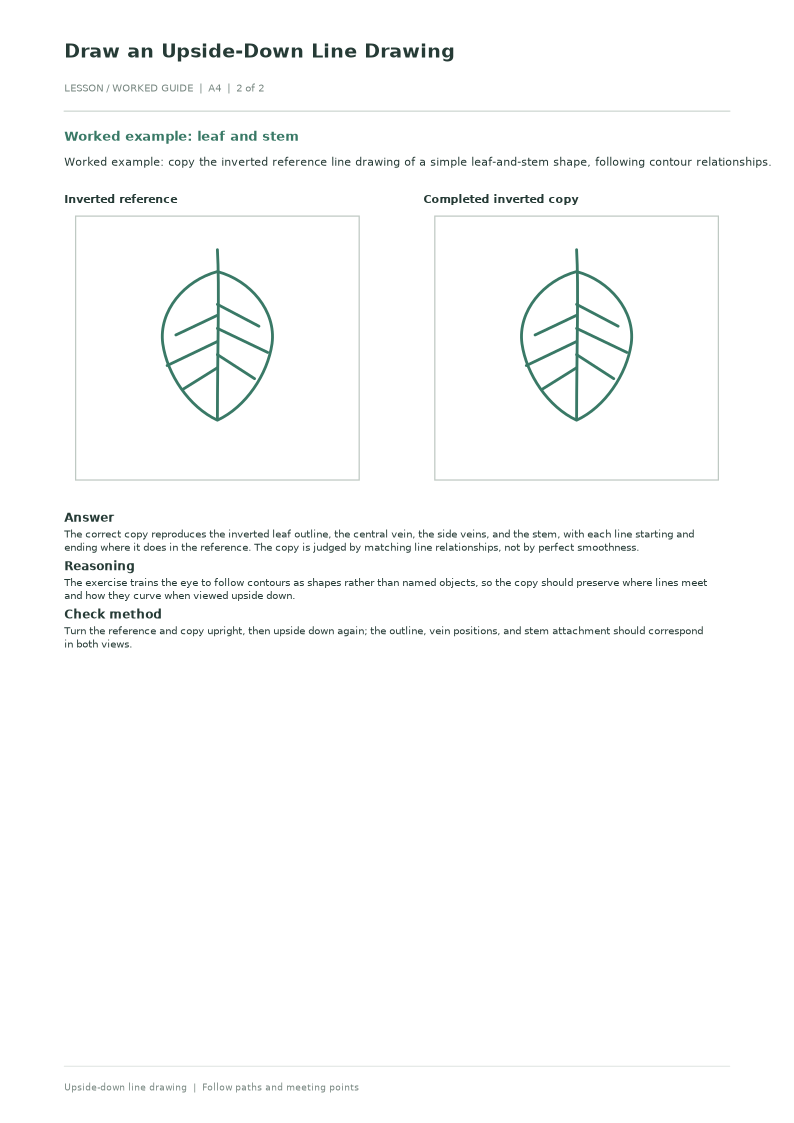
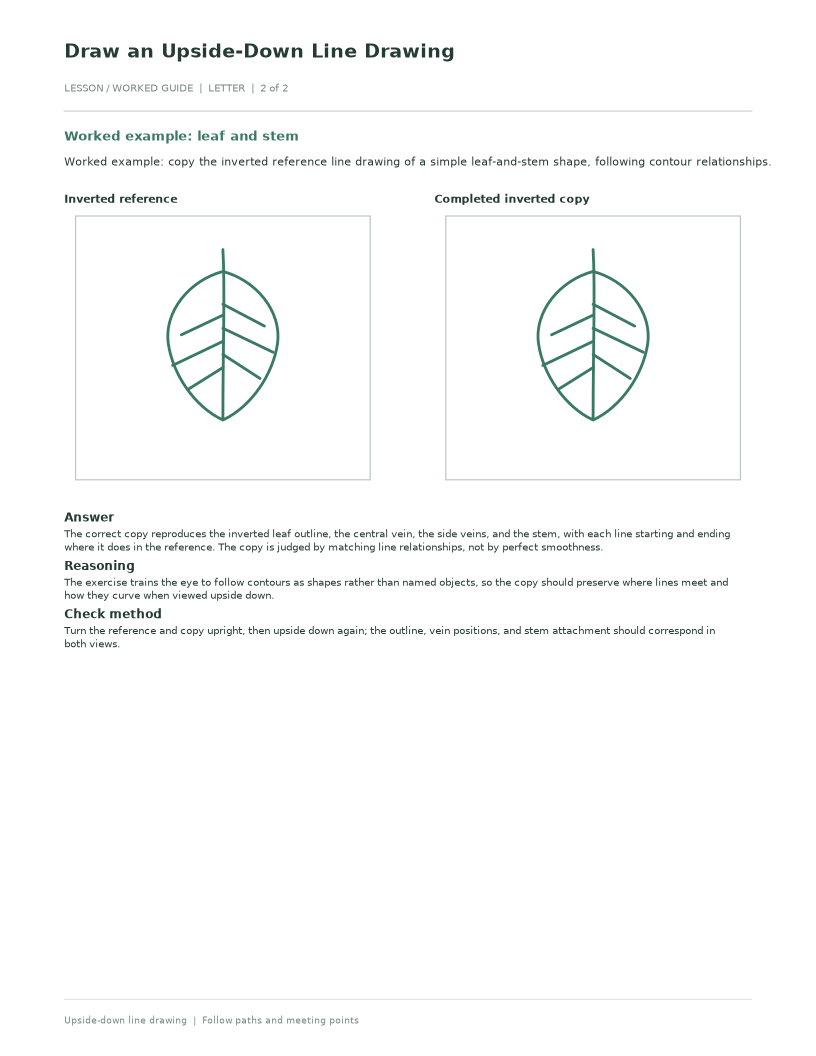
Example: Worked example: copy the inverted reference line drawing of a simple leaf-and-stem shape, following contour relationships.
Answer: The correct copy reproduces the inverted leaf outline, the central vein, the side veins, and the stem, with each line starting and ending where it does in the reference. The copy is judged by matching line relationships, not by perfect smoothness.
Reasoning: The exercise trains the eye to follow contours as shapes rather than named objects, so the copy should preserve where lines meet and how they curve when viewed upside down.
Check: Turn the reference and copy upright, then upside down again; the outline, vein positions, and stem attachment should correspond in both views.
Four practice tasks and complete answers
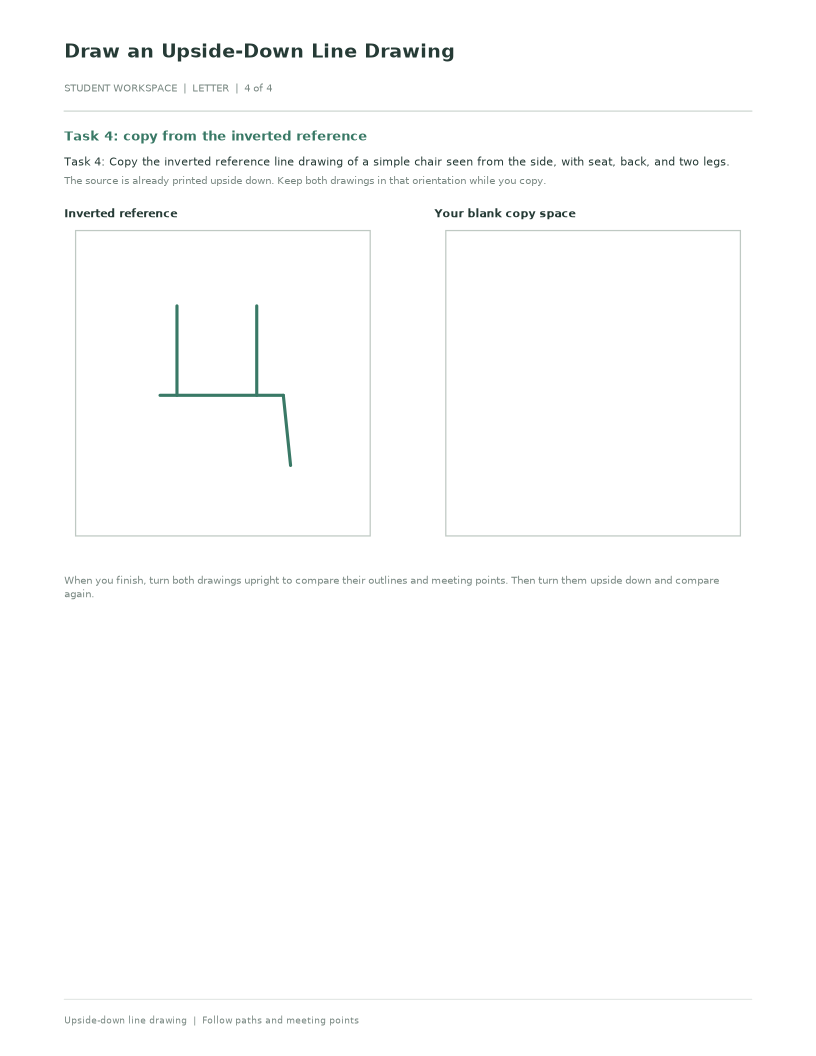
Task 1
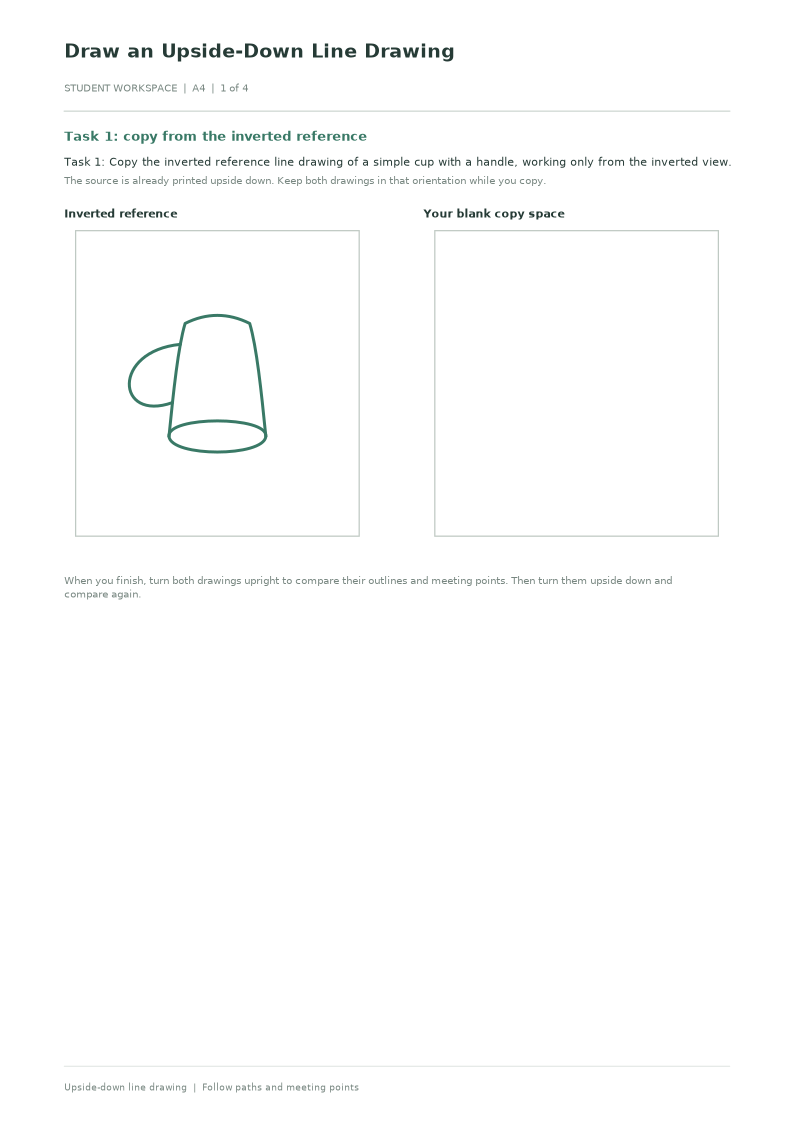
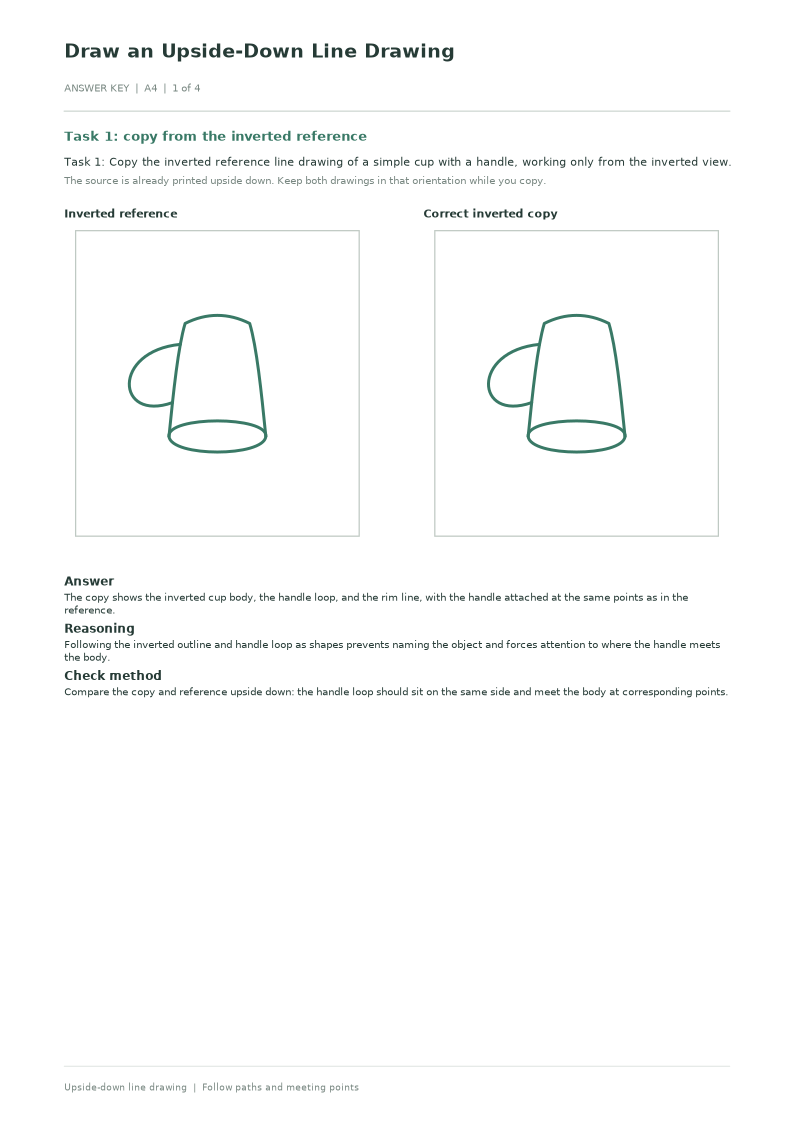
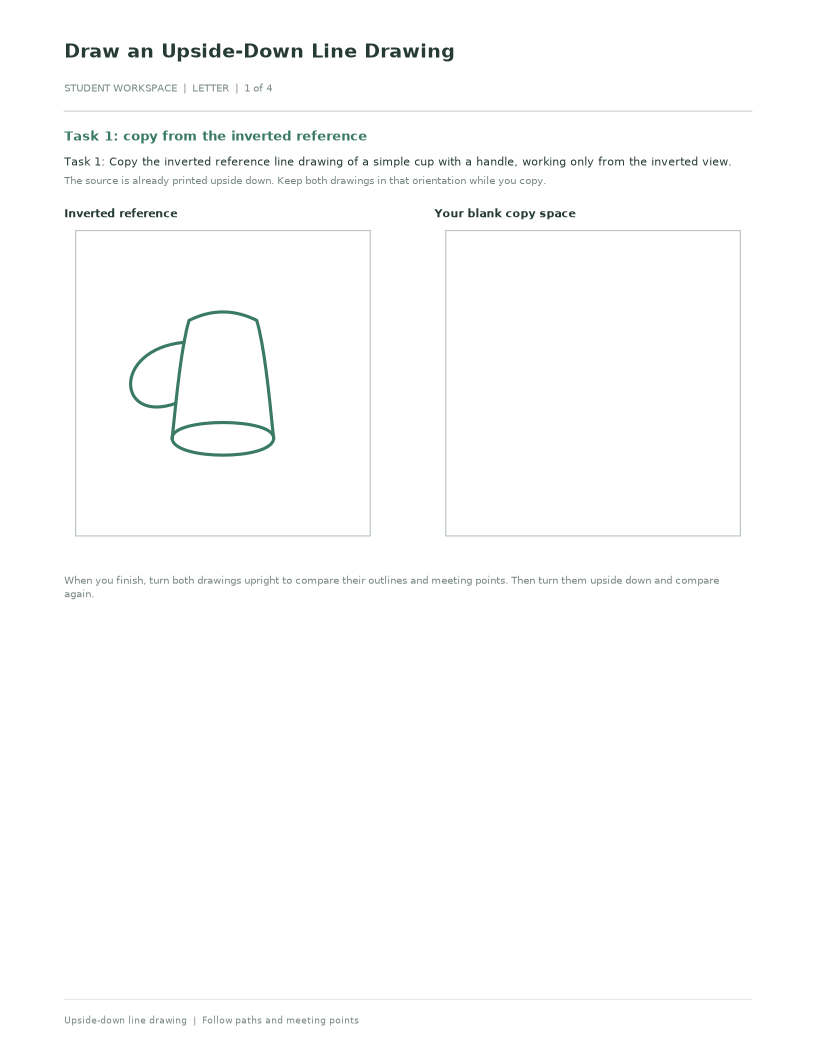
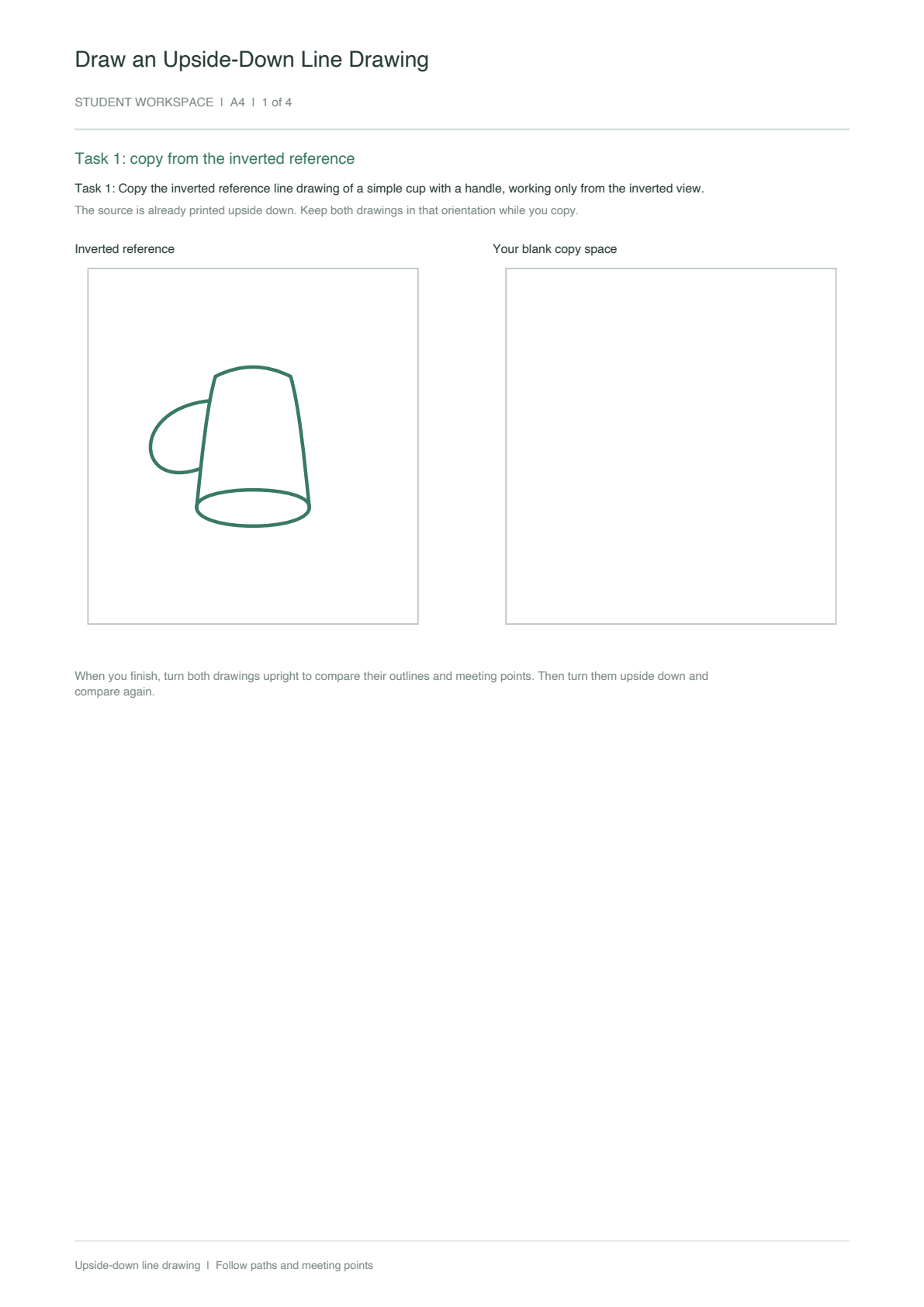
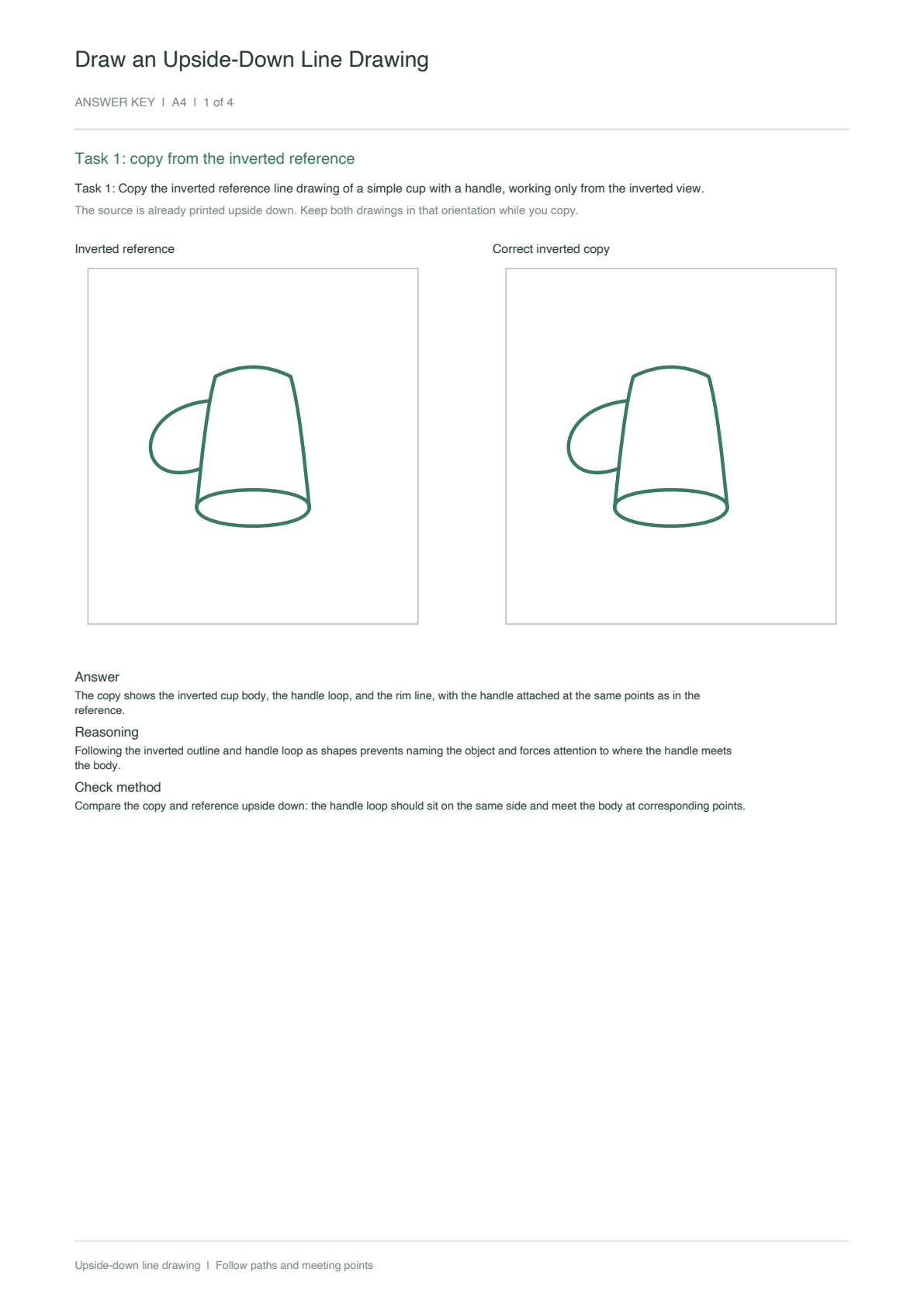
Task 1: Copy the inverted reference line drawing of a simple cup with a handle, working only from the inverted view.
Show answer 1
The copy shows the inverted cup body, the handle loop, and the rim line, with the handle attached at the same points as in the reference.
Following the inverted outline and handle loop as shapes prevents naming the object and forces attention to where the handle meets the body.
Check: Compare the copy and reference upside down: the handle loop should sit on the same side and meet the body at corresponding points.
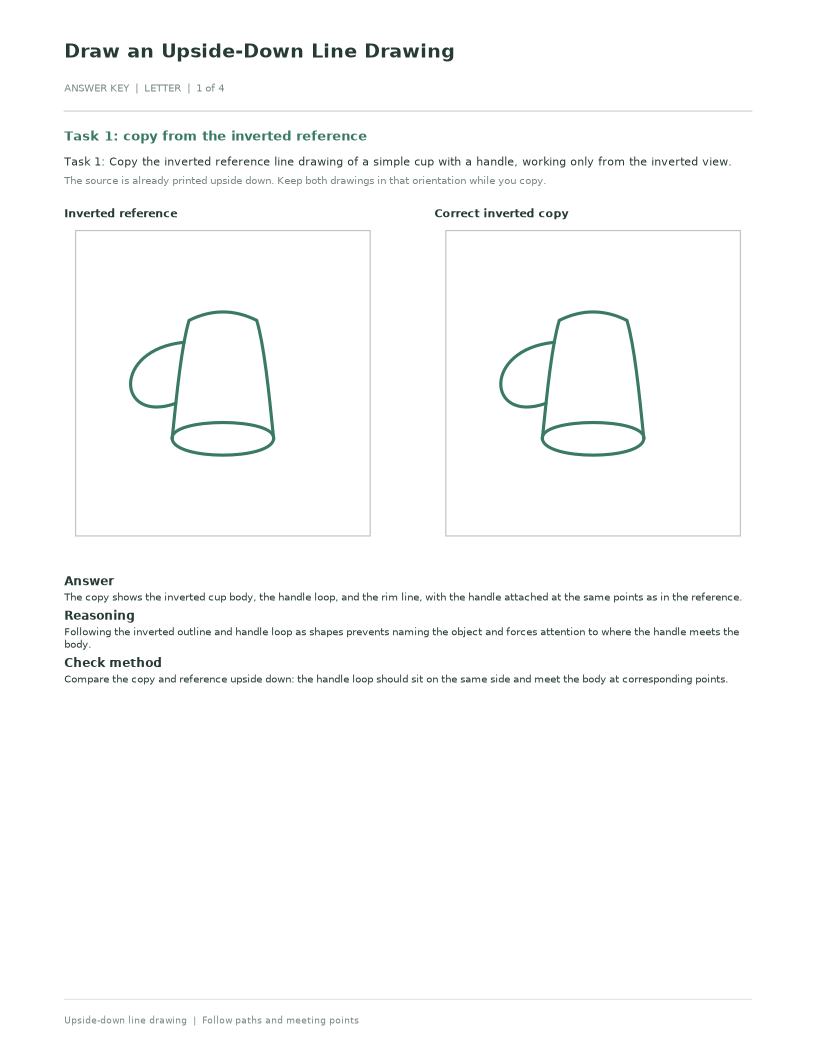
Task 2
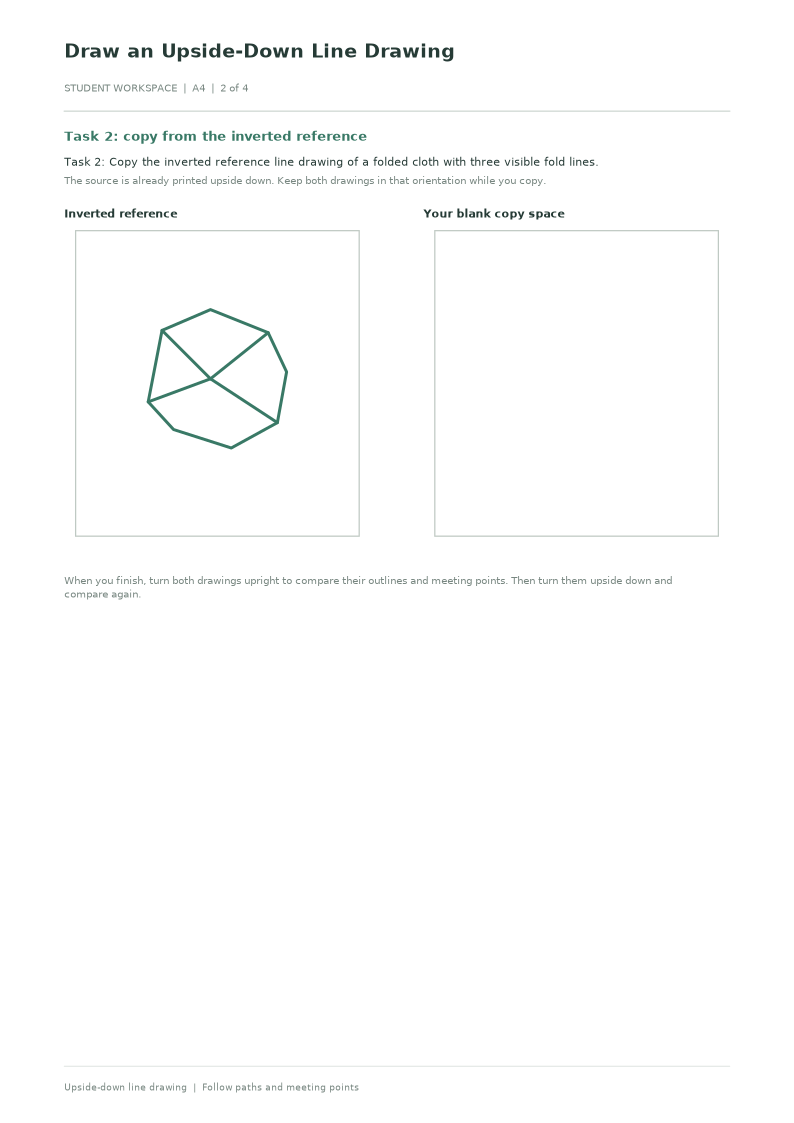
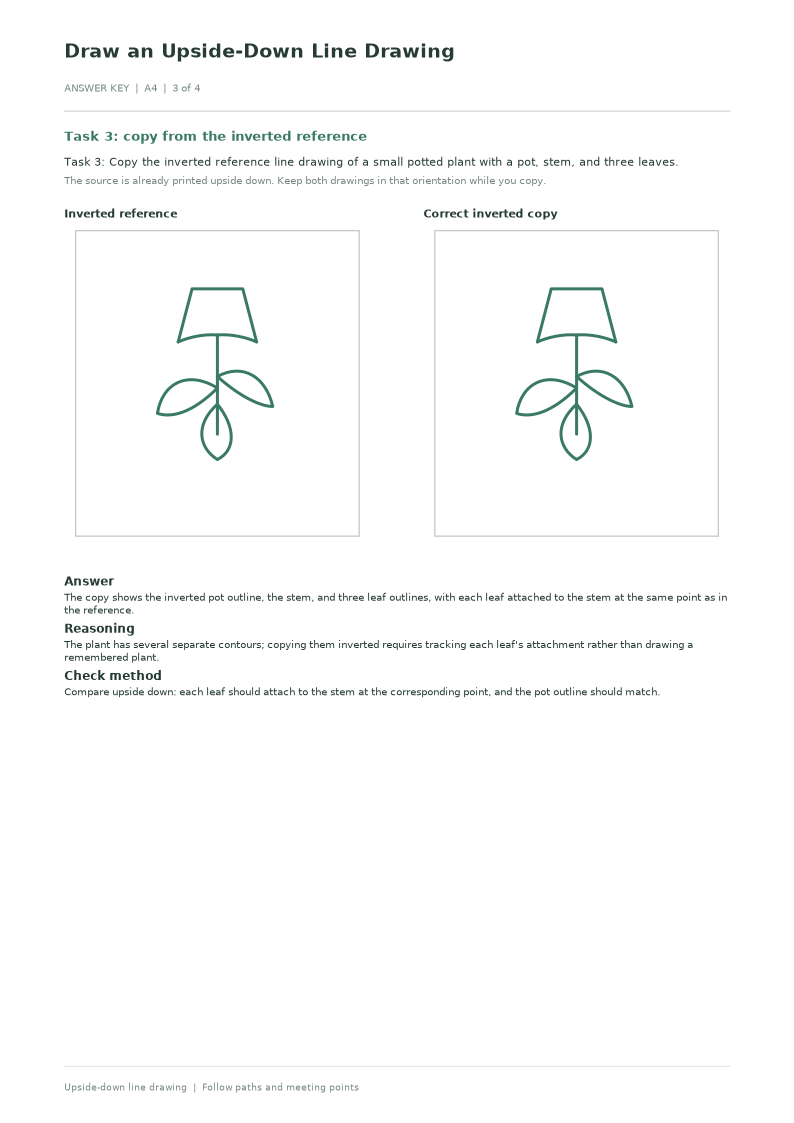
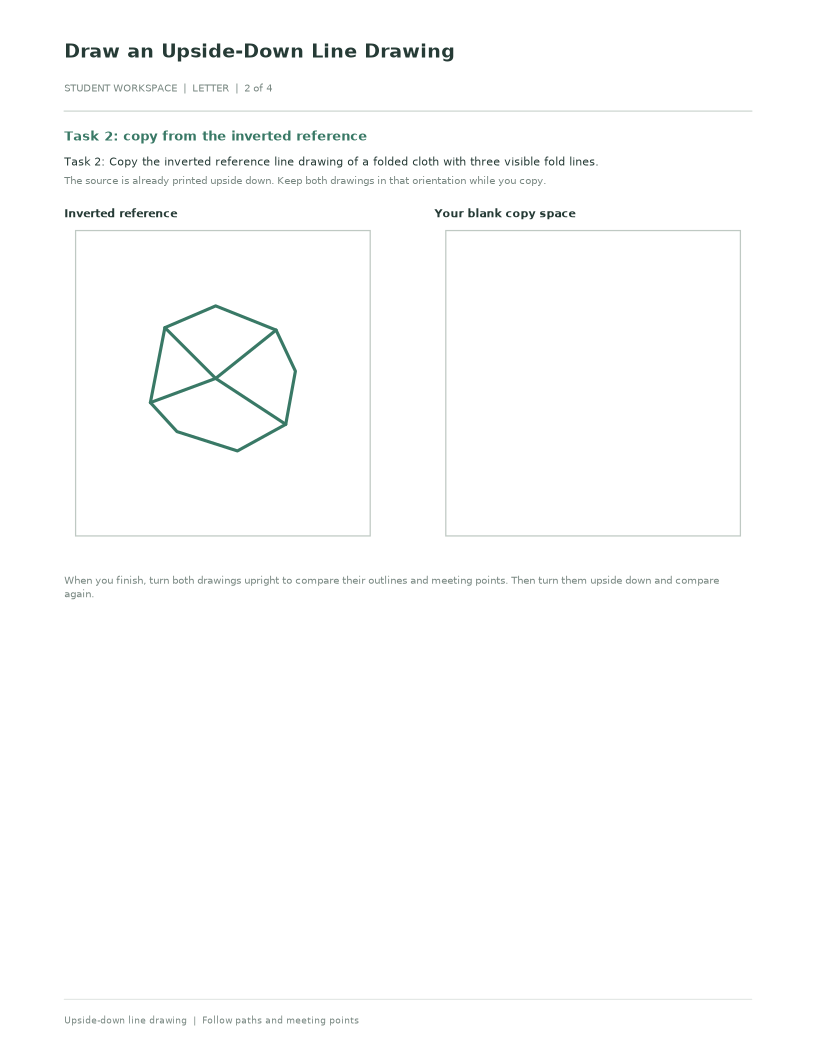
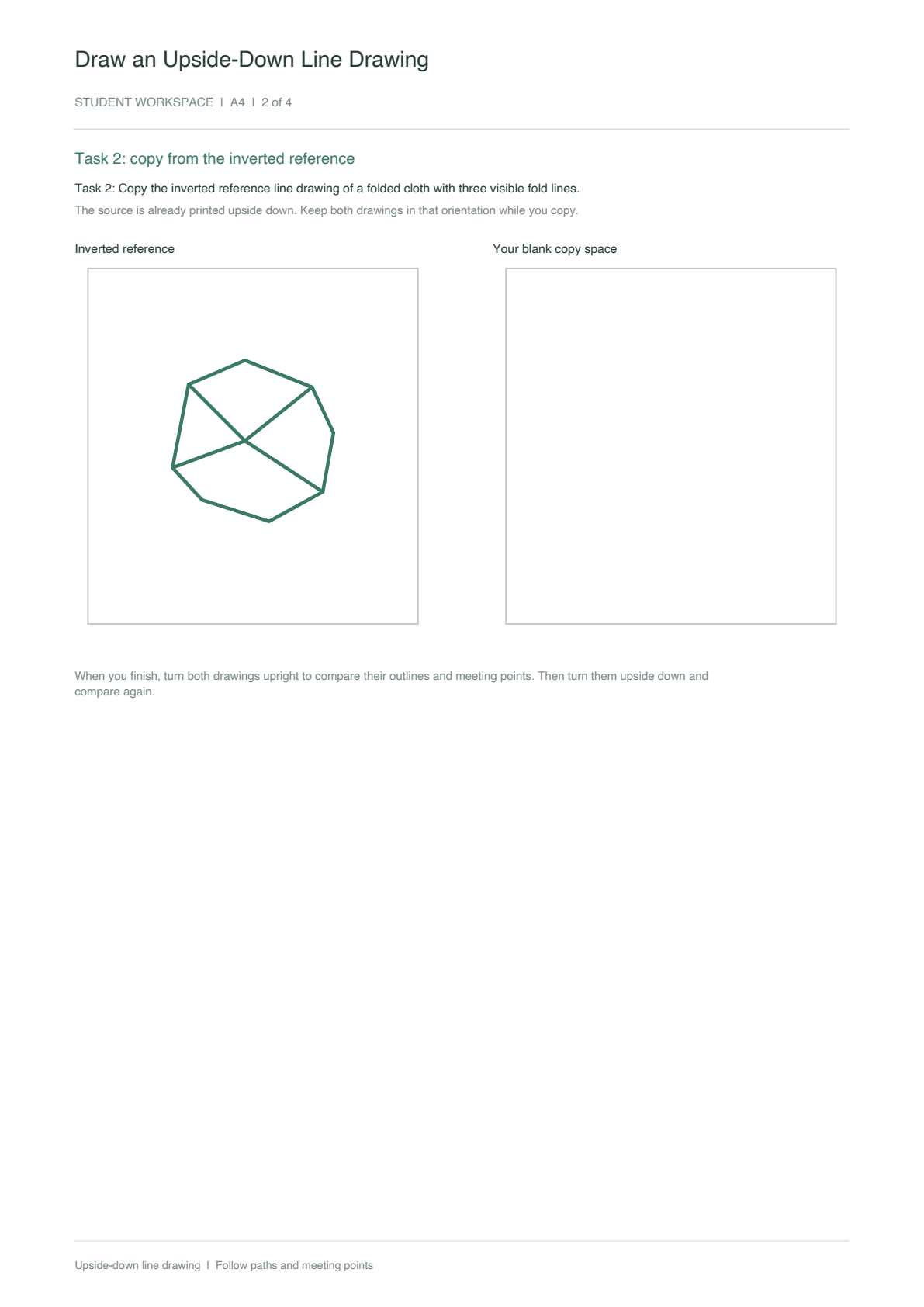
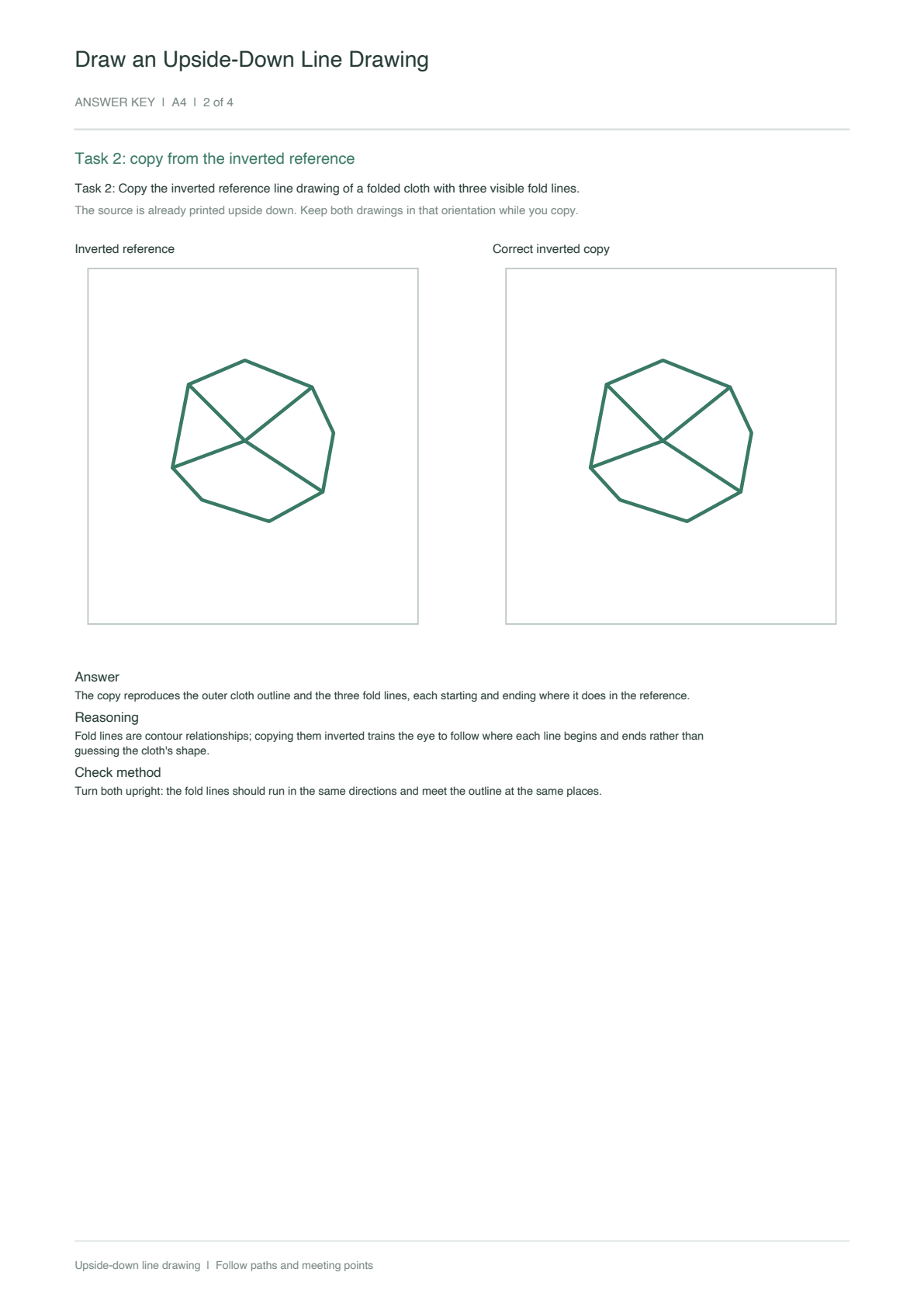
Task 2: Copy the inverted reference line drawing of a folded cloth with three visible fold lines.
Show answer 2
The copy reproduces the outer cloth outline and the three fold lines, each starting and ending where it does in the reference.
Fold lines are contour relationships; copying them inverted trains the eye to follow where each line begins and ends rather than guessing the cloth's shape.
Check: Turn both upright: the fold lines should run in the same directions and meet the outline at the same places.
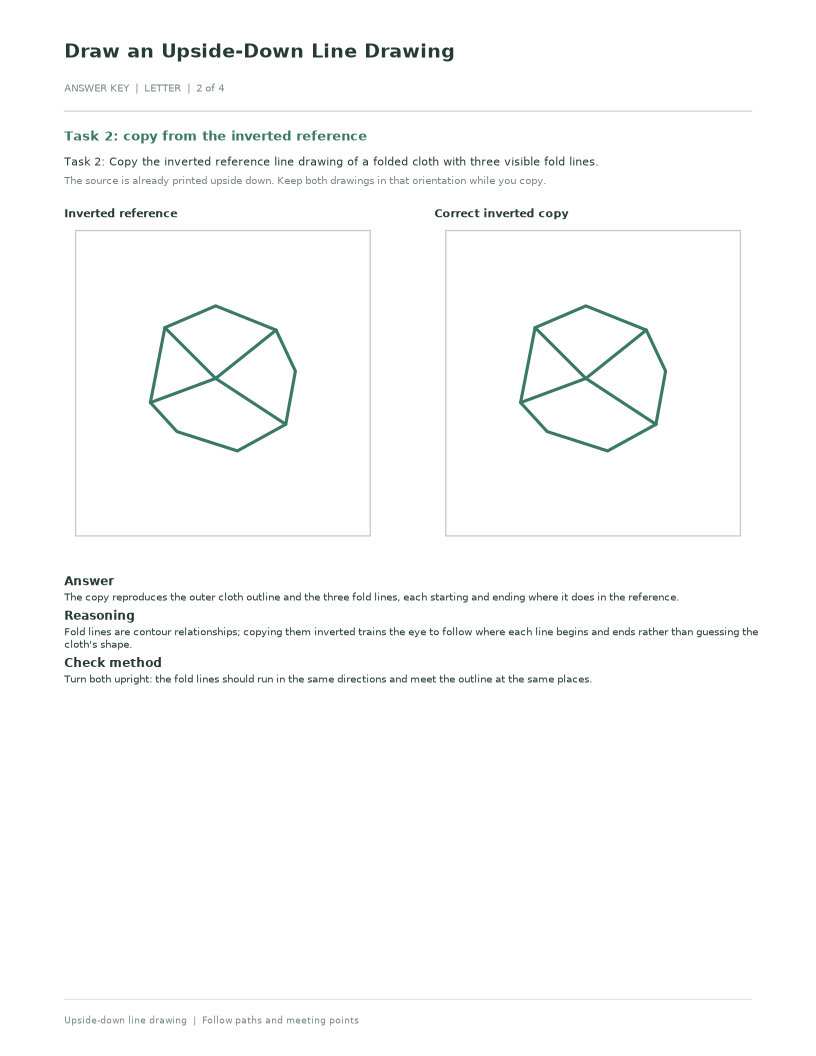
Task 3
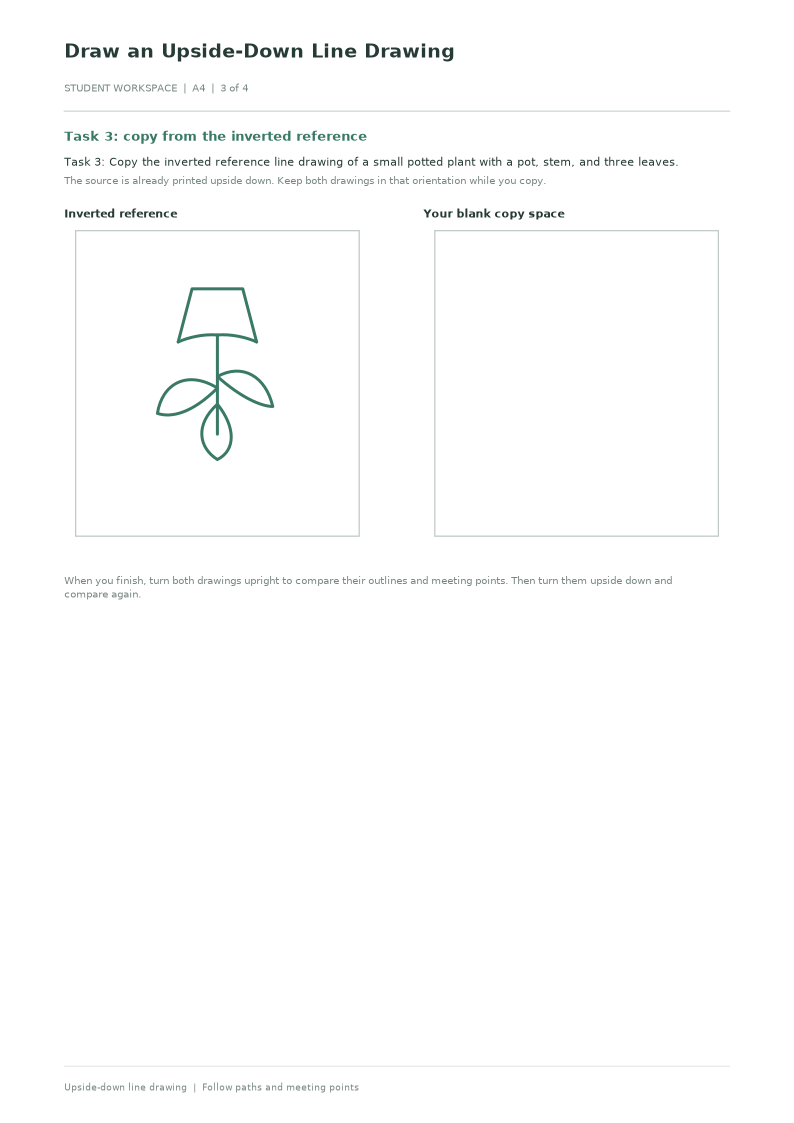
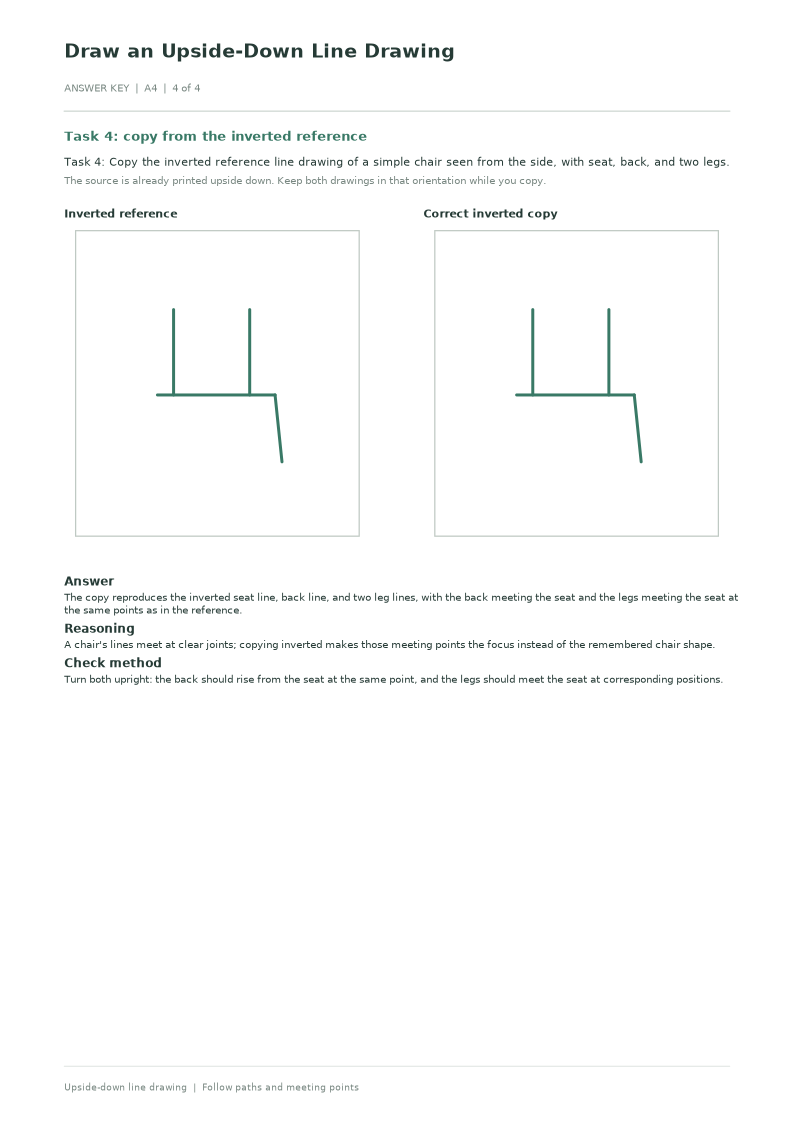
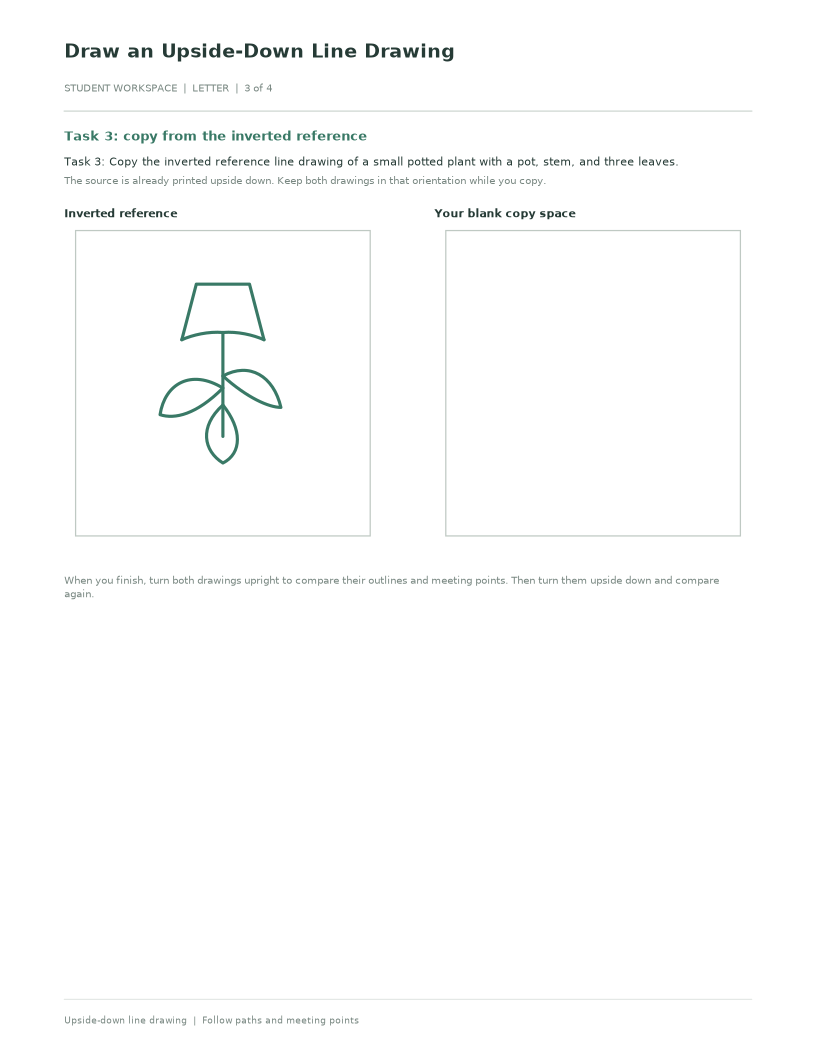
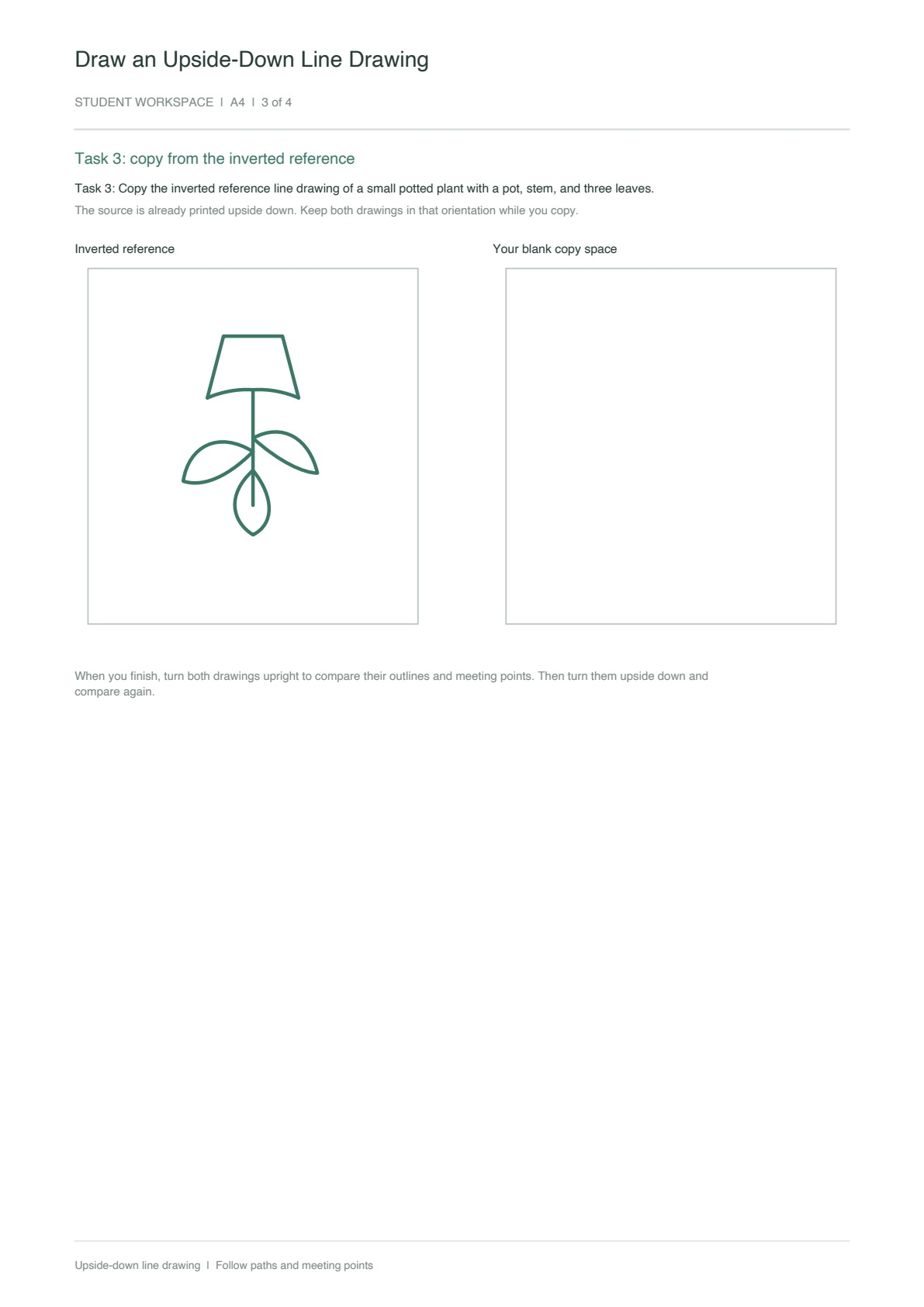
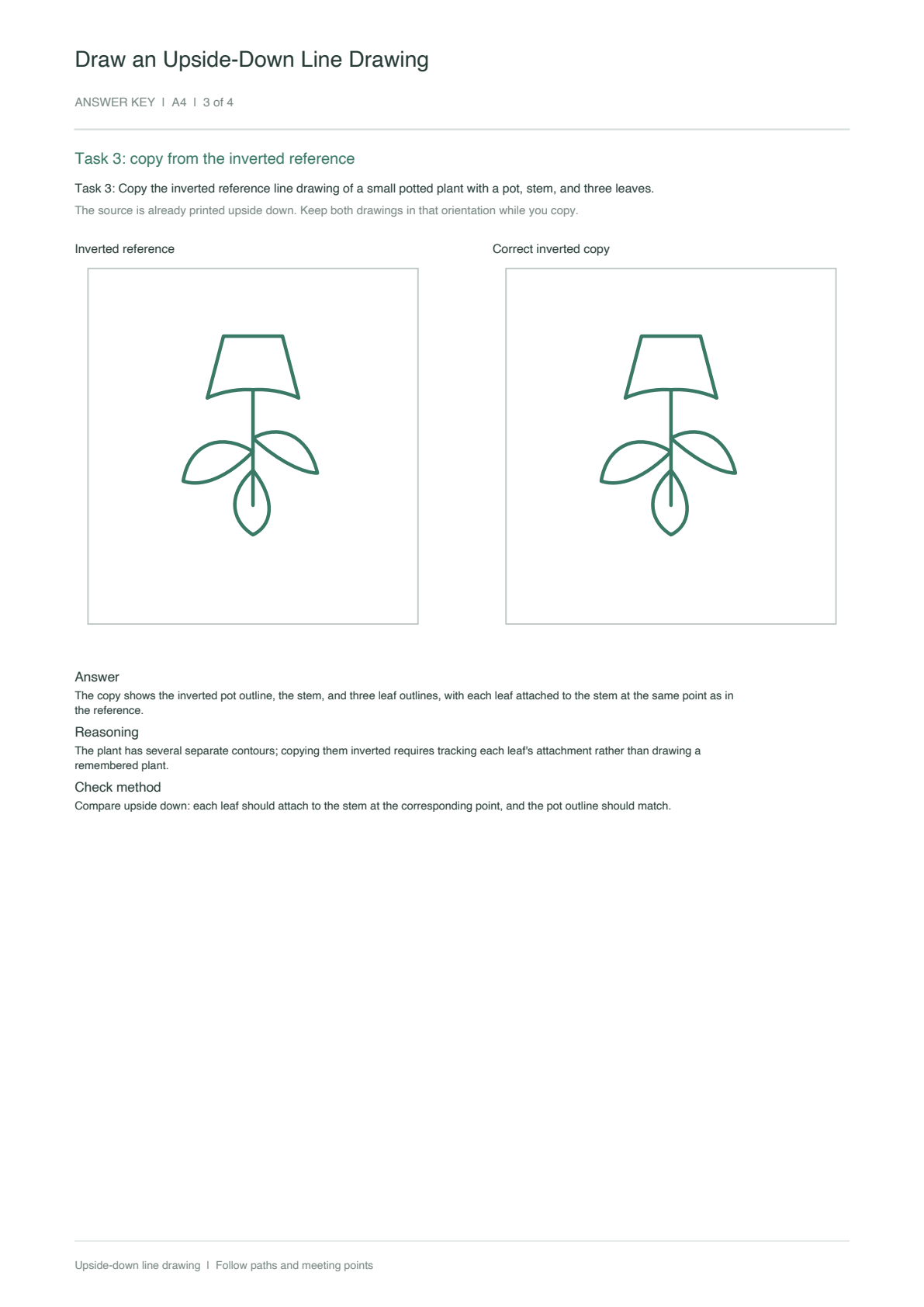
Task 3: Copy the inverted reference line drawing of a small potted plant with a pot, stem, and three leaves.
Show answer 3
The copy shows the inverted pot outline, the stem, and three leaf outlines, with each leaf attached to the stem at the same point as in the reference.
The plant has several separate contours; copying them inverted requires tracking each leaf's attachment rather than drawing a remembered plant.
Check: Compare upside down: each leaf should attach to the stem at the corresponding point, and the pot outline should match.
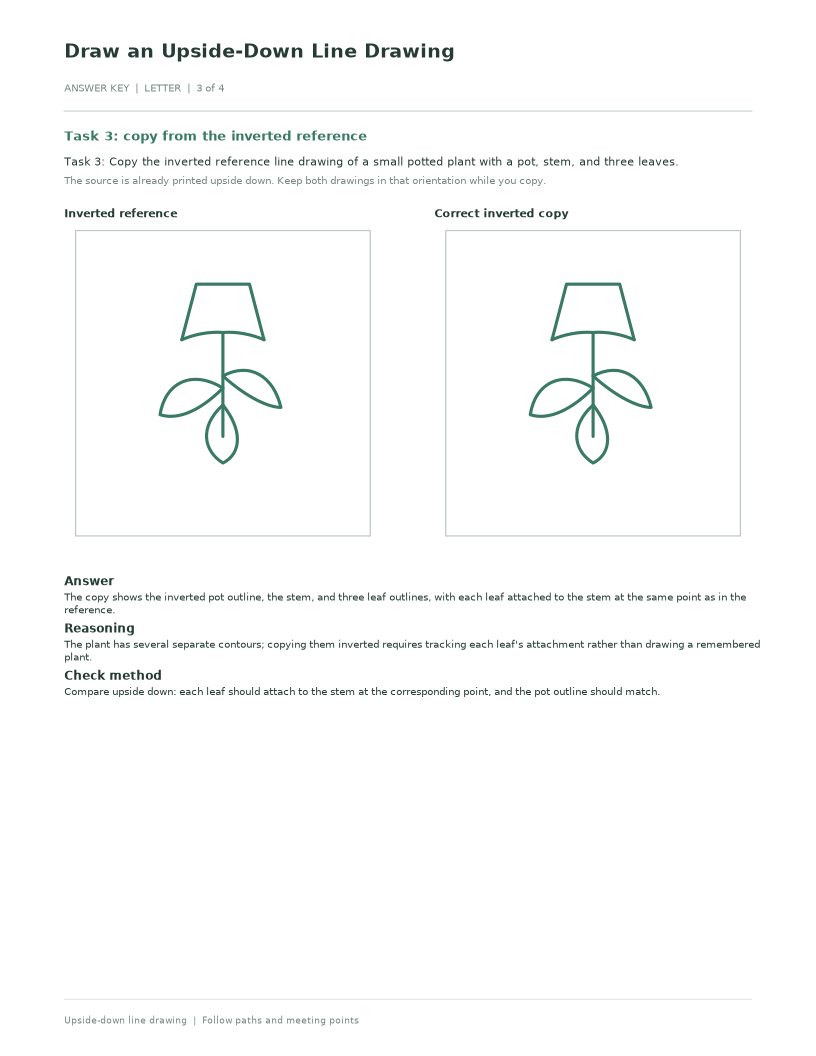
Task 4
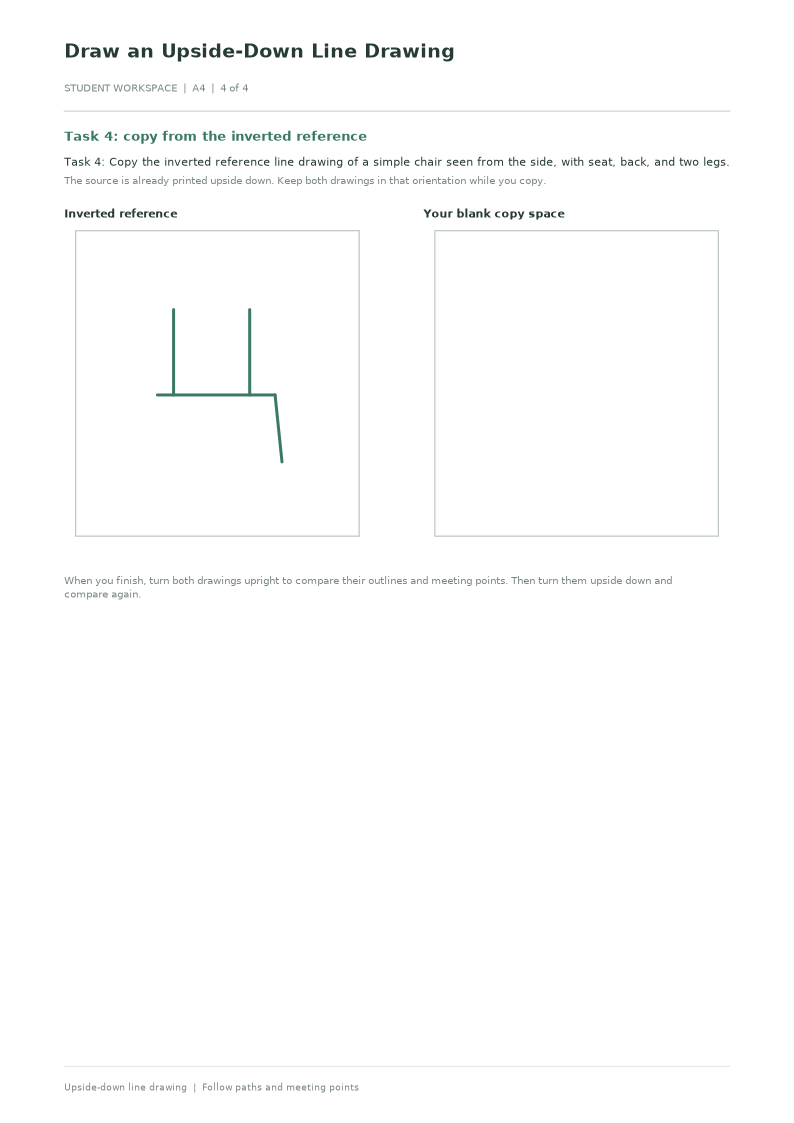
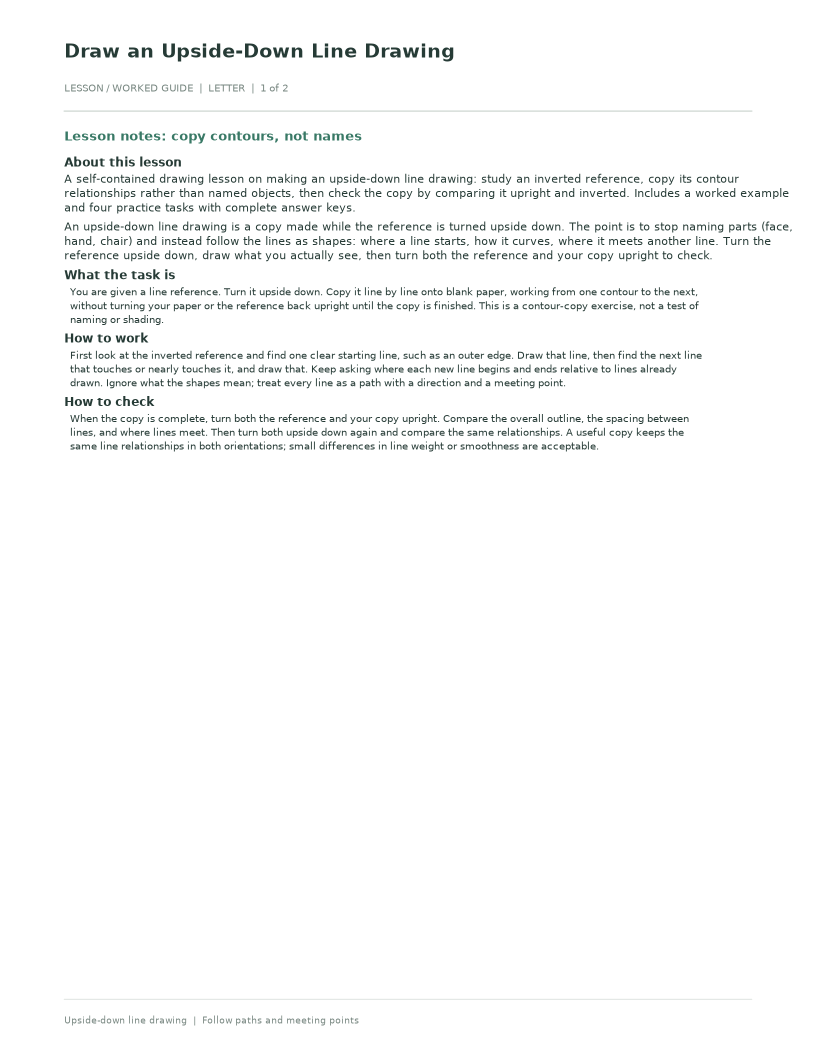
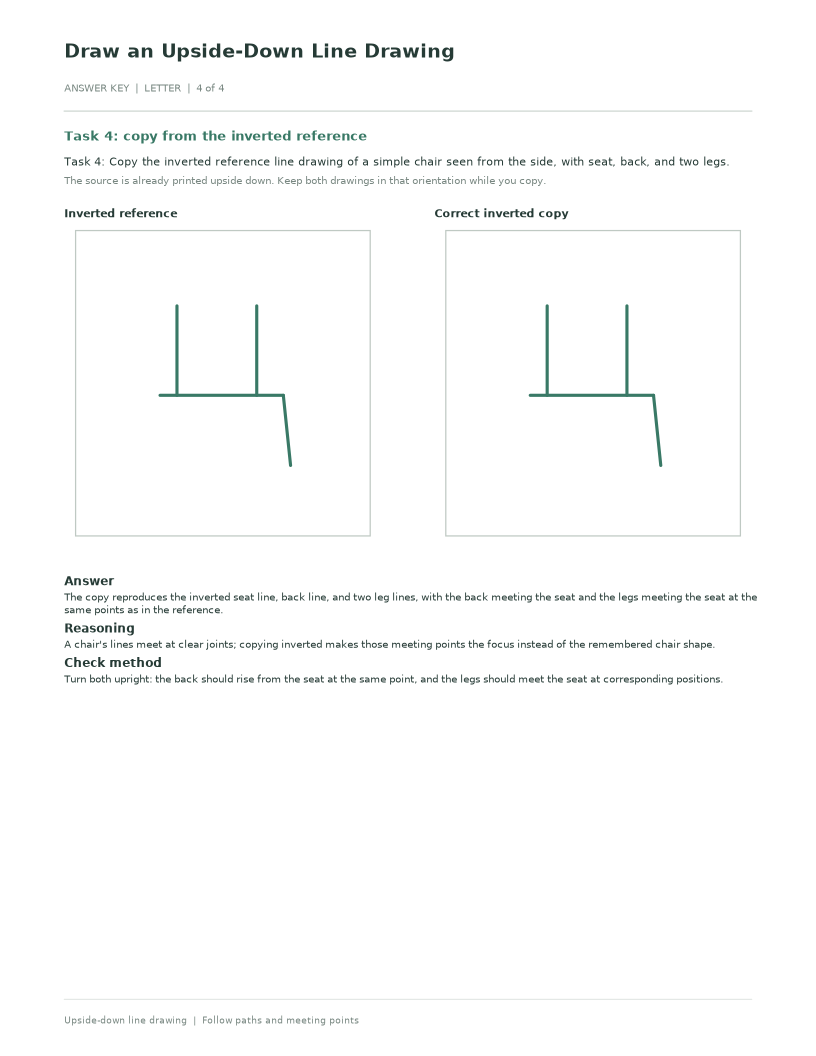
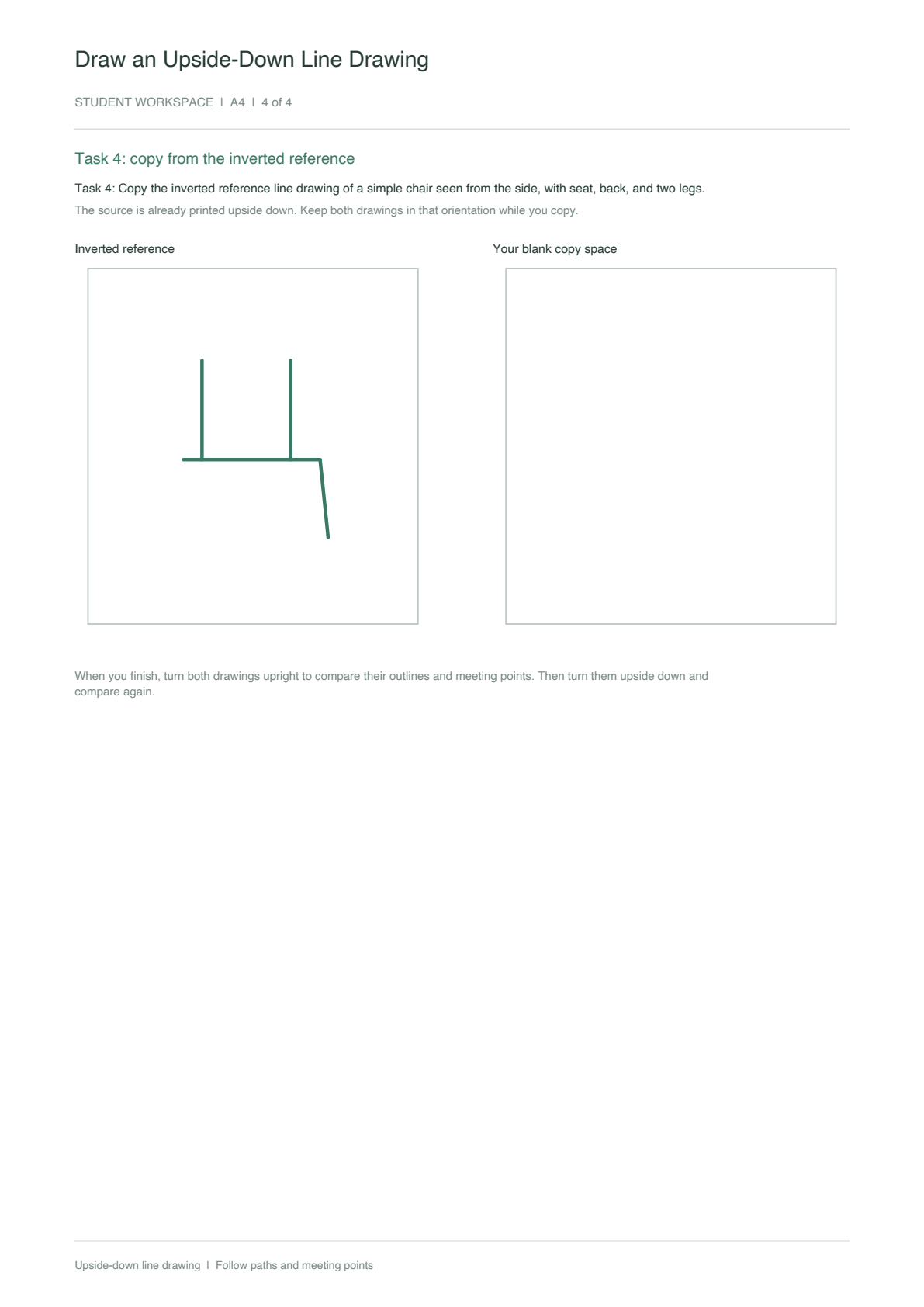
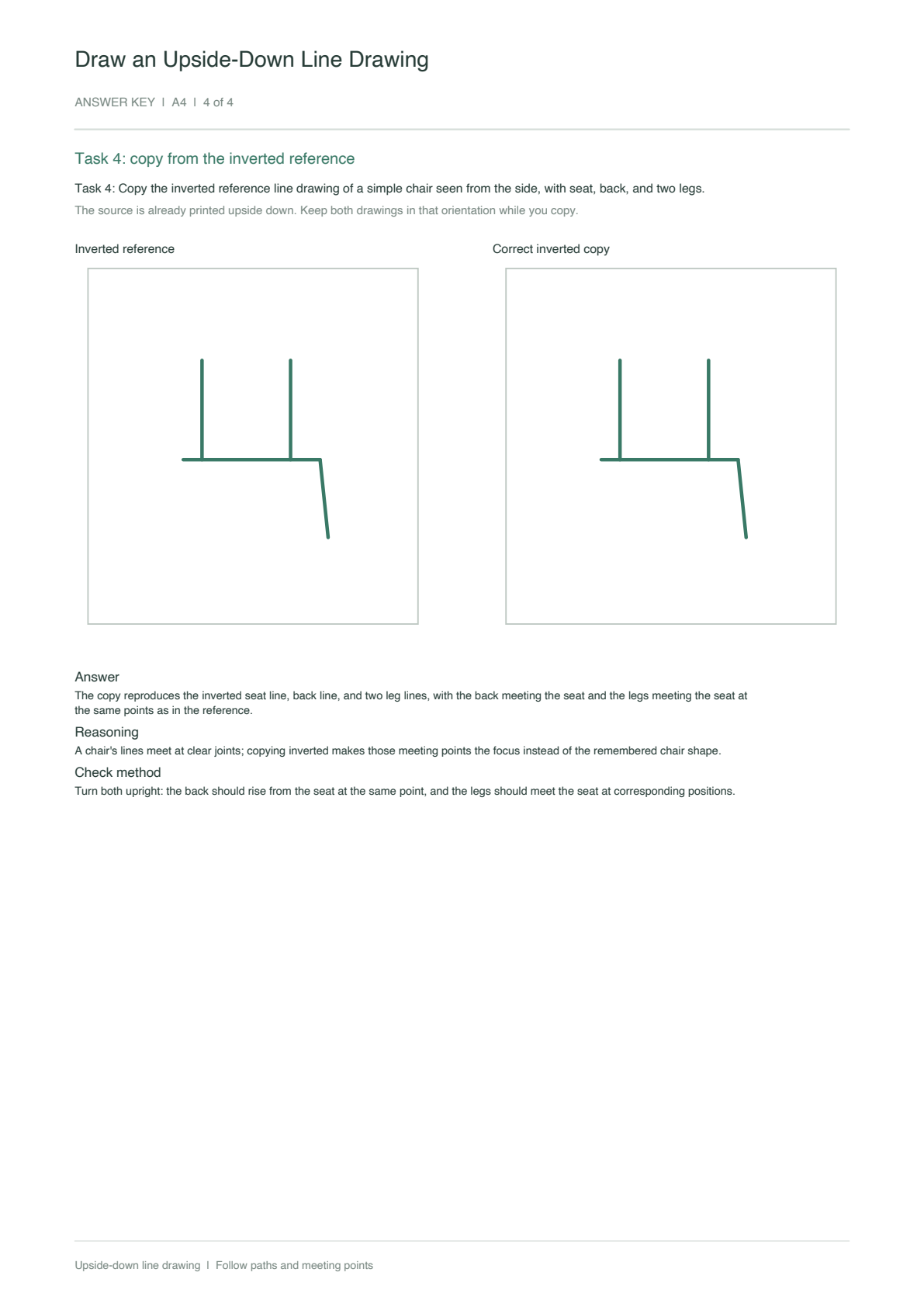
Task 4: Copy the inverted reference line drawing of a simple chair seen from the side, with seat, back, and two legs.
Show answer 4
The copy reproduces the inverted seat line, back line, and two leg lines, with the back meeting the seat and the legs meeting the seat at the same points as in the reference.
A chair's lines meet at clear joints; copying inverted makes those meeting points the focus instead of the remembered chair shape.
Check: Turn both upright: the back should rise from the seat at the same point, and the legs should meet the seat at corresponding positions.
Useful checks
- Turning the reference or paper upright partway through. Keep both inverted until the copy is finished; turning them back invites naming and guessing.
- Drawing a remembered object instead of the lines shown. Start each line from a point on an already-drawn line and follow the reference's direction.
- Judging the copy only upright. Check both upright and inverted; the line relationships should correspond in both views.
Questions about this resource
Do I need to match line thickness exactly?
No. The exercise is about contour relationships, not line weight; small differences in smoothness are acceptable.
Can I use a ruler or grid?
The task is a freehand contour copy; a ruler or grid is not required and may distract from following line relationships.