Free original lessons
Anime Hair Practice: Spiked and Swept Shape Construction
Learn to build anime hair from a crown point using radiating wedge clumps for spiked styles and flowing band clumps for swept styles, with overlap and stroke direction.
Free lesson
Four exercises
Worked answers
Object Drawing Lessons
Anime hair reads as shape first, strand second. This lesson teaches two construction systems on a blank head oval: spiked hair built from radiating wedge clumps that spring from a crown point, and swept hair built from flowing clump bands that follow the head curve. You will place a crown point, choose clump direction, and control overlap so the silhouette stays clear. The convention used here is simple: the head oval's baseline is the chin line and the midline is the eye line; hair volume sits above and around the oval, and clumps are drawn as closed shapes with a wide root and a tapered tip. Letter styles and exact clump counts vary, so the rubric rewards consistent direction and readable overlap rather than one universal answer.
Practice materials: Printable downloads are not available for this lesson yet. Use the instructions and four exercises below.
Reference illustration
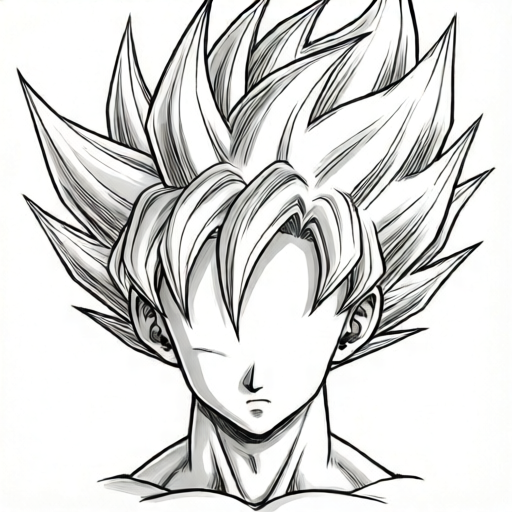
Use the stated measurements and conventions for each exercise.
Set the head oval and crown point
Draw a blank head oval. Mark the baseline at the bottom (chin) and the midline across the middle (eye line). The distance from baseline to midline is called the x-height; it is a placement reference for the eye line, not a hair measurement. The crown point is a single dot on the upper oval, about 1 cm above the midline and 0.5 cm toward the back of the head from the top center; it is the origin for every clump root in both styles.
Keep the oval light so hair shapes dominate. All measurements below are hypothetical examples for practice, not equipment standards.
- Draw the oval about 6 cm tall and 4.5 cm wide on paper.
- Mark the baseline and midline lightly.
- Place the crown point about 1 cm above the midline and 0.5 cm toward the back of the head from the top center, so it sits above the midline but well below the top edge.
- Label the crown point C so every clump can be traced back to it.
Spiked construction: radiating wedge clumps
A spiked clump is a wedge: a wide root near C and a tapered tip pointing outward. Direction radiates from C, so neighboring clumps fan apart. Overlap is deliberate: each new clump crosses the previous one near its root, hiding the root joint and creating a layered silhouette.
Vary tip length but keep root width consistent; this keeps the style readable.
- From C, draw three guide rays outward: up-left, up, up-right.
- On each ray, draw a wedge with a root about 1 cm wide at C and a tip 3 to 5 cm away.
- Add a second layer of shorter wedges between the first, each crossing a neighbor near its root.
- Check that every tip points away from C and no two roots sit isolated from the crown.
Swept construction: flowing clump bands
A swept clump is a band: a curved closed shape that follows the head curve from C toward one side, then releases into a tapered tip. Bands overlap like roof tiles, each starting slightly behind the previous one so the flow direction is unmistakable.
Stroke direction follows the band: draw from root to tip in one smooth arc, then close the shape back along the lower edge.
- From C, draw two curved guide lines sweeping to the right side of the oval.
- Draw a band along each guide, about 1.5 cm wide at the root, tapering to a tip past the oval edge.
- Add two more bands starting slightly behind the first, each overlapping the previous by about one third of its width.
- Check that all bands curve the same way and tips release in the sweep direction.
Apply both styles on a blank head
Use a fresh blank head oval. On the left half, build spiked clumps from C; on the right half, build swept bands from the same C. This side-by-side test shows how one crown point supports two different shape systems.
Keep the stroke-direction legend nearby: short arrows from root to tip for spikes, long curved arrows for sweeps.
- Mark C on the new oval.
- Build three spiked wedges on the left half, radiating outward.
- Build three swept bands on the right half, flowing to one side.
- Compare silhouettes: spikes should fan; sweeps should tile. Adjust overlap where roots look exposed.
Worked example
On a 6 cm by 4.5 cm head oval with C placed 1 cm above the midline, construct a spiked style with three radiating wedges and one overlapping second-layer wedge, then state the check.
Worked answer
Draw three rays from C: up-left, up, up-right. Each wedge has a 1 cm root at C and a tip 4 cm along its ray. Add one shorter wedge between the up-left and up rays, crossing the up-left wedge near its root. Check: extend each wedge's center line; all meet at C, and the second-layer root is hidden by its neighbor.
Four practice exercises
Exercise 1
A head oval is 6 cm tall. C sits 1 cm above the midline. A spiked wedge tip is 4 cm from C along an up-right ray. Describe the wedge and give one check.
Show answer and check
Wedge root 1 cm wide at C, tip 4 cm along the up-right ray, closed shape. Check: extend the center line back to C.
Why: The wedge must radiate from C; the 4 cm tip length is a hypothetical practice value.
Check: Use a ruler to confirm the tip is 4 cm from C and the center line meets C.
Exercise 2
Two swept bands each 1.5 cm wide at the root overlap by one third of band width. What overlap distance is used, and what does the check confirm?
Show answer and check
Overlap is 0.5 cm. Check confirms the second root is partly hidden but still readable.
Why: One third of 1.5 cm is 0.5 cm; this keeps roots visible.
Check: Measure the overlap gap between band roots; it should be about 0.5 cm.
Exercise 3
On a blank head, a learner draws three spikes pointing up, up, and up-right from three separate dots. Name the main error and the fix.
Show answer and check
Roots are not at C and spikes are not radiating. Fix: move all roots to C and fan the tips outward.
Why: Spiked construction requires one crown origin and radiating direction.
Check: Extend spike center lines; they should converge near C.
Exercise 4
A swept style has one band curving left and two curving right from C. State whether this passes the direction check and why.
Show answer and check
It fails unless the left band is redrawn to match the right sweep. Mixed sweep directions break the flow logic.
Why: Swept bands must share one sweep direction to read as a style.
Check: Trace each band's curve; all should bend toward the same side.
Common mistakes
- Drawing clumps from many separate points instead of one crown point. Trace every root back to C; move stray roots to the crown area.
- Making spikes parallel instead of radiating. Extend each spike's center line back; all lines should meet near C.
- Swept bands crossing in opposite directions. Choose one sweep side and redraw any band that curves against it.
- Overlap so deep that roots disappear entirely. Limit overlap to about one third of band width so each root remains readable.
Self-check rubric
- Crown point C is marked once and all clump roots trace to it.
- Spiked clumps are wedges with wide roots and tapered tips radiating from C.
- Swept clumps are curved bands following the head curve in one direction.
- Overlap hides root joints without erasing tips.
- Stroke direction is consistent: root to tip for spikes, smooth arc for sweeps.
- Valid alternatives are accepted: clump count, tip length, and sweep side may vary if direction and overlap logic hold.
Questions and answers
How many clumps should a spiked style have?
There is no fixed count. Three to six clumps per layer is a practical practice range; readability matters more than number.
Can swept and spiked styles mix on one head?
Yes, if each half keeps its own direction logic and both share the same crown point.
What does x-height mean here?
X-height is baseline to midline on the head oval; it is a reference for placing the eye line, not a hair measurement.
How do I check overlap quickly?
Squint at the drawing: if roots look like separate dots, overlap is too shallow; if tips vanish, it is too deep.