Free original lessons
Draw Australia's Coastline: Outline Map Practice
Learn to draw Australia's outline map by tracing a light guide, then freehand. Focus on coastline features like bays, peninsulas, and capes with a clear convention and rubric.
Free lesson
Four exercises
Worked answers
Object Drawing Lessons
This lesson teaches you to draw Australia's coastline and outline map. You will use a simple convention: the coastline is the boundary between land and sea, drawn as a continuous line. X-height is baseline to midline for any labels; letter styles vary, so use clear handwriting. No political borders or interior detail are included. You will trace a light guide, then practice freehand. All resources are planned and free, not yet built. Measure your own paper and pencil; any numbers here are hypothetical examples.
Practice materials: Printable downloads are not available for this lesson yet. Use the instructions and four exercises below.
Reference illustration
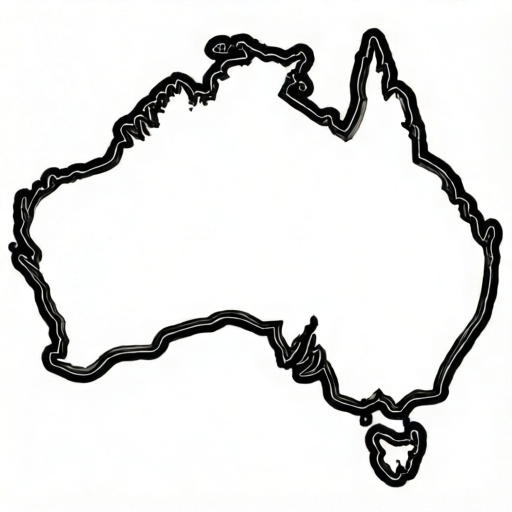
Use the stated measurements and conventions for each exercise.
Set up and trace the outline
Place a light outline guide of Australia on your paper. The guide shows the coastline only. Use a pencil and draw slowly along the guide. Keep the line continuous. Do not add state borders or rivers.
Check that the line closes: the start and end meet. The coastline includes large bays, peninsulas, and capes. Trace these shapes as smooth curves, not sharp corners, unless the guide shows a point.
- Place the guide on a flat surface and secure it.
- Start at the top and trace clockwise.
- Keep the pencil at a steady angle.
- Close the line at the start point.
Identify coastline features
A bay is a curved indentation of the sea into land. A peninsula is land surrounded by water on three sides. A cape is a point of land extending into water. On your outline, mark these with small labels using the x-height convention: letters sit between baseline and midline.
Use simple checkable arithmetic: if your outline is 10 cm wide, a bay might be 1 cm deep. These are hypothetical examples; measure your own drawing.
- Point to a bay and say 'bay'.
- Point to a peninsula and say 'peninsula'.
- Point to a cape and say 'cape'.
- Label one of each with clear handwriting.
Freehand practice
After tracing, draw a freehand outline in a practice box. Start with a light pencil line, then darken it. Compare your freehand outline to the guide. Check that the overall shape is wider than it is tall, with a smooth northern coast and a curved southern coast.
Valid alternatives are allowed: your line may be slightly different but should still show the main features. Use the rubric to self-check.
- Draw a light freehand outline.
- Darken the line once the shape is complete.
- Mark one bay, one peninsula, and one cape.
- Compare with the guide and adjust.
Worked example
Trace a light guide of Australia's outline. Mark one bay, one peninsula, and one cape. Use the x-height convention for labels.
Worked answer
A continuous coastline line that closes at the start. One bay marked as a curved indentation, one peninsula as land surrounded on three sides, and one cape as a point. Labels are clear and sit between baseline and midline.
Four practice exercises
Exercise 1
On a 10 cm wide outline, a bay is 1 cm deep. What is the bay depth as a fraction of the width?
Show answer and check
1/10
Why: Depth divided by width: 1 cm / 10 cm = 1/10.
Check: Measure the bay depth and width on your drawing; divide depth by width.
Exercise 2
Your outline is 12 cm wide and 8 cm tall. Is it wider than tall?
Show answer and check
Yes, 12 cm > 8 cm.
Why: Compare the two measurements: 12 is greater than 8.
Check: Measure width and height with a ruler; compare numbers.
Exercise 3
You mark three capes and two bays. How many coastline features are marked in total?
Show answer and check
5
Why: Add capes and bays: 3 + 2 = 5.
Check: Count the marks on your drawing.
Exercise 4
A freehand outline has a gap of 0.5 cm at the start. Is the line closed?
Show answer and check
No, a gap means the line is not closed.
Why: A closed line has no gap; 0.5 cm is a gap.
Check: Look at the start point; if you see a gap, it is not closed.
Common mistakes
- Adding political borders or interior detail. Draw only the coastline; leave the interior blank.
- Making the outline too tall or too narrow. Check the width-to-height ratio; Australia is wider than tall.
- Leaving gaps in the coastline line. Trace slowly and close the line at the start.
- Using sharp corners for bays and capes. Use smooth curves unless the guide shows a point.
Self-check rubric
- Coastline is a continuous line that closes.
- Outline is wider than tall and shows the main shape.
- At least one bay, one peninsula, and one cape are marked.
- Labels use the x-height convention; letter style may vary.
- No political borders or interior detail.
- Valid alternatives are accepted if features are clear.
Questions and answers
Do I need to draw state borders?
No. This task is only the coastline and outline map.
Can I use a ruler?
A ruler is not needed; freehand curves are fine. Measure your own paper if you want a size check.
What if my outline looks different?
Valid alternatives are allowed if the main features are present and the line is continuous.
How do I label features?
Use clear handwriting with letters between baseline and midline (x-height). Letter styles vary.