Free original lessons
Baroque Drawing: Dome, Volute and Ornament Construction
Construct a Baroque facade using a dome, volute scroll and ornament strip with a defined convention, checkable steps and a clear rubric.
Free lesson
Four exercises
Worked answers
Object Drawing Lessons
This is a stylized architectural drawing exercise using a dome, volute scroll, and ornament strip. The geometry below is a worksheet convention, not a template for every Baroque facade. Use it to practise measured placement and symmetry; all dimensions are hypothetical examples. The dome spring line and the outer volute arcs meet as connected contours at their shared spring points; draw each join once. Volutes sit in front of the ornament strip: keep each scroll contour continuous and stop a strip or motif stroke where it meets a scroll, rather than drawing through or doubling the foreground line.
Practice materials: Printable downloads are not available for this lesson yet. Use the instructions and four exercises below.
Reference illustration
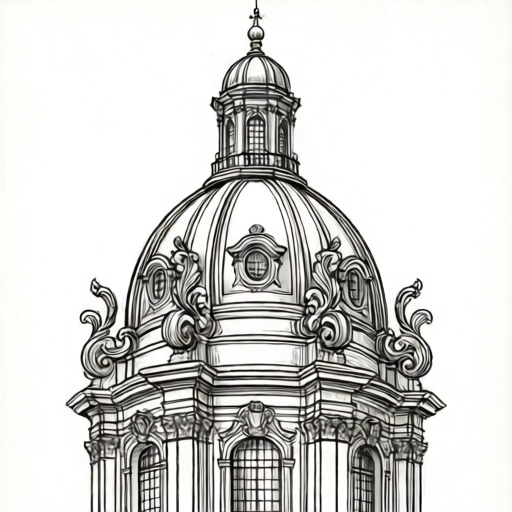
Use the stated measurements and conventions for each exercise.
Setting the convention and baseline
Define the worksheet guides before you start: a horizontal baseline, a vertical centerline, and a top line. These are drawing references, not lettering measurements. Mark them lightly, then label the spring line and volute center.
Choose a frame size. Example: a 12 cm wide by 16 cm tall frame on plain paper. Measure your actual paper and label your chosen values as hypothetical. The dome will sit in the upper half; the volute and ornament strip occupy the lower half.
- Draw a baseline and a midline crossing at the center of the frame.
- Mark a top line 10 cm above the baseline (hypothetical example).
- Mark the midline at the frame center; label it 'M'.
- Lightly label the spring line and the center of the volute.
Constructing the dome shape
For this worksheet, draw a dome as a half-ellipse: width 8 cm, height 5 cm (hypothetical). The dome base sits on a horizontal springing line. The crown sits at springing-line height plus dome height; with a springing line 5 cm above the baseline and a dome height of 5 cm, the crown is 10 cm above the baseline and coincides with the top line. The lantern block sits above the crown and extends beyond the top line; the top line marks the crown only when those values match, not the highest point of the drawing. Check the dome against the midline before adding the lantern: measure the left and right base marks and the left and right widths at mid-height. If a pair differs, adjust the arc rather than the midline. The outer volute arcs meet the springing line at (3,5) and (9,5); join each pair as one continuous contour without retracing the shared point.
- Draw a springing line 5 cm above the baseline (hypothetical).
- Mark the dome base width: 4 cm left and 4 cm right of the midline.
- Draw a half-ellipse from left base to right base, peaking at springing-line height plus dome height (5 + 5 = 10 cm above the baseline in this example, coinciding with the top line only when those values sum to the top-line height).
- Add a lantern block: a small rectangle 2 cm wide by 1.5 cm tall centered on the midline, resting on the crown and extending above the top line.
Building the volute scroll
Use coordinates with x measured from the left edge and y upward from the baseline. In this 12 cm frame, set the left outer center C0=(3,2) cm and mirror it to (9,2) cm across x=6; use radii 3, 1.5, and 0.75 cm. Draw the left outer quarter-turn counterclockwise from (3,5) to (0,2). Each smaller arc starts exactly at the previous endpoint, so its center shifts: radius 1.5 uses center (1.5,2) and runs from (0,2) to (1.5,0.5); radius 0.75 uses center (1.5,1.25) and runs from (1.5,0.5) to (2.25,1.25). Mirror every center and endpoint across x=6 for the right scroll; those arcs turn clockwise. Each join shares a point and continues the tangent direction, forming one connected scroll. These dimensions are a worksheet convention, not a universal facade layout. Draw the arcs lightly at this stage; darken the scroll contours after placing the ornament strip so the scroll remains the foreground line.
- In the 12 cm frame, mark centerline x=6 and outer centers (3,2) and (9,2), with y measured up from the baseline.
- Draw the left radius-3 arc from top point (3,5) to side point (0,2), then mirror it from (9,5) to (12,2) on the right.
- Continue the left scroll from (0,2) with radius 1.5 centered at (1.5,2), ending at (1.5,0.5); then radius 0.75 centered at (1.5,1.25), ending at (2.25,1.25).
- Mirror the smaller centers and endpoints across x=6; verify each arc starts where the previous one ends and the radii halve. Keep the arcs light until the strip is placed; darken them as the foreground contours in the final pass.
- Check that all arcs stay inside the 12 cm frame and that both scrolls mirror one another.
Placing ornament with a strip
Use a placement strip 10 cm long and 2 cm tall, centered horizontally at x=6 and spanning y=1 to y=3. Divide the 10 cm run from x=1 to x=11 into five equal 2 cm segments; their centers are x=2,4,6,8,10. Place one small motif, no larger than 0.6 cm by 0.6 cm, in each segment centered at y=2.5; these centers leave the scroll paths clear. Mirror matching motifs about x=6. Draw the strip and motifs first, then darken the volutes over them: a volute contour stays continuous, and any strip stroke that reaches it stops at the scroll edge and resumes only if visible beyond it. Do not draw a dashed or solid duplicate through a foreground scroll. Keep each motif inside its segment.
Ornament can include simple leaf shapes or geometric rosettes. Draw each motif within its segment so placement is checkable. The strip sits below the dome and above the baseline, centered on the midline.
- Draw the strip from x=1 to x=11 and y=1 to y=3 in the same 12 cm frame.
- Divide the strip into five 2 cm segments and mark centers x=2,4,6,8,10.
- Draw one motif no larger than 0.6 by 0.6 cm at y=2.5 in each segment; mirror matching motifs across x=6.
- Leave the strip and motif strokes light where they meet a volute; darken the scroll contour continuously in front and stop the hidden strip strokes at that contour.
- Check that visible motif parts remain inside their segments and no strip stroke runs through a foreground scroll.
Worked example
Construct a facade in a 12 cm by 16 cm frame. Use a dome 8 cm wide and 5 cm high with its spring line at y=5 and crown at y=10. Center it at x=6. Use outer volute centers (3,2) and (9,2), outer radius 3 cm with half-radius reduction. Place a 10 by 2 cm ornament strip from x=1 to 11 and y=1 to 3, divided into five segments; center small motifs at y=2.5. Describe the construction order and checks.
Worked answer
Draw the baseline at y=0, the spring line at y=5 cm, and the top guide at y=10 cm. Center the 8 cm dome on x=6: its base spans x=2 to x=10 at y=5, and its crown is y=10. Add the 2 by 1.5 cm lantern centered on x=6 from y=10 to y=11.5. For the left volute, use outer center (3,2) and draw radius 3 from (3,5) to (0,2). Continue with radius 1.5 centered at (1.5,2), from (0,2) to (1.5,0.5), then radius 0.75 centered at (1.5,1.25), from (1.5,0.5) to (2.25,1.25). Mirror those centers and endpoints across x=6 for the right volute. The arcs meet at each listed endpoint and their tangents continue in the same direction. Draw the 10 cm strip from x=1 to x=11 and y=1 to y=3. Split it into five 2 cm segments and place 0.6 by 0.6 cm motifs centered at (2,2.5), (4,2.5), (6,2.5), (8,2.5), and (10,2.5); the outer pair mirror across x=6 and the small motifs sit clear of the scroll paths. Draw strip and motif strokes lightly, then darken the scrolls in front. Where a scroll crosses the strip border, keep the scroll unbroken and stop the strip stroke at the crossing; do not double or continue a hidden line through the scroll. Check dome symmetry, the shared dome/scroll joins, and motif containment.
Four practice exercises
Exercise 1
In a 10 cm by 14 cm frame, use the bottom edge as baseline y=0 and set the spring line at y=10 cm and top guide at y=14 cm. Draw a centered half-ellipse dome 6 cm wide and 4 cm high. Mark the midline and check symmetry at the base, halfway up, and crown using a 2 mm tolerance (hypothetical).
Show answer and check
The frame midline is x=5 cm. Set the dome base from x=2 to x=8 at y=10 cm and its crown at (5,14), giving a 6 cm width and 4 cm height. At the base, halfway up the arc, and crown, compare left and right distances from x=5; each pair should differ by no more than 2 mm.
Why: The prompt fixes the vertical placement, while the midline fixes the horizontal center. Equal left and right offsets at the three checks show that the half-ellipse remains centered.
Check: Measure both sides from x=5 at y=10, y=12, and y=14 cm. Confirm equal offsets within 2 mm and confirm the crown is at y=14.
Exercise 2
In a 12 cm wide frame with centerline x=6, draw mirrored connected volutes. Use left outer center (3,2), its mirror (9,2), and radii 2, 1, and 0.5 cm for three quarter-turns. Measure x from the left edge and y upward from the baseline. Turn the left arcs counterclockwise and mirror them clockwise on the right; describe shifted centers and shared endpoints.
Show answer and check
For the left scroll, draw radius 2 centered at (3,2) counterclockwise from (3,4) to (1,2). Continue counterclockwise with radius 1 centered at (2,2) from (1,2) to (2,1), then radius 0.5 centered at (2,1.5) from (2,1) to (2.5,1.5). Mirror the centers and endpoints across x=6; the right arcs turn clockwise from (9,4) to (11,2), then to (10,1), then (9.5,1.5). Each endpoint is also the next arc's start.
Why: Halving the radii alone does not connect arcs; shifting each center makes the next arc start at the previous endpoint. Reflection across x=6 produces the paired scroll.
Check: Check the left joins at (1,2) and (2,1), the mirrored right joins at (11,2) and (10,1), and radii 2, 1, 0.5 cm. Confirm each next arc starts at the previous endpoint, its center is the stated radius from both ends, and the two scrolls mirror across x=6.
Exercise 3
Draw an 8 cm ornament strip centered on its midline x=4, spanning x=0 to x=8. Divide it into four equal segments and place one simple leaf motif at each segment center, mirrored about x=4. Keep each motif inside its segment.
Show answer and check
The segments are 2 cm wide, with centers at x=1, 3, 5, and 7. Place one leaf at each center; pair x=1 with x=7 and x=3 with x=5 as mirror positions about x=4. Keep each leaf within its 2 cm segment.
Why: An 8 cm strip divided into four equal parts gives 8÷4=2 cm per segment. The centers are equally spaced and reflected pairs have equal distances from x=4.
Check: Measure each segment as 2 cm. Confirm centers at 1, 3, 5, and 7 cm and equal mirrored distances from x=4; keep each motif inside its own segment.
Exercise 4
Combine a centered dome 7 cm wide and 4.5 cm high, volutes with outer radius 2.5 cm and half-radius reductions, and a 9 cm ornament strip in a 12 cm by 15 cm frame. Set centerline x=6 and dome spring line y=5.5; use outer volute centers (3,3) and (9,3) so the arcs join the spring line at (3,5.5) and (9,5.5). Place the strip from x=1.5 to 10.5 and y=1 to 3, divided into three segments. Describe the order and checks.
Show answer and check
Use the 12 cm frame midline x=6. Set the dome spring line to y=5.5 cm and top guide to y=10 cm; a 4.5 cm dome reaches the guide. For the left volute use outer center (3,3): radius 2.5 runs from (3,5.5) to (0.5,3); radius 1.25 centered at (1.75,3) continues to (1.75,1.75); radius 0.625 centered at (1.75,2.375) continues to (2.375,2.375). The outer arc starts on the dome spring line at (3,5.5). Mirror these points across x=6 for the right scroll, where the outer arc starts at (9,5.5). The centers shift so each arc begins at the preceding endpoint. Draw the 9 cm strip from x=1.5 to x=10.5 and y=1 to y=3; divide it into three 3 cm segments with centers x=3,6,9. Place one 0.6 by 0.6 cm motif centered at y=2 in each segment; the outer pair mirror across x=6 and stay inside their segments. This strip sits behind the volutes. At any crossing, keep the scroll line continuous in front and stop the strip or motif line where it reaches that edge; never draw two strokes at the same boundary. Check dome symmetry, the shared arc joins and halved radii, and motif containment.
Why: Constructing from the midline keeps the facade aligned. The volutes are the foreground decoration; the strip is behind them wherever their paths meet, so the visible scroll line stays continuous and coincident hidden strokes are omitted.
Check: Measure dome offsets at three heights; confirm the 2.5 cm outer arcs join the dome spring line at (3,5.5) and (9,5.5), the smaller 1.25 and 0.625 cm arcs share the listed endpoints and mirror across x=6; measure each ornament segment as 3 cm and keep each 0.6 by 0.6 cm motif inside its segment, centered at y=2. At any crossing, confirm the volute line is continuous and the strip/motif stroke stops at it.
Common mistakes
- Drawing the dome without a midline, causing asymmetry. Mark the midline first and measure left and right distances at three heights.
- Making volute arcs with inconsistent radius reduction. Label each arc's center and endpoint. Shift the next center so its start point is exactly the previous arc's endpoint, then check that the tangent direction continues.
- Placing ornament outside the strip segments. Draw segment boundaries lightly, keep each motif inside its segment, then darken the volute in front and stop any hidden strip stroke at the scroll.
- Placing the volute center too far from the frame center. Place the volute center so its outer radius fits inside the frame.
Self-check rubric
- Baseline, midline and top line are marked and labeled consistently.
- Dome is symmetrical about the midline within the chosen tolerance.
- Volute quarter-turn arcs use labeled shifted centers, meet at shared endpoints, continue smoothly, and mirror left to right.
- Ornament motifs stay within strip segments and are mirrored.
- The volute remains inside the frame and its center is labeled.
- All numerical values are labeled as hypothetical examples.
- At decoration overlaps, scroll contours remain continuous in front and strip or motif strokes stop at the scroll; shared dome/scroll joins are drawn once.
Questions and answers
Do I need exact measurements?
No. Use the hypothetical examples as a guide, then measure your own paper and label your chosen values.
Can I use a different dome shape?
Yes. A segmented arc is an acceptable worksheet variation if it remains centered and fits the frame.
How do I check the volute?
For each smaller quarter-turn, begin at the previous arc's endpoint and shift the center to that point's matching radius position. Check the shared endpoint, tangent direction, halved radius, and left-right mirror.
What if my ornament motifs differ?
Any motif is valid if it stays within its segment and is mirrored about the midline. If a motif or strip line meets a scroll, draw the scroll in front and stop the underlying stroke at the scroll edge.