Free original lessons
How to Draw Chameleon Scales: Layered Pattern Construction
Learn to draw chameleon scales by building layered rows, overlapping shapes, and a clear scale grid using a simple convention and checkable steps.
Free lesson
Four exercises
Worked answers
Object Drawing Lessons
Chameleon scales read as a rhythmic, overlapping pattern rather than a random texture. This lesson teaches a repeatable construction method: define a scale convention, build rows from the body midline outward, overlap each new row slightly over the previous one, and check spacing with simple arithmetic. You will use a pencil and paper, a ruler, and a consistent unit such as one centimeter per grid square. The goal is a believable layered scale field that follows the body contour, not anatomical detail or color study. All measurements below are hypothetical examples; measure your own paper and tools and label any chosen values as examples.
Practice materials: Printable downloads are not available for this lesson yet. Use the instructions and four exercises below.
Reference illustration
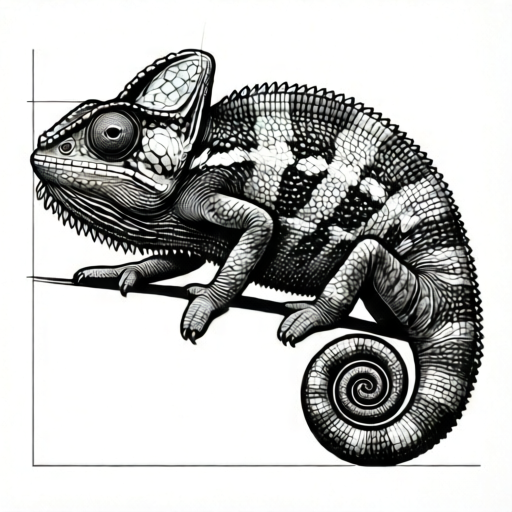
Use the stated measurements and conventions for each exercise.
Define a scale convention before drawing
A convention is a repeatable rule for one scale shape. For this lesson, use a rounded diamond: four curved sides meeting at soft points, wider than tall by about one to one and a half. Draw one scale at actual size in the corner of your paper and label it as your convention. Every scale in the pattern will be a scaled copy of this shape, rotated to follow the body contour.
Choose a grid unit. A practical hypothetical example is a one-centimeter square grid on A4 paper, giving a body area about fifteen centimeters wide and twenty centimeters long. Measure your paper first and write your actual unit at the top of the page. Keep all spacing arithmetic in the same unit.
Decide the row offset. Scales in adjacent rows should interlock, so each new row sits half a scale width to the side of the row above. If your scale is two units wide, the offset is one unit. Write this rule down: row offset equals half the scale width.
- Draw and label one convention scale at actual size.
- Measure your paper and record the grid unit in centimeters.
- Write the row offset rule: half the scale width.
- Mark a body midline and a body outline lightly.
Build rows from the midline outward
Start at the body midline and work outward in both directions. The midline row is the reference row: place scales point to point along it with a small gap, about one fifth of a scale width, so the row reads as a chain. Count the scales in this row and record the number.
Each following row is offset by half a scale width and overlaps the row before it by about one quarter of the scale height. Overlap is what creates the layered look. Draw the new row so its lower edge crosses the upper edge of the previous row, then erase only the hidden portion of the previous scale outline if you want a clean layered finish.
Work in pairs of rows: one row left to right, the next right to left. This keeps the offset consistent and prevents drift. After every two rows, step back and check that the pattern follows the body contour rather than a straight rectangle.
- Draw the midline row point to point with a small gap.
- Count and record the scales in the midline row.
- Offset the next row by half a scale width.
- Overlap the new row by one quarter of the scale height.
- Alternate drawing direction every row to keep the offset even.
Check spacing with simple arithmetic
Use arithmetic to catch drift. If the midline row has ten scales across a body width of twenty units, the average spacing is two units per scale. The next row should have about the same number, offset by one unit. If a row suddenly has eight or twelve scales, the spacing has drifted; adjust before continuing.
Check overlap consistency by measuring three random overlaps per row. They should all be close to one quarter of the scale height. Record the three measurements and compare. Small differences are acceptable; large differences mean the row needs redrawing.
Keep units consistent. If your grid unit is one centimeter, write all measurements in centimeters. Do not mix units in the same check.
- Divide body width by scale count to find average spacing.
- Compare each new row count to the midline row count.
- Measure three overlaps per row and record them.
- Redraw any row whose count or overlap is far from the rule.
Finish the layered field and review
Continue rows until the body outline is filled, then review the whole field. The pattern should read as overlapping layers, with each row slightly in front of the one above. Valid alternatives include scales that are more rounded or more pointed, provided the convention is stated and applied consistently.
Use the rubric to self-check: convention stated, row offset consistent, overlap consistent, spacing arithmetic recorded, and contour followed. A drawing that meets these checks is successful even if the scale shape differs from the example.
- Fill the body outline with offset rows.
- Review the field for consistent layering.
- Self-check against the rubric.
- Note one improvement for a second attempt.
Worked example
A body area is twenty units wide. The midline row has ten scales. What is the average spacing, and what offset should the next row use if each scale is two units wide?
Worked answer
Average spacing is twenty divided by ten, which equals two units per scale. The next row offset is half the scale width, so one unit.
Four practice exercises
Exercise 1
A body area is sixteen units wide. The midline row has eight scales. Find the average spacing and the row offset if each scale is two units wide.
Show answer and check
Average spacing is two units per scale; row offset is one unit.
Why: Divide sixteen by eight to get two. Offset is half the scale width, so one unit.
Check: Multiply the spacing by the count to confirm sixteen, and confirm the offset is half of two.
Exercise 2
A scale is three units wide and two units tall. What is the row offset, and what overlap height is one quarter of the scale height?
Show answer and check
Row offset is one and a half units; overlap height is half a unit.
Why: Offset is half the width, so three divided by two equals one and a half. One quarter of two is half.
Check: Double the offset to confirm three, and multiply the overlap by four to confirm two.
Exercise 3
A midline row has twelve scales across twenty-four units. A later row has nine scales. Is the later row consistent with the midline spacing? Show the arithmetic.
Show answer and check
No. Midline spacing is two units per scale; nine scales across twenty-four units gives about two point seven units per scale, so the row has drifted.
Why: Divide twenty-four by twelve to get two, then divide twenty-four by nine to get about two point seven. The counts differ, so spacing is inconsistent.
Check: Multiply two by twelve to confirm twenty-four, and multiply two point seven by nine to confirm about twenty-four.
Exercise 4
You measure three overlaps in a row as zero point four, zero point five, and zero point six units. The scale height is two units. Are the overlaps acceptable under the one-quarter rule? Explain.
Show answer and check
The target overlap is zero point five units. The three measurements are close to the target, so they are acceptable; the zero point four and zero point six differ by only zero point one from the target.
Why: One quarter of two is zero point five. Compare each measurement to zero point five and note the small differences.
Check: Subtract each measurement from zero point five and confirm the differences are small and consistent.
Common mistakes
- Drawing scales in straight vertical columns instead of offset rows. Offset each new row by half a scale width and alternate drawing direction.
- Making overlap random so some scales sit fully on top of others. Measure three overlaps per row and keep them near one quarter of the scale height.
- Changing the scale convention midway through the drawing. Keep the labeled convention scale visible and compare each new scale to it.
- Mixing units in spacing checks. Write the grid unit at the top of the page and use only that unit in all arithmetic.
Self-check rubric
- Convention scale is drawn, labeled, and applied consistently.
- Midline row is point to point with a small gap and its count is recorded.
- Each new row is offset by half a scale width.
- Overlap is close to one quarter of the scale height in three measured samples per row.
- Spacing arithmetic is recorded in one consistent unit.
- Pattern follows the body contour rather than a straight rectangle.
- Valid alternative scale shapes are accepted if the convention is stated and consistent.
Questions and answers
Do I need a ruler?
A ruler makes the spacing and overlap checks easier, but you can use a marked strip of paper as a simple measuring tool.
How many scales should the midline row have?
Count depends on your body width and scale size. Divide body width by scale width to estimate the count, then record the actual number.
Can I use a different scale shape?
Yes. State your convention clearly and apply it consistently. The rubric allows valid alternatives.
What if my rows drift?
Stop, measure the row count and three overlaps, and redraw the row from the last correct offset.