Free original lessons
Practice Drawing Child Proportions with Head-Count Guides
Learn to draw toddler, child, and pre-teen figures using head-count ratios, landmark lines, and simple proportion checks for believable bodies.
Free lesson
Four exercises
Worked answers
Object Drawing Lessons
Child body proportions change predictably with age, and head-count guides make those changes easy to draw. This lesson teaches you to build a figure from a stack of head units, place landmark lines for shoulders, waist, hips, and knees, and check your drawing with simple arithmetic. You will work only with body proportions, not facial detail or portrait rendering. All measurements are relative to the head height you choose, so the method works at any scale. Use a pencil and paper; no special tools are required. The convention for head height is baseline to midline of the head, and letter styles vary, so treat every ratio as a guide rather than a rigid rule.
Practice materials: Printable downloads are not available for this lesson yet. Use the instructions and four exercises below.
Reference illustration
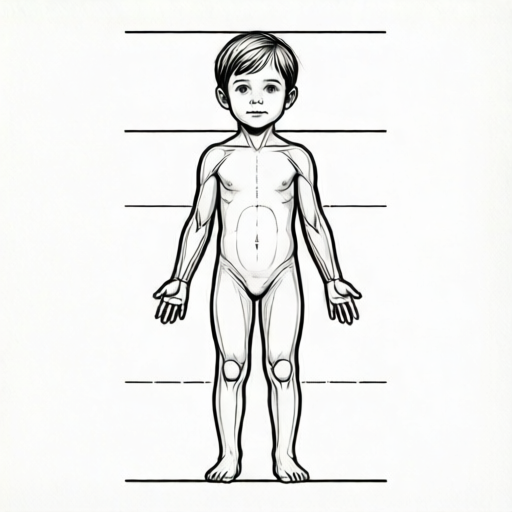
Use the stated measurements and conventions for each exercise.
Why Head Counts Work for Children
A head-count guide divides a figure into equal vertical units based on head height. Adults are often drawn as seven to eight heads tall, but children are shorter in head units because their heads grow more slowly than their bodies. A toddler is roughly four heads tall, a young child about five, and a pre-teen about six. These are working ratios, not universal truths; individual children vary.
The key is consistency: once you choose a head height, every landmark is measured in that same unit. This keeps the figure coherent even if you adjust the ratios slightly for a specific child.
- Draw a head shape and mark its height from baseline to midline.
- Decide the total head count for the age you are drawing.
- Stack that many head-height units vertically below the first head.
- Mark landmark lines at the ratios given in the next section.
Landmark Ratios for Three Age Groups
Use these hypothetical example ratios as starting points. Toddler: 4 heads total; shoulder line at 1.3 heads from top; waist at 2.2; hip at 2.6; knee at 3.2. Child: 5 heads total; shoulder at 1.4; waist at 2.5; hip at 3.0; knee at 3.8. Pre-teen: 6 heads total; shoulder at 1.5; waist at 2.8; hip at 3.4; knee at 4.4. Measure from the top of the head downward.
These numbers are chosen for practice, not copied from a standard. Measure your own paper and pencil to confirm your unit is consistent. If your head height is 3 cm, a child's shoulder line sits at 1.4 times 3 cm, or 4.2 cm from the top.
- Write your head height in centimetres or grid squares.
- Multiply each ratio by that height to get landmark distances.
- Draw light horizontal lines at those distances.
- Check that the total figure height equals the head count times head height.
Building the Body Between Landmarks
With landmark lines in place, sketch simple shapes: a rounded rectangle for the torso between shoulder and hip, tapered limbs, and a neck that is short in toddlers and slightly longer in pre-teens. Keep limb widths proportional to the torso, and avoid adding facial features beyond a simple midline.
A common error is making the torso too long. In a five-head child, the torso from shoulder to hip is about 1.6 heads, leaving the legs to carry the rest. Count the units before drawing details.
- Draw the torso between shoulder and hip lines.
- Add arms from shoulder to about mid-thigh for a child.
- Add legs from hip to baseline, with knees at the knee line.
- Erase construction lines only after checking all landmarks.
Checking Your Proportion Drawing
A good check is arithmetic: total height divided by head height should equal your chosen head count. For a child drawing with a 3 cm head and 15 cm total height, 15 divided by 3 equals 5, which matches the five-head guide. Also check that the shoulder line is above the waist and the waist above the hip.
Because letter styles and body shapes vary, accept any drawing that stays within about half a head unit of the guide and keeps the landmark order correct. The goal is believable proportion, not a single correct answer.
- Measure total height and head height with the same ruler.
- Divide total by head height and compare to the guide.
- Confirm landmark order from top to bottom.
- Adjust one landmark at a time rather than redrawing everything.
Worked example
A student draws a child with a head height of 2.5 cm and a total height of 12.5 cm. The shoulder line is at 3.5 cm from the top, waist at 6.25 cm, hip at 7.5 cm, and knee at 9.5 cm. Check whether this matches a five-head child guide.
Worked answer
Total divided by head height is 12.5 divided by 2.5, which equals 5, so the head count matches. Shoulder ratio is 3.5 divided by 2.5, or 1.4 heads, which matches the child guide. Waist is 6.25 divided by 2.5, or 2.5 heads, matching. Hip is 7.5 divided by 2.5, or 3.0 heads, matching. Knee is 9.5 divided by 2.5, or 3.8 heads, matching. The drawing is consistent with the five-head guide.
Four practice exercises
Exercise 1
A toddler drawing uses a 4 cm head height and a total height of 16 cm. The shoulder line is at 5.2 cm from the top. Does this match a four-head toddler guide with a shoulder ratio of 1.3?
Show answer and check
Yes. Total divided by head height is 16 divided by 4, or 4 heads. Shoulder ratio is 5.2 divided by 4, or 1.3 heads, which matches the guide.
Why: Check the head count first, then divide the shoulder distance by the same head height to compare with the ratio.
Check: Recompute 16 divided by 4 and 5.2 divided by 4 with a calculator or by hand.
Exercise 2
A pre-teen drawing has a head height of 3 cm and a total height of 18 cm. The knee line is at 13.2 cm from the top. The guide knee ratio is 4.4. Is the knee line correct?
Show answer and check
Yes. Total divided by head height is 18 divided by 3, or 6 heads. Knee ratio is 13.2 divided by 3, or 4.4 heads, matching the guide.
Why: Confirm the six-head total, then divide the knee distance by head height.
Check: Multiply 4.4 by 3 to see whether it returns 13.2 cm.
Exercise 3
A child drawing uses a 2 cm head height and a total height of 10 cm. The waist is at 5 cm from the top and the hip is at 6 cm. The guide waist ratio is 2.5 and hip ratio is 3.0. Are both landmarks correct?
Show answer and check
Yes. Total divided by head height is 10 divided by 2, or 5 heads. Waist ratio is 5 divided by 2, or 2.5 heads. Hip ratio is 6 divided by 2, or 3.0 heads. Both match.
Why: Use the same head height for both landmarks and compare each quotient to the guide.
Check: Multiply 2.5 by 2 and 3.0 by 2 to recover 5 cm and 6 cm.
Exercise 4
A student draws a child with a 3 cm head height and a total height of 15 cm. The shoulder line is at 5.4 cm from the top, but the guide shoulder ratio is 1.4. Is the shoulder line acceptable within half a head unit?
Show answer and check
Yes. The shoulder ratio is 5.4 divided by 3, or 1.8 heads. The guide is 1.4 heads, and the difference is 0.4 heads, which is within half a head unit (0.5), so the line is acceptable.
Why: Compute the ratio, subtract the guide value, and compare the absolute difference to 0.5 head units.
Check: Check that 5.4 divided by 3 equals 1.8 and that 1.8 minus 1.4 is less than 0.5.
Common mistakes
- Using adult head counts for a child. Choose four, five, or six heads for toddler, child, or pre-teen before drawing.
- Measuring head height from top to chin instead of baseline to midline. Mark the midline clearly and use only that distance as your unit.
- Placing the waist below the hip line. Check landmark order: shoulder, waist, hip, knee, baseline.
- Changing head height halfway through the drawing. Write the unit on the page and multiply every ratio by that same number.
Self-check rubric
- Head height is measured baseline to midline and used consistently.
- Total height divided by head height equals the chosen head count within half a unit.
- Landmark order is correct: shoulder above waist above hip above knee.
- Landmark ratios are within half a head unit of the chosen age guide.
- Body shapes connect landmarks without gaps or overlaps.
- Valid alternative proportions are accepted when landmark order and head count check pass.
Questions and answers
Are these head counts exact for every child?
No. They are working guides. Real children vary, so treat the ratios as starting points and adjust within about half a head unit.
Can I use grid squares instead of centimetres?
Yes. Any consistent unit works. One grid square can equal one head height, and ratios become simple multiples.
Why exclude facial detail?
This lesson focuses on body proportion. Facial features add complexity that can distract from landmark placement.
How do I know my drawing is close enough?
Divide total height by head height. If the result is within half a unit of your chosen head count and landmarks are in order, it is acceptable.