Free original lessons
How to Draw Eyes to Scale: Proportional Ratios and Measured Lid Spans
Learn to size eyes correctly against head width and height using simple ratios, measured lid spans, and a repeatable checking method for any head size.
Free lesson
Four exercises
Worked answers
Object Drawing Lessons
Drawing eyes at the right scale is a measurement problem before it is a rendering problem. This lesson teaches a convention: treat the head as a measurable shape, express eye width and lid span as fractions of head width, and verify placement with arithmetic. The convention is explicit so you can check your work, but it allows valid stylistic alternatives because eye shapes vary. All numerical values below are hypothetical examples chosen for easy arithmetic; measure your own reference or drawing surface and keep units consistent.
Practice materials: Printable downloads are not available for this lesson yet. Use the instructions and four exercises below.
Reference illustration
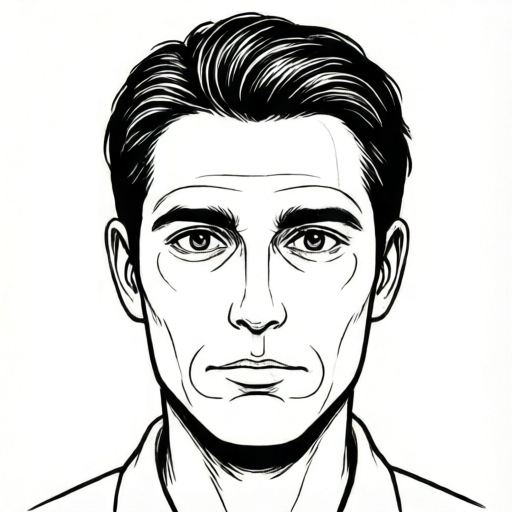
Use the stated measurements and conventions for each exercise.
Define the head box and the eye-width unit
Start by drawing a head box: a rectangle whose width is the widest part of the head and whose height runs from the top of the skull to the chin. Label the width W and the height H in the same unit, such as centimeters or grid squares. For a front-facing head, the eye line sits roughly halfway down the head box in many conventions, but this lesson focuses on scale, not placement depth.
Choose an eye-width unit E. A common proportional convention for a front-facing adult head is that one eye width is about one-fifth of head width, so E = W / 5. This is a convention, not a universal law; children and stylized heads often use larger eyes. Write your chosen ratio as a fraction, for example E = W/5, and keep it visible while drawing.
- Draw and label a head box with width W and height H.
- Measure W with a ruler or count grid squares.
- Choose a ratio such as E = W/5 and calculate E.
- Mark E on a scrap strip of paper to use as a repeating unit.
Measure lid span and eye height
Lid span is the horizontal distance from the outer corner to the inner corner of the visible eyelid opening. In the convention used here, lid span equals the eye-width unit E for a neutral, front-facing eye. Eye height is the vertical distance from the upper lid to the lower lid at the pupil; a common convention is about half of E, so eye height = E/2. These are starting measurements, not rigid rules.
Because letter styles and eye shapes vary, treat the ratio as a range. For example, you might allow lid span between 0.9E and 1.1E and eye height between 0.4E and 0.6E. Record the range you choose so your rubric can accept valid alternatives.
- Mark the outer and inner corners so the horizontal lid span equals E.
- Mark the upper and lower lid so the vertical eye height equals E/2.
- Check that both eyes use the same E and the same height convention.
- If your style calls for a different shape, note the adjusted ratio before drawing.
Place two eyes and check the gap
For a front-facing head using the one-fifth convention, two eyes occupy 2E of the head width. A common spacing convention places one eye-width between the eyes, so the total across both eyes and the gap is 3E. The remaining width is 2E, which is often divided into equal margins on each side of the face. This arithmetic gives you a checkable layout without a grid.
Measure the actual gap between the inner corners and compare it to E. If the gap is noticeably larger or smaller, adjust the eye positions symmetrically rather than changing one eye only. Keep the eye line horizontal unless your chosen style intentionally tilts it.
- Calculate total eye span: 2E for two eyes plus 1E for the gap equals 3E.
- Subtract 3E from W to find the combined side margins.
- Divide the combined margins equally for a symmetrical front-facing layout.
- Measure the gap and confirm it matches your chosen ratio.
Scale up or down without redrawing the ratio
When the head size changes, recalculate E from the new W instead of copying the old eye size. For example, if W increases from 10 cm to 15 cm and the ratio is E = W/5, then E changes from 2 cm to 3 cm. The ratio stays constant while the absolute measurements change.
Use a ratio reference table to avoid arithmetic errors. A simple table lists head width W, chosen ratio, calculated E, lid span target, and eye height target. Fill it in before drawing so every measurement is traceable and checkable.
- Measure the new head width W.
- Apply the same ratio to calculate the new E.
- Update lid span and eye height targets from the new E.
- Compare the finished drawing to the table values.
Worked example
A front-facing head box has width W = 20 cm. Use the convention E = W/5, lid span = E, eye height = E/2, and a gap of 1E between the eyes. Calculate E, the lid span, the eye height, the total span of two eyes plus the gap, and the combined side margins.
Worked answer
E = 20/5 = 4 cm. Lid span = 4 cm. Eye height = 4/2 = 2 cm. Two eyes plus gap = 2E + 1E = 3E = 12 cm. Combined side margins = W - 3E = 20 - 12 = 8 cm, so each side margin is 4 cm if divided equally.
Four practice exercises
Exercise 1
A head box has width W = 15 cm. Using E = W/5, lid span = E, and eye height = E/2, calculate E, lid span, and eye height.
Show answer and check
E = 3 cm, lid span = 3 cm, eye height = 1.5 cm.
Why: Divide 15 by 5 to get E = 3 cm. Lid span equals E, so 3 cm. Eye height is half of E, so 1.5 cm.
Check: Multiply E by 5 to recover W: 3 × 5 = 15 cm. Double the eye height to recover E: 1.5 × 2 = 3 cm.
Exercise 2
A head box has width W = 24 cm. Using E = W/6, a gap of 1E between the eyes, and two eyes each with lid span E, calculate the total span of two eyes plus the gap and the combined side margins.
Show answer and check
E = 4 cm, total span = 12 cm, combined side margins = 12 cm.
Why: E = 24/6 = 4 cm. Two eyes plus gap = 2E + 1E = 3E = 12 cm. Combined margins = 24 - 12 = 12 cm.
Check: Add the total span and combined margins: 12 + 12 = 24 cm, which equals W.
Exercise 3
A drawing uses E = 2.5 cm and a lid span range from 0.9E to 1.1E. Calculate the minimum and maximum acceptable lid span in centimeters.
Show answer and check
Minimum = 2.25 cm, maximum = 2.75 cm.
Why: 0.9 × 2.5 = 2.25 cm and 1.1 × 2.5 = 2.75 cm. The range allows valid stylistic variation around the target E.
Check: The target E = 2.5 cm lies between 2.25 and 2.75, and the range width is 0.5 cm, which equals 0.2E.
Exercise 4
A head box is 18 cm wide. You choose E = W/4.5 and a gap of 1E. Calculate E, the total span of two eyes plus the gap, and the combined side margins. State whether the side margins are positive.
Show answer and check
E = 4 cm, total span = 12 cm, combined side margins = 6 cm, and the margins are positive.
Why: 18/4.5 = 4 cm. Two eyes plus gap = 3E = 12 cm. Combined margins = 18 - 12 = 6 cm, which is greater than zero.
Check: Add total span and combined margins: 12 + 6 = 18 cm, matching W. Positive margins confirm the layout fits.
Common mistakes
- Copying eye size from a smaller drawing to a larger head. Recalculate E from the new head width using the same ratio, then redraw the lid span and height.
- Measuring lid span from the pupil instead of the visible corners. Mark the outer and inner corners first, then measure the horizontal distance between them.
- Using different eye-width units for the left and right eye. Make one paper unit strip and use it for both eyes, or calculate both from the same W.
- Treating the one-fifth ratio as a universal rule for every head. State your chosen ratio and range explicitly, and allow valid stylistic alternatives in the rubric.
Self-check rubric
- Head width W and height H are labeled with consistent units.
- A ratio such as E = W/5 is stated before drawing, with any stylistic range noted.
- Lid span is measured between the outer and inner corners and matches the chosen ratio within the stated range.
- Eye height is measured vertically and matches the chosen ratio within the stated range.
- Both eyes use the same unit E and the gap is checked arithmetically.
- Valid alternative eye shapes are accepted if the recorded ratios and measurements are consistent.
Questions and answers
Is one eye width always one-fifth of head width?
No. It is a common convention for front-facing adult heads in this lesson. Children, stylized characters, and different proportions may use larger or smaller ratios. Choose and record your ratio.
What is lid span?
Lid span is the horizontal distance between the outer and inner corners of the visible eyelid opening. In this convention it equals the eye-width unit E.
How do I check my drawing without a grid?
Measure W, calculate E from your ratio, and compare the drawn lid span and gap to the calculated values. Simple arithmetic replaces the grid.
Can I use different eye shapes and still meet the rubric?
Yes. The rubric checks proportional ranges and consistent units, not a single universal eye shape. Record any adjusted ratio before drawing.