Free original lessons
Draw an Upward-Tilted Face: Foreshortened Feature Placement
Learn to construct a front-view face tilted upward, placing foreshortened eyes, nose, and mouth using simple proportional guides and checkable steps.
Free lesson
Four exercises
Worked answers
Object Drawing Lessons
When a face tilts upward, the front view changes: the chin recedes, the underside of the jaw and nose becomes visible, and features compress vertically. This lesson teaches a repeatable construction for a front-facing head looking up, using a defined convention for feature placement and foreshortening. You will build the head as a tilted ovoid, locate the brow-to-chin axis, compress the eye-to-mouth spacing, and check proportions with simple arithmetic. All measurements are hypothetical examples; measure your own paper and tools. The convention: x-height means baseline to midline of lowercase letters, and letter styles vary, so treat all written labels as approximate guides, not fixed templates.
Practice materials: Printable downloads are not available for this lesson yet. Use the instructions and four exercises below.
Reference illustration
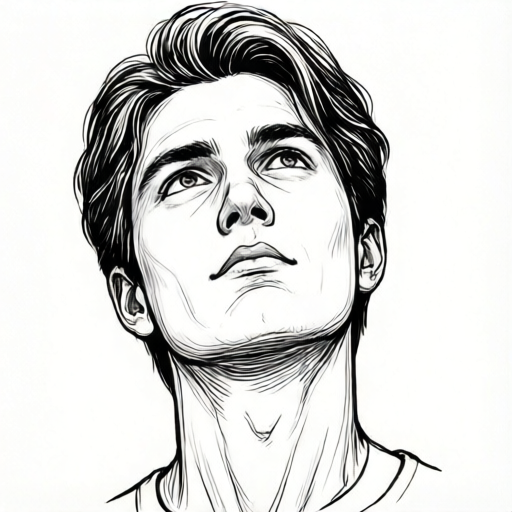
Use the stated measurements and conventions for each exercise.
Establish the tilted head envelope
Begin with a light vertical centerline. Mark a top point for the crown and a bottom point for the chin. For an upward tilt, the chin sits closer to the crown than in a neutral front view because the lower face recedes. As a hypothetical example, if the neutral crown-to-chin distance is 12 cm, use 10 cm for a moderate upward tilt. Draw an ovoid that is wider at the brow and narrower at the chin, then tilt the lower half backward so the chin appears slightly behind the brow line.
Add a horizontal brow line across the upper third of the ovoid. Because the face looks up, the brow line stays relatively high while the chin moves up toward it. Mark the jaw curve from ear to ear, showing the underside of the jaw as a shallow arc below the chin. Keep all lines light so you can adjust after checking the envelope.
- Draw a vertical centerline and mark crown and chin points.
- Set crown-to-chin distance shorter than a neutral face; label your chosen value as hypothetical.
- Draw an ovoid wider at the brow and narrower at the chin.
- Add a brow line across the upper third and a shallow jaw arc below the chin.
Compress and place the features
In an upward tilt, the vertical distance from brow to chin compresses. Divide the brow-to-chin span into four equal bands, numbered one to four from brow to chin. Place the eyes in the upper portion of band one, the nose base at the boundary between bands two and three (two band widths below the brow), and the mouth at the boundary between bands three and four (three band widths below the brow), with the chin at the bottom of band four (four band widths below the brow). The nose base stays fixed at the band two/three boundary; what changes with the tilt is the compressed overall brow-to-chin span, which pulls the nose and mouth closer to the brow. Use a ruler to keep band widths equal; if your brow-to-chin span is 8 cm, each band is 2 cm.
Foreshorten each feature horizontally as well as vertically. The eyes become shallower arcs, the nose shortens, and the mouth flattens. Show the underside of the nose as a small triangle or curve below the nose base. The ears sit lower than the brow line and may appear slightly behind the jaw curve. Check the intervals between features using the band boundaries: brow-to-nose-base spans two bands, nose-base-to-mouth spans one band, and mouth-to-chin spans one band, so brow-to-nose-base should be about twice nose-base-to-mouth. If your measured intervals differ noticeably, recheck the band divisions.
- Divide brow-to-chin span into four equal bands using a ruler.
- Place eyes in band one, nose base at the boundary between bands two and three (two band widths below brow), and mouth at the boundary between bands three and four (three band widths below brow).
- Draw eyes as shallow arcs and flatten the mouth.
- Add the nose underside and lower the ears below the brow line.
Check foreshortening with simple arithmetic
Use checkable arithmetic to confirm the tilt. Measure the brow-to-chin span and the crown-to-chin span. For a moderate upward tilt, the brow-to-chin span should be roughly 70 to 80 percent of the crown-to-chin span. As a hypothetical example, if crown-to-chin is 10 cm, brow-to-chin should be about 7 to 8 cm. If your measurement falls outside this range, adjust the chin point or brow line before adding detail.
Also check feature spacing using the four equal bands: brow-to-nose-base spans two bands, nose-base-to-mouth spans one band, and mouth-to-chin spans one band. Measure in centimeters and record the values; brow-to-nose-base should be about twice nose-base-to-mouth. If the mouth sits too low, raise it by one band width and recheck. Keep units consistent and label all chosen numbers as hypothetical examples.
- Measure crown-to-chin and brow-to-chin in centimeters.
- Confirm brow-to-chin is about 70 to 80 percent of crown-to-chin.
- Measure nose-base-to-mouth and brow-to-nose-base; confirm the second is about twice the first.
- Adjust chin, brow, or mouth position and remeasure.
Refine structure without losing the tilt
Once proportions check out, strengthen the jaw underside and the nose underside. The jaw underside should curve gently from ear to ear, passing below the chin. The nose underside should be visible as a small shape because the head tilts up. Keep the eyes level with each other along a shallow arc that follows the brow line. Avoid drawing a full profile nose; this is a front view with foreshortening, so the nose remains centered and shortened.
Finally, compare your drawing to the construction plate described in the resource plan: a plate showing the tilted ovoid, four bands, and feature guides. Use the plate as a reference, not a template. Valid alternatives include different ovoid widths, ear heights, and eye shapes, as long as the band ratios and tilt checks hold.
- Strengthen jaw underside and nose underside.
- Keep eyes level along a shallow brow arc.
- Avoid profile nose; keep nose centered and shortened.
- Compare to the described construction plate and adjust only if checks fail.
Worked example
Construct a front-view face tilted upward using a crown-to-chin span of 10 cm. Place the brow line, divide the brow-to-chin span into four equal bands, and state the band width and feature placements.
Worked answer
Crown-to-chin is 10 cm. For a moderate upward tilt, set brow-to-chin to 8 cm, so each of four bands is 2 cm. Place eyes in band one (0 to 2 cm below brow), nose base at 4 cm below brow (boundary between bands two and three), mouth at 6 cm below brow (boundary between bands three and four), and chin at 8 cm below brow. Draw a shallow jaw arc below the chin and a small nose underside. Check: brow-to-chin is 80 percent of crown-to-chin, within the 70 to 80 percent range; brow-to-nose-base (4 cm) is twice nose-base-to-mouth (2 cm).
Four practice exercises
Exercise 1
A front-view upward-tilted face has crown-to-chin 12 cm and brow-to-chin 9 cm. Divide brow-to-chin into four equal bands. State each band width and the placement of eyes, nose base, and mouth.
Show answer and check
Each band is 2.25 cm. Eyes in band one (0 to 2.25 cm below brow), nose base at the boundary between bands two and three (4.5 cm below brow), mouth at the boundary between bands three and four (6.75 cm below brow), chin at the bottom of band four (9 cm below brow).
Why: 9 cm divided by 4 equals 2.25 cm per band. The nose base sits two bands below the brow and the mouth three bands below the brow.
Check: Multiply 2.25 cm by 4 to get 9 cm; confirm brow-to-chin is 75 percent of crown-to-chin, within 70 to 80 percent.
Exercise 2
A drawing has crown-to-chin 10 cm and brow-to-chin 6 cm. Is the tilt within the moderate upward range? If not, suggest one adjustment and give the new percentage.
Show answer and check
No, 6 cm is 60 percent of 10 cm, below the 70 to 80 percent range. Lower the brow line so brow-to-chin becomes 7.5 cm, which is 75 percent of the 10 cm crown-to-chin.
Why: The check compares brow-to-chin to crown-to-chin. 6 divided by 10 is 0.60, too low. Setting brow-to-chin to 7.5 cm gives 7.5 ÷ 10 = 0.75.
Check: Divide 7.5 by 10 to get 0.75, or 75 percent; confirm it lies between 70 and 80 percent.
Exercise 3
In an upward-tilted front view built with four equal bands, the brow-to-nose-base distance is 4 cm and the nose-base-to-mouth distance is 2 cm. Does this match the lesson's check that brow-to-nose-base is about twice nose-base-to-mouth? State the ratio.
Show answer and check
Yes. The ratio is 4 to 2, or 2.0, which matches the check that brow-to-nose-base is about twice nose-base-to-mouth.
Why: Brow-to-nose-base spans two bands and nose-base-to-mouth spans one band, so the first should be about twice the second. Divide 4 by 2 to get 2.0.
Check: Multiply 2 cm by 2 to get 4 cm; confirm the measured brow-to-nose-base matches and that each span covers the expected number of equal bands.
Exercise 4
A student draws a front-view face with the chin far below the brow, no nose underside, and a full profile nose. Name two errors and give one fix for each.
Show answer and check
Error one: chin too low, so the tilt reads neutral or downward. Fix: raise the chin so brow-to-chin is 70 to 80 percent of crown-to-chin. Error two: profile nose on a front view. Fix: keep the nose centered and shortened, and add only a small underside shape.
Why: The brief excludes downward tilt and profile construction. The checks use the brow-to-chin ratio and the centered nose rule.
Check: Measure brow-to-chin and crown-to-chin and compute the percentage; confirm the nose remains centered on the vertical centerline.
Common mistakes
- Drawing the chin too low, making the face look neutral or downward-tilted. Raise the chin point (shortening crown-to-chin) and/or lower the brow line so brow-to-chin is about 70 to 80 percent of crown-to-chin, then remeasure.
- Placing the mouth too low because the lower face is compressed. Move the mouth to the boundary between bands three and four (three band widths below the brow) and confirm it sits there.
- Drawing a profile nose on a front view. Keep the nose centered and shortened; show only a small underside shape below the nose base.
- Making the eyes too tall or round. Flatten the eyes into shallow arcs and check that eye height is less than half the eye width.
Self-check rubric
- Tilt reads upward: chin closer to crown than neutral, nose underside visible.
- Brow-to-chin span is 70 to 80 percent of crown-to-chin span, measured in consistent units.
- Four equal bands divide brow-to-chin; eyes sit in band one, nose base at the boundary between bands two and three (two band widths below brow), and mouth at the boundary between bands three and four (three band widths below brow).
- Features are foreshortened: eyes are shallow arcs, mouth is flattened, nose is shortened and centered.
- Jaw underside and nose underside are shown without turning the view into a profile.
- Valid alternatives in ovoid width, ear height, and eye shape are accepted if checks hold.
Questions and answers
What does x-height mean in this lesson?
X-height is the distance from the baseline to the midline of lowercase letters. Letter styles vary, so use it only as an approximate label guide, not a fixed measurement.
Can I use different numerical values?
Yes. All numbers here are hypothetical examples. Measure your own paper and tools, keep units consistent, and label your chosen values as hypothetical.
How do I know the tilt is upward and not downward?
Check that the chin is closer to the crown than in a neutral face and that the nose underside is visible. If the chin is farther away and the nose underside is hidden, the tilt reads downward.
Are there valid alternative answers?
Yes. Ovoid width, ear height, and eye shape can vary. The rubric accepts alternatives that preserve the band ratios and foreshortening checks.