Free original lessons
Draw Wheel Rims: Spoke Patterns and Tire Profile Comparison
Learn rim geometry step by step: lay out multi-spoke, five-spoke, and mesh patterns, place the hub and lugs, and draw a tire sidewall profile with a checkable convention.
Free lesson
Four exercises
Worked answers
Object Drawing Lessons
This lesson teaches a repeatable way to draw wheel rims so that spoke patterns, hub placement, and tire sidewall profile can be compared fairly. Work on a circle template or draw a clean circle with a compass. Use one convention throughout: the tire sidewall is the band between the outer tire circle and the rim edge, and the rim edge is the circle where the spokes meet the barrel. X-height is measured from baseline to midline for any lettering on the chart; letter styles vary, so keep your own lettering consistent rather than copying a single style. All numerical values below are hypothetical examples chosen for easy arithmetic, not equipment specifications. Measure your own paper, compass, and ruler before drawing, and label any chosen values as examples. The goal is clear geometry and honest comparison, not photorealism.
Practice materials: Printable downloads are not available for this lesson yet. Use the instructions and four exercises below.
Reference illustration
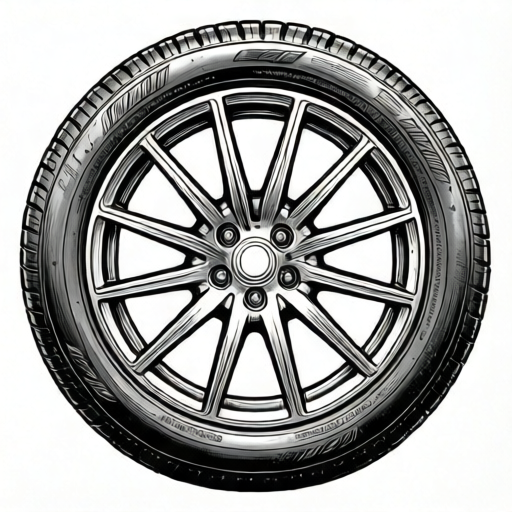
Use the stated measurements and conventions for each exercise.
Set the circles and the comparison convention
Begin with three concentric circles: the outer tire circle, the rim edge circle, and the hub circle. For a hypothetical example, use radii of 60 mm, 45 mm, and 12 mm on a 120 mm outer diameter. The sidewall band is the area between 60 mm and 45 mm. Mark the center with a small cross so every pattern shares the same hub placement.
Decide the comparison convention before drawing: each rim plate shows the same outer tire circle and the same hub circle, and only the spoke pattern changes. This makes spoke count, spacing, and visual density directly comparable. Write the convention at the top of the page in consistent lettering; x-height is baseline to midline, and your letter style may differ from the example as long as it stays consistent.
- Measure your compass opening and record the three radii you will use, labeling them as hypothetical examples.
- Draw the outer tire circle, rim edge circle, and hub circle from the same center point.
- Mark the center cross and a vertical reference line through the hub.
- Write the comparison convention at the top: same outer circle, same hub, only spokes vary.
Lay out three spoke patterns
For a multi-spoke pattern, divide the rim edge circle into equal angular steps. A hypothetical example uses 12 spokes at 30 degrees apart, since 360 divided by 12 equals 30. Draw each spoke as a straight line from the hub circle to the rim edge circle, then check that adjacent spokes are evenly spaced by measuring the angle at the center.
For a five-spoke pattern, use five spokes at 72 degrees apart, since 360 divided by 5 equals 72. Five spokes look wider and more open than twelve. For a mesh pattern, draw two sets of curved or angled lines that cross between hub and rim; keep the crossings inside the sidewall band so the mesh reads as a pattern rather than a solid block. In all three plates, the hub circle stays the same size and position.
- Draw the 12-spoke plate at 30-degree steps and number the spokes lightly.
- Draw the five-spoke plate at 72-degree steps and compare openness with the 12-spoke plate.
- Draw the mesh plate with two crossing line sets, keeping crossings between hub and rim edge.
- Check each plate against the shared outer circle and hub circle before adding labels.
Place the hub and lug pattern
The hub is the small central circle; lugs are the small marks around it. A hypothetical example places five lugs evenly on the hub circle at 72-degree steps, matching the five-spoke plate for comparison. On the 12-spoke plate, keep the same five-lug layout so the hub does not change between plates; only the spokes vary. This isolates spoke pattern as the comparison variable.
Measure lug spacing from the center angle, not by eye. If you choose a different lug count, state it as a hypothetical example and keep it identical across all three plates. Check that every lug mark sits on the hub circle and that the center cross remains visible.
- Mark five lug positions on the hub circle at 72-degree steps as a hypothetical example.
- Repeat the identical lug layout on all three plates.
- Verify each lug mark touches the hub circle and no lug overlaps the center cross.
- Label the hub and lug convention once at the top of the page.
Draw the tire sidewall profile and compare
The sidewall profile is a cross-section band between the outer tire circle and the rim edge circle. Draw a simple profile line that rises from the rim edge outward to the tire shoulder, then returns to the rim edge on the other side. Keep the band width consistent across plates; in the hypothetical example the band is 15 mm wide because 60 minus 45 equals 15.
Build a comparison chart with columns for spoke count, angular step, visual density, and sidewall band width. For the hypothetical example, record 12 spokes at 30 degrees, five spokes at 72 degrees, and mesh as two crossing sets. Check the arithmetic: 12 times 30 equals 360, and 5 times 72 equals 360. Use the same units throughout, and label all chosen numbers as hypothetical examples.
- Draw the sidewall profile band on each plate using the same 15 mm hypothetical width.
- Fill the comparison chart with spoke count, angular step, density note, and band width.
- Check that 12 times 30 equals 360 and 5 times 72 equals 360.
- Confirm all plates share the same outer circle, hub circle, and sidewall band width.
Worked example
A student draws a rim plate with an outer tire radius of 50 mm, a rim edge radius of 38 mm, and 10 spokes. What is the sidewall band width, and what angular step should the spokes use? Show the arithmetic.
Worked answer
Sidewall band width is 50 minus 38 equals 12 mm. Angular step is 360 divided by 10 equals 36 degrees. Check: 10 times 36 equals 360, so the spokes close the circle evenly. Label 50 mm, 38 mm, and 12 mm as hypothetical examples.
Four practice exercises
Exercise 1
Draw a five-spoke rim plate with an outer tire radius of 55 mm, a rim edge radius of 40 mm, and five lugs. State the sidewall band width and the angular step for spokes and lugs.
Show answer and check
Sidewall band width is 55 minus 40 equals 15 mm. Spoke step is 360 divided by 5 equals 72 degrees. Lug step is also 72 degrees for five lugs. Check: 5 times 72 equals 360 for both.
Why: Subtract the rim edge radius from the outer tire radius to get the band. Divide 360 by the count to get the angular step, then multiply back to confirm the full circle.
Check: Measure the drawn band against the stated 15 mm hypothetical example and verify each adjacent spoke and lug angle is 72 degrees by center measurement.
Exercise 2
A mesh plate uses two crossing line sets between the hub circle and rim edge circle. The outer tire radius is 60 mm and the rim edge radius is 45 mm. Where must the crossings stay, and what is the band width?
Show answer and check
Crossings must stay between the hub circle and the rim edge circle, inside the sidewall band. Band width is 60 minus 45 equals 15 mm. Check: 60 minus 45 equals 15.
Why: The mesh pattern belongs to the rim area, so crossings should not spill into the sidewall band or over the hub. The band width comes from subtracting the two radii.
Check: Trace each crossing and confirm it lies between the hub circle and rim edge circle; measure the band width and compare with 15 mm as a hypothetical example.
Exercise 3
Compare a 12-spoke plate and a five-spoke plate that share an outer tire radius of 50 mm and a rim edge radius of 38 mm. Give the angular steps, the band width, and one visual difference.
Show answer and check
12-spoke step is 360 divided by 12 equals 30 degrees. Five-spoke step is 360 divided by 5 equals 72 degrees. Band width is 50 minus 38 equals 12 mm. The five-spoke plate looks more open because its spokes are farther apart.
Why: Both plates share the same circles, so only the spoke count changes. Dividing 360 by each count gives the step, and subtracting the radii gives the band.
Check: Verify 12 times 30 equals 360 and 5 times 72 equals 360; measure the band against 12 mm as a hypothetical example and compare spoke spacing on both plates.
Exercise 4
You choose a hypothetical outer tire radius of 48 mm and want a sidewall band of 10 mm. What rim edge radius do you need, and if you draw 8 spokes, what is the angular step?
Show answer and check
Rim edge radius is 48 minus 10 equals 38 mm. Spoke step is 360 divided by 8 equals 45 degrees. Check: 8 times 45 equals 360, and 38 plus 10 equals 48.
Why: Subtract the band width from the outer radius to find the rim edge radius. Divide 360 by the spoke count for the step, then reverse both operations to confirm.
Check: Add the rim edge radius and band width to recover the outer radius, and multiply the step by the spoke count to recover 360.
Common mistakes
- Changing the hub size or position between plates, which makes spoke patterns incomparable. Draw the hub circle first from one center cross and reuse it on every plate.
- Spacing spokes by eye so the angular steps are uneven. Measure angles from the center and check that the step times the count equals 360.
- Letting mesh crossings spill outside the sidewall band or over the hub. Keep crossings between the hub circle and rim edge circle, then recheck the band.
- Mixing units or treating hypothetical example numbers as equipment specifications. Use one unit throughout, measure your own tools, and label chosen values as hypothetical examples.
Self-check rubric
- Three plates share the same outer tire circle, rim edge circle, and hub circle drawn from one center cross.
- Spoke patterns are evenly spaced and the arithmetic checks: step times count equals 360.
- Hub and lug layout is identical across plates, isolating spoke pattern as the comparison variable.
- Sidewall band is drawn between outer tire circle and rim edge circle with a consistent width.
- Comparison chart records spoke count, angular step, density note, and band width in one unit.
- All chosen numerical values are labeled as hypothetical examples, and lettering is consistent with x-height from baseline to midline.
Questions and answers
Do I need a compass, or can I use a circle template?
Either works. A template gives a clean outer circle; a compass lets you set the three radii directly. Measure whichever tool you use and record the values as hypothetical examples.
How many spokes should the multi-spoke plate have?
Any count that divides evenly into 360 is easy to check. The lesson uses 12 spokes at 30 degrees as a hypothetical example, but you may choose another count and state it.
What exactly is the sidewall band?
It is the area between the outer tire circle and the rim edge circle. In the hypothetical example it is 15 mm wide because 60 minus 45 equals 15.
Can my lettering look different from the example?
Yes. X-height is baseline to midline, and letter styles vary. Keep your own lettering consistent across the chart and plates rather than copying one style.