Free original lessons
Draw Shadows in Perspective
Construct a cast shadow from one direction of light and a flat ground plane. Mark the light vanishing point (LVP) and its horizontal projection on the horizon, called the shadow vanishing point (SVP). Use the two guides to find the shadow tips.
Letter & A4
PDF & SVG
The two vanishing points that control a cast shadow
The LVP represents a family of parallel light rays in this perspective view. The SVP is the vanishing point of their horizontal ground direction. The construction for a vertical post uses the light line through its top and the ground line through its base.
Use one level camera, horizontal ground and one directional light throughout these figures. In this setup the LVP is vertically above the SVP. You can place the pair left or right of the picture center to change the apparent direction.
Construction steps
Step 1: Place the SVP on the horizon. Step 2: Place the LVP above it on the same vertical line. Keep both fixed for objects that share the light.
Step 3: Draw the object on the ground. Step 4: Extend a line through each base corner and the SVP, and a line through its matching top corner and the LVP. Step 5: Mark the intersection of these lines on the side away from the light. Step 6: For a box, draw the outer ground outline enclosing its base and all the projected tips.
Worked example: a box on the ground
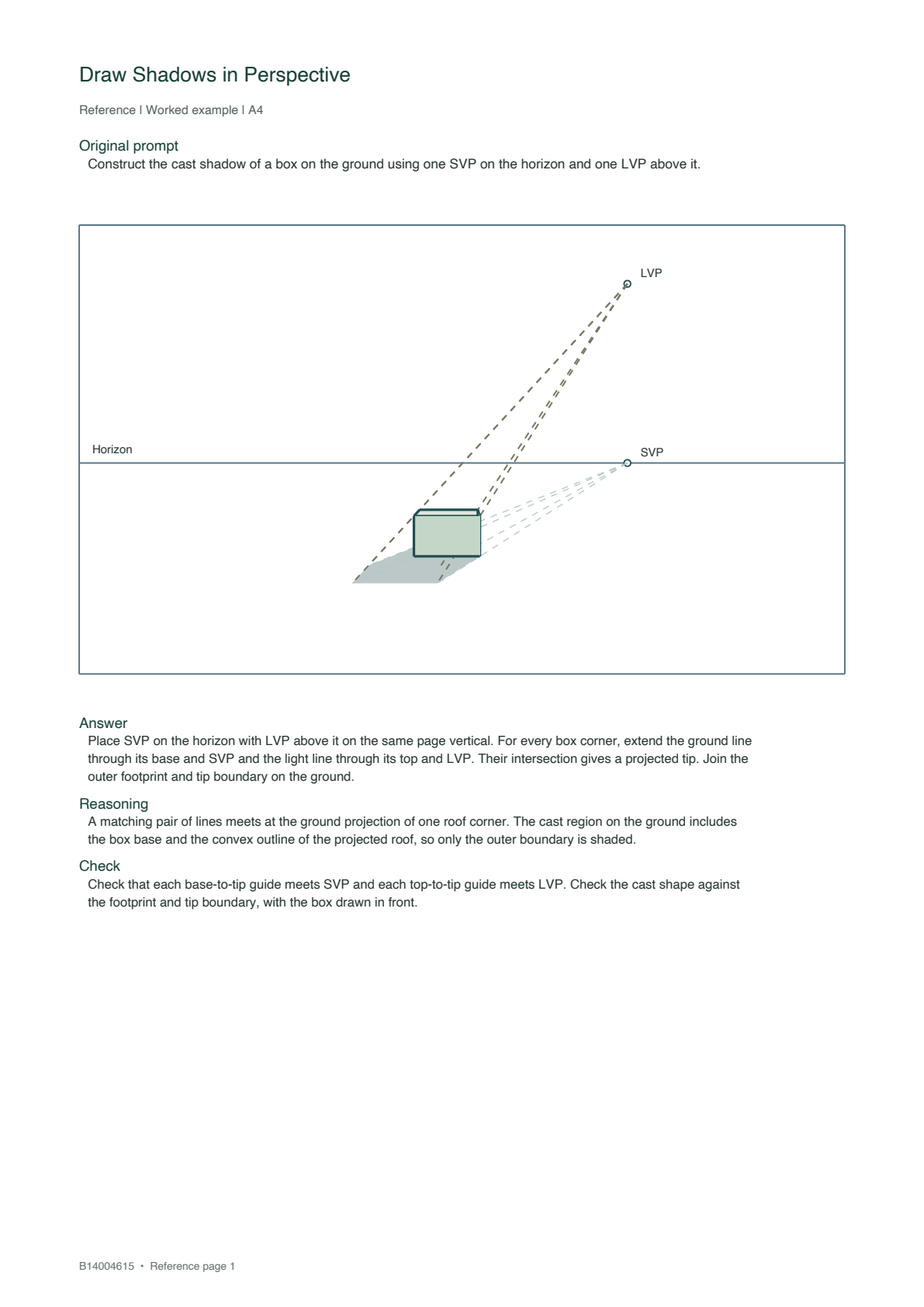
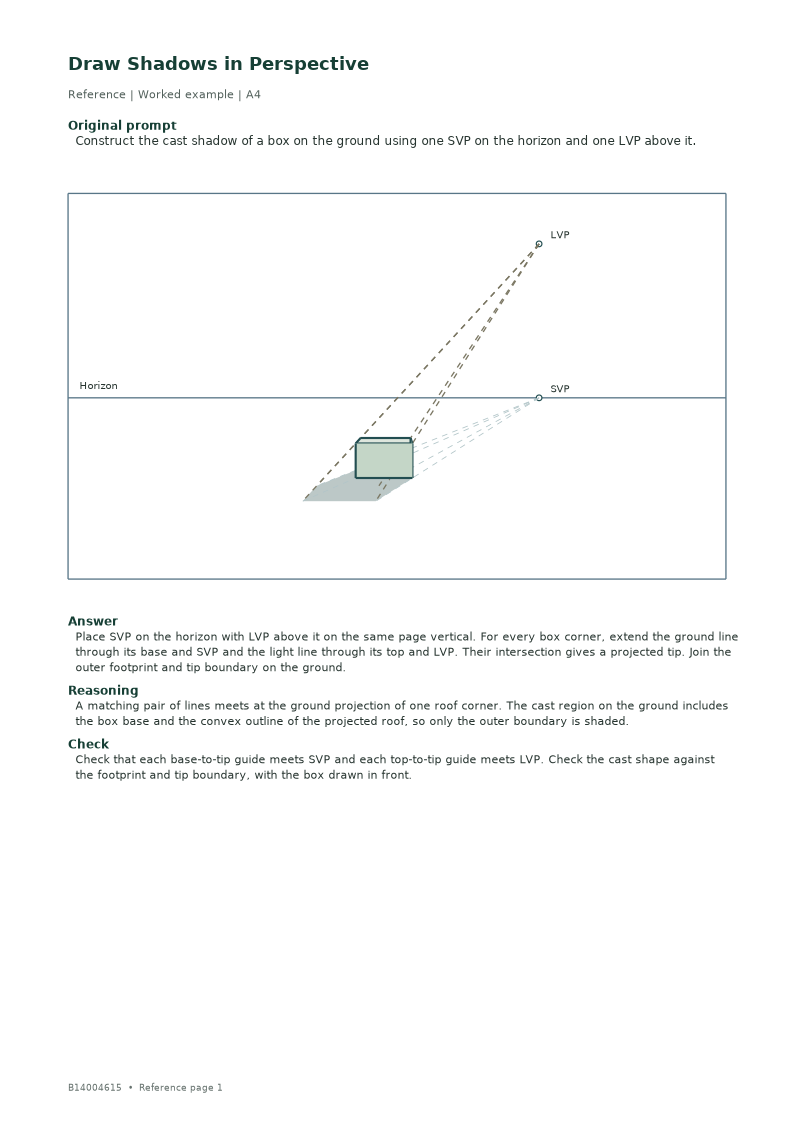
Draw a horizon line and mark SVP on it to the right. Place LVP vertically above it. The shadows in this example extend down and to the left across the page.
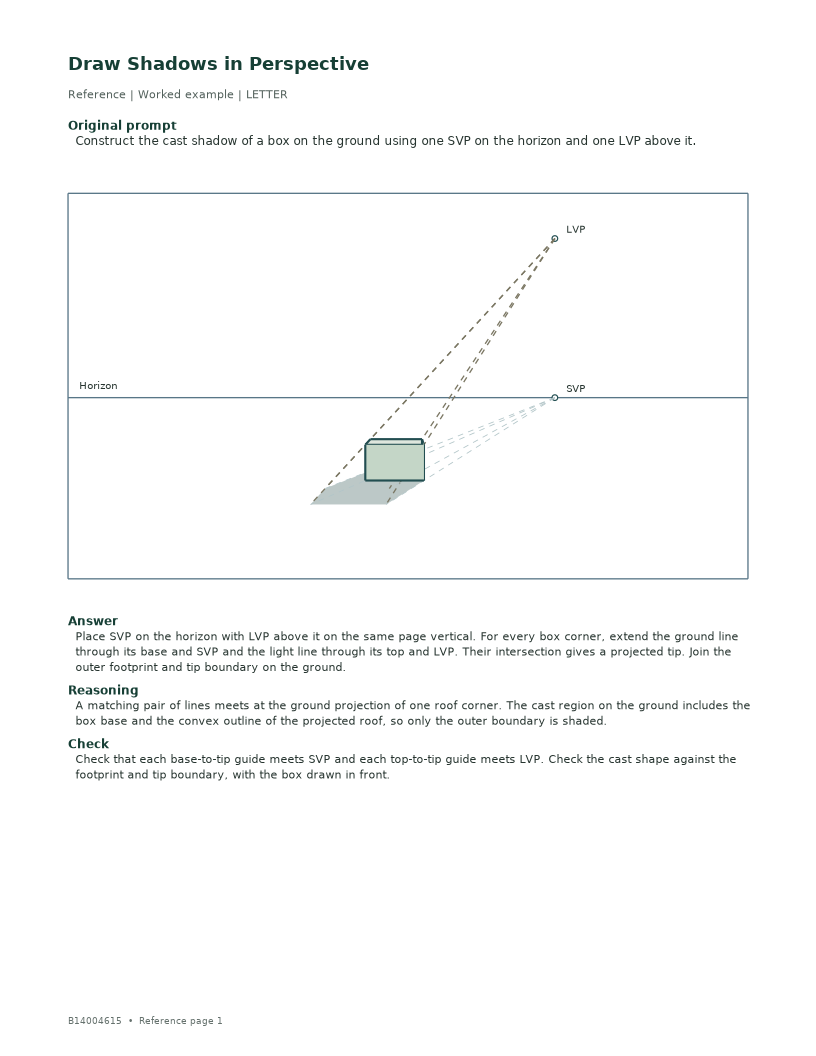
For the box, extend the ground guide through every base point and the light guide through the top vertex immediately above it. Each pair meets at a projected ground tip. Trace the outer shadow boundary around the footprint and tips, leaving the box in front. Check the dotted construction separately from the shaded ground shape.
Practice tasks
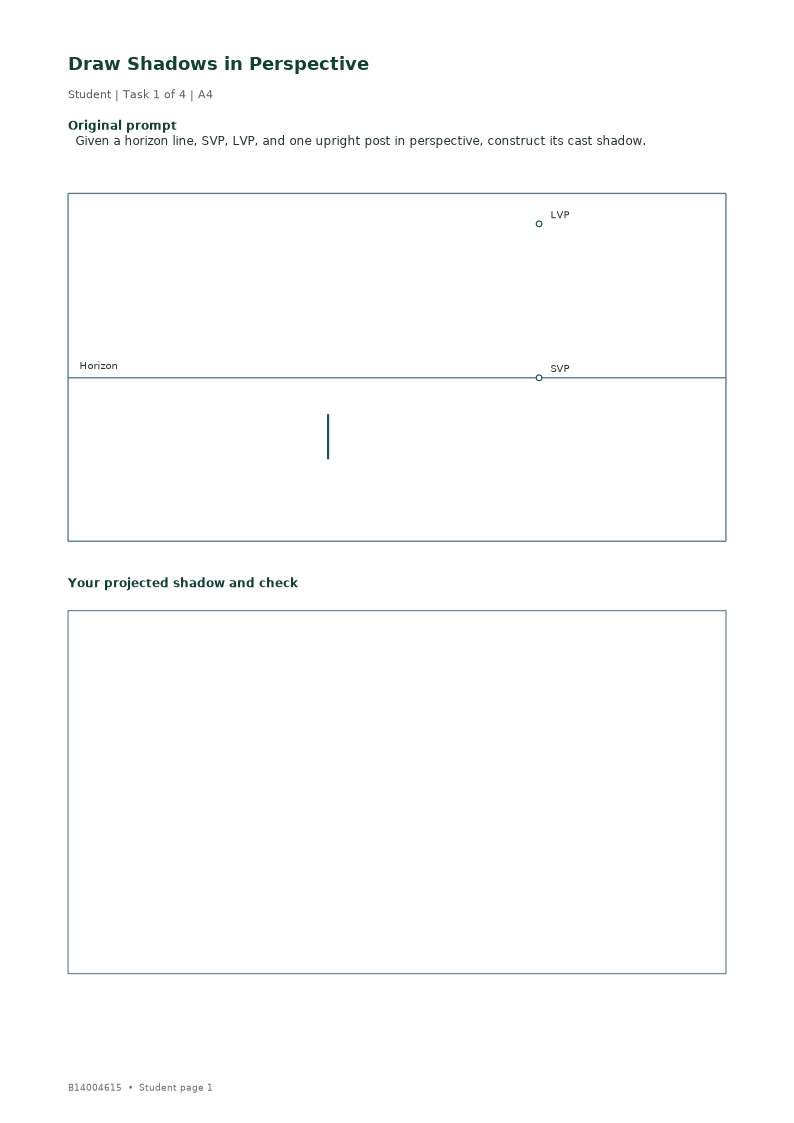
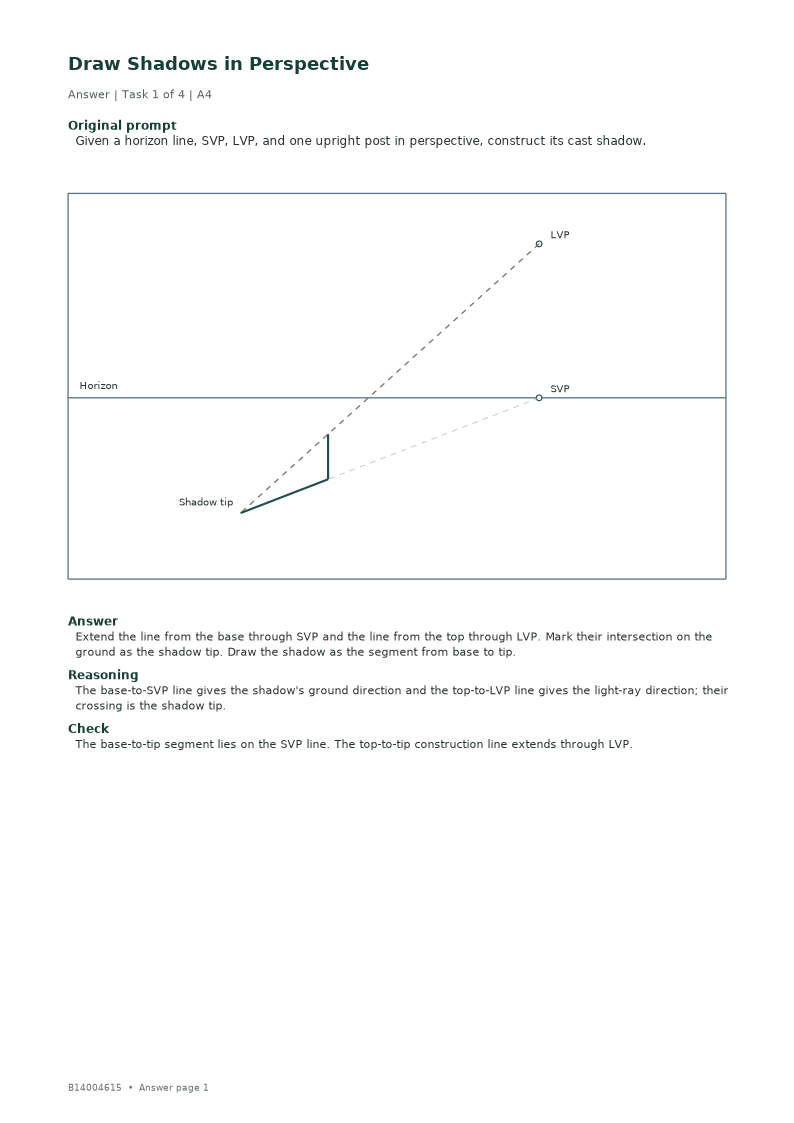
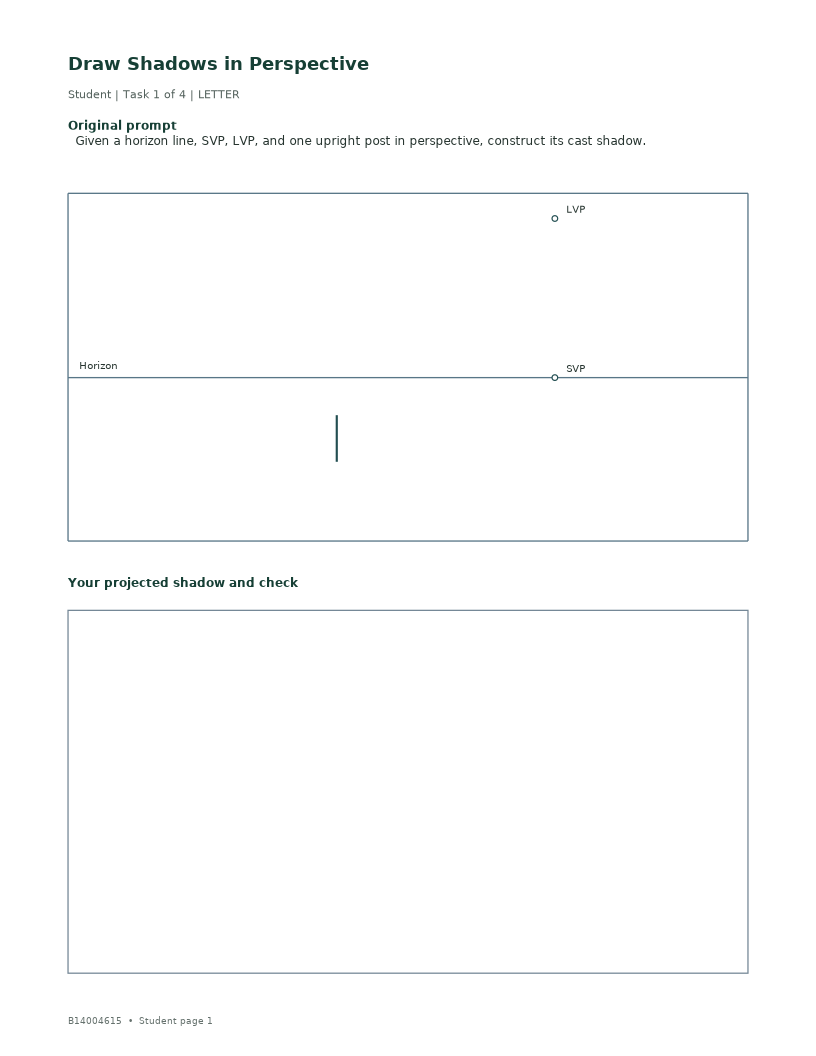
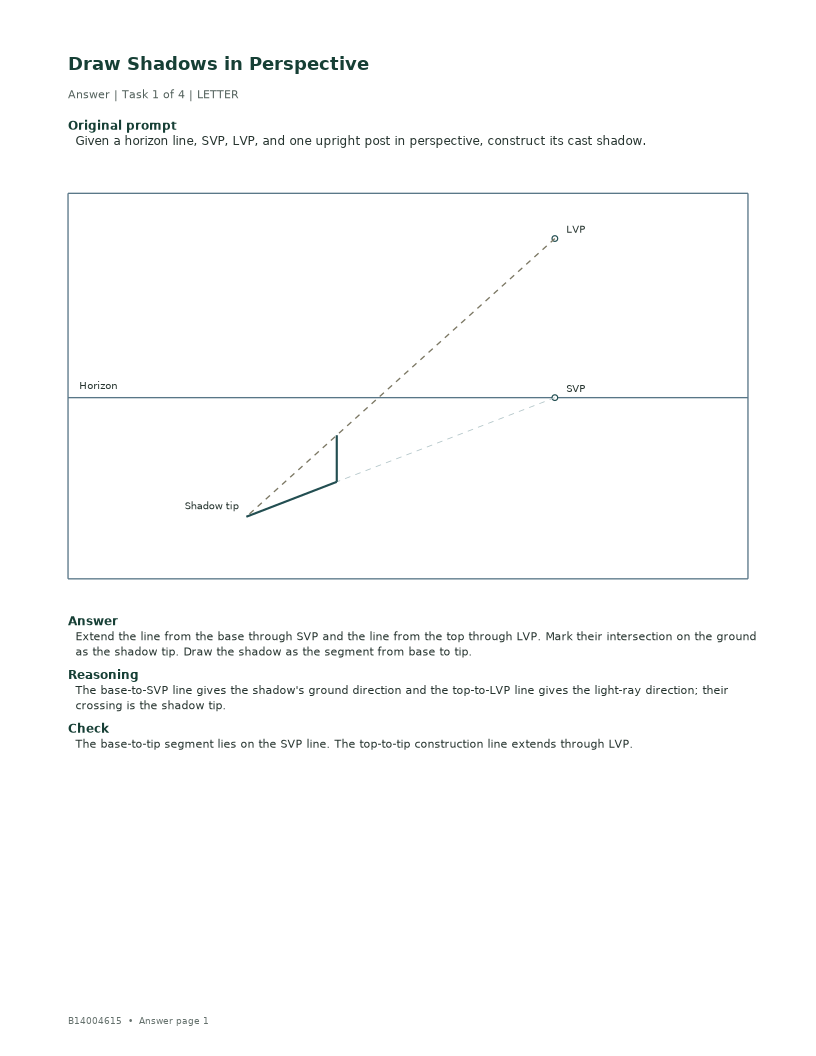
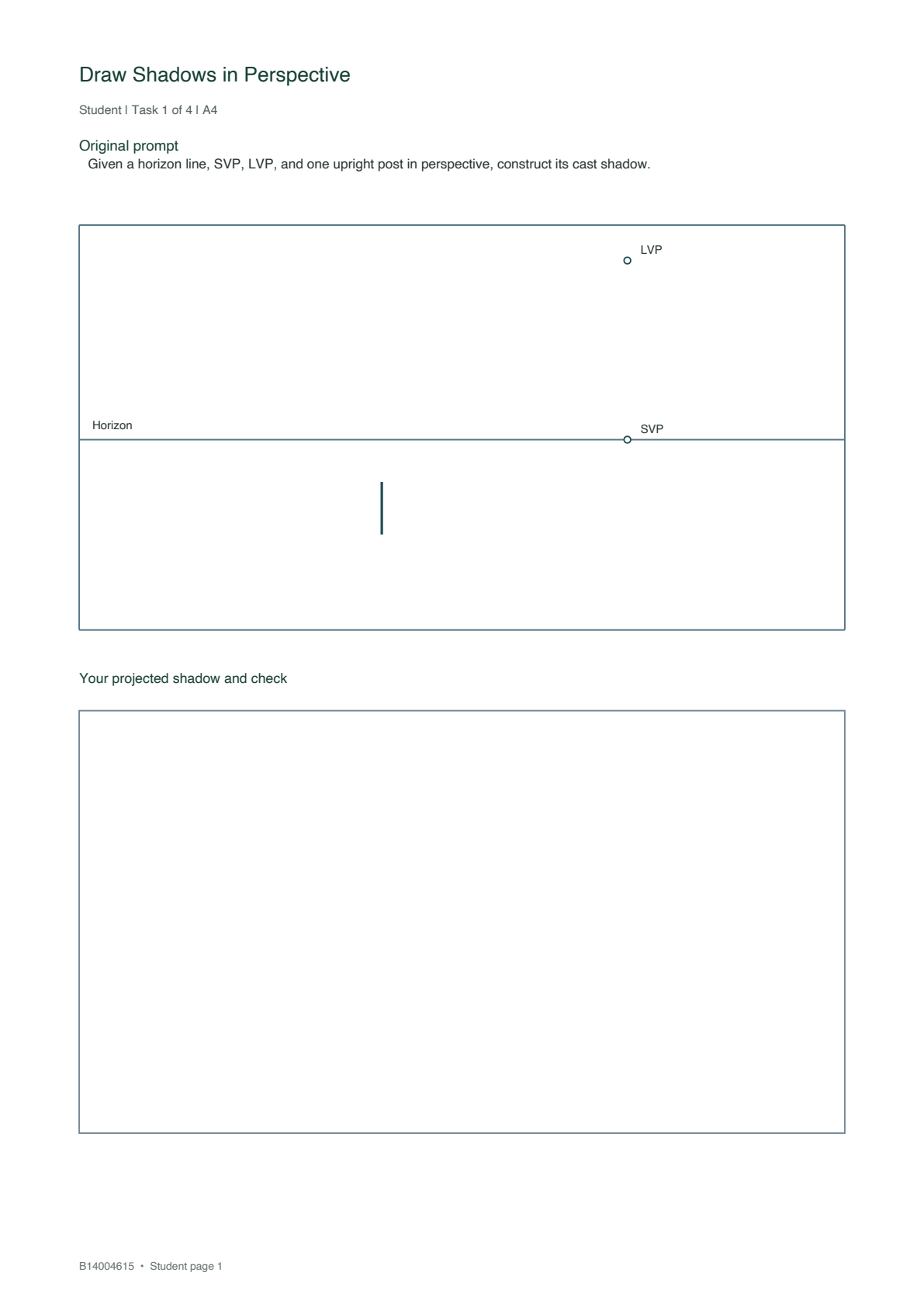
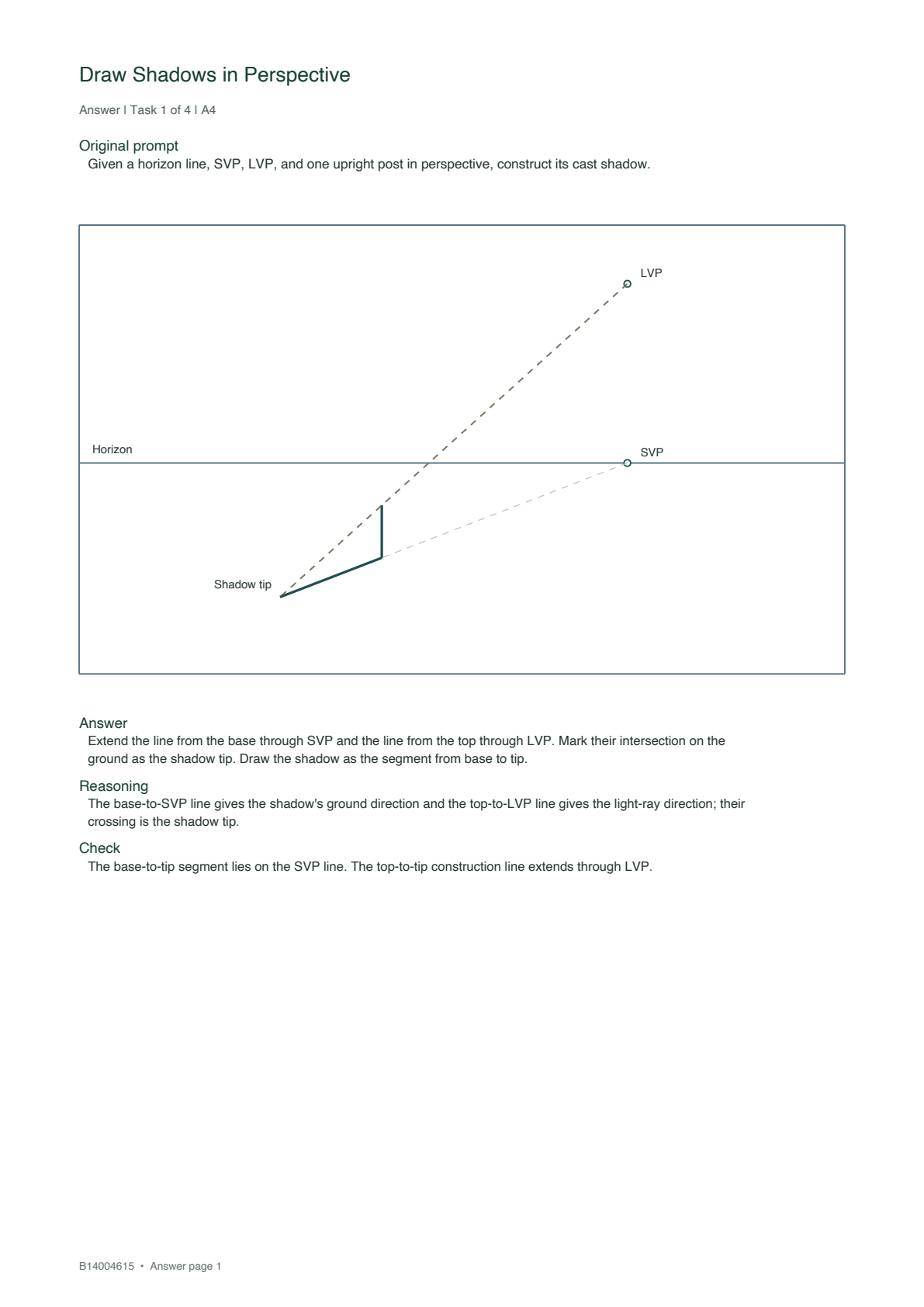
Task 1: For the example post, the shadow is the ground segment from the base to the tip. The line from the post top through LVP meets the ground line through SVP at that tip.
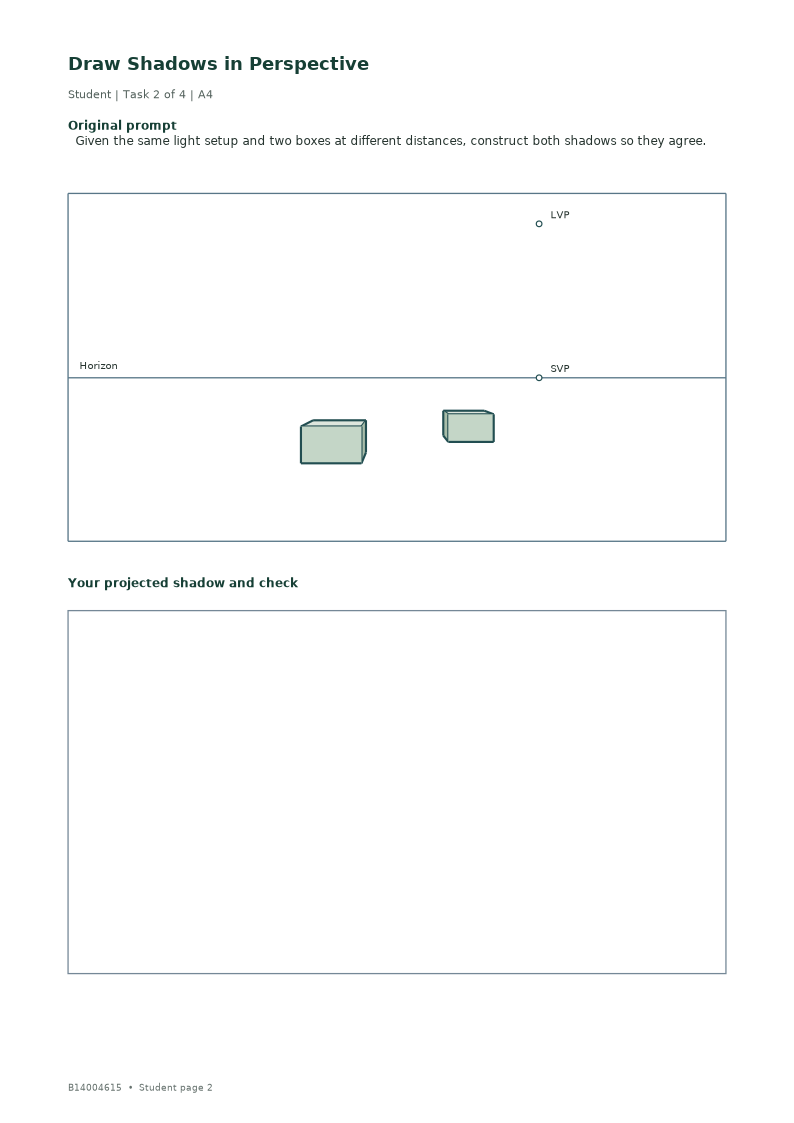
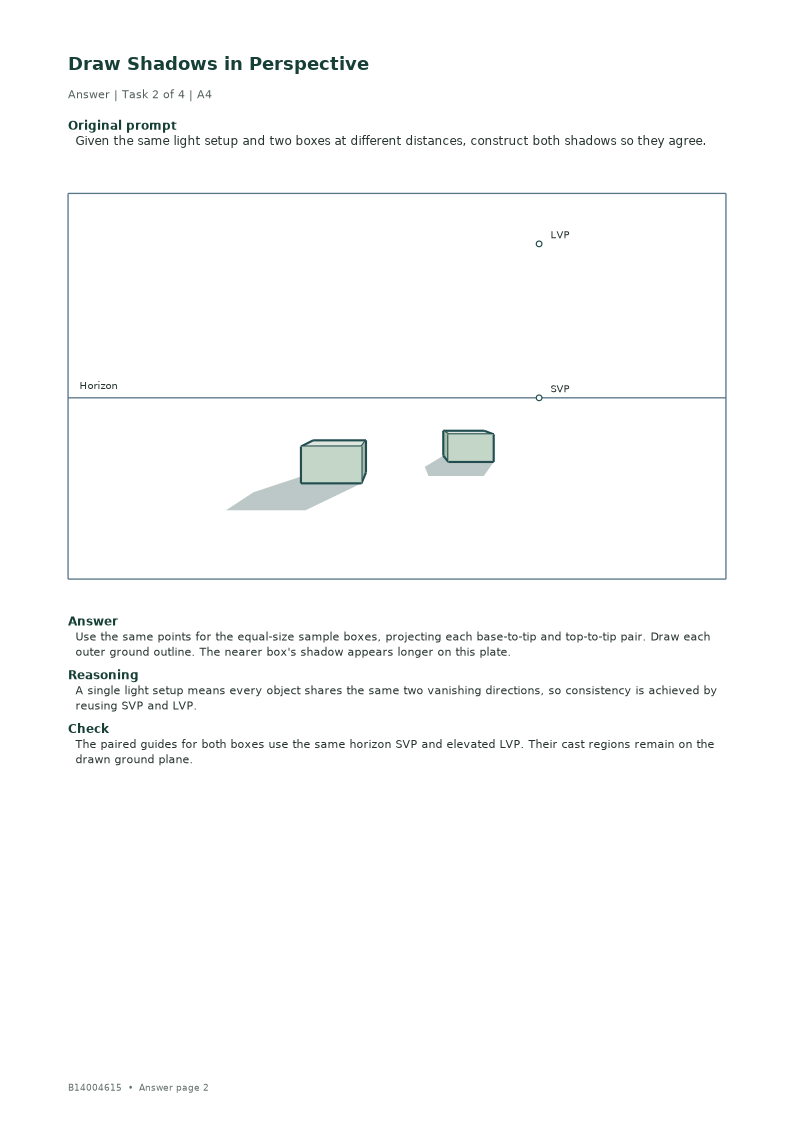
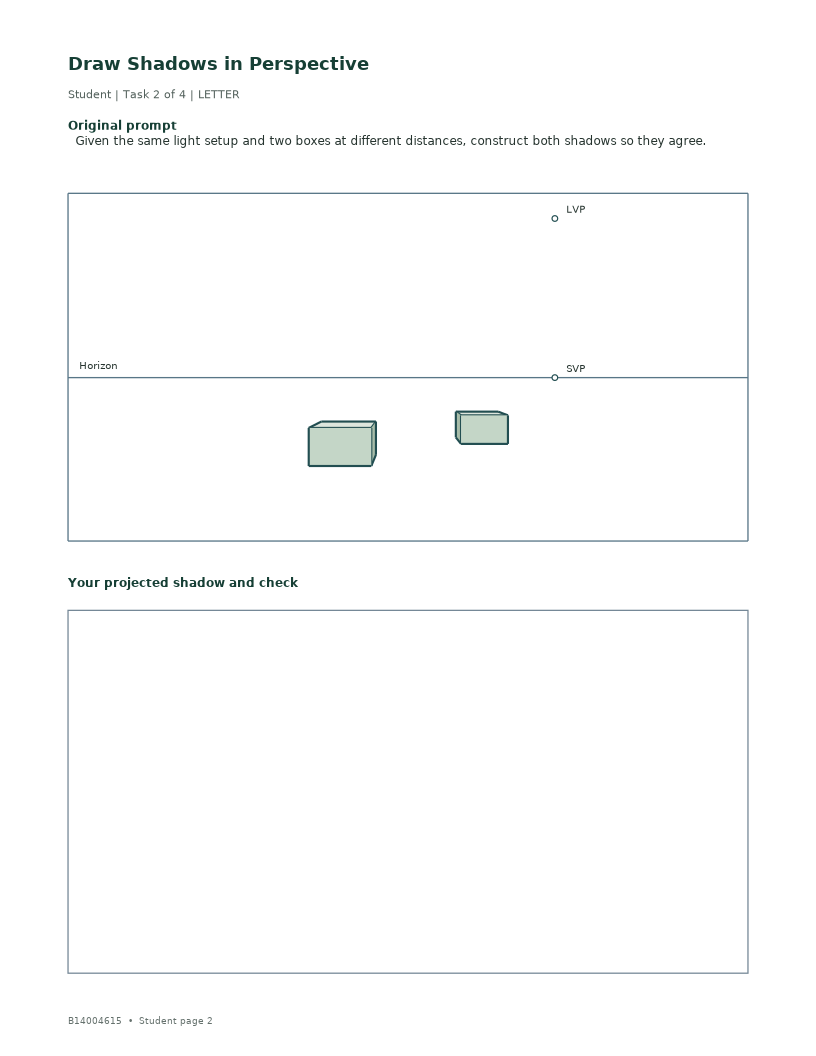
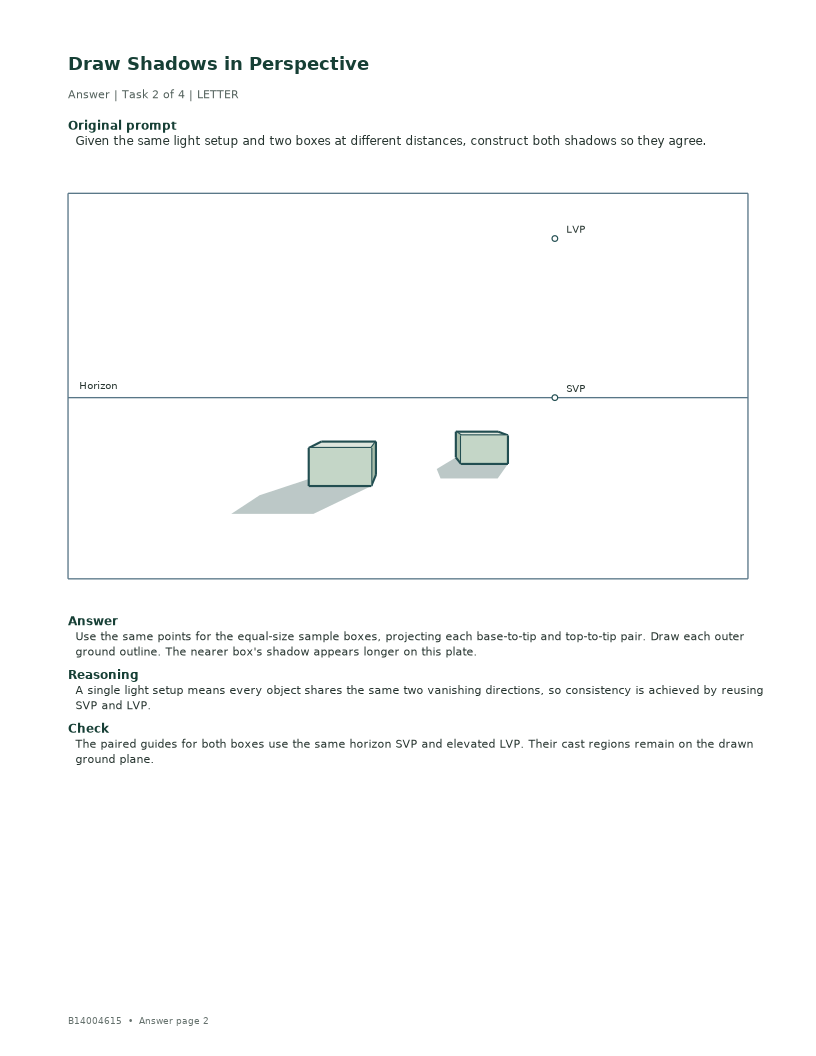
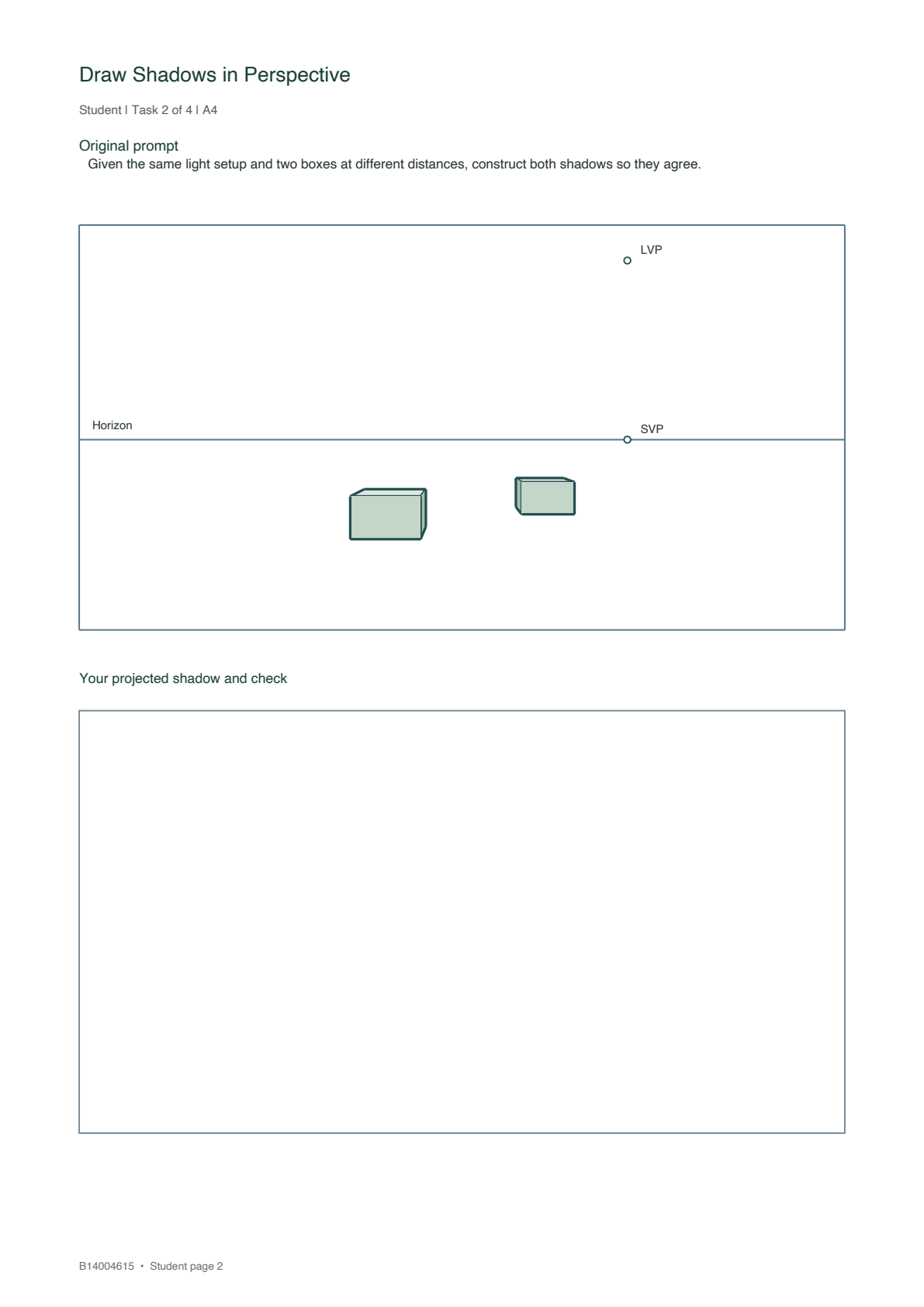
Task 2: Construct two shadows with the same LVP and SVP. The sample compares equal boxes at different distances under an unchanged light, so the nearer shadow appears longer in this view.
Practice tasks (continued)
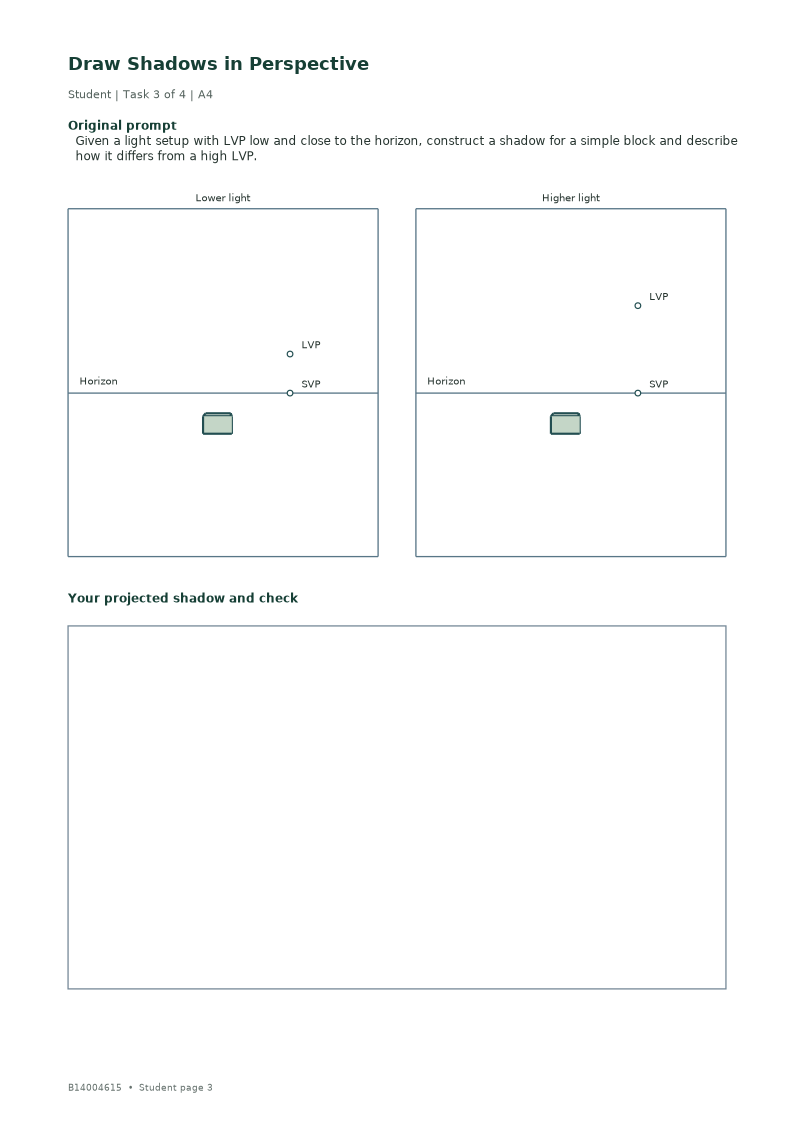
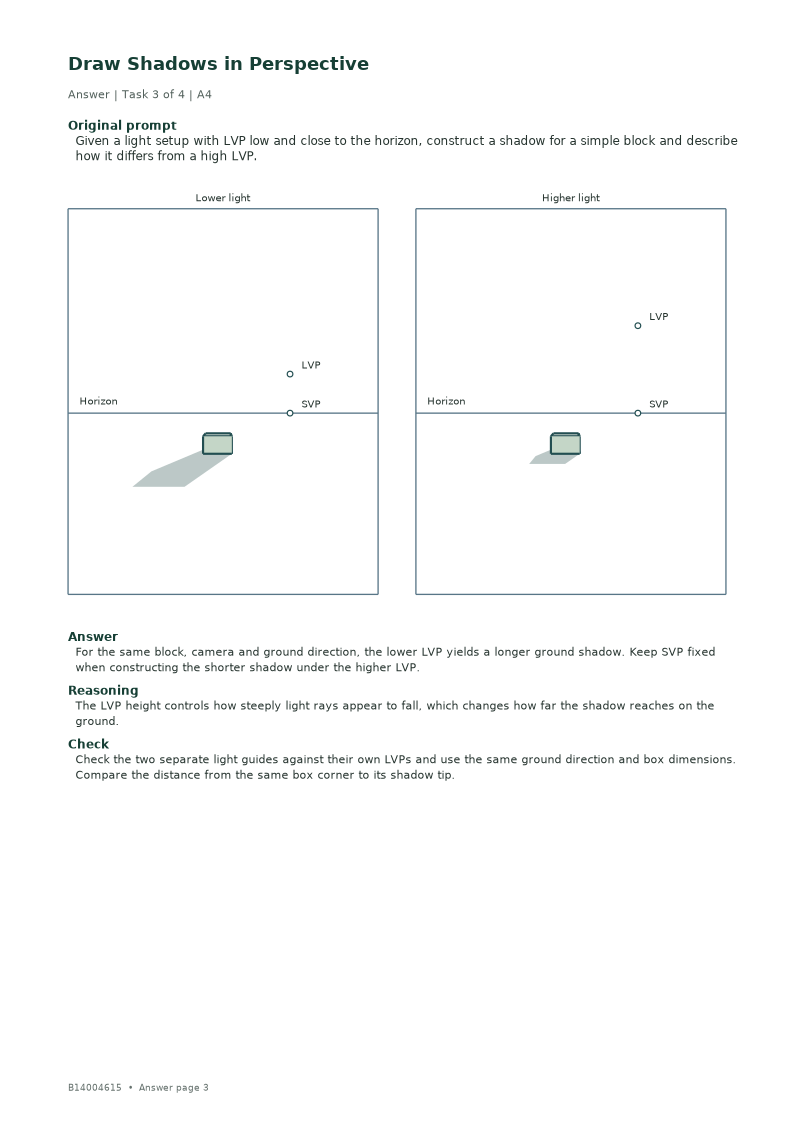
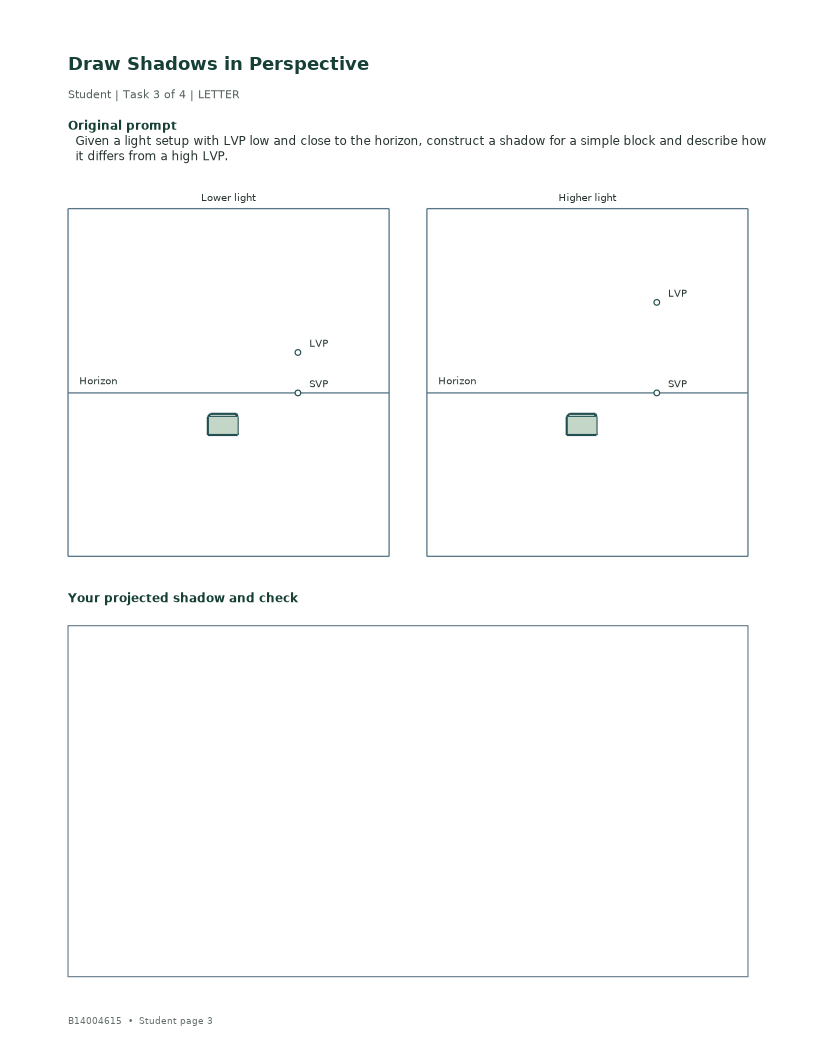
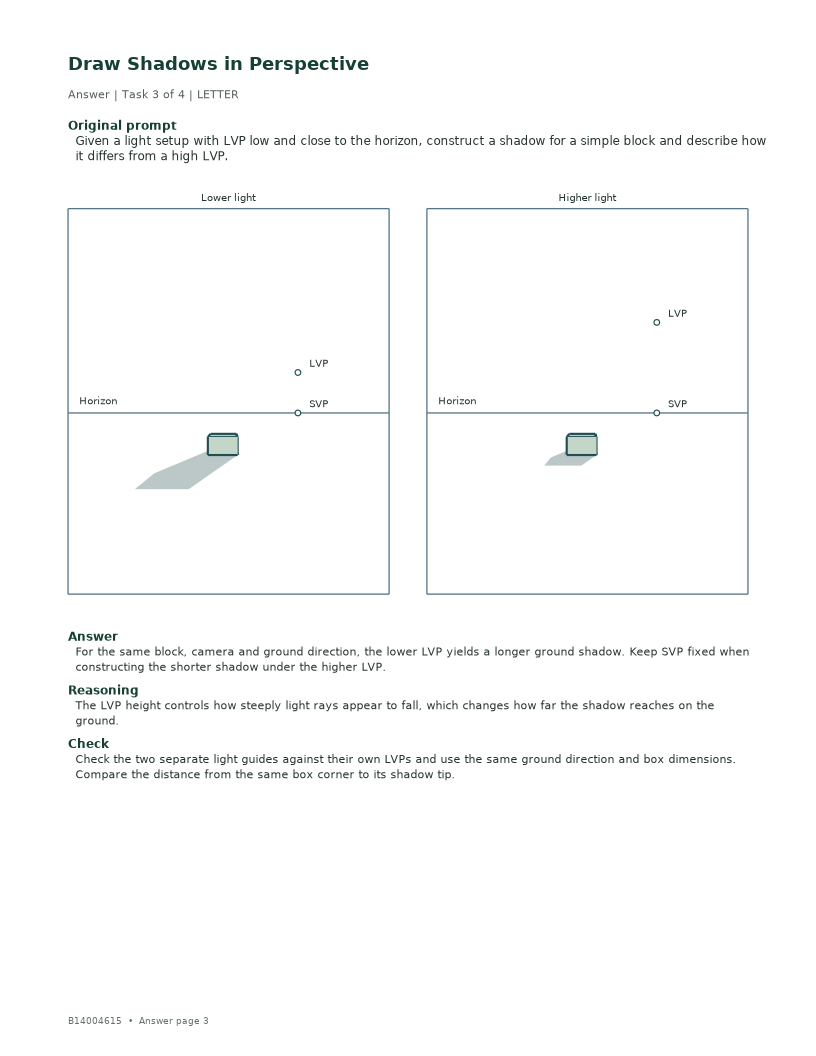
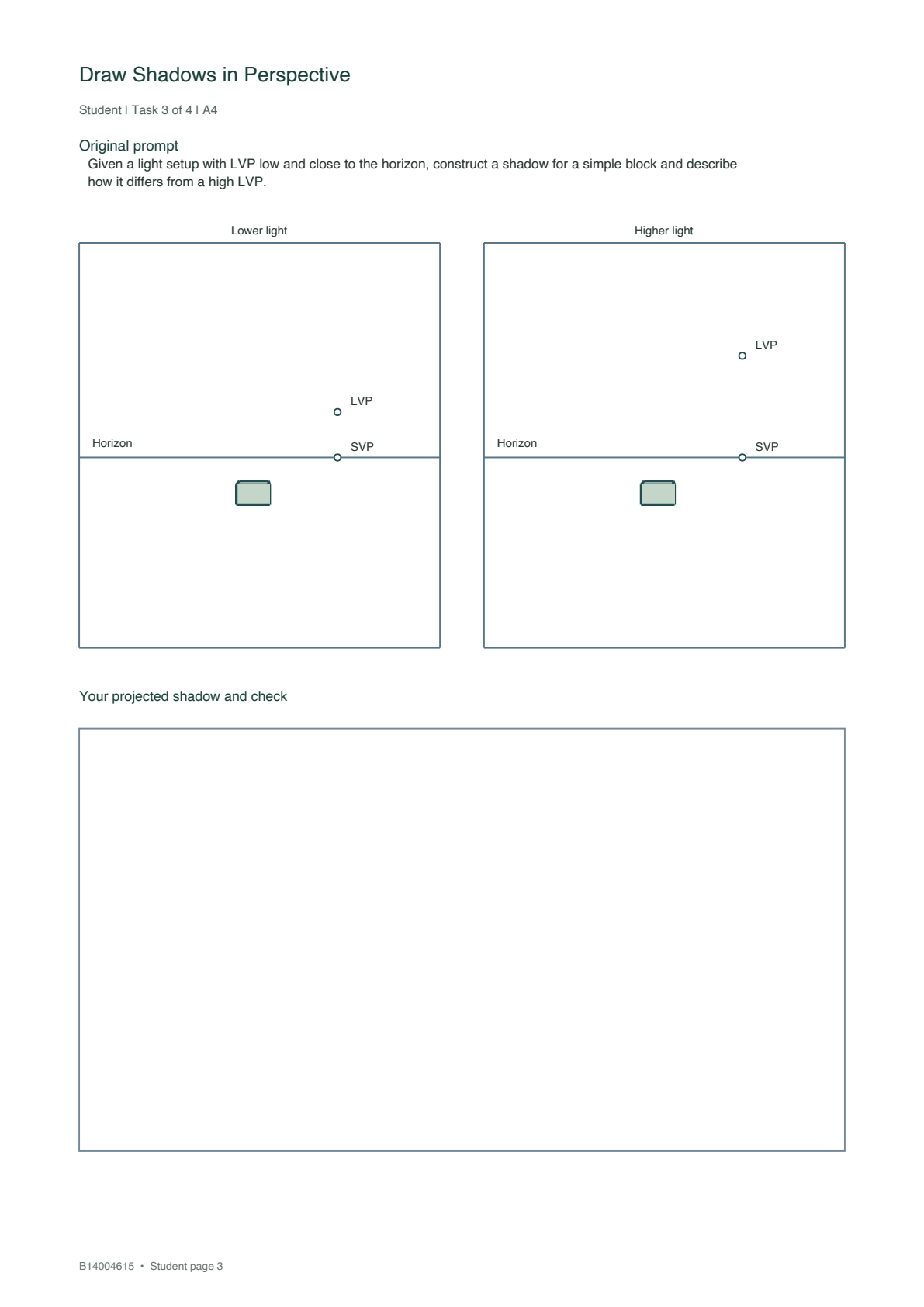
Task 3: Compare copies of the same block under two light elevations. Keep the camera and ground direction fixed. Lowering the LVP toward the horizon lengthens the sample shadow.
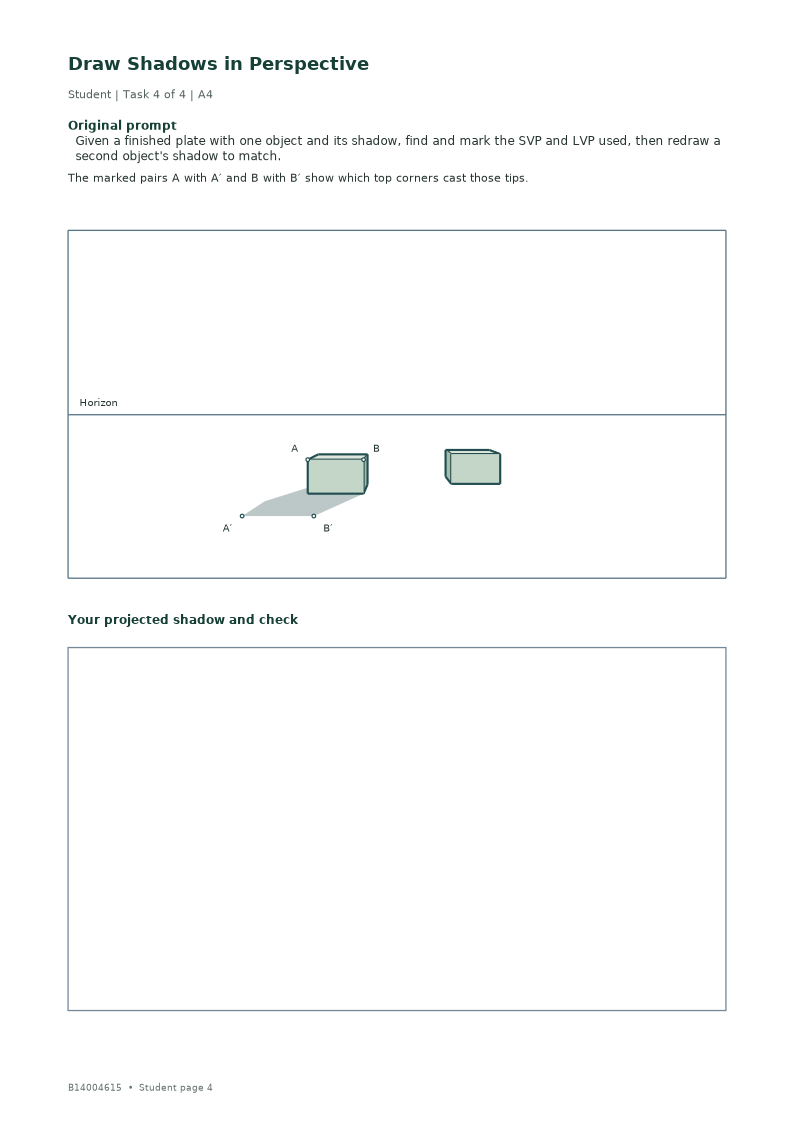
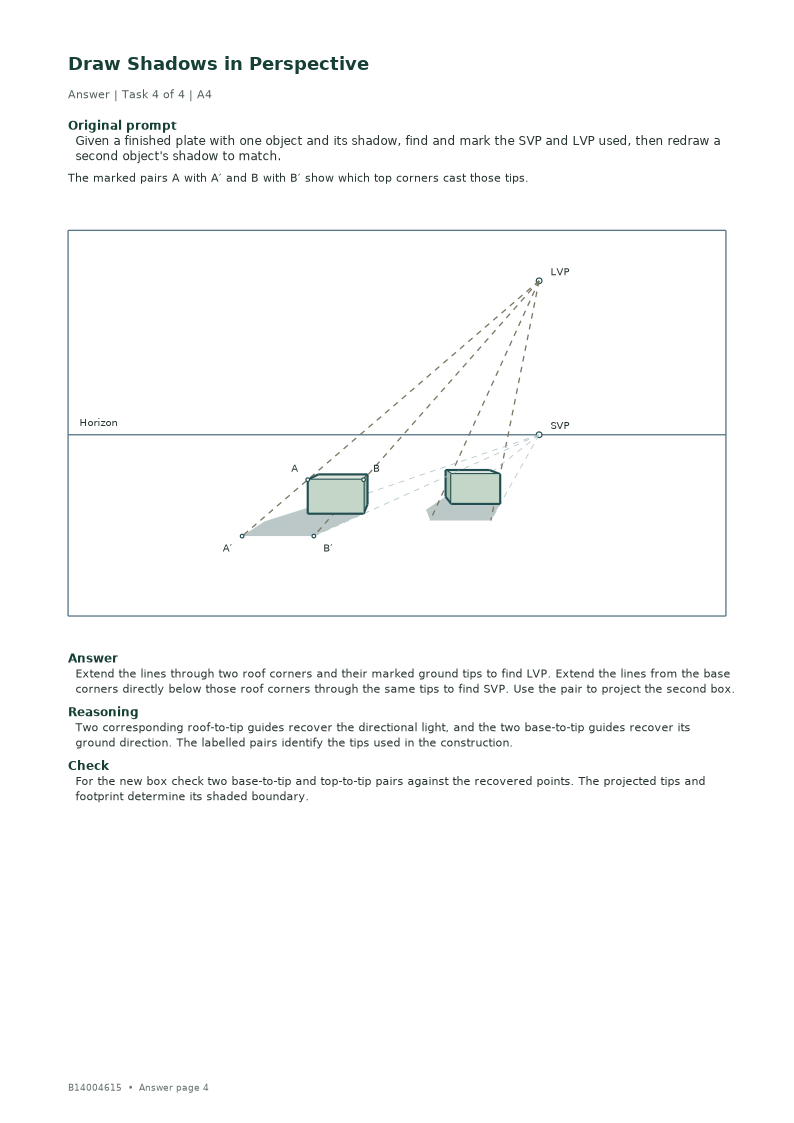
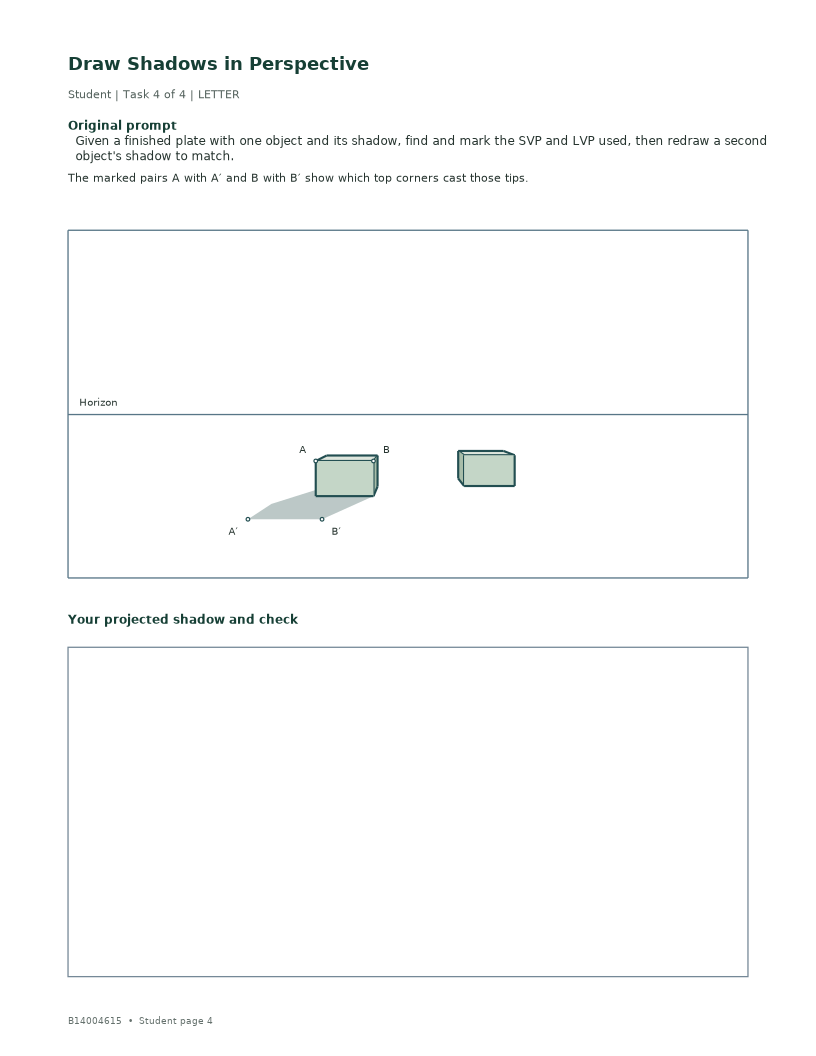
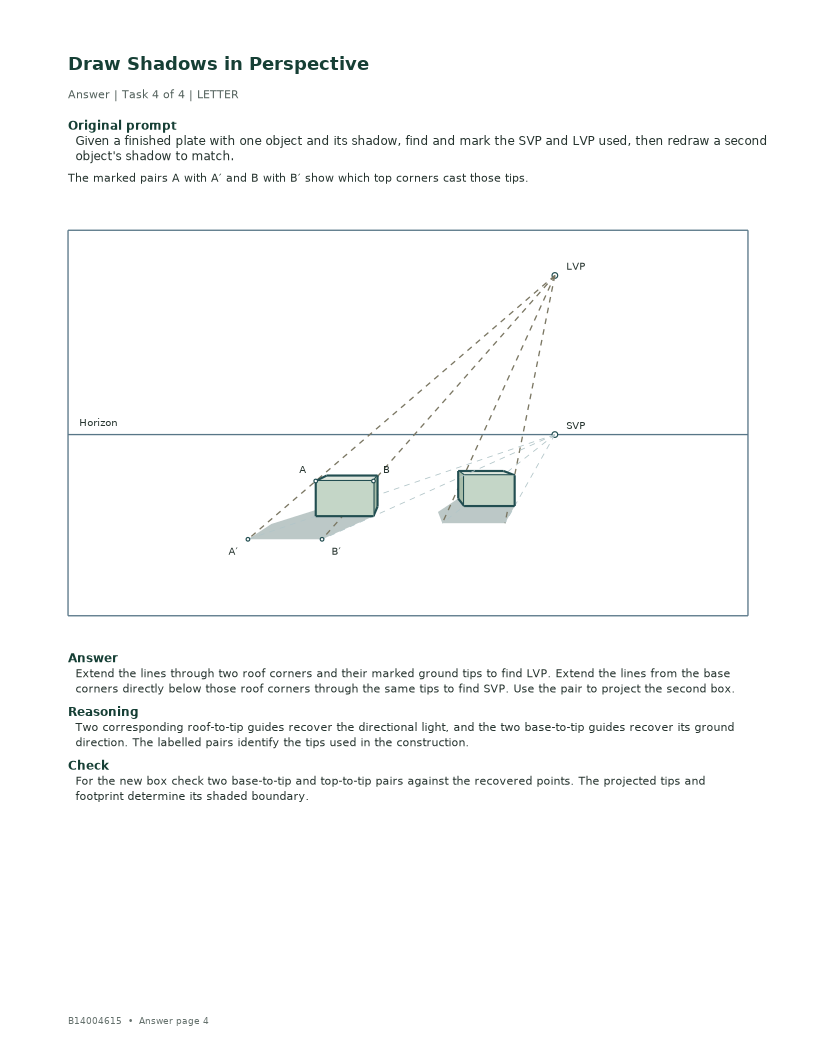
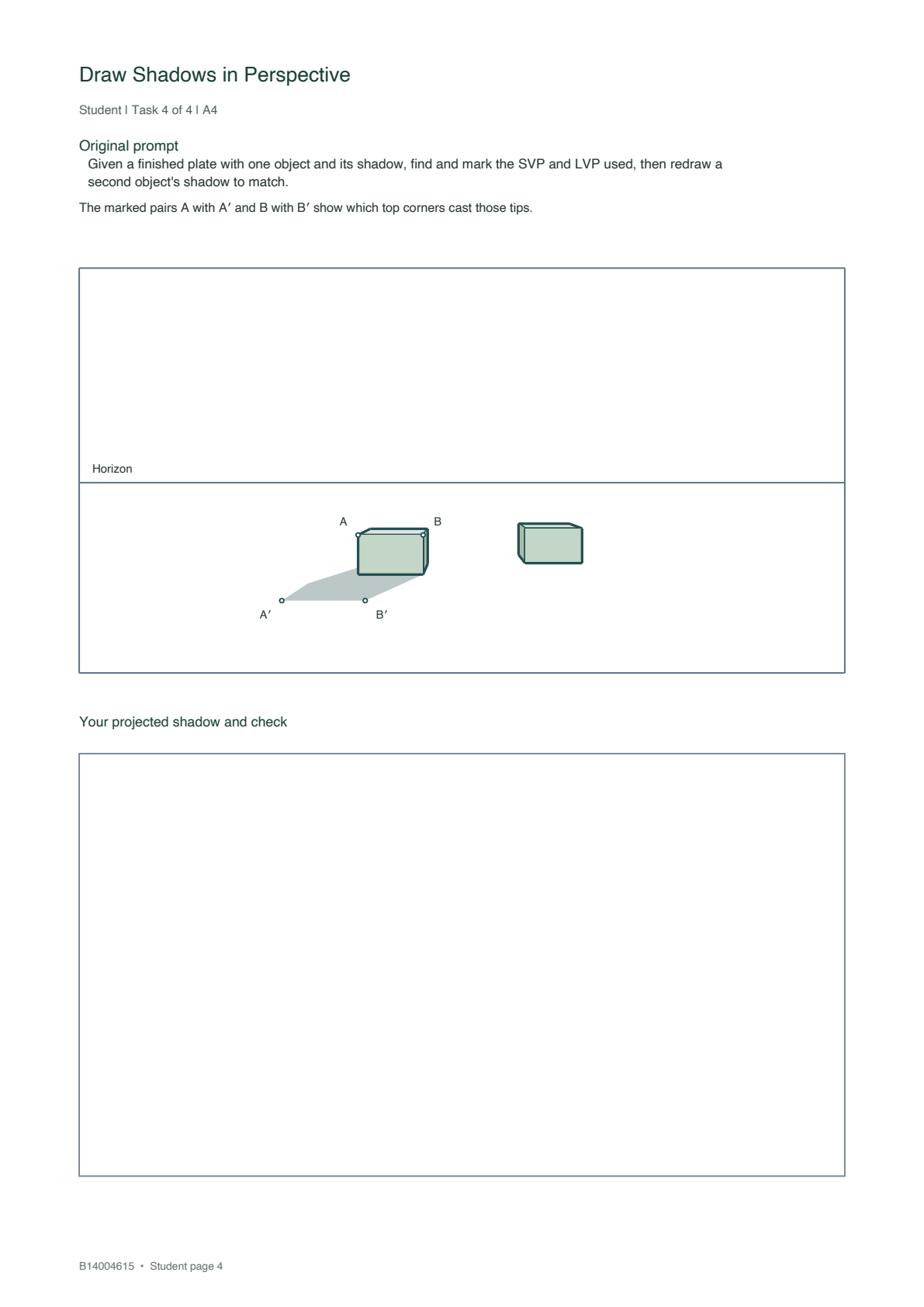
Task 4: Use two known top-corner and shadow-tip pairs. Extend the line from each roof corner through its marked tip to recover LVP. Extend the corresponding lines from the base corners to the same tips to recover SVP on the horizon. Then use the pair for the second object.
Download the complete resource pack
All individual SVG pages (18)
- A4 reference page 1
- A4 student page 1
- A4 student page 2
- A4 student page 3
- A4 student page 4
- A4 answer page 1
- A4 answer page 2
- A4 answer page 3
- A4 answer page 4
- LETTER reference page 1
- LETTER student page 1
- LETTER student page 2
- LETTER student page 3
- LETTER student page 4
- LETTER answer page 1
- LETTER answer page 2
- LETTER answer page 3
- LETTER answer page 4
Print at 100% / actual size. Use the stated scale on any schematic diagram; physical cutting templates are identified separately. A4 and US Letter are separate files. Free access, no signup; CC BY 4.0.
How to use these pages
- The two vanishing points that control a cast shadow
- Construction steps
- Worked example: a box on the ground
- Practice tasks
- Practice tasks (continued)
Worked example
Example: Construct the cast shadow of a box on the ground using one SVP on the horizon and one LVP above it.
Answer: Place SVP on the horizon with LVP above it on the same page vertical. For every box corner, extend the ground line through its base and SVP and the light line through its top and LVP. Their intersection gives a projected tip. Join the outer footprint and tip boundary on the ground.
Reasoning: A matching pair of lines meets at the ground projection of one roof corner. The cast region on the ground includes the box base and the convex outline of the projected roof, so only the outer boundary is shaded.
Check: Check that each base-to-tip guide meets SVP and each top-to-tip guide meets LVP. Check the cast shape against the footprint and tip boundary, with the box drawn in front.
Four practice tasks and complete answers
Task 1
Given a horizon line, SVP, LVP, and one upright post in perspective, construct its cast shadow.
Show answer 1
Extend the line from the base through SVP and the line from the top through LVP. Mark their intersection on the ground as the shadow tip. Draw the shadow as the segment from base to tip.
The base-to-SVP line gives the shadow's ground direction and the top-to-LVP line gives the light-ray direction; their crossing is the shadow tip.
Check: The base-to-tip segment lies on the SVP line. The top-to-tip construction line extends through LVP.
Task 2
Given the same light setup and two boxes at different distances, construct both shadows so they agree.
Show answer 2
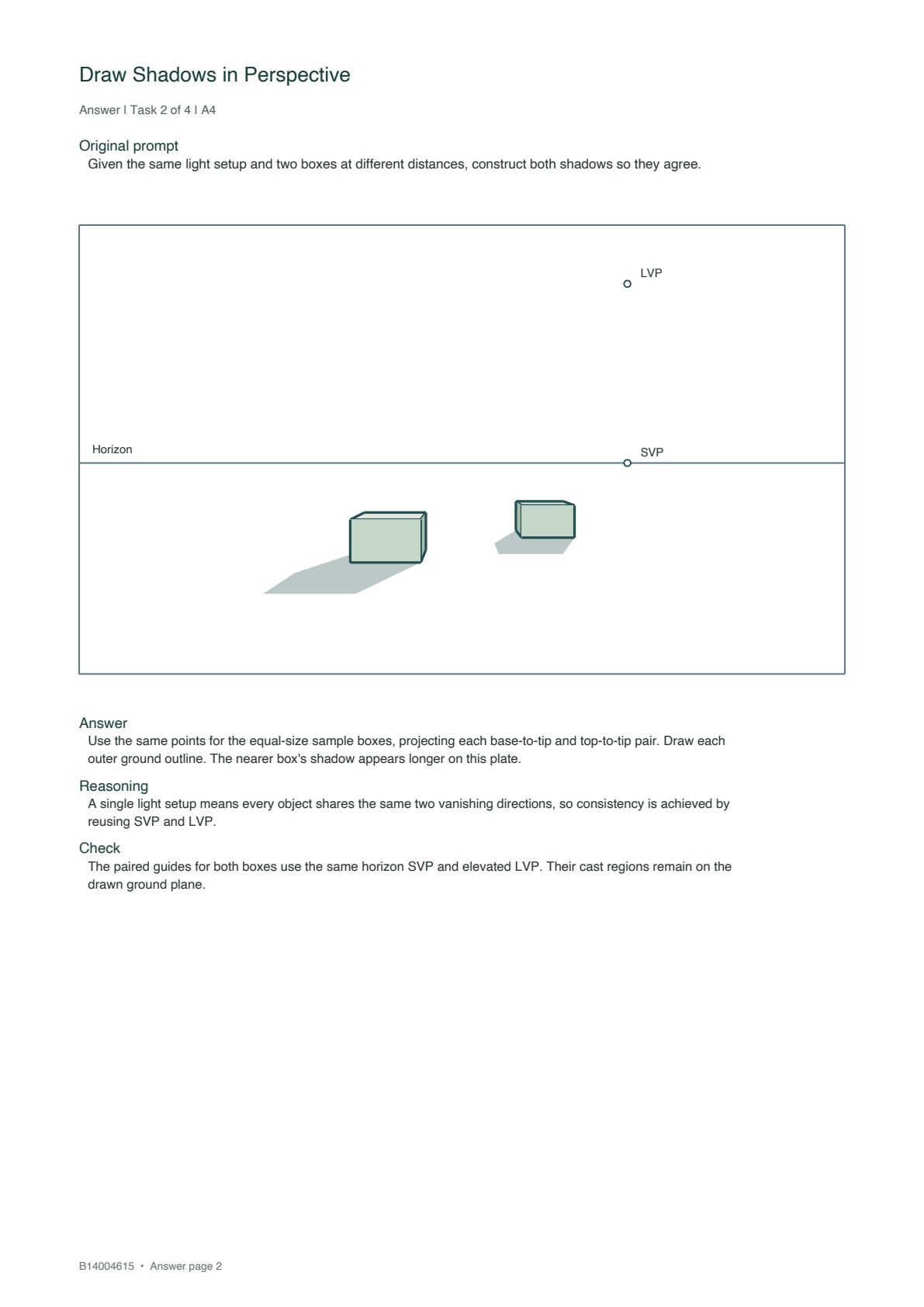
Use the same points for the equal-size sample boxes, projecting each base-to-tip and top-to-tip pair. Draw each outer ground outline. The nearer box's shadow appears longer on this plate.
A single light setup means every object shares the same two vanishing directions, so consistency is achieved by reusing SVP and LVP.
Check: The paired guides for both boxes use the same horizon SVP and elevated LVP. Their cast regions remain on the drawn ground plane.
Task 3
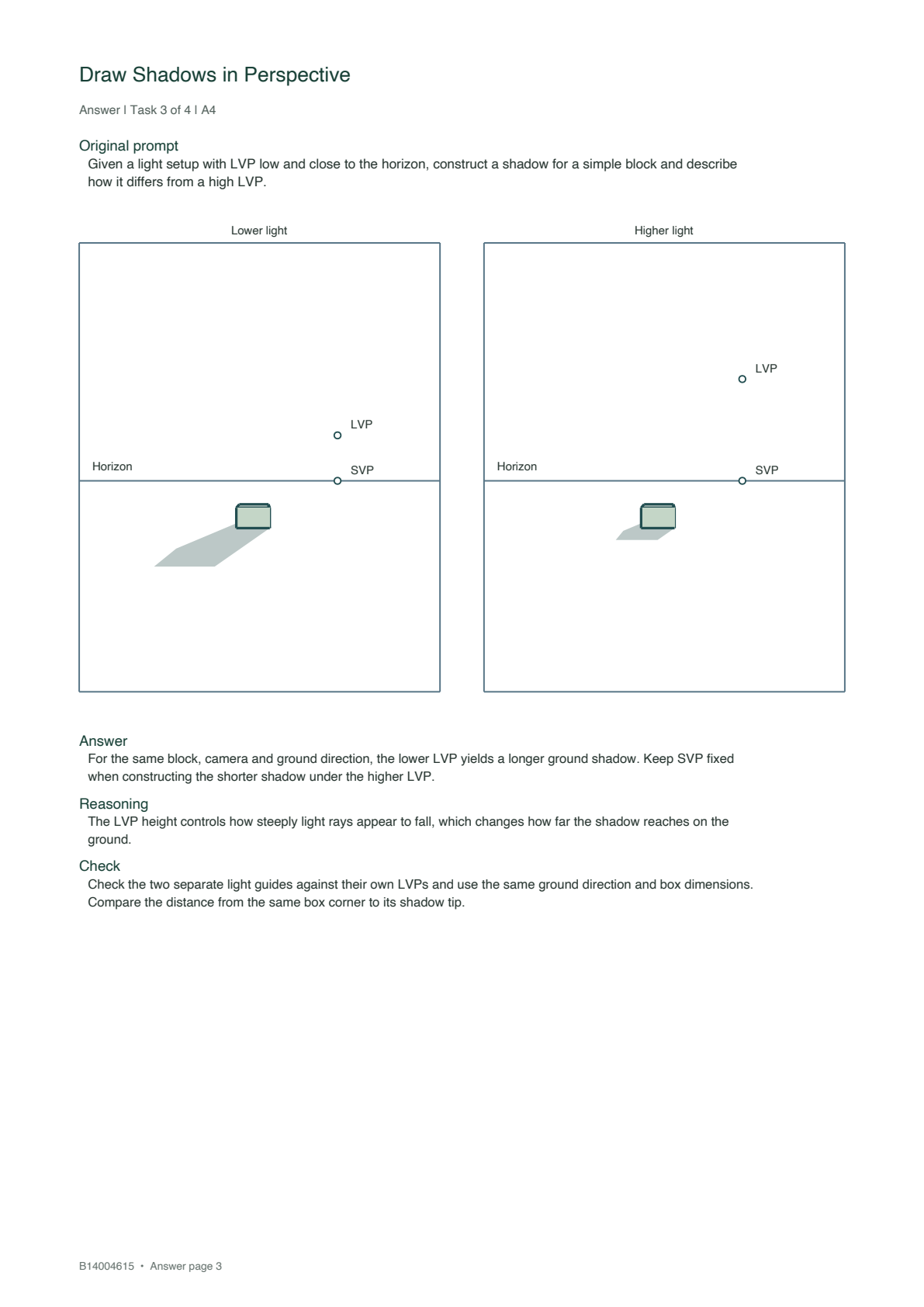
Given a light setup with LVP low and close to the horizon, construct a shadow for a simple block and describe how it differs from a high LVP.
Show answer 3
For the same block, camera and ground direction, the lower LVP yields a longer ground shadow. Keep SVP fixed when constructing the shorter shadow under the higher LVP.
The LVP height controls how steeply light rays appear to fall, which changes how far the shadow reaches on the ground.
Check: Check the two separate light guides against their own LVPs and use the same ground direction and box dimensions. Compare the distance from the same box corner to its shadow tip.
Task 4
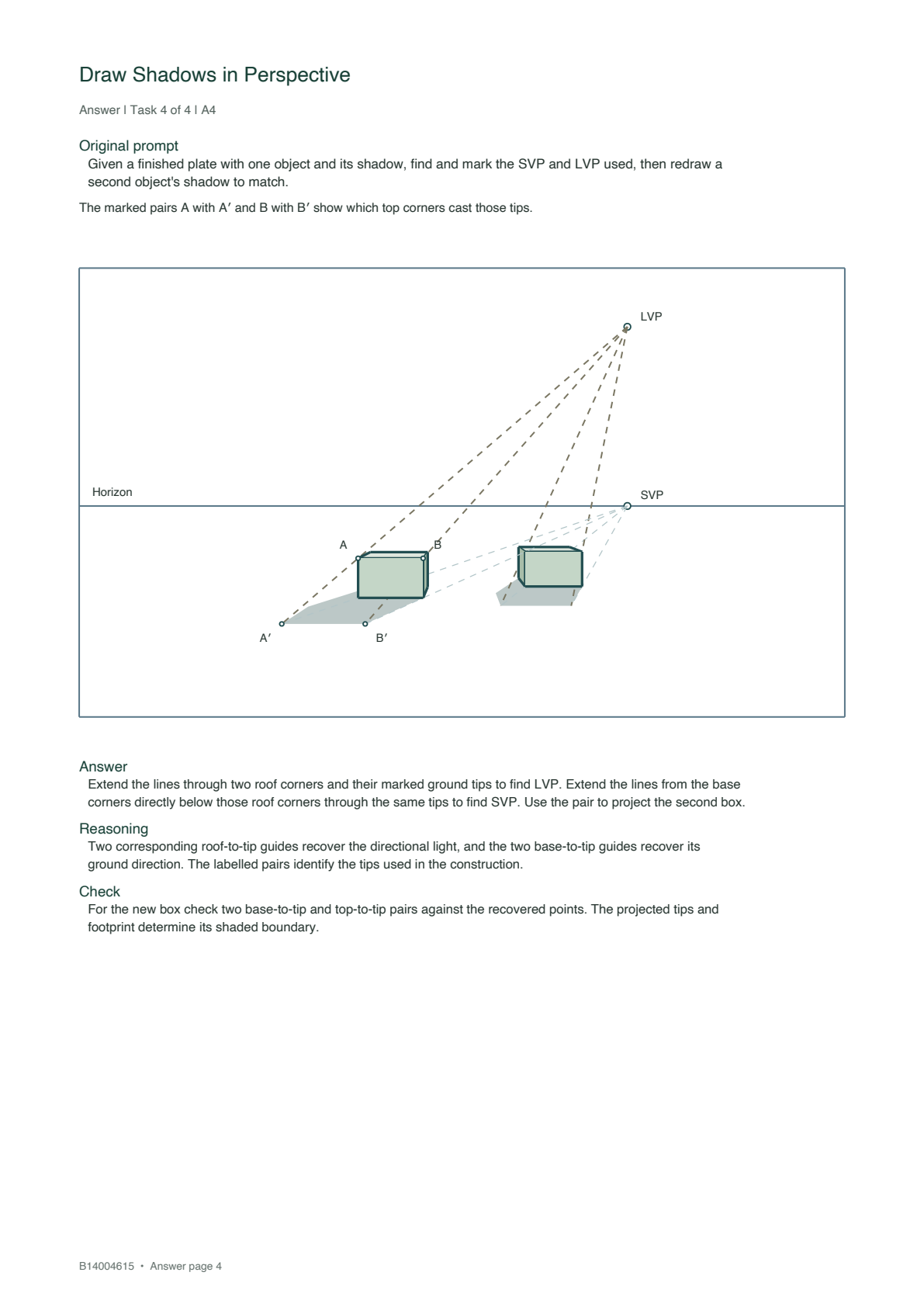
Given a finished plate with one object and its shadow, find and mark the SVP and LVP used, then redraw a second object's shadow to match.
Show answer 4
Extend the lines through two roof corners and their marked ground tips to find LVP. Extend the lines from the base corners directly below those roof corners through the same tips to find SVP. Use the pair to project the second box.
Two corresponding roof-to-tip guides recover the directional light, and the two base-to-tip guides recover its ground direction. The labelled pairs identify the tips used in the construction.
Check: For the new box check two base-to-tip and top-to-tip pairs against the recovered points. The projected tips and footprint determine its shaded boundary.
Useful checks
- Using different SVP or LVP for each object on the same plate. Fix one SVP and one LVP for the whole plate so all shadows agree.
- Projecting top corners to SVP instead of LVP. Ground contact points go to SVP; matching top corners go to LVP.
- Closing the shadow before marking all crossings. Locate all the projected tips, then trace the outer ground boundary that includes those tips and the box footprint.
Questions about this resource
Why are there two vanishing points for a shadow?
One controls the ground shadow direction (SVP) and one controls the light-ray direction (LVP); together they fix the shadow's shape.
Can I use this for any object?
The simple example needs a directional light, flat ground and identifiable corresponding points on the object and its projected shadow. A local lamp or uneven ground needs a different setup.