Free original lessons
Draw Sugar Granules and Cubes: Shape, Texture, and Practice
Learn to draw sugar granules and cubes with clear shape steps, texture cues, and a blank practice panel for focused sketching.
Free lesson
Four exercises
Worked answers
Object Drawing Lessons
Sugar appears in two common drawing subjects: tiny irregular granules and blocky cubes. This lesson separates their geometry, shows how to suggest crystalline texture without overworking, and provides a structured practice sequence. You will use a simple convention for scale and a rubric that accepts valid stylistic alternatives. All measurements are hypothetical examples; measure your own paper and tools before drawing.
Practice materials: Printable downloads are not available for this lesson yet. Use the instructions and four exercises below.
Reference illustration
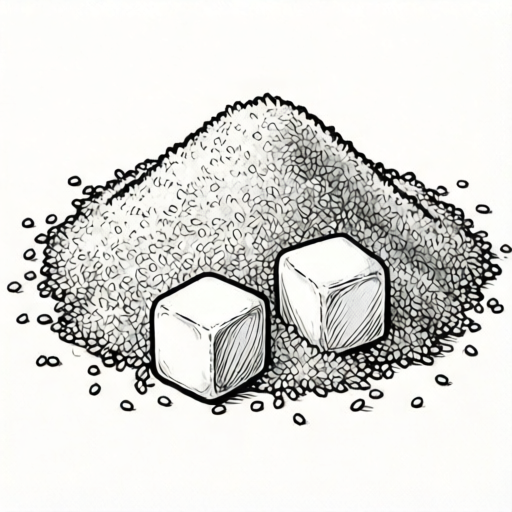
Use the stated measurements and conventions for each exercise.
Granule geometry and texture cues
A sugar granule is a small, irregular polyhedron. At drawing scale, treat each granule as a tiny faceted shape with two or three visible planes. Avoid perfect circles; vary edge angles and size slightly. A useful convention: define one granule unit as roughly the width of a pencil tip (about 1 mm on a typical sketch). This is a hypothetical example, not a standard.
Texture comes from contrast between adjacent facets, not from shading every grain. Draw a cluster as overlapping outlines, then add short directional strokes on a few facets to suggest light catching an edge. Leave white space between some granules to prevent a muddy mass.
- Draw three to five tiny irregular polygons, each about one pencil-tip wide, with two or three sides visible.
- Vary the angles: one granule sharper, one rounder, one elongated.
- Add a single short stroke on the lit facet of two granules only.
- Check that at least one gap remains between granules so the cluster reads as separate pieces.
Cube construction and edge logic
A sugar cube is a rounded rectangular prism. Draw it as a box with softened corners. Use a simple isometric convention: vertical edges stay vertical, and the two receding edge sets slant at consistent angles. A hypothetical example is 30 degrees from horizontal for both receding directions; choose angles that match your own view and keep them consistent.
Show three faces: top, front, and one side. The top face is a parallelogram; the front is a rectangle; the side is a parallelogram. Round only the corners, not the whole shape. Texture on a cube is subtler than on granules: a few tiny dots or short strokes on one face suggest compressed crystals.
- Draw a vertical front rectangle with rounded corners.
- From its top corners, draw two parallel receding lines at the same angle.
- Close the top parallelogram and the side parallelogram with rounded corners.
- Add three to five tiny marks on one face only to suggest crystal texture.
- Check that all receding lines are parallel in pairs.
Scale, spacing, and the practice panel
Decide a scale before drawing: for example, one cube equals four granule units in width. This is a hypothetical ratio; adjust to your paper. Keep units consistent within a single drawing. On a blank practice panel, divide the space into three zones: granule cluster, single cube, and cube stack. Label zones lightly in pencil if helpful, then erase labels after practice.
Spacing matters. Granules should sit close but not merge; cubes should touch only where stacked. A simple check is to trace a finger between shapes: if the gap disappears, redraw that edge.
- Mark a practice panel with three light zones.
- In zone one, draw a granule cluster of six to eight pieces.
- In zone two, draw one cube using the isometric convention.
- In zone three, draw two stacked cubes sharing one top face.
- Review gaps and parallel edges before adding texture.
Worked example
Draw one sugar cube and a cluster of five granules beside it, using a scale where the cube width equals four granule units. Use the isometric convention with parallel receding edges.
Worked answer
A cube with three visible faces, rounded corners, and parallel receding edge pairs; beside it, five irregular polygons each about one quarter of the cube width, with two or three facets and one short highlight stroke on two granules. Gaps remain between granules.
Four practice exercises
Exercise 1
Draw a single granule with three visible facets. Label the lit facet with a short stroke.
Show answer and check
An irregular polygon with three sides visible and one short stroke on the brightest facet.
Why: A granule reads as faceted when at least two planes meet at an angle; one highlight confirms light direction.
Check: Confirm the shape has three distinct sides and only one highlight stroke.
Exercise 2
Draw a cube using vertical front edges and two parallel receding pairs at the same angle. Round only the corners.
Show answer and check
A box with a rectangular front, parallelogram top and side, parallel receding pairs, and softened corners.
Why: Parallel receding pairs create a consistent isometric read; rounding only corners preserves block structure.
Check: Trace each receding line; pairs must be parallel. Check that straight edges are not bowed.
Exercise 3
Draw a cluster of six granules with at least two gaps and texture on only two granules.
Show answer and check
Six irregular polygons, two visible gaps, and short strokes on two facets.
Why: Gaps separate pieces; limited texture prevents a muddy mass.
Check: Count gaps and textured granules; gaps must be at least two and textured granules exactly two.
Exercise 4
Draw two stacked cubes sharing one top face, with a scale note that one cube equals four granule units.
Show answer and check
Two cubes aligned so the upper cube sits on the lower top face; a written scale note of 1 cube = 4 units.
Why: Shared face shows stacking logic; a scale note keeps units consistent.
Check: Verify the shared face is drawn once and the scale note matches the stated ratio.
Common mistakes
- Drawing granules as perfect circles or dots. Use irregular polygons with two or three visible facets; vary edge angles.
- Shading every granule heavily. Add contrast to only a few facets and leave most outlines light.
- Making cube receding lines non-parallel. Draw both receding edge sets as parallel pairs at one chosen angle.
- Rounding the entire cube instead of just corners. Keep straight edges straight; soften only the corner junctions.
Self-check rubric
- Granules are irregular polygons, not circles, with visible facets.
- At least one gap remains between granules in the cluster.
- Cube shows three faces with parallel receding edge pairs.
- Cube corners are rounded but edges remain straight.
- Texture marks appear on a few facets only, not all.
- Scale is consistent within the drawing.
Questions and answers
Do I need special paper?
No. Any sketch paper works. Measure your own paper size and pencil width to set a scale.
How many granules should a cluster have?
Six to eight is enough to show variation without clutter. Adjust to your panel size.
Can I use a different cube angle?
Yes. Choose any consistent receding angle; the rubric checks parallelism, not a fixed degree.
How do I know texture is working?
Step back: if you see separate facets and a few bright edges, texture reads. If it looks like a gray blob, reduce strokes.