Free original lessons
Draw a Ferris Wheel: Spoke Layout and Capsule Ring
Learn radial spoke construction, even capsule placement, and circular symmetry to draw a large observation wheel with a clean hub and rim.
Free lesson
Four exercises
Worked answers
Object Drawing Lessons
A large observation wheel looks complex, but it is built from a few repeatable geometric decisions. This lesson shows how to set a center, divide the circle into equal angles, draw spokes that radiate cleanly, and place capsule rectangles around the rim so the wheel reads as balanced and intentional. You will work with a simple convention: capsule size and spoke style may vary, so the rubric rewards consistent spacing and clear radial construction rather than a single perfect line. All measurements below are hypothetical examples; measure your own paper and tools before drawing.
Practice materials: Printable downloads are not available for this lesson yet. Use the instructions and four exercises below.
Reference illustration
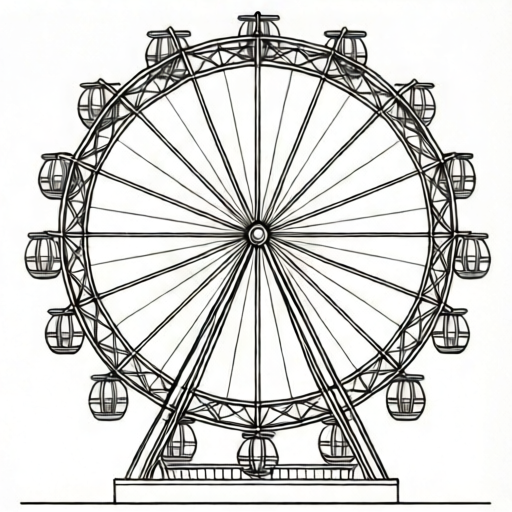
Use the stated measurements and conventions for each exercise.
Set the center and the rim
Begin by choosing a center point that leaves room for the full wheel and a small margin. Mark it lightly. Decide a rim radius that fits your page, for example 8 cm on a 21 by 29.7 cm sheet. Use a compass or a circular guide to draw the outer rim once, lightly, so you can adjust later.
Draw a vertical center line and a horizontal center line through the center point. These are construction lines, not final spokes. They help you check that the wheel is not leaning and that the top and bottom capsules will sit opposite each other.
- Mark the center point with a small cross.
- Draw one light circle for the rim using your chosen radius.
- Add vertical and horizontal center lines through the center.
- Check that the rim is round by rotating the paper and comparing the curve.
Divide the circle into equal angles
A wheel with many capsules needs evenly spaced attachment points. For a 12-capsule layout, each gap is 360 divided by 12, which equals 30 degrees. For 16 capsules, each gap is 22.5 degrees. Choose a number that divides evenly into 360 so the arithmetic stays simple and checkable.
Use a protractor or an angle template to mark the first quadrant only. Start at the top vertical line and mark every chosen angle until you reach the horizontal line. Then mirror those marks into the other three quadrants by measuring the same distances from the center lines. This quadrant-first method reduces cumulative angle error.
- Choose a capsule count that divides 360 evenly, such as 12 or 16.
- Calculate the angle gap: 360 divided by the capsule count.
- Mark angle positions in the top-right quadrant only.
- Mirror the marks across the vertical and horizontal center lines.
- Number the marks lightly so you can check for missing or doubled points.
Draw spokes and place capsule rectangles
Spokes should run from the hub to the rim attachment points. Draw them as straight lines with a consistent width, or as double lines if you want a structural look. Keep the hub small and centered; a hub that drifts makes the whole wheel look unbalanced.
Each capsule is a small rectangle or rounded rectangle centered on its rim point. A practical convention is to make each capsule about one-eighth of the rim radius in width and about one-sixth in height, but treat these as hypothetical proportions and adjust to your drawing size. The capsule should sit outside the rim, with its inner edge touching or slightly overlapping the rim line. Rotate each capsule so its long axis points outward from the center. This radial alignment is what makes the ring of capsules look orderly.
- Draw the hub as a small circle at the center point.
- Connect each rim mark to the hub with a light spoke line.
- At each rim mark, draw a capsule rectangle centered on the spoke direction.
- Rotate each capsule so its long axis points away from the center.
- Check that opposite capsules are aligned across the center.
Complete by symmetry and refine
After drawing one quadrant, use the center lines to mirror the spokes and capsules into the remaining quadrants. Compare opposite pairs: the capsule at the top should match the capsule at the bottom in size and angle, and the left and right capsules should mirror each other. If a pair does not match, adjust the lighter construction line first, then darken the final line.
Refine the rim by drawing a second, slightly inner circle if you want a double rim. Keep the gap between the two circles even. Erase construction marks carefully, and darken the final spokes and capsules only after the symmetry check passes.
- Mirror the top-right quadrant into the top-left, bottom-left, and bottom-right.
- Compare opposite capsule pairs for size and radial alignment.
- Add an inner rim line only if it stays evenly spaced.
- Erase construction marks and darken final lines.
- Label the capsule count and angle gap in the margin for your own check.
Worked example
A student draws a wheel with 12 capsules and a rim radius of 8 cm. They mark the top-right quadrant every 30 degrees. How many marks should appear in that quadrant from the top vertical line to the horizontal line, including both endpoints?
Worked answer
Four marks: at 0, 30, 60, and 90 degrees from the top vertical line. The 0-degree mark is the top point, and the 90-degree mark is the right point. The gap is 360 divided by 12, which equals 30 degrees.
Four practice exercises
Exercise 1
A wheel has 16 capsules. Calculate the angle gap between adjacent capsule attachment points. Then state how many marks appear in one quadrant from the top vertical line to the horizontal line, including both endpoints.
Show answer and check
The angle gap is 360 divided by 16, which equals 22.5 degrees. One quadrant contains five marks: 0, 22.5, 45, 67.5, and 90 degrees.
Why: Dividing the full circle by the capsule count gives the gap. A quadrant spans 90 degrees, so the number of intervals is 90 divided by 22.5, which equals 4 intervals, giving 5 marks including both endpoints.
Check: Multiply the gap by the number of intervals: 22.5 times 4 equals 90 degrees. Count the marks: 0, 22.5, 45, 67.5, 90, which is five marks.
Exercise 2
A student uses a rim radius of 10 cm and makes each capsule 1.5 cm wide. Using the hypothetical convention that capsule width is about one-eighth of the rim radius, is 1.5 cm a reasonable width? Show the arithmetic.
Show answer and check
One-eighth of 10 cm is 1.25 cm. A width of 1.5 cm is slightly larger than the convention but still close; it is reasonable if the capsules do not overlap.
Why: The convention gives a starting size, not a rule. The check is whether adjacent capsules overlap. With 12 capsules, the rim circumference is about 2 times 3.14 times 10, which equals 62.8 cm, so the spacing along the rim is about 62.8 divided by 12, which equals about 5.2 cm. A 1.5 cm capsule fits within that spacing.
Check: Calculate one-eighth of the radius: 10 divided by 8 equals 1.25 cm. Compare 1.5 cm to 1.25 cm. Then estimate rim spacing: circumference divided by capsule count. Confirm that capsule width is less than spacing.
Exercise 3
A drawing has 12 spokes, but the student marked 13 capsule positions around the rim. What is the most likely error, and how can they check it using angle arithmetic?
Show answer and check
The most likely error is a doubled or misplaced mark in one quadrant, or counting the top mark twice when mirroring. With 12 capsules, the gap is 30 degrees. The student should count intervals, not marks: 360 divided by 30 equals 12 intervals, which gives 12 capsules around a closed ring.
Why: A closed ring has the same number of gaps as capsules. If the student counts 13 marks, one gap is too small or one mark is duplicated. Checking each quadrant for the correct number of marks and comparing opposite pairs will locate the error.
Check: List the angle positions from 0 to 330 in 30-degree steps. There should be 12 positions. If a position appears twice or an extra angle is inserted, remove it and recheck the mirror.
Exercise 4
A capsule at the top of the wheel is drawn 2 cm tall and 1 cm wide. A capsule at the right side is drawn 1 cm tall and 2 cm wide. Using the radial alignment convention, explain whether these two capsules are consistent, and state what should be checked.
Show answer and check
They are consistent if each capsule's long axis points outward from the center. The top capsule should be taller than wide because its outward direction is vertical; the right capsule should be wider than tall because its outward direction is horizontal. Check that each capsule is rotated to match its spoke direction and that opposite pairs mirror correctly.
Why: Radial alignment means the capsule's long axis follows the spoke. At the top, the spoke is vertical, so the long axis is vertical. At the right, the spoke is horizontal, so the long axis is horizontal. The dimensions swap because the orientation changes, not because the capsules are different sizes.
Check: Draw a short arrow from the center through each capsule. Confirm that the capsule's longer side is parallel to that arrow. Then compare the top capsule with the bottom capsule and the right capsule with the left capsule for matching size.
Common mistakes
- Spokes do not meet at a single center point. Redraw the hub first, then extend each spoke from the hub edge to the rim mark. Check with a straight edge that every spoke passes through the center cross.
- Capsules are placed at uneven gaps around the rim. Recalculate the angle gap by dividing 360 by the capsule count. Mark one quadrant, mirror it, and number the marks before drawing capsules.
- Capsules are not rotated outward, so they look tilted randomly. Align each capsule's long axis with its spoke direction. A capsule at the top points up; one at the right points right; one at the bottom points down.
- The rim is drawn as an oval rather than a circle. Rotate the paper while drawing and compare the curve from several directions. Use a compass or circular guide for the first light rim.
Self-check rubric
- Center is clearly marked and all spokes meet at the hub.
- Rim is circular within the drawing's own scale and is drawn lightly before final lines.
- Capsule count divides 360 evenly, and the angle gap is stated or implied.
- Capsules are evenly spaced around the rim and mirrored across center lines.
- Each capsule is rotated so its long axis points outward from the center.
- Opposite capsule pairs match in size and alignment.
- Construction lines are erased or clearly subordinate to final lines.
- Valid alternatives are accepted: capsule shape may be rectangular or rounded, and spoke style may be single or double, provided spacing and radial alignment remain consistent.
Questions and answers
How many capsules should I draw?
Choose a count that divides 360 evenly, such as 12 or 16. Twelve gives a 30-degree gap; sixteen gives a 22.5-degree gap. Fewer capsules are easier to space, while more capsules create a denser ring.
Do I need a protractor?
A protractor makes angle marking easier, but you can also use an angle template or divide the quadrant by repeated bisection. Whatever tool you use, check that the marks mirror correctly across the center lines.
How large should each capsule be?
There is no universal size. A workable convention is to make each capsule about one-eighth of the rim radius wide and one-sixth tall, but these are hypothetical proportions. Adjust so capsules are visible and do not overlap.
Can I draw the wheel without a compass?
Yes. Use a circular guide, a plate, or a string tied to a pencil. Draw the rim lightly first, then check roundness by rotating the paper and comparing the curve.