Free original lessons
Draw the Sphinx: Headdress and Paw Construction Steps
Learn to draw the Sphinx using ordered steps for body mass, headdress, face, and paw placement, with a blank grid for redrawing from the same sequence.
Free lesson
Four exercises
Worked answers
Object Drawing Lessons
This guide teaches a repeatable construction sequence for drawing the Sphinx, focusing on the headdress and paw placement that define its silhouette. You will build the figure from large masses to specific details, using a simple convention for proportion and alignment. The method is designed for pencil and paper, and it works at any scale as long as you keep the same relative measurements. You will practice with four self-contained exercises and compare your results against a clear rubric that allows valid stylistic variation.
Practice materials: Printable downloads are not available for this lesson yet. Use the instructions and four exercises below.
Reference illustration
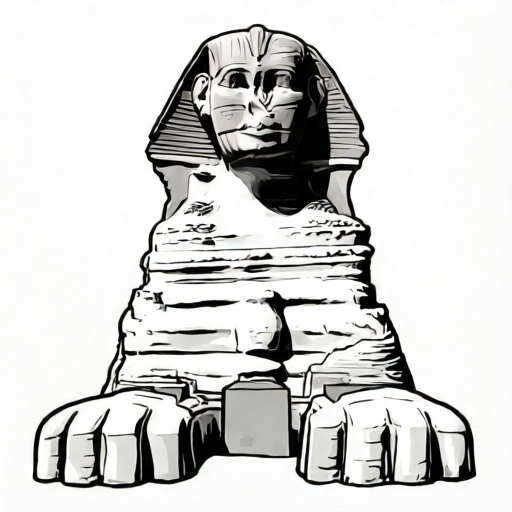
Use the stated measurements and conventions for each exercise.
Establishing the Body Mass and Ground Line
Begin by drawing a light horizontal ground line. Mark a total body length from the front paw tip to the rear haunch. Divide that length into three equal parts: front paws and chest, midsection, and hindquarters. The Sphinx typically rests with forepaws extended forward and the body low to the ground.
Draw a long oval for the body mass, tilted slightly so the chest is higher than the hindquarters. Add a smaller oval for the haunch at the rear. Keep all lines light so they can be adjusted. The head will sit above the chest, not above the midsection.
- Draw a horizontal ground line and mark three equal body-length segments.
- Place a long oval for the body, with the chest end slightly higher.
- Add a smaller oval at the rear for the haunch.
- Lightly mark the chest center where the head will align.
Building the Headdress and Head
The headdress, often called a nemes, creates a trapezoidal shape around the face. Draw a vertical center line through the chest mark. Place the face as a small oval centered on that line, then build the headdress outward: two side flaps that widen toward the shoulders and a top band that arcs over the forehead.
Use a simple convention: the face height is one-quarter of the body length. The headdress side flaps extend down to the shoulder line, and their outer edges flare outward by about one-eighth of the body length on each side. These are hypothetical proportions for practice; adjust them to match your reference if you have one.
- Draw a vertical center line through the chest mark.
- Place a small oval for the face on the center line.
- Add the top band of the headdress as a shallow arc above the face.
- Draw the side flaps as widening trapezoids down to the shoulder line.
- Check that the headdress is symmetrical about the center line.
Placing the Face Features and Forepaws
Within the face oval, mark the eye line at the vertical midpoint and the nose line one-third down from the top. Keep features simple: two short eye marks, a narrow nose, and a calm mouth line. The headdress should frame the face without covering it.
For the forepaws, draw two long rectangles extending forward from the chest, parallel to the ground line. Each paw is about one-third of the body length. Round the front ends and add three short toe lines per paw. The paws should be level with each other and rest on the ground line.
- Mark the eye line and nose line inside the face oval.
- Add simple eye, nose, and mouth marks.
- Draw two forward rectangles for the forepaws from the chest.
- Round the paw ends and add three toe lines per paw.
- Confirm both paws touch the ground line and are level.
Refining the Silhouette and Checking Alignment
Darken the final outline: the headdress trapezoid, the face oval, the body oval, the haunch, and the forepaws. Erase the construction lines gently. Check that the headdress side flaps reach the shoulder line and that the forepaws are centered under the chest.
A useful check is to measure the distance from the ground line to the top of the headdress and compare it to the body length. In this convention, the total height is about half the body length. If your drawing differs greatly, adjust the headdress height rather than the paws, which anchor the figure to the ground.
- Darken the final outline and erase construction lines.
- Verify headdress flaps reach the shoulder line.
- Verify forepaws are centered and level on the ground line.
- Compare total height to body length using the half-length convention.
Worked example
A learner draws a Sphinx with a body length of 12 cm. Using the convention in this guide, what should be the face height, the outward flare of each headdress side flap, and the length of each forepaw?
Worked answer
Face height: 3 cm (one-quarter of 12 cm). Outward flare per side flap: 1.5 cm (one-eighth of 12 cm). Forepaw length: 4 cm (one-third of 12 cm).
Four practice exercises
Exercise 1
Draw a Sphinx with a body length of 9 cm using the construction sequence. State the face height, side-flap flare per side, and forepaw length you used.
Show answer and check
Face height 2.25 cm; side-flap flare 1.125 cm per side; forepaw length 3 cm.
Why: Apply the conventions: face height is one-quarter of body length (9 ÷ 4 = 2.25), flare is one-eighth per side (9 ÷ 8 = 1.125), and forepaw length is one-third (9 ÷ 3 = 3).
Check: Measure each stated value on your drawing with a ruler. Confirm the face oval height, the horizontal distance from center line to each flap edge, and the paw rectangle length match the calculated values within 2 mm.
Exercise 2
A drawing has a body length of 15 cm and a total height from ground line to top of headdress of 8 cm. Using the half-length convention, is the height acceptable? If not, what should it be?
Show answer and check
No. The expected total height is 7.5 cm (half of 15 cm). The drawn height of 8 cm is 0.5 cm too tall.
Why: The convention states total height is about half the body length. Half of 15 cm is 7.5 cm. Compare the measured 8 cm to 7.5 cm.
Check: Measure body length and total height on the drawing. Divide body length by 2 and compare to measured height. A difference of 0.5 cm or less is acceptable for practice.
Exercise 3
Describe how to adjust a Sphinx drawing where the head sits above the midsection and the forepaws are at different heights. Give the corrected placement in order.
Show answer and check
Move the vertical center line to the chest mark in the front third of the body oval. Redraw the headdress and face on that line. Then redraw both forepaw rectangles parallel to the ground line so both paw ends touch it.
Why: The head must align with the chest, and the paws must be level on the ground line. Correcting the center line first prevents repeating the head placement error when redrawing the headdress.
Check: After correction, measure the horizontal distance from the body oval's front edge to the center line; it should be about one-third of body length. Place a ruler along the ground line and confirm both paw ends touch it.
Exercise 4
Using a body length of 18 cm, calculate the face height, the total width added by both side flaps beyond the face oval, and the forepaw length. Then state one symmetry check.
Show answer and check
Face height 4.5 cm; total added width from both flaps 4.5 cm (2.25 cm per side); forepaw length 6 cm. Symmetry check: measure from the center line to each outer flap edge at the same height; the two distances should be equal.
Why: Face height is 18 ÷ 4 = 4.5 cm. Each flap flares 18 ÷ 8 = 2.25 cm, so both add 4.5 cm total. Forepaw length is 18 ÷ 3 = 6 cm. Symmetry is checked by comparing left and right distances from the center line.
Check: Measure the face oval height, the combined outward flare of both flaps, and one paw length with a ruler. For symmetry, measure left and right flap distances at the shoulder line height and confirm they differ by no more than 2 mm.
Common mistakes
- Placing the head above the midsection instead of the chest. Align the vertical center line with the chest mark, which is the front third of the body oval.
- Making the headdress side flaps too narrow or too short. Widen each flap outward by about one-eighth of the body length and extend it to the shoulder line.
- Drawing forepaws at different heights or angles. Use the ground line as a guide and keep both paw rectangles parallel to it.
- Adding face details before the headdress shape is stable. Complete the headdress trapezoid and symmetry check before marking eyes, nose, and mouth.
Self-check rubric
- Body mass is drawn as a long oval with the chest higher than the hindquarters.
- A vertical center line aligns the head with the chest, not the midsection.
- The headdress is a trapezoidal shape with a top band and two side flaps reaching the shoulder line.
- The face oval is centered on the vertical line and contains simple eye, nose, and mouth marks.
- Two forepaws extend forward, are parallel to the ground line, and are level with each other.
- Construction lines are light and final outline is clear.
- Valid stylistic alternatives are accepted if the construction order and relative proportions remain consistent.
Questions and answers
Do I need to use the exact proportions given?
No. The proportions are hypothetical examples for practice. Keep them consistent within your drawing, or adjust them to match a reference you are using.
Can I draw the Sphinx facing the other direction?
Yes. Mirror the construction sequence horizontally. The same order of body mass, headdress, face, and paws applies.
How do I know if my headdress is symmetrical?
Measure the distance from the center line to each outer flap edge at the same height. The two distances should be equal within a small margin.
What if my forepaws look too short?
Check that each paw rectangle is about one-third of the body length. If it is shorter, extend the rectangle forward while keeping it parallel to the ground line.