Free original lessons
Rolling Offset Isometric Drawing
A rolling offset shifts a run sideways and vertically between two bends. Here the two straight end runs are parallel and the bend points have no separation along those runs. Draw the offset in isometric view and calculate its true length from the sideways shift and rise.
Letter & A4
PDF & SVG
What a rolling offset is
A rolling offset has two bends. The first bend turns the run off its original line; the travel segment then rises or falls while also moving sideways; the second bend turns the run back onto a line parallel to the original. In isometric projection the three visible directions are the vertical axis and two horizontal axes drawn at 30 degrees to the horizontal.
The travel is the segment connecting the two bends. In this exercise it lies in the plane of the sideways shift and rise, with no additional displacement along the end runs. Its true length is the square root of the sum of those two squared changes. The length measured on the finished page depends on the chosen drawing scale and projection.
Drawing the plate
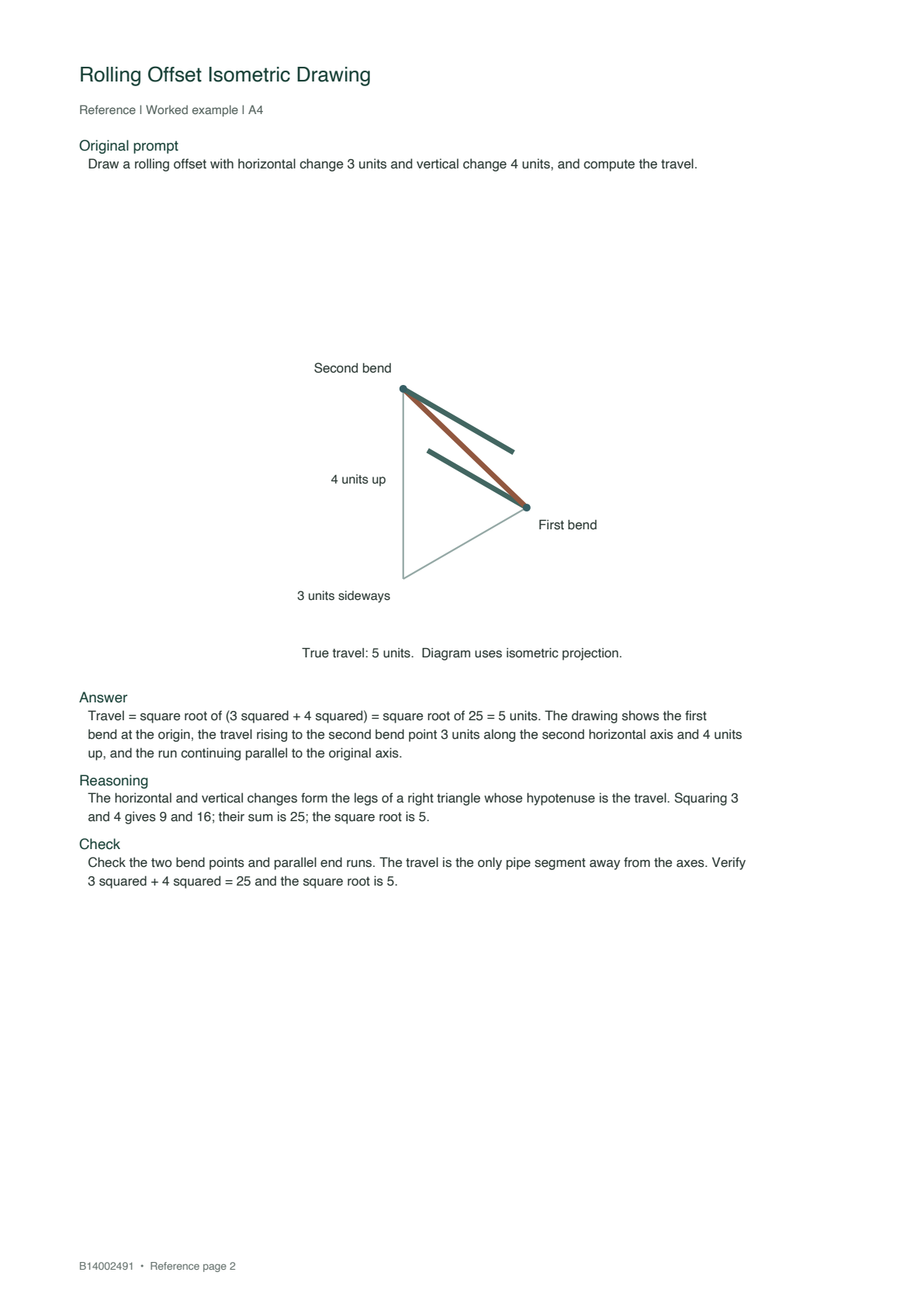
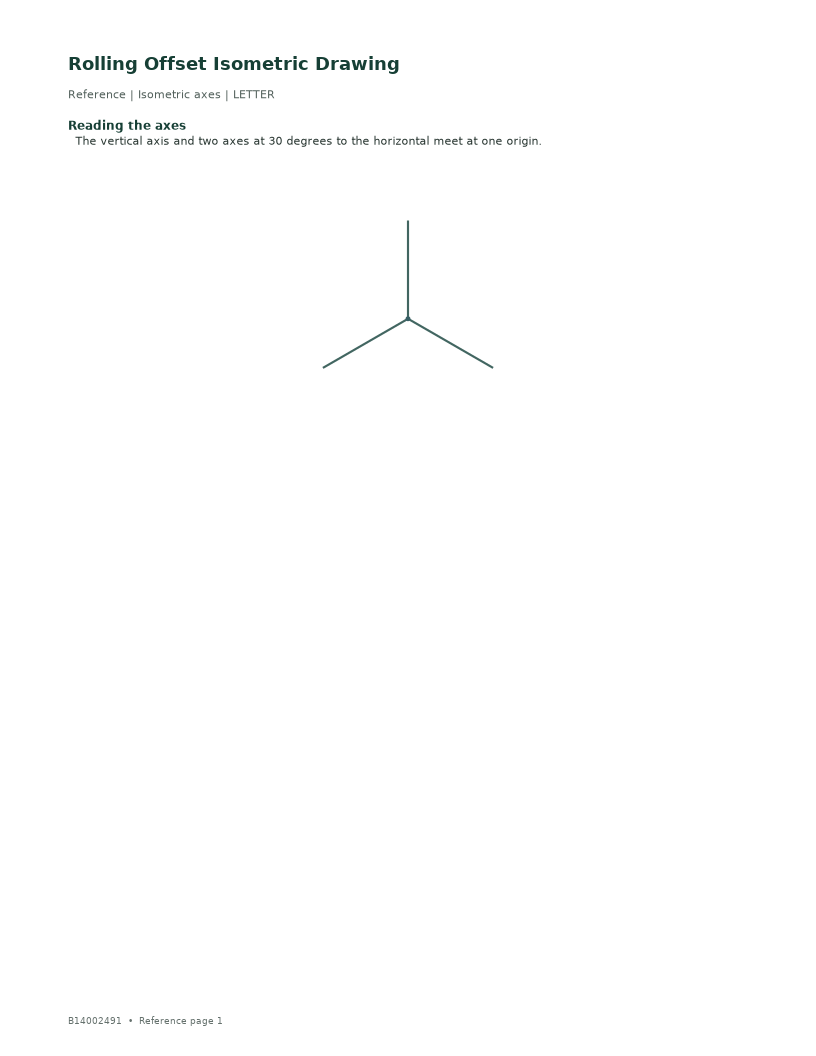
Start by drawing the isometric axes: a vertical line and two lines at 30 degrees to the horizontal, meeting at an origin. Mark the first bend point on one horizontal axis. From that point, mark the horizontal change along the other horizontal axis and the vertical change along the vertical axis; the travel runs from the first bend point to the point reached by combining those two changes.
Draw one straight travel segment between the two bend points. Continue the run from the second bend parallel to its original direction. Check that only the travel segment goes away from the isometric axes. In space, parallel end runs make equal turn angles with the travel. Their corners can look different after projection.
Worked example
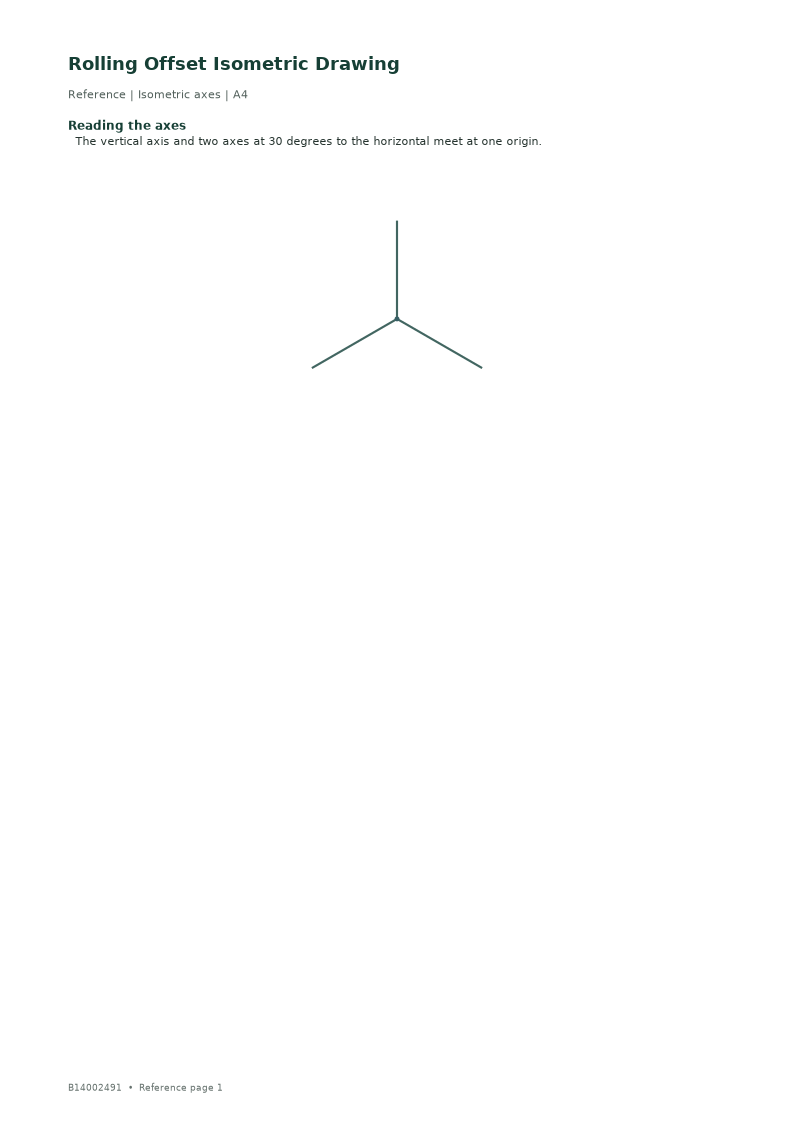
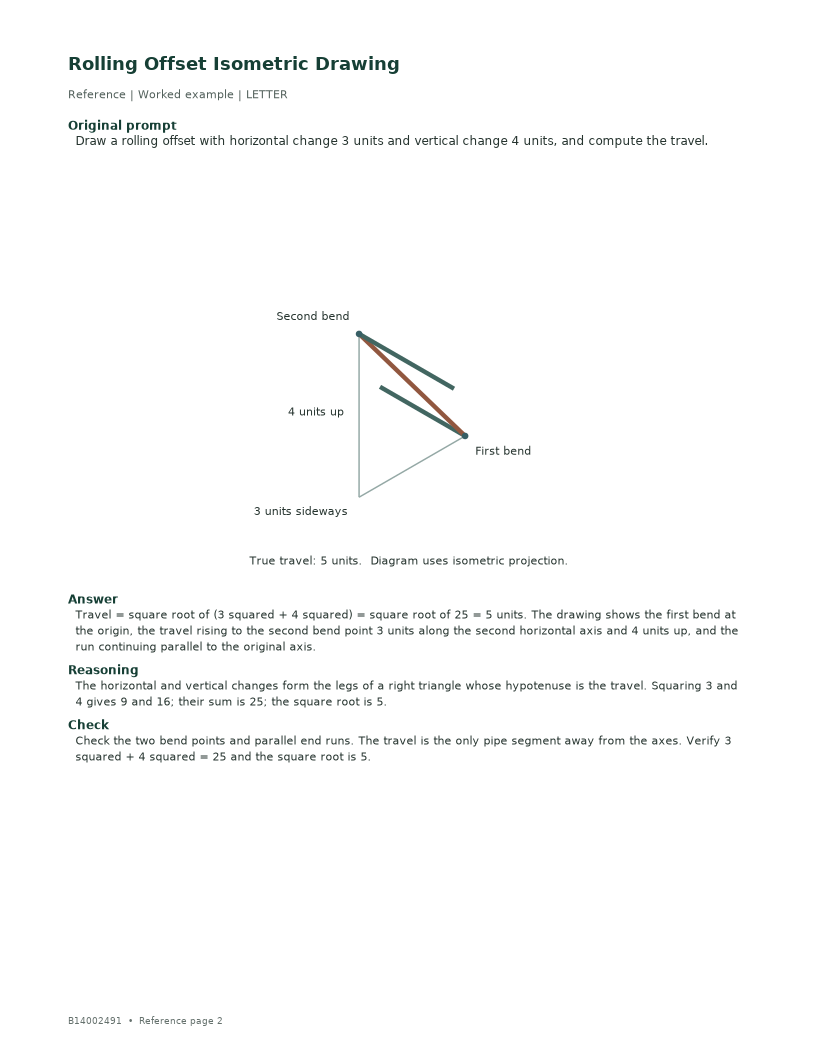
Example: a run starts along one horizontal axis. The first bend is at the origin. The horizontal change is 3 units along the other horizontal axis, and the vertical change is 4 units upward. The travel goes from the origin to the point 3 units along the second horizontal axis and 4 units up.
Travel length = square root of (3 squared + 4 squared) = square root of (9 + 16) = square root of 25 = 5 units. The drawing shows the first bend at the origin, the travel rising to the second bend point, and the run continuing parallel to the original axis.
Practice tasks
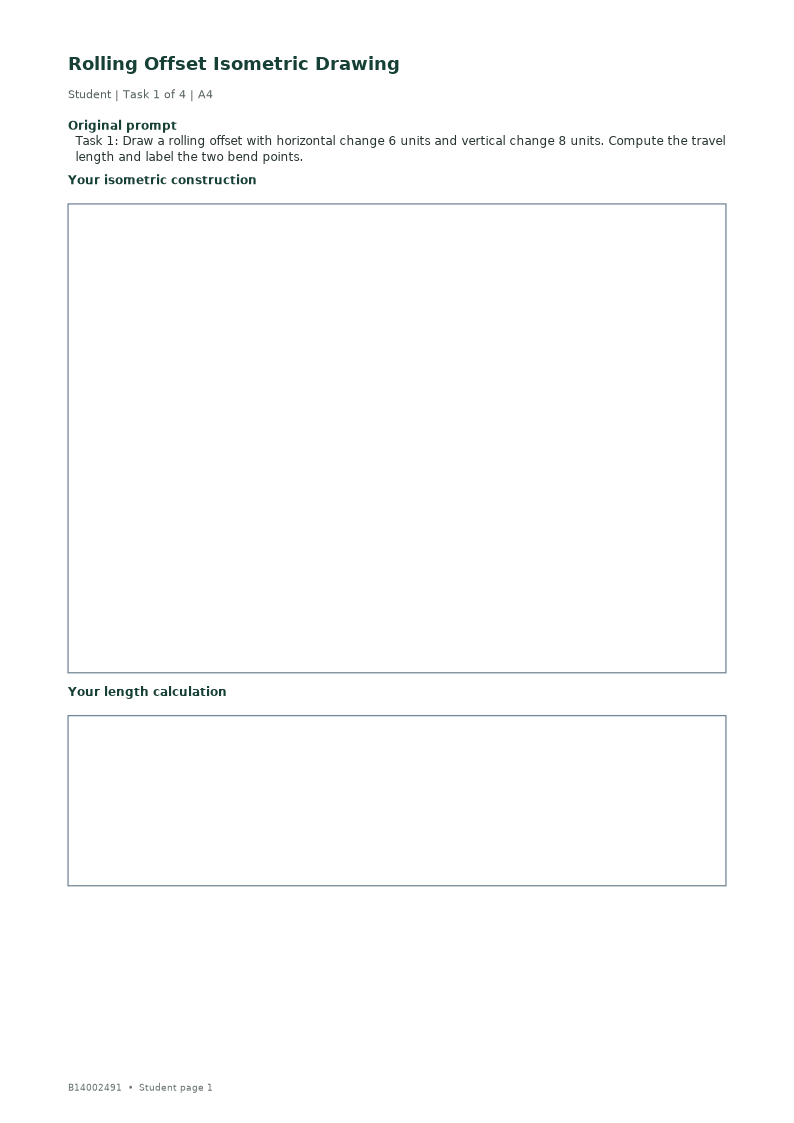
Task 1: Draw a rolling offset with a horizontal change of 6 units and a vertical change of 8 units. Compute the travel length and label the two bend points.
Task 2: Draw a rolling offset with a horizontal change of 5 units and a vertical change of 12 units. Compute its length and identify the single pipe segment that follows neither end-run direction nor a construction axis. In this drawing the end runs follow the same isometric axis direction.
Download the complete resource pack
All individual SVG pages (20)
- A4 reference page 1
- A4 reference page 2
- A4 student page 1
- A4 student page 2
- A4 student page 3
- A4 student page 4
- A4 answer page 1
- A4 answer page 2
- A4 answer page 3
- A4 answer page 4
- LETTER reference page 1
- LETTER reference page 2
- LETTER student page 1
- LETTER student page 2
- LETTER student page 3
- LETTER student page 4
- LETTER answer page 1
- LETTER answer page 2
- LETTER answer page 3
- LETTER answer page 4
Print at 100% / actual size. Use the stated scale on any schematic diagram; physical cutting templates are identified separately. A4 and US Letter are separate files. Free access, no signup; CC BY 4.0.
How to use these pages
- What a rolling offset is
- Drawing the plate
- Worked example
- Practice tasks
Worked example
Example: Draw a rolling offset with horizontal change 3 units and vertical change 4 units, and compute the travel.
Answer: Travel = square root of (3 squared + 4 squared) = square root of 25 = 5 units. The drawing shows the first bend at the origin, the travel rising to the second bend point 3 units along the second horizontal axis and 4 units up, and the run continuing parallel to the original axis.
Reasoning: The horizontal and vertical changes form the legs of a right triangle whose hypotenuse is the travel. Squaring 3 and 4 gives 9 and 16; their sum is 25; the square root is 5.
Check: Check the two bend points and parallel end runs. The travel is the only pipe segment away from the axes. Verify 3 squared + 4 squared = 25 and the square root is 5.
Four practice tasks and complete answers
Task 1
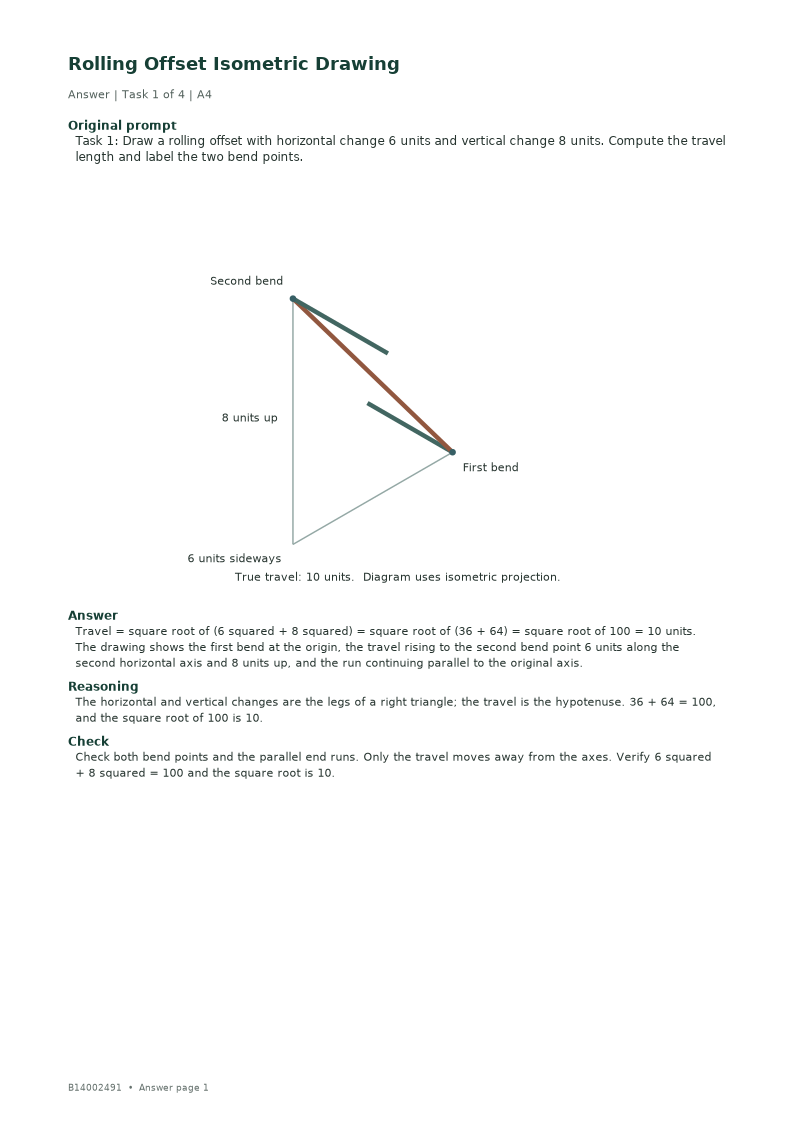
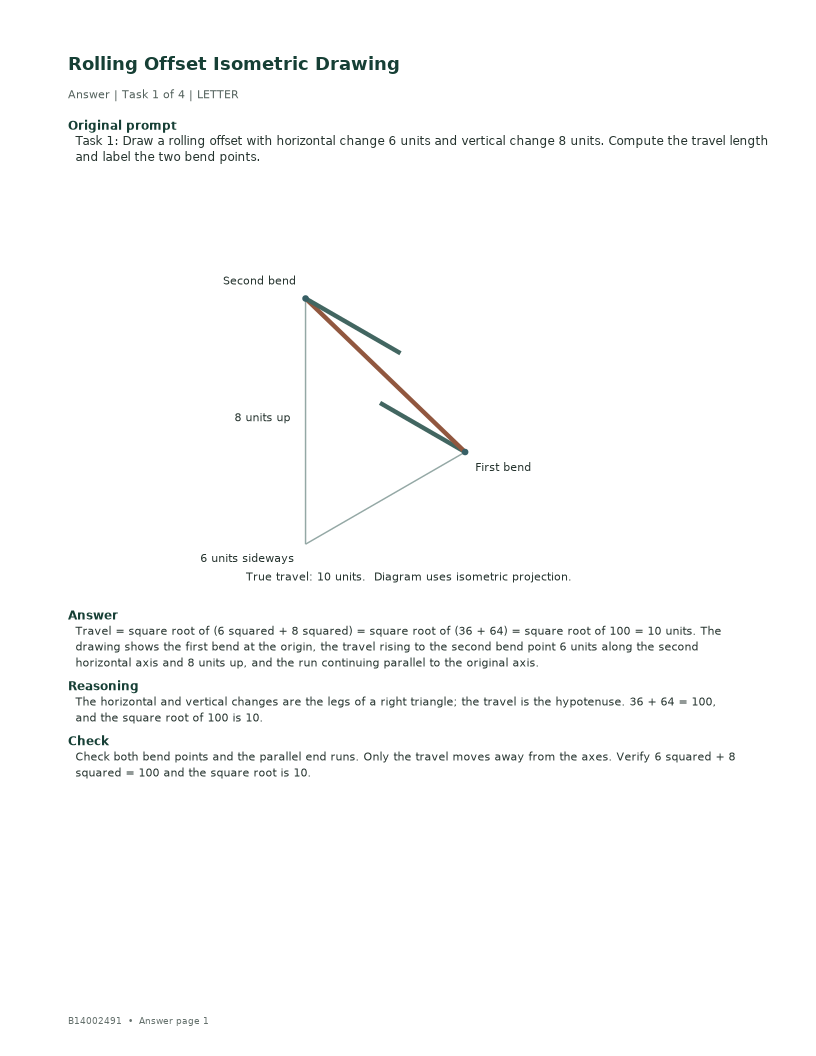
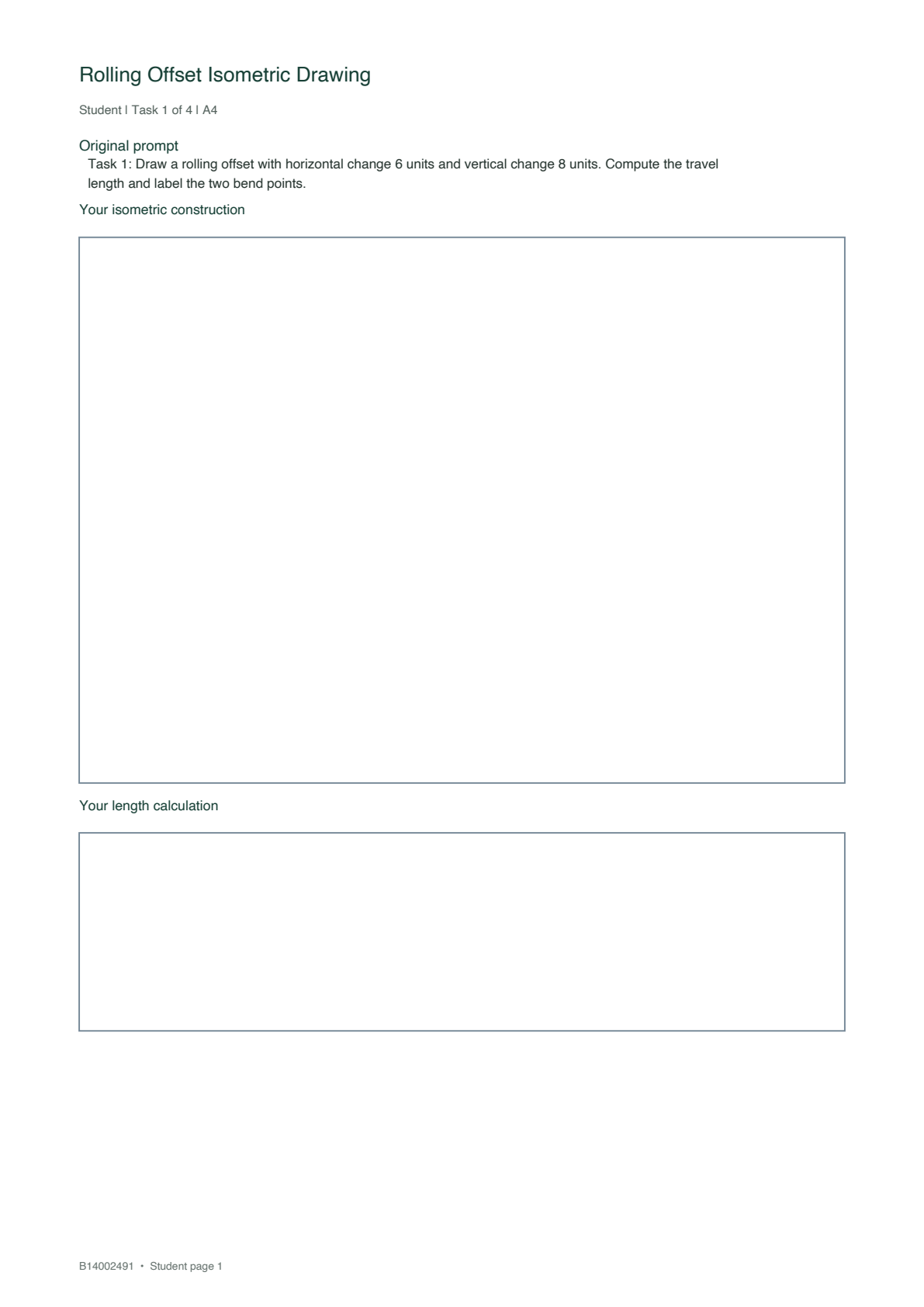
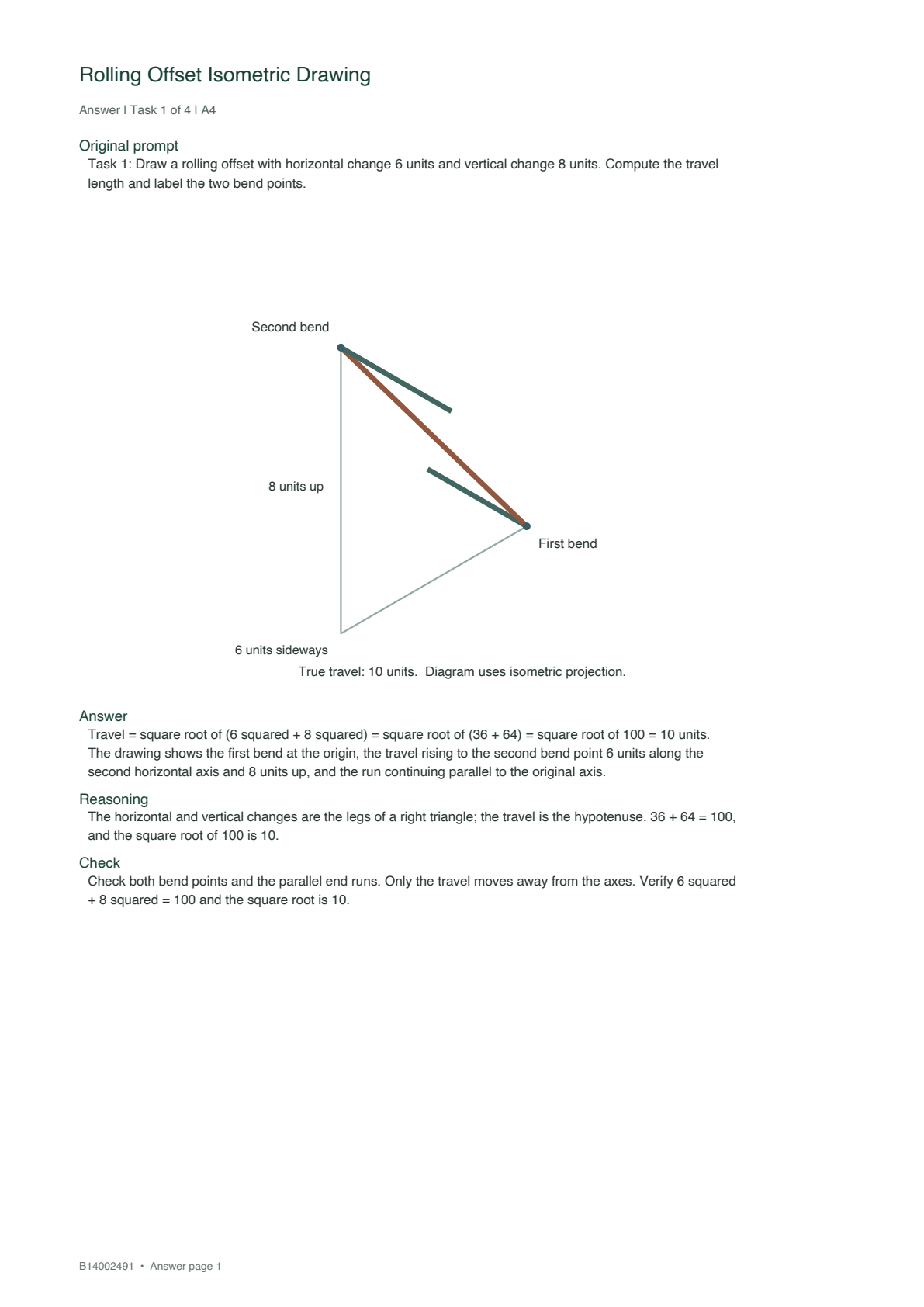
Task 1: Draw a rolling offset with horizontal change 6 units and vertical change 8 units. Compute the travel length and label the two bend points.
Show answer 1
Travel = square root of (6 squared + 8 squared) = square root of (36 + 64) = square root of 100 = 10 units. The drawing shows the first bend at the origin, the travel rising to the second bend point 6 units along the second horizontal axis and 8 units up, and the run continuing parallel to the original axis.
The horizontal and vertical changes are the legs of a right triangle; the travel is the hypotenuse. 36 + 64 = 100, and the square root of 100 is 10.
Check: Check both bend points and the parallel end runs. Only the travel moves away from the axes. Verify 6 squared + 8 squared = 100 and the square root is 10.
Task 2
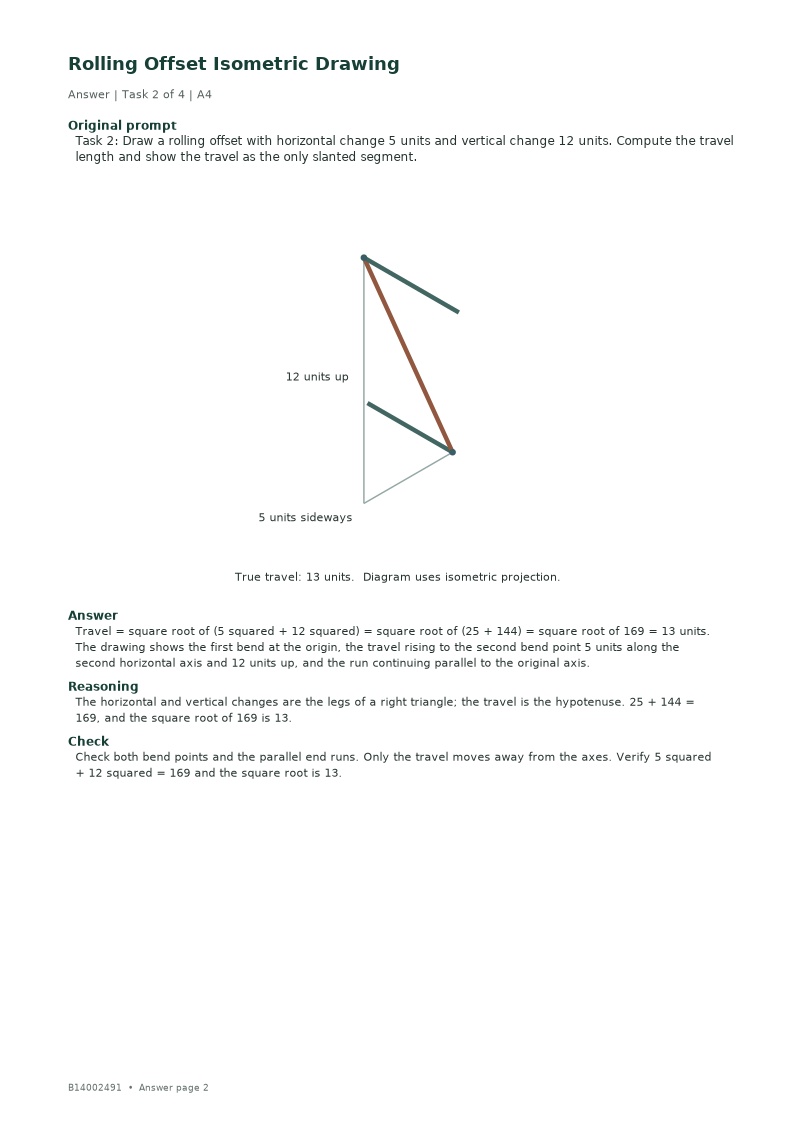
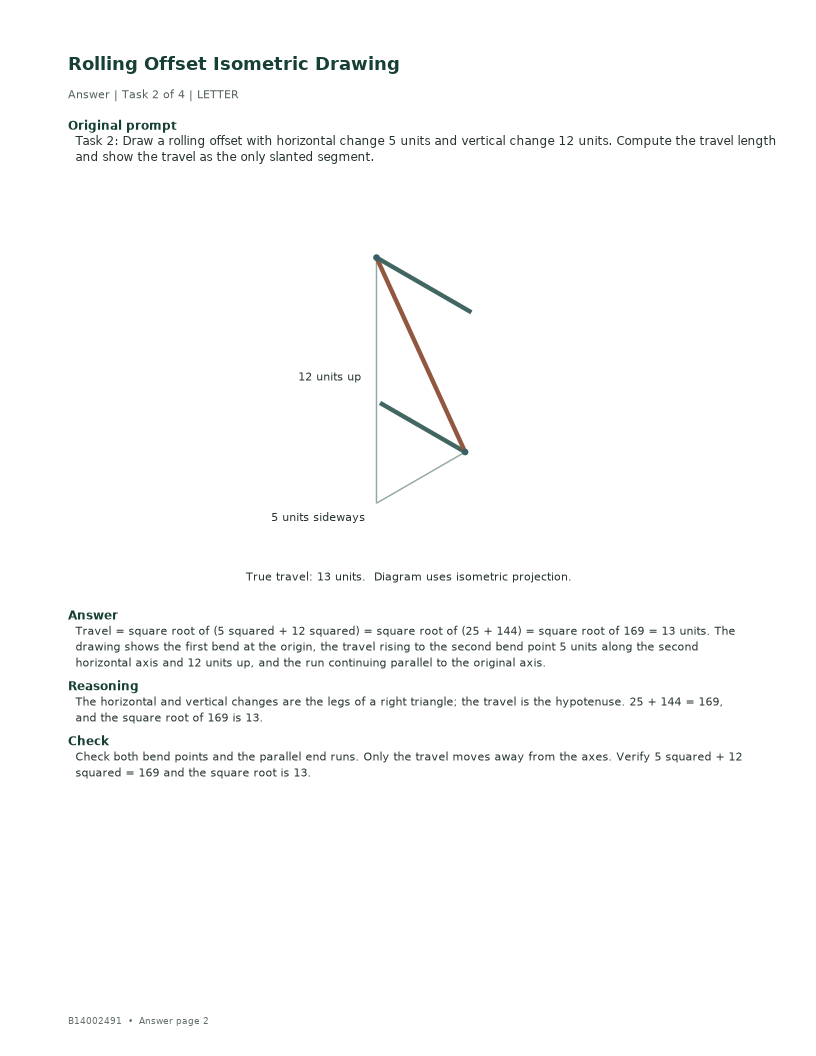
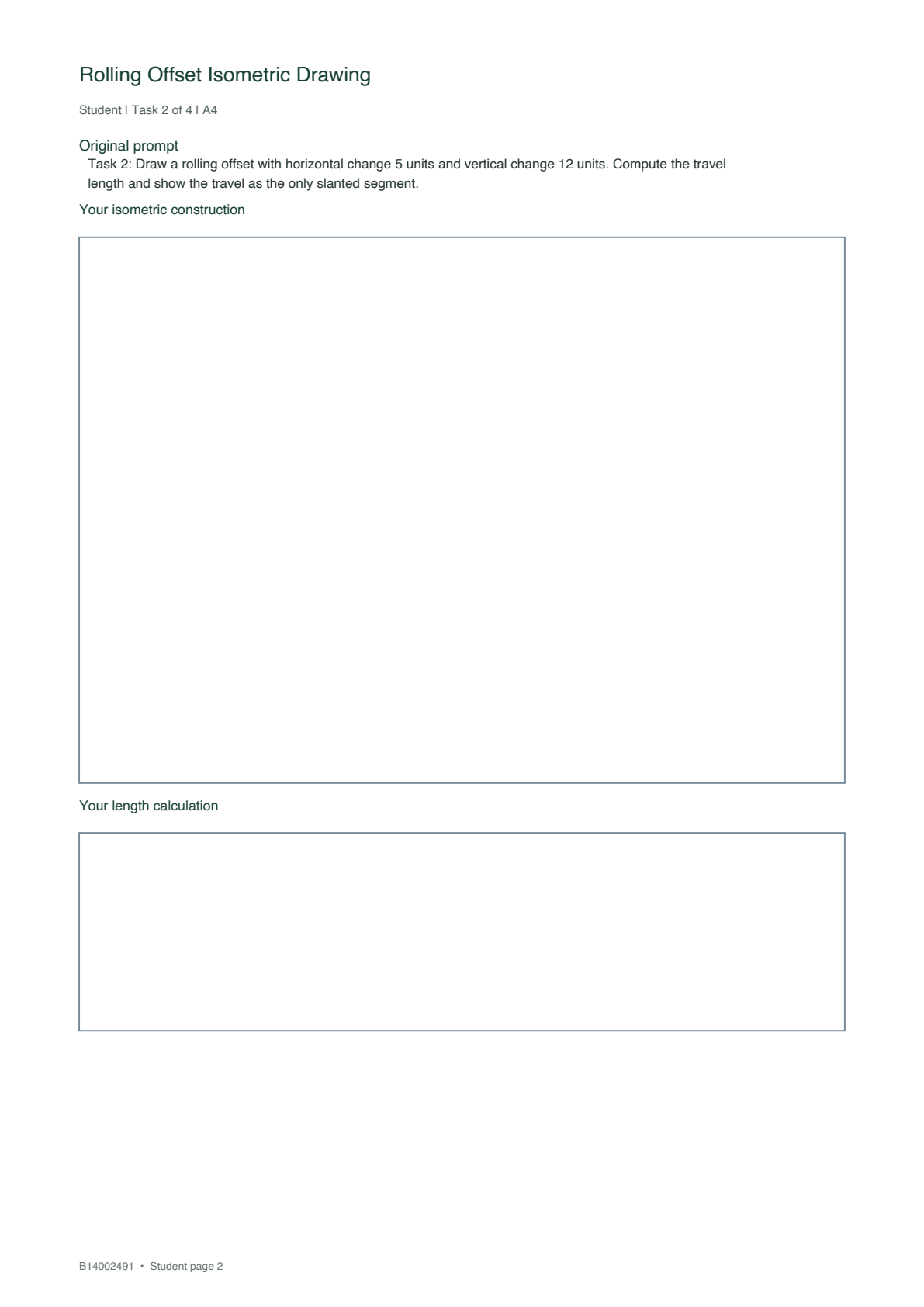
Task 2: Draw a rolling offset with horizontal change 5 units and vertical change 12 units. Compute the travel length and show the travel as the only slanted segment.
Show answer 2
Travel = square root of (5 squared + 12 squared) = square root of (25 + 144) = square root of 169 = 13 units. The drawing shows the first bend at the origin, the travel rising to the second bend point 5 units along the second horizontal axis and 12 units up, and the run continuing parallel to the original axis.
The horizontal and vertical changes are the legs of a right triangle; the travel is the hypotenuse. 25 + 144 = 169, and the square root of 169 is 13.
Check: Check both bend points and the parallel end runs. Only the travel moves away from the axes. Verify 5 squared + 12 squared = 169 and the square root is 13.
Task 3
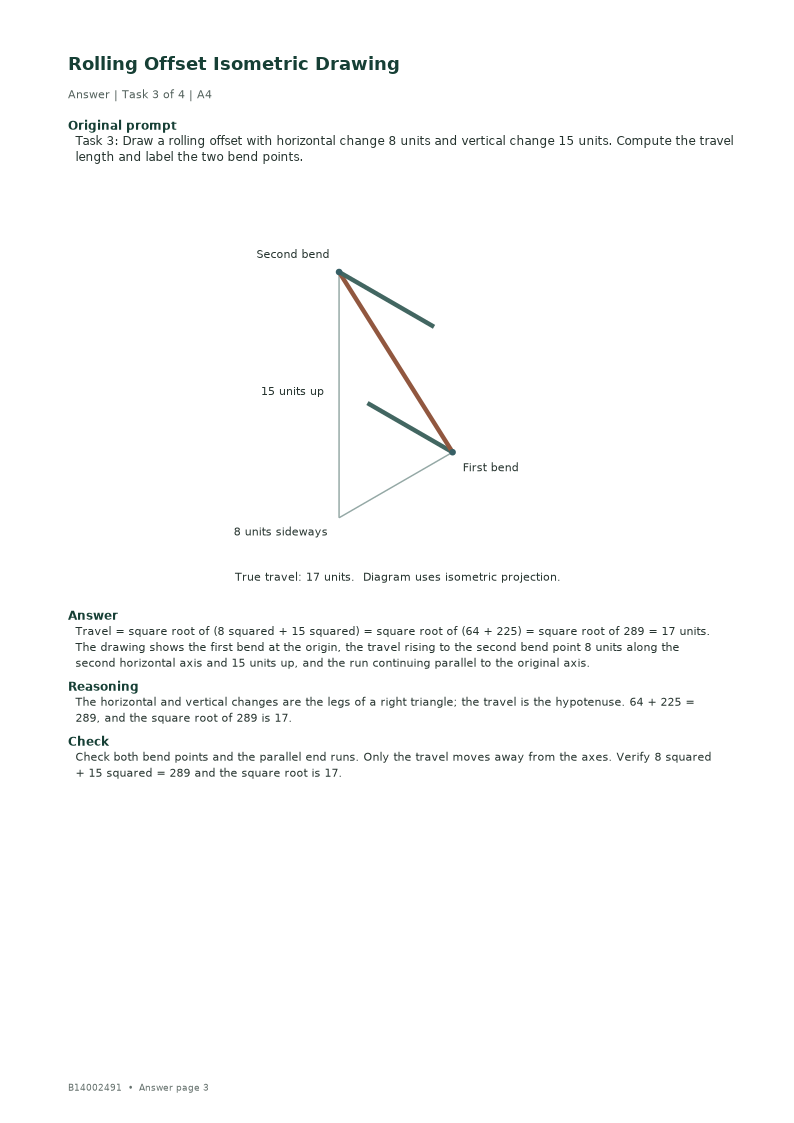
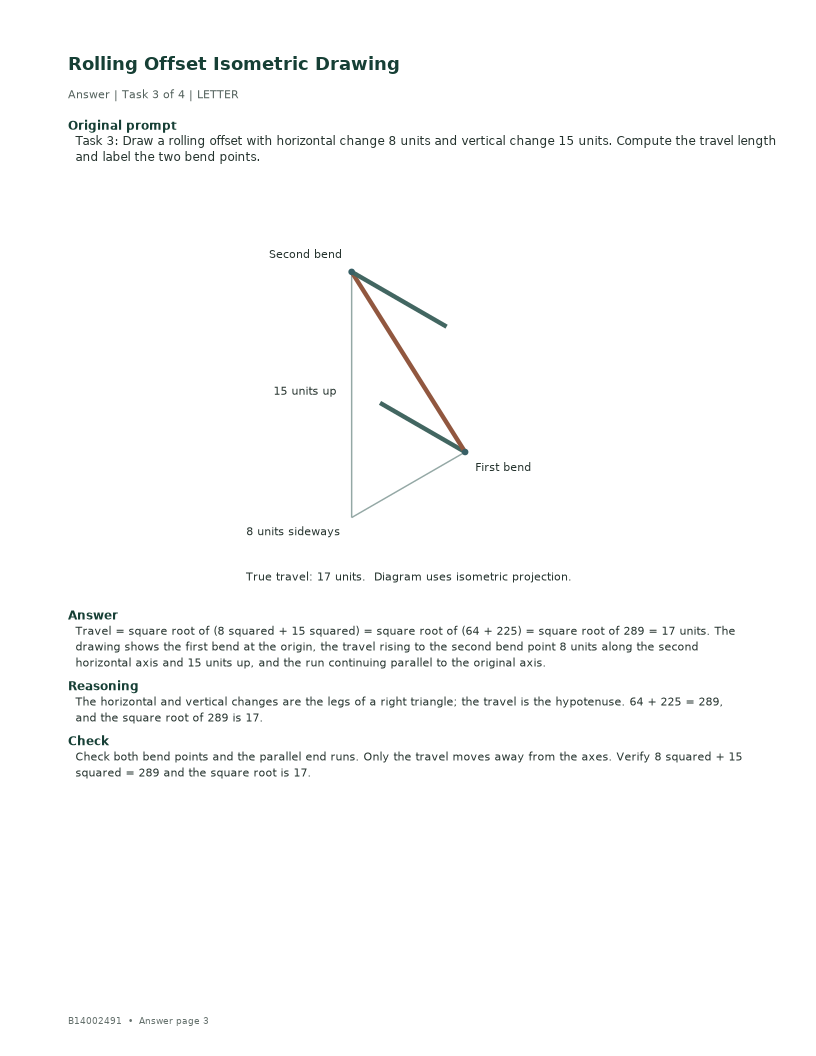
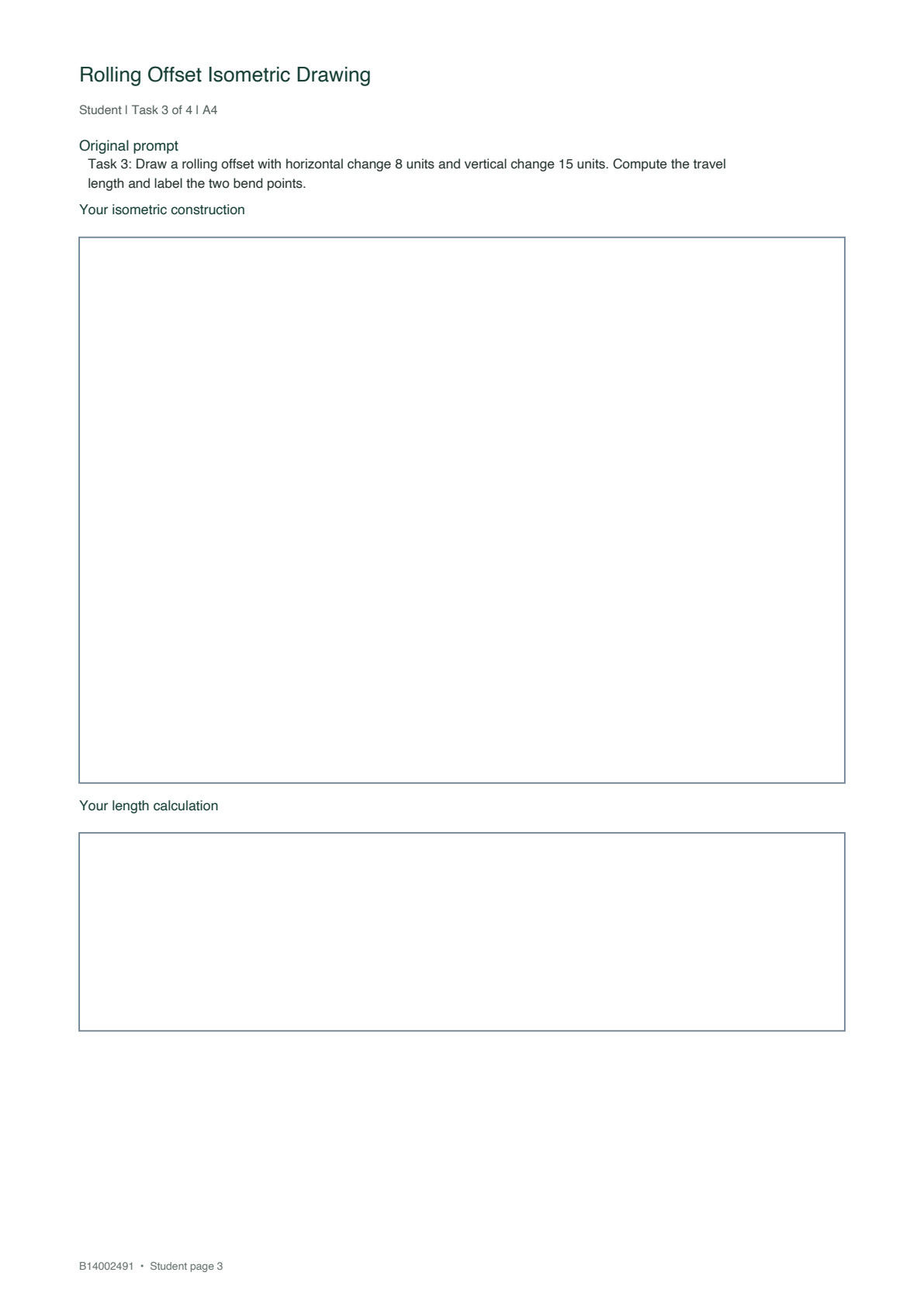
Task 3: Draw a rolling offset with horizontal change 8 units and vertical change 15 units. Compute the travel length and label the two bend points.
Show answer 3
Travel = square root of (8 squared + 15 squared) = square root of (64 + 225) = square root of 289 = 17 units. The drawing shows the first bend at the origin, the travel rising to the second bend point 8 units along the second horizontal axis and 15 units up, and the run continuing parallel to the original axis.
The horizontal and vertical changes are the legs of a right triangle; the travel is the hypotenuse. 64 + 225 = 289, and the square root of 289 is 17.
Check: Check both bend points and the parallel end runs. Only the travel moves away from the axes. Verify 8 squared + 15 squared = 289 and the square root is 17.
Task 4
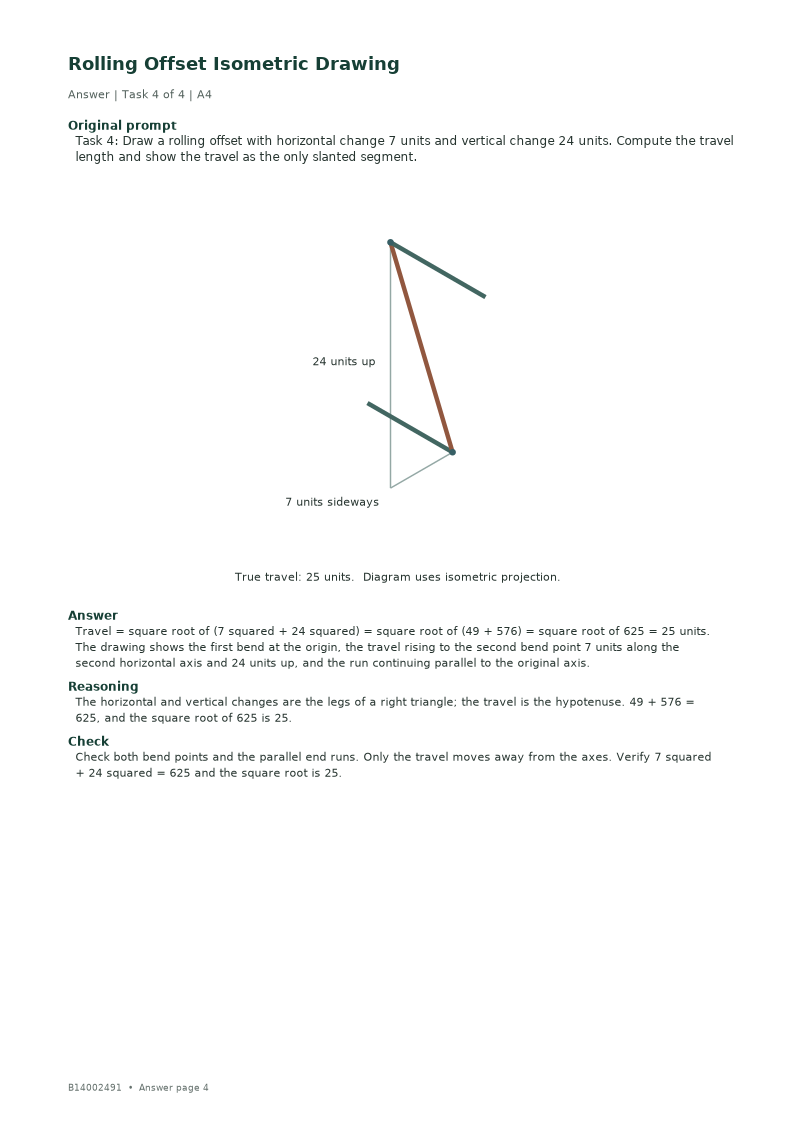
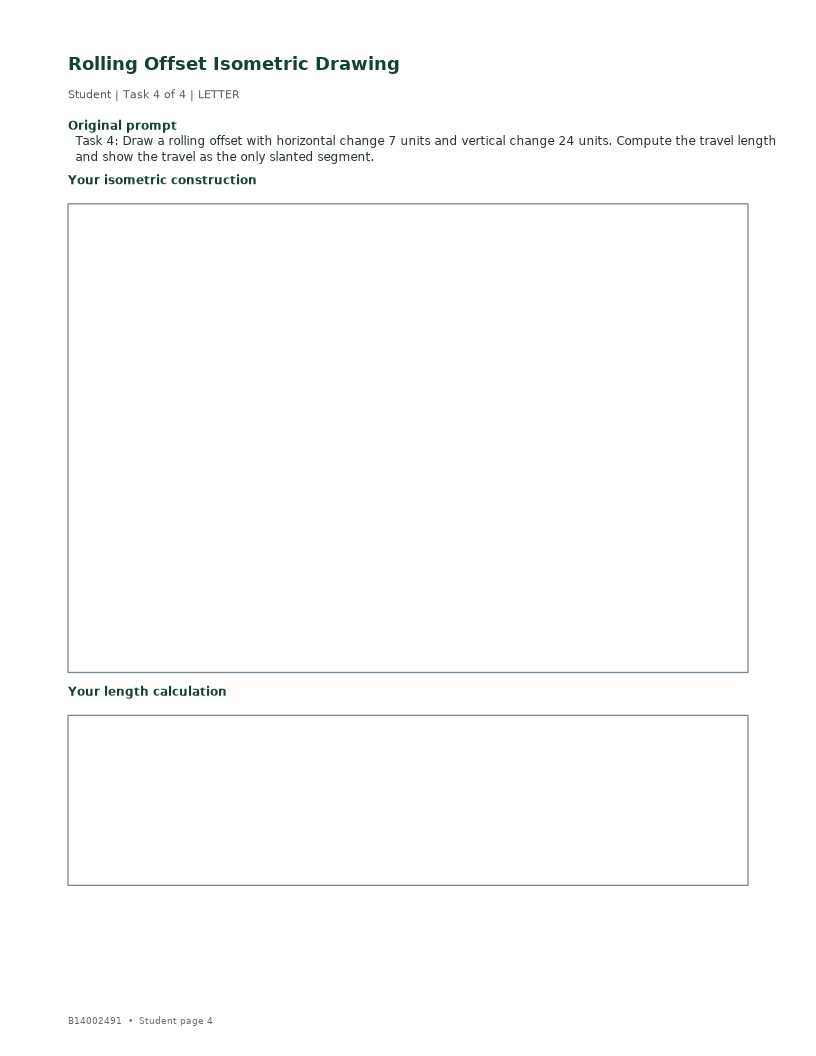
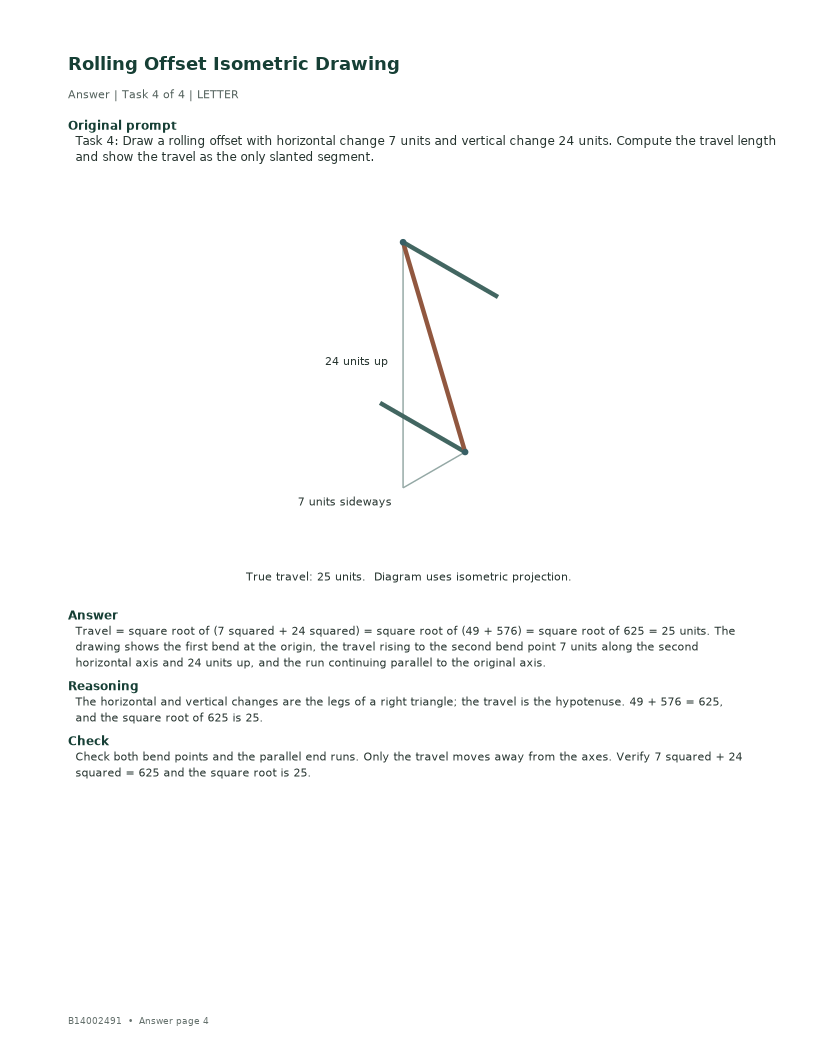
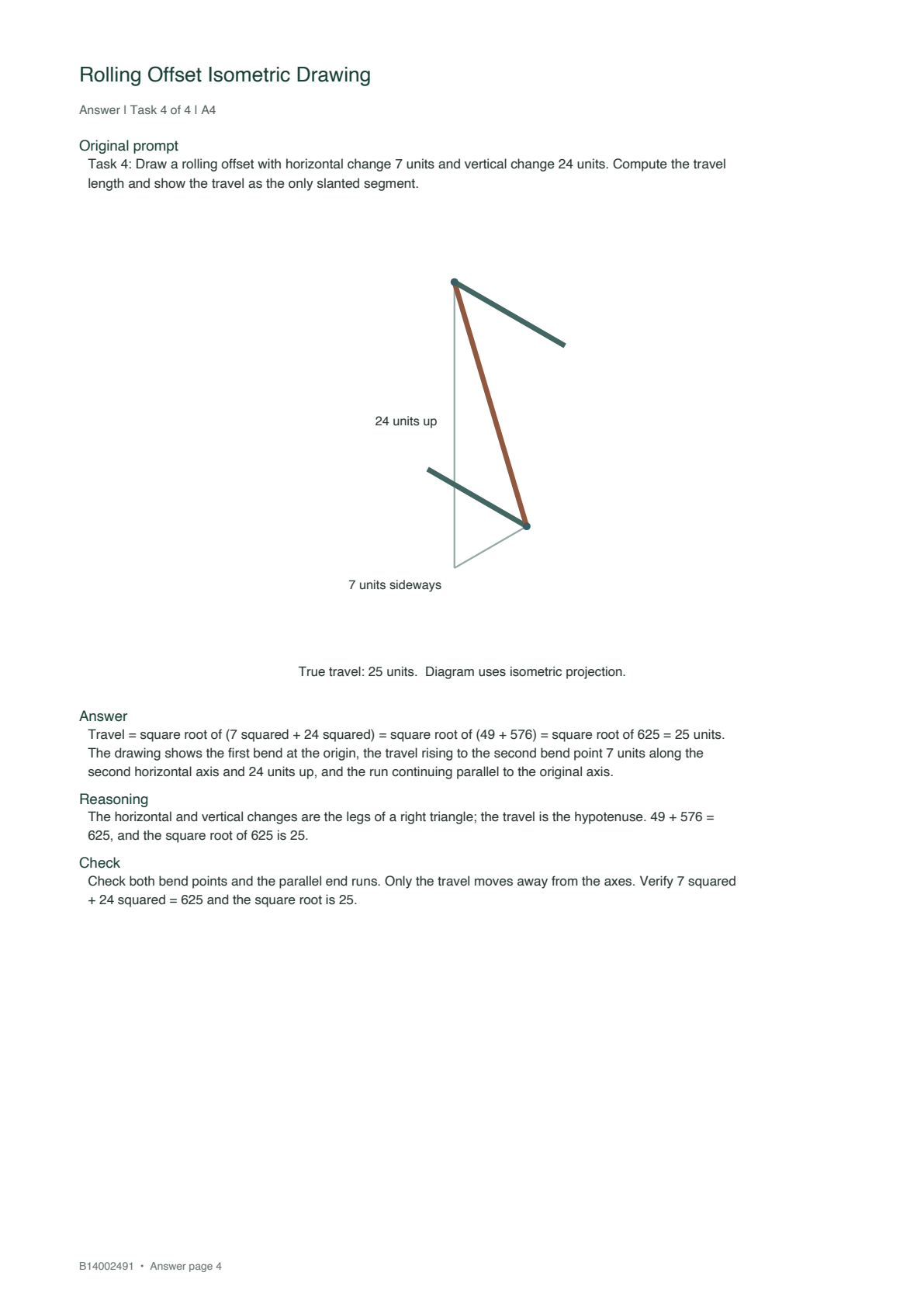
Task 4: Draw a rolling offset with horizontal change 7 units and vertical change 24 units. Compute the travel length and show the travel as the only slanted segment.
Show answer 4
Travel = square root of (7 squared + 24 squared) = square root of (49 + 576) = square root of 625 = 25 units. The drawing shows the first bend at the origin, the travel rising to the second bend point 7 units along the second horizontal axis and 24 units up, and the run continuing parallel to the original axis.
The horizontal and vertical changes are the legs of a right triangle; the travel is the hypotenuse. 49 + 576 = 625, and the square root of 625 is 25.
Check: Check both bend points and the parallel end runs. Only the travel moves away from the axes. Verify 7 squared + 24 squared = 625 and the square root is 25.
Useful checks
- Drawing the travel as a horizontal or vertical segment instead of a slanted segment. Show the two given changes along their own axes and connect their combined endpoint to the first bend. Inspect the travel endpoints to confirm that both given changes are present.
- Adding the horizontal and vertical changes instead of using the Pythagorean relationship. The travel is the hypotenuse of a right triangle, so square each change, add the squares, and take the square root.
Questions about this resource
Why is the travel longer than either the horizontal or vertical change?
Because the travel is the hypotenuse of a right triangle whose legs are the horizontal and vertical changes, so it is longer than either leg.
Do the two bends have to be equal?
The two turn angles are equal for parallel end runs because the travel meets the same spatial direction at both ends. The outline can look different at each bend in a drawing. Check parallel end runs and the two given changes.