Free original lessons
Step-by-Step Drawing Practice for Kids
This pack teaches a young child to build a small drawing in a few visible steps, then copy it in a practice box. Each task shows a reference plate, a blank box to draw in, and a finished key to compare against. The drawings use simple marks a 4-year-old can make with a crayon: straight lines, curved lines, circles, triangles, squares, and short repeated strokes.
Letter & A4
PDF & SVG
How to use this pack
Look at the reference plate first. Point to each step and say what mark it is: a straight line, a curved line, a circle, a triangle, a square, or a dot. Then draw the same steps in the blank practice box, one step at a time, and stop to look before adding the next part. When the drawing is finished, compare it with the key and check the simple things listed for that task. A grown-up can read the steps aloud; the child does the drawing.
Worked example: a small sun
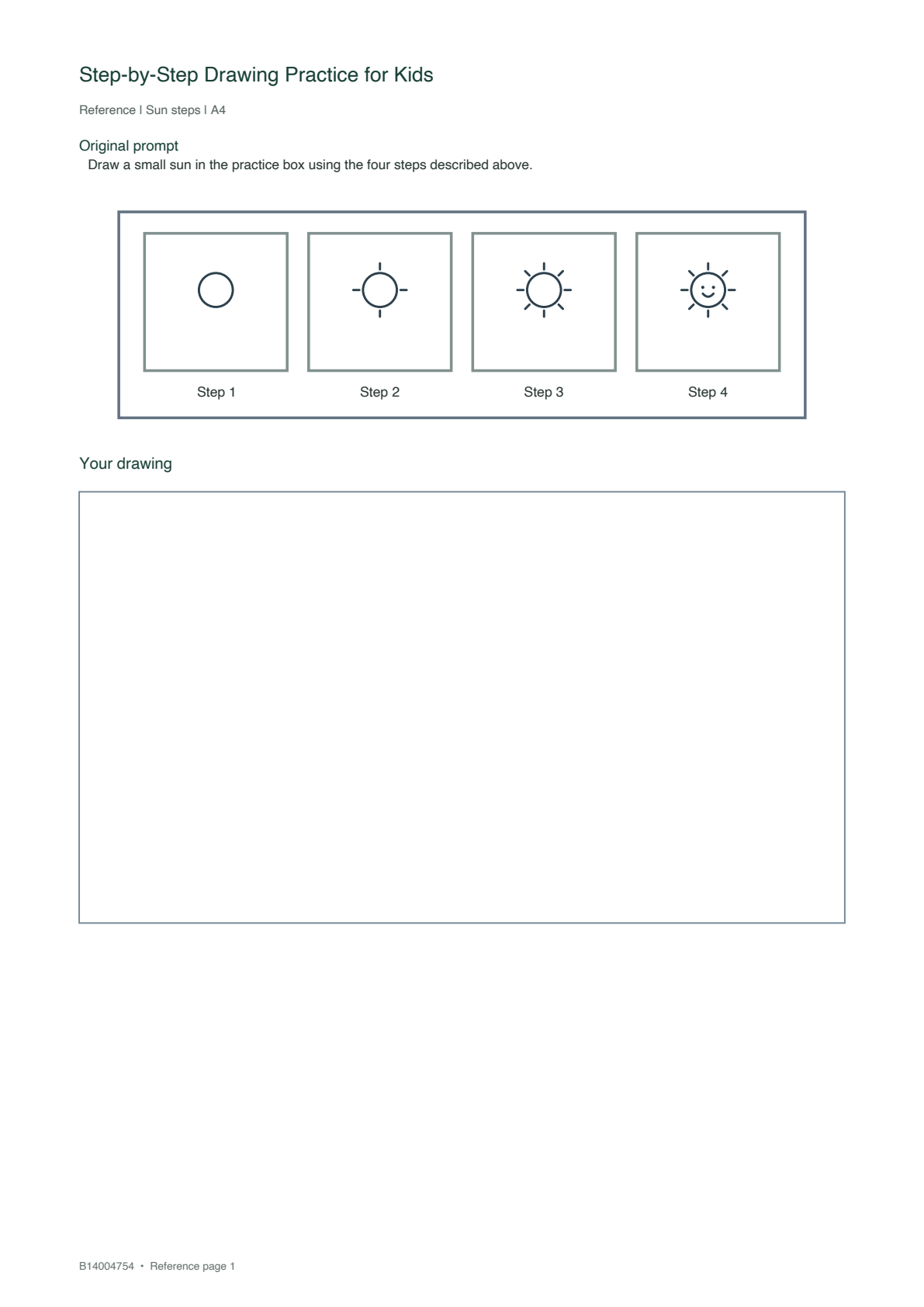
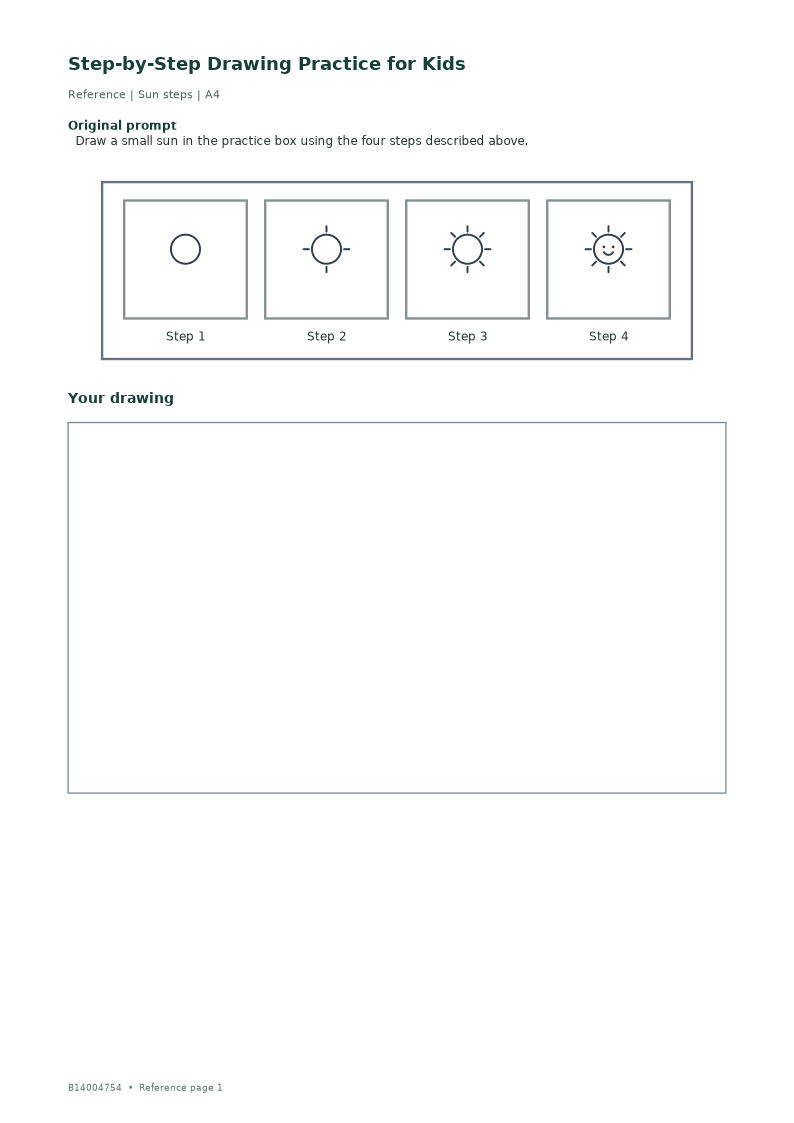
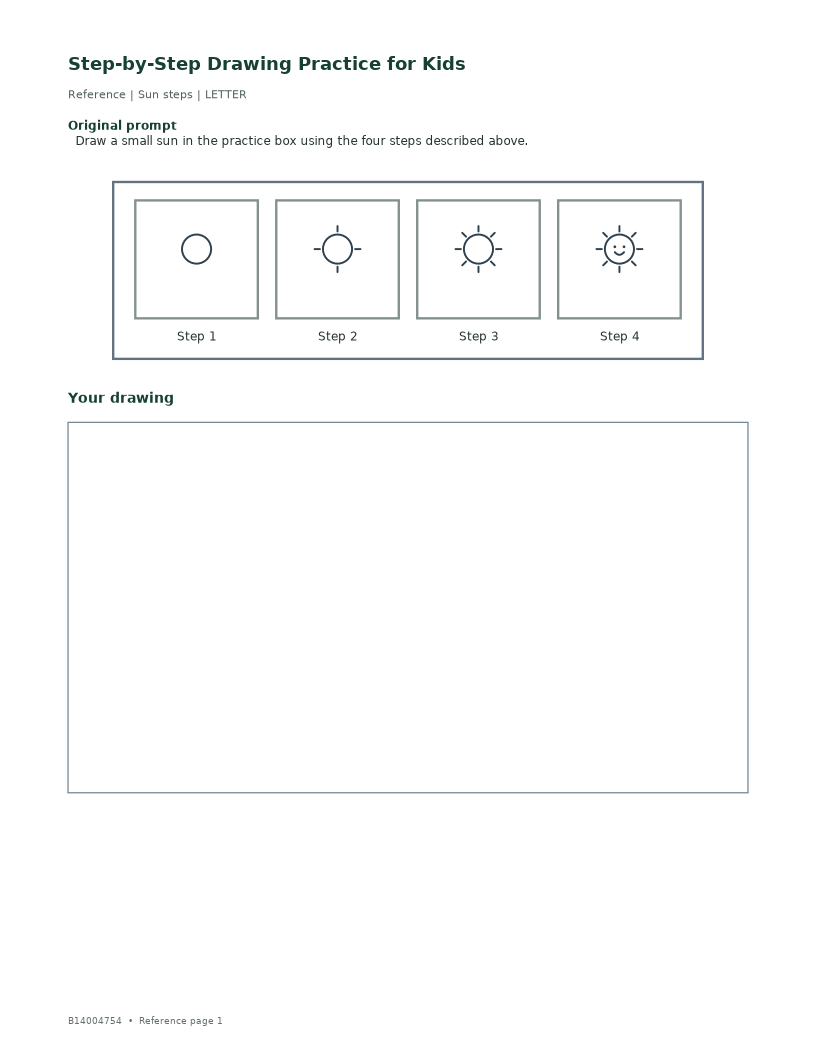
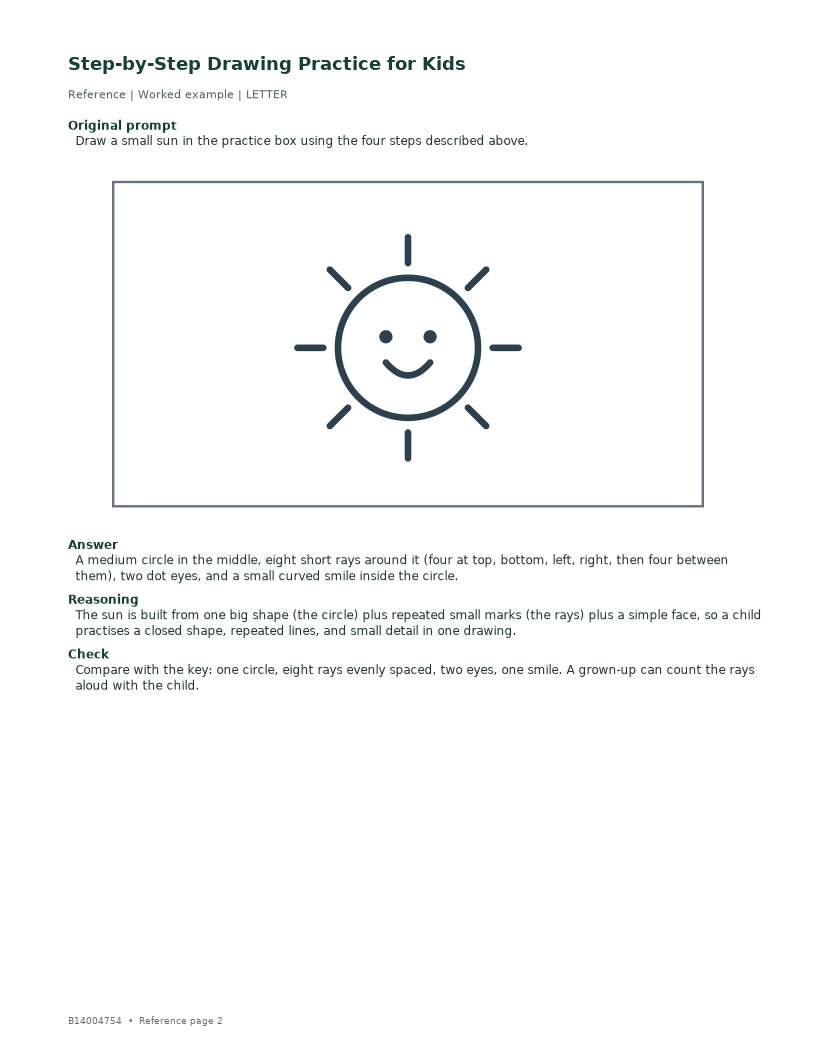
Step 1: draw one medium circle in the middle of the box. Step 2: draw four short straight lines pointing out from the circle, one at the top, one at the bottom, one on the left, one on the right. Step 3: draw four more short lines between them, so the sun has eight rays in total. Step 4: add two small dots inside the circle for eyes and one small curved line below them for a smile. The finished sun is a circle with eight rays and a simple face.
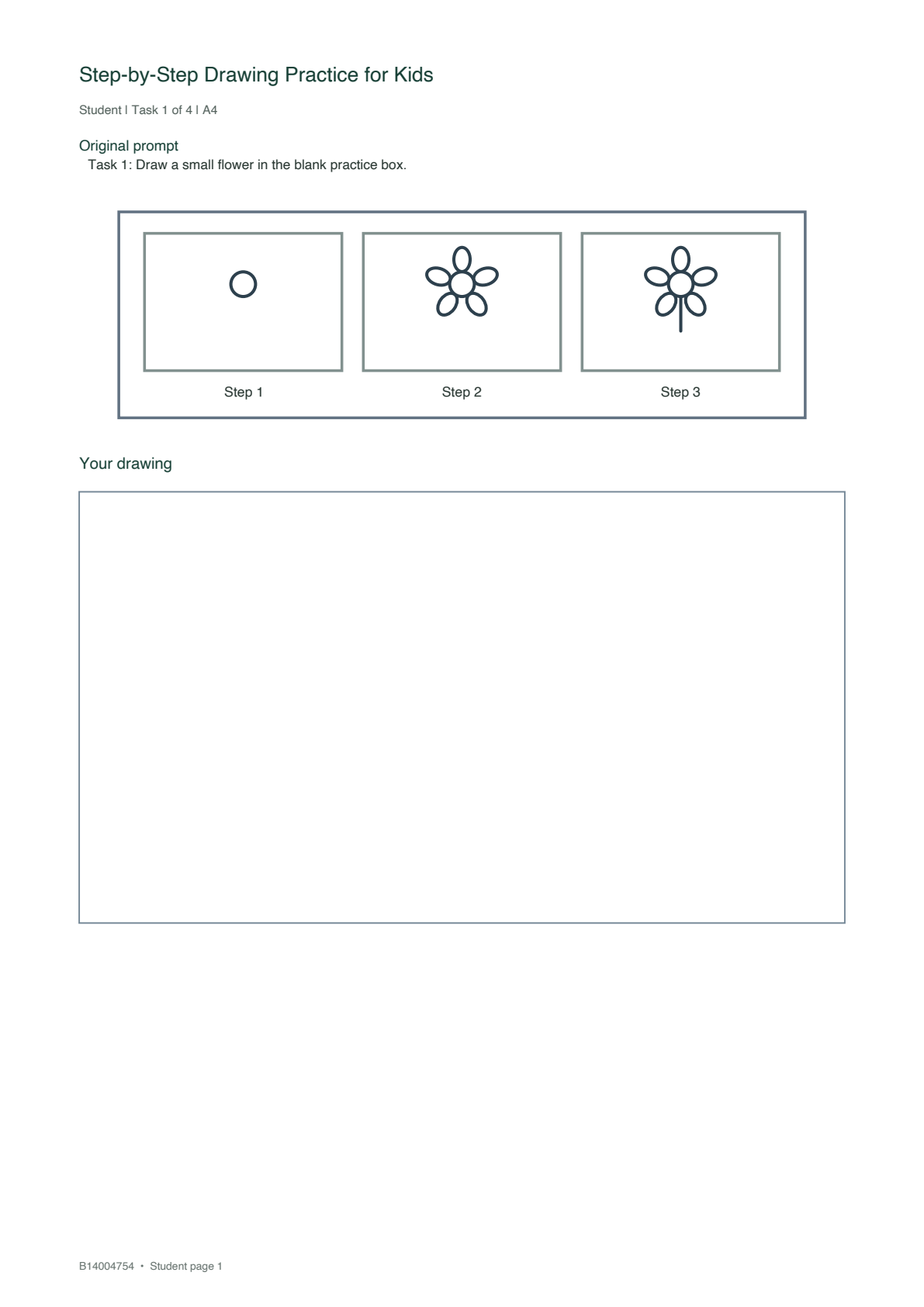
Task 1: a small flower
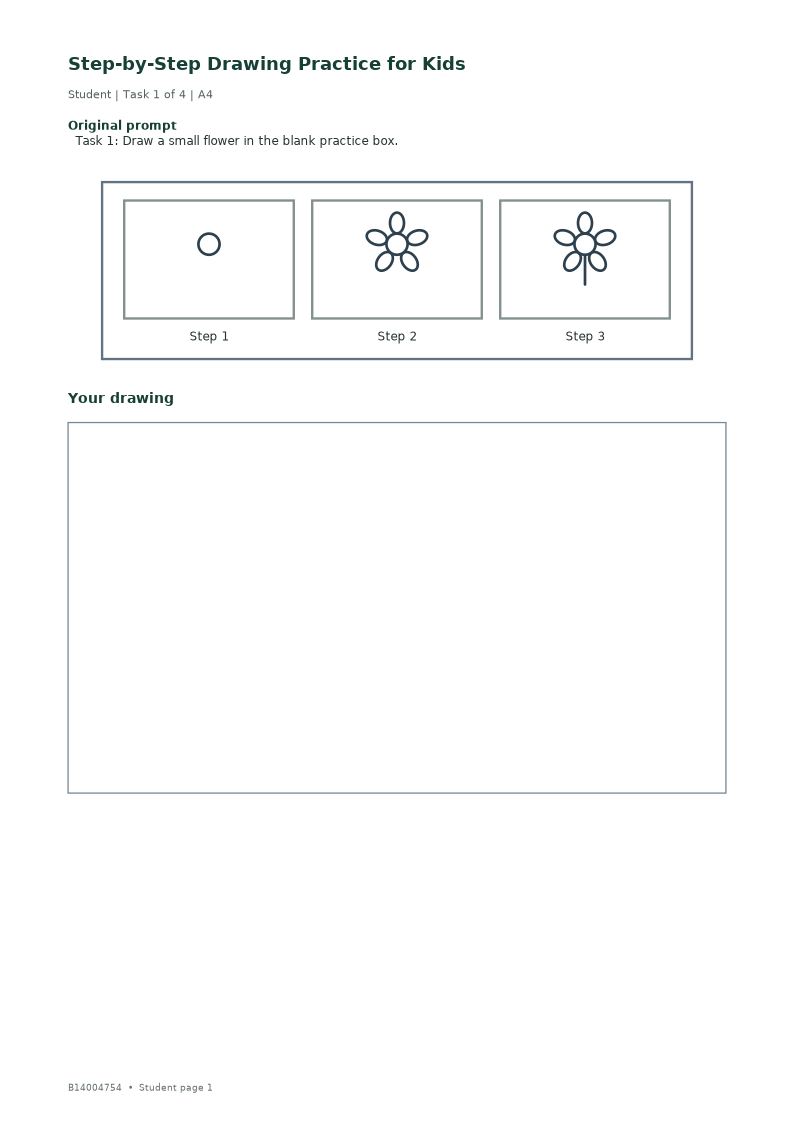
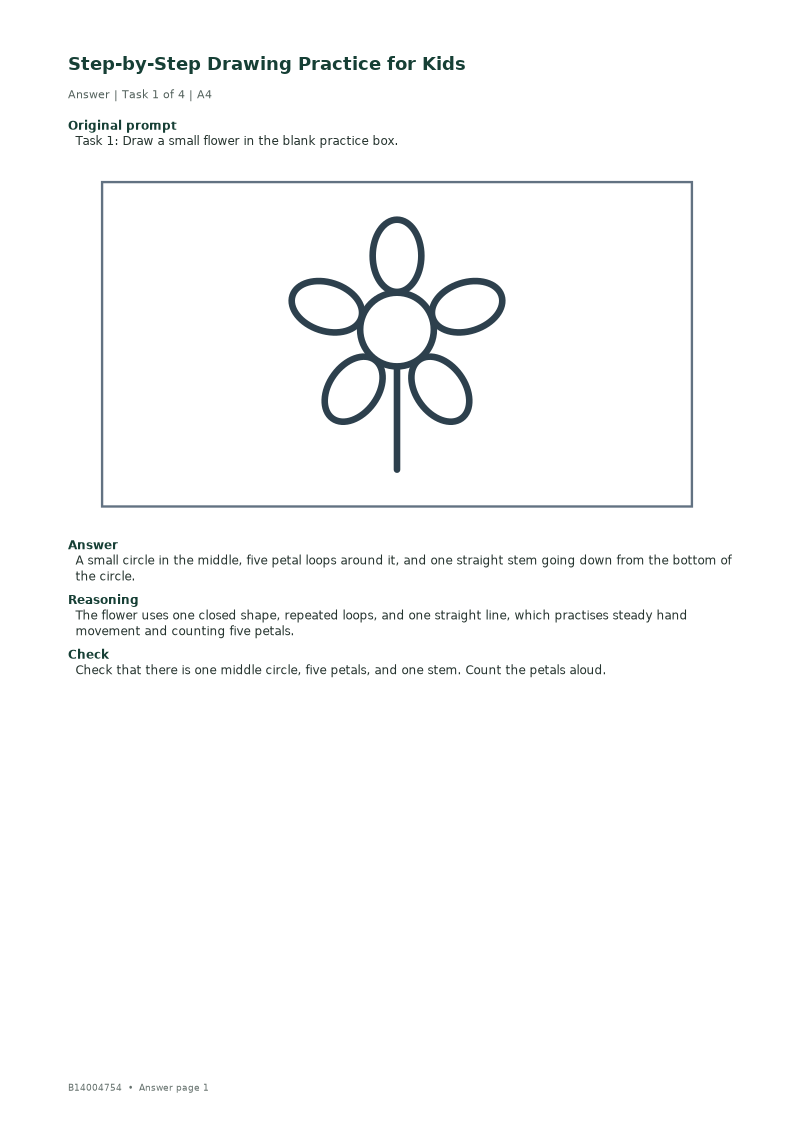
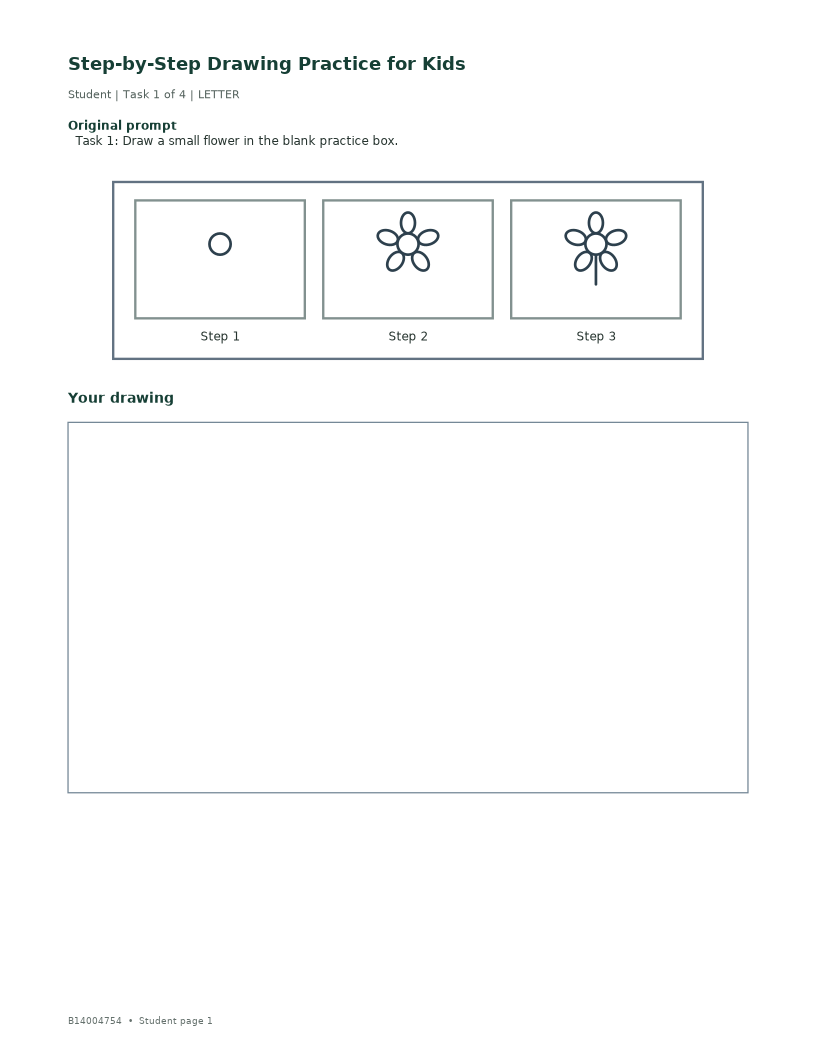
Reference plate: a flower made from one small circle in the middle, five petal loops around it, and one straight stem going down. Practice box: blank. Steps: draw the middle circle, add five petal loops around it, then draw the stem down from the bottom of the circle. Key: a flower with a round middle, five petals, and one stem. Check: does the drawing have a middle circle, five petals, and one stem?
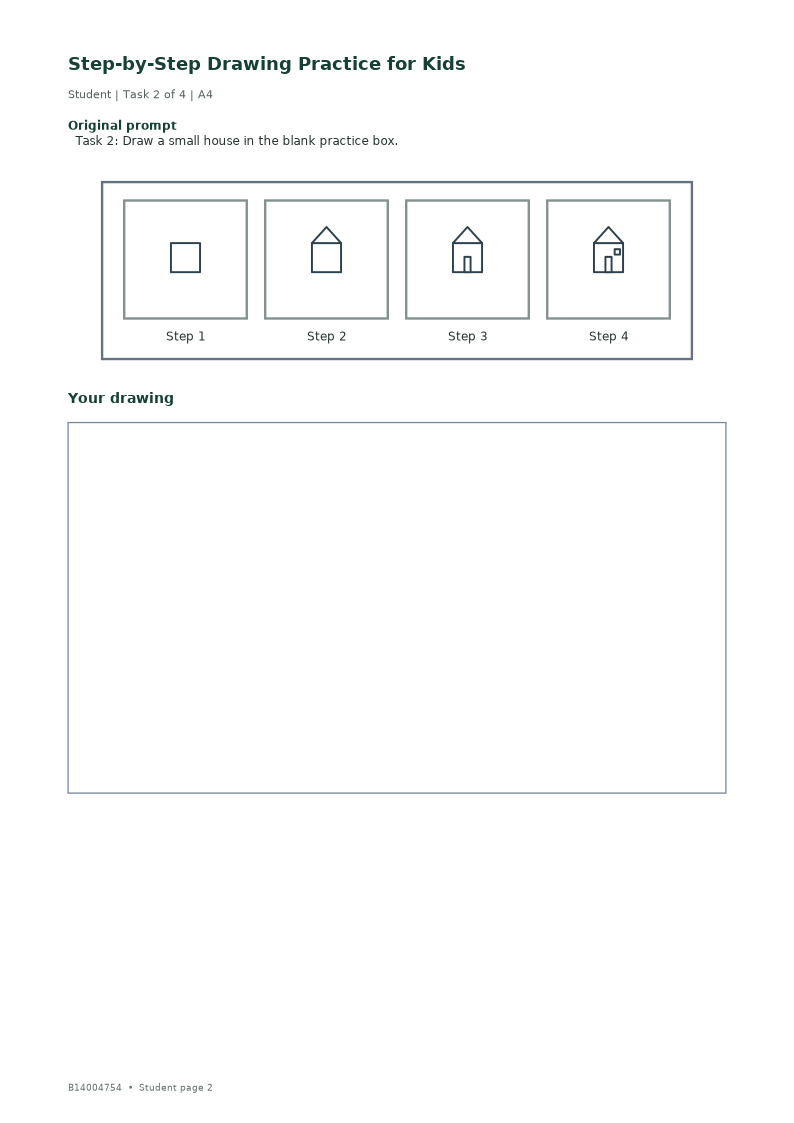
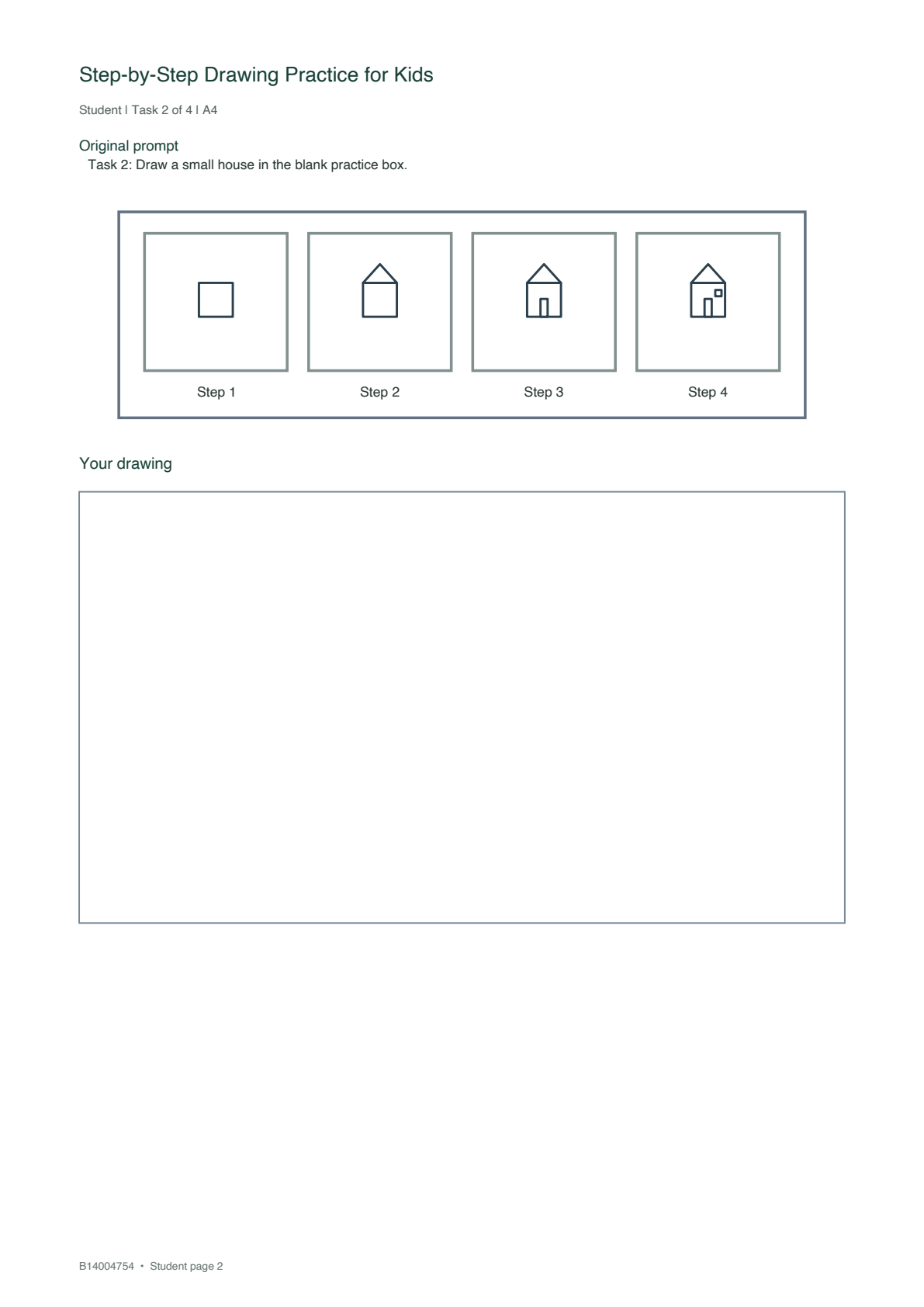
Task 2: a small house
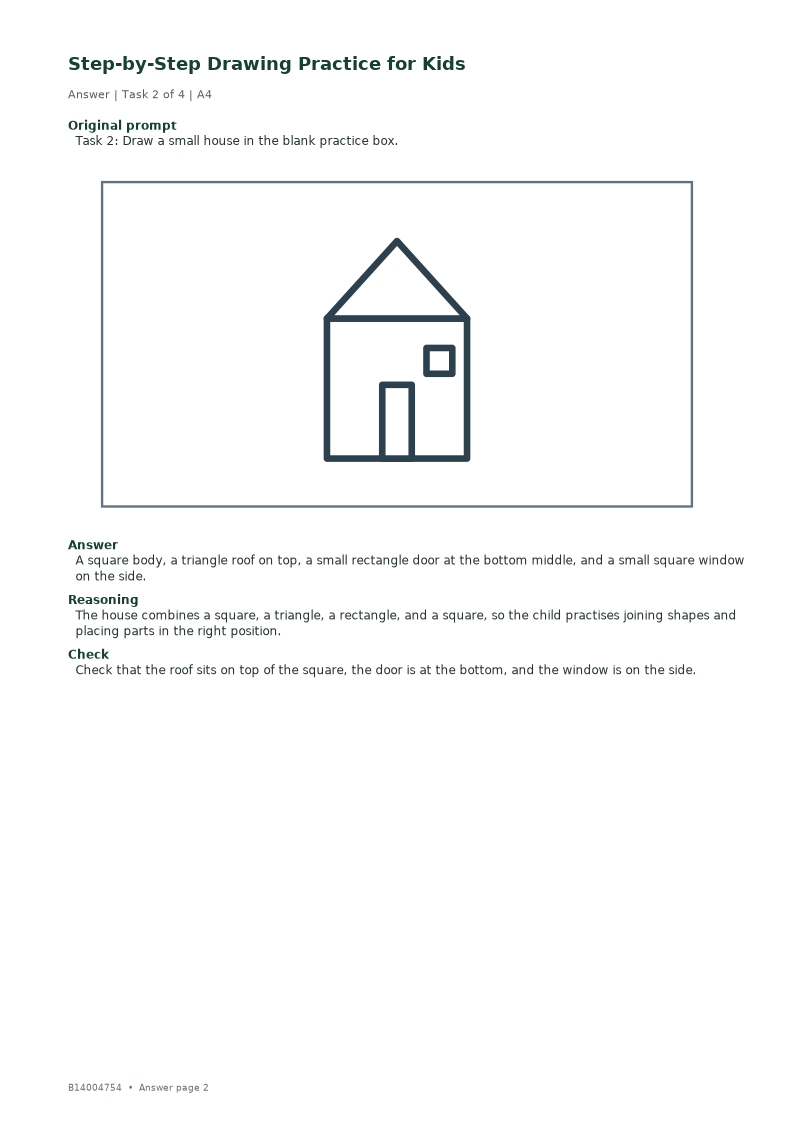
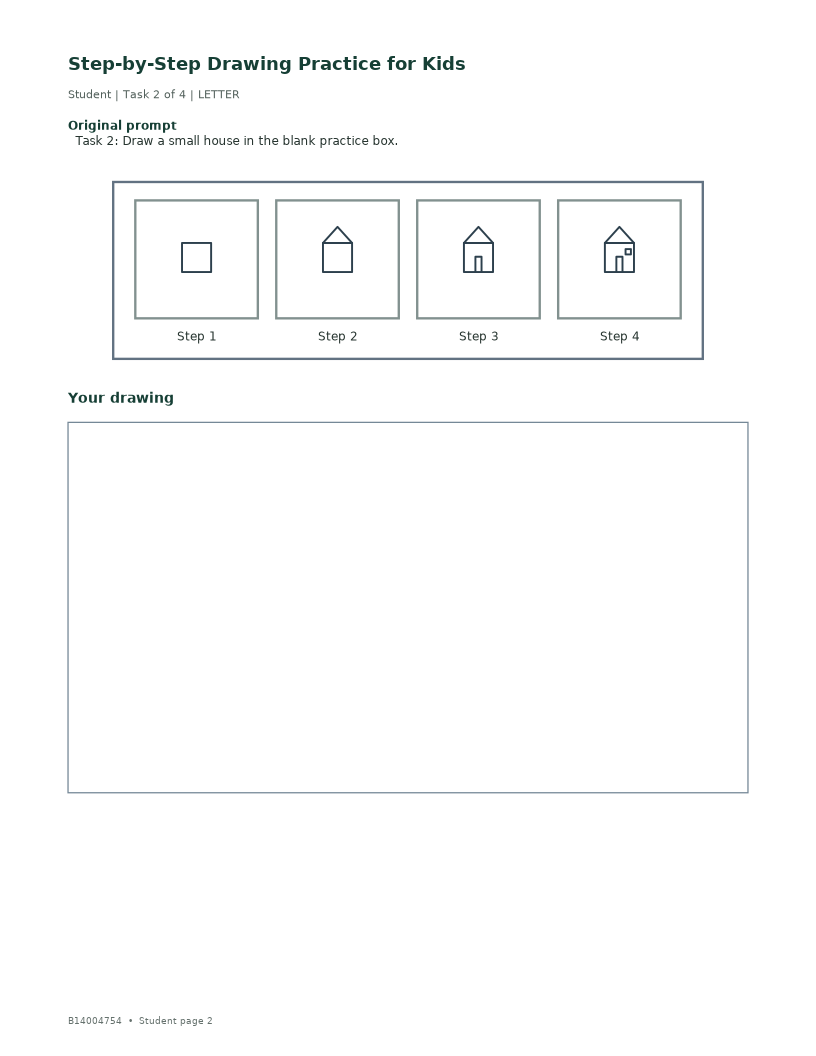
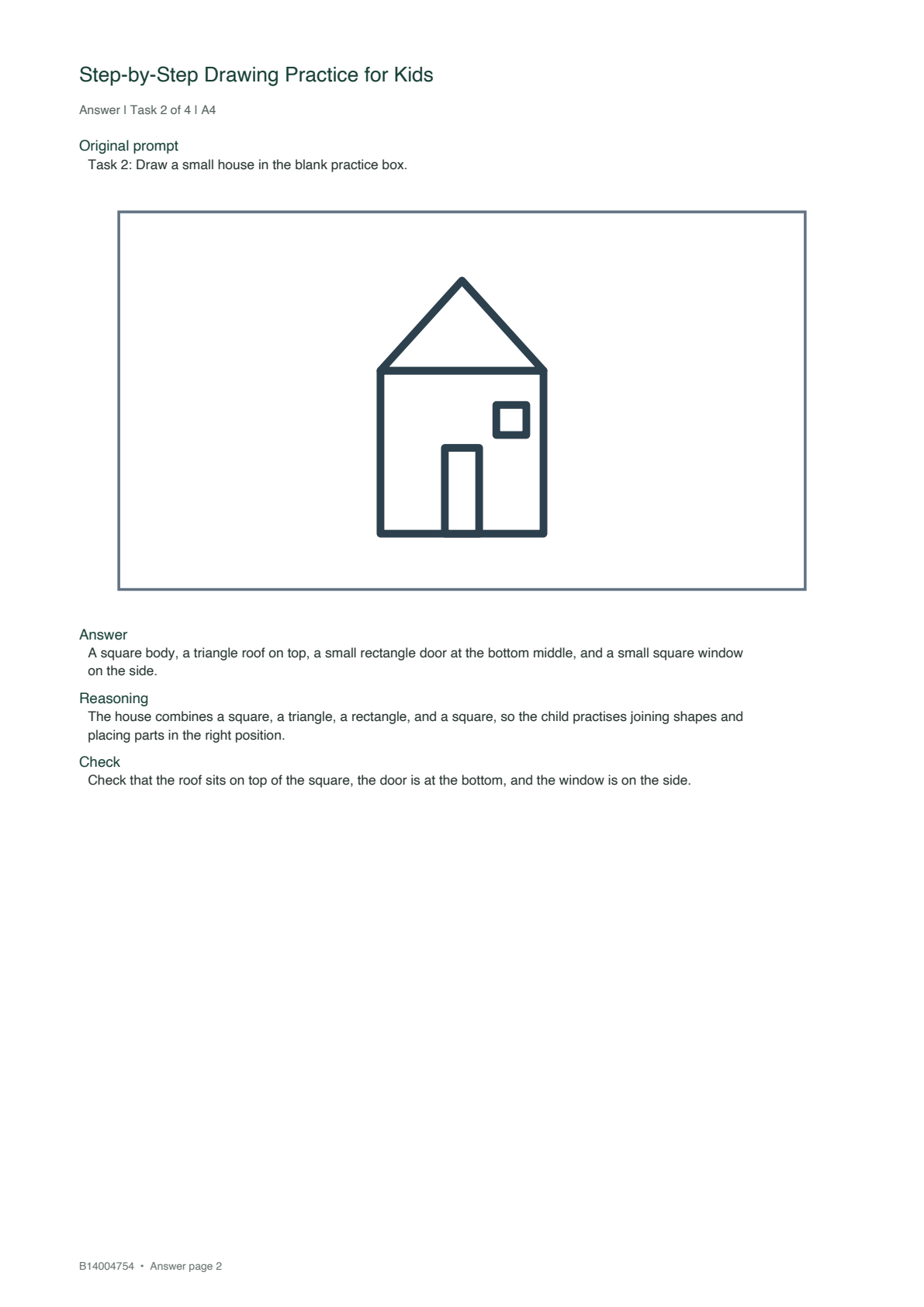
Reference plate: a house made from one square body, one triangle roof on top, one small rectangle door at the bottom middle, and one small square window on the side. Practice box: blank. Steps: draw the square, put the triangle roof on top, add the door, then add the window. Key: a house with a square body, a triangle roof, a rectangle door, and a square window. Check: are the roof on top, the door at the bottom, and the window on the side?
Download the complete resource pack
All individual SVG pages (20)
- A4 reference page 1
- A4 reference page 2
- A4 student page 1
- A4 student page 2
- A4 student page 3
- A4 student page 4
- A4 answer page 1
- A4 answer page 2
- A4 answer page 3
- A4 answer page 4
- LETTER reference page 1
- LETTER reference page 2
- LETTER student page 1
- LETTER student page 2
- LETTER student page 3
- LETTER student page 4
- LETTER answer page 1
- LETTER answer page 2
- LETTER answer page 3
- LETTER answer page 4
Print at 100% / actual size. Use the stated scale on any schematic diagram; physical cutting templates are identified separately. A4 and US Letter are separate files. Free access, no signup; CC BY 4.0.
How to use these pages
- How to use this pack
- Worked example: a small sun
- Task 1: a small flower
- Task 2: a small house
Worked example
Example: Draw a small sun in the practice box using the four steps described above.
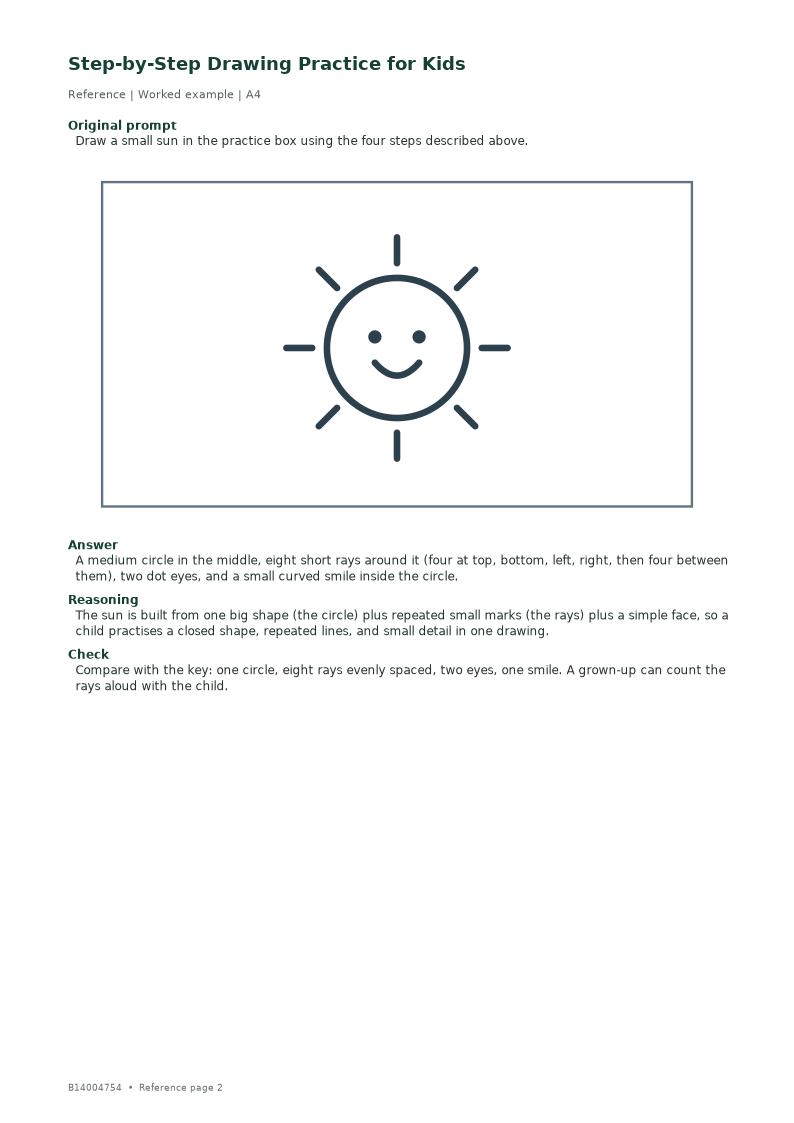
Answer: A medium circle in the middle, eight short rays around it (four at top, bottom, left, right, then four between them), two dot eyes, and a small curved smile inside the circle.
Reasoning: The sun is built from one big shape (the circle) plus repeated small marks (the rays) plus a simple face, so a child practises a closed shape, repeated lines, and small detail in one drawing.
Check: Compare with the key: one circle, eight rays evenly spaced, two eyes, one smile. A grown-up can count the rays aloud with the child.
Four practice tasks and complete answers
Task 1
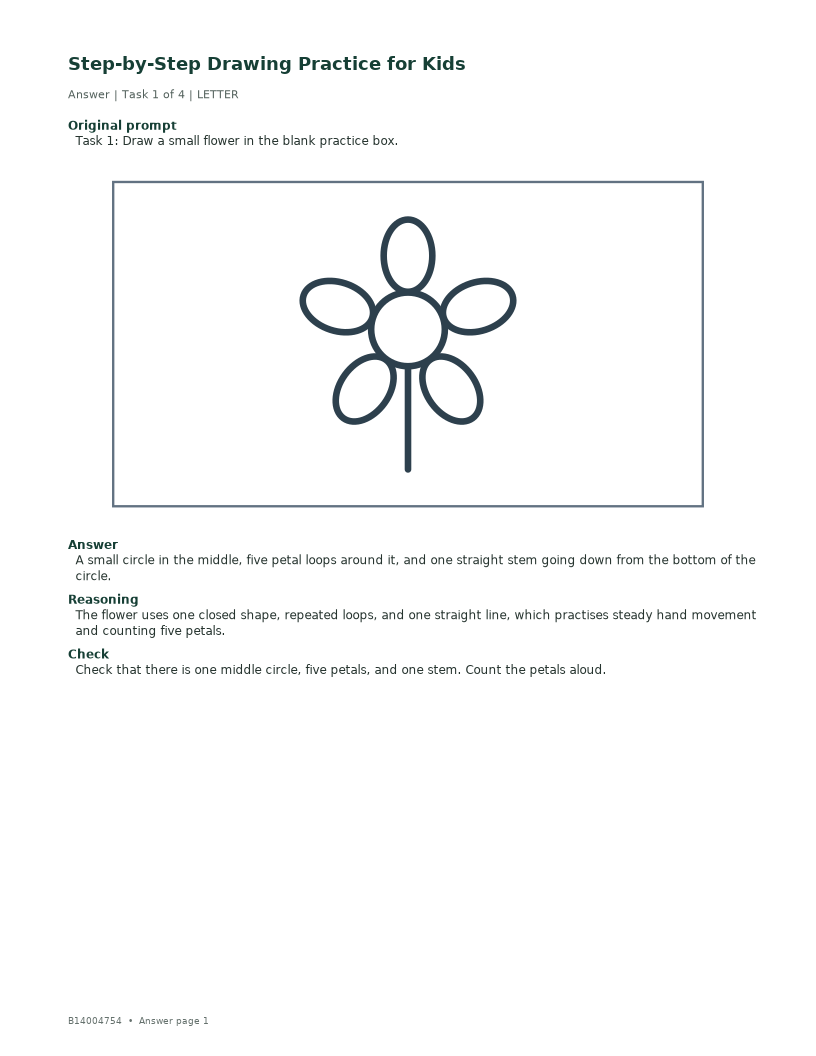
Task 1: Draw a small flower in the blank practice box.
Show answer 1
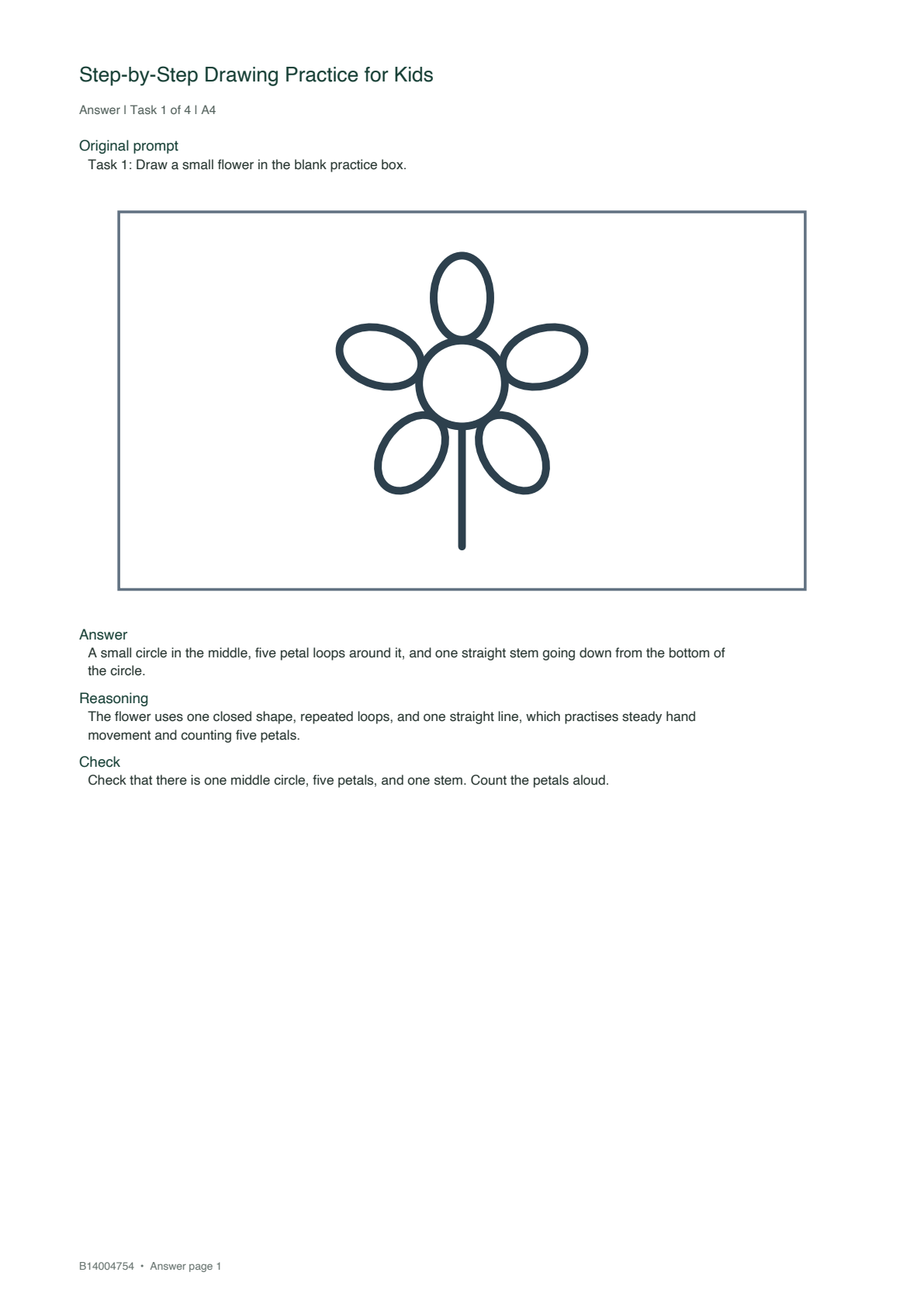
A small circle in the middle, five petal loops around it, and one straight stem going down from the bottom of the circle.
The flower uses one closed shape, repeated loops, and one straight line, which practises steady hand movement and counting five petals.
Check: Check that there is one middle circle, five petals, and one stem. Count the petals aloud.
Task 2
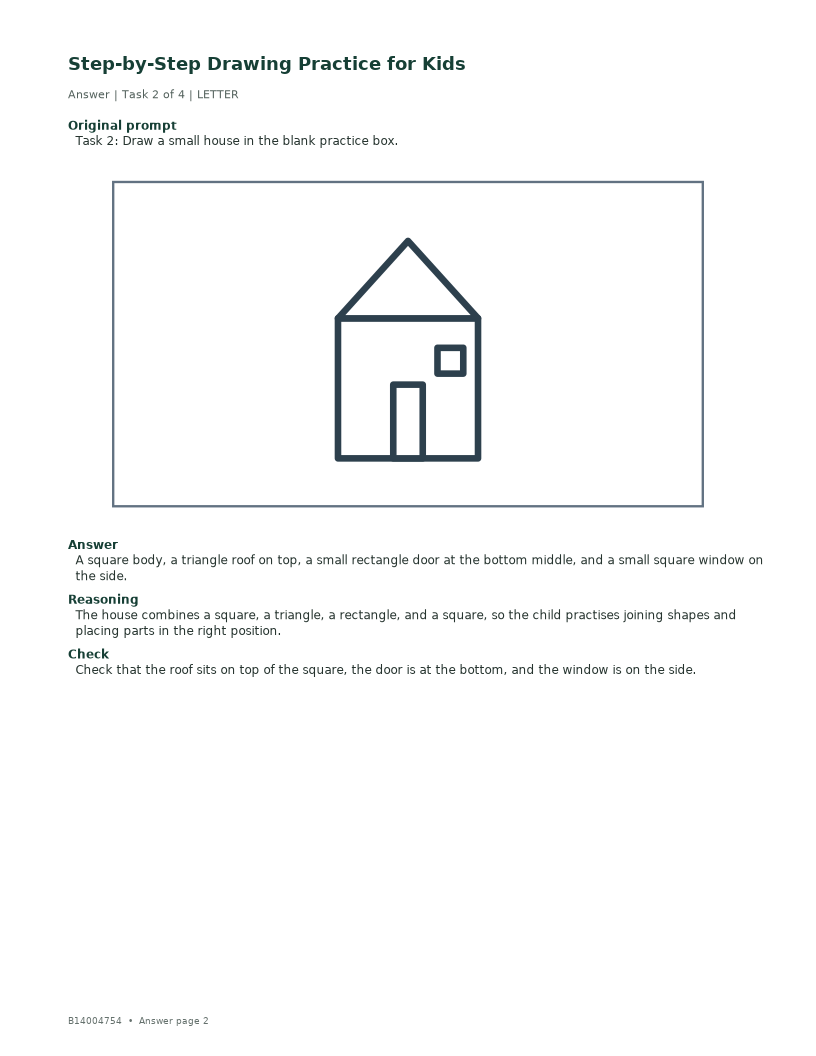
Task 2: Draw a small house in the blank practice box.
Show answer 2
A square body, a triangle roof on top, a small rectangle door at the bottom middle, and a small square window on the side.
The house combines a square, a triangle, a rectangle, and a square, so the child practises joining shapes and placing parts in the right position.
Check: Check that the roof sits on top of the square, the door is at the bottom, and the window is on the side.
Task 3
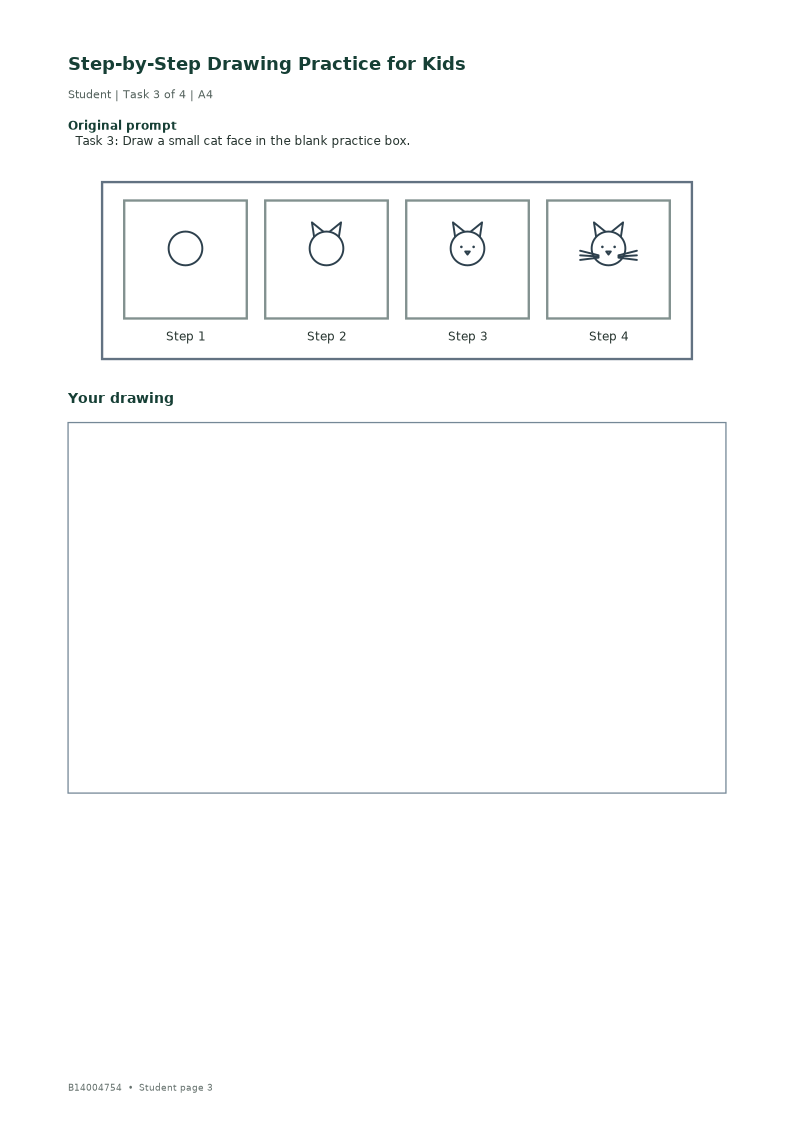
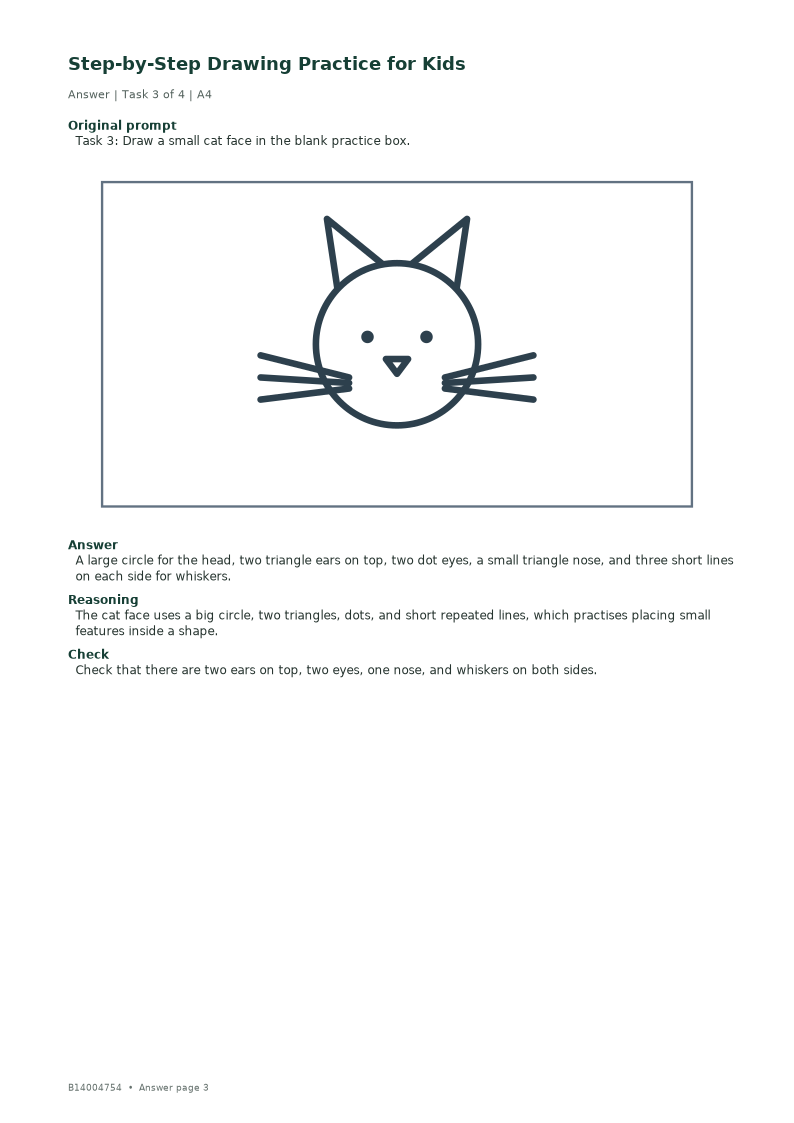
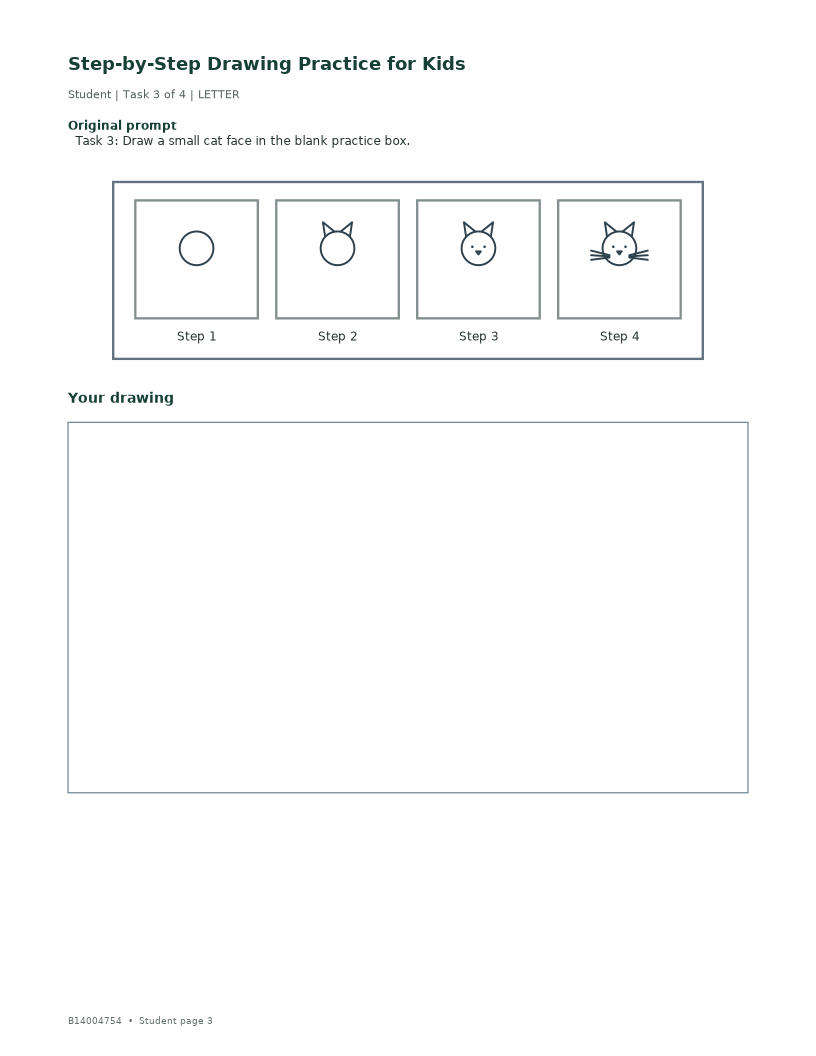
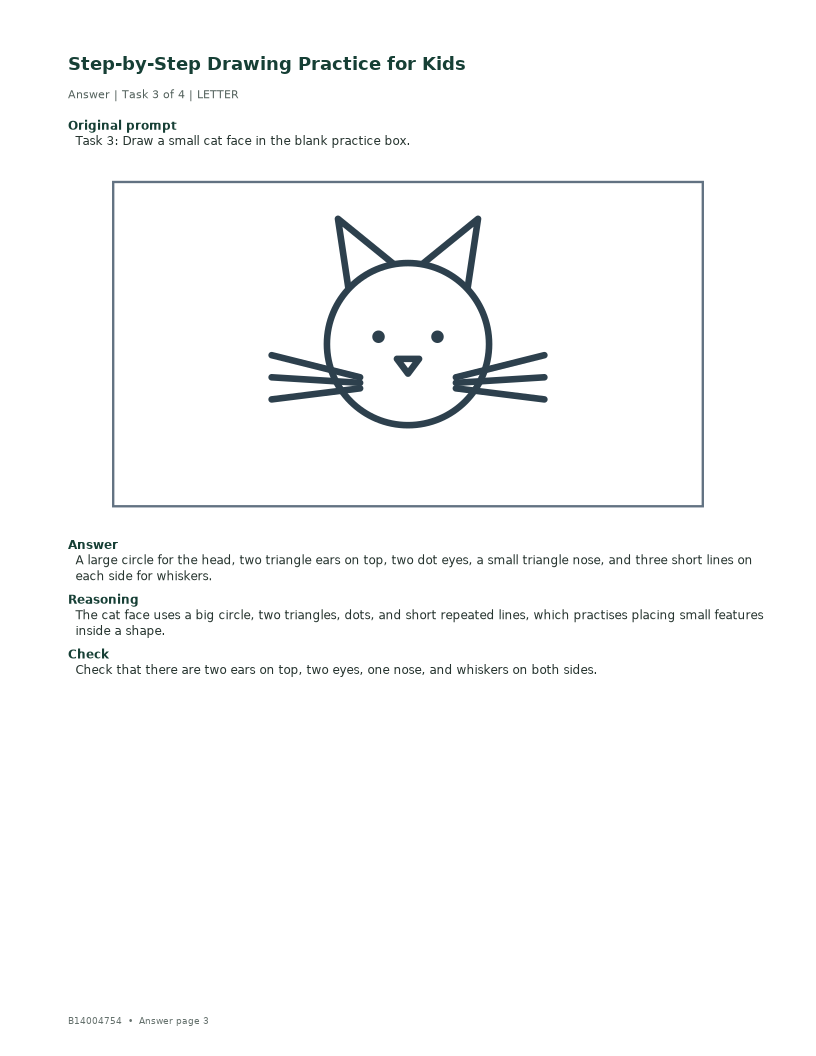
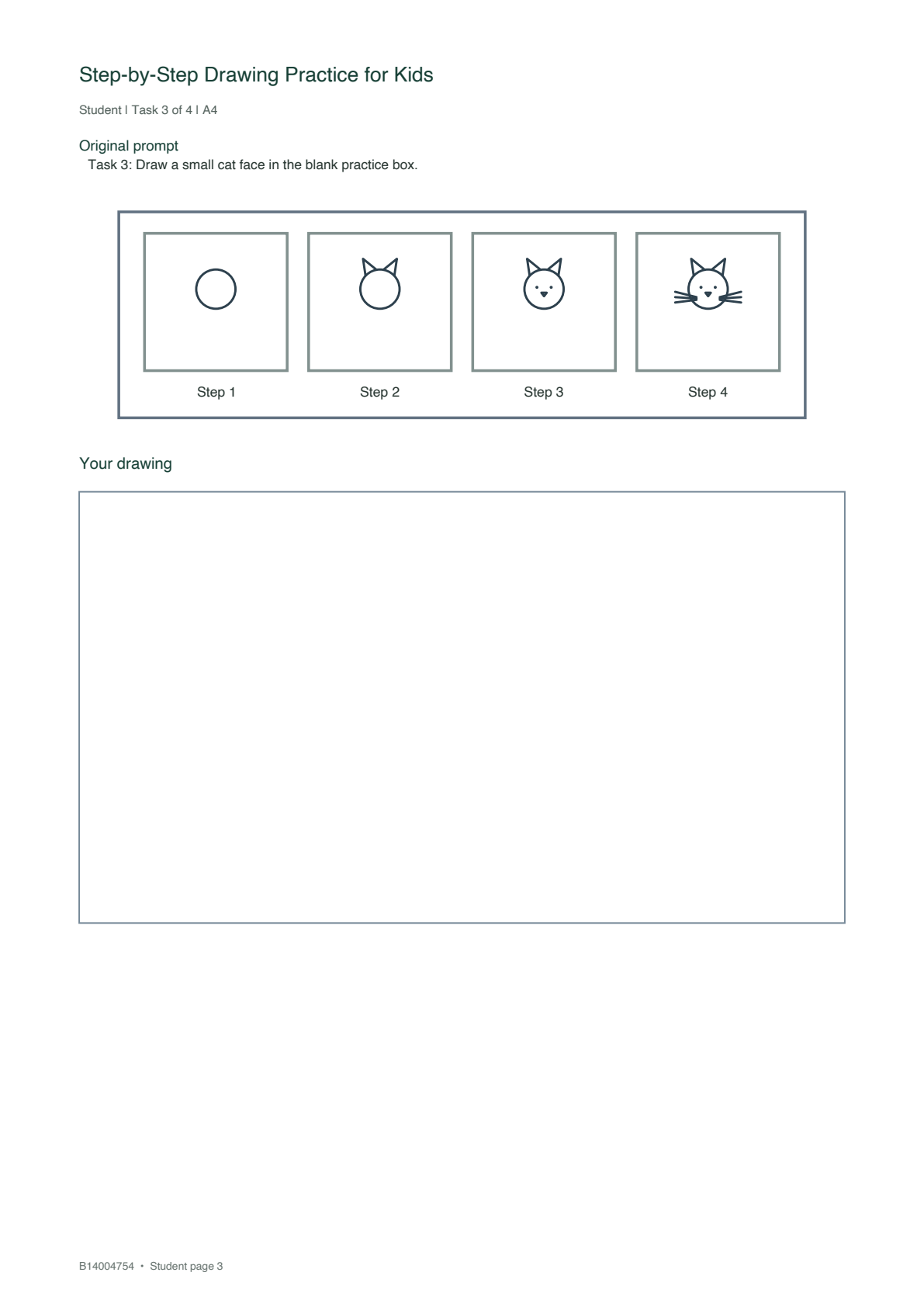
Task 3: Draw a small cat face in the blank practice box.
Show answer 3
A large circle for the head, two triangle ears on top, two dot eyes, a small triangle nose, and three short lines on each side for whiskers.
The cat face uses a big circle, two triangles, dots, and short repeated lines, which practises placing small features inside a shape.
Check: Check that there are two ears on top, two eyes, one nose, and whiskers on both sides.
Task 4
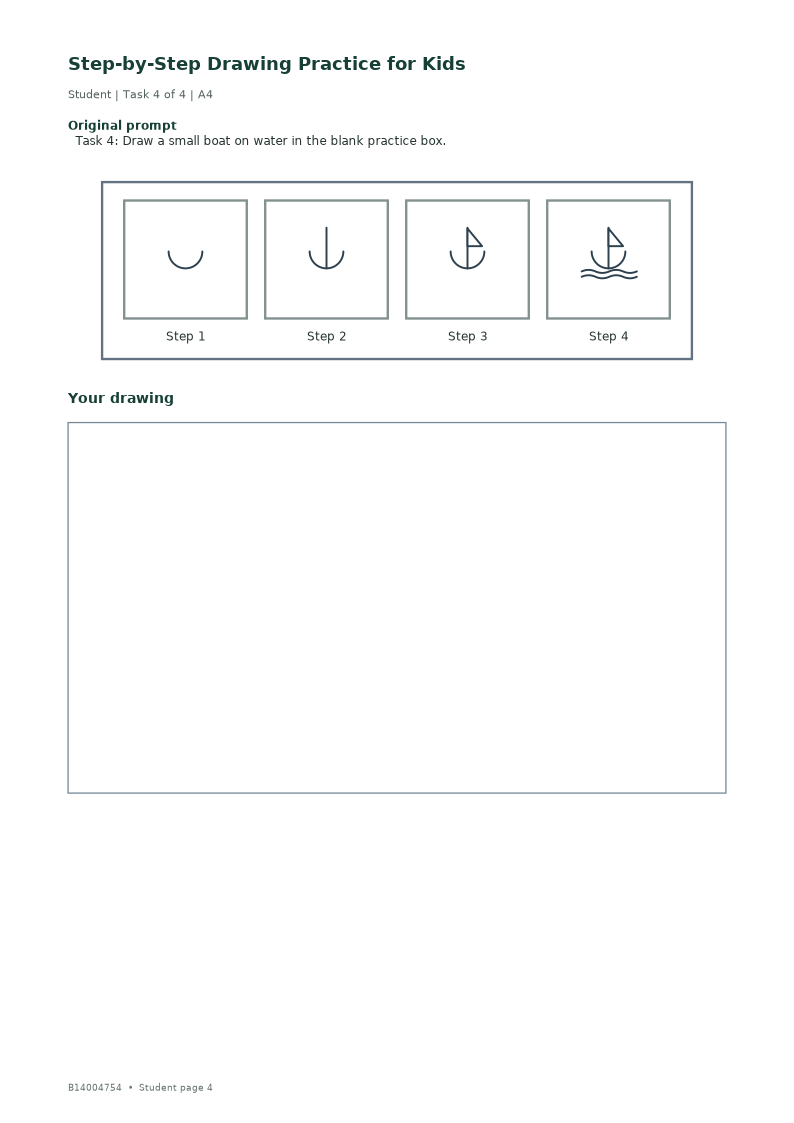
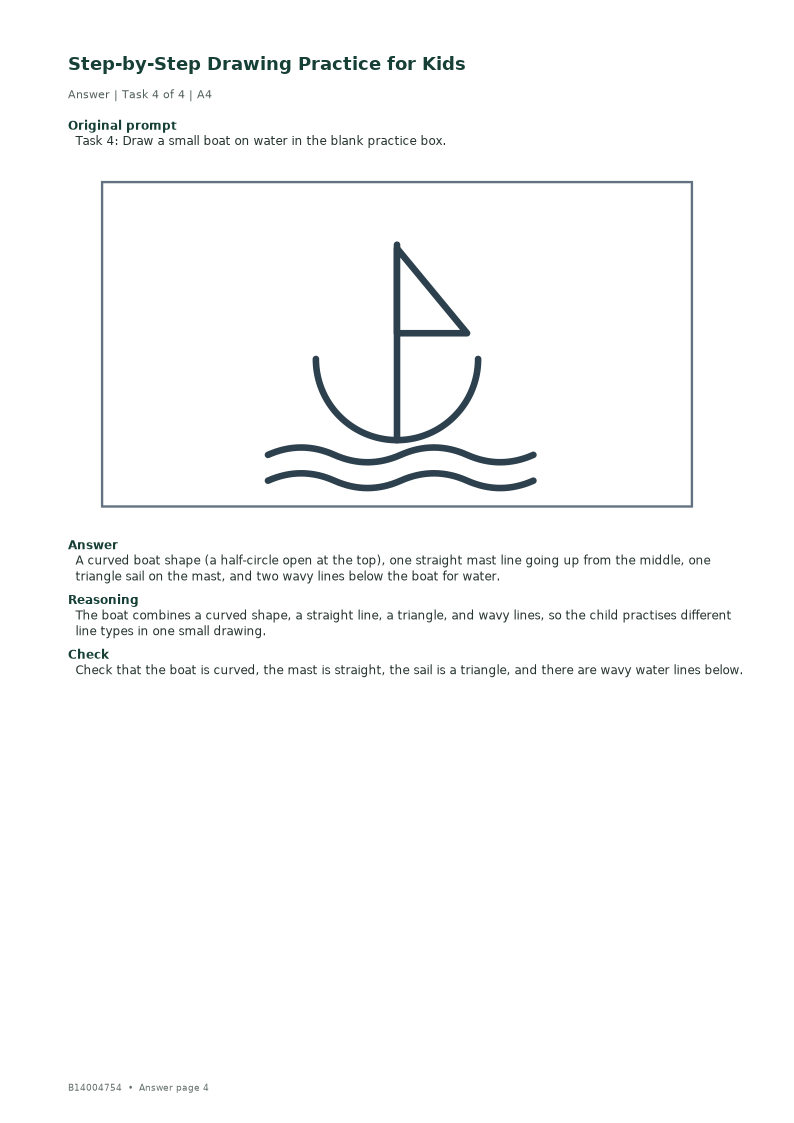
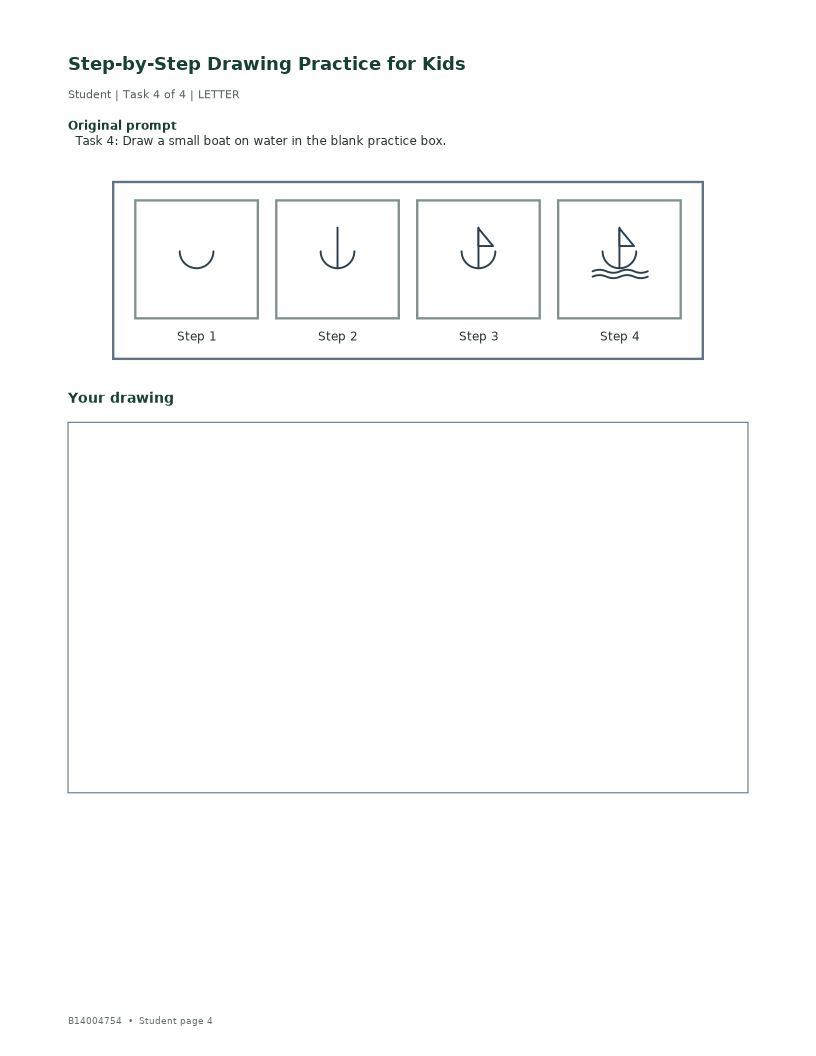
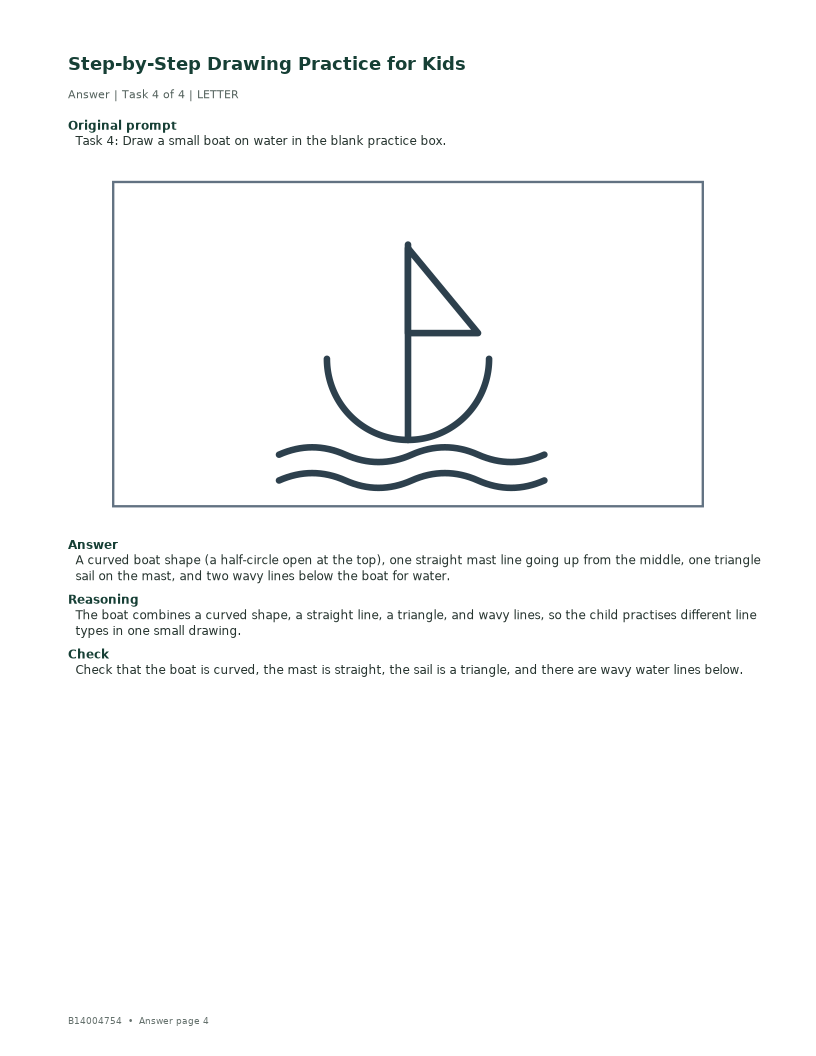
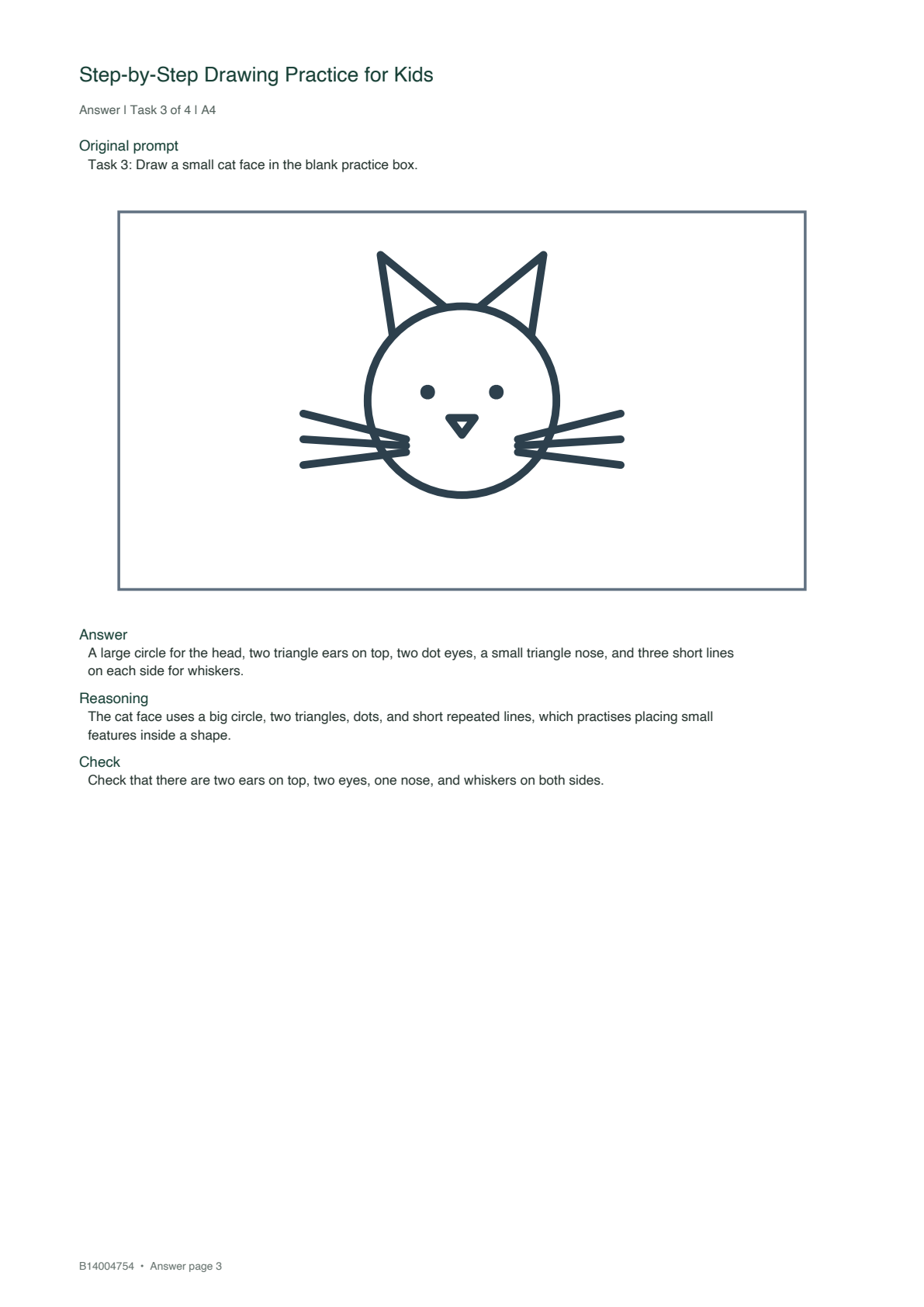
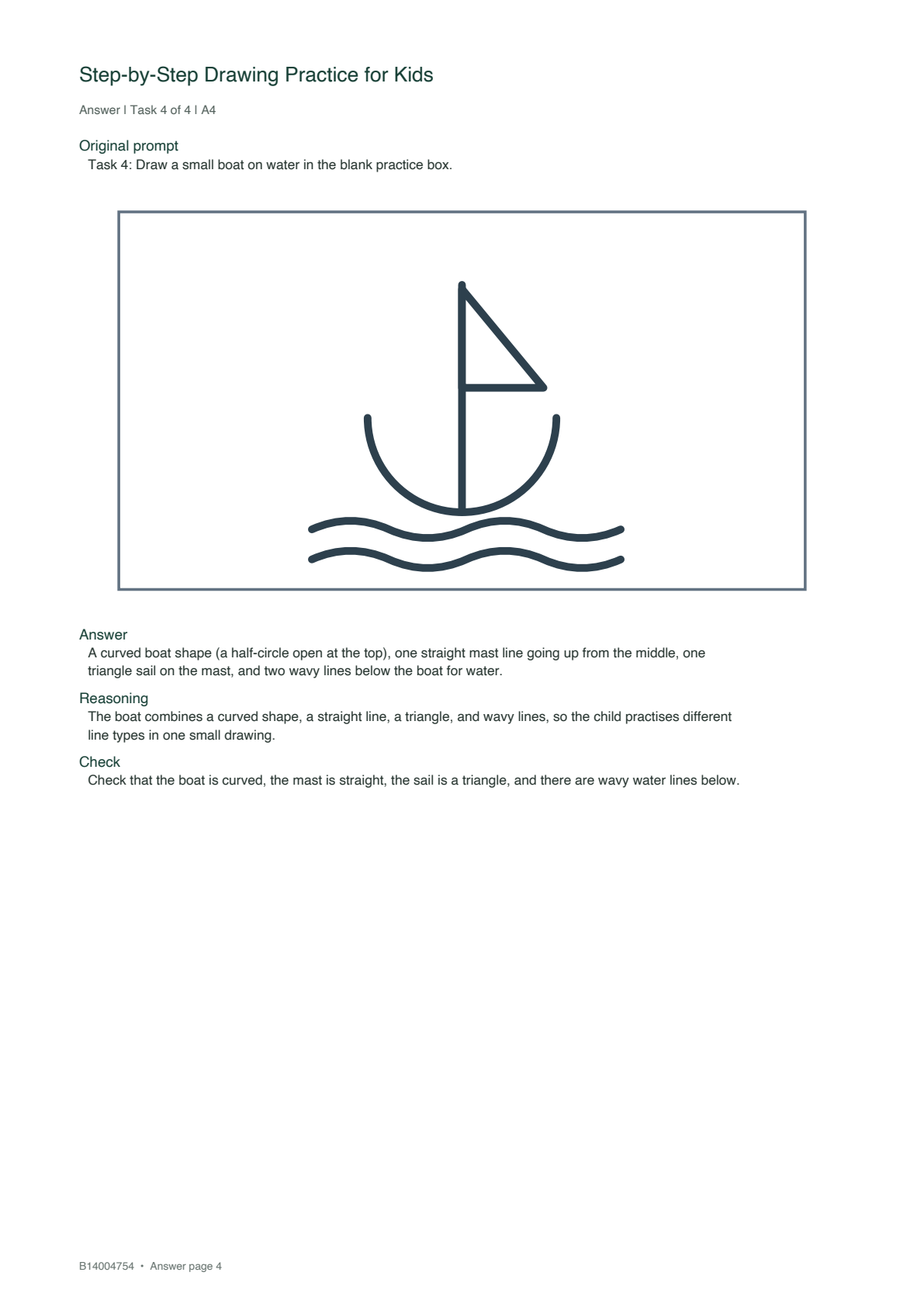
Task 4: Draw a small boat on water in the blank practice box.
Show answer 4
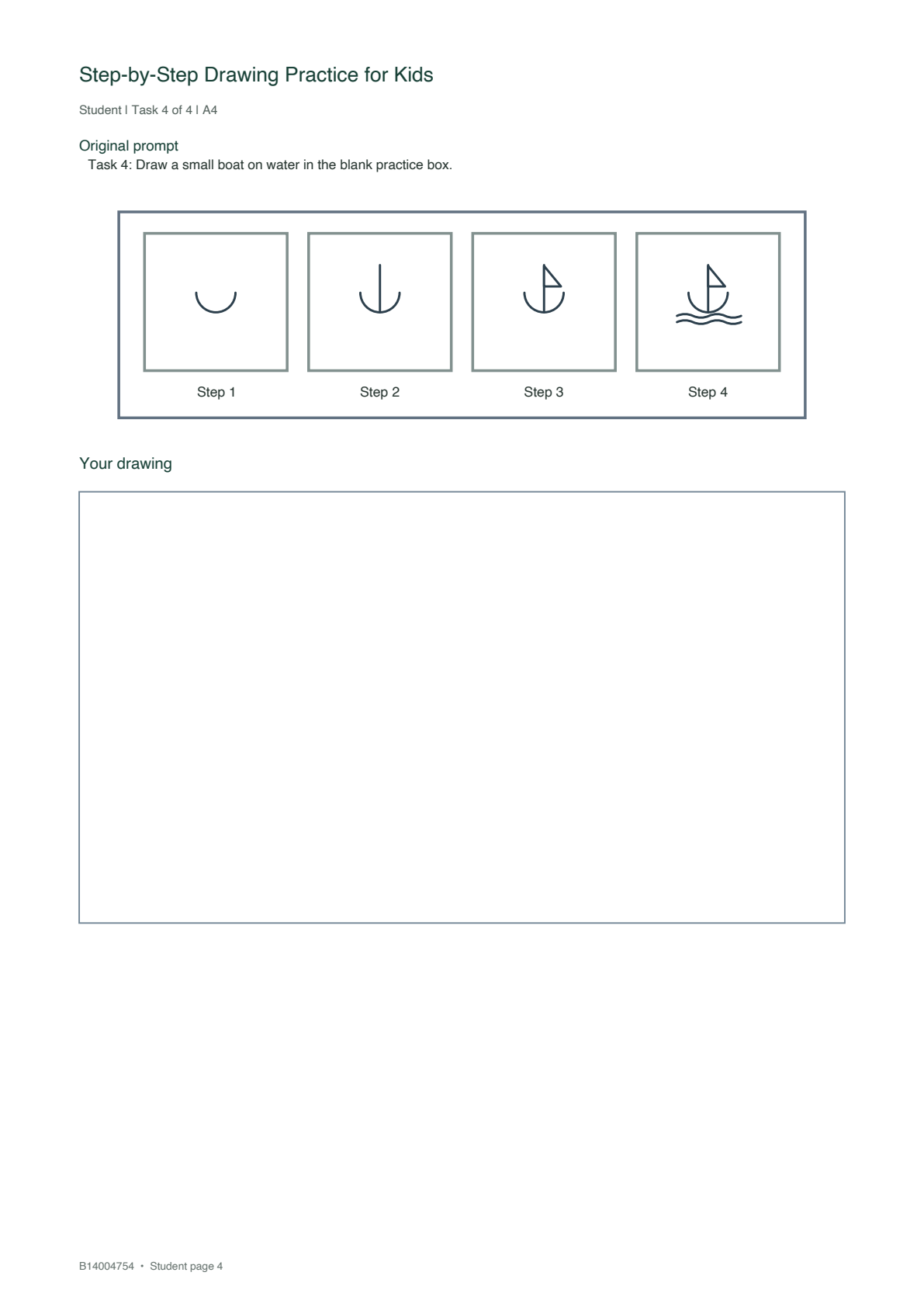
A curved boat shape (a half-circle open at the top), one straight mast line going up from the middle, one triangle sail on the mast, and two wavy lines below the boat for water.
The boat combines a curved shape, a straight line, a triangle, and wavy lines, so the child practises different line types in one small drawing.
Check: Check that the boat is curved, the mast is straight, the sail is a triangle, and there are wavy water lines below.
Useful checks
- Drawing the sun rays only on one side. Point to the top, bottom, left, and right of the circle and add one ray at each before filling the gaps.
- Putting the house roof beside the square instead of on top. Draw the square first, then place the triangle so its flat side rests on the top edge of the square.
- Drawing whiskers only on one side of the cat face. Draw three short lines on the left and three on the right, checking both sides before finishing.
Questions about this resource
Does my child need to copy exactly?
No. The key shows one correct version; the goal is to follow the steps and include the main parts, not to match every line perfectly.
How long should each task take?
There is no set time. A grown-up can stop the task when the child has drawn the main parts and checked them against the key.