HomeBlank Sheet Music: Stave Counts, Clefs, and Spacing That Work Free original lessons
Blank Sheet Music: Stave Counts, Clefs, and Spacing That Work
Plan blank staved music paper with treble, bass, or grand staves. Choose stave counts from measured page height, mark clefs clearly, and check spacing by hand.
Free downloads
Letter & A4
PDF & SVG
Writing and Handwriting Paper Guides
Blank staved paper is a layout decision before it is a printing decision. The useful questions are how many staves fit on your page, which clef each stave or system carries, and whether the gap between staves leaves room for ledger lines, dynamics, and your own handwriting. This draft explains those choices with simple arithmetic you can redo yourself. It describes concepts and a standard free pack; the pack is available in both paper sizes.
Practice materials: Download the free reference pages, practice sheets and separate answer keys below, in A4 and US Letter PDF and SVG formats.
What a clef fixes, and what it does not
A clef assigns pitch meaning to staff positions. In treble clef, the second line from the bottom is G above middle C. In bass clef, the second line from the top is F below middle C. The same staff position therefore denotes a different pitch under each clef. A note that already has a fixed pitch name does not change sound because the clef changed; what changes is where that pitch is written.
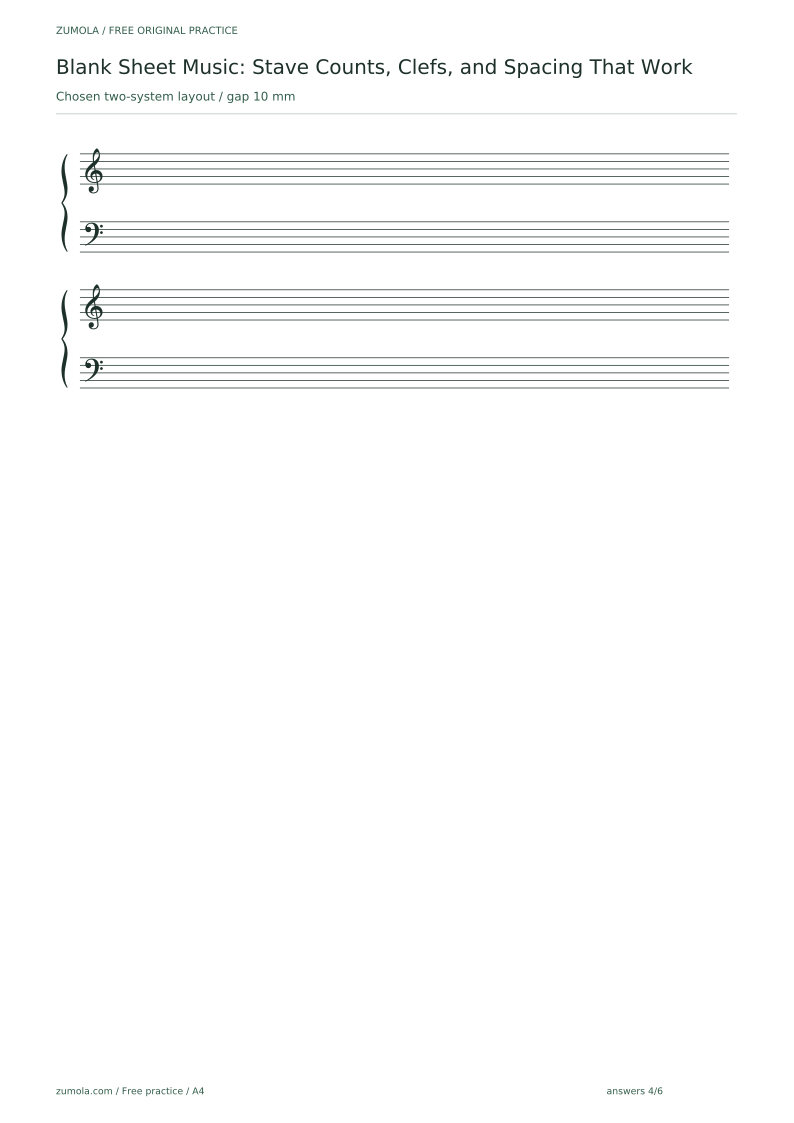
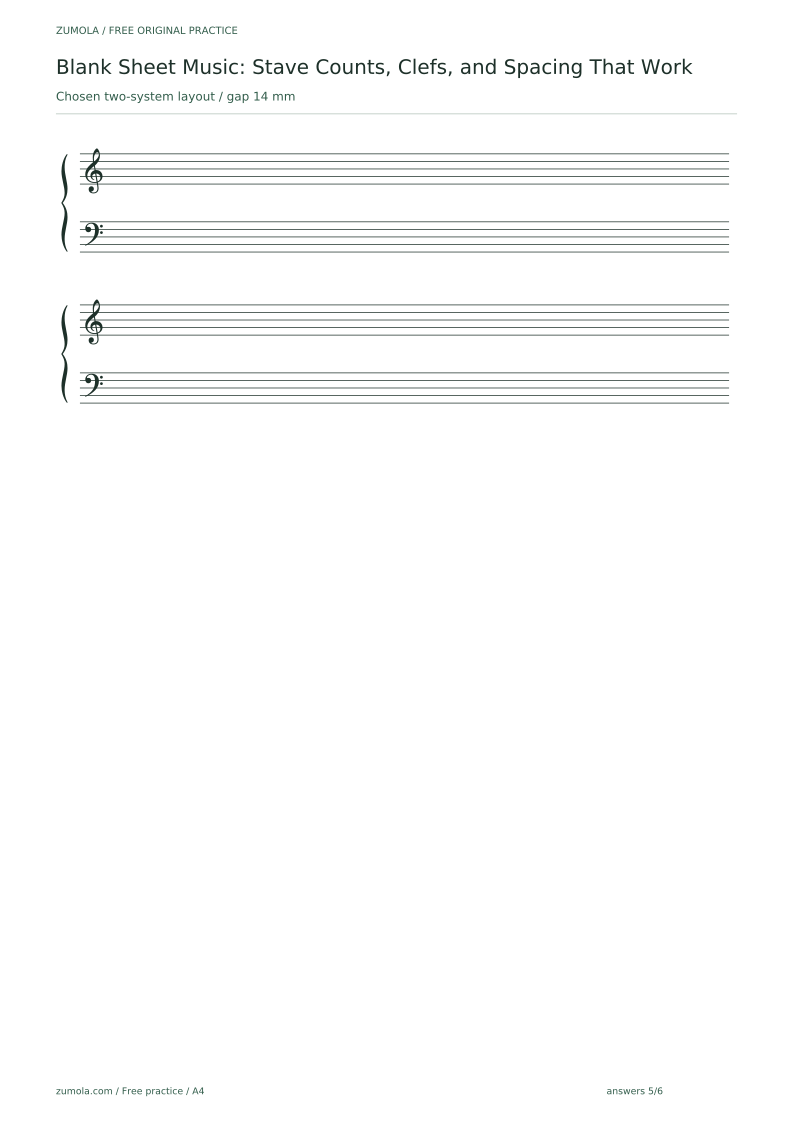
Grand staff pairs treble and bass staves, usually joined at the left by a brace, so one player reads both at once. Clefs may be marked on each stave or once per system where that is conventional and unambiguous. Rhythm-only staves, drum notation, and lyric-lined manuscript paper are separate tasks and are outside this page.
- Decide whether the player reads one stave or a grand-staff system.
- Mark the clef at the start of each stave, or once per system if the layout makes the pairing unmistakable.
- Leave the top margin clear for a title and the clef area clear of binding or trimming.
Choosing a stave count from measured height
Stave count follows from usable height, not from a fixed number. Measure the printable height of your own paper and printer, subtract top and bottom margins you actually need, then account for the gaps only between adjacent staves. For single staves the formula is n = floor((H - margins + g) / (s + g)), where s is stave height and g is the gap between staves. For n positive staves the occupied height is n x s + (n - 1) x g; no extra gap is needed after the last stave.
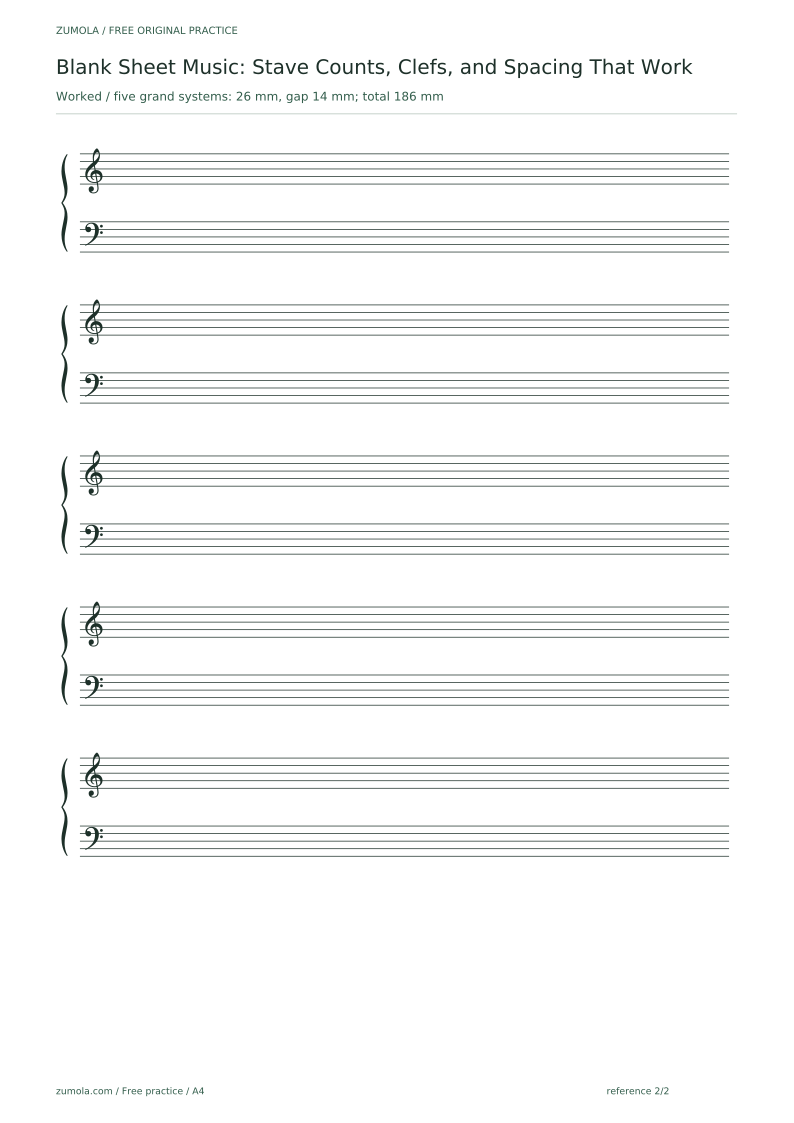
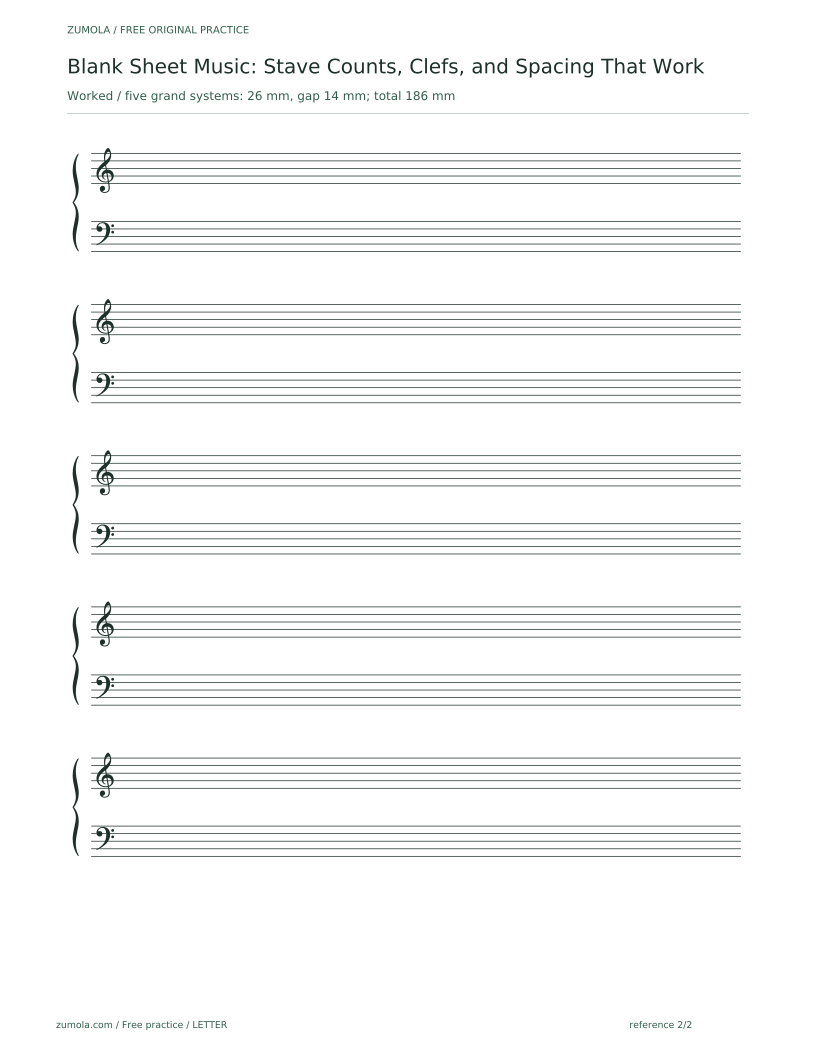
For grand-staff systems the gap sits between systems, not inside each pair. With system height S and inter-system gap G, n systems need n x S + (n - 1) x G. Using hypothetical inputs S = 26 mm and G = 14 mm: five systems need 5 x 26 + 4 x 14 = 130 + 56 = 186 mm; six systems need 6 x 26 + 5 x 14 = 156 + 70 = 226 mm. These numbers are examples only; measure your equipment and substitute your own values.
- Measure printable height and the margins your printer and binding require.
- Measure one stave and choose a gap that leaves room for ledger lines and markings.
- Apply the single-stave or system formula and round down to a whole count.
- Write a header you add yourself stating clef choice and stave count, placed outside the stave area.
Checking spacing before you commit
A layout that looks fine on screen can crowd handwriting. Test by writing a few notes with ledger lines above and below a stave, plus a dynamic mark and a fingering number, then check whether anything collides with the neighbouring stave. Compare the extent of ledger lines with the inter-stave gap; if they meet, increase the gap or reduce the count.
Keep one worked layout per page variant so you can compare counts honestly. Label each example's inputs separately, because a count derived from a 200 mm usable height is not the same claim as one derived from 240 mm.
- Write ledger lines, a dynamic, and a fingering mark by hand on a draft.
- Compare ledger-line extent with the gap to the stave below.
- Adjust gap or count, then record the inputs you used.
Worked example
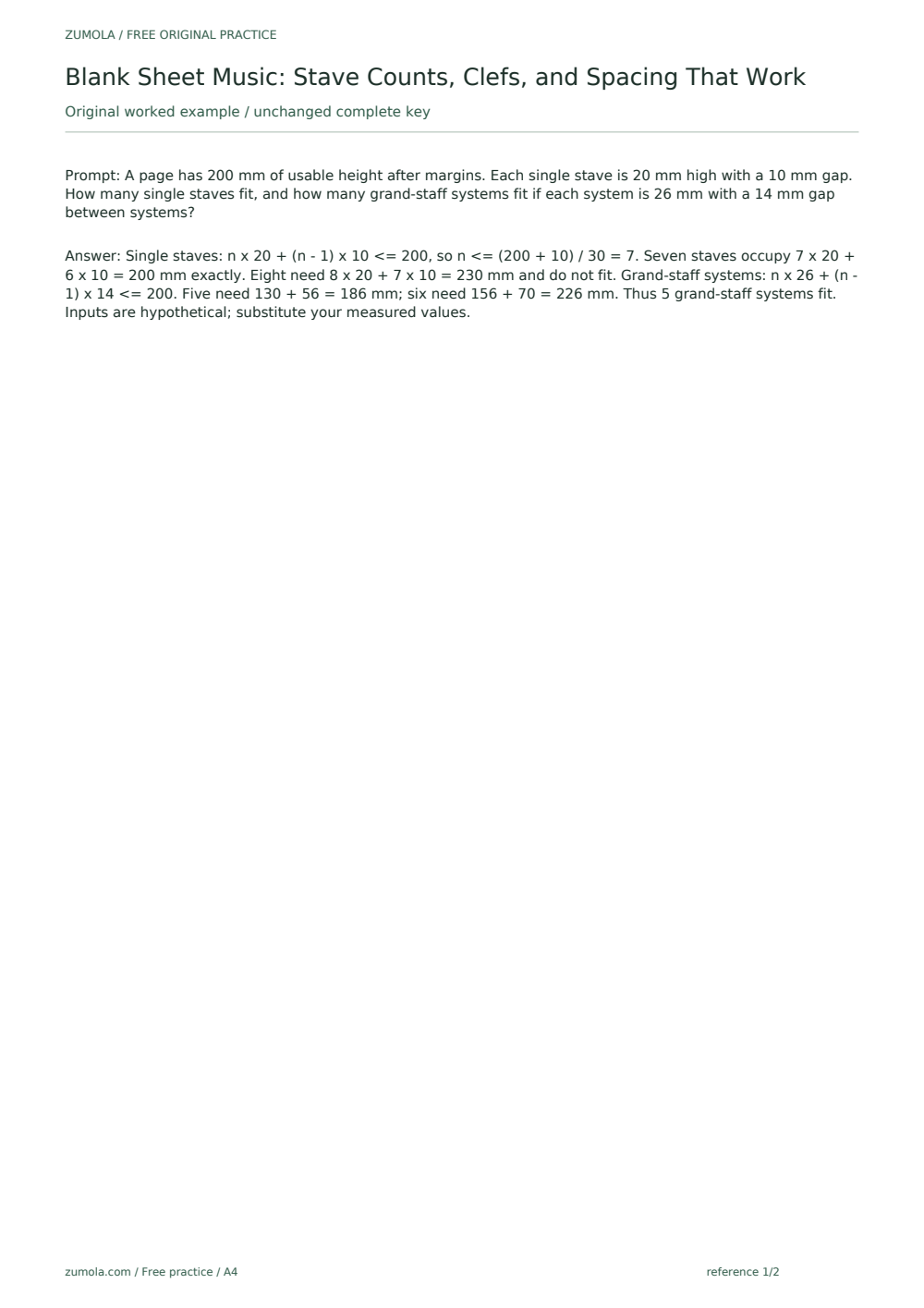
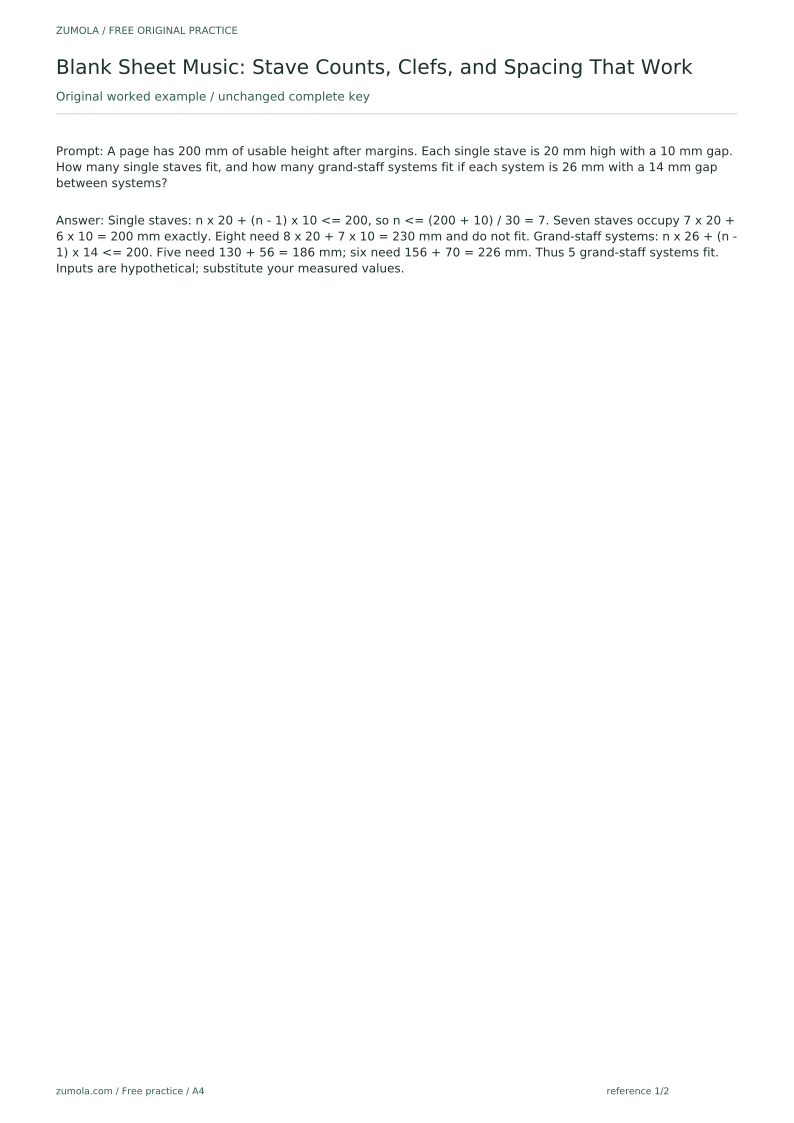
A page has 200 mm of usable height after margins. Each single stave is 20 mm high with a 10 mm gap. How many single staves fit, and how many grand-staff systems fit if each system is 26 mm with a 14 mm gap between systems?
Worked answer
Single staves: n x 20 + (n - 1) x 10 <= 200, so n <= (200 + 10) / 30 = 7. Seven staves occupy 7 x 20 + 6 x 10 = 200 mm exactly. Eight need 8 x 20 + 7 x 10 = 230 mm and do not fit. Grand-staff systems: n x 26 + (n - 1) x 14 <= 200. Five need 130 + 56 = 186 mm; six need 156 + 70 = 226 mm. Thus 5 grand-staff systems fit. Inputs are hypothetical; substitute your measured values.
Four practice exercises
Exercise 1
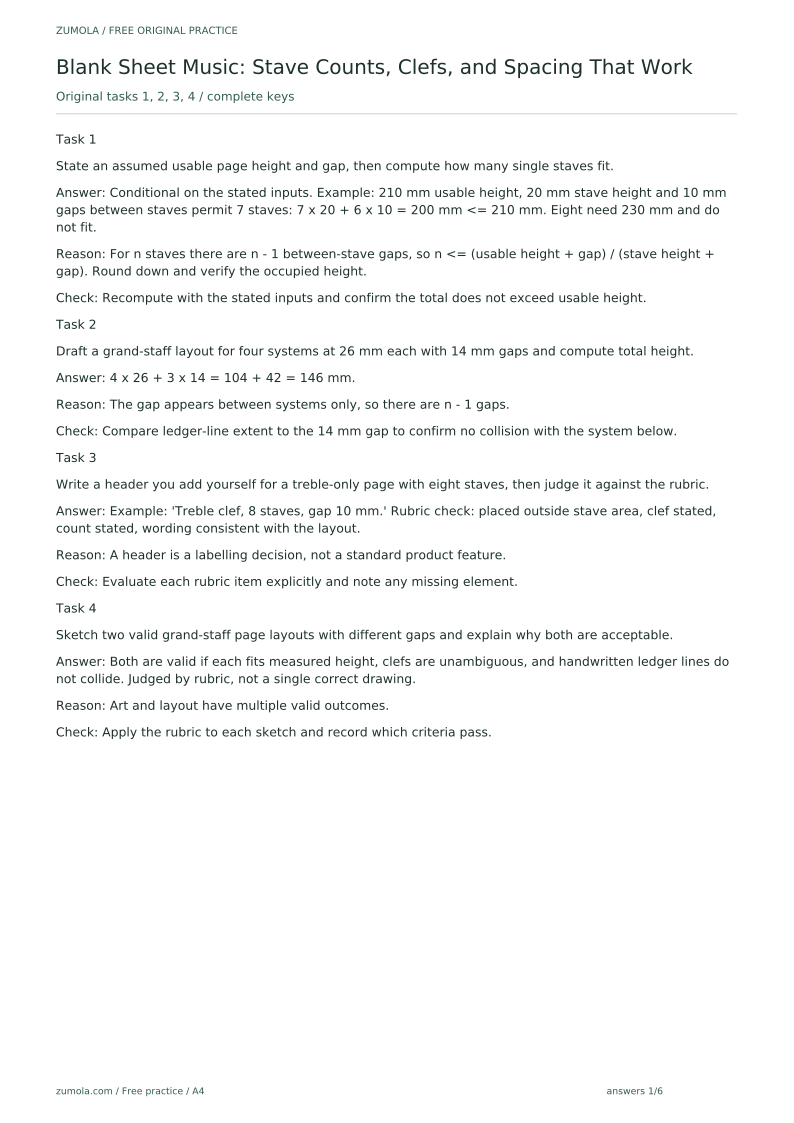
State an assumed usable page height and gap, then compute how many single staves fit.
Show answer and check
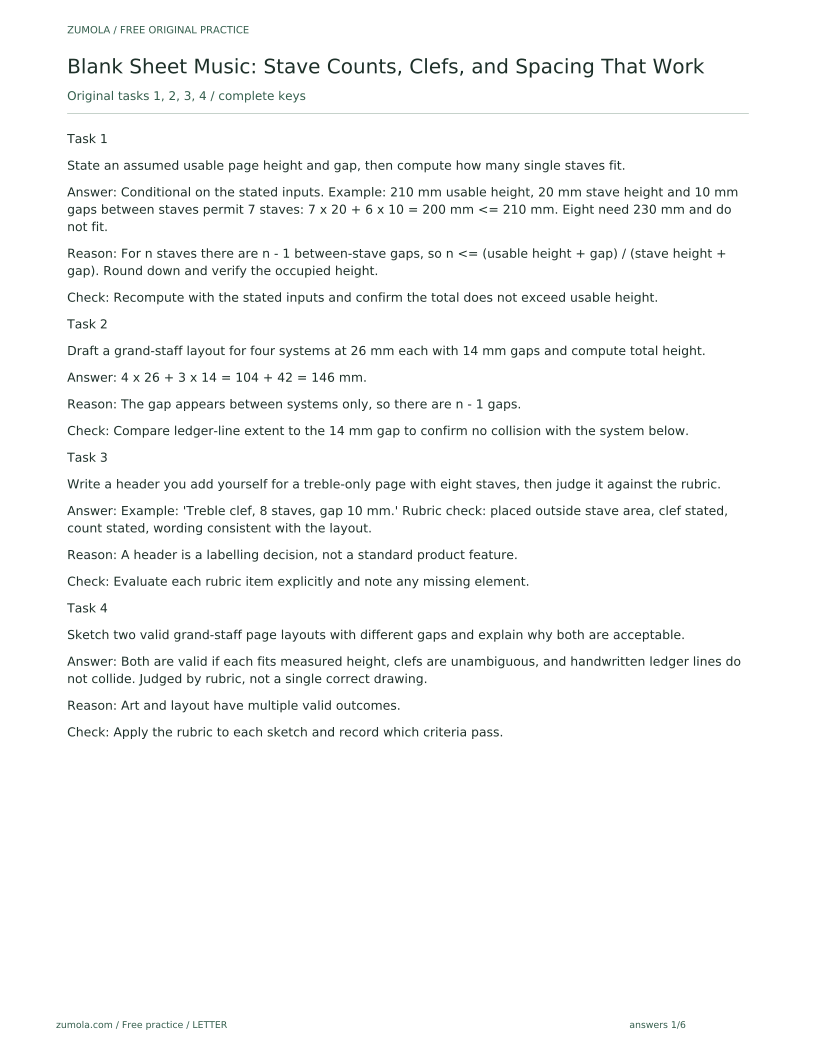
Conditional on the stated inputs. Example: 210 mm usable height, 20 mm stave height and 10 mm gaps between staves permit 7 staves: 7 x 20 + 6 x 10 = 200 mm <= 210 mm. Eight need 230 mm and do not fit.
Why: For n staves there are n - 1 between-stave gaps, so n <= (usable height + gap) / (stave height + gap). Round down and verify the occupied height.
Check: Recompute with the stated inputs and confirm the total does not exceed usable height.
Exercise 2
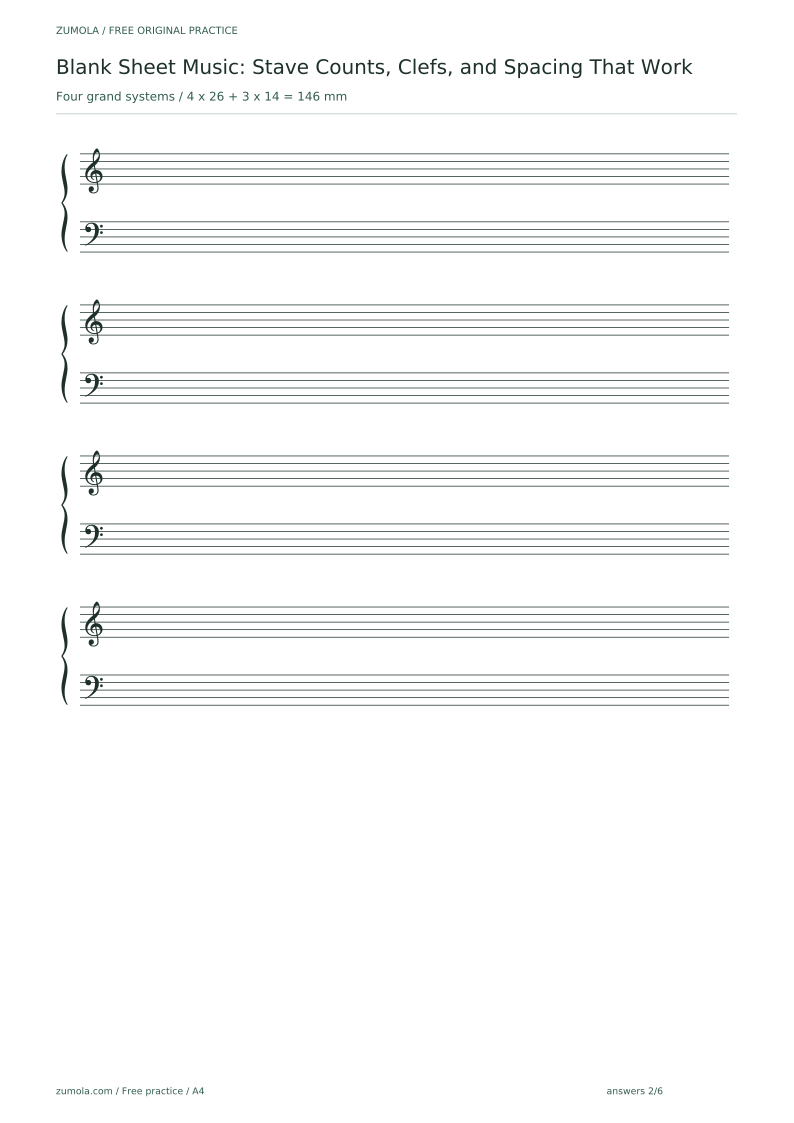
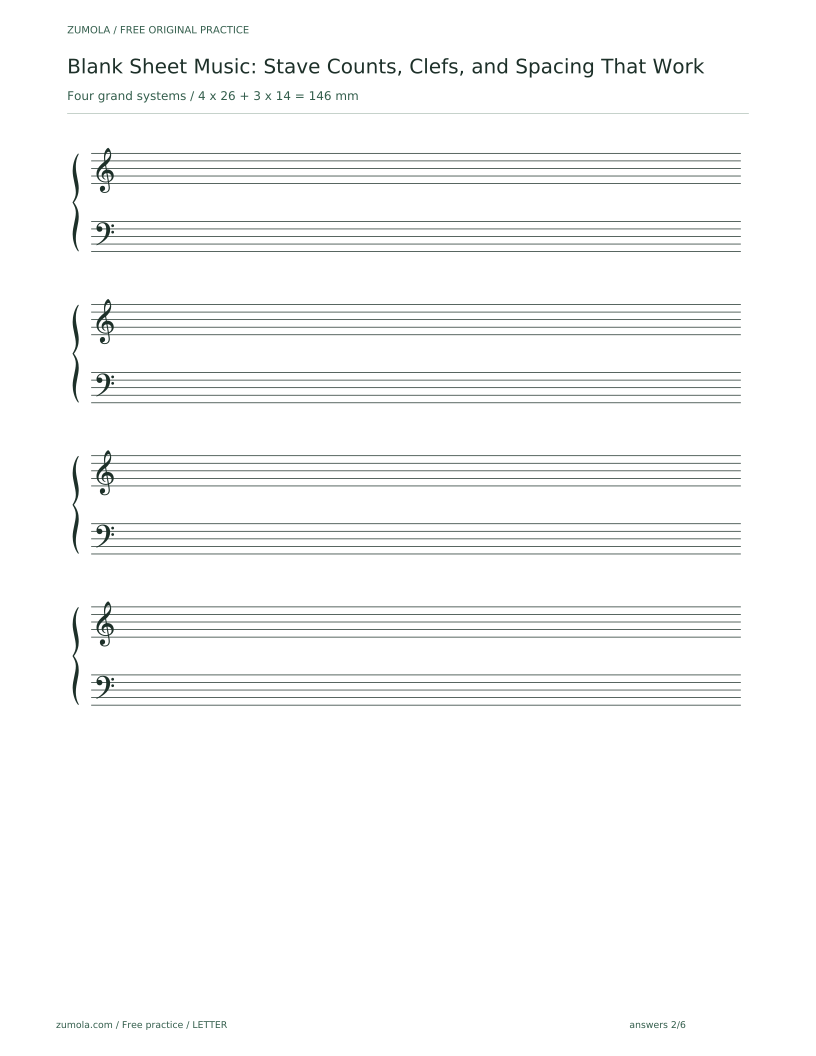
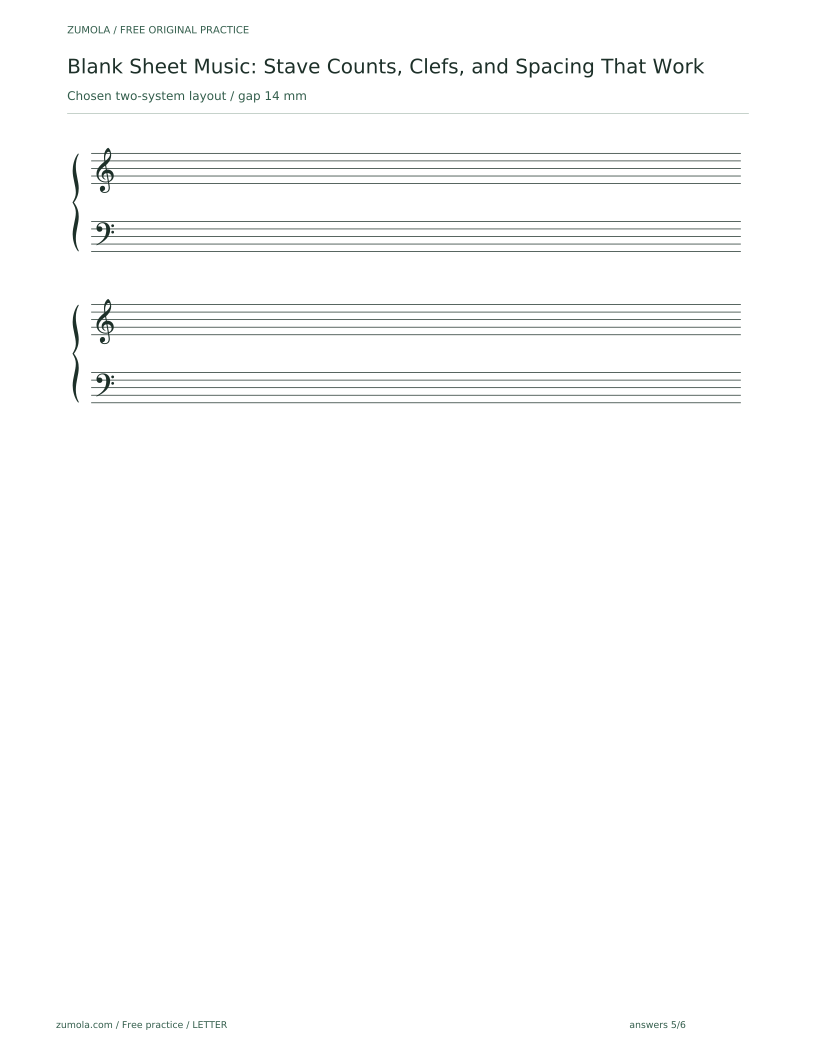
Draft a grand-staff layout for four systems at 26 mm each with 14 mm gaps and compute total height.
Show answer and check
4 x 26 + 3 x 14 = 104 + 42 = 146 mm.
Why: The gap appears between systems only, so there are n - 1 gaps.
Check: Compare ledger-line extent to the 14 mm gap to confirm no collision with the system below.
Exercise 3
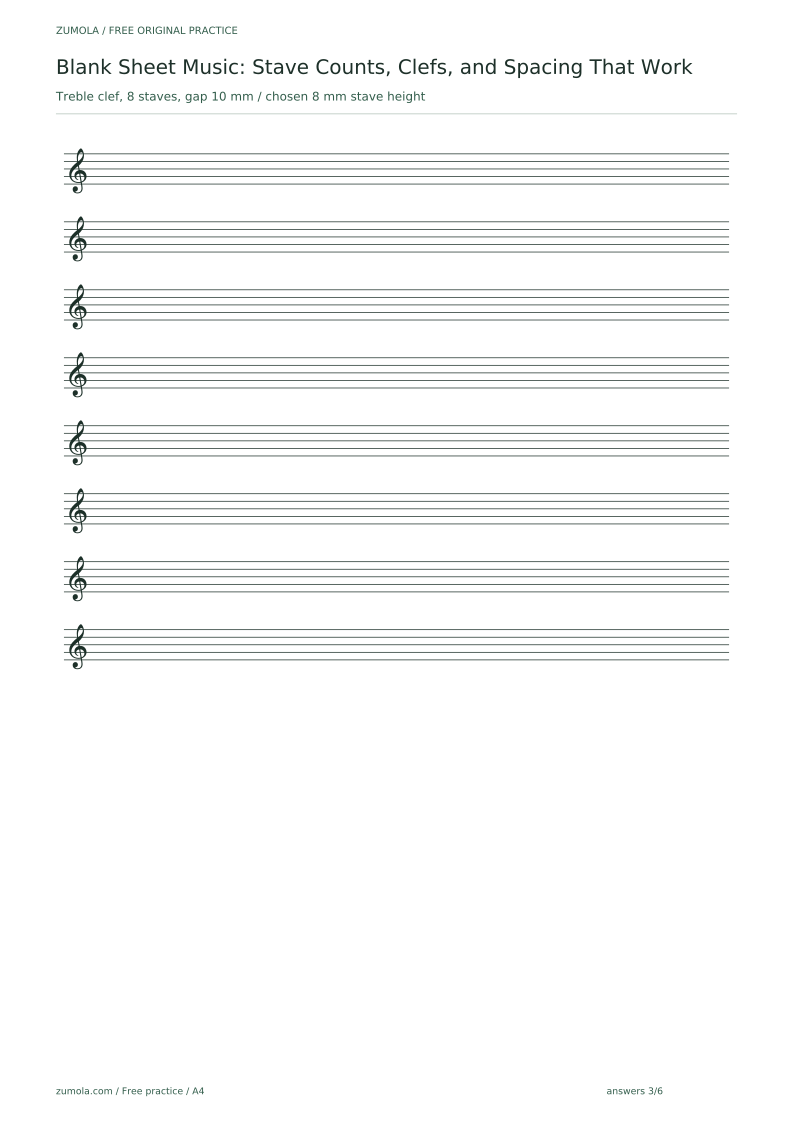
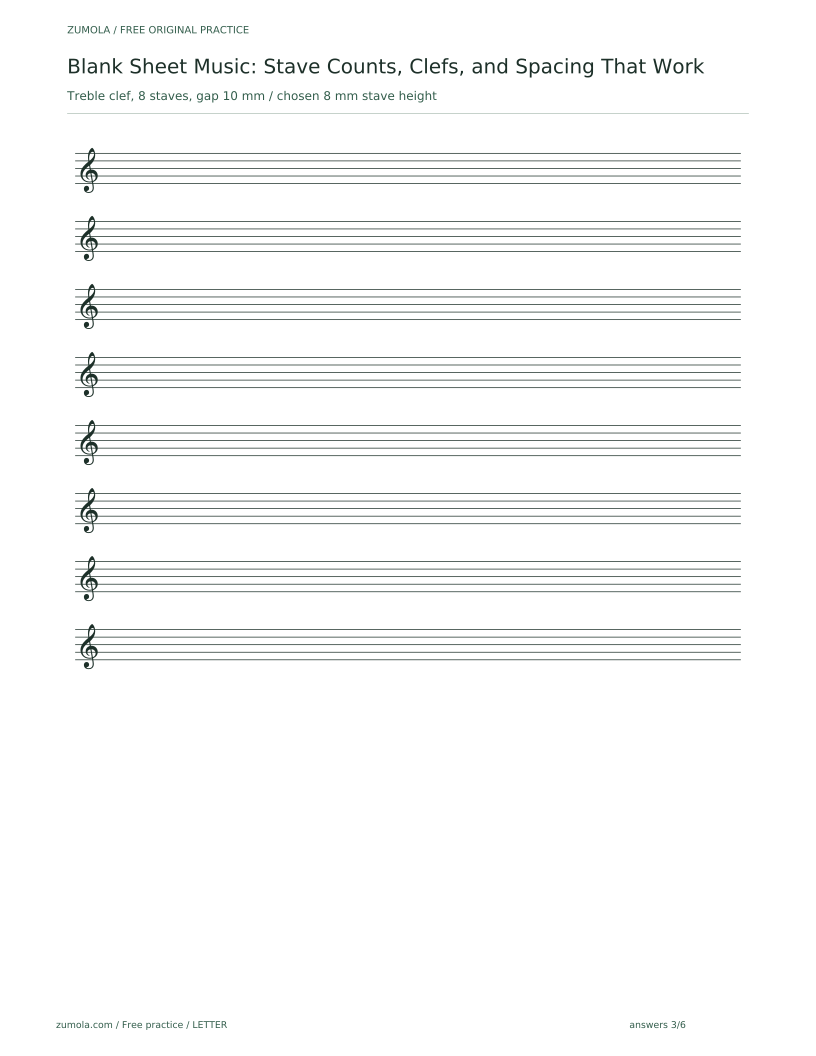
Write a header you add yourself for a treble-only page with eight staves, then judge it against the rubric.
Show answer and check
Example: 'Treble clef, 8 staves, gap 10 mm.' Rubric check: placed outside stave area, clef stated, count stated, wording consistent with the layout.
Why: A header is a labelling decision, not a standard product feature.
Check: Evaluate each rubric item explicitly and note any missing element.
Exercise 4
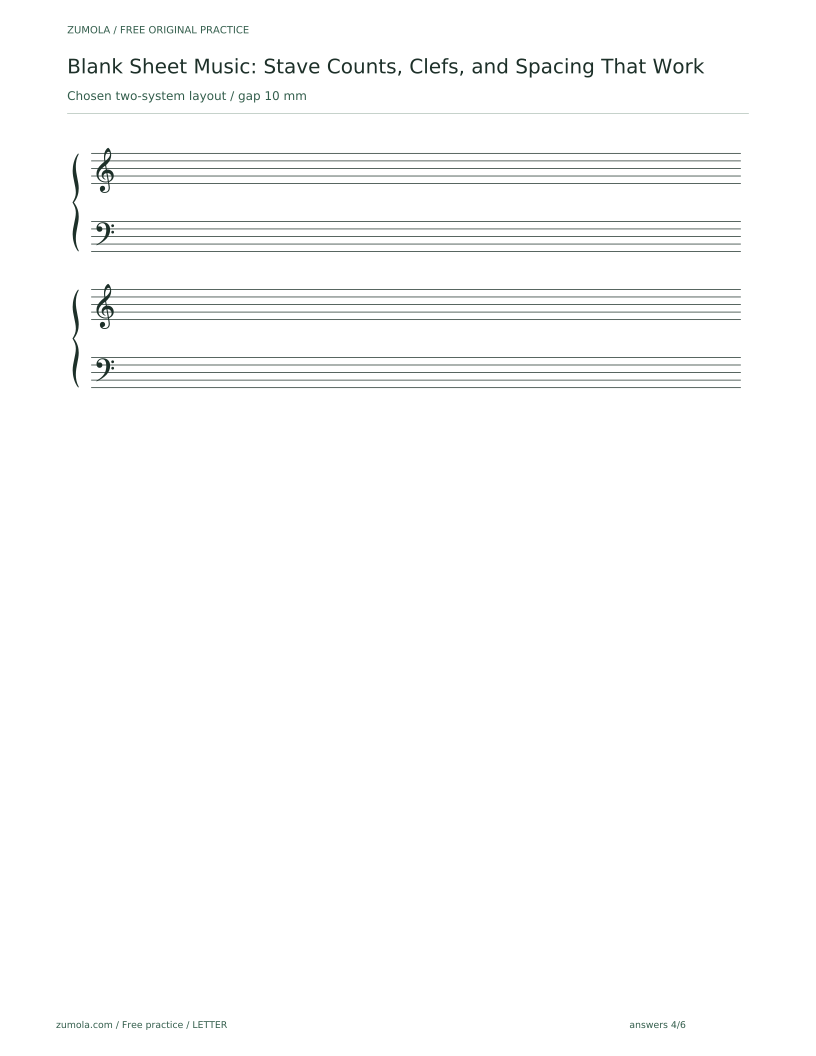
Sketch two valid grand-staff page layouts with different gaps and explain why both are acceptable.
Show answer and check
Both are valid if each fits measured height, clefs are unambiguous, and handwritten ledger lines do not collide. Judged by rubric, not a single correct drawing.
Why: Art and layout have multiple valid outcomes.
Check: Apply the rubric to each sketch and record which criteria pass.
Common mistakes
- Assuming a fixed stave count fits every page without measuring. Measure printable height and margins on your own equipment, then apply the formula and round down.
- Treating a grand-staff gap as if it belonged after every system, including the last. Use n x S + (n - 1) x G so the trailing gap is excluded, and recompute rather than copying a total.
- Leaving clefs ambiguous on a grand-staff system. Mark clefs on each stave, or once per system only where the brace and pairing make the reading unmistakable.
Self-check rubric
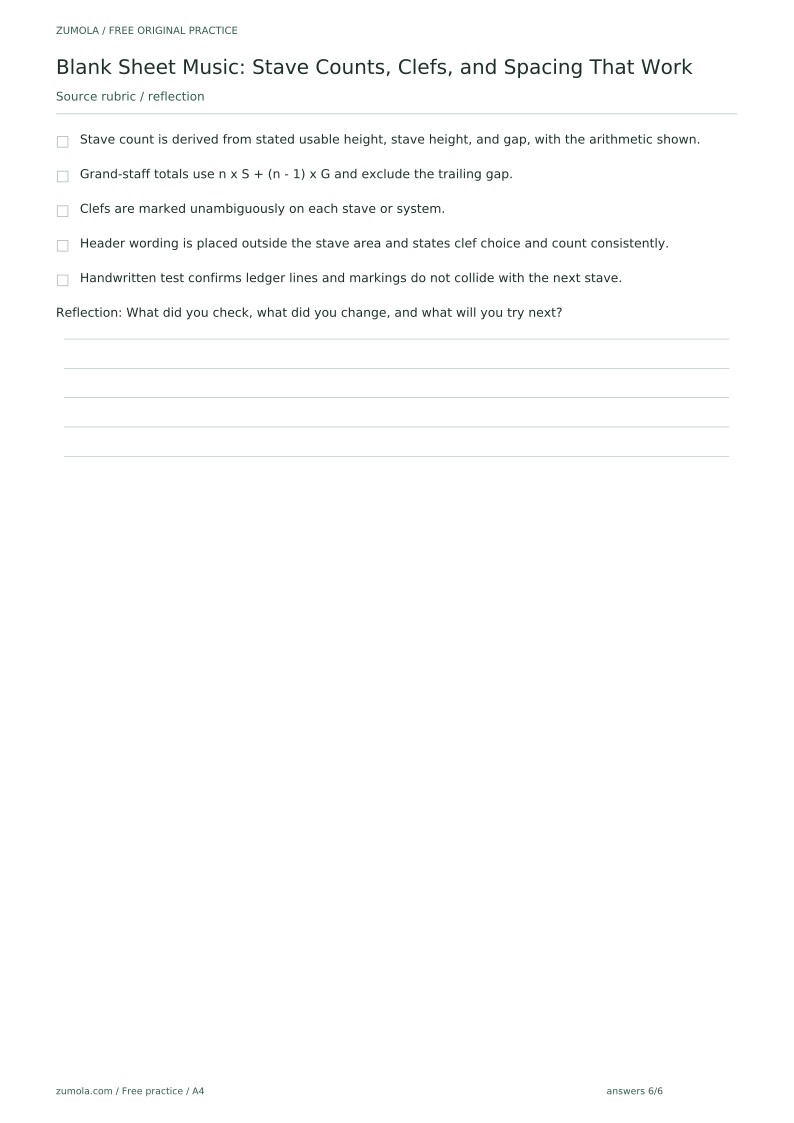
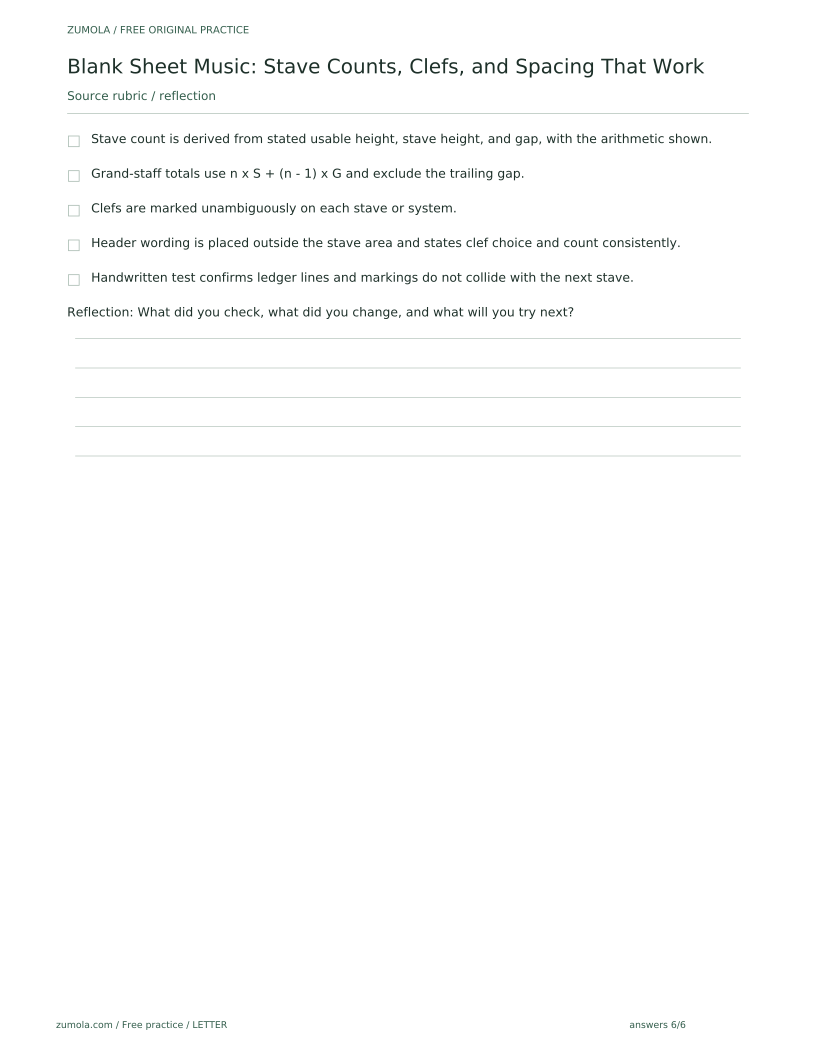
- Stave count is derived from stated usable height, stave height, and gap, with the arithmetic shown.
- Grand-staff totals use n x S + (n - 1) x G and exclude the trailing gap.
- Clefs are marked unambiguously on each stave or system.
- Header wording is placed outside the stave area and states clef choice and count consistently.
- Handwritten test confirms ledger lines and markings do not collide with the next stave.
Questions and answers
Does every stave need its own clef?
Each stave or system must have its clef unambiguously indicated. Grand-staff systems often share clefs at system level; single staves normally carry their own.
Can I use one gap value for every layout?
No. Gap depends on handwriting size, ledger-line extent, and the markings you expect. Test by hand and adjust.
Are printable files available now?
This is a standard free pack describing concepts and a resource set. The pack is available in both paper sizes.
Free printable downloads
Choose a paper size. Practice sheets and answer keys are separate. Download every file free, without registration.
This standard pack covers the four original exercises, blank work areas, complete keys and necessary figures. Additional extension sets described in the lesson are outside this download.
PDF bundles
Individual SVG pages
Reference-page preview