HomeDrawing a Mother and Child Pair: Relative Scale and Pose Free original lessons
Drawing a Mother and Child Pair: Relative Scale and Pose
Learn to draw an adult and child together with believable size difference and connected pose, using simple proportion guides and two annotated pose variants.
Free lesson
Four exercises
Worked answers
Object Drawing Lessons
Drawing a mother and child pair is not two separate figures placed side by side. The child must read as smaller in a consistent way, and the two bodies must share a pose relationship: touching, leaning, or seated together. This lesson teaches a repeatable method for relative scale and pose connection. You will compare head units, align key body landmarks, and build poses from a shared contact point. The convention used here is simple: one head unit equals the vertical distance from the top of the head to the chin. All numerical values are hypothetical examples for practice, not universal standards. Measure your own reference or model to set your own values. The worksheet and diagrams described in the resource plan are planned but not yet built; this text is self-contained.
Practice materials: Printable downloads are not available for this lesson yet. Use the instructions and four exercises below.
Reference illustration
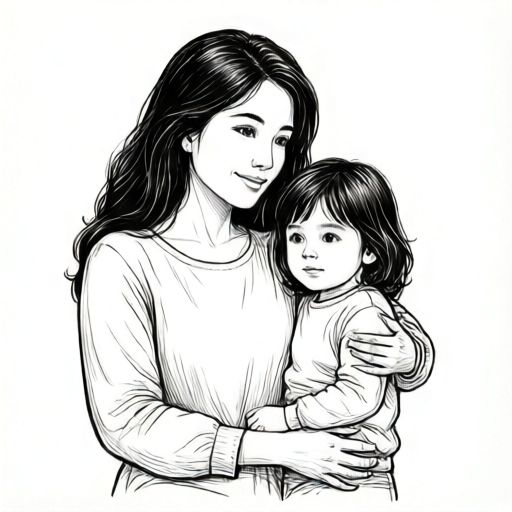
Use the stated measurements and conventions for each exercise.
Establish relative scale with head units
Start by deciding the adult's head unit on your page. A common practice value is 2.5 cm for the adult head height, but treat this as a hypothetical example. Measure your own paper and choose a value that fits. The child's head is proportionally larger relative to body height in early childhood, so the child's head unit may be similar in absolute size to the adult's or slightly smaller. What changes is how many head units tall each figure is.
For a standing adult, a practice ratio might be 7.5 head units tall; for a young child, about 4.5 to 5 head units. These are hypothetical examples. The key check is arithmetic: if the adult head unit is 2.5 cm and the adult is 7.5 units tall, the adult height on paper is 18.75 cm. If the child head unit is 2.2 cm and the child is 4.8 units tall, the child height is 10.56 cm. The child should be roughly 56 percent of the adult's height in this example. Adjust numbers to match your reference, but keep the arithmetic consistent.
- Draw a vertical line for the adult and mark the adult head unit from top of head to chin.
- Repeat the head unit down the adult line to count total height; label the count.
- Draw a second vertical line nearby for the child and mark the child head unit.
- Count child head units and compute both heights in the same unit.
- Compare the two heights as a ratio and adjust before drawing details.
Connect the pose at a shared contact point
A mother and child pair reads as connected when at least one body part touches or overlaps consistently. Choose a contact point first: the child's hand on the adult's leg, the adult's arm around the child's shoulder, or the child leaning into the adult's side. Draw that contact point before drawing either full figure. Then build outward from it.
For a standing embrace, the adult's near arm curves around the child's back, and the child's near arm reaches toward the adult's waist. The child's head may rest against the adult's torso. For a seated pair, the adult sits with knees bent and the child sits in the lap or beside the hip, with the child's shoulder overlapping the adult's arm. In both variants, check that the child's feet or knees do not float above the ground line unless the pose intentionally lifts them.
- Mark the contact point on the page with a small cross.
- Draw the adult's torso and the child's torso as simple ovals that overlap at the contact point.
- Add the adult's near arm and the child's near arm so they meet or cross at the contact.
- Place the ground line and check that standing feet or seated hips rest on it.
- Add head and limbs last, keeping the head-unit scale from the first section.
Check pose relationship with landmark alignment
Use landmark alignment to test whether the pair looks natural. For a standing pair, the adult's shoulder line is usually higher than the child's head top or near it; the child's shoulder line sits near the adult's waist or lower rib. For a seated pair, the adult's knee height and the child's hip height should relate consistently to the seat surface. These are descriptive guides, not fixed rules.
A simple check is to draw horizontal guide lines across both figures at the child's eye level, shoulder level, and hip level. On the adult, note where those lines land. If the child's shoulder line lands at the adult's knee in a standing pose, the child may be too low or the adult too tall. Adjust one figure rather than both to preserve your chosen scale.
- Draw three light horizontal lines across the page at the child's eye, shoulder, and hip levels.
- Note where each line crosses the adult figure and label the adult landmark.
- Compare the labels to your intended pose description.
- Adjust the child's vertical position or the adult's limb placement, not the head-unit scale.
- Erase guide lines after the check.
Worked example
An adult head unit is 2.4 cm and the adult is 7 head units tall. The child head unit is 2.0 cm and the child is 5 head units tall. Compute both heights and the child-to-adult height ratio. Then state one contact point for a standing embrace.
Worked answer
Adult height = 2.4 cm × 7 = 16.8 cm. Child height = 2.0 cm × 5 = 10.0 cm. Ratio = 10.0 ÷ 16.8 ≈ 0.60, so the child is about 60 percent of the adult's height. A valid contact point is the child's near hand resting on the adult's waist, with the adult's near arm curving around the child's back.
Four practice exercises
Exercise 1
An adult head unit is 3 cm and the adult is 6 head units tall. A child head unit is 2.5 cm and the child is 4 head units tall. Compute both heights and the ratio. Describe one standing contact point.
Show answer and check
Adult height = 18 cm; child height = 10 cm; ratio = 10 ÷ 18 ≈ 0.56. A valid contact point is the child's hand on the adult's hip.
Why: Multiply head unit by head-unit count for each figure, then divide child height by adult height. The contact point must physically link the two figures.
Check: Recompute 3 × 6 = 18 and 2.5 × 4 = 10. Confirm the ratio is less than 1 and that the described contact point involves touching or overlap.
Exercise 2
A seated adult has a head unit of 2 cm and is 7 head units tall when standing, but seated height is about 4 head units from seat to head top. The child head unit is 1.8 cm and seated height is 3 head units. Compute seated heights and state where the child's shoulder should overlap the adult.
Show answer and check
Adult seated height = 8 cm; child seated height = 5.4 cm. The child's shoulder may overlap the adult's upper arm or side, with the child seated beside the adult's hip.
Why: Use seated head-unit counts, not standing counts, because the seat shortens the vertical measure. The overlap location follows from the contact point chosen for the seated variant.
Check: Verify 2 × 4 = 8 and 1.8 × 3 = 5.4. Check that the stated overlap is a touching relationship, not a gap.
Exercise 3
An adult head unit is 2.2 cm and the adult is 7.5 head units tall. A child head unit is 2.2 cm and the child is 4.5 head units tall. Compute both heights. Then explain whether the child's head unit being equal to the adult's is acceptable in this convention.
Show answer and check
Adult height = 16.5 cm; child height = 9.9 cm. Equal head units are acceptable because the child's proportionally larger head is expressed through fewer total head units, not necessarily a smaller absolute head unit.
Why: The convention measures head height directly; the child's larger head-to-body ratio appears as a lower head-unit count. The arithmetic stays consistent in the same unit.
Check: Recompute 2.2 × 7.5 = 16.5 and 2.2 × 4.5 = 9.9. Confirm the child is shorter and that the explanation refers to head-unit count, not absolute head size alone.
Exercise 4
A standing pair has an adult height of 20 cm and a child height of 12 cm. The child's shoulder line is drawn at 9 cm from the ground. The adult's waist is at 10 cm from the ground. State whether the shoulder-to-waist relationship is plausible and give one adjustment if not.
Show answer and check
The child's shoulder at 9 cm is close to the adult's waist at 10 cm, which is plausible for a standing embrace. If the shoulder were at 6 cm, it would be too low; raise the child's position or lower the adult's waist line by adjusting one figure only.
Why: Compare vertical landmark heights in the same unit. A small difference between child shoulder and adult waist supports a connected standing pose.
Check: Subtract the two heights: 10 − 9 = 1 cm difference. Confirm the adjustment changes only one figure and preserves the stated heights.
Common mistakes
- Drawing the child as a scaled-down adult with the same head-to-body ratio. Give the child a proportionally larger head and shorter limbs; count head units separately for each figure.
- Placing the two figures side by side with no overlapping contact. Choose one contact point first and build both torsos outward from it so the pair reads as connected.
- Letting the child's feet float above the ground line in a standing pose. Draw the ground line before the feet and check that both standing figures touch it.
- Changing both figures at once when the scale looks wrong. Adjust only one figure per check so you can see which change fixed the relationship.
Self-check rubric
- Relative scale: child height is consistently smaller than adult height using stated head-unit counts and checkable arithmetic.
- Pose connection: at least one clear contact point links the two figures, such as hand on waist or arm around shoulder.
- Landmark alignment: child eye, shoulder, and hip lines relate plausibly to adult landmarks for the chosen pose.
- Ground or seat contact: standing feet touch the ground line, or seated hips rest on the seat surface.
- Valid alternatives: different contact points and pose variants are accepted if the scale arithmetic and connection check pass.
Questions and answers
Do I need exact head-unit numbers?
No. The numbers are hypothetical examples. Measure your own reference or model and keep your arithmetic consistent in the same unit.
Can the child be taller than the adult in some poses?
In this lesson the pair is a mother and young child, so the child is shorter. If you draw an older child, adjust the head-unit count and state your chosen values.
What if the pose is seated and the feet do not touch the ground?
That is valid if the seat supports the body. Check that hips or thighs rest on the seat surface and that the contact point between figures is clear.
How do I know the pose looks connected?
Trace from the contact point outward: at least one arm, hand, or torso overlap should link the two figures without a gap.