HomeDraw and Label the Planets in Order: Size Comparison Worksheet Free original lessons
Draw and Label the Planets in Order: Size Comparison Worksheet
Plan a worksheet where students label planets in order and shade circles to compare relative diameters, using a clear convention and checkable rubric.
Free lesson
Four exercises
Worked answers
Object Drawing Lessons
This lesson teaches two linked skills: placing the eight planets in correct order from the Sun and comparing their sizes using a simple shading convention. Students work on a planned worksheet that shows a blank ordered row of circles at comparative sizes, a label bank, and a size-comparison bar. The task excludes surface detail, orbital mechanics, and scale-accurate distances. All resources are free but planned, not yet built. The instructional text below is complete and self-contained; any diagram needed for an exercise is described in words so students can draw it themselves.
Practice materials: Printable downloads are not available for this lesson yet. Use the instructions and four exercises below.
Reference illustration
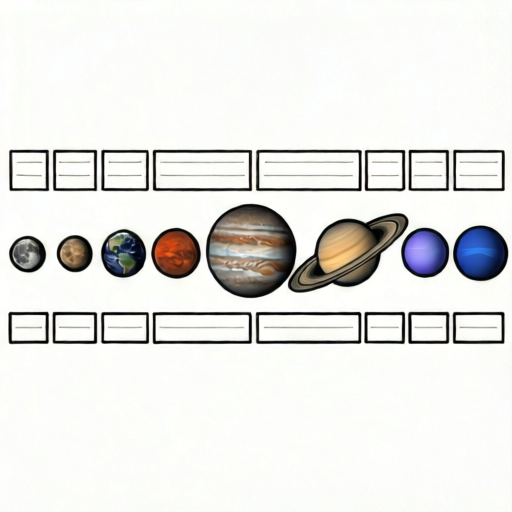
Use the stated measurements and conventions for each exercise.
Ordering the planets from the Sun
The eight planets in order from the Sun are Mercury, Venus, Earth, Mars, Jupiter, Saturn, Uranus, and Neptune. A common memory phrase is My Very Educated Mother Just Served Us Noodles, where each word starts with the same letter as a planet. The order never changes, so students can check their row by reciting the phrase and matching the first letters.
On the worksheet, the ordered row has eight blank circles. Students write each planet name below its circle in the correct position. The label bank lists all eight names in mixed order so students must recall the sequence rather than copy it directly. A useful check is to count from the Sun: position one is Mercury, position four is Mars, position five is Jupiter, and position eight is Neptune.
- Recite the memory phrase and write the first letter of each planet above the row.
- Match each letter to a name in the label bank and write the full name below the correct circle.
- Check the row by counting positions: 1 Mercury, 2 Venus, 3 Earth, 4 Mars, 5 Jupiter, 6 Saturn, 7 Uranus, 8 Neptune.
- Confirm that no name is used twice and that all eight names appear exactly once.
Comparing sizes with a shading convention
The worksheet uses a defined convention with four shaded heights. Each planet circle is drawn at a comparative size, and students shade the circle from the baseline upward to one of four heights: one-quarter height for smaller than Earth, one-half height for about Earth-sized, three-quarters height for larger than Earth but smaller than Jupiter, and full height for Jupiter-sized or larger. This convention allows valid alternatives because students may use different shading styles, such as cross-hatching or solid fill, as long as the shaded height matches the chosen band.
Relative diameters, using Earth as 1 unit, are approximately: Mercury 0.38, Venus 0.95, Earth 1.00, Mars 0.53, Jupiter 11.2, Saturn 9.4, Uranus 4.0, Neptune 3.9. These are hypothetical example values for comparison only; students do not need to calculate exact ratios. The size-comparison bar on the worksheet shows four bands: smaller than Earth, about Earth-sized, larger than Earth but smaller than Jupiter, and Jupiter-sized or larger. Students shade each circle to the height that matches its band. Use these thresholds consistently: values below 1 are smaller than Earth; values near 1 (about 0.95 to 1.00) are about Earth-sized; values greater than 1 and less than 11.2 are larger than Earth but smaller than Jupiter; values 11.2 and above are Jupiter-sized or larger.
- Read the relative diameter value for each planet from the size-comparison bar.
- Decide which band the planet belongs to: smaller than Earth, about Earth-sized, larger than Earth but smaller than Jupiter, or Jupiter-sized or larger.
- Shade the circle from the baseline to the height for the chosen band: one-quarter height, one-half height, three-quarters height, or full height.
- Label each shaded circle with the planet name and the band name so the comparison is clear.
Checking order and size together
A complete answer has two parts: the correct order and a size shading that matches the band. Students should check both parts separately. First, verify the order using the memory phrase and position count. Second, verify each shading by asking whether the shaded height matches the correct band height: one-quarter for smaller than Earth, one-half for about Earth-sized, three-quarters for larger than Earth but smaller than Jupiter, and full for Jupiter-sized or larger. If a circle is shaded taller than its band height, the student has chosen a larger band than needed; if shaded shorter, the band is too small.
The rubric rewards correct order, correct band choice, consistent shading, and clear labels. Because letter styles and shading styles vary, the rubric accepts any legible handwriting and any consistent shading method. The key is that the convention is applied consistently across all eight circles.
- Check order first: recite the phrase and confirm each position.
- Check size second: compare each shaded height to the four band heights and the band label.
- Check labels: every circle has a planet name and a band name.
- Check consistency: the same shading style is used for all circles.
Worked example
A student draws eight circles in a row and writes the planet names below them. The student shades Mercury to one-quarter height, Venus to one-half height, Earth to one-half height, Mars to one-quarter height, Jupiter to full height, Saturn to full height, Uranus to three-quarters height, and Neptune to three-quarters height. Check the order and the size bands.
Worked answer
Order is correct: Mercury, Venus, Earth, Mars, Jupiter, Saturn, Uranus, Neptune. Size bands: Mercury smaller than Earth (one-quarter height) is correct. Venus about Earth-sized (one-half height) is correct. Earth about Earth-sized (one-half height) is correct. Mars smaller than Earth (one-quarter height) is correct. Jupiter Jupiter-sized or larger (full height) is correct. Saturn larger than Earth but smaller than Jupiter (three-quarters height) is correct. Uranus larger than Earth but smaller than Jupiter (three-quarters height) is correct. Neptune larger than Earth but smaller than Jupiter (three-quarters height) is correct. All eight circles use consistent shading and clear labels.
Four practice exercises
Exercise 1
Draw a row of eight circles. Write the planet names below them in correct order from the Sun. Then shade each circle using the band system: one-quarter height for smaller than Earth, one-half height for about Earth-sized, three-quarters height for larger than Earth but smaller than Jupiter, and full height for Jupiter-sized or larger. Use the relative diameters Mercury 0.38, Venus 0.95, Earth 1.00, Mars 0.53, Jupiter 11.2, Saturn 9.4, Uranus 4.0, Neptune 3.9 as hypothetical examples.
Show answer and check
Order: Mercury, Venus, Earth, Mars, Jupiter, Saturn, Uranus, Neptune. Bands: Mercury smaller than Earth; Venus about Earth-sized; Earth about Earth-sized; Mars smaller than Earth; Jupiter Jupiter-sized or larger; Saturn larger than Earth but smaller than Jupiter; Uranus larger than Earth but smaller than Jupiter; Neptune larger than Earth but smaller than Jupiter.
Why: The order follows distance from the Sun. The bands follow the relative diameter values: values below 1 are smaller than Earth; values near 1 (about 0.95 to 1.00) are about Earth-sized; values greater than 1 and less than 11.2 are larger than Earth but smaller than Jupiter; values 11.2 and above are Jupiter-sized or larger.
Check: Recite the memory phrase to check order. For each circle, confirm the shaded height matches the band height (one-quarter, one-half, three-quarters, or full) and that the band label matches the relative diameter value.
Exercise 2
A student writes the order as Mercury, Venus, Earth, Jupiter, Mars, Saturn, Uranus, Neptune. Identify the mistake and write the correct order.
Show answer and check
The mistake is that Jupiter and Mars are swapped. The correct order is Mercury, Venus, Earth, Mars, Jupiter, Saturn, Uranus, Neptune.
Why: Mars is fourth from the Sun and Jupiter is fifth. The student placed Jupiter before Mars, which breaks the distance order.
Check: Count positions: position four should be Mars and position five should be Jupiter. Recite the phrase and match the first letters.
Exercise 3
Draw four circles labeled Mercury, Earth, Jupiter, and Neptune. Shade each circle to show its band using the four-height convention. Explain why Jupiter gets full-height shading and Mercury gets one-quarter-height shading.
Show answer and check
Mercury: one-quarter height (smaller than Earth). Earth: one-half height (about Earth-sized). Jupiter: full height (Jupiter-sized or larger). Neptune: three-quarters height (larger than Earth but smaller than Jupiter). Jupiter gets full-height shading because its relative diameter is 11.2, which is Jupiter-sized or larger. Mercury gets one-quarter-height shading because its relative diameter is 0.38, which is smaller than Earth.
Why: The band system maps relative diameter to shaded height. Jupiter's value is the largest in the set, so it receives the fullest shading. Mercury's value is the smallest, so it receives the lightest shading.
Check: Compare each shaded height to the four band heights and confirm the band label matches the relative diameter value. Check that the same shading style is used for all four circles.
Exercise 4
A worksheet shows a size-comparison bar with four bands. A student shades Saturn to full height and Uranus to full height. Is this correct? Explain using the relative diameters Saturn 9.4 and Uranus 4.0.
Show answer and check
Saturn at full height is incorrect because 9.4 is larger than Earth but smaller than Jupiter, so it should be shaded to three-quarters height. Uranus at full height is also incorrect because 4.0 is larger than Earth but smaller than Jupiter, so it should be shaded to three-quarters height.
Why: The band for Jupiter-sized or larger includes values 11.2 and above. Saturn's value 9.4 and Uranus's value 4.0 both fall between 1 and 11.2, so both belong to the larger-than-Earth-but-smaller-than-Jupiter band.
Check: Read the band thresholds from the size-comparison bar. Confirm that Saturn and Uranus are both shaded to three-quarters height, not full height.
Common mistakes
- Placing Jupiter before Mars because it is larger. Order is by distance from the Sun, not by size. Mars is fourth and Jupiter is fifth. Recite the phrase and count positions to confirm.
- Shading every circle fully because larger planets seem more important. Use the band system: only Jupiter-sized or larger planets get full-height shading. Smaller planets get shading at one-quarter, one-half, or three-quarters height depending on their band.
- Writing planet names in the label bank order instead of the correct order. The label bank is mixed on purpose. Match each name to its position using the memory phrase, then write it below the correct circle.
- Using different shading styles on different circles. Choose one shading style, such as cross-hatching or solid fill, and use it for all eight circles so the comparison is fair.
Self-check rubric
- Order: all eight planets placed in correct sequence from the Sun (4 points).
- Size bands: each circle shaded to the correct band using the four-height shading convention (one-quarter, one-half, three-quarters, or full height) (4 points).
- Labels: every circle has a legible planet name and band name (2 points).
- Consistency: one shading style used across all circles (1 point).
- Valid alternatives: any legible handwriting and any consistent shading style accepted (1 point).
Questions and answers
Do I need to draw the planets to scale?
No. The worksheet uses comparative sizes, not scale-accurate distances or diameters. The circles are drawn at relative sizes so you can compare bands, but exact ratios are not required.
What if my handwriting is messy?
The rubric accepts any legible handwriting. Letter styles vary, so focus on clear labels rather than perfect lettering. If a label is hard to read, rewrite it neatly below the circle.
Can I use a different shading style?
Yes. Any consistent shading style is valid, such as cross-hatching, solid fill, or dots. The convention is that the shaded height matches the band: one-quarter for smaller than Earth, one-half for about Earth-sized, three-quarters for larger than Earth but smaller than Jupiter, and full for Jupiter-sized or larger. Apply your style consistently.
How do I know which band a planet belongs to?
Use the size-comparison bar. Mercury and Mars are smaller than Earth. Venus and Earth are about Earth-sized. Saturn, Uranus, and Neptune are larger than Earth but smaller than Jupiter. Jupiter is Jupiter-sized or larger.