HomeDesign Your Own Greek God: Attributes, Symbols, and Costume Free original lessons
Design Your Own Greek God: Attributes, Symbols, and Costume
Invent an original Greek-style deity by choosing a domain, symbols, and costume, then sketch a figure with clear attribute logic and a simple self-check rubric.
Free lesson
Four exercises
Worked answers
Object Drawing Lessons
This lesson teaches character design by building an original Greek god figure from scratch. You will not draw Zeus, Athena, or any existing named god. Instead, you will assign a domain, select symbols that communicate that domain, design a costume that supports the character, and sketch a finished figure. The goal is clear visual storytelling: every attribute should have a reason, and every symbol should be readable without a caption. You will use a simple convention for proportion and a rubric that allows different valid styles. All measurements are hypothetical examples unless you measure your own paper and tools.
Practice materials: Printable downloads are not available for this lesson yet. Use the instructions and four exercises below.
Reference illustration
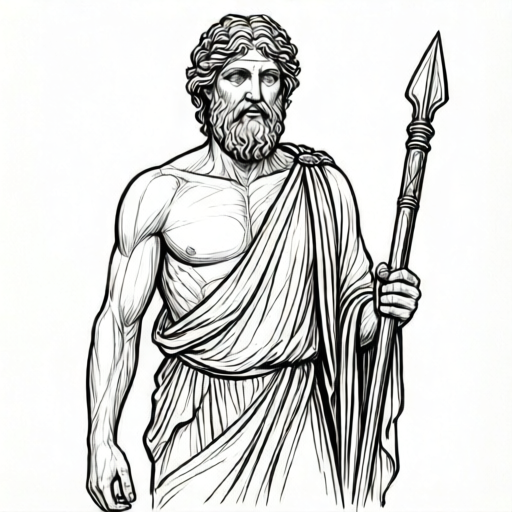
Use the stated measurements and conventions for each exercise.
Choose a domain and define the character
Start by naming an original domain that is not already owned by a well-known Greek god. Good domains are specific and visual: the keeper of river crossings, the guardian of lost tools, the spirit of morning fog, or the protector of seed libraries. Write one sentence that states what your god cares about and how they act. This sentence becomes your design brief and keeps every later choice focused.
Next, decide the character's attitude: calm, stern, playful, watchful, or restless. Attitude affects posture, face, and costume weight. A watchful god might lean forward with a raised hand; a calm god might stand straight with open palms. Keep the attitude visible in the silhouette so the figure reads from a distance.
- Write a one-sentence domain statement: 'This god protects ___ by ___.'
- Choose one attitude word and one gesture that shows it.
- List three things this god would carry, wear, or stand near.
- Circle the one item that best communicates the domain at a glance.
Select symbols and assign meaning
A symbol is a simple shape or object that stands for the domain. Use a selection bank such as thunderbolt, laurel, owl, trident, key, sheaf, wave, flame, mask, mirror, rope, or seed pod. Pick two or three symbols, not more. For each symbol, write a short meaning statement: 'The key means I guard what is lost.' This prevents decoration without purpose.
Place symbols where they are easy to see: in the hand, on the chest, on a shoulder, or in the background. Vary size so one symbol is dominant and the others support it. Avoid stacking symbols on top of each other; overlap hides meaning. If a symbol is small, repeat it once in a second location to reinforce the idea.
- Choose one dominant symbol and one or two supporting symbols.
- Write a meaning statement for each symbol in eight words or fewer.
- Decide the placement: hand, chest, shoulder, or background.
- Check that the dominant symbol is the largest and most central.
Design the costume and figure convention
Use a simple proportion convention so the figure looks intentional. A common convention is eight head-heights for a standing figure: mark the top of the head, then eight equal vertical units down to the feet. This is a convention, not a rule; you may choose seven or nine if you state it. X-height is baseline to midline for lowercase letters, but letter styles vary, so do not force a single handwriting style. For the figure, keep the head, torso, and legs in clear blocks so the silhouette stays readable.
Costume should support the domain. A river guardian might wear a wrapped cloth with a wave pattern; a seed keeper might have deep pockets and a layered apron. Use two or three main garment shapes and one accent. Keep patterns simple: stripes, dots, or a single repeated motif. Label the costume parts on your sketch so the logic is visible: 'wave wrap,' 'seed pouch,' 'fog hood.'
- Mark eight equal head-heights on your paper as a guide.
- Block the head, torso, and legs with simple shapes.
- Add two or three garment shapes and one accent.
- Label each costume part with a short functional name.
Sketch, refine, and self-check
Sketch lightly first, then darken the final lines. Keep the dominant symbol in the hand or at chest height so the eye finds it first. Check the silhouette by squinting: if you cannot tell the domain from the outline alone, adjust the symbol size or posture. Add a simple ground line and a background hint only if it supports the domain, such as a low wave line or a few seed shapes.
Use the rubric to self-check. The rubric allows valid alternatives: a calm standing figure and a dynamic leaning figure can both score well if the attribute logic is clear. Do not aim for a single universal answer. Aim for a figure where every symbol has a stated meaning and the costume supports the domain.
- Sketch lightly, then darken final lines.
- Squint-test the silhouette for domain readability.
- Add a ground line and one background hint if useful.
- Score your figure with the rubric and revise one weak point.
Worked example
Design an original god of lost tools. Choose a dominant symbol, one supporting symbol, a costume, and a posture. State the proportion convention and sketch a figure with labels.
Worked answer
Domain statement: This god protects lost tools by guiding them back to their owners. Attitude: watchful. Dominant symbol: a large iron key held at chest height, meaning 'I open what is misplaced.' Supporting symbol: a small coil of rope on the belt, meaning 'I tie loose things together.' Costume: a short work apron with two deep pockets, a shoulder wrap with a single stripe, and a low hood. Posture: leaning slightly forward with one hand raised as if listening. Proportion convention: eight head-heights, marked lightly. Labels: 'key of return,' 'rope of binding,' 'pocket apron,' 'listening hood.' The silhouette shows the key and the forward lean, so the domain reads without a caption.
Four practice exercises
Exercise 1
Invent a god of river crossings. Choose one dominant symbol and one supporting symbol. Write a meaning statement for each. State a proportion convention and describe the posture in one sentence.
Show answer and check
Example: Domain: This god guides travelers across safe river crossings. Dominant symbol: a flat stepping stone held in the left hand, meaning 'I mark the safe path.' Supporting symbol: a short reed in the right hand, meaning 'I read the current.' Proportion convention: seven head-heights. Posture: standing with feet apart and one hand pointing down to the stone.
Why: The domain is specific and original. Two symbols are chosen, each with a short meaning statement. The proportion convention is stated, and the posture supports the guiding role.
Check: Count the symbols: one dominant and one supporting. Check each meaning statement is eight words or fewer. Confirm the proportion number is stated and the posture sentence mentions the guiding action.
Exercise 2
Design a costume for a god of seed libraries. List two main garment shapes and one accent. Label each with a functional name. Explain in one sentence how the costume supports the domain.
Show answer and check
Example: Main shape one: a layered apron with three horizontal pockets, labeled 'seed pocket apron.' Main shape two: a loose shoulder wrap, labeled 'carry wrap.' Accent: a repeated seed-pod motif along the hem, labeled 'pod hem.' The costume supports the domain because the pockets hold seeds and the wrap suggests carrying and protecting a collection.
Why: Two main shapes and one accent meet the limit. Functional labels connect each part to the domain. The explanation ties the costume to seed keeping.
Check: Verify there are exactly two main shapes and one accent. Check each label is a functional name, not a decorative word. Confirm the explanation mentions seeds or protecting a collection.
Exercise 3
A student draws a god of morning fog with five symbols: a sun, a cloud, a mirror, a key, and a feather. The silhouette is cluttered. Suggest a revision that keeps one dominant symbol and two supporting symbols, and state a meaning for each.
Show answer and check
Example revision: Keep the cloud as the dominant symbol, meaning 'I soften the morning light.' Keep the mirror as a supporting symbol, meaning 'I hide what is far.' Keep the feather as a supporting symbol, meaning 'I drift without sound.' Remove the sun and the key because they do not support the fog domain as directly.
Why: The revision reduces five symbols to three and assigns a short meaning to each. Removing the sun and key improves focus and reduces clutter.
Check: Count the kept symbols: one dominant and two supporting. Check each meaning is eight words or fewer. Confirm the removed symbols are named and a reason is given.
Exercise 4
Measure your paper and drawing tool. Suppose your paper is 20 cm wide and 28 cm tall, and you choose eight head-heights. Calculate the height of one head-height unit in centimeters if the figure uses the full paper height minus a 4 cm margin at the top and bottom. Show the arithmetic and state the unit.
Show answer and check
Example: Usable height = 28 cm minus 4 cm top margin minus 4 cm bottom margin = 20 cm. One head-height = 20 cm divided by 8 = 2.5 cm. Unit: centimeters. These numbers are hypothetical examples; measure your own paper and state your actual values.
Why: The calculation subtracts both margins from the paper height, then divides by the number of head-heights. The unit is kept consistent in centimeters.
Check: Recheck the subtraction: 28 minus 4 minus 4 equals 20. Recheck the division: 20 divided by 8 equals 2.5. Confirm the answer states centimeters and notes the values are hypothetical.
Common mistakes
- Choosing a domain already owned by a famous Greek god, such as thunder or wisdom. Pick a specific, original domain like river crossings, lost tools, or morning fog, and state it in one sentence.
- Adding many symbols without meaning, so the figure looks cluttered. Limit to one dominant symbol and two supporting symbols, each with an eight-word meaning statement.
- Costume parts that do not connect to the domain. Label each garment with a functional name and remove any part that does not support the domain statement.
- Using a proportion convention without stating it, so the figure looks accidental. State your convention, such as eight head-heights, and mark the units lightly before blocking the figure.
Self-check rubric
- Domain is original and stated in one clear sentence.
- One dominant symbol and no more than two supporting symbols are present.
- Each symbol has a short meaning statement of eight words or fewer.
- Costume has two or three main shapes and one accent, each labeled with a functional name.
- Proportion convention is stated and used consistently.
- Silhouette communicates the domain when squinted at.
- Labels are readable and consistent enough to check; letter style may vary.
Questions and answers
Can I draw an existing Greek god instead?
No. This task is for an original god figure. You may use Greek-style symbols and costume shapes, but the domain and character must be your own invention.
How many symbols should I use?
Use one dominant symbol and one or two supporting symbols. More than three usually weakens the visual message.
Do I have to use eight head-heights?
No. Eight is a common convention, but you may choose seven or nine if you state it and keep the units equal. The rubric rewards consistency, not a single number.
What if my handwriting or letter style is different?
Letter styles vary. X-height is baseline to midline, but do not force a single style. Labels only need to be readable and consistent enough to check.