Free original lessons
Perspective Drawing Mathematics
Build the vanishing points in plan, then carry their horizontal positions onto the horizon of the upright view. The practice plates show how a station point and the given object directions fix the result.
Letter & A4
PDF & SVG
The three primitives
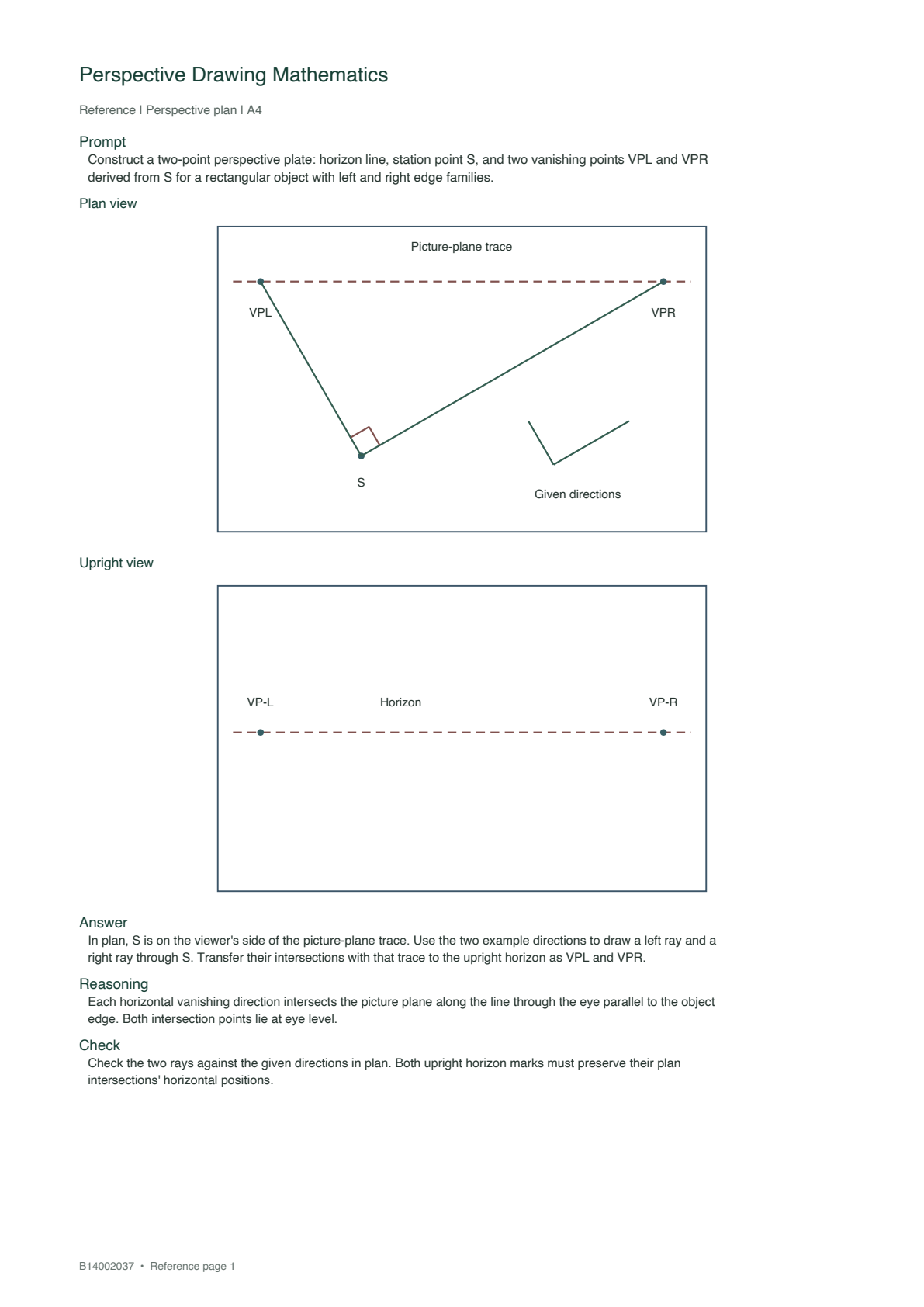
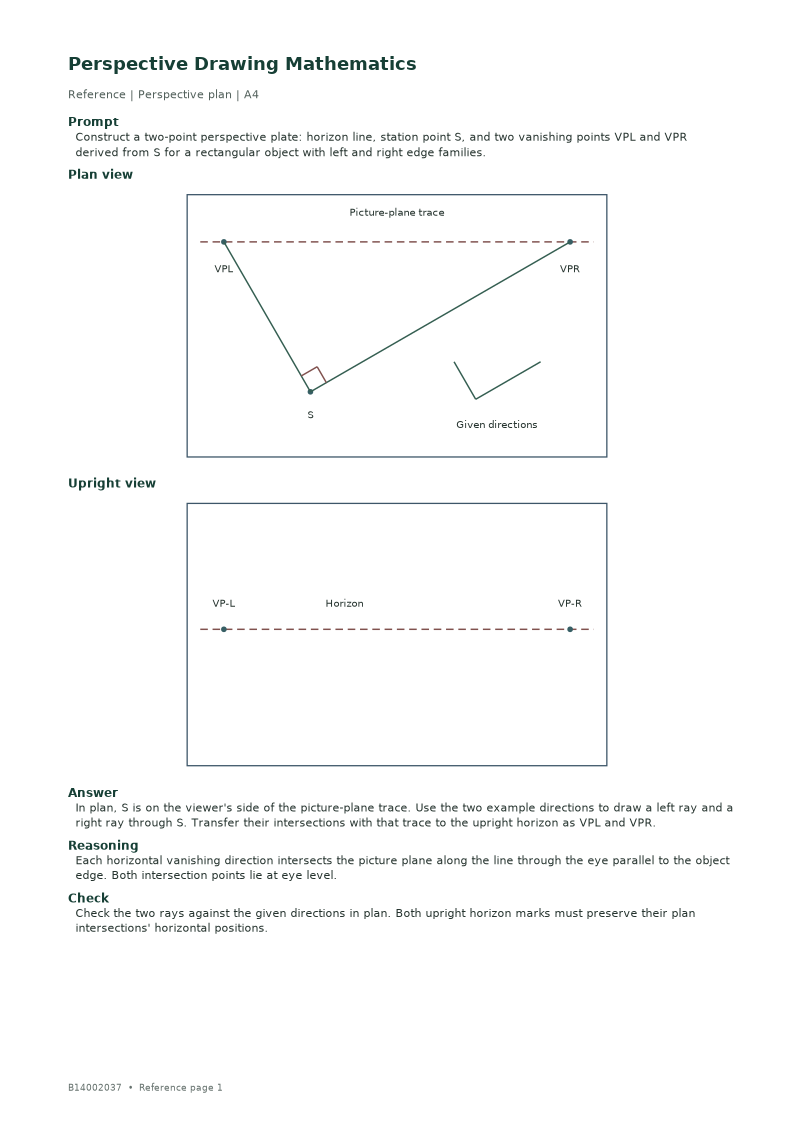
In plan, look down on a horizontal slice at eye level. The station point S marks the eye's position, and the line across the plan is the picture-plane trace. In the upright drawing the horizon is the line at eye level. The two views share the same horizontal coordinates along the picture plane.
In the centered one-point example the depth direction is perpendicular to the picture plane. Its ray from S meets the picture plane at the picture center. In two-point perspective, both horizontal edge directions meet the picture plane at separate points. A rotated object can create two vanishing points with an eye centered on the sheet.
Worked example: deriving two vanishing points
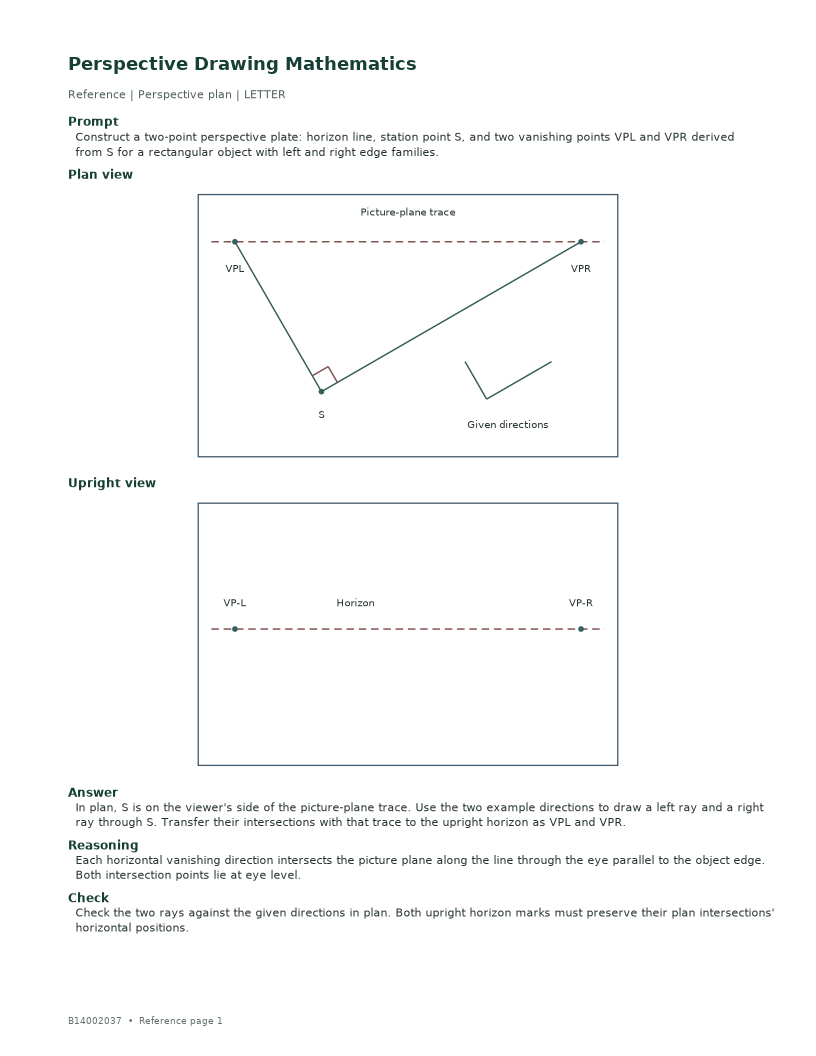
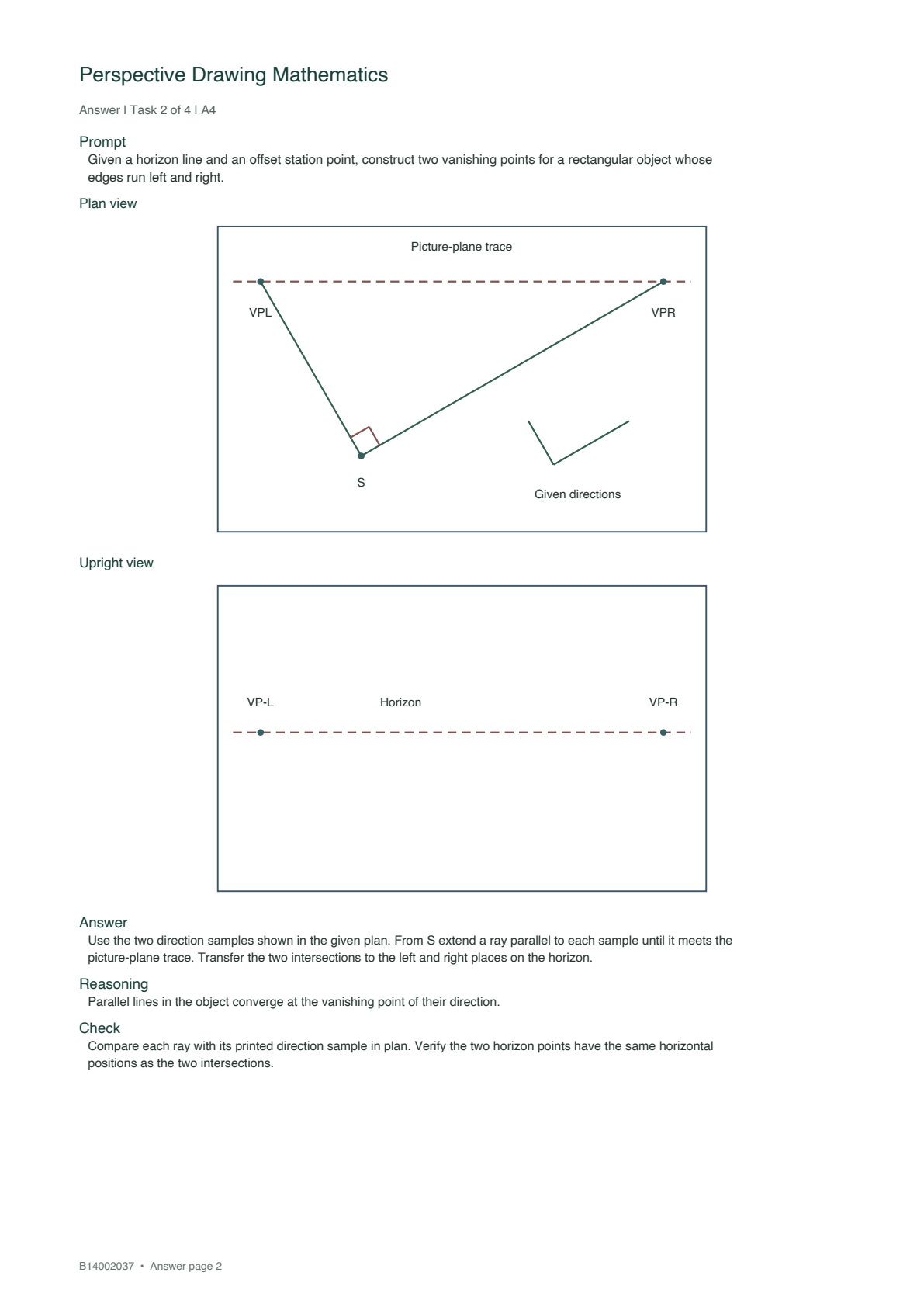
Use the two supplied perpendicular plan directions. Draw a ray through S parallel to each direction. Mark where each ray crosses the picture-plane trace, and transfer both horizontal positions to the horizon of the upright view.
Check the right angle at S in plan. On the upright view both transferred points must lie on the horizon, with the same horizontal spacing used in plan.
Practice tasks
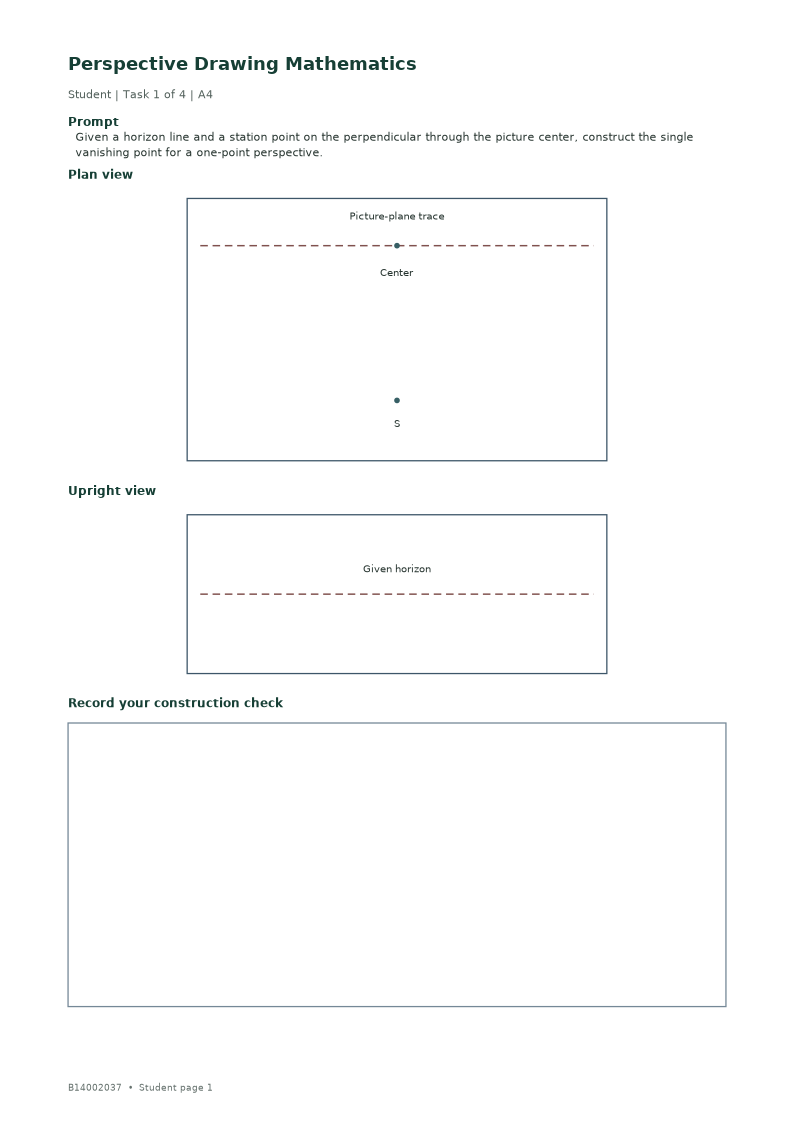
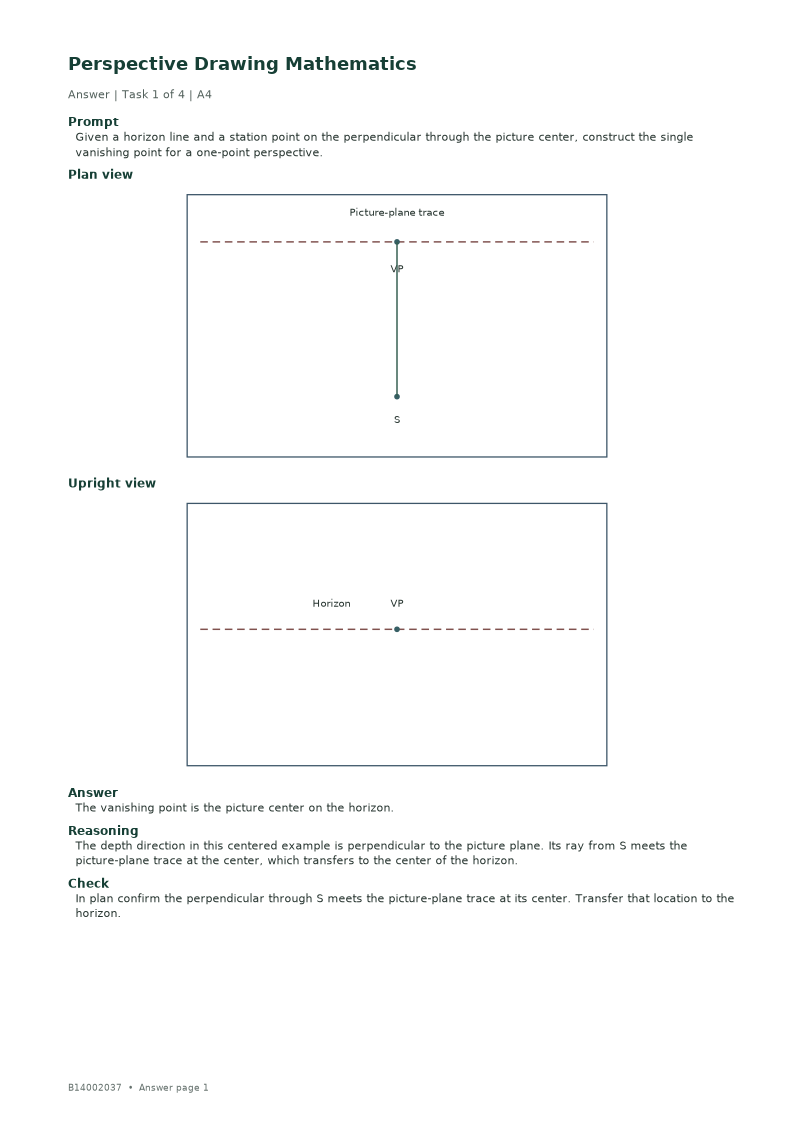
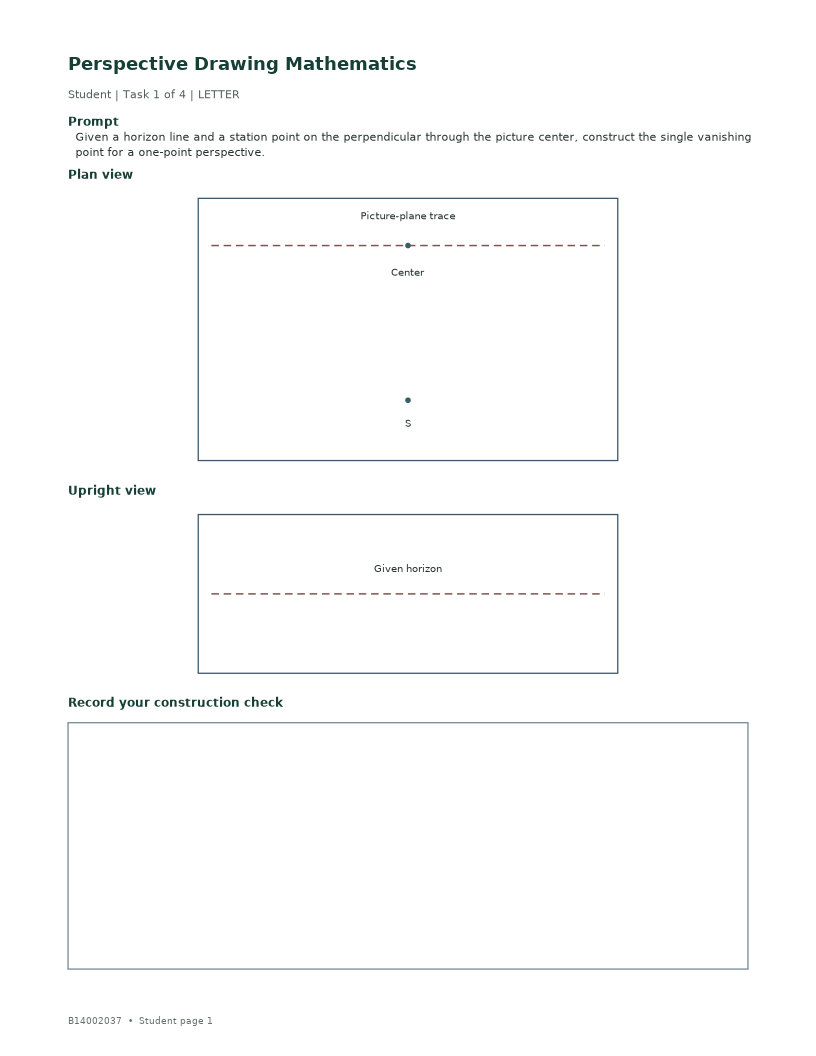
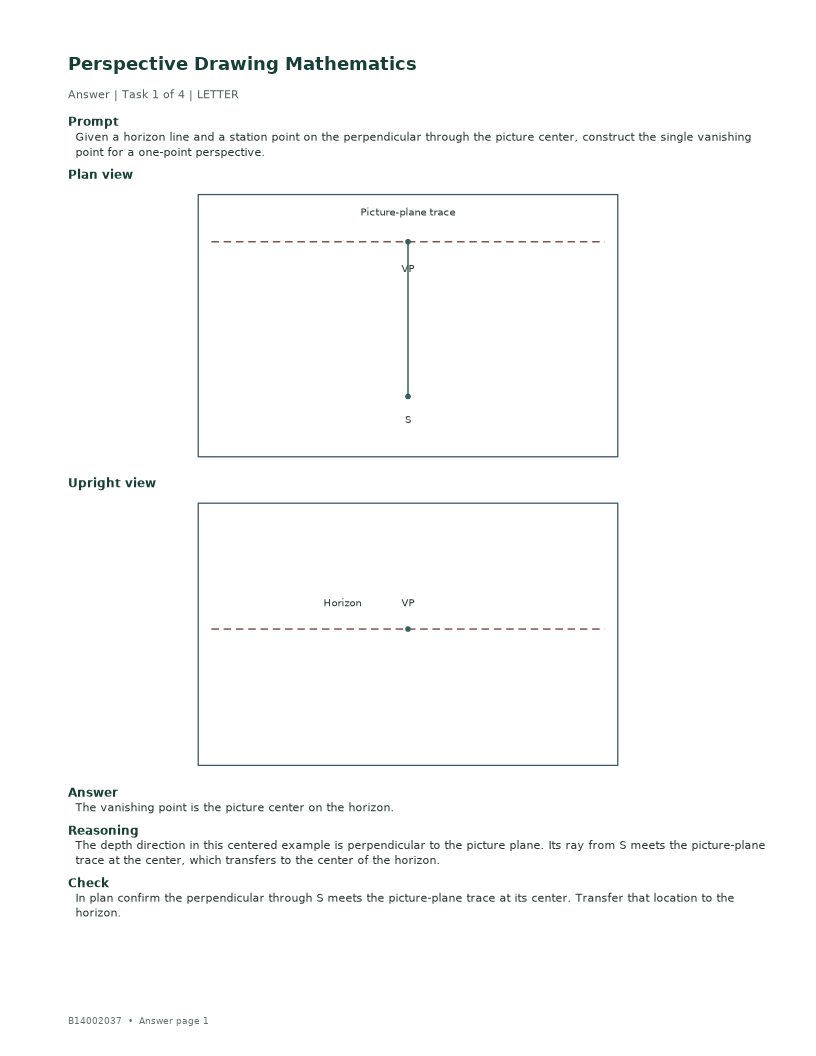
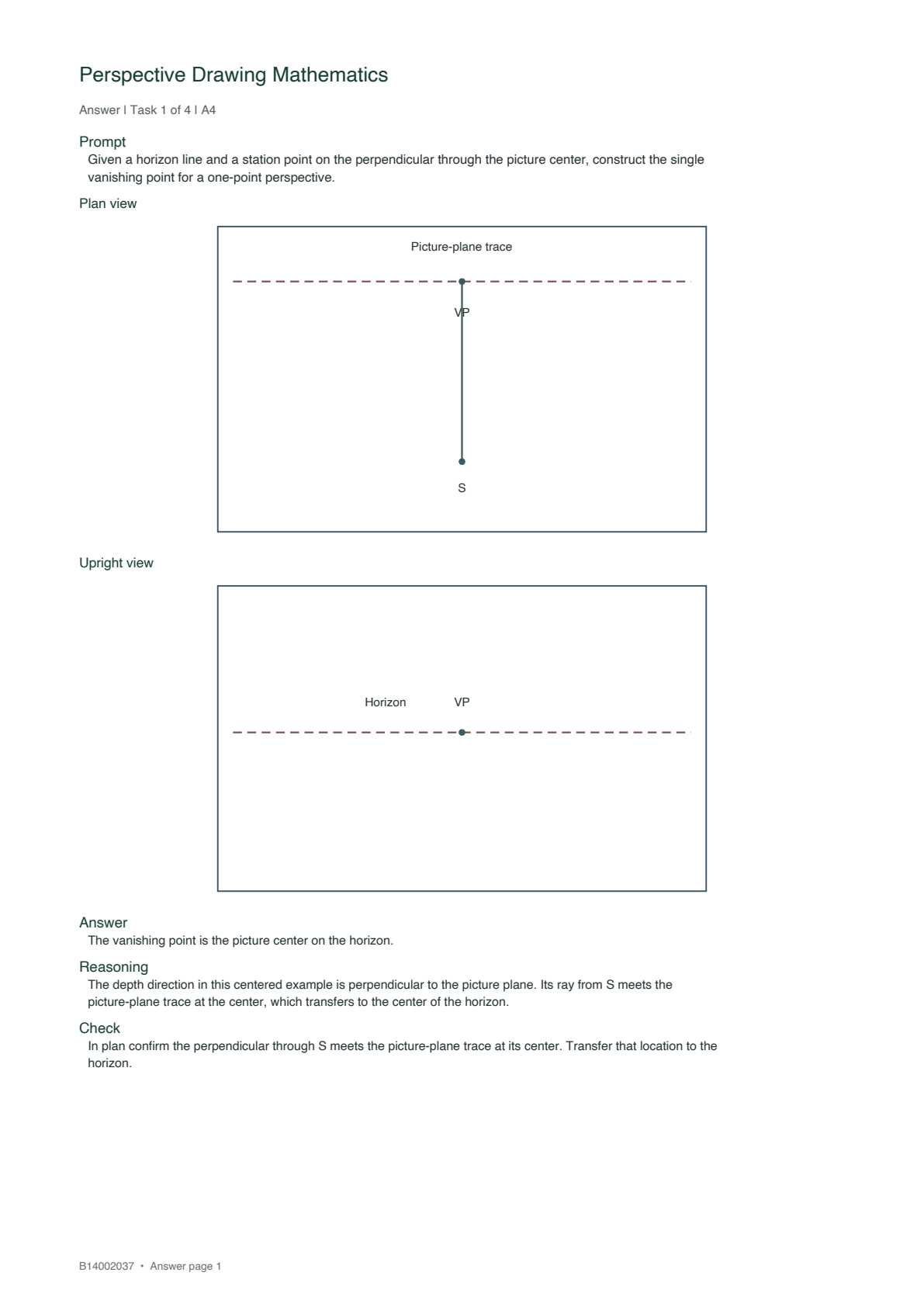
In Task 1, start with S and the center mark. Draw the perpendicular ray in plan, then transfer the intersection to the upright horizon.
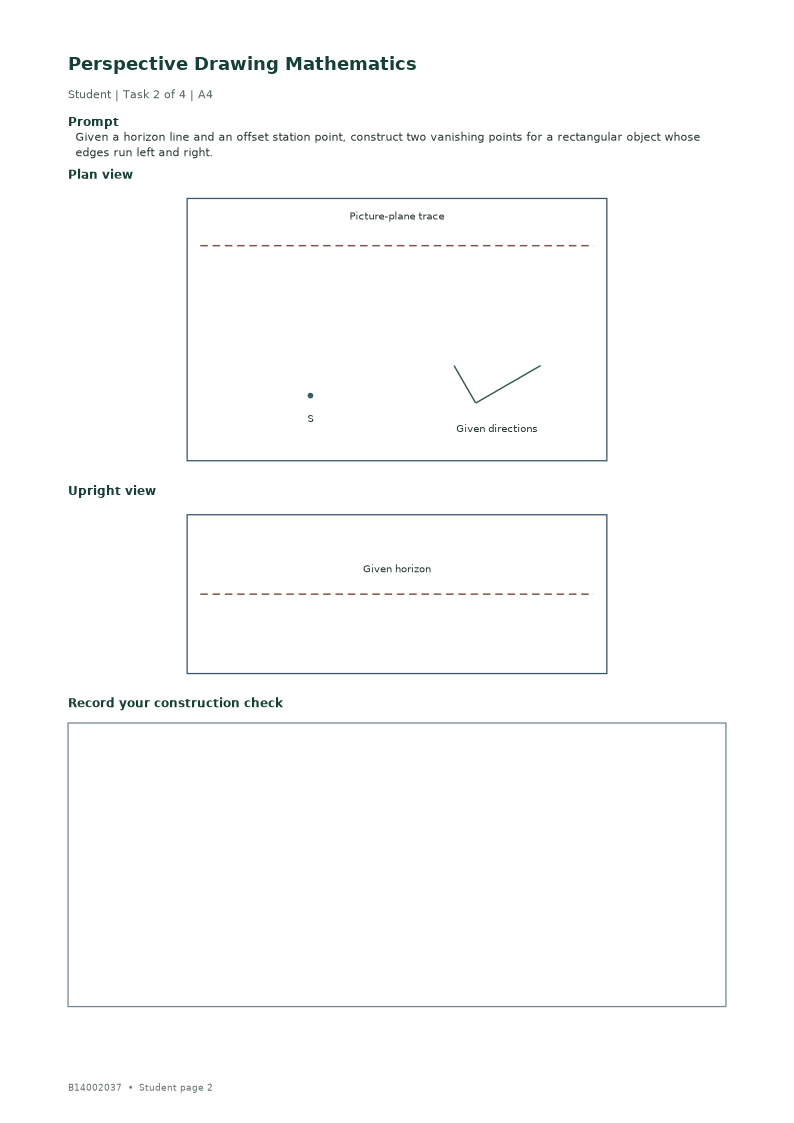
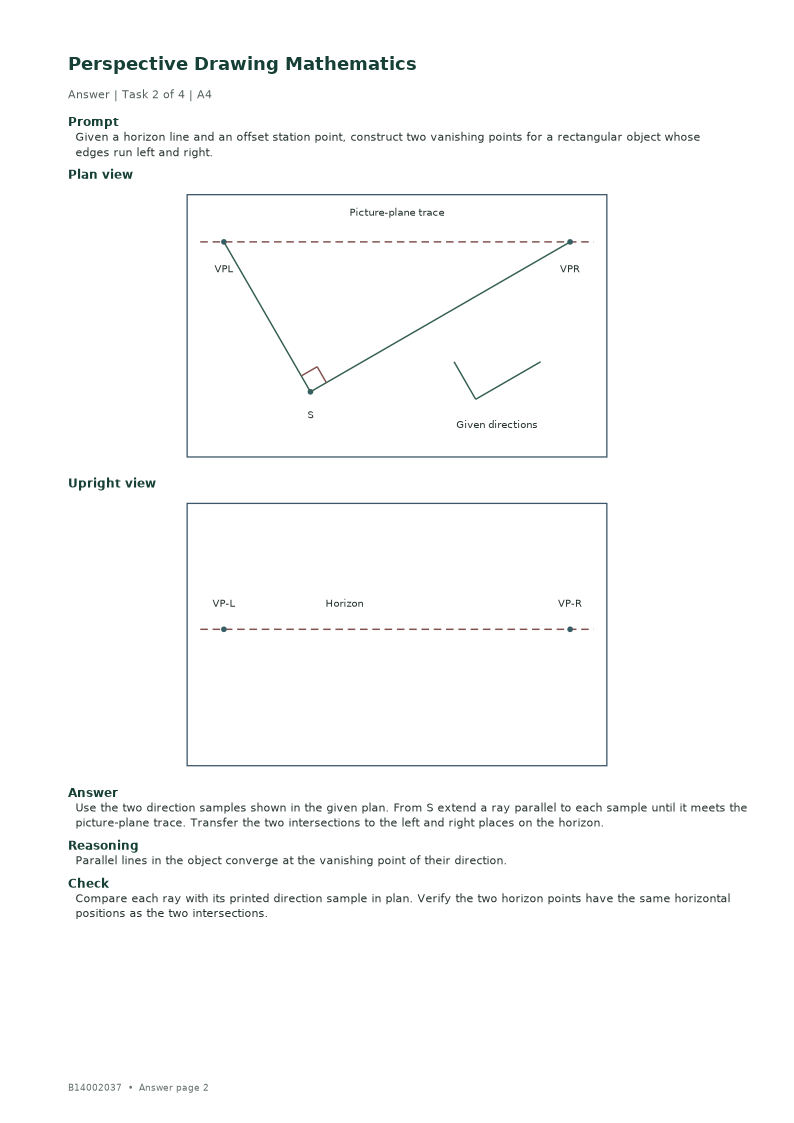
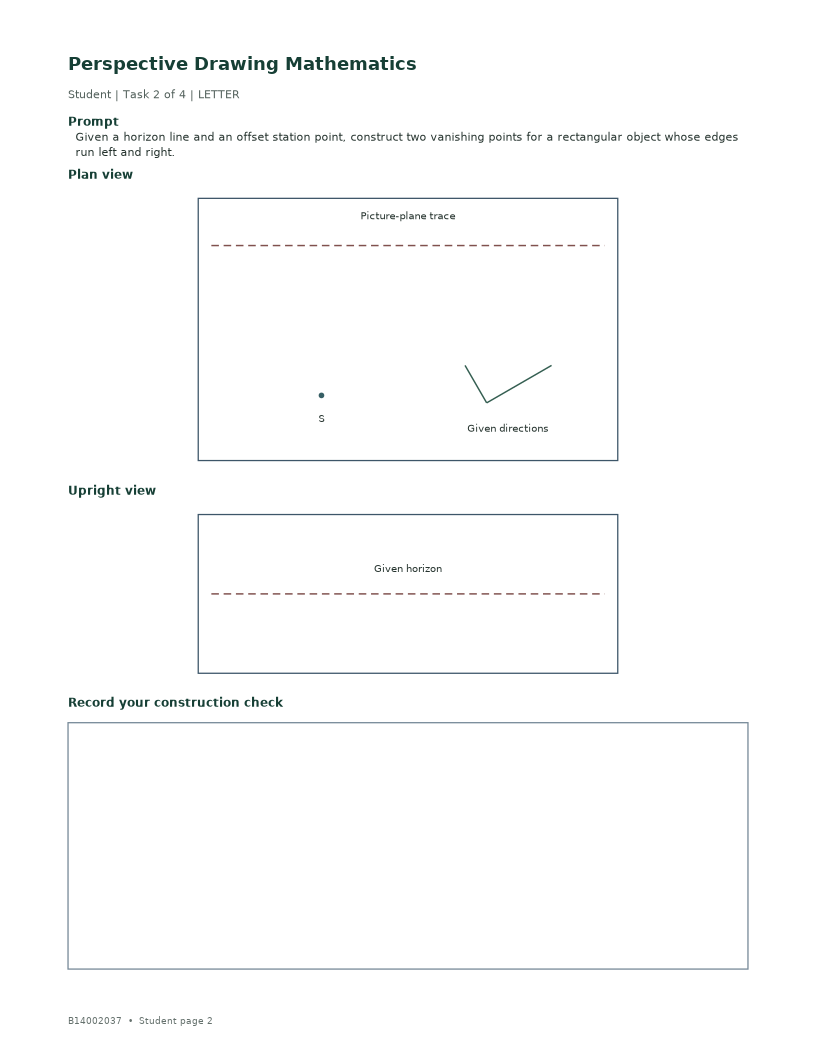
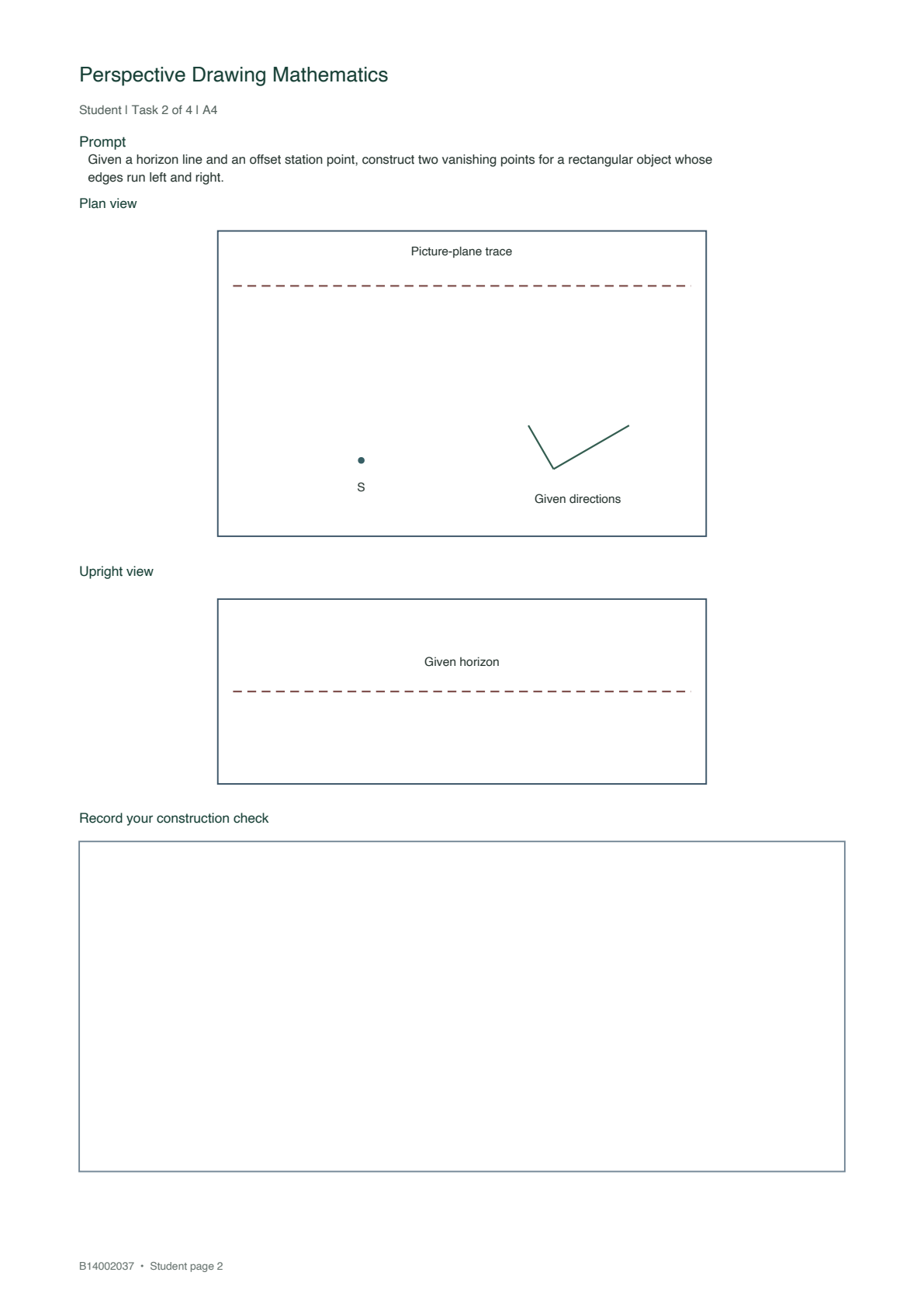
In Task 2, use the two printed direction samples. The chosen pair of directions matters, since an offset station point by itself does not determine two vanishing points.
Practice tasks (continued)
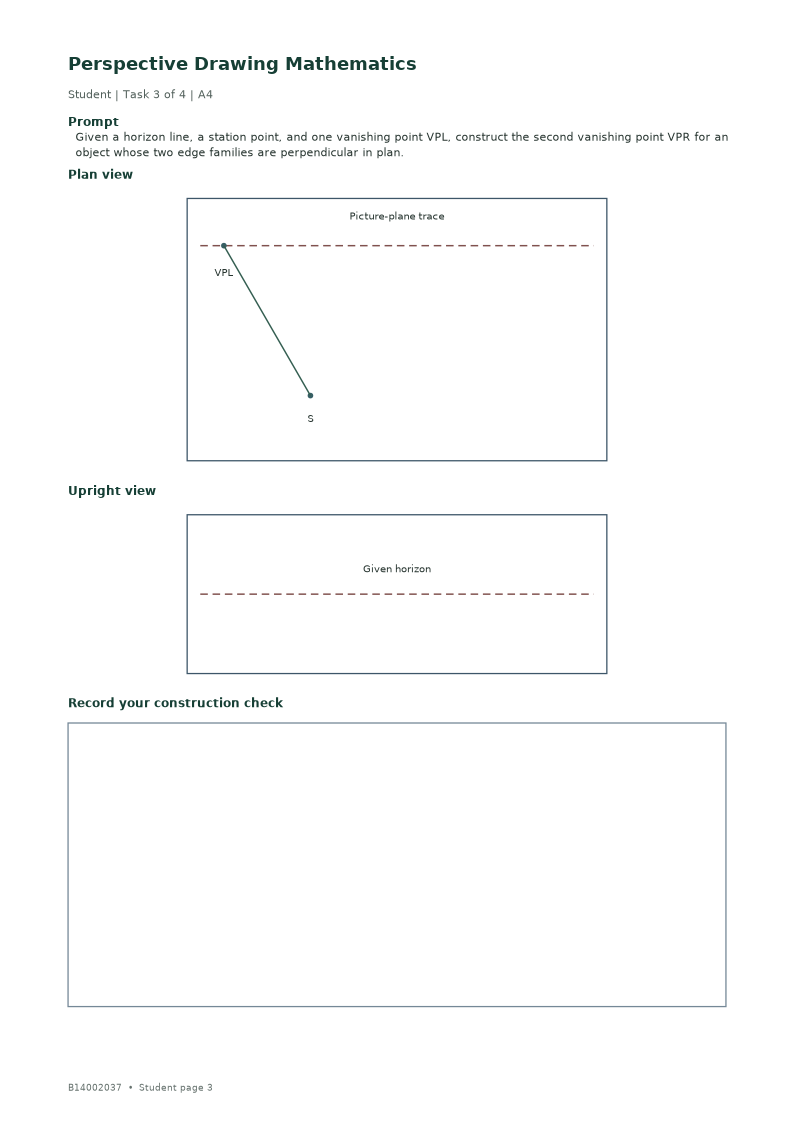
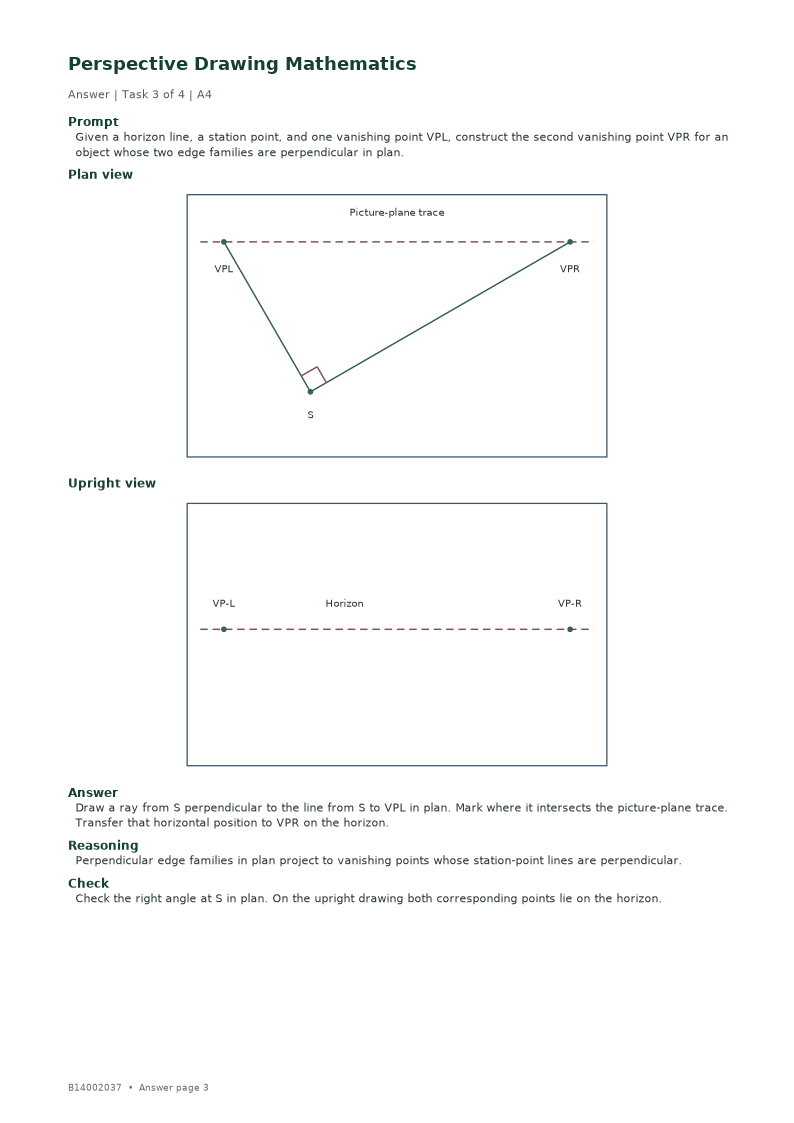
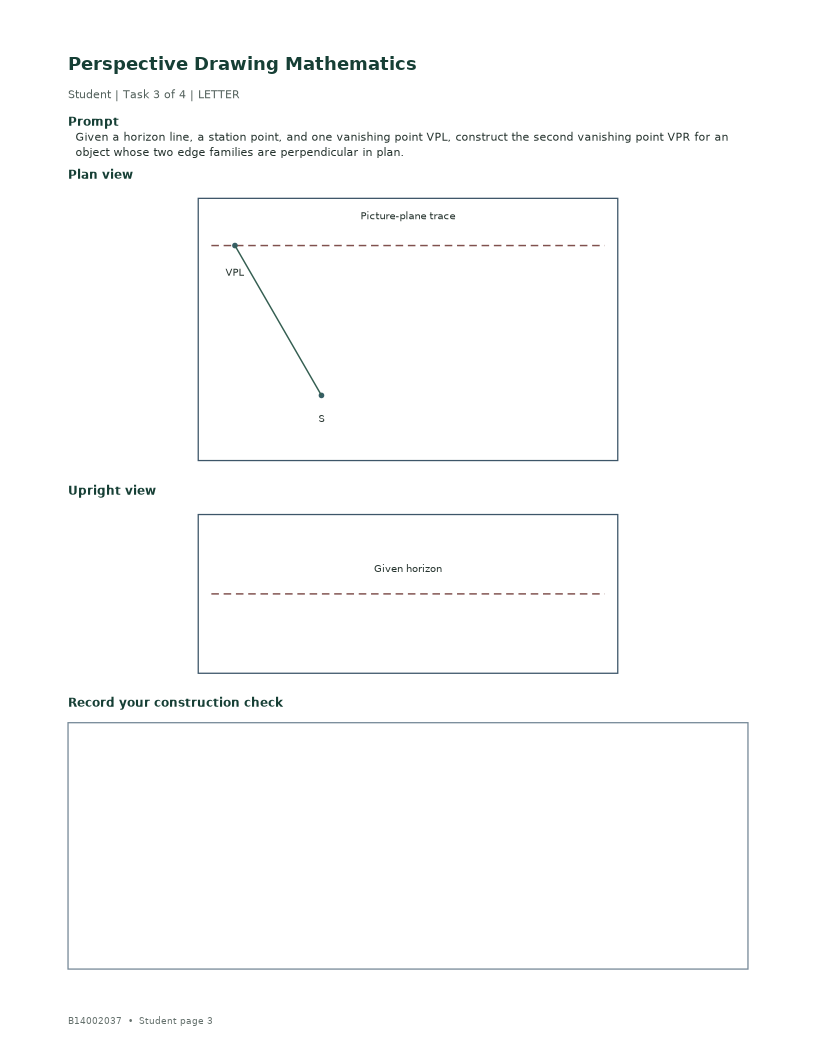
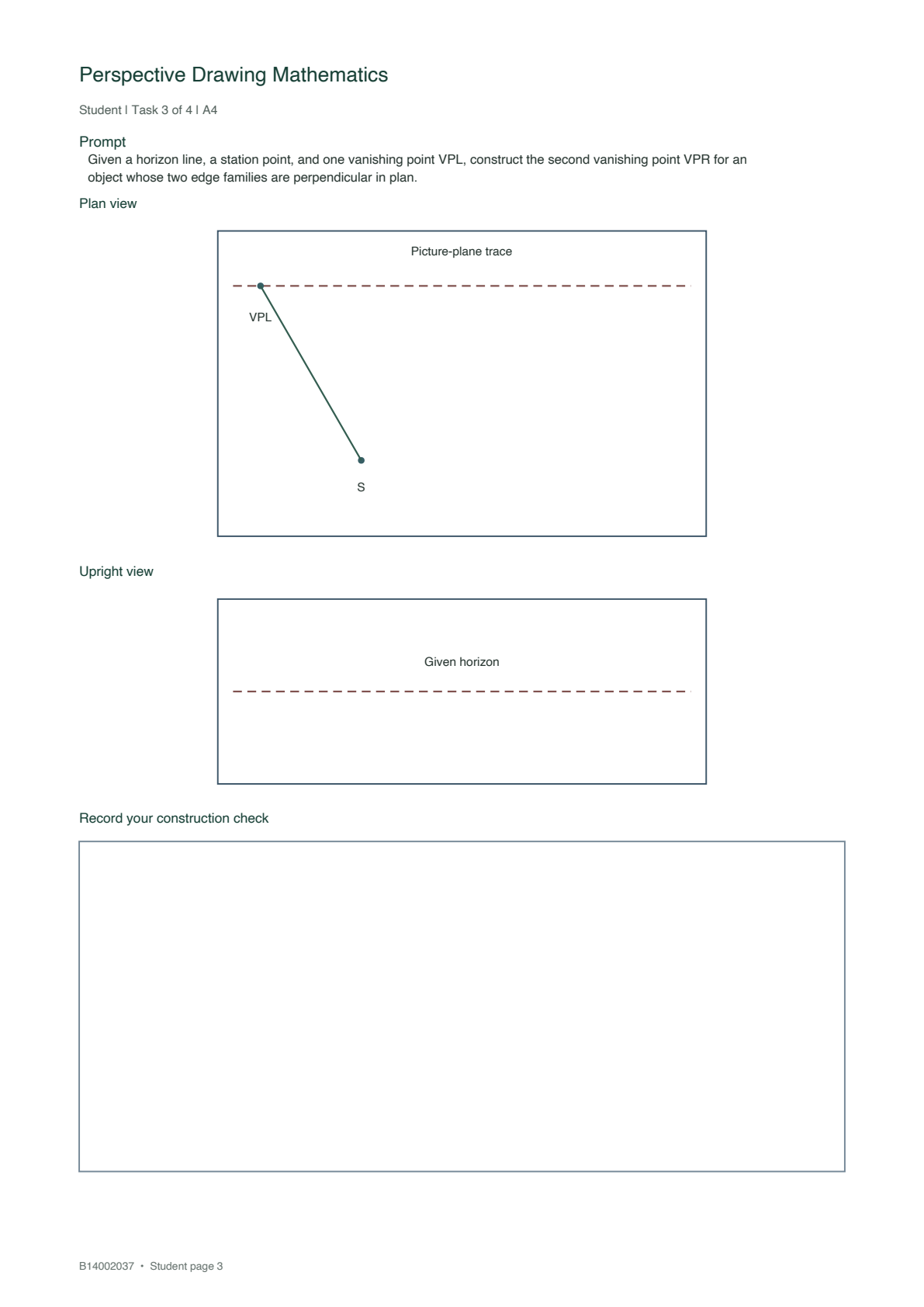
In Task 3, the first point and S already fix the left ray. Draw the perpendicular from S toward the right and intersect the picture-plane trace.
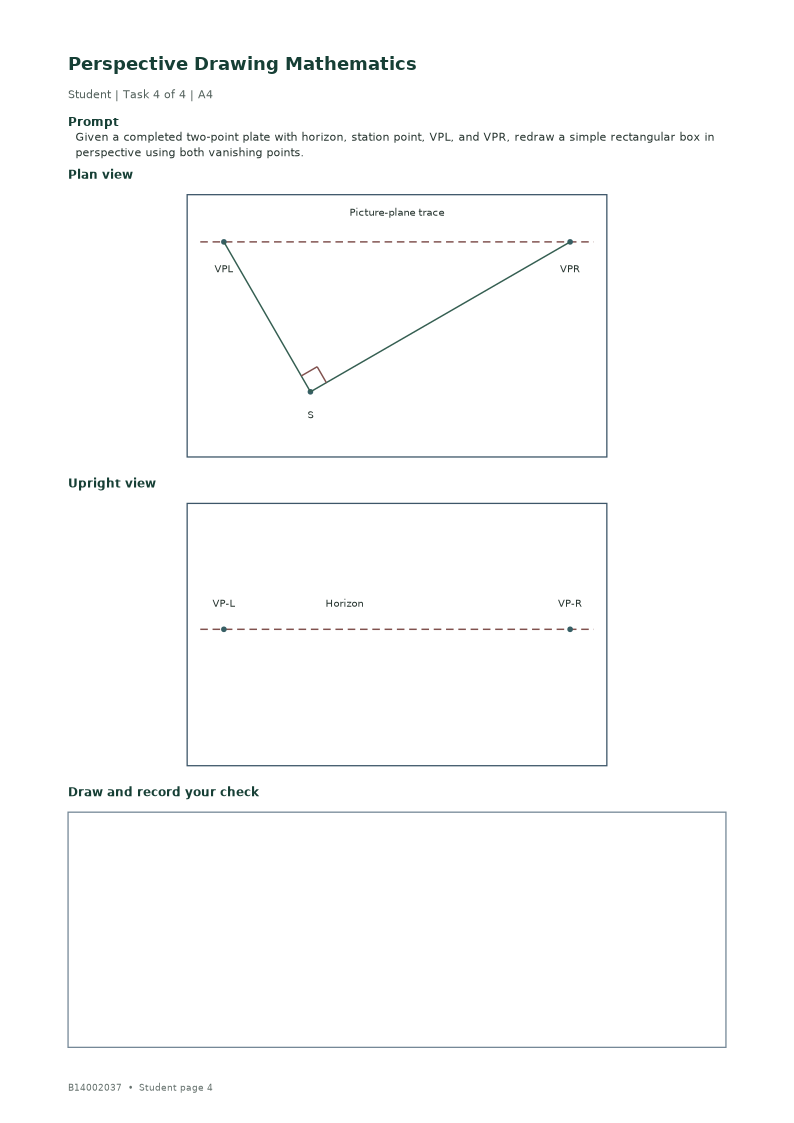
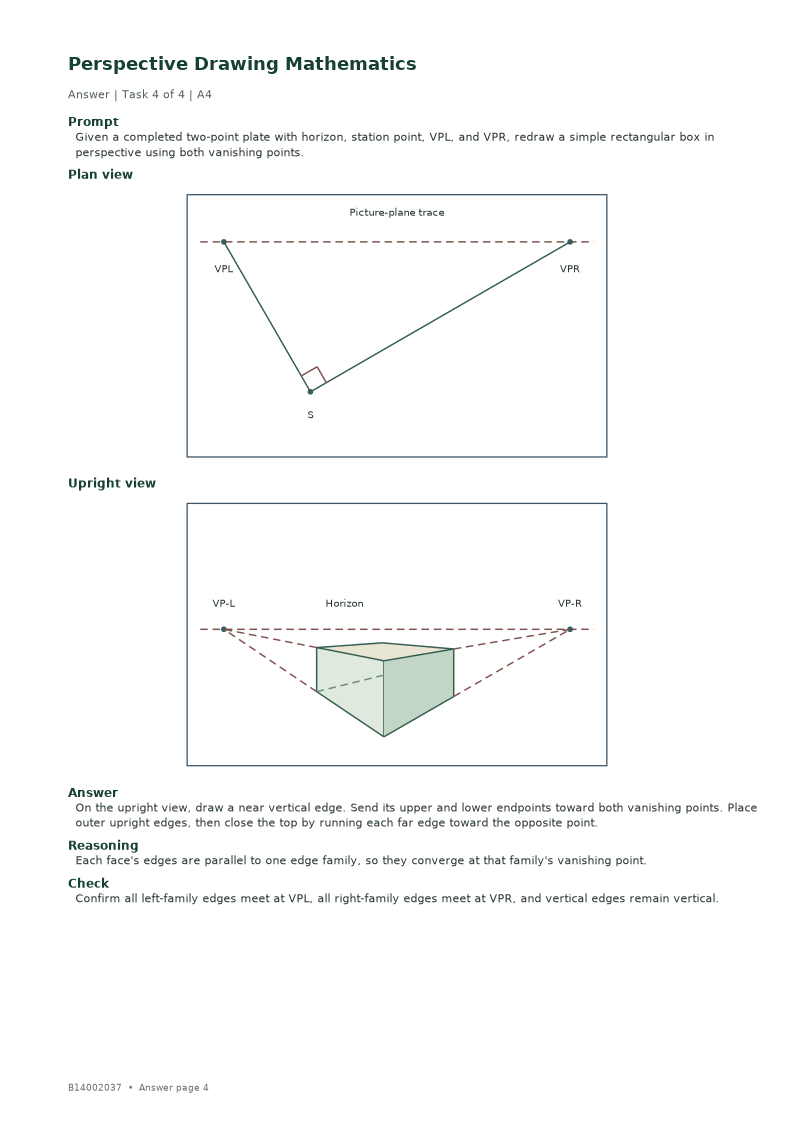
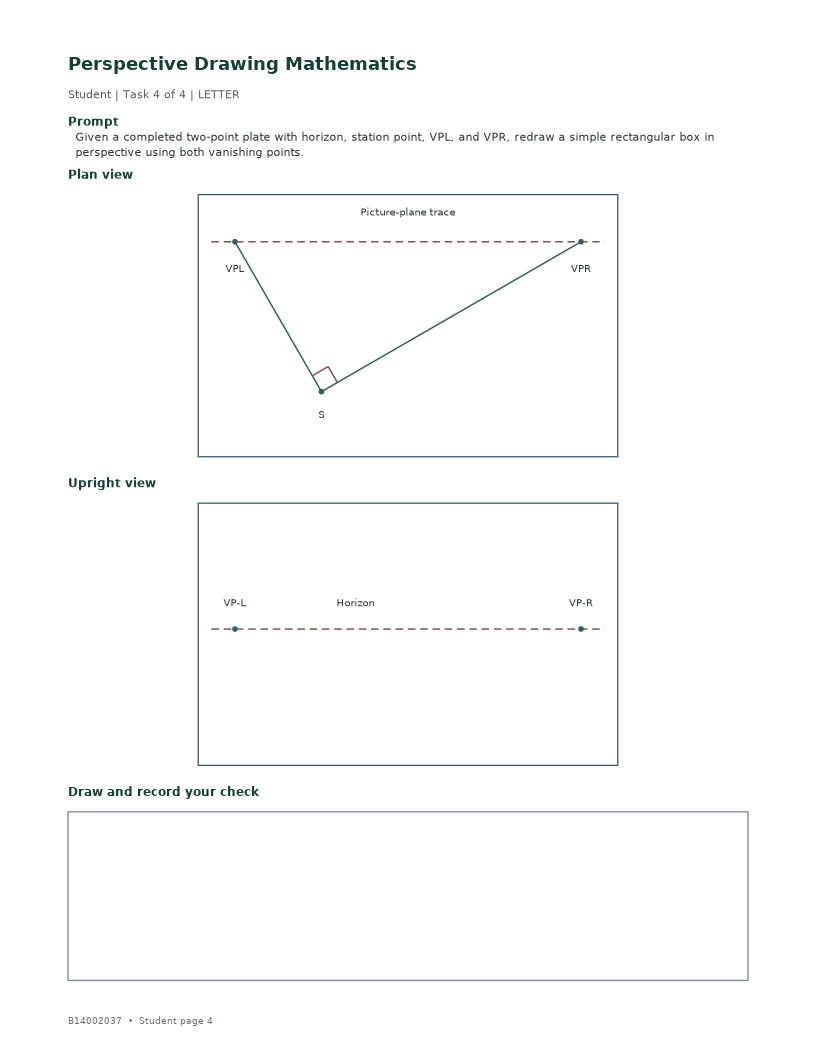
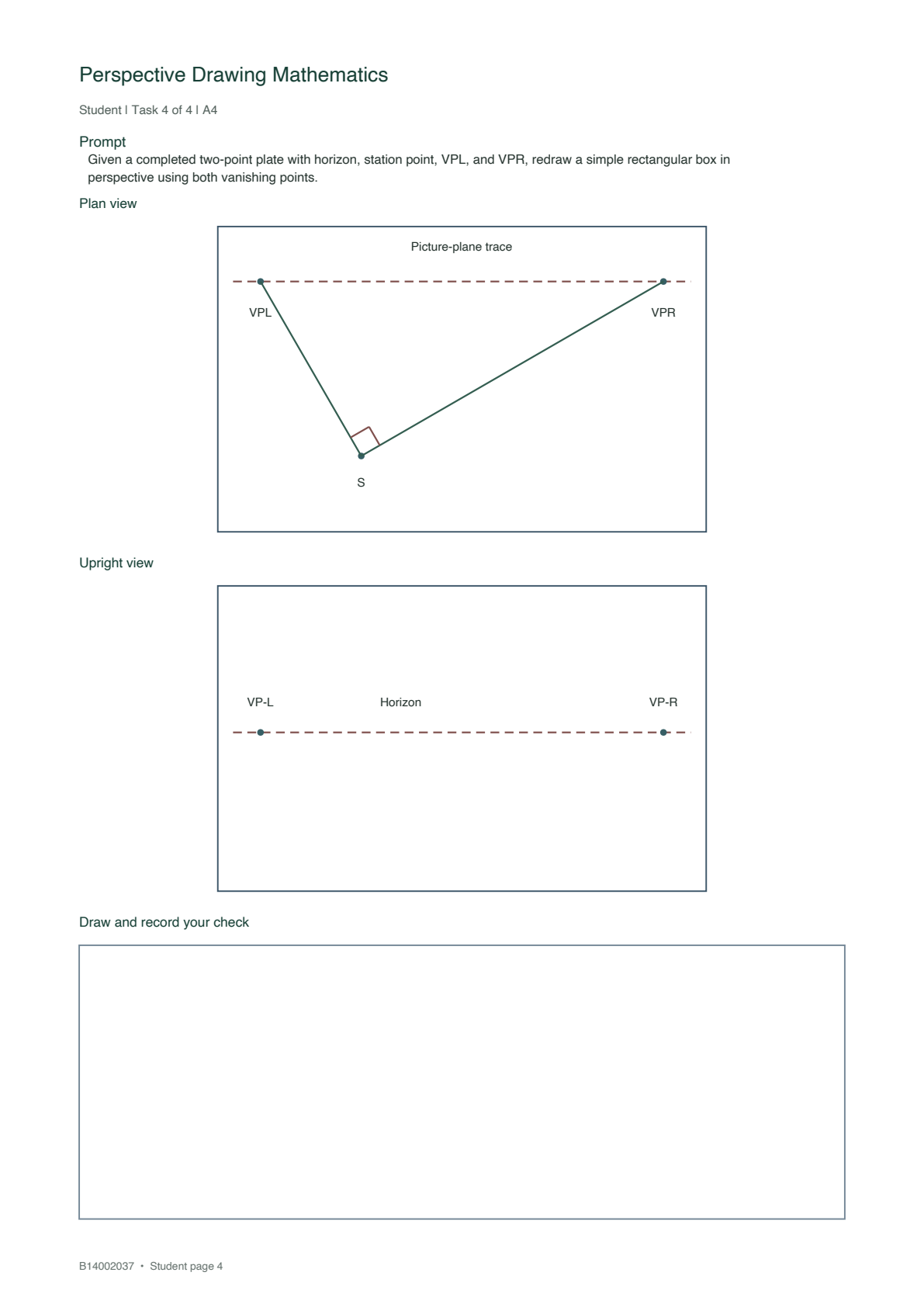
In Task 4, keep the same horizontal positions as you transfer both points to the horizon. Draw the rectangular block in the upright view, using the two corresponding edge families.
Download the complete resource pack
All individual SVG pages (18)
- A4 reference page 1
- A4 student page 1
- A4 student page 2
- A4 student page 3
- A4 student page 4
- A4 answer page 1
- A4 answer page 2
- A4 answer page 3
- A4 answer page 4
- LETTER reference page 1
- LETTER student page 1
- LETTER student page 2
- LETTER student page 3
- LETTER student page 4
- LETTER answer page 1
- LETTER answer page 2
- LETTER answer page 3
- LETTER answer page 4
Print at 100% / actual size. Use the stated scale on any schematic diagram; physical cutting templates are identified separately. A4 and US Letter are separate files. Free access, no signup; CC BY 4.0.
How to use these pages
- The three primitives
- Worked example: deriving two vanishing points
- Practice tasks
- Practice tasks (continued)
Worked example
Example: Construct a two-point perspective plate: horizon line, station point S, and two vanishing points VPL and VPR derived from S for a rectangular object with left and right edge families.
Answer: In plan, S is on the viewer's side of the picture-plane trace. Use the two example directions to draw a left ray and a right ray through S. Transfer their intersections with that trace to the upright horizon as VPL and VPR.
Reasoning: Each horizontal vanishing direction intersects the picture plane along the line through the eye parallel to the object edge. Both intersection points lie at eye level.
Check: Check the two rays against the given directions in plan. Both upright horizon marks must preserve their plan intersections' horizontal positions.
Four practice tasks and complete answers
Task 1
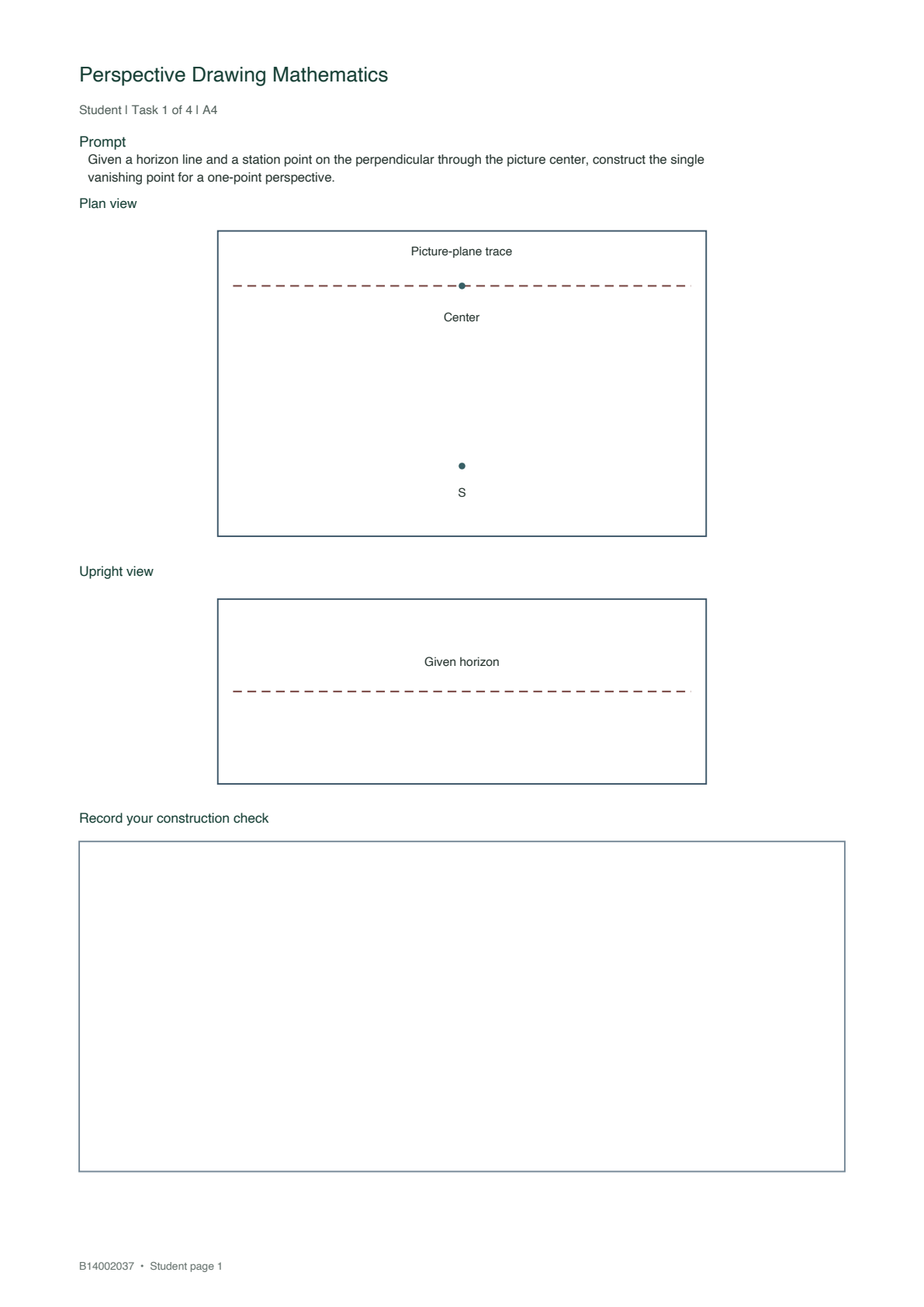
Given a horizon line and a station point on the perpendicular through the picture center, construct the single vanishing point for a one-point perspective.
Show answer 1
The vanishing point is the picture center on the horizon.
The depth direction in this centered example is perpendicular to the picture plane. Its ray from S meets the picture-plane trace at the center, which transfers to the center of the horizon.
Check: In plan confirm the perpendicular through S meets the picture-plane trace at its center. Transfer that location to the horizon.
Task 2
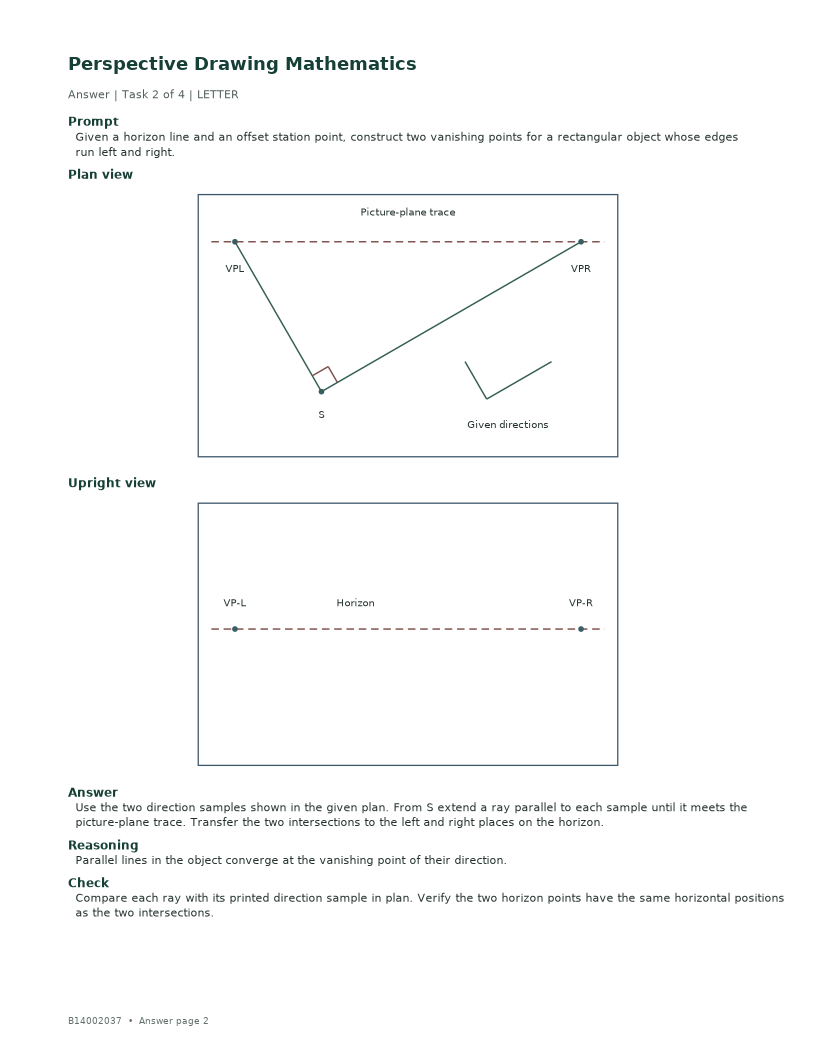
Given a horizon line and an offset station point, construct two vanishing points for a rectangular object whose edges run left and right.
Show answer 2
Use the two direction samples shown in the given plan. From S extend a ray parallel to each sample until it meets the picture-plane trace. Transfer the two intersections to the left and right places on the horizon.
Parallel lines in the object converge at the vanishing point of their direction.
Check: Compare each ray with its printed direction sample in plan. Verify the two horizon points have the same horizontal positions as the two intersections.
Task 3
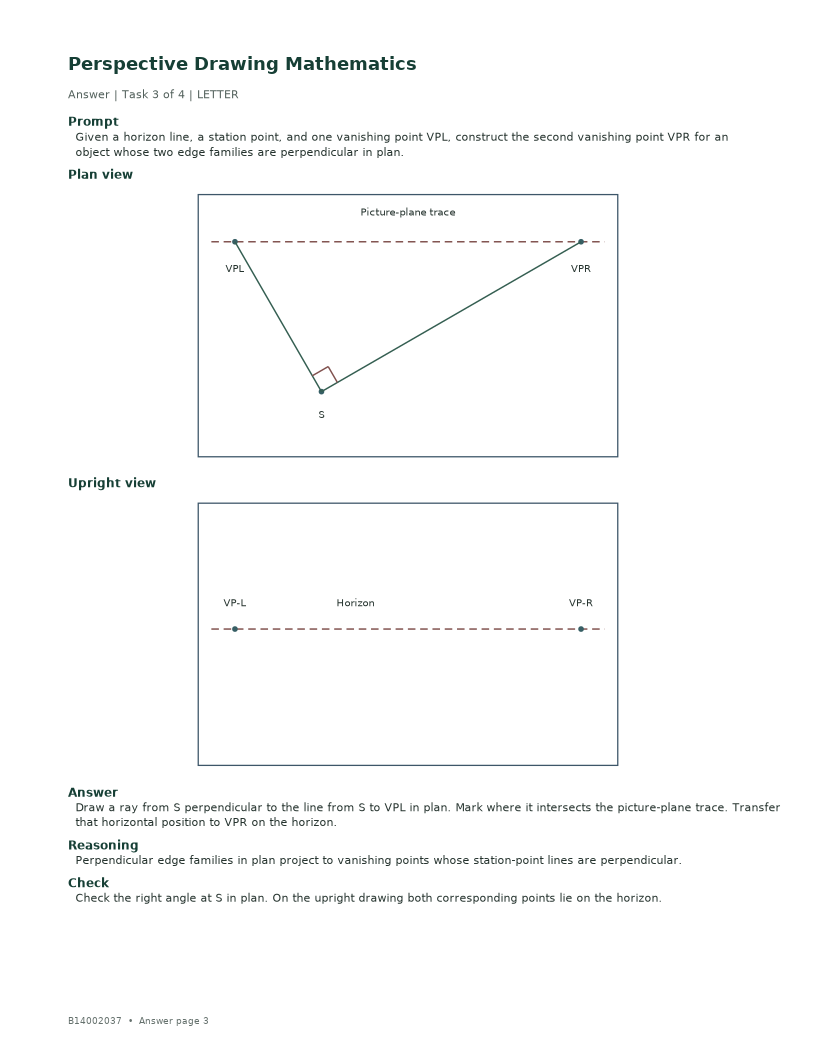
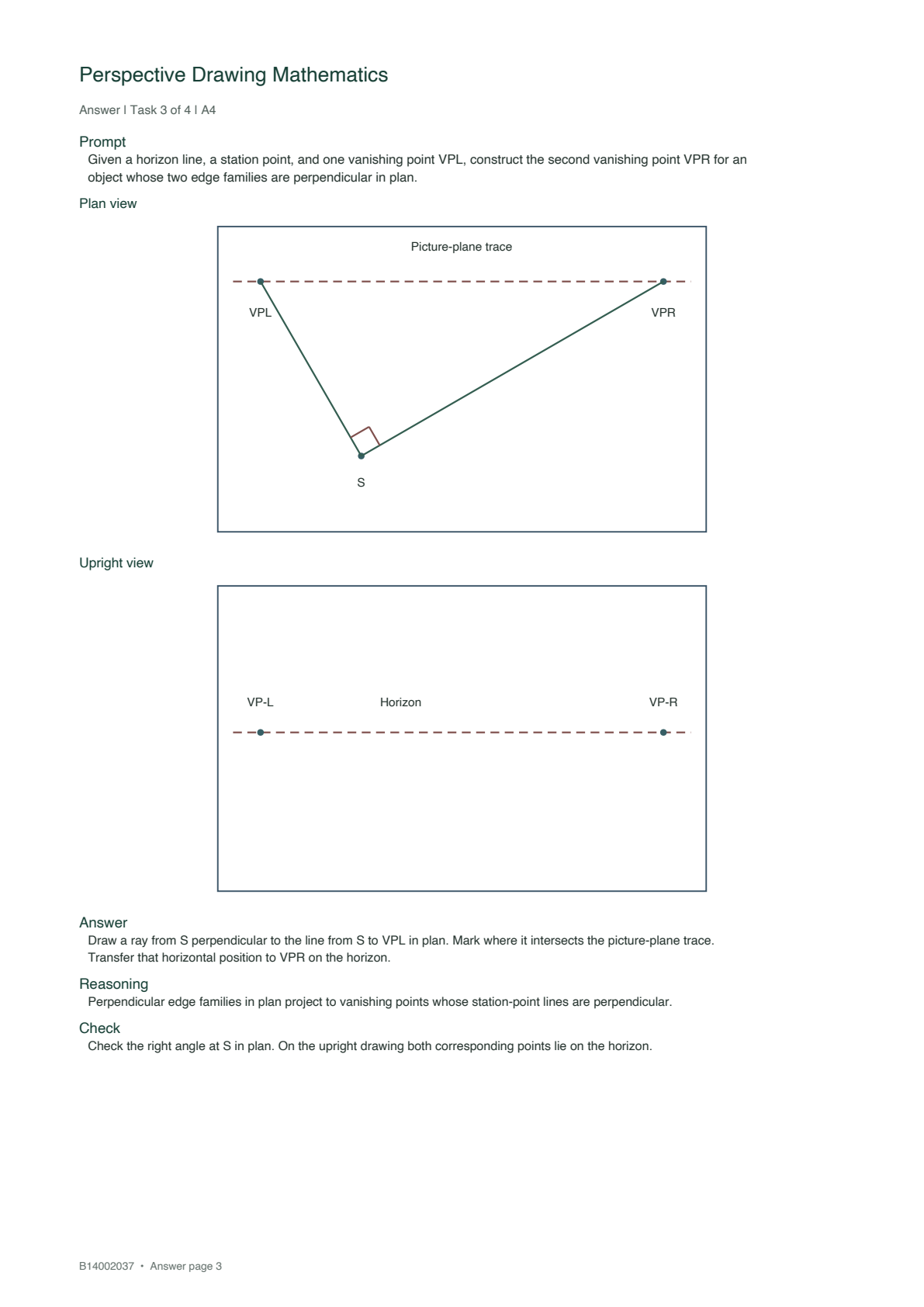
Given a horizon line, a station point, and one vanishing point VPL, construct the second vanishing point VPR for an object whose two edge families are perpendicular in plan.
Show answer 3
Draw a ray from S perpendicular to the line from S to VPL in plan. Mark where it intersects the picture-plane trace. Transfer that horizontal position to VPR on the horizon.
Perpendicular edge families in plan project to vanishing points whose station-point lines are perpendicular.
Check: Check the right angle at S in plan. On the upright drawing both corresponding points lie on the horizon.
Task 4
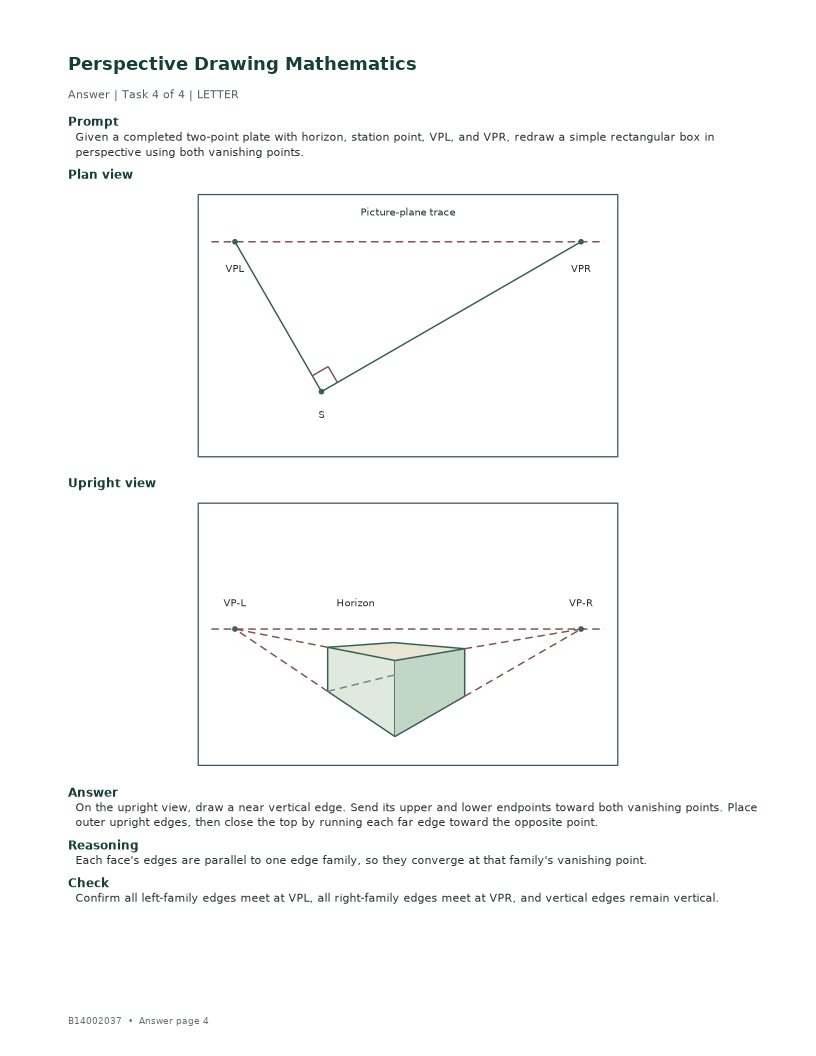
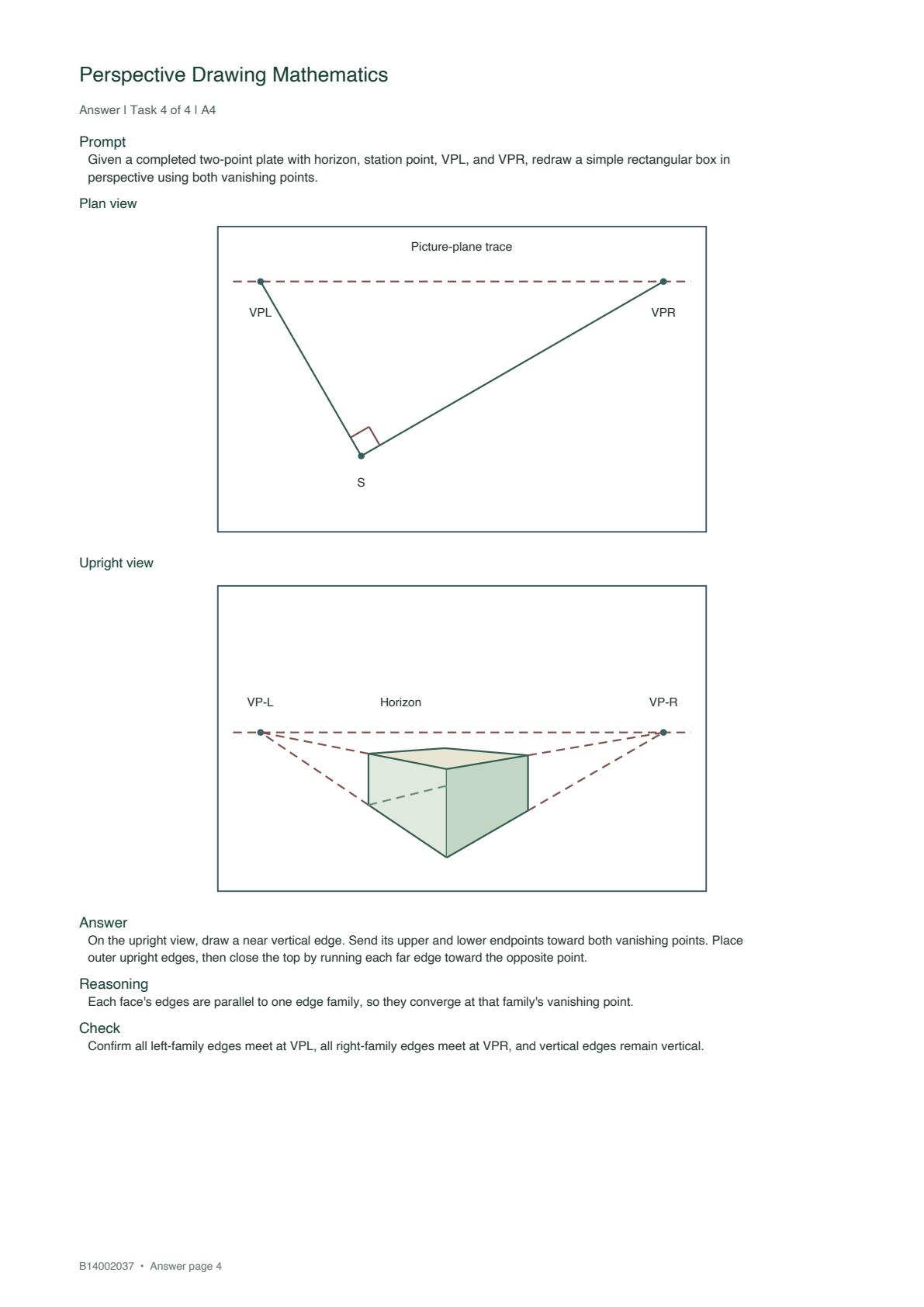
Given a completed two-point plate with horizon, station point, VPL, and VPR, redraw a simple rectangular box in perspective using both vanishing points.
Show answer 4
On the upright view, draw a near vertical edge. Send its upper and lower endpoints toward both vanishing points. Place outer upright edges, then close the top by running each far edge toward the opposite point.
Each face's edges are parallel to one edge family, so they converge at that family's vanishing point.
Check: Confirm all left-family edges meet at VPL, all right-family edges meet at VPR, and vertical edges remain vertical.
Useful checks
- Placing a vanishing point off the horizon line. The vanishing points for the horizontal edge families in these exercises are on the horizon. An inclined direction can have a vanishing point away from that line.
- Drawing projection lines from S that are not parallel to the edge family. The projection line from S must be parallel to the edge family; otherwise the intersection is not the correct vanishing point.
Questions about this resource
Why must the station point be in plan view?
The station point represents the viewer's eye position in plan, so projection lines from it to the picture plane give the correct vanishing points.
How do I know my vanishing points are correct?
Both must lie on the horizon, and each projection line from S must be parallel to its edge family.