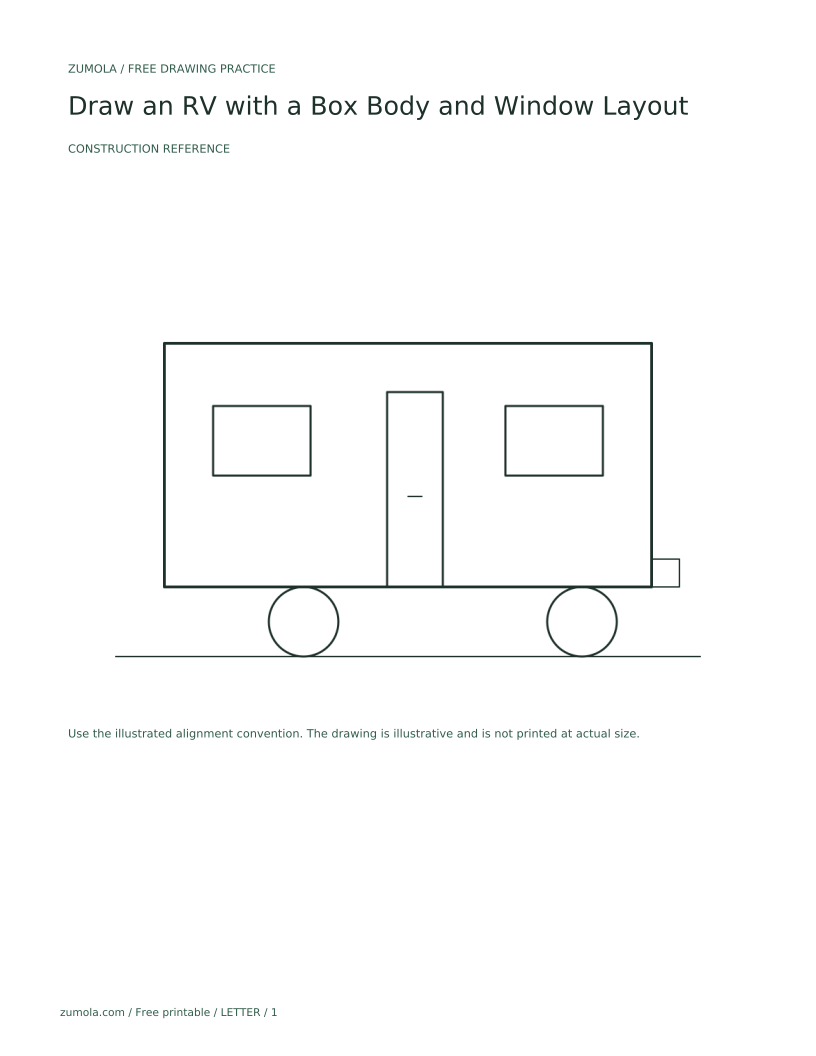
Reference diagram
LETTER · Download PDF (1 page)
Free original resources
Learn to draw a box-body RV with correct proportions, window and door layout, and wheel placement using a simple grid and measured guides.
Original reference diagrams, four practice exercises and separate worked answers. All files are free. No signup required.
LETTER · Download PDF (1 page)
LETTER · Download PDF (4 pages)
LETTER · Download PDF (4 pages)
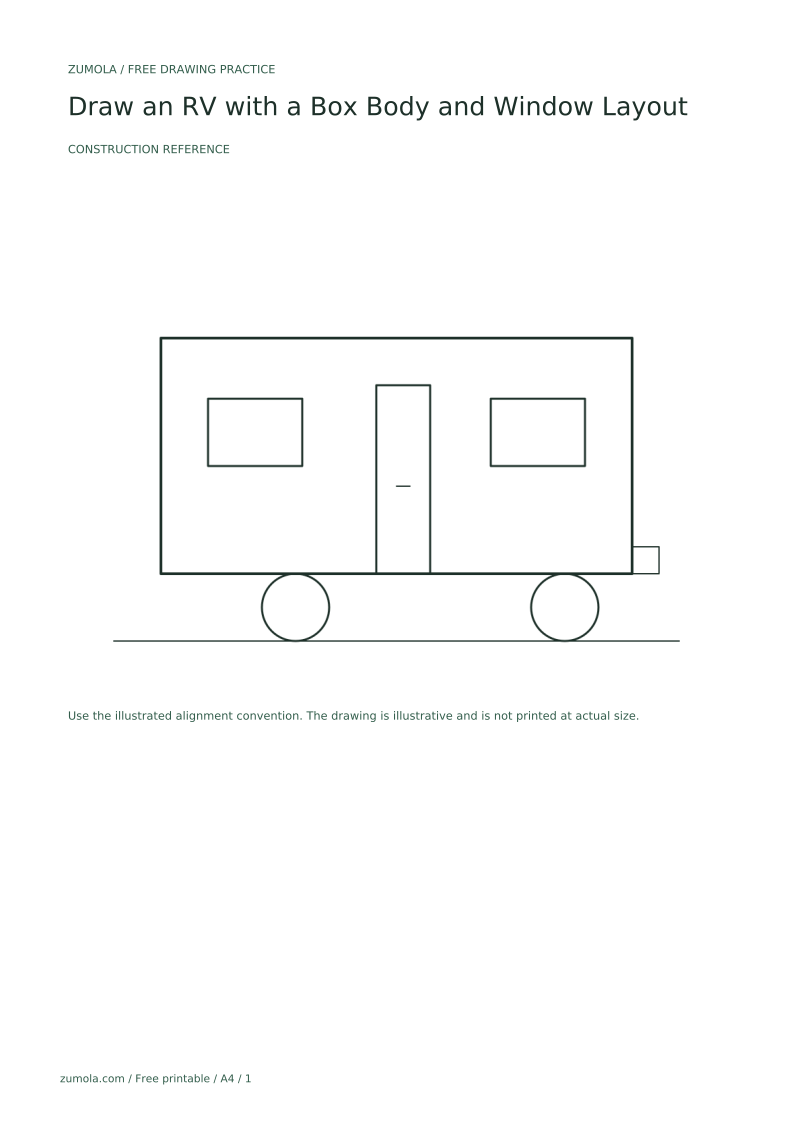
Choose A4 or US Letter for your printer. The reference and answer illustrations are not physical rulers; follow the scale instruction printed on the practice worksheet.
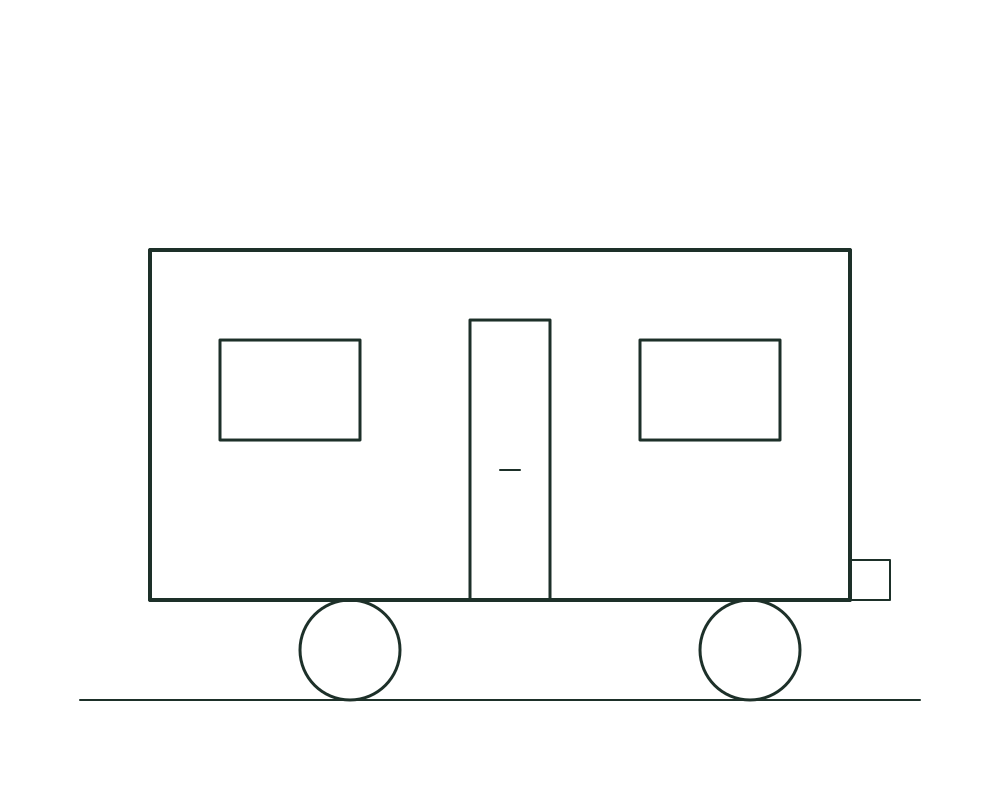
This lesson teaches a repeatable method for drawing a recreational vehicle whose body is a rectangular box. You will set overall proportions, place windows and a door on a side elevation, position wheels, and check the result with simple arithmetic. Use a side view with the body drawn as a rectangle. All numerical values are hypothetical examples; measure your own paper and tools.
Begin with a side elevation. Decide the overall length and height of the body as a rectangle. A common hypothetical proportion is length to height of about 2.5 to 1, but any consistent ratio works if you record it.
Draw a light baseline and a top line parallel to it. Mark the front and rear vertical edges. Keep the body edges straight; the box shape is the defining feature of this RV.
Divide the side into zones: front cab area, living area, and rear area. Place a door in the living zone and windows in the remaining zones. Keep spacing even by measuring from the body edges rather than guessing.
Use a simple convention: each window is a rectangle whose width is about one third of its zone width and whose height is about one half of the body height. These are hypothetical starting values; adjust to fit your layout.
Wheels sit below the body, centered under the rear and front axle zones. Draw two circles of equal radius. The distance between wheel centers should be less than the body length and greater than half the body length.
Check alignment by measuring from each wheel center to the nearest body edge. If the values differ by more than a small amount you choose, shift the wheel.
Add a roof line, a simple bumper, and a door handle. Keep details inside the body rectangle so the box shape remains clear. Avoid adding curved body panels; this task is specifically about a box body.
Use the rubric to judge whether proportions, window layout, and wheel placement are consistent, not whether the drawing matches one universal style.
A side-view RV body is 10 units long and 4 units high. Place two windows of width 2 units each with equal gaps, and one door of width 1 unit. Find the gap width if the door sits between the windows.
Total window and door width is 2 + 1 + 2 = 5 units. Remaining length is 10 - 5 = 5 units. With four gaps (left edge, between window and door, between door and window, right edge), each gap is 5 / 4 = 1.25 units.
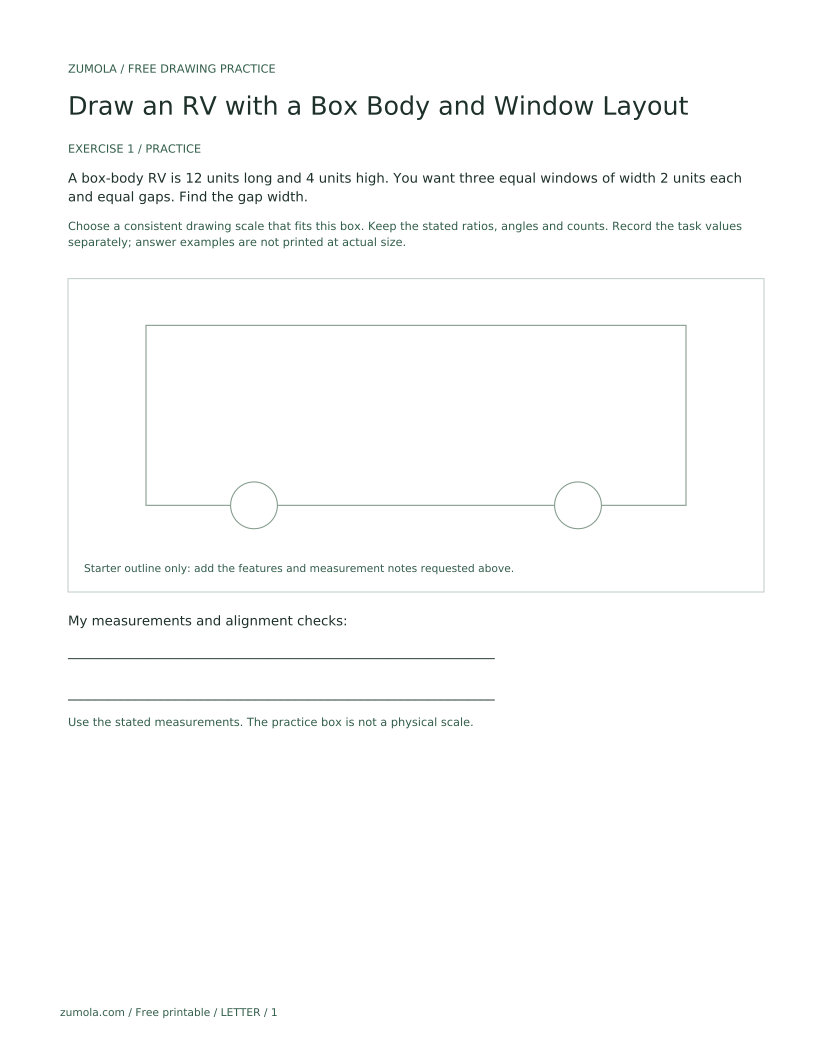
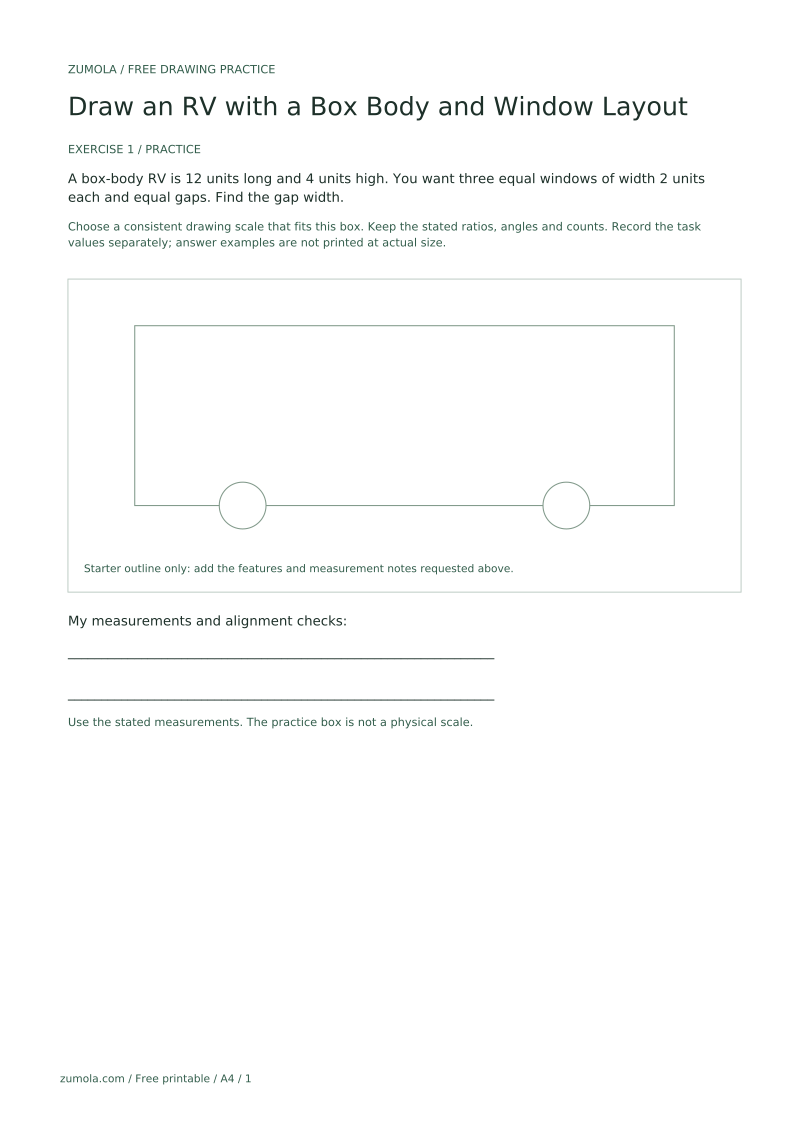
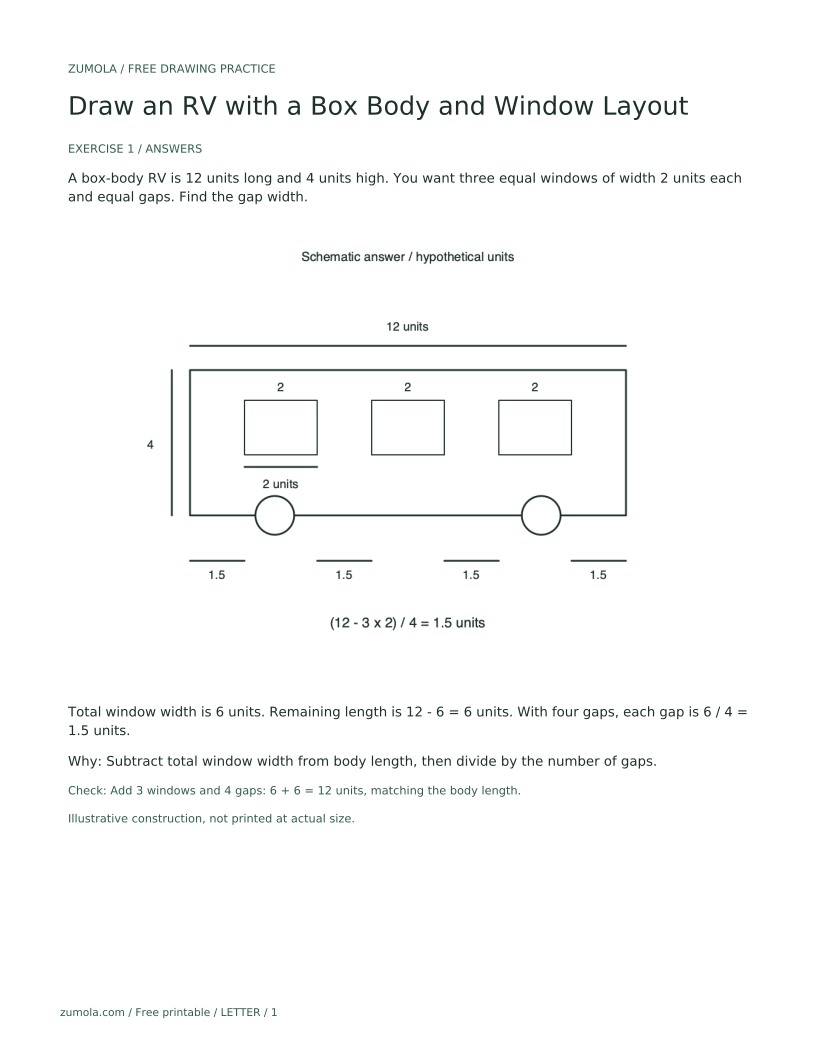
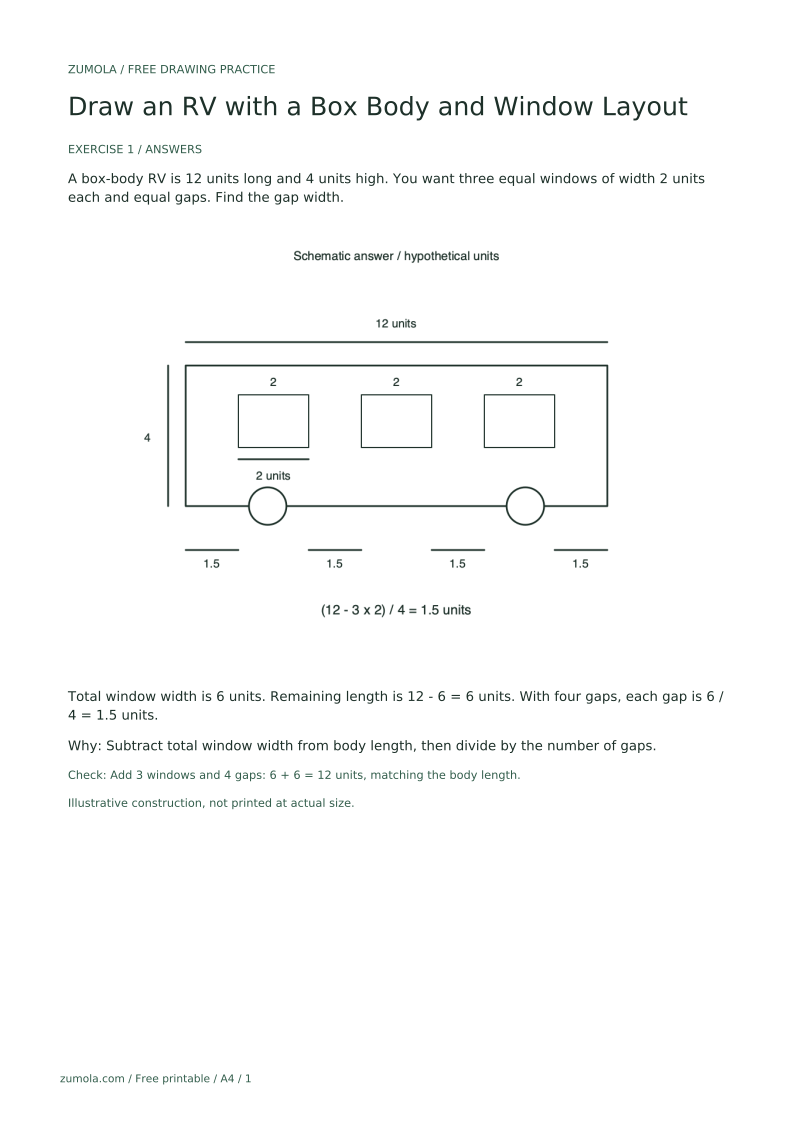
A box-body RV is 12 units long and 4 units high. You want three equal windows of width 2 units each and equal gaps. Find the gap width.
Total window width is 6 units. Remaining length is 12 - 6 = 6 units. With four gaps, each gap is 6 / 4 = 1.5 units.
Subtract total window width from body length, then divide by the number of gaps.
Check: Add 3 windows and 4 gaps: 6 + 6 = 12 units, matching the body length.
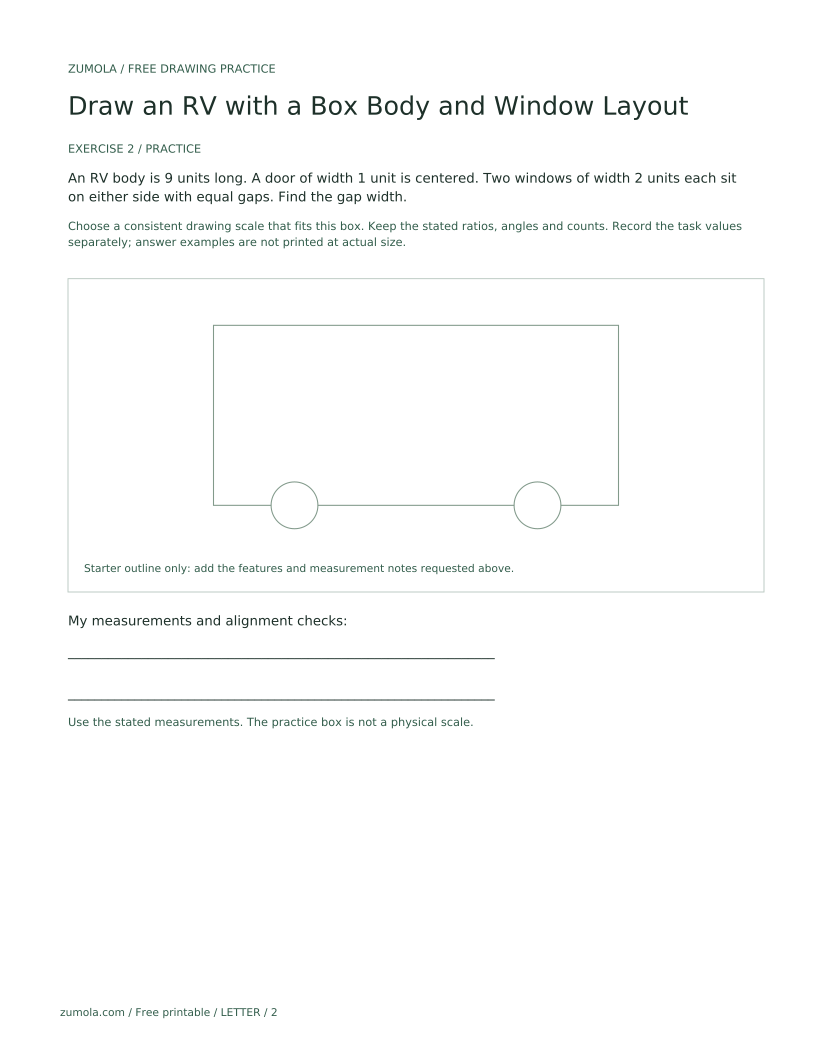
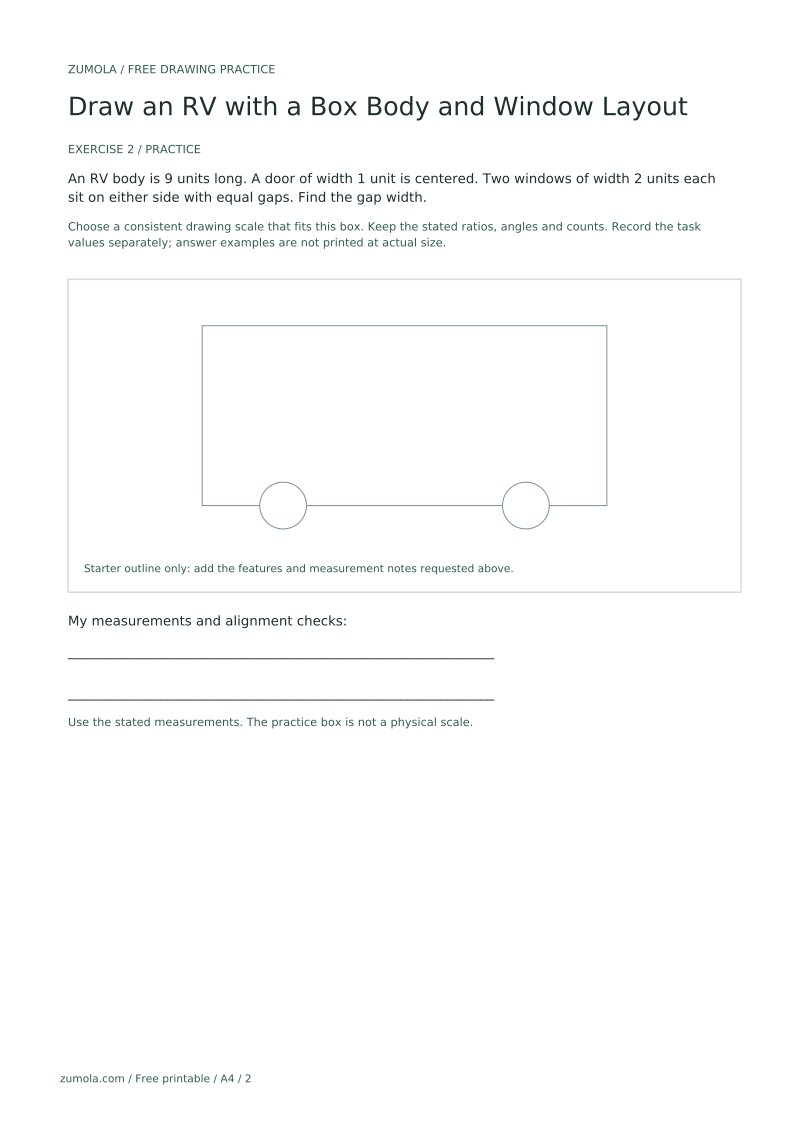
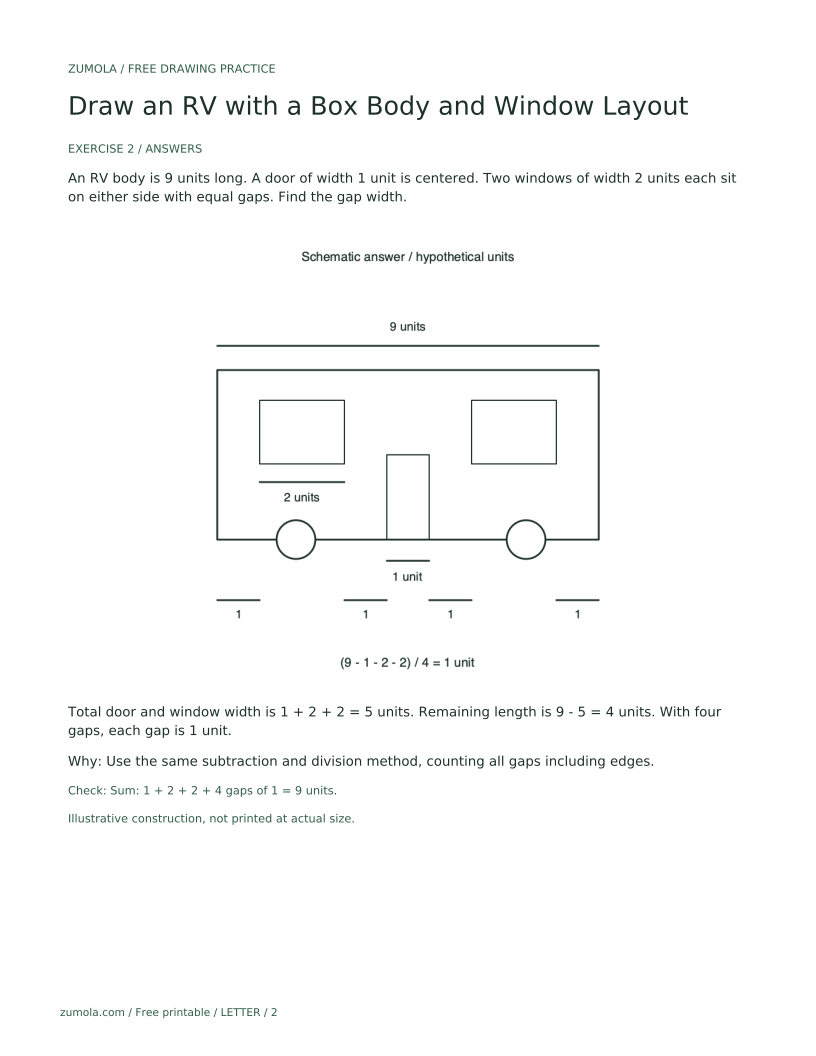
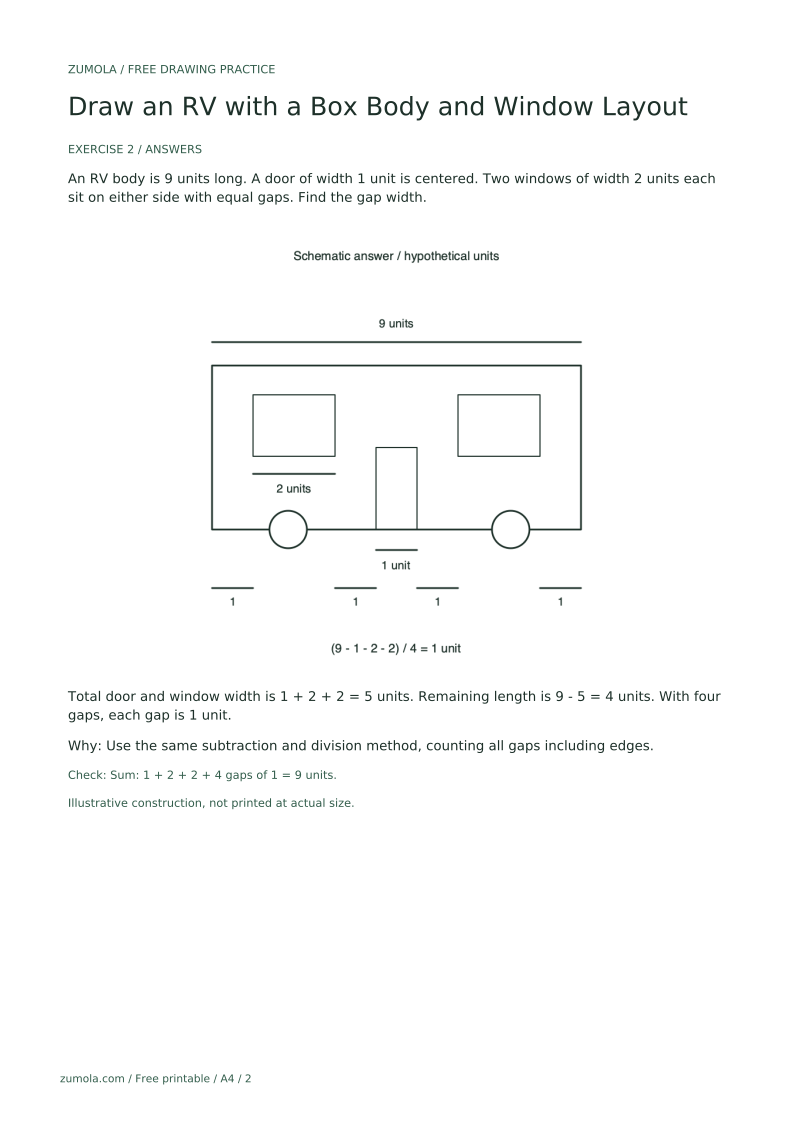
An RV body is 9 units long. A door of width 1 unit is centered. Two windows of width 2 units each sit on either side with equal gaps. Find the gap width.
Total door and window width is 1 + 2 + 2 = 5 units. Remaining length is 9 - 5 = 4 units. With four gaps, each gap is 1 unit.
Use the same subtraction and division method, counting all gaps including edges.
Check: Sum: 1 + 2 + 2 + 4 gaps of 1 = 9 units.
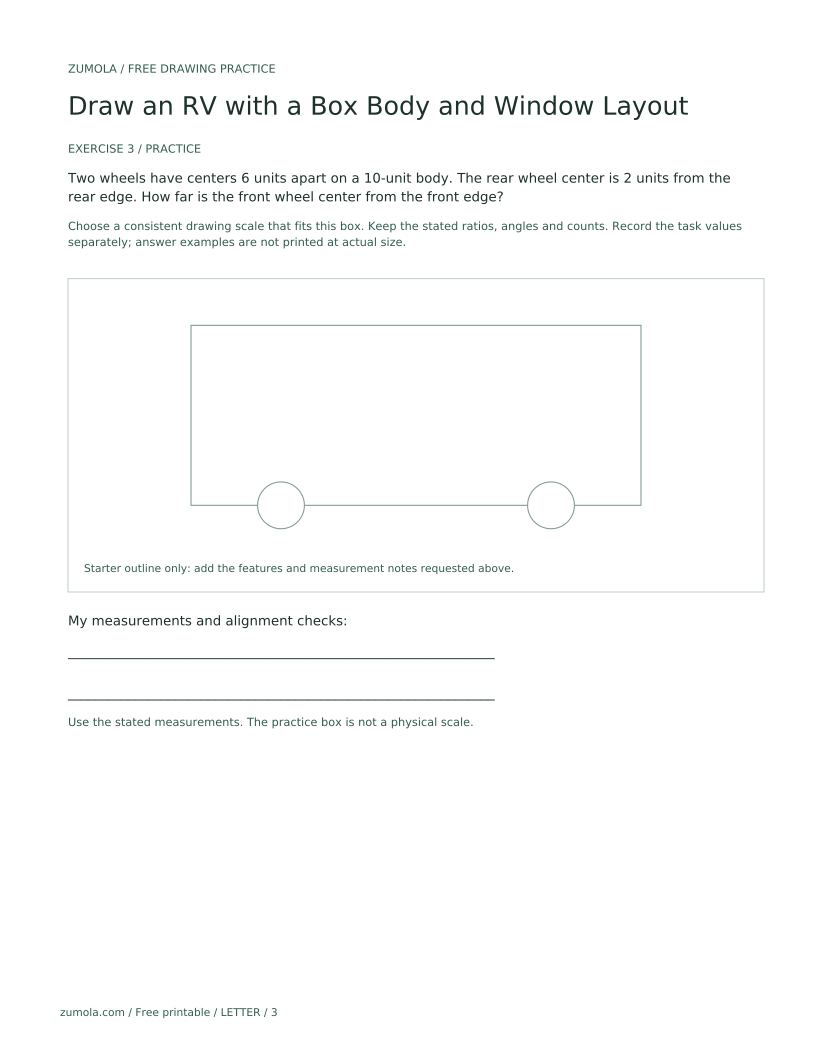
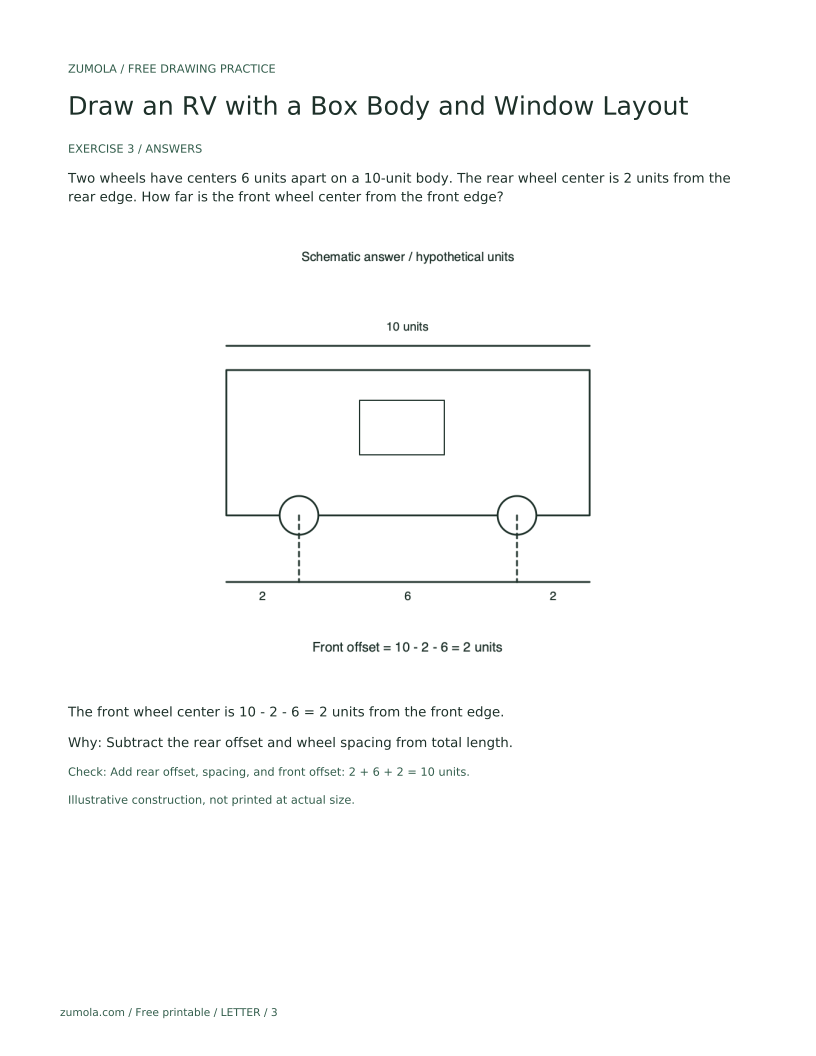
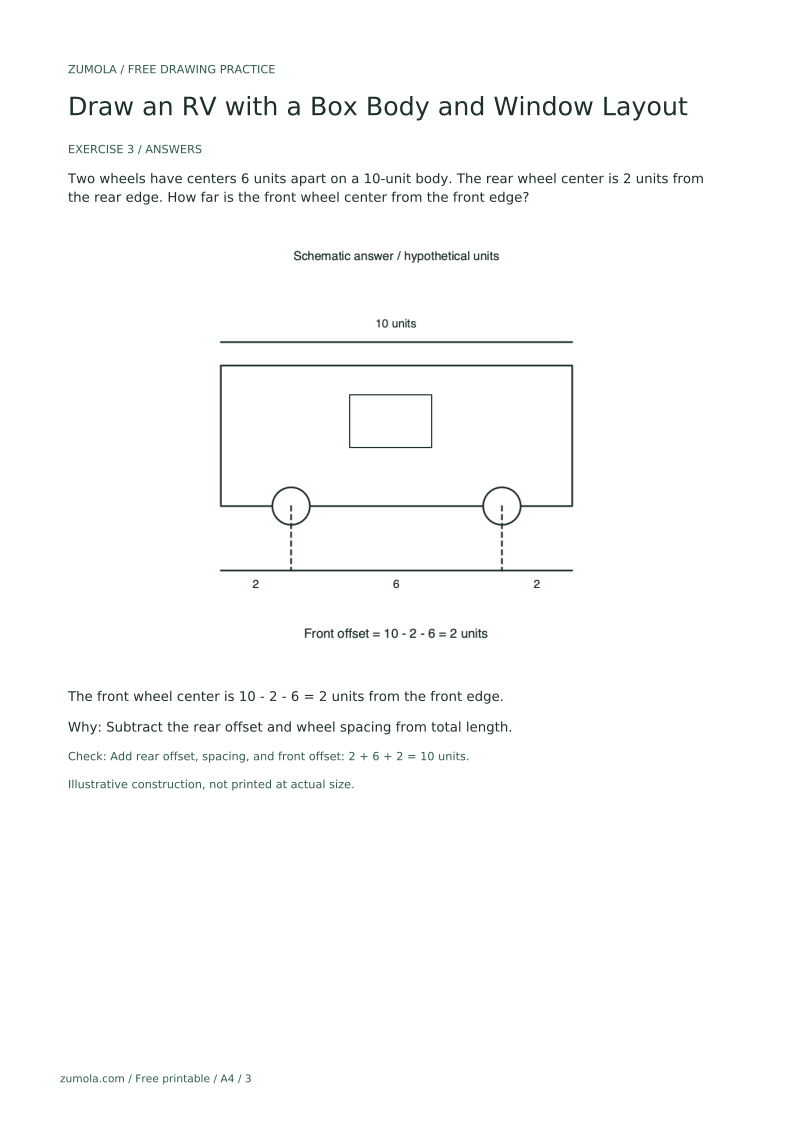
Two wheels have centers 6 units apart on a 10-unit body. The rear wheel center is 2 units from the rear edge. How far is the front wheel center from the front edge?
The front wheel center is 10 - 2 - 6 = 2 units from the front edge.
Subtract the rear offset and wheel spacing from total length.
Check: Add rear offset, spacing, and front offset: 2 + 6 + 2 = 10 units.
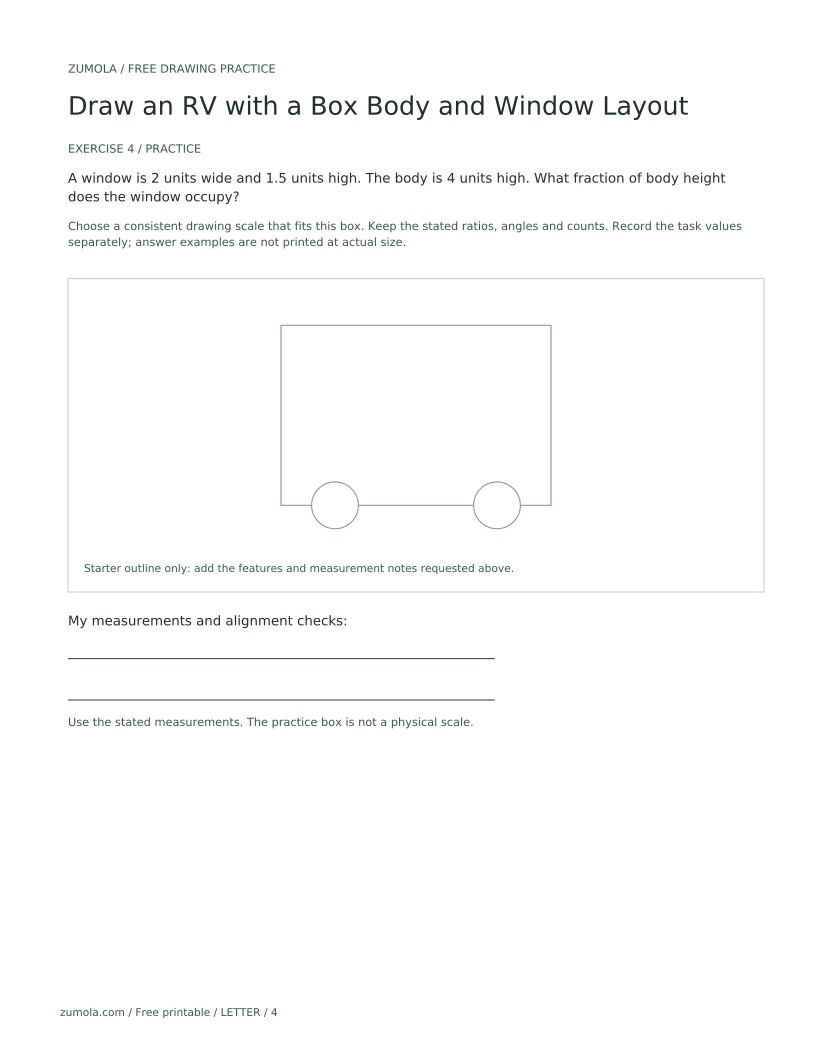
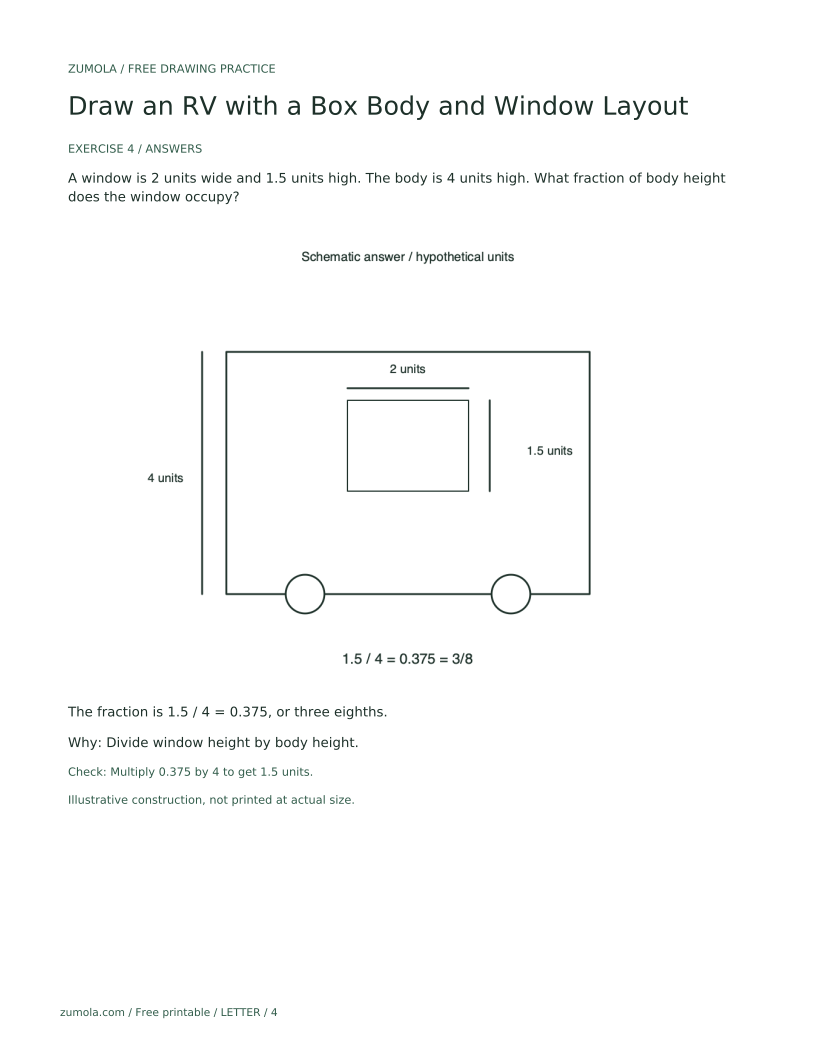
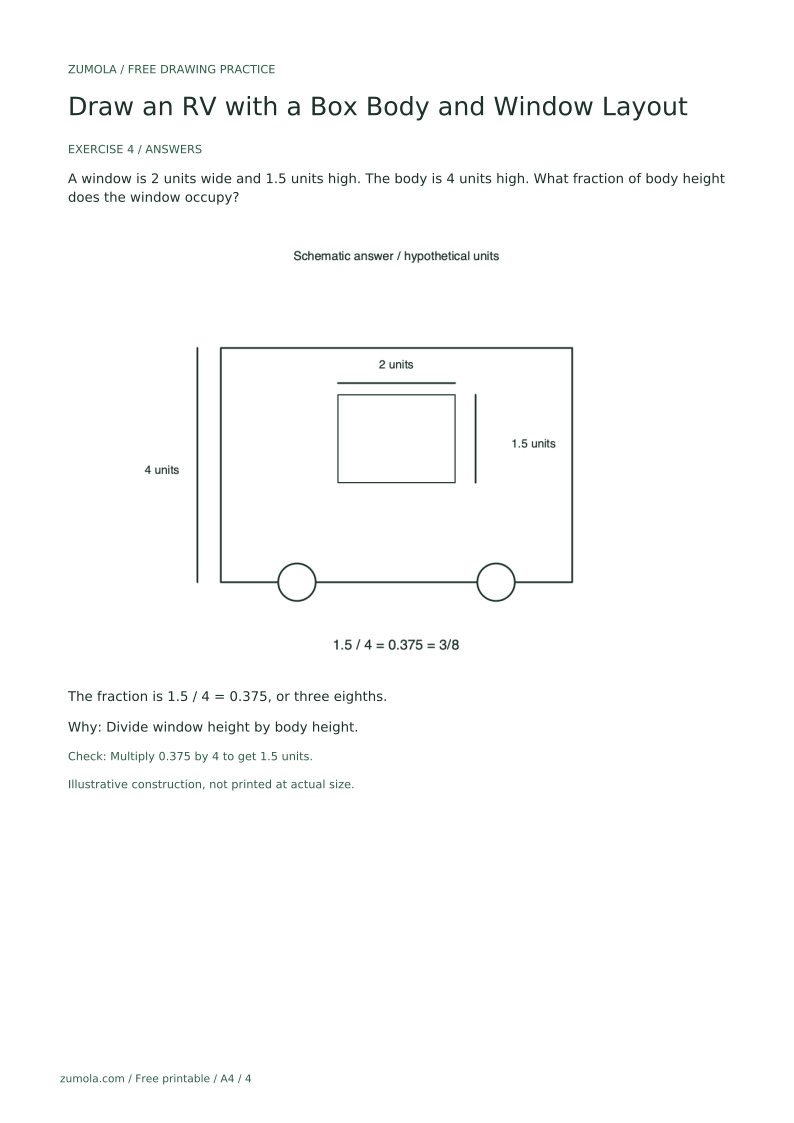
A window is 2 units wide and 1.5 units high. The body is 4 units high. What fraction of body height does the window occupy?
The fraction is 1.5 / 4 = 0.375, or three eighths.
Divide window height by body height.
Check: Multiply 0.375 by 4 to get 1.5 units.
Redraw the body as a rectangle with straight vertical and horizontal edges.
Mark zone boundaries first, then measure equal gaps between windows.
Use one radius for both wheels and check with a ruler.
Assign separate zones for door and windows before drawing.
Yes for this task. The brief specifies a box body, so keep the main body edges straight and parallel.
Any number that fits the zones evenly. Three to five windows is a practical starting point.
Yes, but use one unit consistently within a drawing and record it.