Reference diagram
LETTER · Download PDF (1 page)
Free original resources
Learn to construct a scaled cross with a fixed arm-to-post ratio, using a grid, simple arithmetic, and a measurement check for accurate proportions.
Original reference diagrams, four practice exercises and separate worked answers. All files are free. No signup required.
LETTER · Download PDF (1 page)
LETTER · Download PDF (4 pages)
LETTER · Download PDF (4 pages)
Choose A4 or US Letter for your printer. The reference and answer illustrations are not physical rulers; follow the scale instruction printed on the practice worksheet.
This lesson teaches a repeatable method for drawing a cross to scale. You will define a ratio between the vertical post height and the horizontal arm length, set a scale factor, and use a grid to place every point. Measure each horizontal arm from the post centerline to one end. Any consistent construction is valid when it meets the stated ratio and measurement check. All measurements use the same unit, and any numerical values are hypothetical examples you can replace with your own.
A properly proportioned cross is built from two numbers: post height and arm length. Choose a ratio such as post height to arm length of 3 to 1. This means if the post is 12 units tall, each arm extends 4 units from the center. The ratio is the design decision; the scale factor converts it to your paper size.
Write the ratio as a fraction or pair, then multiply both parts by the same scale factor. For example, ratio 3:1 with scale factor 4 gives post 12 units and arm 4 units. Keep all units identical, whether centimeters, grid squares, or arbitrary units.
Use a square grid so every unit is visible. Mark a vertical centerline for the post and a horizontal centerline for the arms. The intersection is the center point. Count grid squares rather than estimating distances.
Place the top of the post and the bottom of the post at equal distances from the center if the design is symmetric. For a traditional cross, the vertical post extends above and below the arm line; the arm line sits at a chosen fraction of the post height. State that fraction explicitly, for example arms at one-third from the top.
Connect the marked points to form the post and arms. Keep edges parallel to the grid lines. The arm width is a separate decision; choose a width and apply it consistently to both arms and the post. The check box compares measured post height to measured arm length using the same unit.
Measure the actual drawing with a ruler or count grid squares. Compare the measured post height to the measured arm length. If the ratio is not within your stated tolerance, adjust the scale factor and redraw rather than stretching one part.
Measure each arm from the centerline to its outer end. State the post-height-to-each-arm ratio and use one unit throughout. The rubric rewards a clear ratio statement, consistent units, a grid-based construction, and a completed measurement check.
Valid alternatives include different ratios, different scale factors, and different arm widths, as long as the ratio is stated, the units are consistent, and the check is performed. There is no single universal answer; the goal is a defensible, measurable construction.
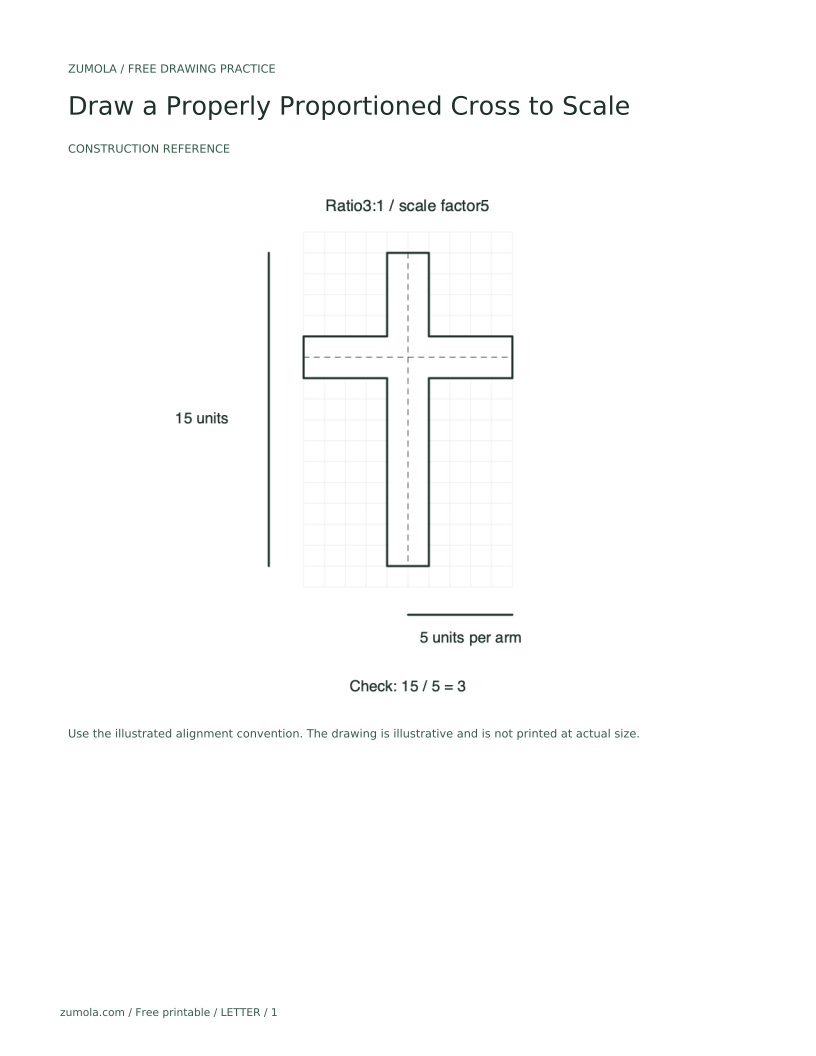
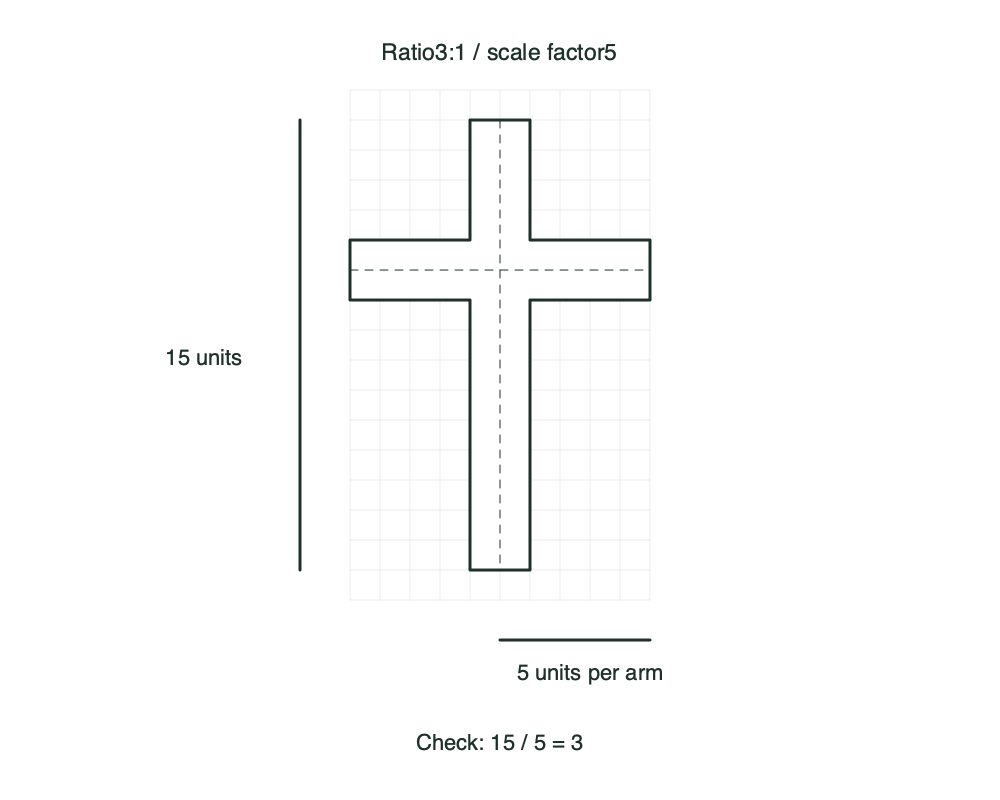
Construct a cross with post height to arm length ratio 3:1 using scale factor 5. State measurements, describe the grid construction, and perform the check.
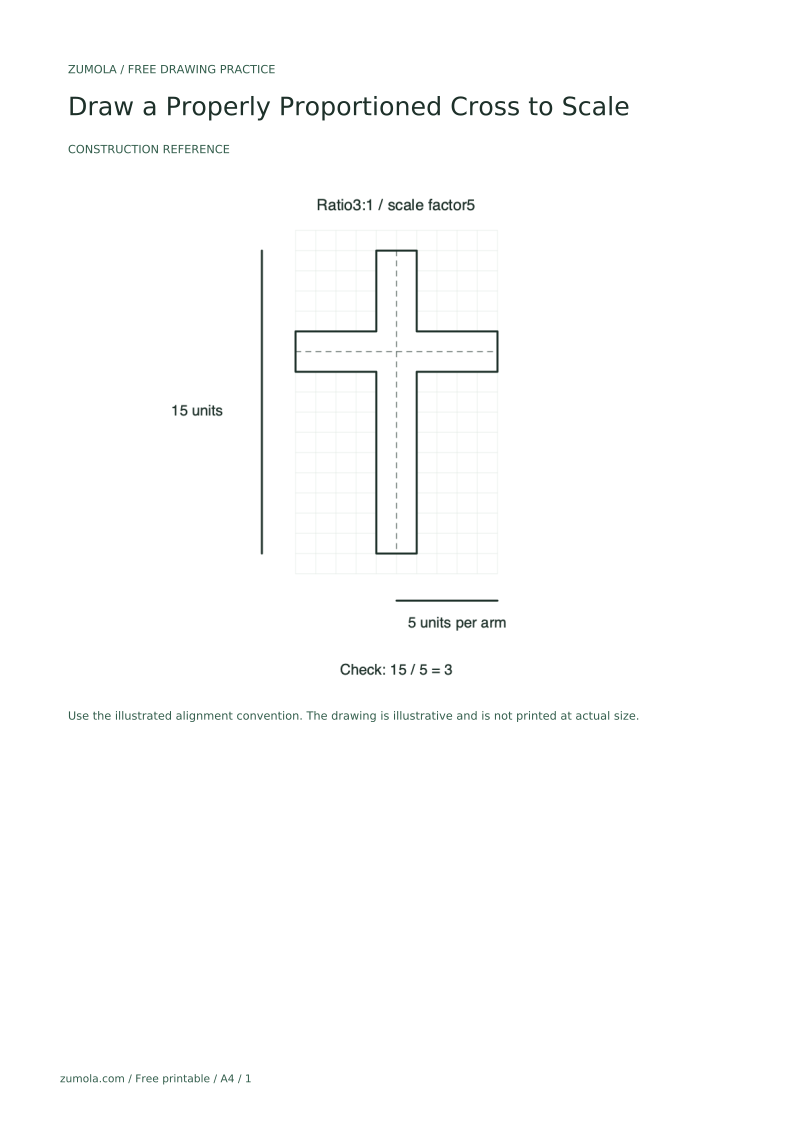
Ratio 3:1, scale factor 5 gives post height 15 units and arm length 5 units. On a square grid, mark a vertical centerline and horizontal centerline. Mark the post top 5 units above center and bottom 10 units below center so the arm line is one-third from the top. Mark each arm end 5 units from center. Draw the post and arms with a chosen width, for example 2 units. Measure: post height 15 units, arm length 5 units. Check: 15 divided by 5 equals 3, matching the ratio 3:1. Record 15, 5, and 3 in the check box.
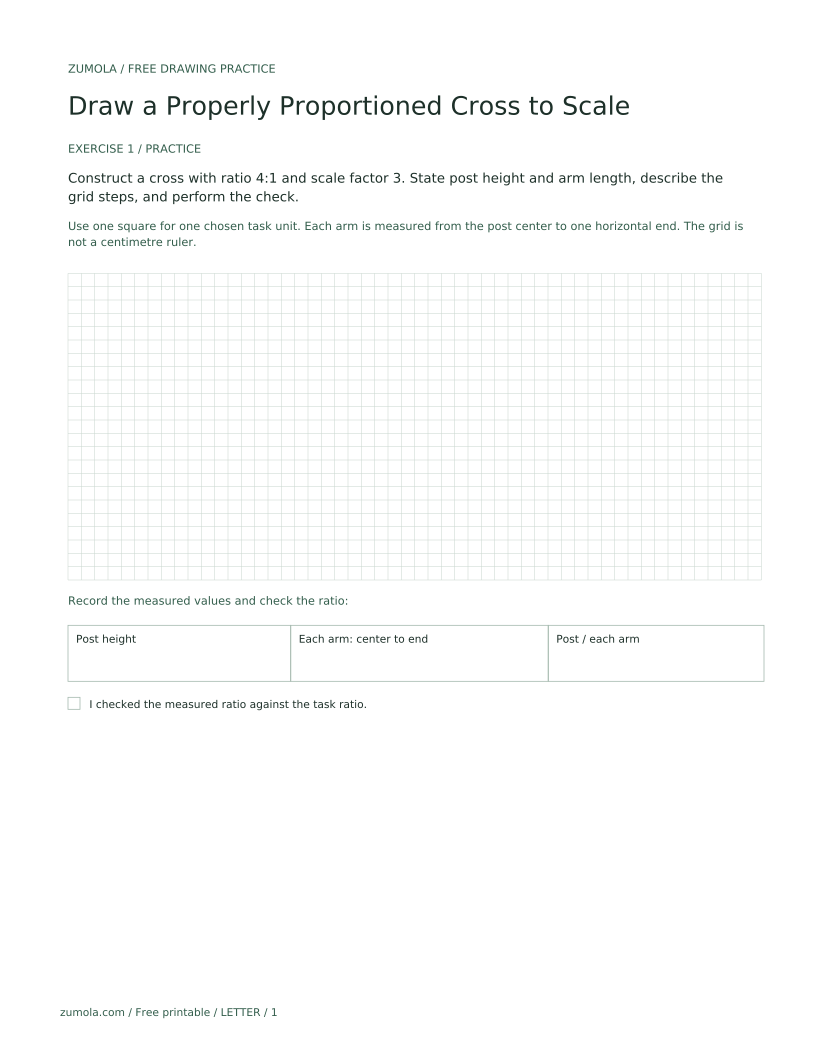
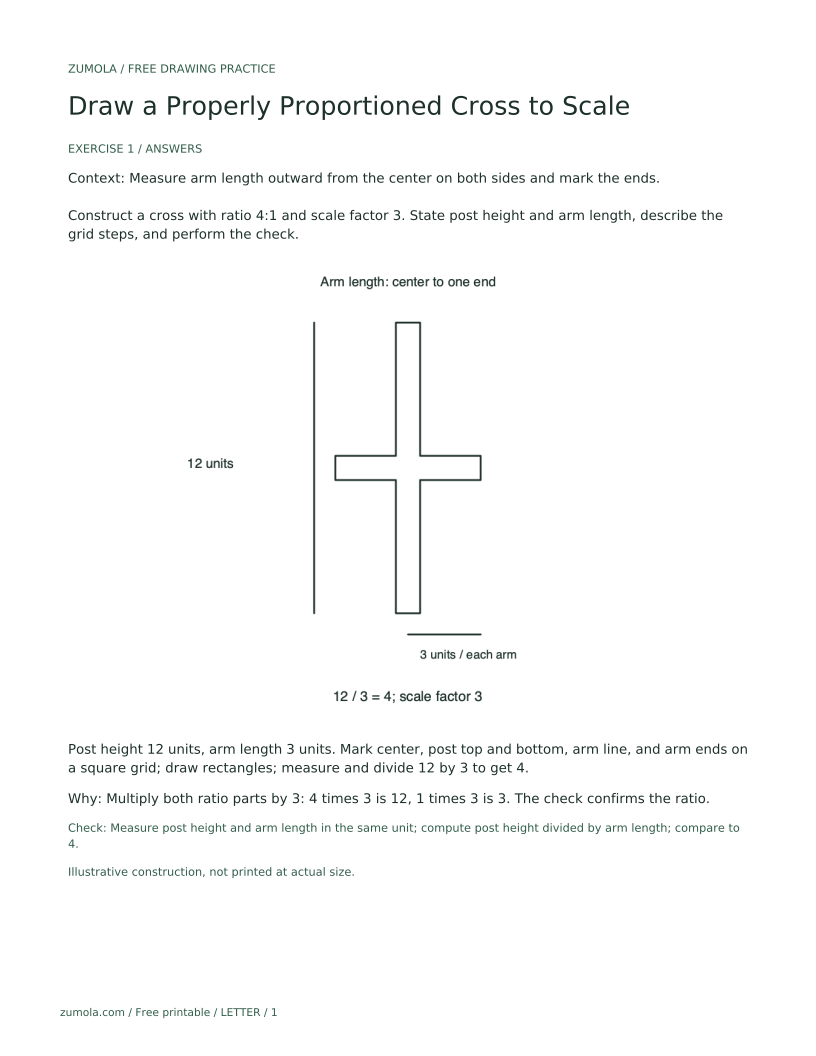
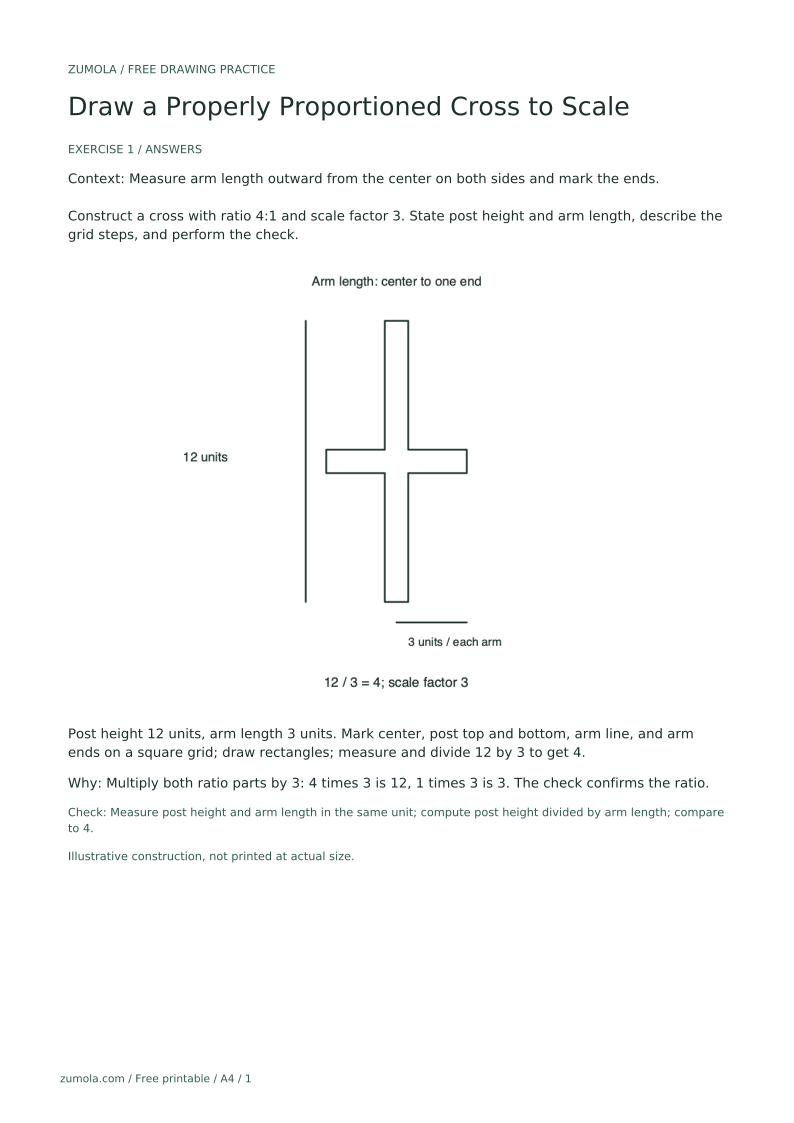
Construct a cross with ratio 4:1 and scale factor 3. State post height and arm length, describe the grid steps, and perform the check.
Post height 12 units, arm length 3 units. Mark center, post top and bottom, arm line, and arm ends on a square grid; draw rectangles; measure and divide 12 by 3 to get 4.
Multiply both ratio parts by 3: 4 times 3 is 12, 1 times 3 is 3. The check confirms the ratio.
Check: Measure post height and arm length in the same unit; compute post height divided by arm length; compare to 4.
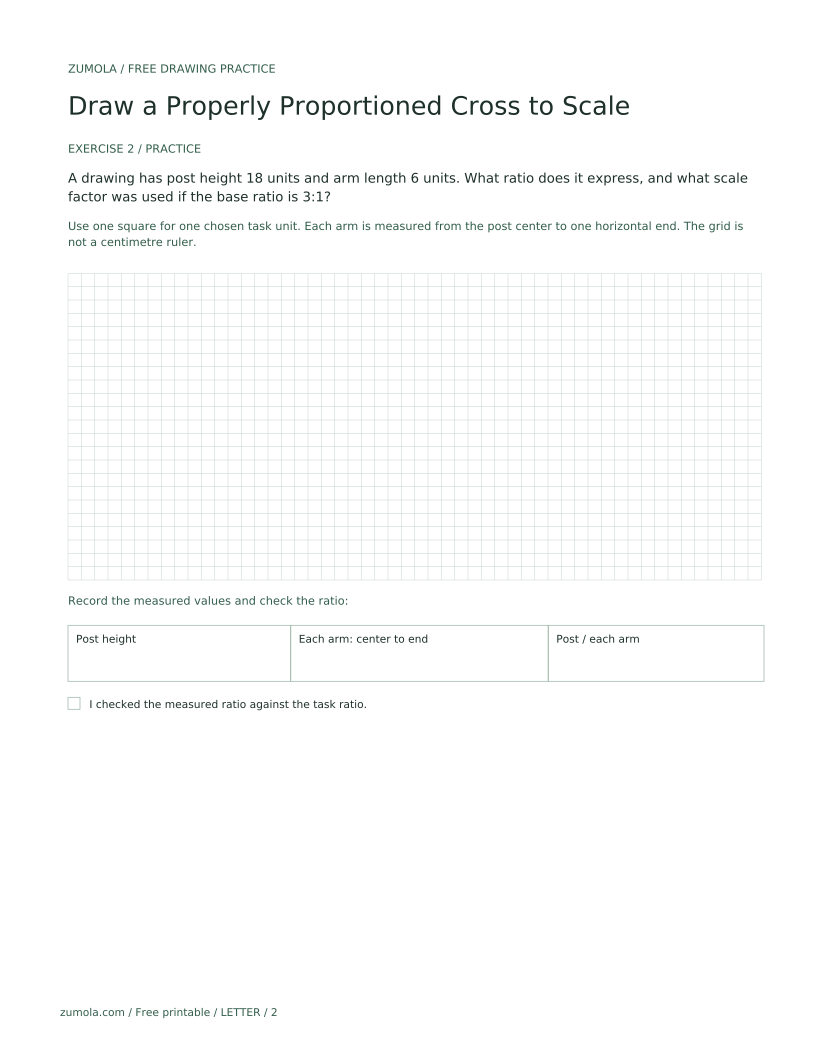
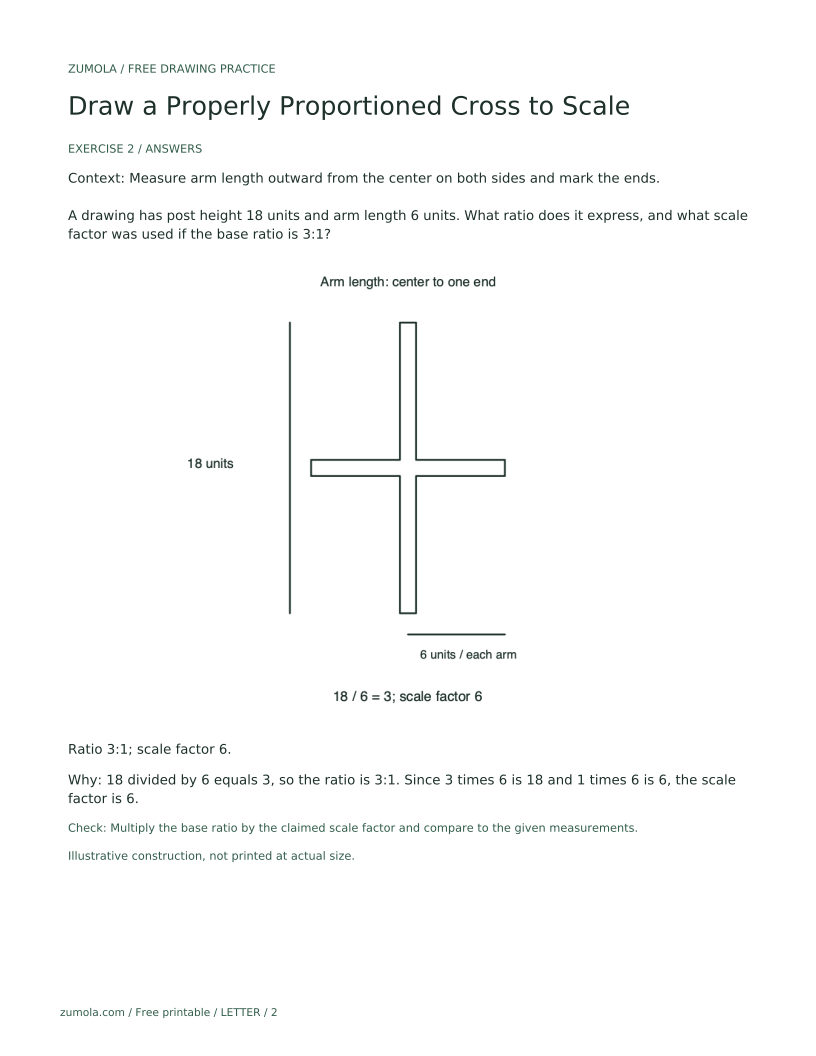
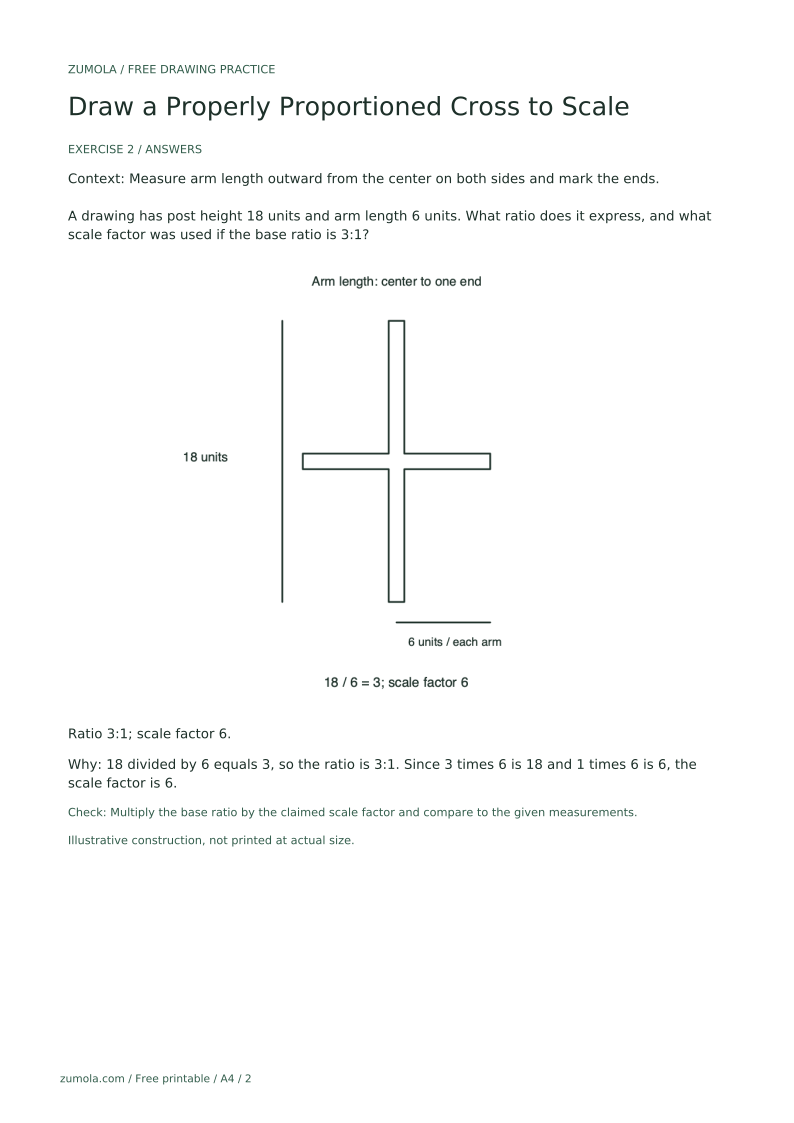
A drawing has post height 18 units and arm length 6 units. What ratio does it express, and what scale factor was used if the base ratio is 3:1?
Ratio 3:1; scale factor 6.
18 divided by 6 equals 3, so the ratio is 3:1. Since 3 times 6 is 18 and 1 times 6 is 6, the scale factor is 6.
Check: Multiply the base ratio by the claimed scale factor and compare to the given measurements.
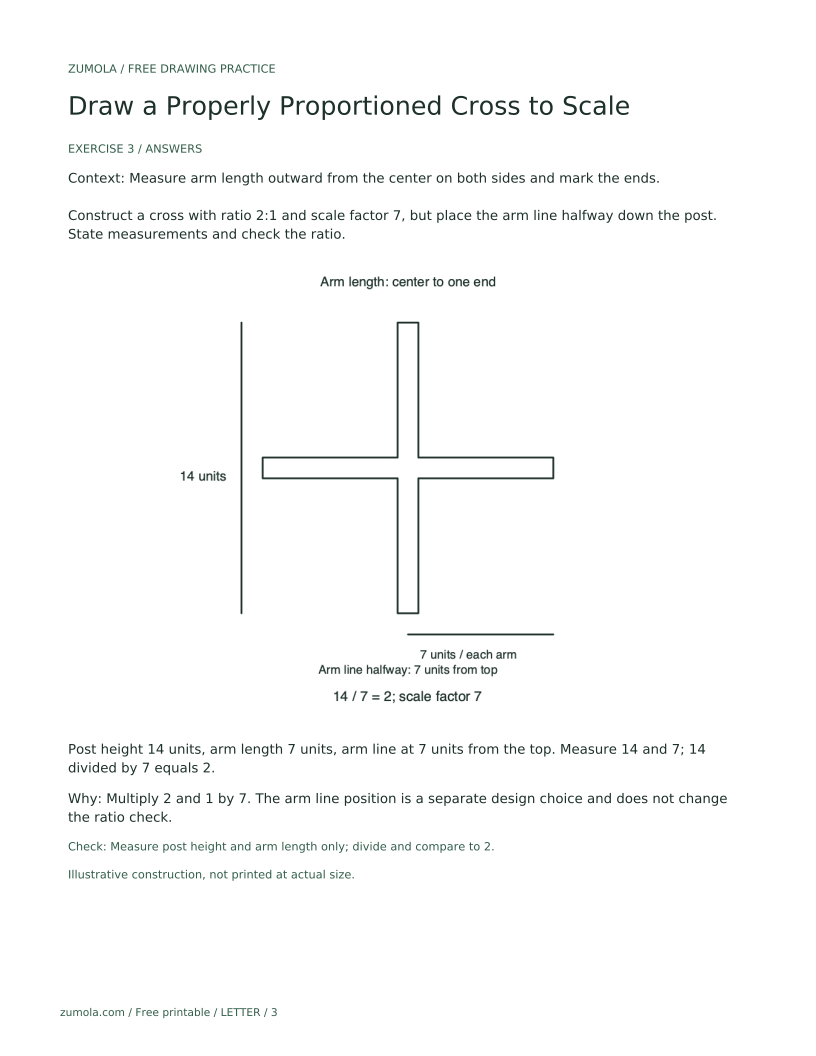
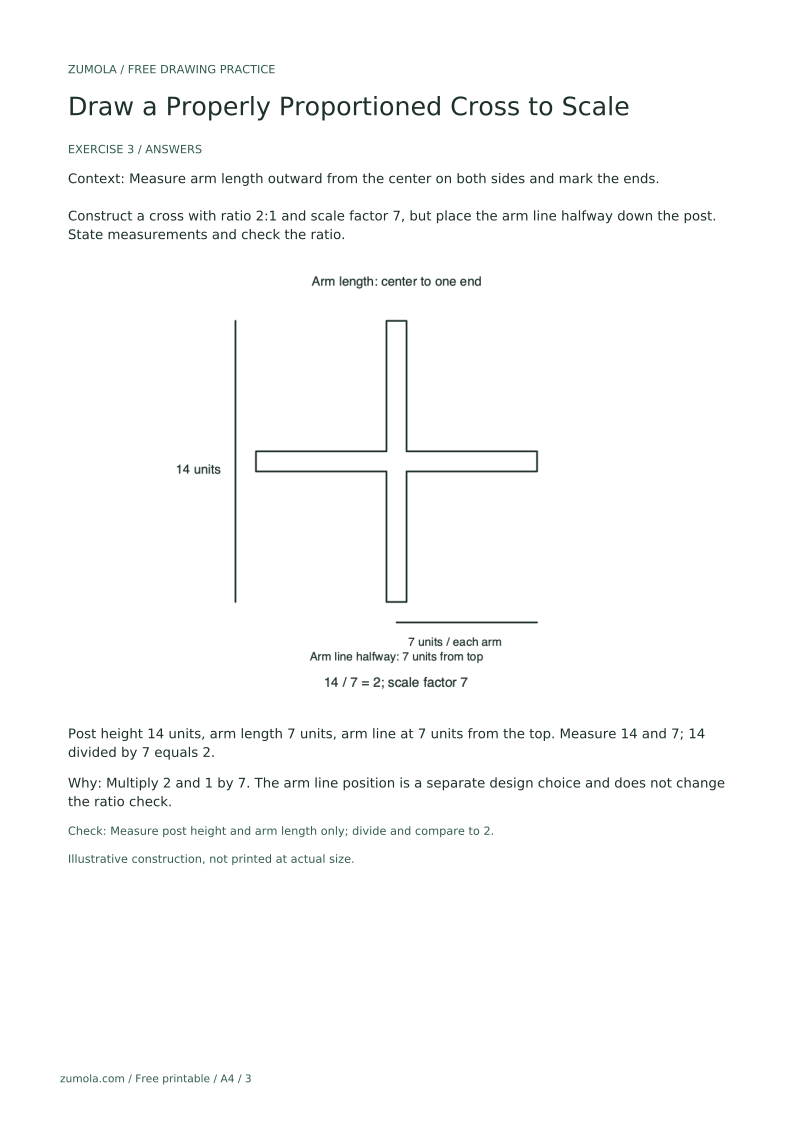
Construct a cross with ratio 2:1 and scale factor 7, but place the arm line halfway down the post. State measurements and check the ratio.
Post height 14 units, arm length 7 units, arm line at 7 units from the top. Measure 14 and 7; 14 divided by 7 equals 2.
Multiply 2 and 1 by 7. The arm line position is a separate design choice and does not change the ratio check.
Check: Measure post height and arm length only; divide and compare to 2.
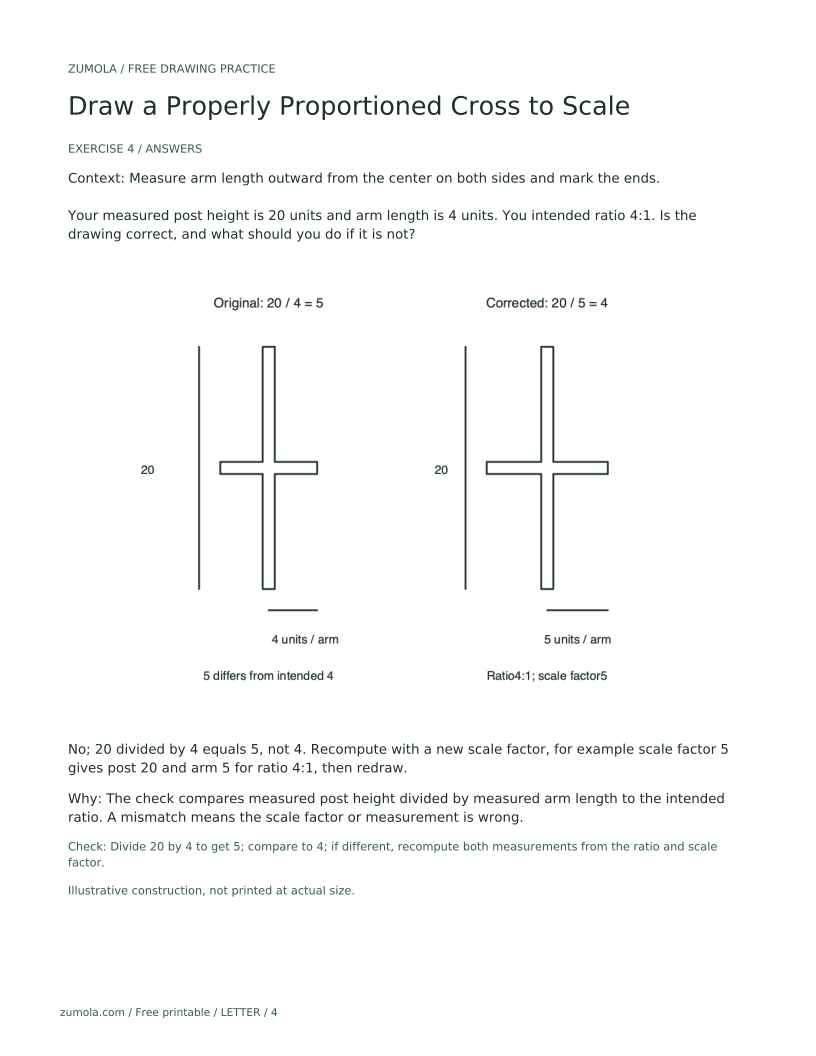
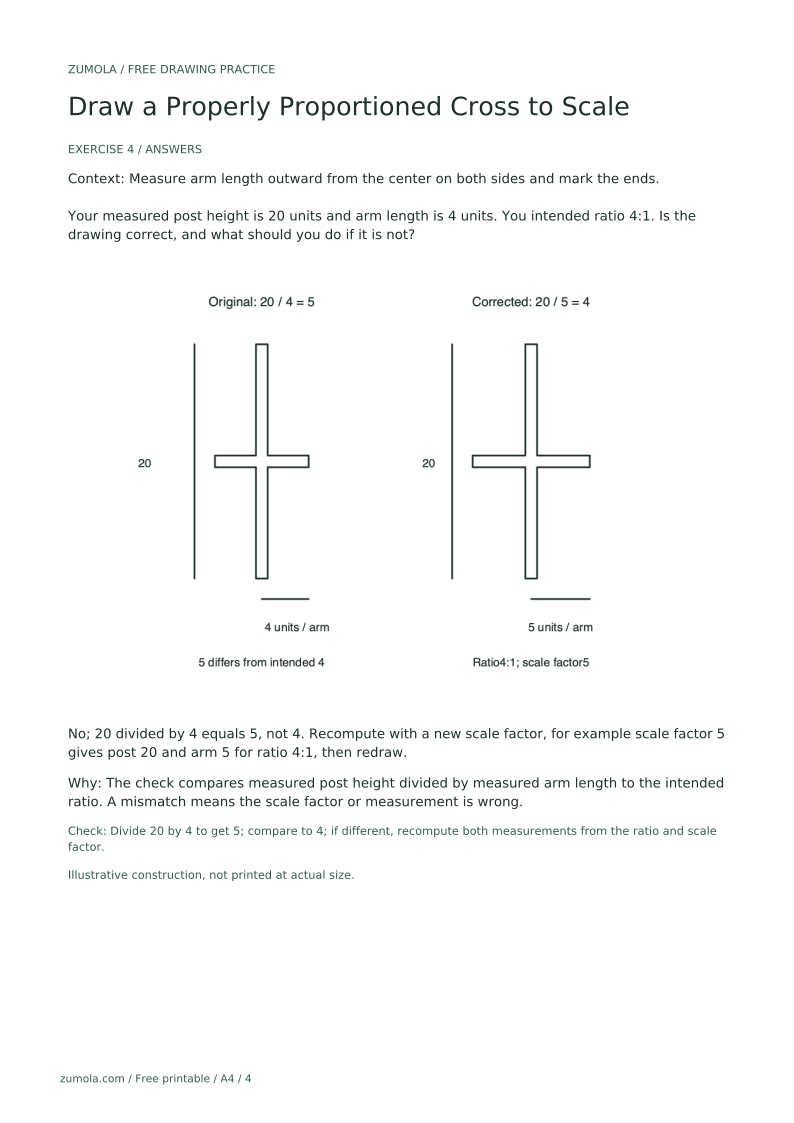
Your measured post height is 20 units and arm length is 4 units. You intended ratio 4:1. Is the drawing correct, and what should you do if it is not?
No; 20 divided by 4 equals 5, not 4. Recompute with a new scale factor, for example scale factor 5 gives post 20 and arm 5 for ratio 4:1, then redraw.
The check compares measured post height divided by measured arm length to the intended ratio. A mismatch means the scale factor or measurement is wrong.
Check: Divide 20 by 4 to get 5; compare to 4; if different, recompute both measurements from the ratio and scale factor.
Measure arm length from the center intersection outward; the post width is separate.
Convert all measurements to one unit before multiplying by the scale factor.
Choose a new scale factor, recompute both measurements, and redraw on the grid.
Write the ratio and scale factor at the top and use them in the check box.
Any ratio you state clearly works. A common hypothetical example is post height to arm length of 3:1. The rubric checks consistency, not a single required ratio.
A grid makes counting units easier and reduces estimation errors. You can use graph paper or draw a square grid lightly in pencil.
Measure post height and arm length in the same unit, divide post height by arm length, and compare to your stated ratio. Record the values in the check box.