Reference diagram
LETTER · Download PDF (3 pages)
Free original resources
Learn android drawing by blocking a head, antenna, torso, and segmented limbs with clear proportions, panel lines, and a repeatable check method.
Original reference diagrams, four practice exercises and separate worked answers. All files are free. No signup required.
LETTER · Download PDF (3 pages)
LETTER · Download PDF (5 pages)
LETTER · Download PDF (4 pages)
Choose A4 or US Letter for your printer. The reference and answer illustrations are not physical rulers; follow the scale instruction printed on the practice worksheet.
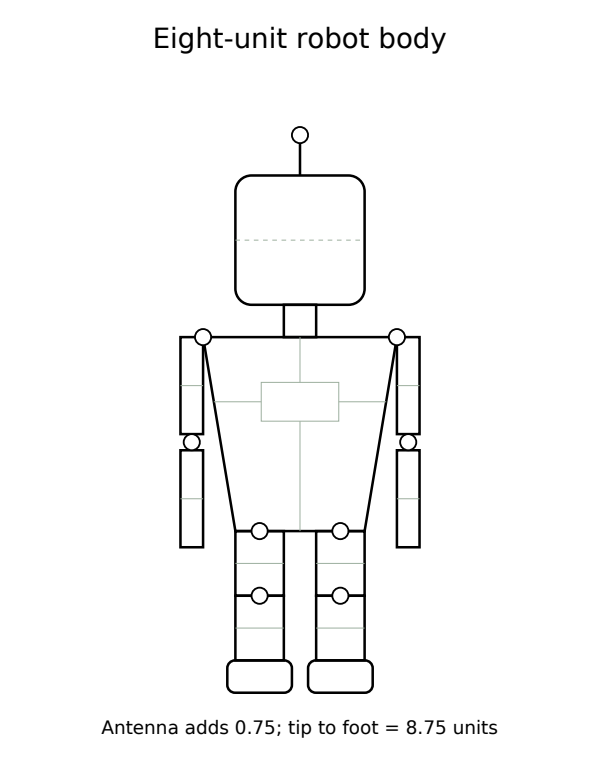
Android drawing is figure construction, not human anatomy. This lesson treats the robot as a set of simple shapes: a rounded head, a single antenna, a boxy torso, and limbs made from two or three segments. You will use a defined convention for height and width so your drawing can be checked without relying on a single universal style. All measurements below are hypothetical examples; measure your own paper and tools before drawing. The goal is a clean, readable android that stands on the page with consistent segment lengths and clear panel lines.
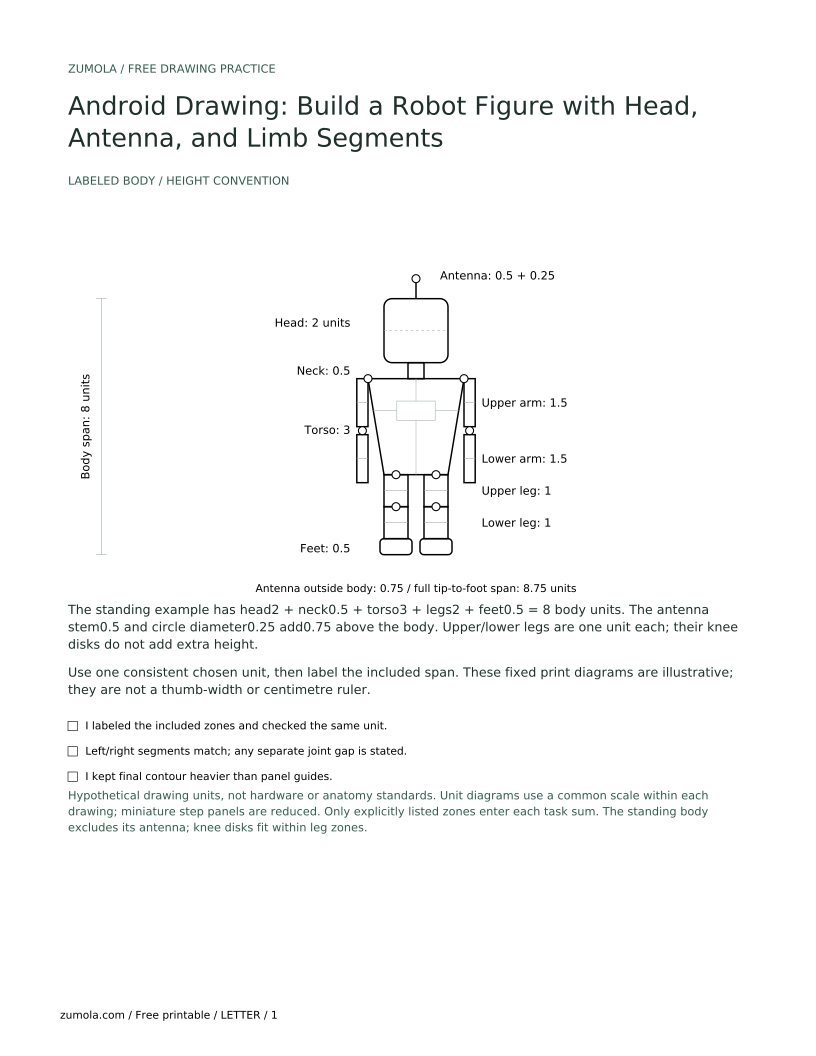
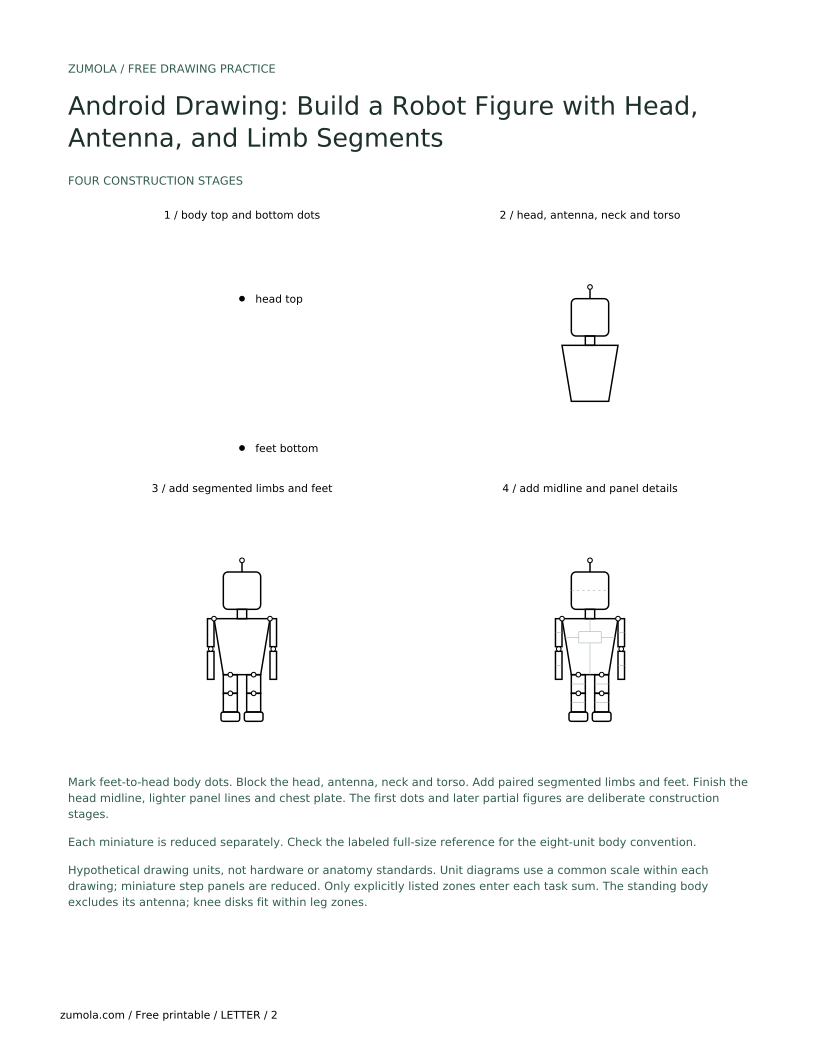
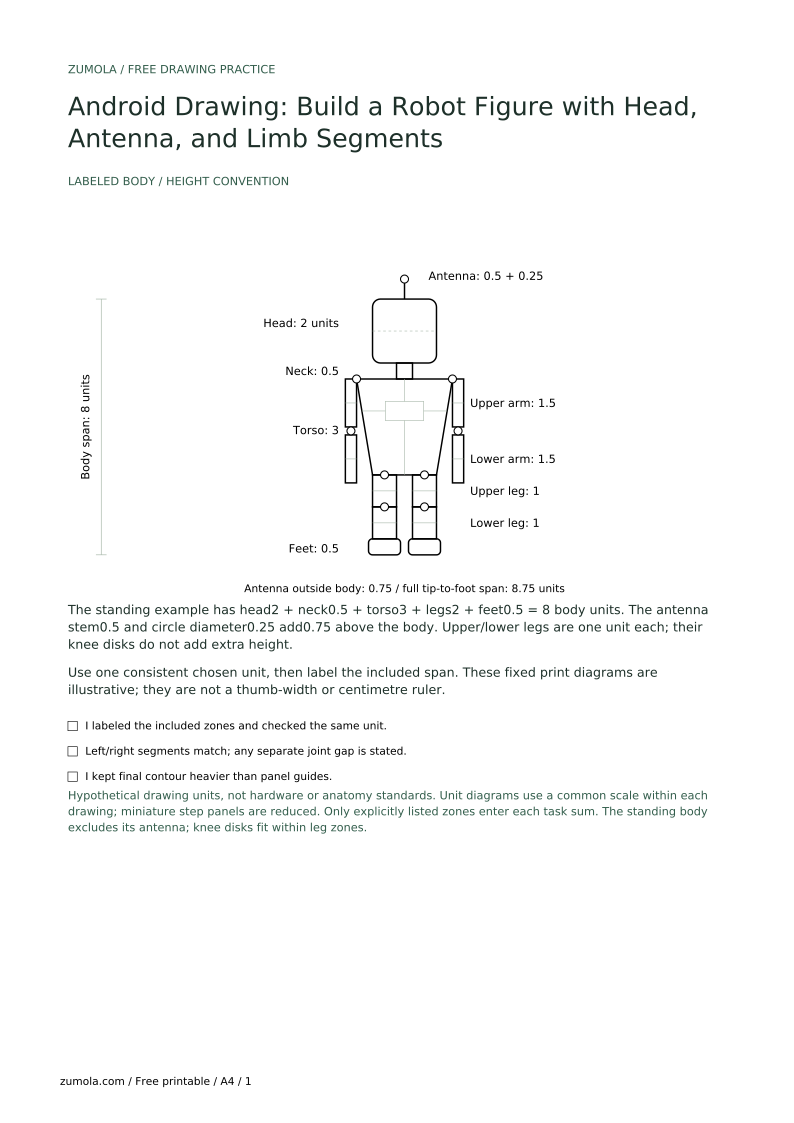
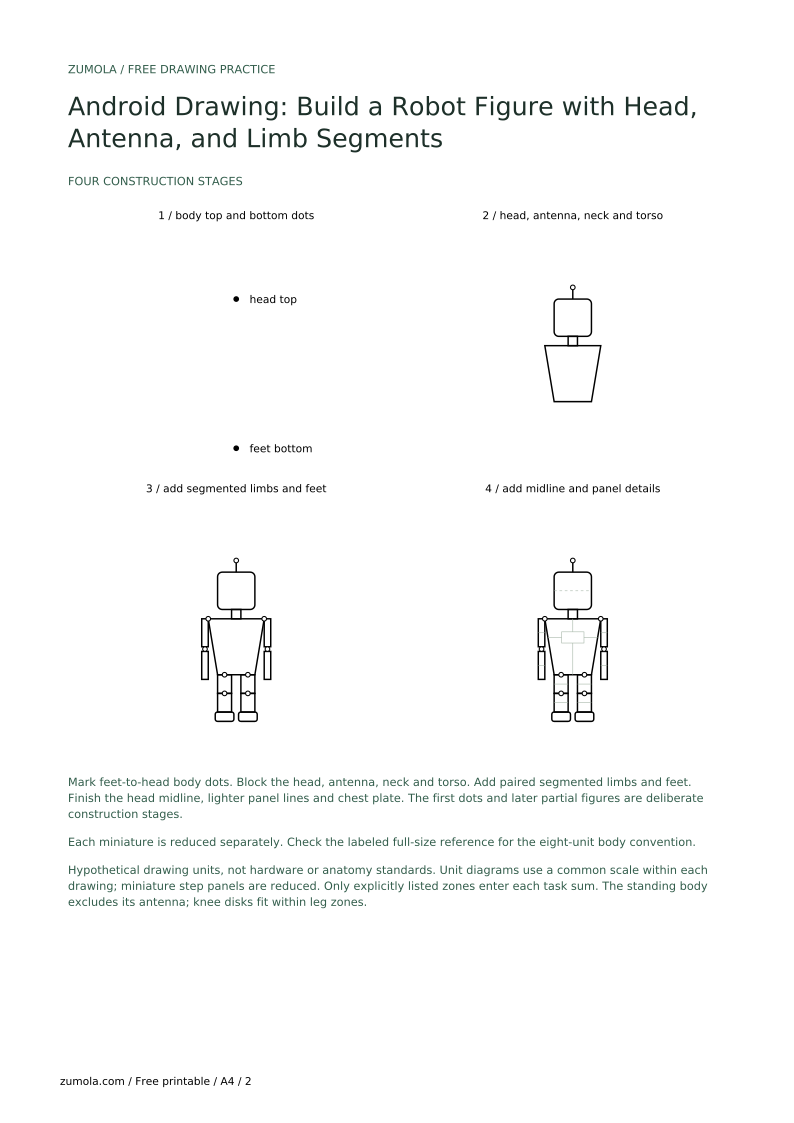
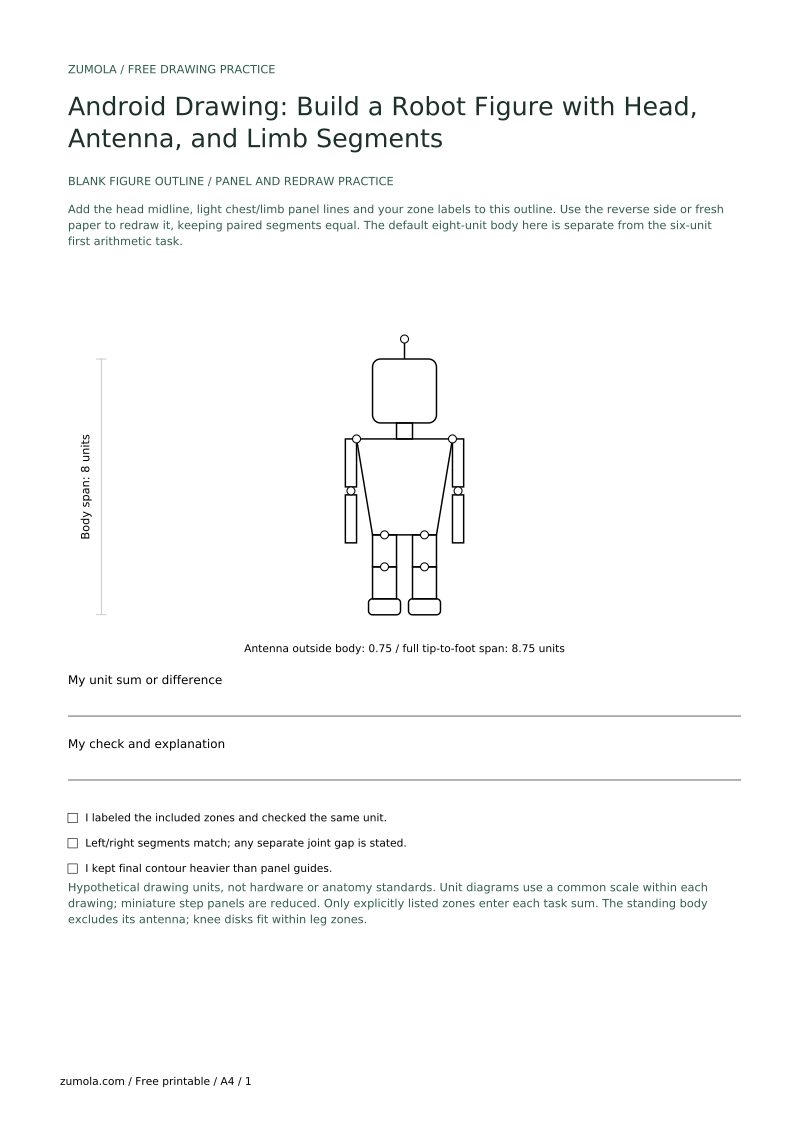
Choose a body height in simple units. For this lesson, let one unit equal the width of your thumb, and plan the body at eight units tall. Measure this body height from the bottom of the feet to the top of the head; the antenna extends above it and is counted separately. This is a hypothetical drawing convention, not a standard. Mark the body top and bottom with light pencil dots.
Define the head's midline distance as the distance from the bottom of the head to its horizontal midline. Do not confuse this with typographic x-height, which is the height of a lowercase x from the baseline. Letter styles vary, so use your own midline mark rather than copying a fixed proportion. For the android, place the head between the top dot and the two-unit mark, and draw a midline halfway down the head.
Keep all units consistent. If you change paper size, remeasure the unit and rewrite the numbers. Label the head, antenna, torso, and limb segments before the final drawing. Each worked example or exercise sums only the zones it explicitly lists; do not add unlisted feet or an antenna to that task sum. In the standing body example, the leg joints lie within the stated leg zones instead of adding height. The arm-length task explicitly counts its joint circle between the two segments, so that joint does add to arm length.
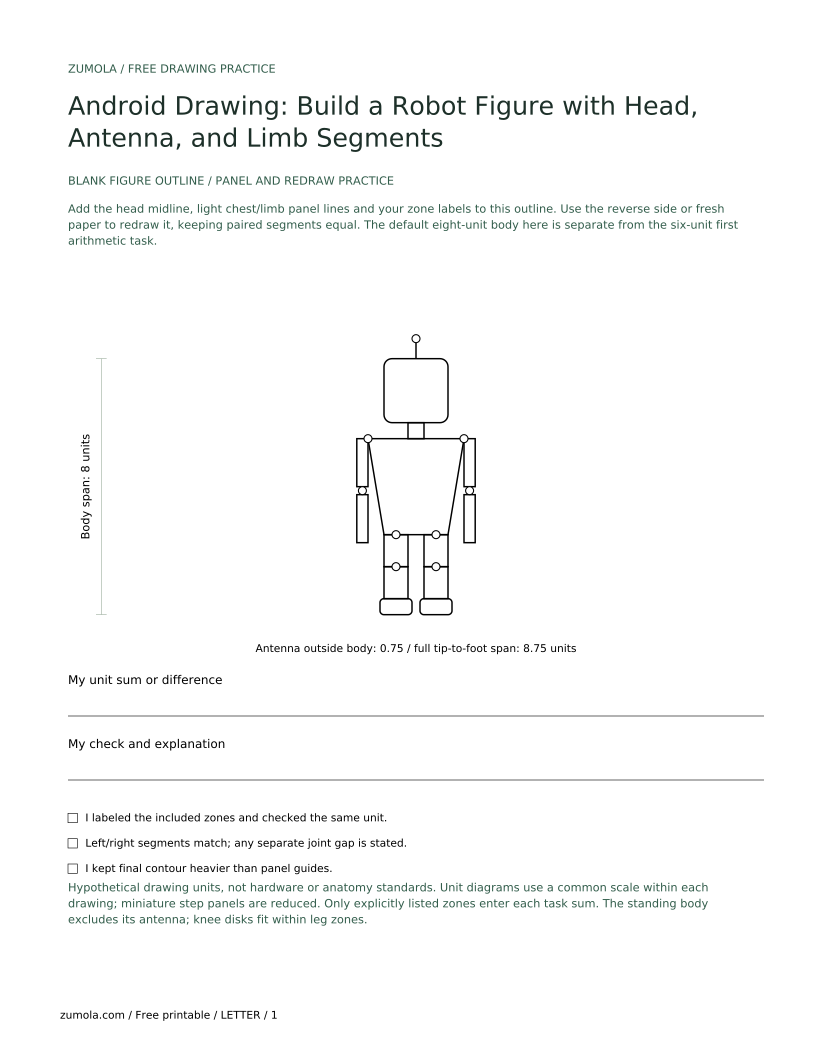
Draw the head as a rounded rectangle two units wide and two units tall. Place the antenna at the top center: a stem one-half unit tall, with the bottom of a small circle one-quarter unit wide touching the stem tip. The antenna adds three-quarters of a unit above the head and is outside the body-height span. Keep it on the vertical center line.
Build the torso as a trapezoid three units wide at the shoulders and two units wide at the waist, three units tall. Leave a half-unit gap between the head and torso for a neck block. Add a horizontal panel line across the chest at the one-unit mark from the top of the torso.
Use light construction lines first. Darken only the outer contour and the panel lines you intend to keep. This keeps the android drawing clean and makes corrections easy.
Each arm has an upper segment and a lower segment. Make the upper arm one and one-half units long and the lower arm one and one-half units long, with a small circle joint one-quarter unit wide between them. Attach the arm at the shoulder corner of the torso.
Each leg has an upper and a lower segment, with a joint circle centered on their shared boundary. The leg length includes this joint; do not add a separate knee gap to the body-height sum. Two-unit upper and two-unit lower segments make a four-unit leg in the initial ten-unit body example. For an eight-unit body, use one-unit upper and one-unit lower segments, making each leg two units total. Attach the legs at the bottom of the torso with a half-unit clear horizontal gap between them. Feet are rounded rectangles one unit wide and one-half unit tall.
Check that left and right limb segments match in length. If one side is longer, remeasure from the joint circle rather than from the torso edge. Panel lines on the limbs should run parallel to the segment edges.
Panel lines separate the android's body into readable parts. Add one vertical line down the center of the torso, one line across each limb segment, and a small rectangular chest plate. Keep line weight consistent: outer contour heavier, panel lines lighter.
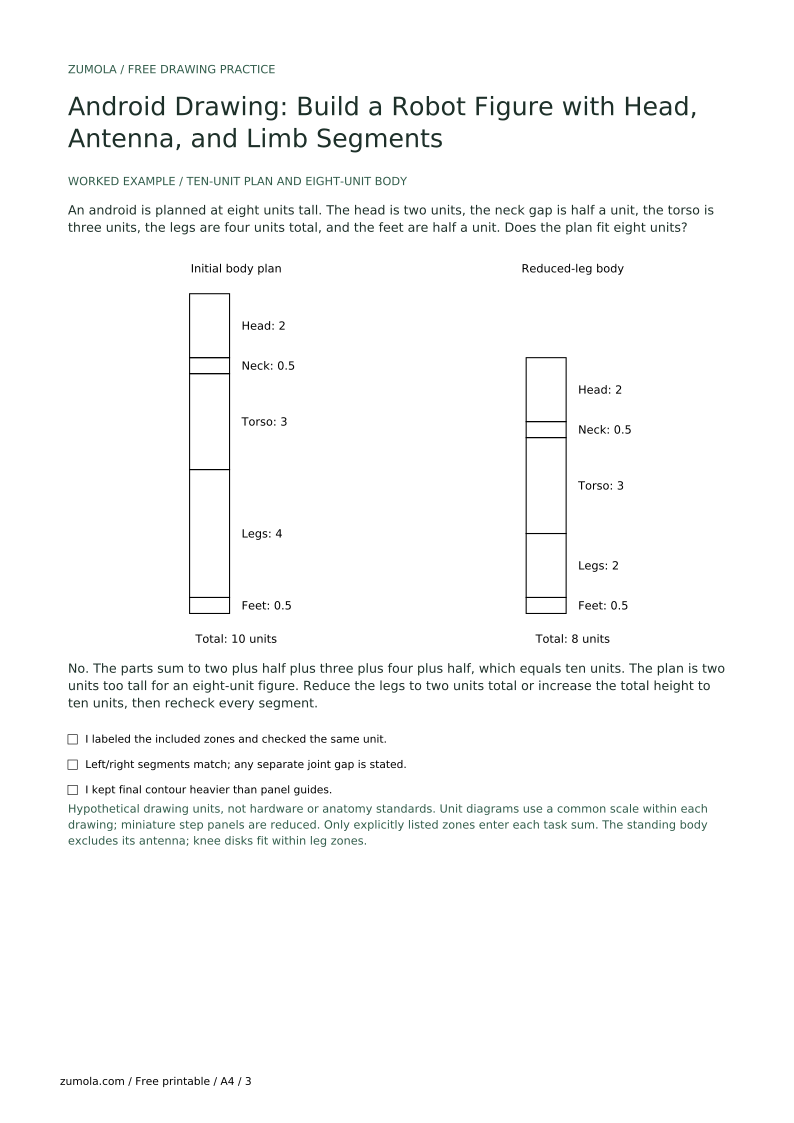
Verify the initial body-height sum: head two, neck half, torso three, legs four, feet half. These zones total ten units, two more than the eight-unit body plan. Either reduce each leg to two units total or choose a ten-unit body plan. With two-unit legs, two plus half plus three plus two plus half equals eight. The separately drawn antenna adds three-quarters of a unit above the head, so the eight-unit body has an overall tip-to-foot height of eight and three-quarters units. Joint circles inside the leg zones do not add body height.
Remember that letter styles and head shapes vary. A valid android drawing may use a square head, a round head, or a rounded rectangle, as long as the convention is stated and the segment lengths are consistent.
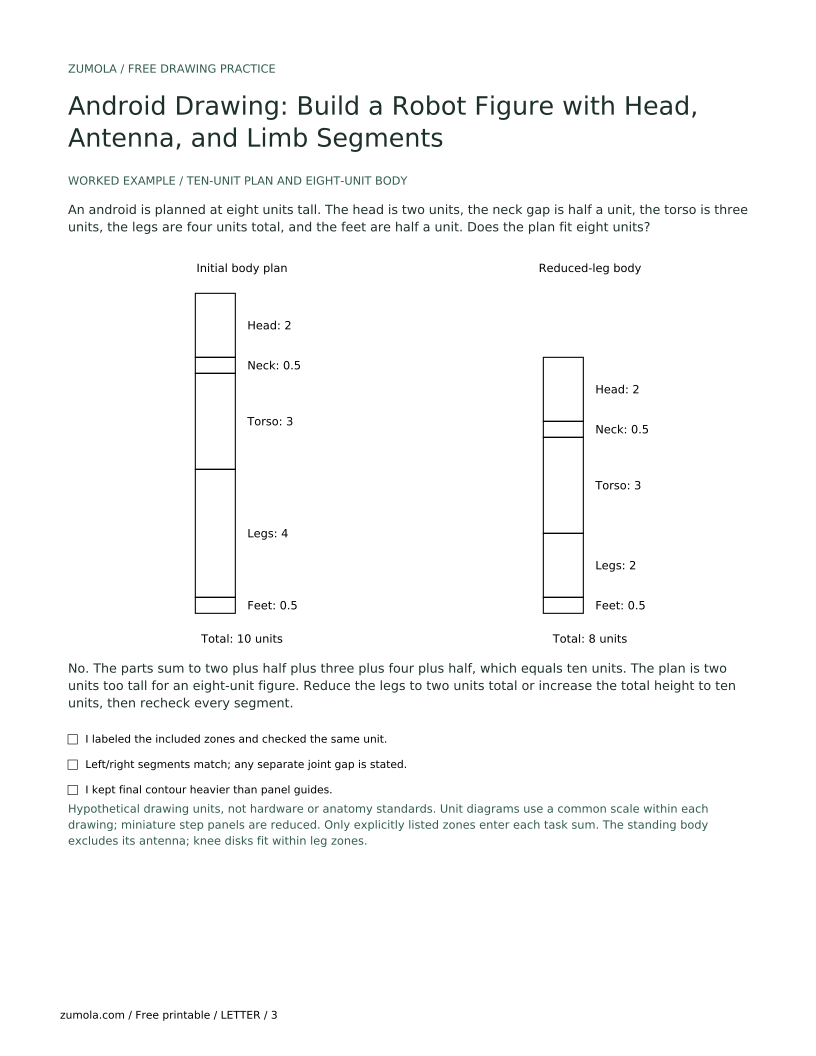
An android is planned at eight units tall. The head is two units, the neck gap is half a unit, the torso is three units, the legs are four units total, and the feet are half a unit. Does the plan fit eight units?
No. The parts sum to two plus half plus three plus four plus half, which equals ten units. The plan is two units too tall for an eight-unit figure. Reduce the legs to two units total or increase the total height to ten units, then recheck every segment.
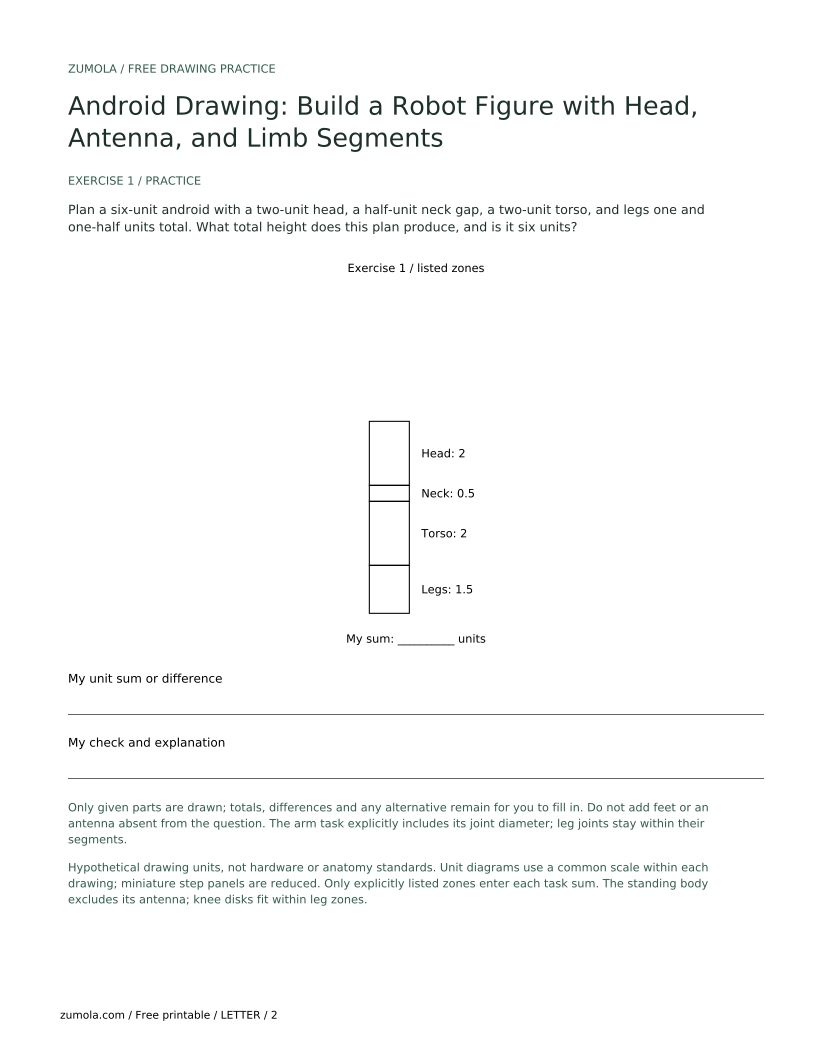
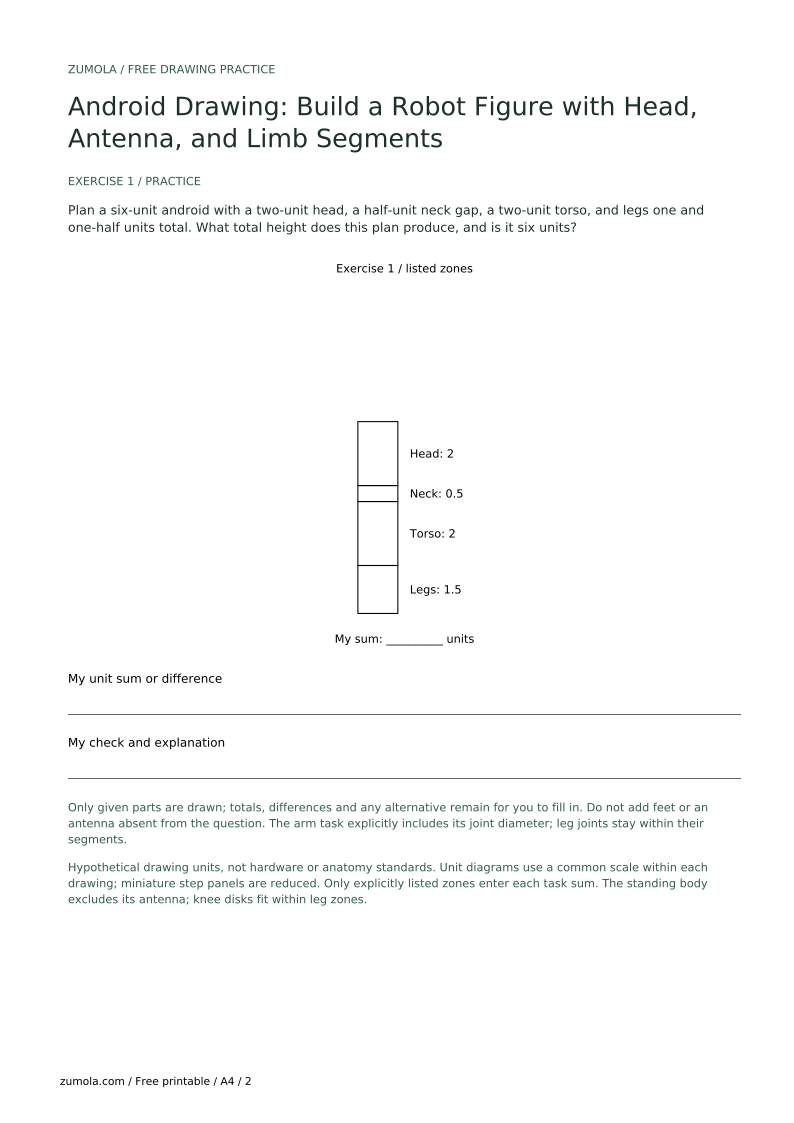
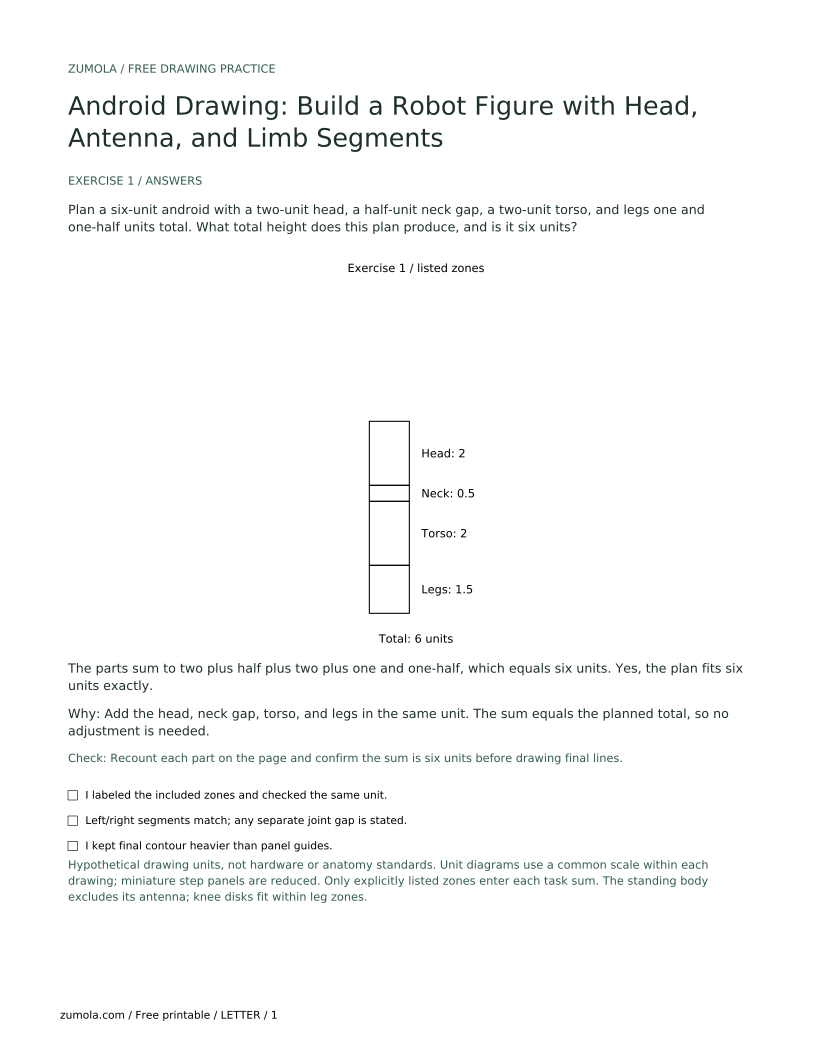
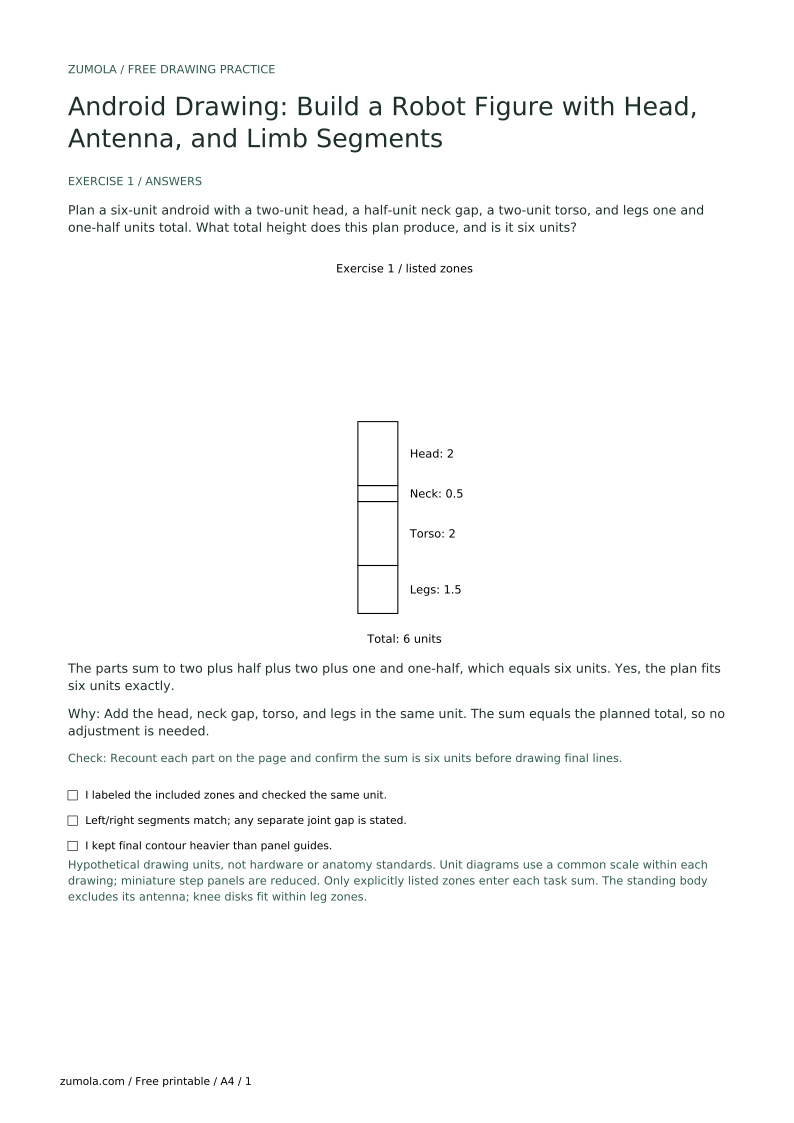
Plan a six-unit android with a two-unit head, a half-unit neck gap, a two-unit torso, and legs one and one-half units total. What total height does this plan produce, and is it six units?
The parts sum to two plus half plus two plus one and one-half, which equals six units. Yes, the plan fits six units exactly.
Add the head, neck gap, torso, and legs in the same unit. The sum equals the planned total, so no adjustment is needed.
Check: Recount each part on the page and confirm the sum is six units before drawing final lines.
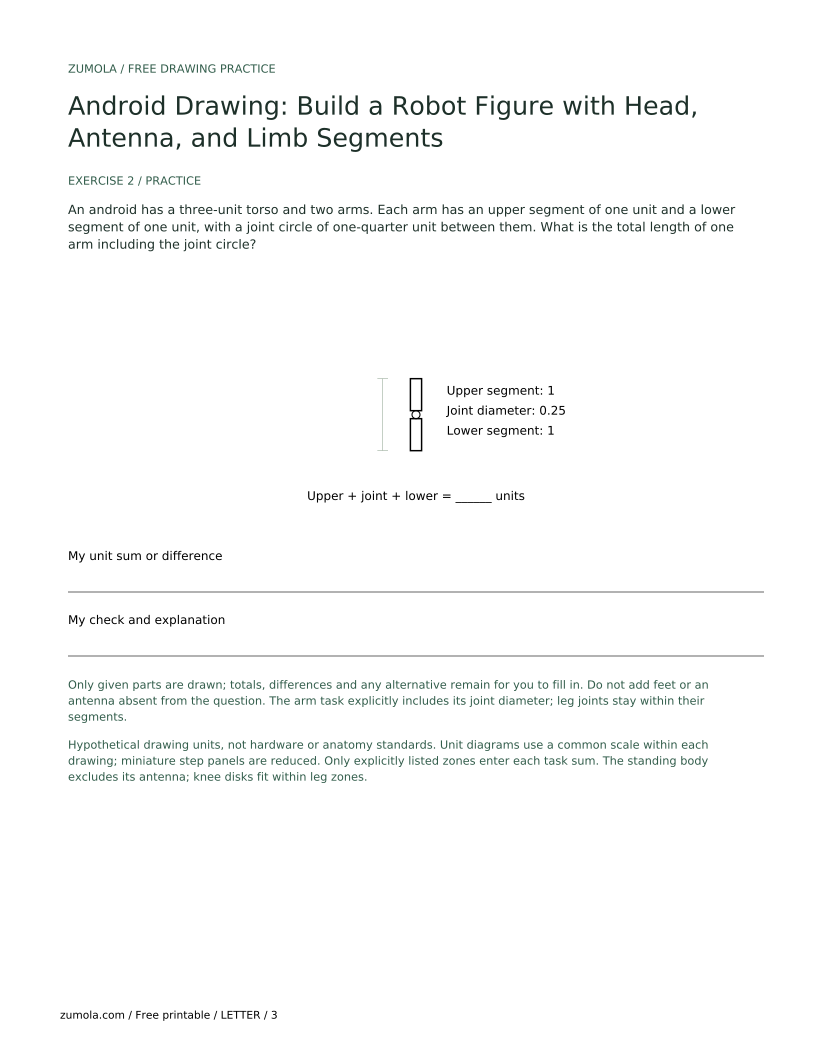
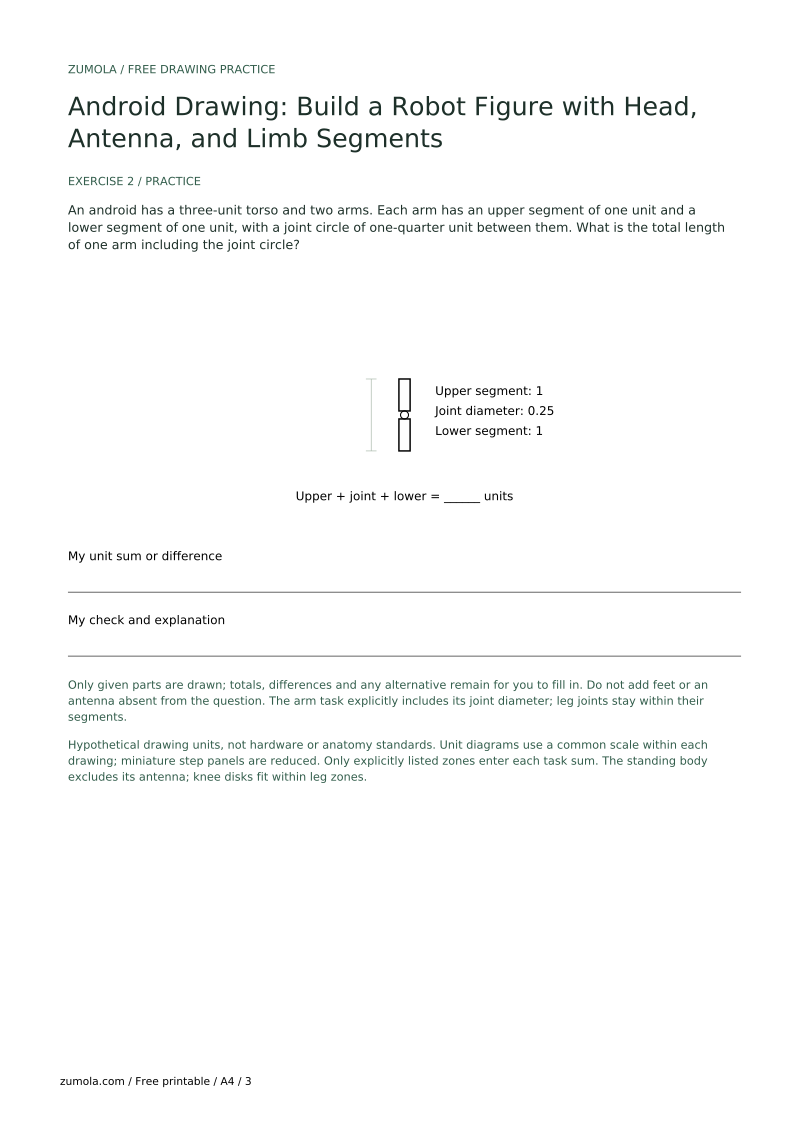
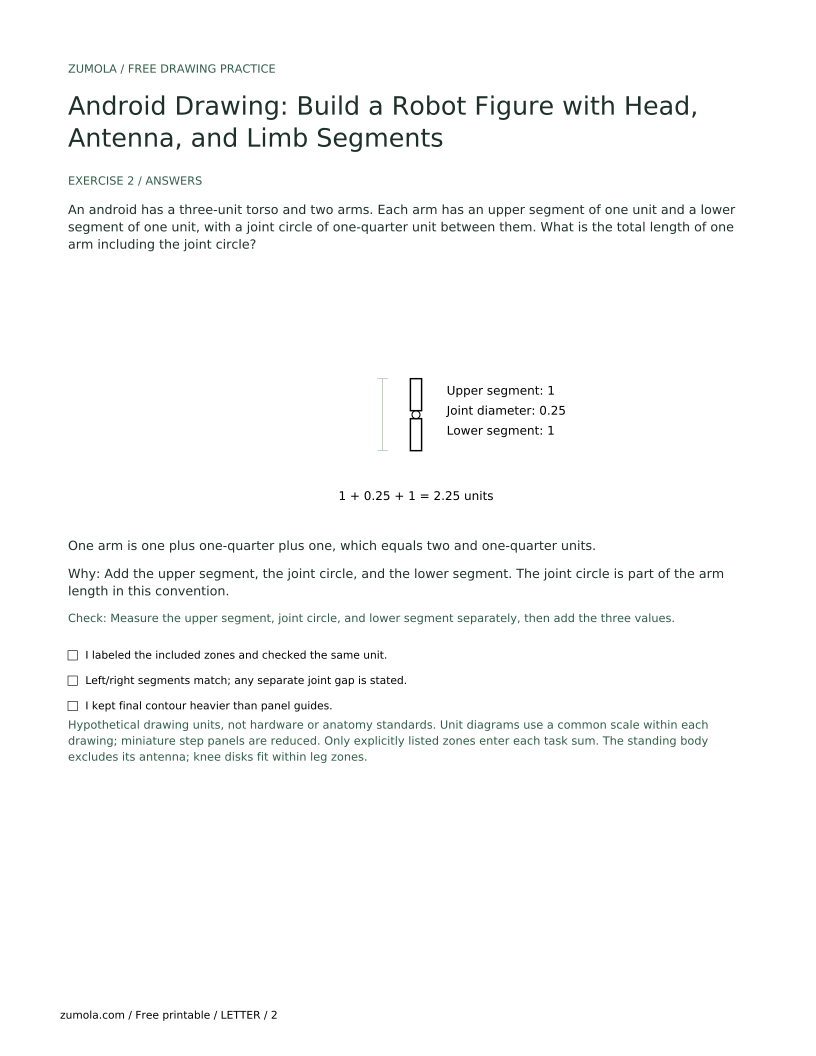
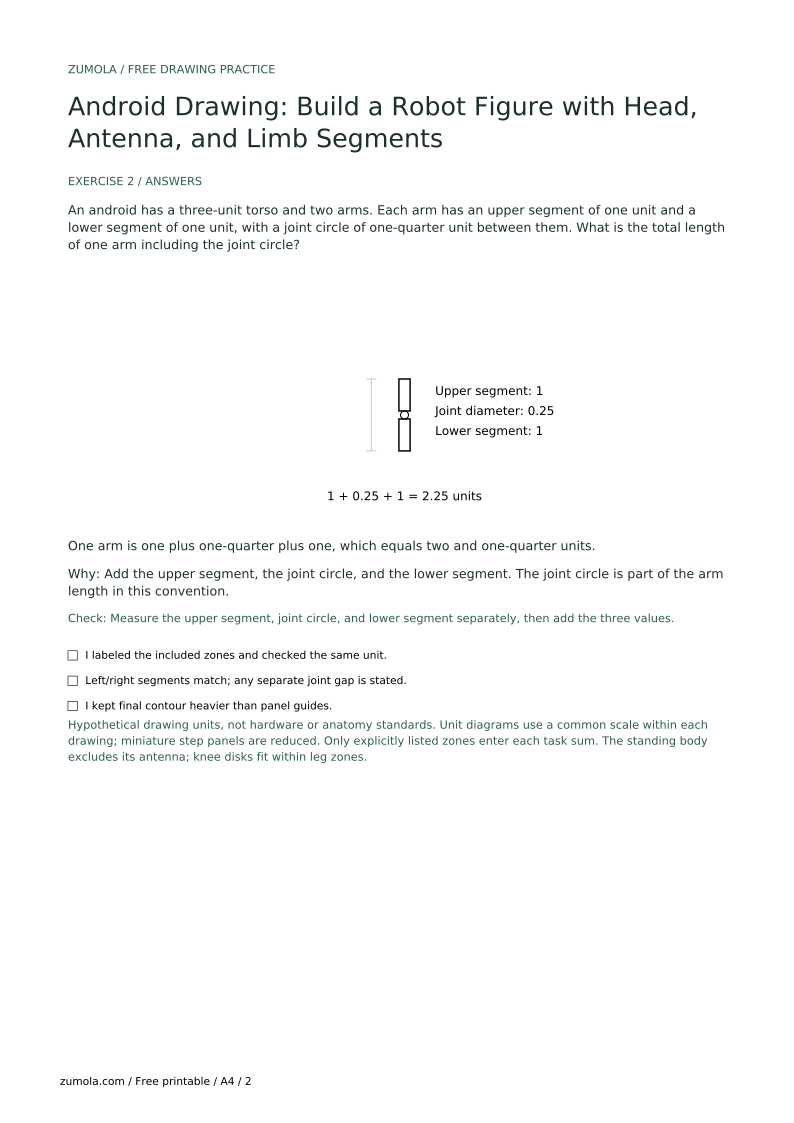
An android has a three-unit torso and two arms. Each arm has an upper segment of one unit and a lower segment of one unit, with a joint circle of one-quarter unit between them. What is the total length of one arm including the joint circle?
One arm is one plus one-quarter plus one, which equals two and one-quarter units.
Add the upper segment, the joint circle, and the lower segment. The joint circle is part of the arm length in this convention.
Check: Measure the upper segment, joint circle, and lower segment separately, then add the three values.
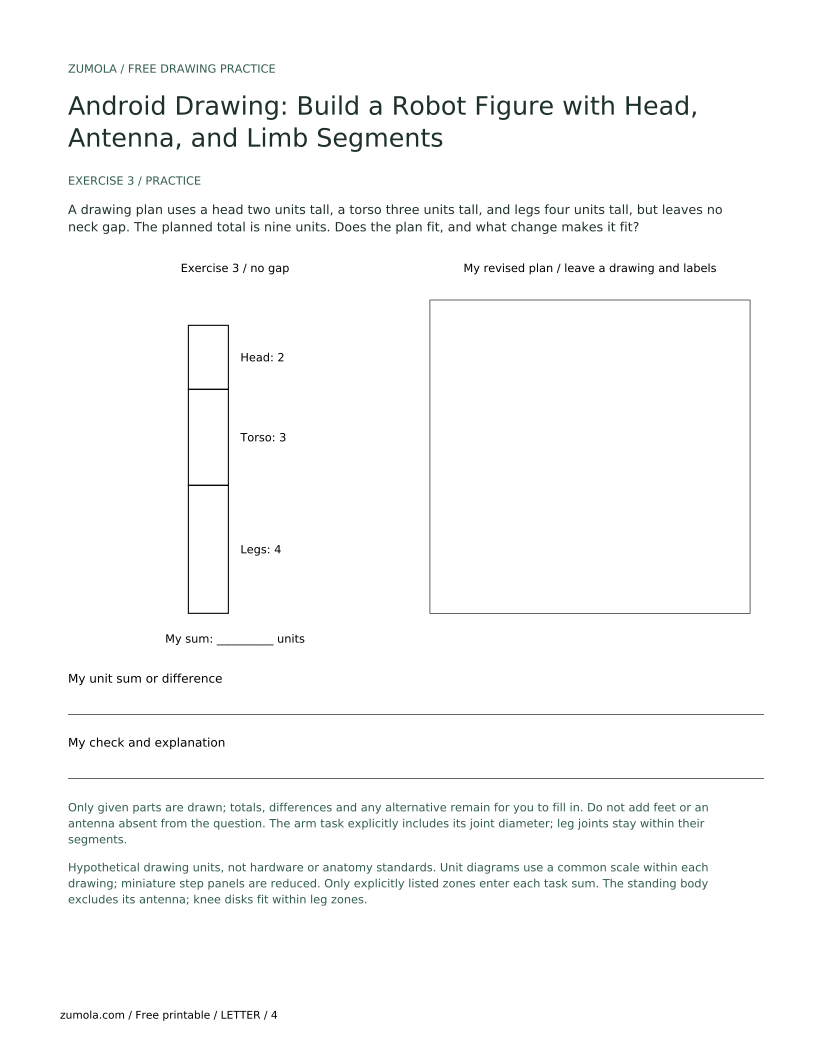
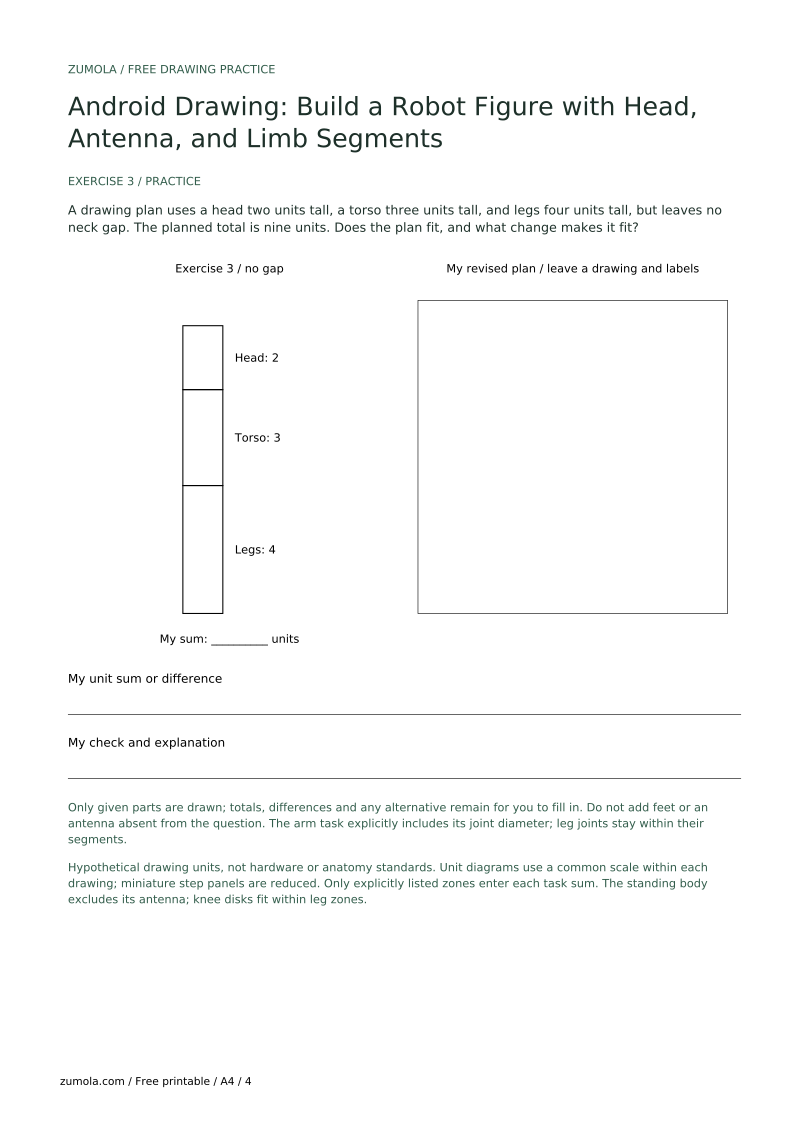
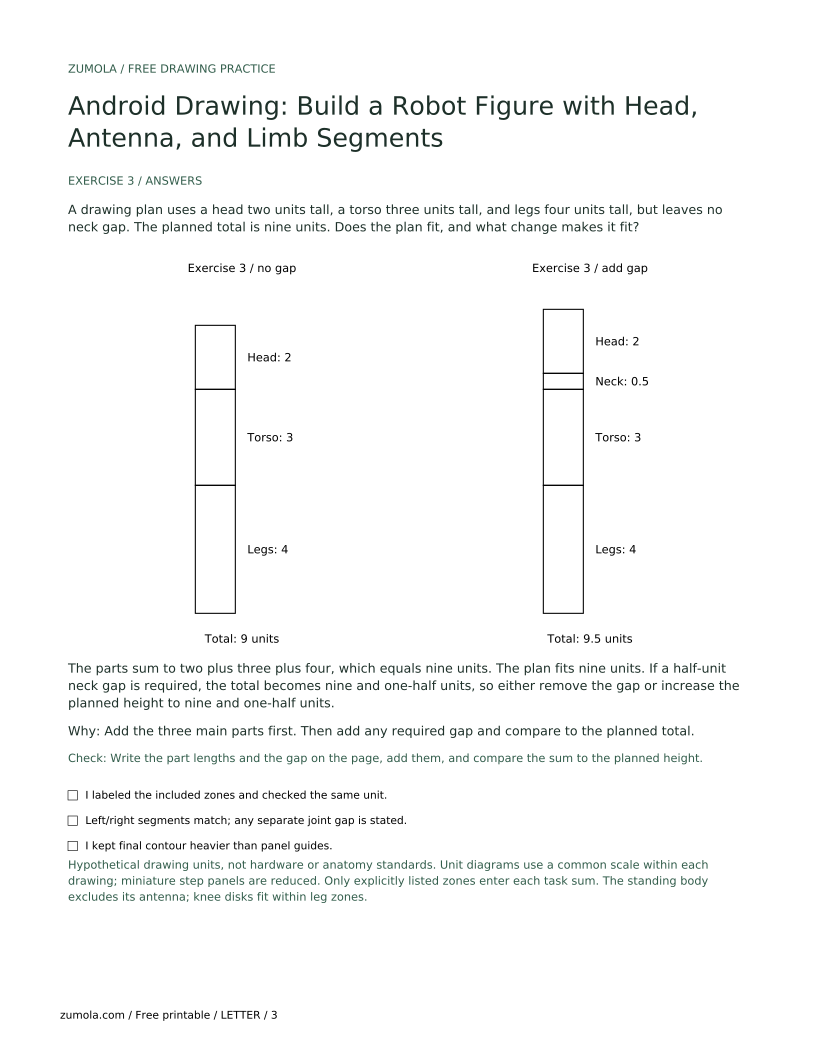
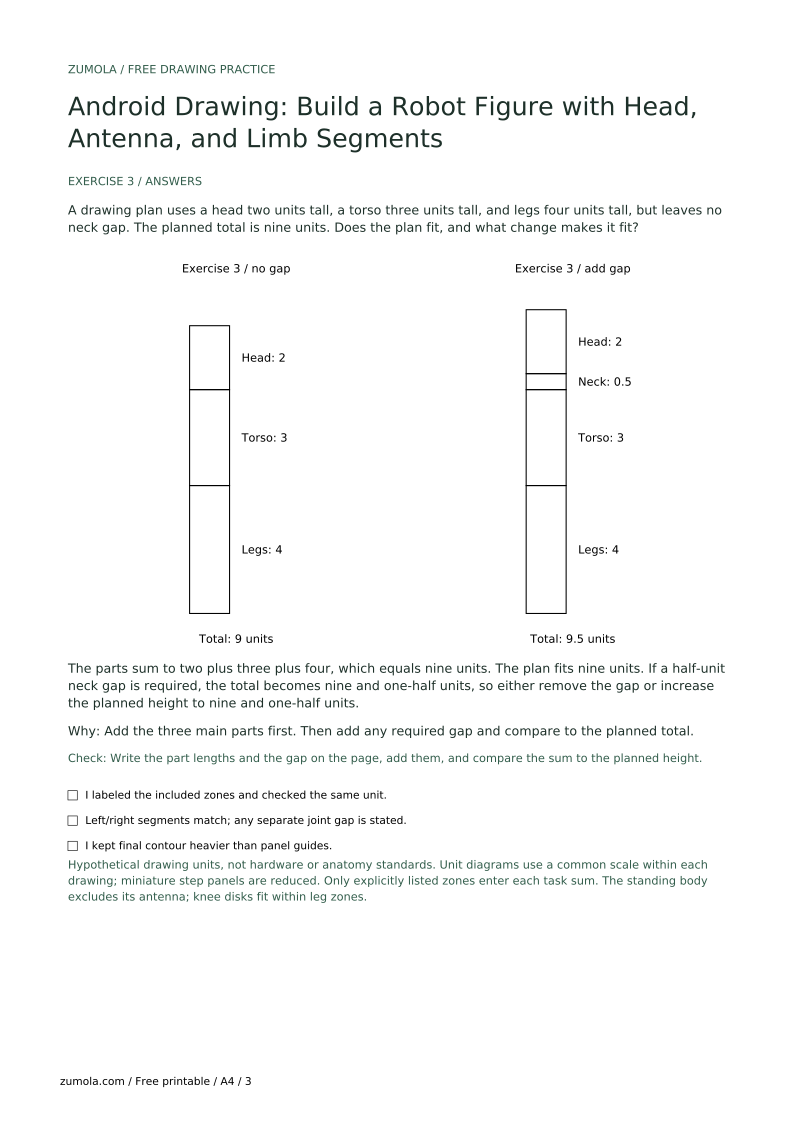
A drawing plan uses a head two units tall, a torso three units tall, and legs four units tall, but leaves no neck gap. The planned total is nine units. Does the plan fit, and what change makes it fit?
The parts sum to two plus three plus four, which equals nine units. The plan fits nine units. If a half-unit neck gap is required, the total becomes nine and one-half units, so either remove the gap or increase the planned height to nine and one-half units.
Add the three main parts first. Then add any required gap and compare to the planned total.
Check: Write the part lengths and the gap on the page, add them, and compare the sum to the planned height.
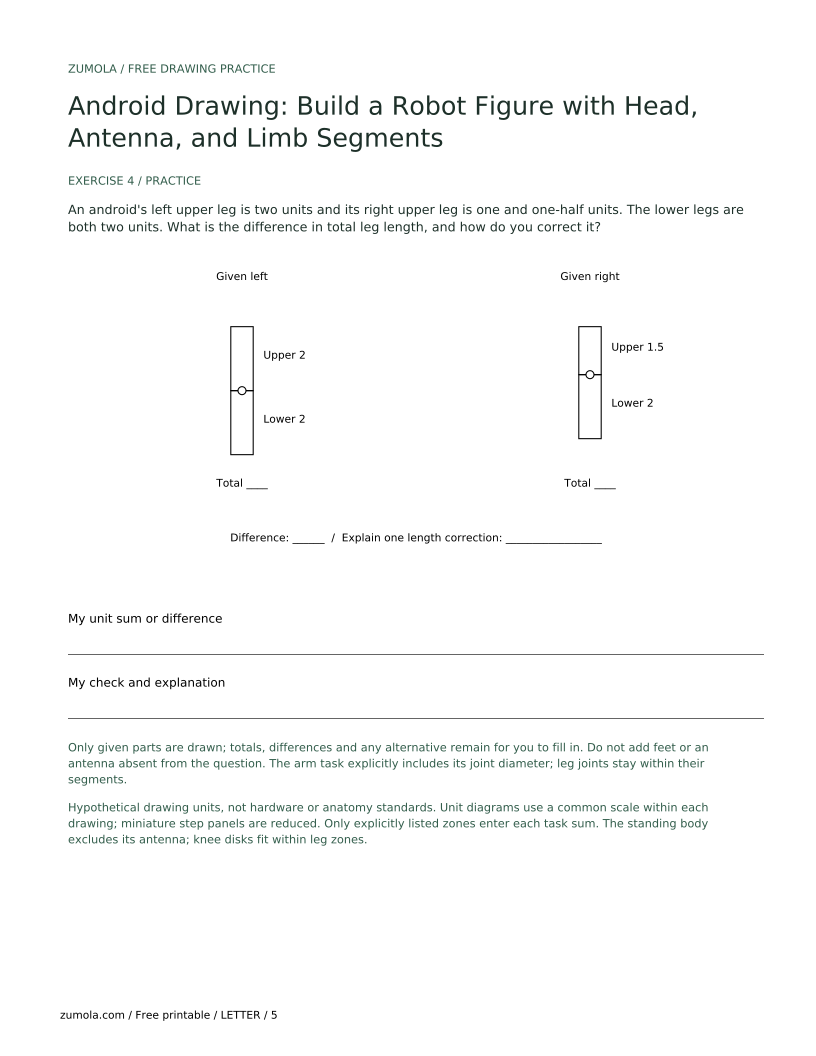
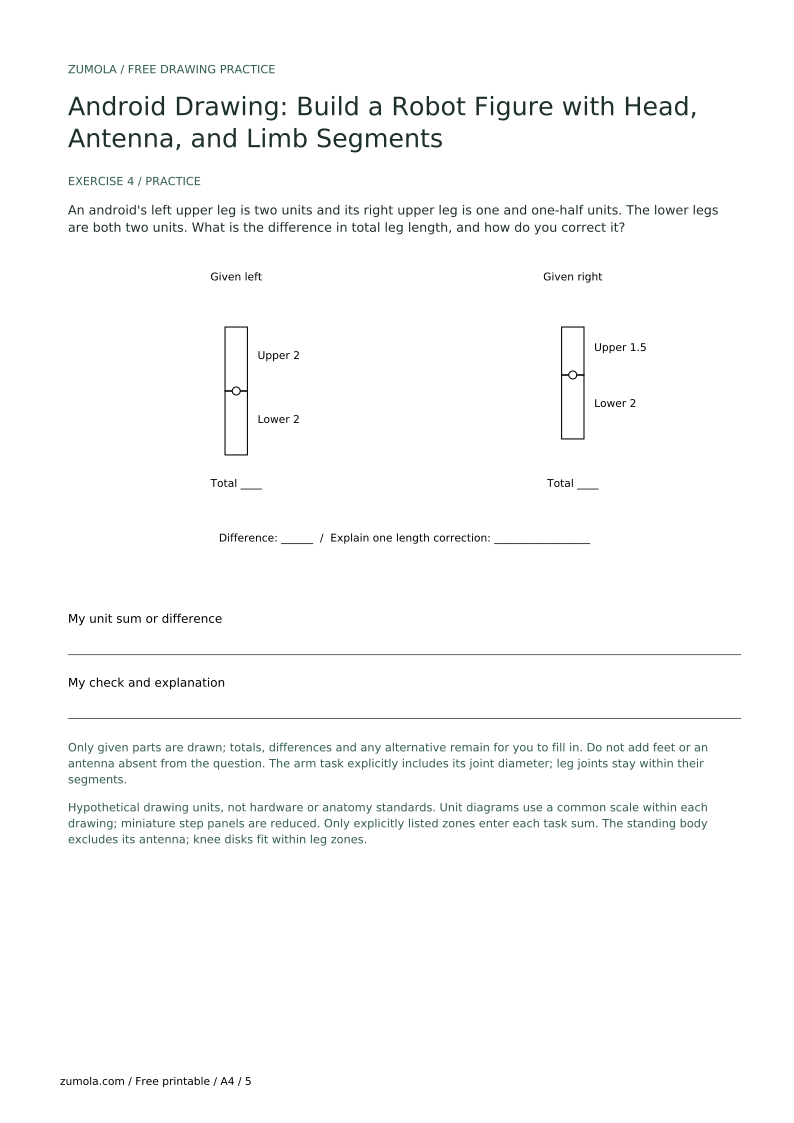
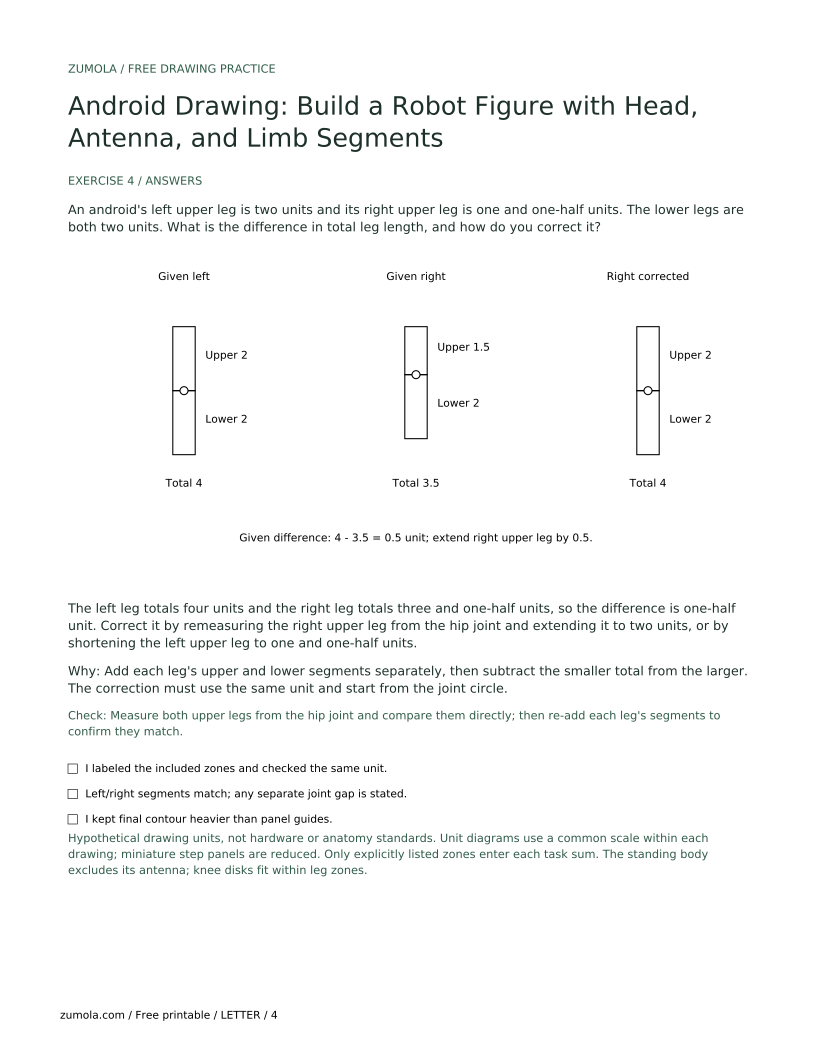
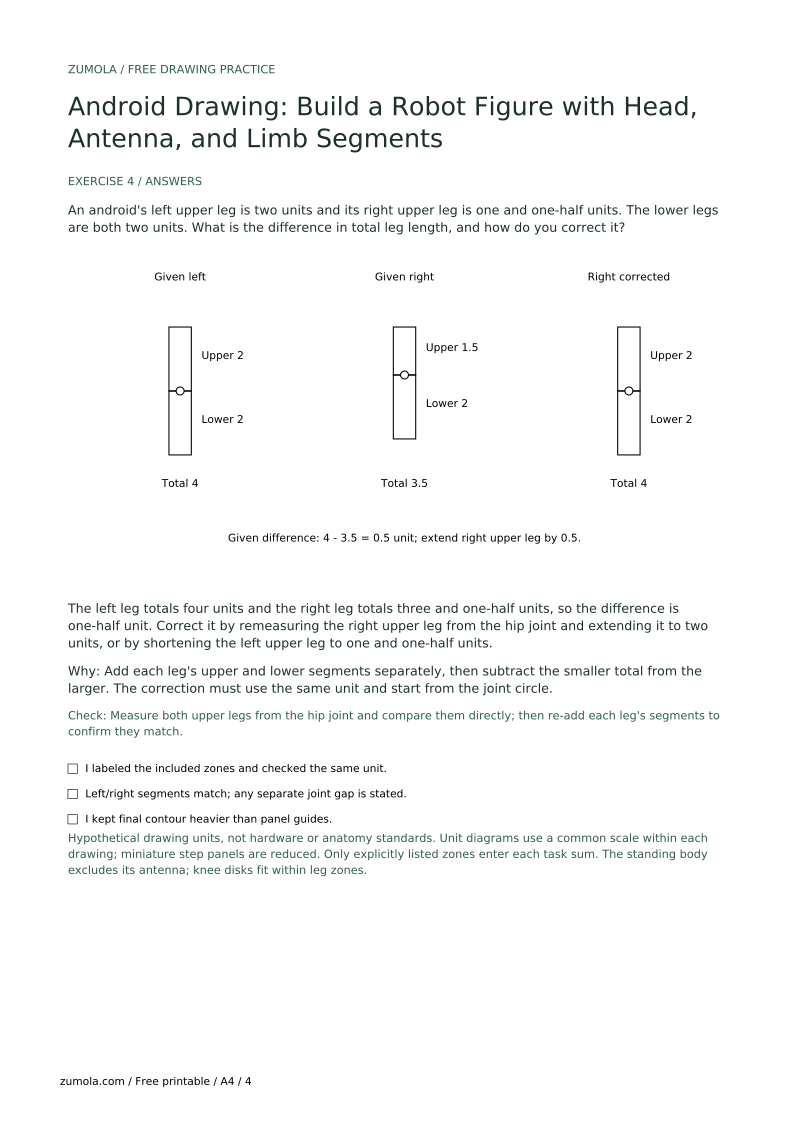
An android's left upper leg is two units and its right upper leg is one and one-half units. The lower legs are both two units. What is the difference in total leg length, and how do you correct it?
The left leg totals four units and the right leg totals three and one-half units, so the difference is one-half unit. Correct it by remeasuring the right upper leg from the hip joint and extending it to two units, or by shortening the left upper leg to one and one-half units.
Add each leg's upper and lower segments separately, then subtract the smaller total from the larger. The correction must use the same unit and start from the joint circle.
Check: Measure both upper legs from the hip joint and compare them directly; then re-add each leg's segments to confirm they match.
Mark the vertical center line first, then place the antenna stem and circle on it.
Measure each segment from its joint circle and compare left and right lengths in the same unit.
Write the unit on the page and remeasure every zone with that same unit.
Complete and check the shape blocks first, then add panel lines with a lighter line weight.
No. Eight units is the hypothetical body-height span from feet to head in this example; its antenna extends above that span. Choose a height convention, state the unit and which parts are included, and keep every segment consistent.
Two segments per limb plus a joint circle is enough for this lesson. Three segments can work if you state the lengths and check them.
Typographic x-height concerns lowercase letters, not a robot head. For this figure use the head midline distance: from the bottom of the head to its horizontal halfway line. It is one unit for the two-unit head. Do not call this head measurement typographic x-height.
Yes. The convention allows valid alternatives. Keep the head two units tall and place the antenna on its center line.