Free original lessons
Poker Run Sheet
These practice runs use one shared deck without replacing dealt cards. At each checkpoint, write one card's rank and suit together. If an entry is wrong or missing, verify it at that checkpoint. Use the blank scorecard to record one entry at each of five checkpoints.
Letter & A4
PDF & SVG
What the scorecard must contain
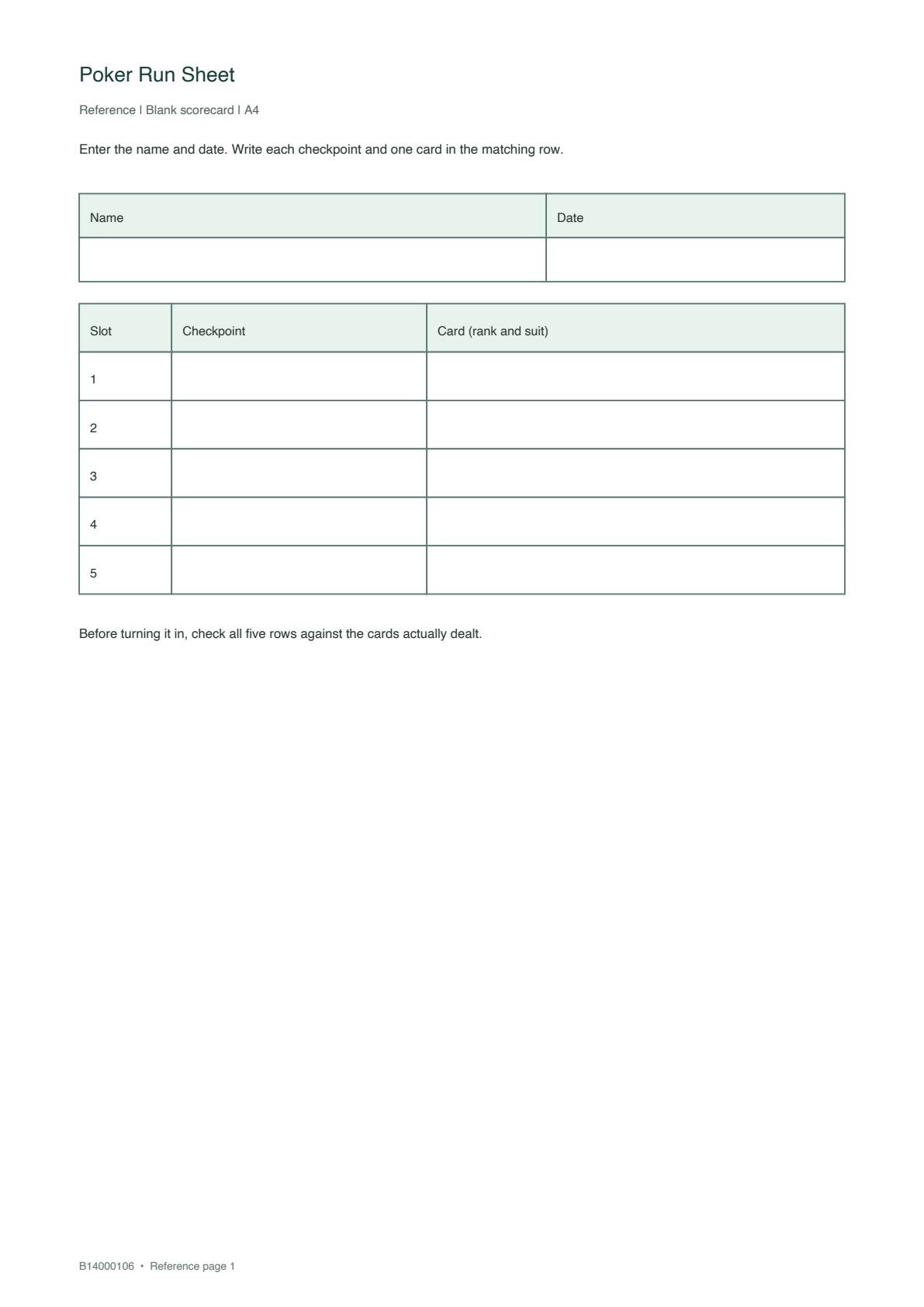
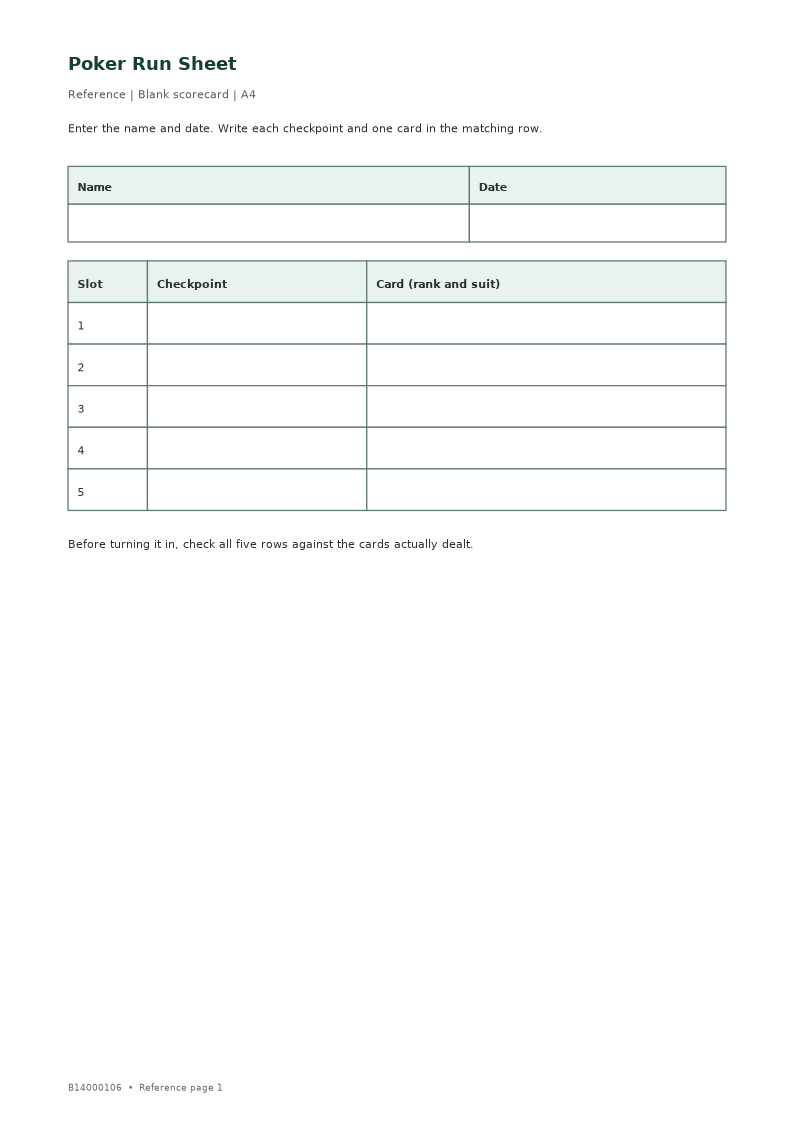
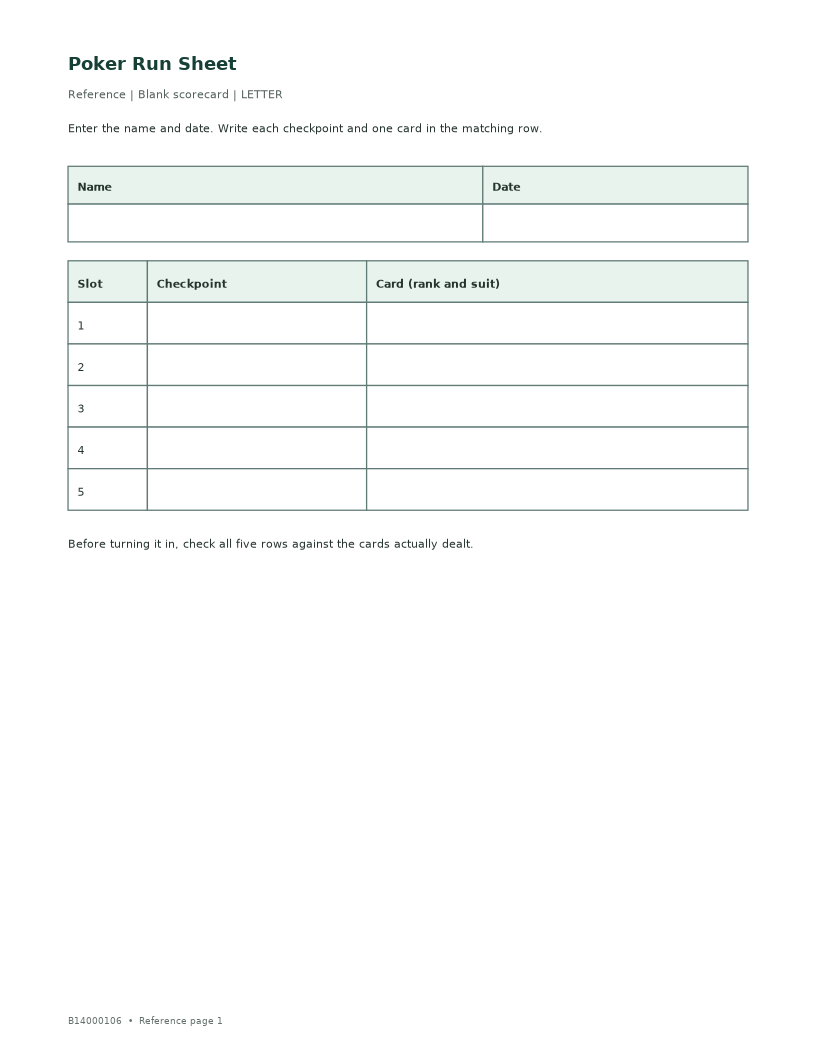
A usable poker run scorecard has a header for the participant's name and the run date, then exactly five numbered checkpoint slots. Each slot has a place for the checkpoint name or number and a card field where the dealt card is recorded.
The card field records the card's rank and suit, for example '7 of hearts' or 'K of spades'. One card is recorded per checkpoint, and no checkpoint is left blank on a completed sheet.
How to fill a checkpoint slot
At a checkpoint, the worker deals or stamps one card. Write the checkpoint's name in the slot's checkpoint field, then write the card's rank and suit in the card field beside it.
Keep the five slots in checkpoint order so the finished sheet reads as a sequence of five cards. Do not add extra cards to a slot or move a card to a different slot.
Checking a completed sheet
Before handing in, check three things: the header is filled, all five checkpoint slots have a checkpoint name, and all five card fields hold exactly one card each.
A blank field, a repeated card in this shared-deck exercise, or two cards in one slot needs checking. Confirm the card actually dealt before correcting its entry.
Download the complete resource pack
All individual SVG pages (20)
- A4 reference page 1
- A4 reference page 2
- A4 student page 1
- A4 student page 2
- A4 student page 3
- A4 student page 4
- A4 answer page 1
- A4 answer page 2
- A4 answer page 3
- A4 answer page 4
- LETTER reference page 1
- LETTER reference page 2
- LETTER student page 1
- LETTER student page 2
- LETTER student page 3
- LETTER student page 4
- LETTER answer page 1
- LETTER answer page 2
- LETTER answer page 3
- LETTER answer page 4

Print at 100% / actual size. Use the stated scale on any schematic diagram; physical cutting templates are identified separately. A4 and US Letter are separate files. Free access, no signup; CC BY 4.0.
How to use these pages
- What the scorecard must contain
- How to fill a checkpoint slot
- Checking a completed sheet
Worked example
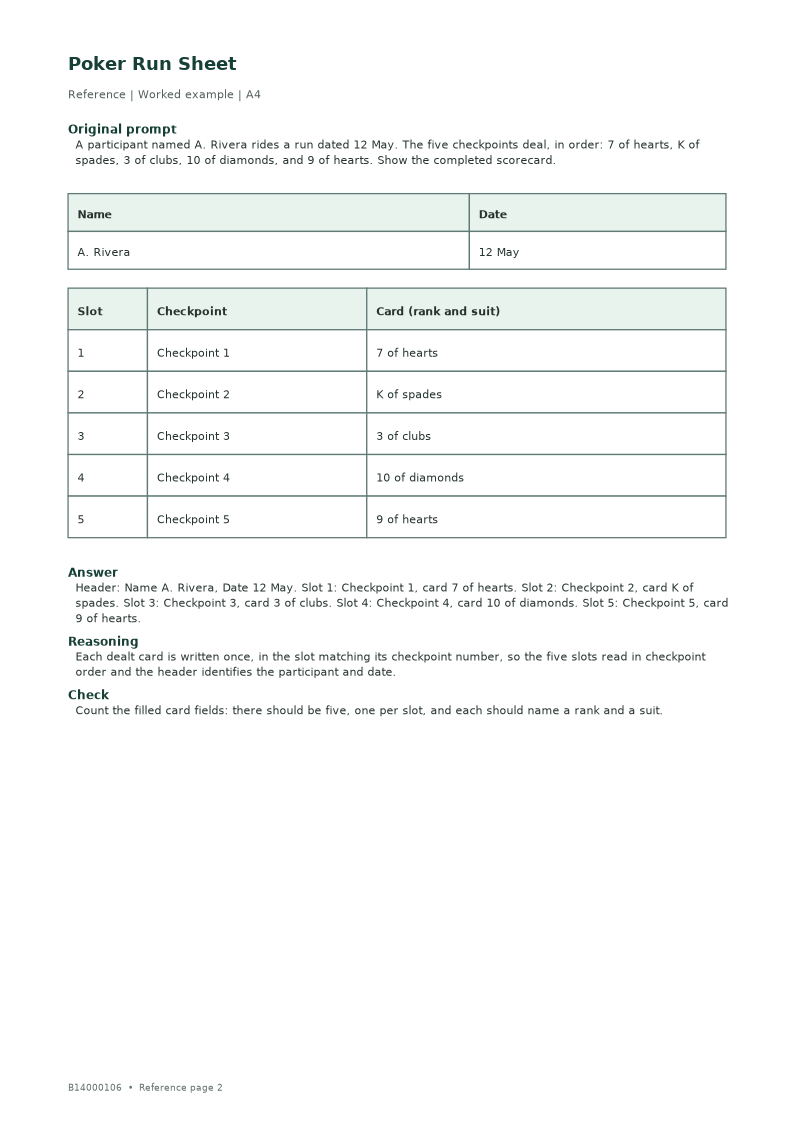
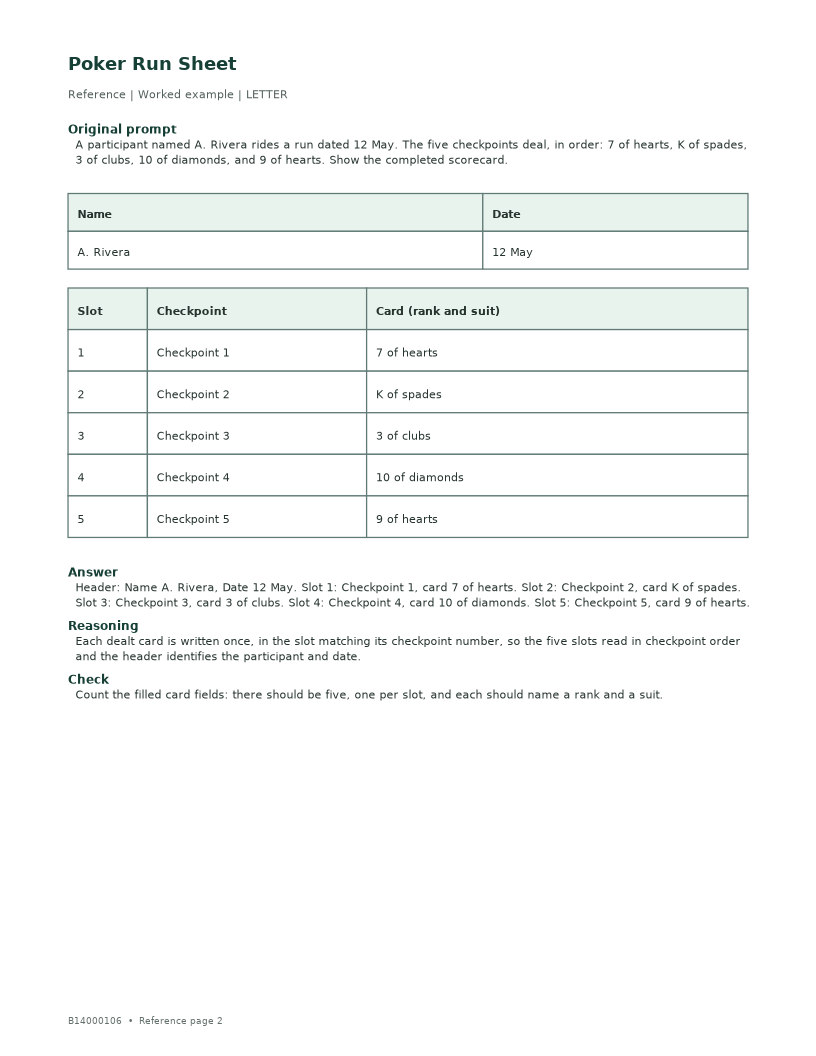
Example: A participant named A. Rivera rides a run dated 12 May. The five checkpoints deal, in order: 7 of hearts, K of spades, 3 of clubs, 10 of diamonds, and 9 of hearts. Show the completed scorecard.
Answer: Header: Name A. Rivera, Date 12 May. Slot 1: Checkpoint 1, card 7 of hearts. Slot 2: Checkpoint 2, card K of spades. Slot 3: Checkpoint 3, card 3 of clubs. Slot 4: Checkpoint 4, card 10 of diamonds. Slot 5: Checkpoint 5, card 9 of hearts.
Reasoning: Each dealt card is written once, in the slot matching its checkpoint number, so the five slots read in checkpoint order and the header identifies the participant and date.
Check: Count the filled card fields: there should be five, one per slot, and each should name a rank and a suit.
Four practice tasks and complete answers
Task 1
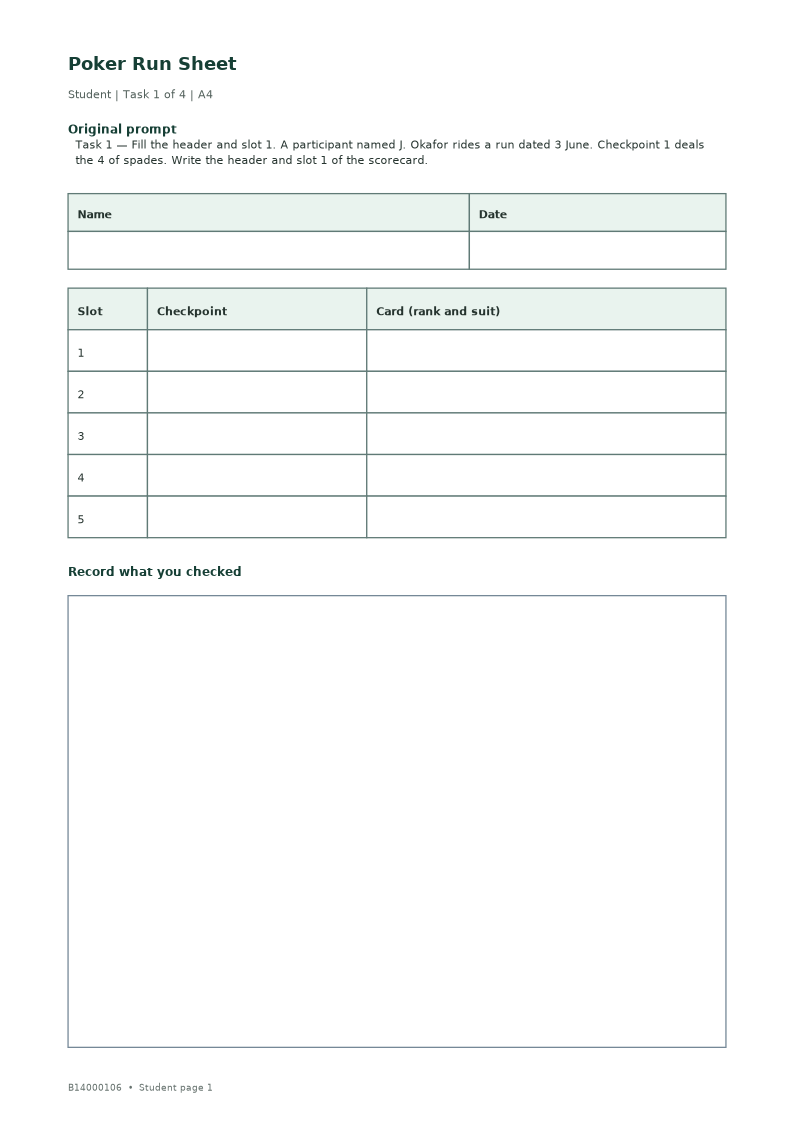
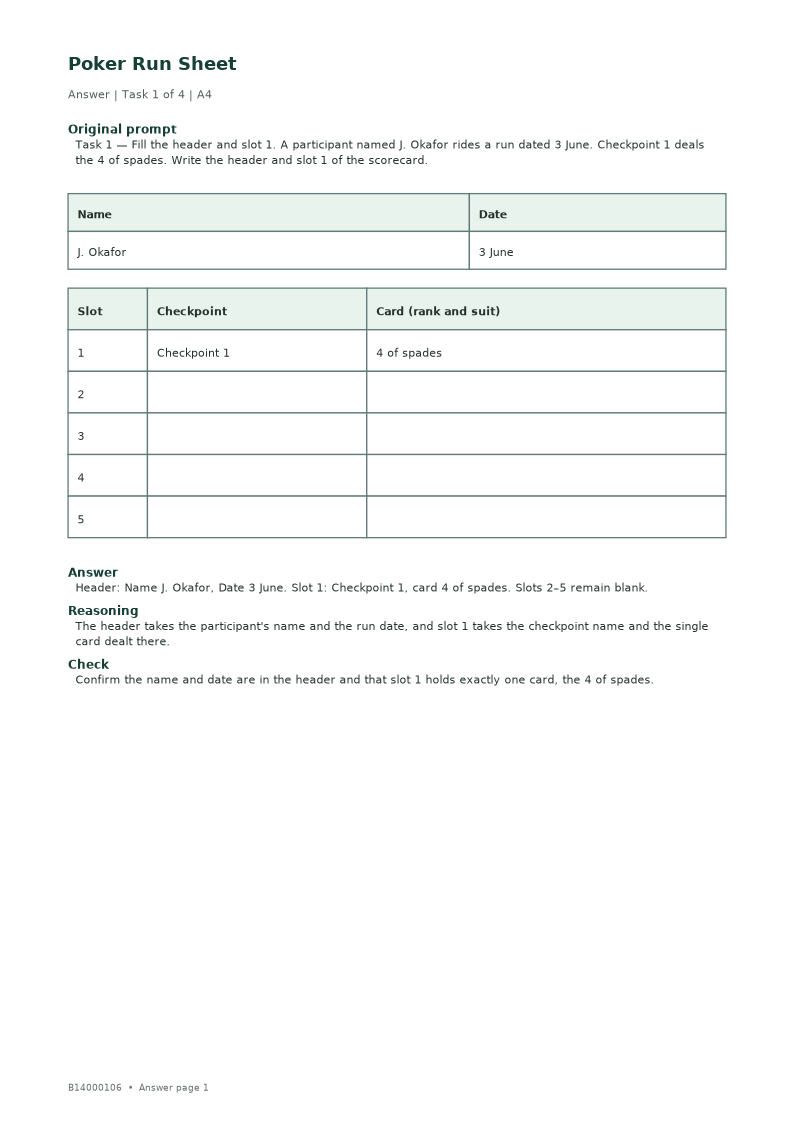
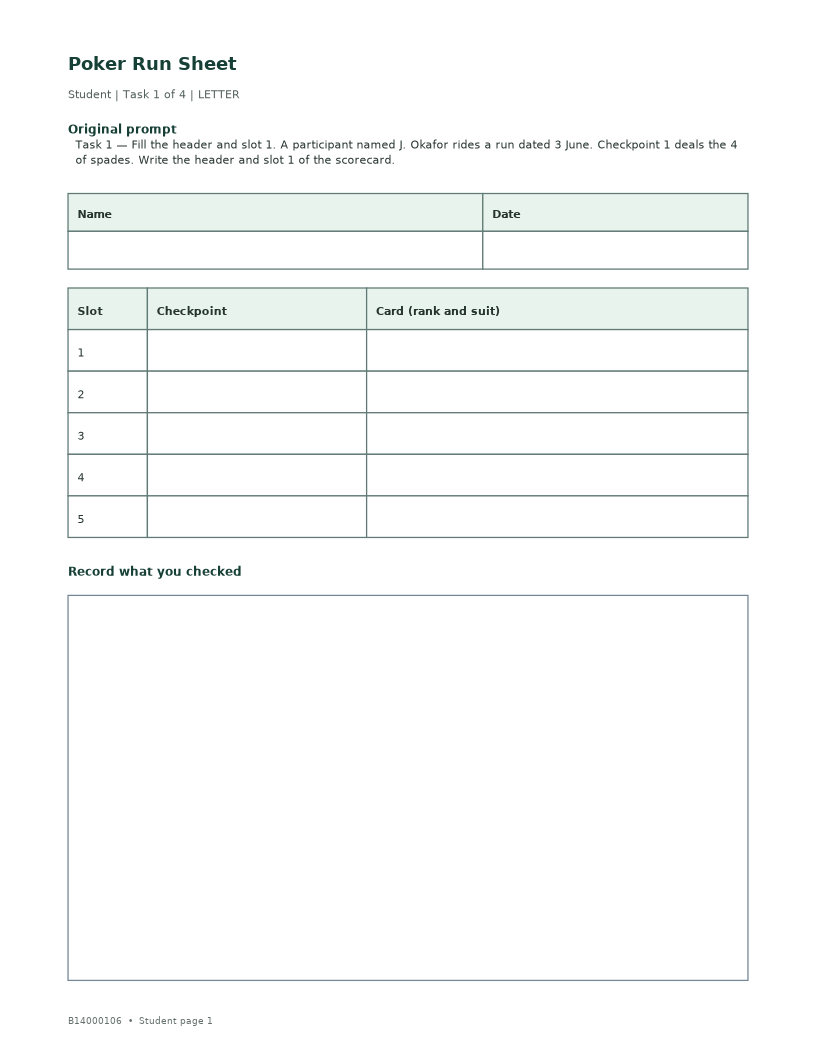
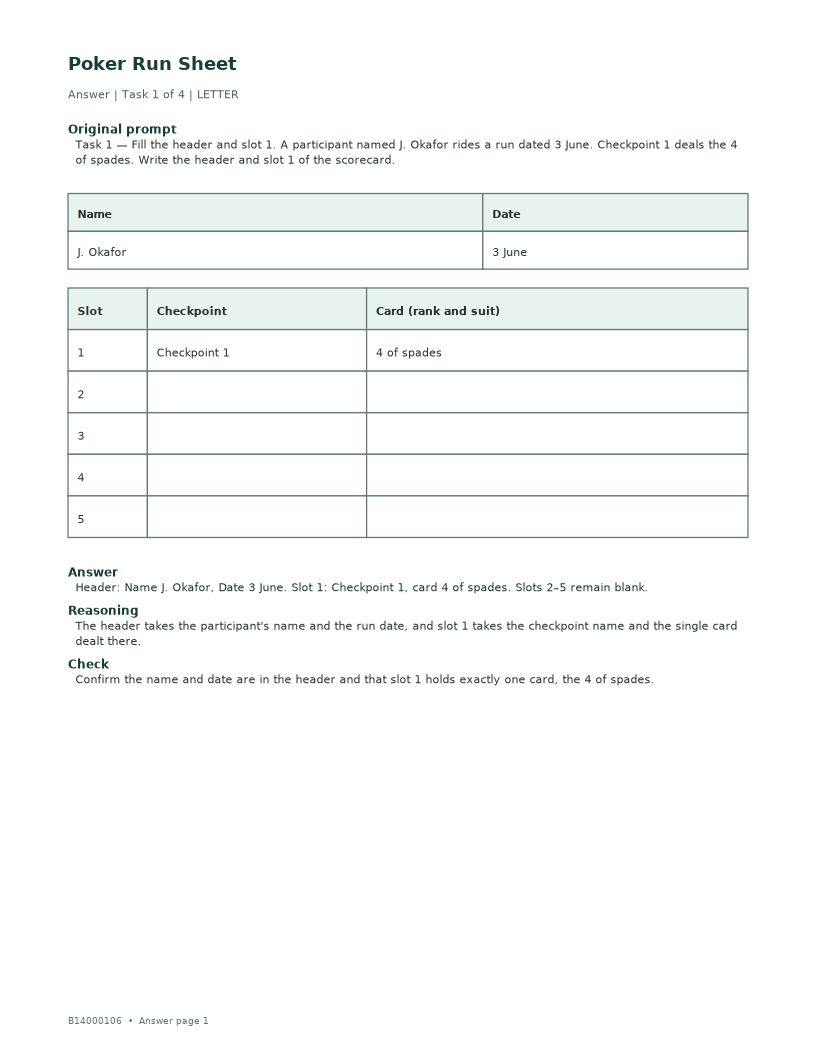
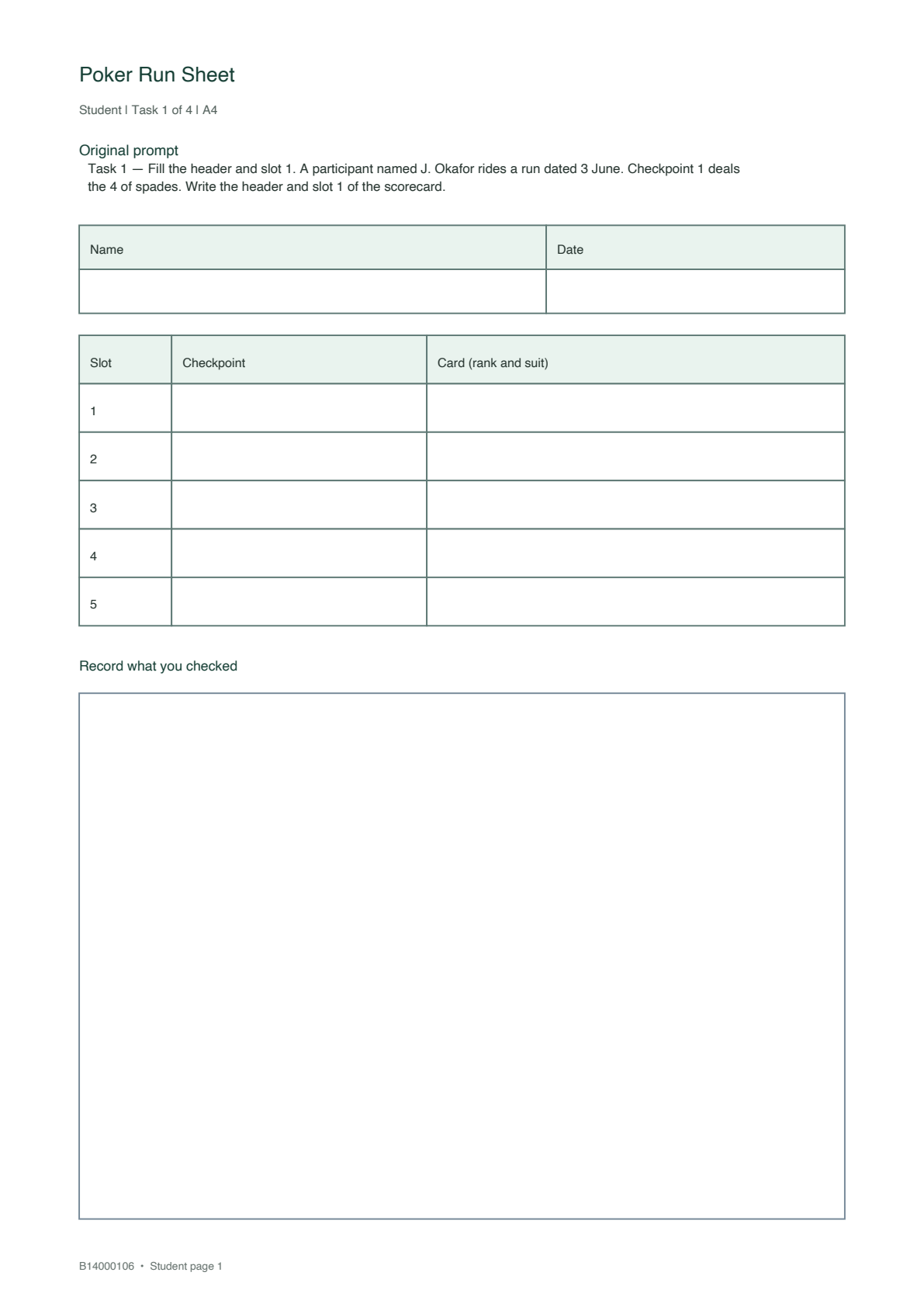
Task 1 — Fill the header and slot 1. A participant named J. Okafor rides a run dated 3 June. Checkpoint 1 deals the 4 of spades. Write the header and slot 1 of the scorecard.
Show answer 1
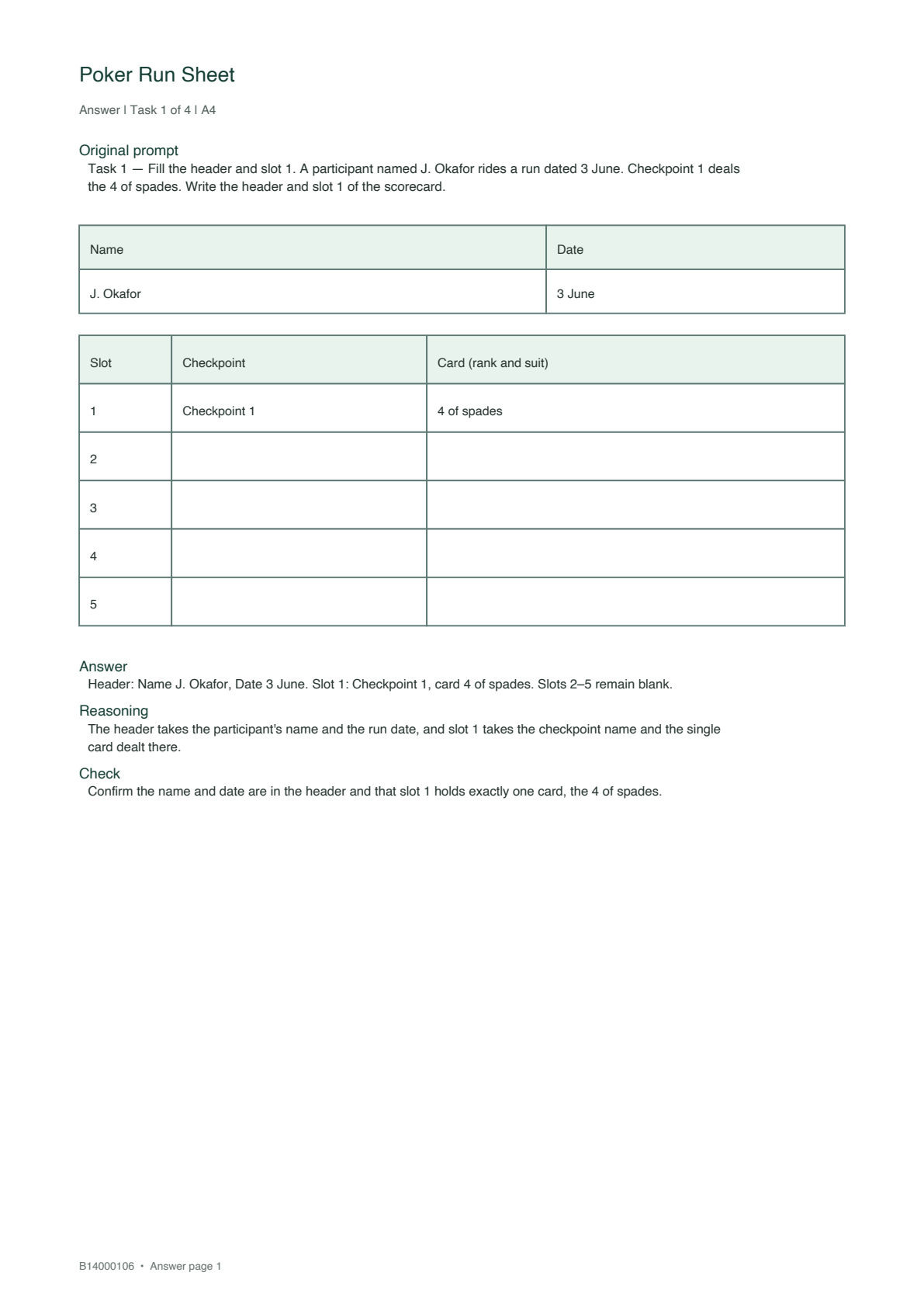
Header: Name J. Okafor, Date 3 June. Slot 1: Checkpoint 1, card 4 of spades. Slots 2–5 remain blank.
The header takes the participant's name and the run date, and slot 1 takes the checkpoint name and the single card dealt there.
Check: Confirm the name and date are in the header and that slot 1 holds exactly one card, the 4 of spades.
Task 2
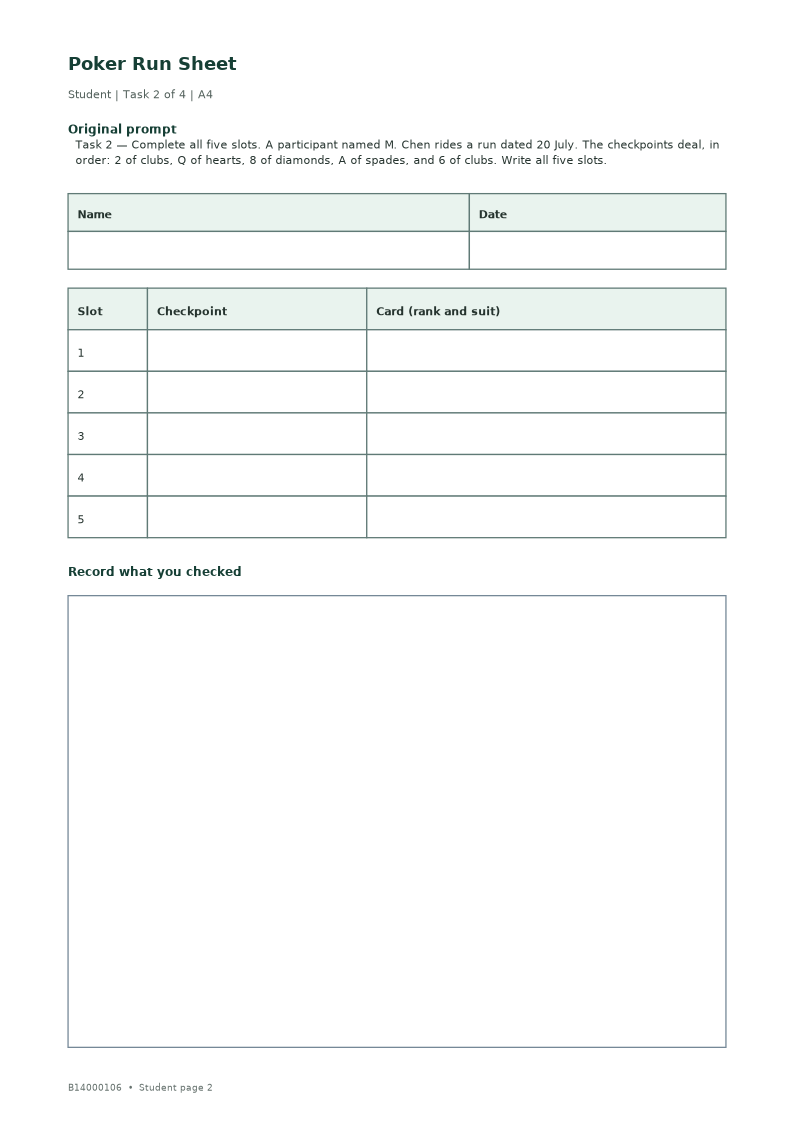
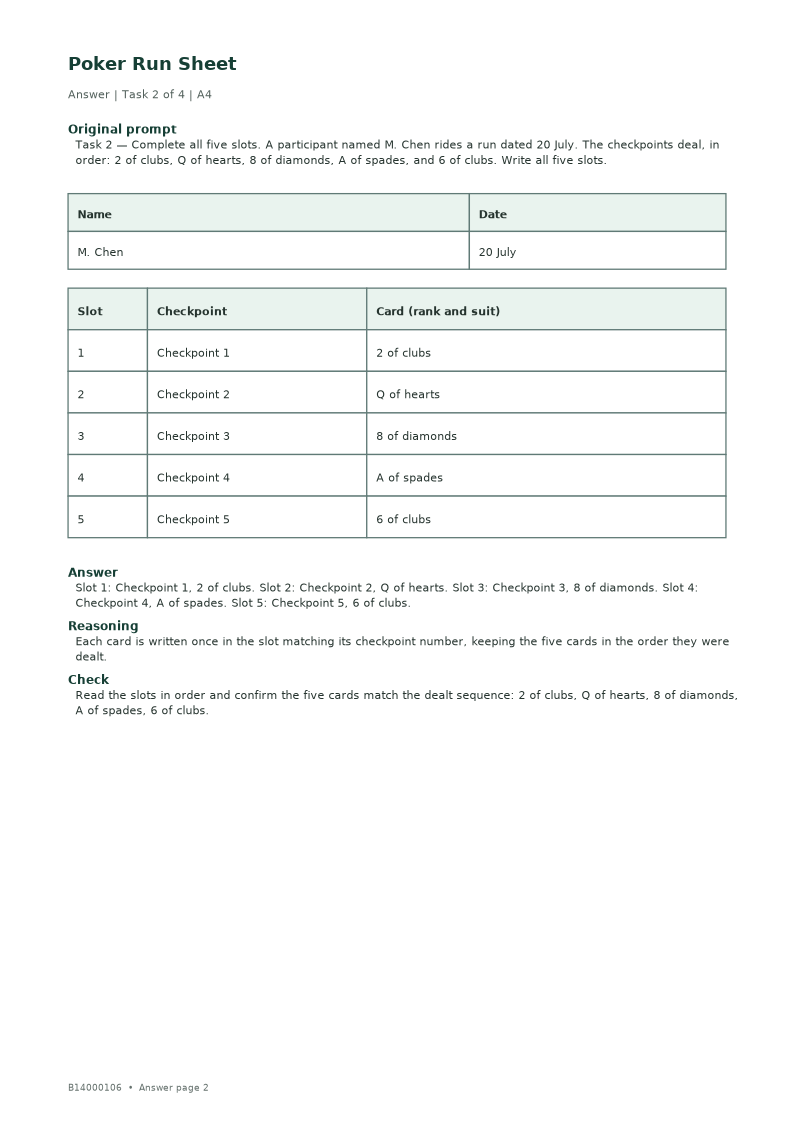
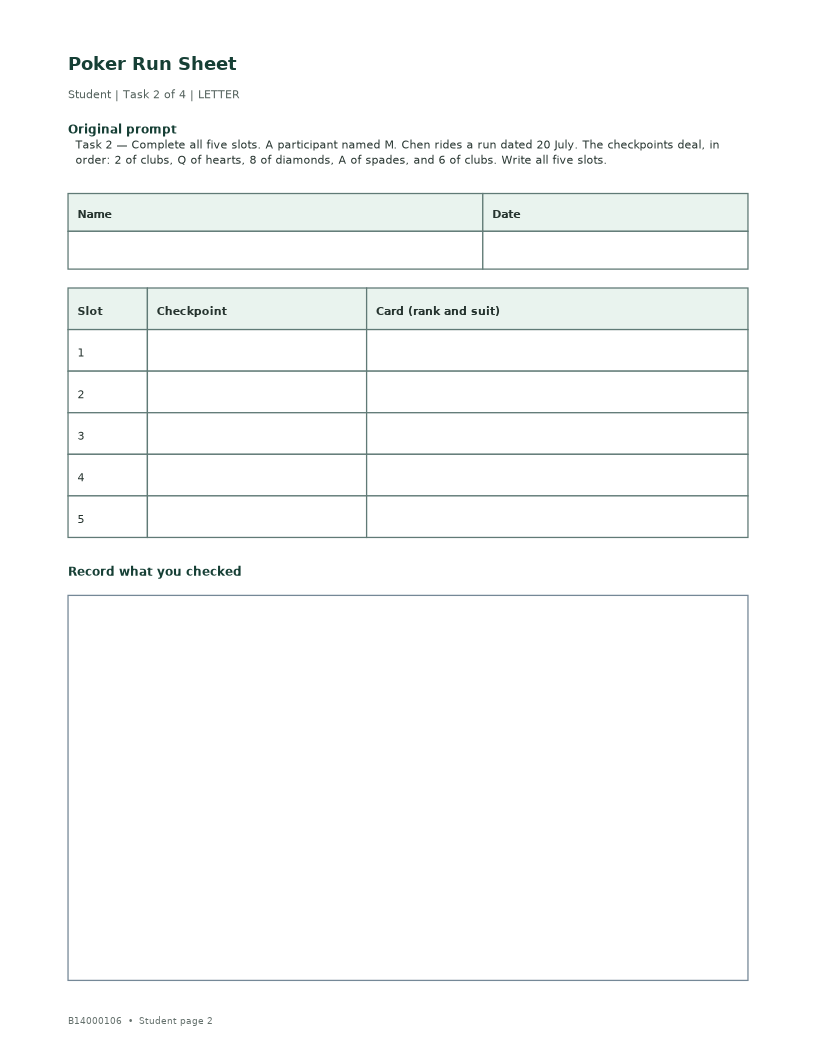
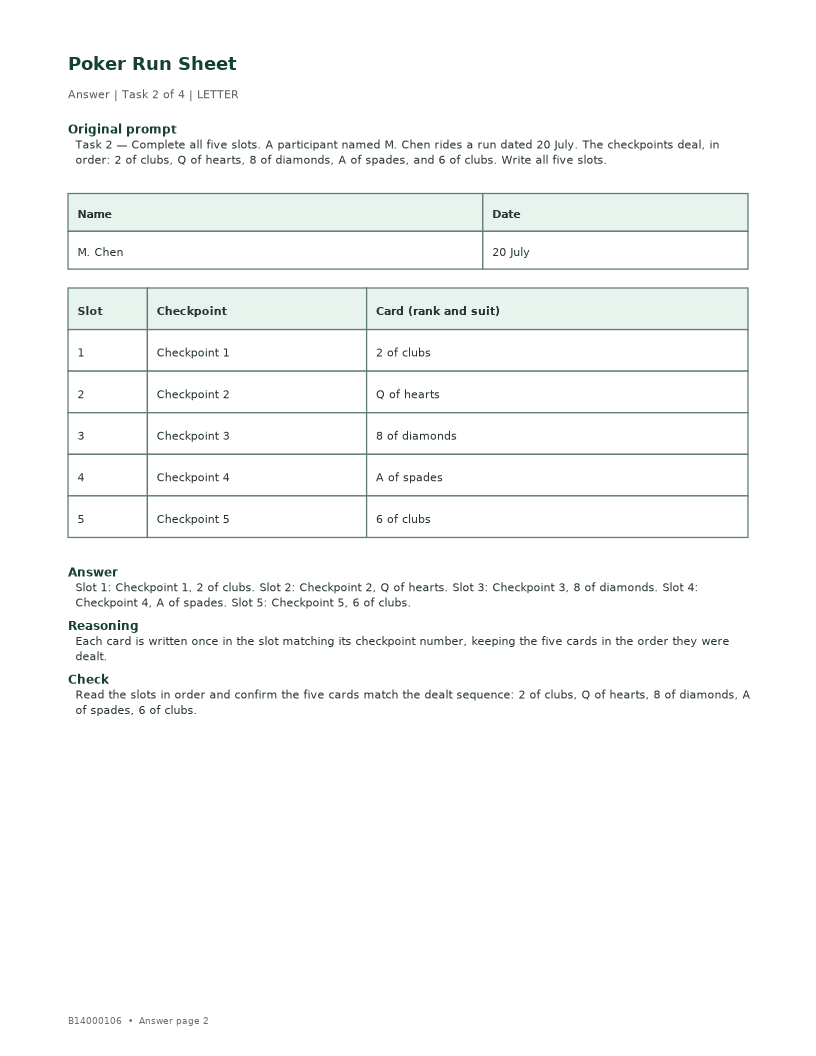
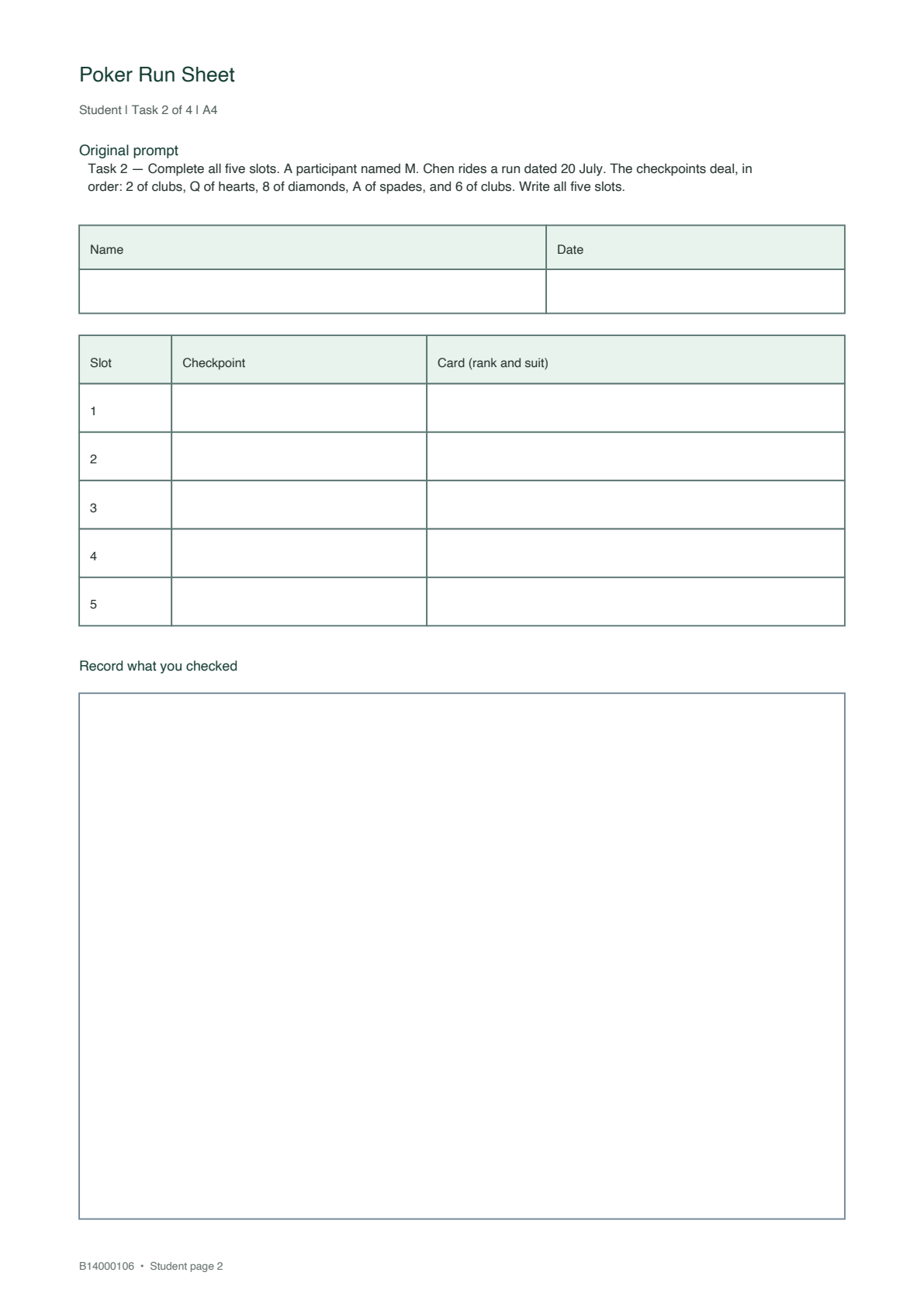
Task 2 — Complete all five slots. A participant named M. Chen rides a run dated 20 July. The checkpoints deal, in order: 2 of clubs, Q of hearts, 8 of diamonds, A of spades, and 6 of clubs. Write all five slots.
Show answer 2
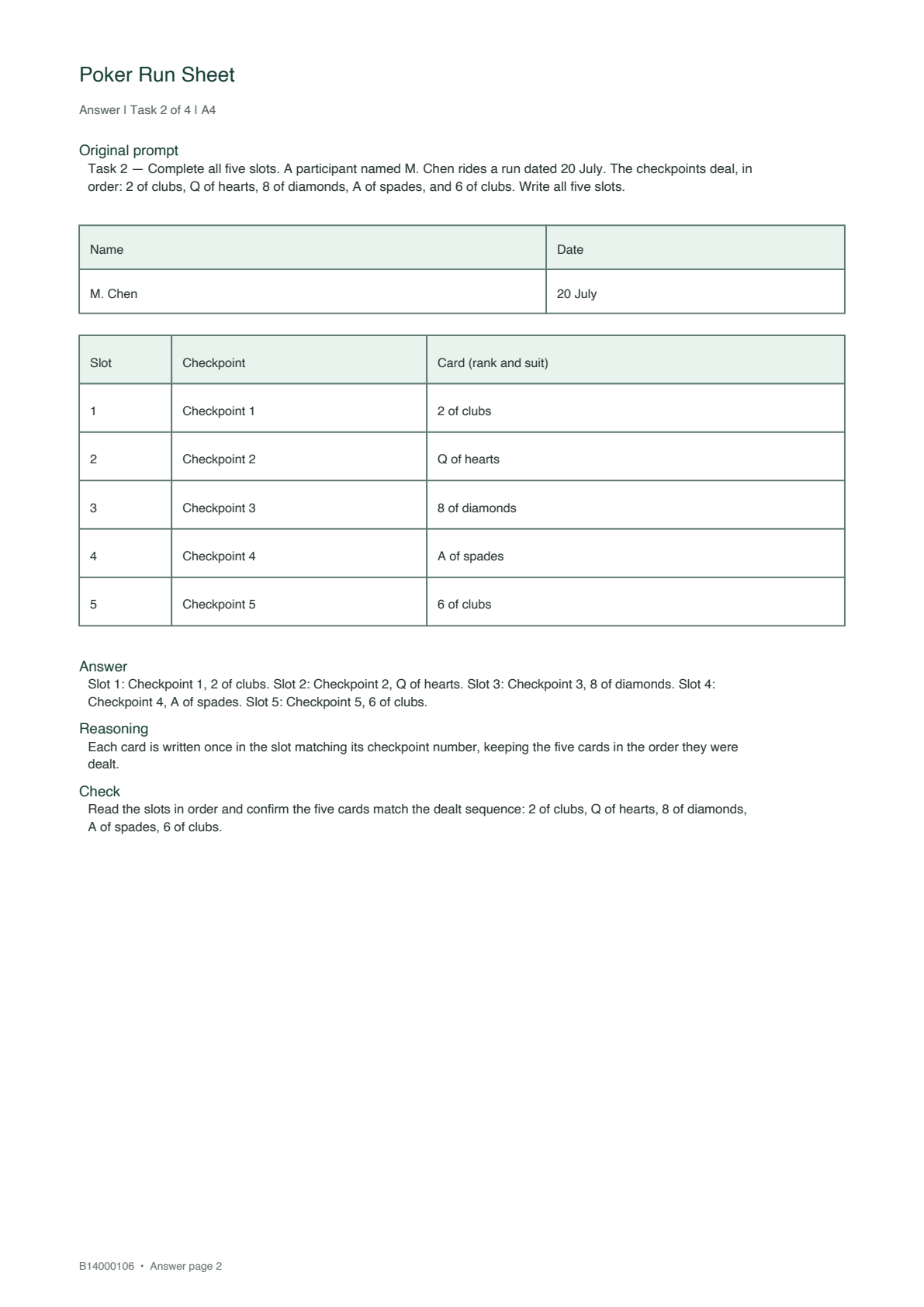
Slot 1: Checkpoint 1, 2 of clubs. Slot 2: Checkpoint 2, Q of hearts. Slot 3: Checkpoint 3, 8 of diamonds. Slot 4: Checkpoint 4, A of spades. Slot 5: Checkpoint 5, 6 of clubs.
Each card is written once in the slot matching its checkpoint number, keeping the five cards in the order they were dealt.
Check: Read the slots in order and confirm the five cards match the dealt sequence: 2 of clubs, Q of hearts, 8 of diamonds, A of spades, 6 of clubs.
Task 3
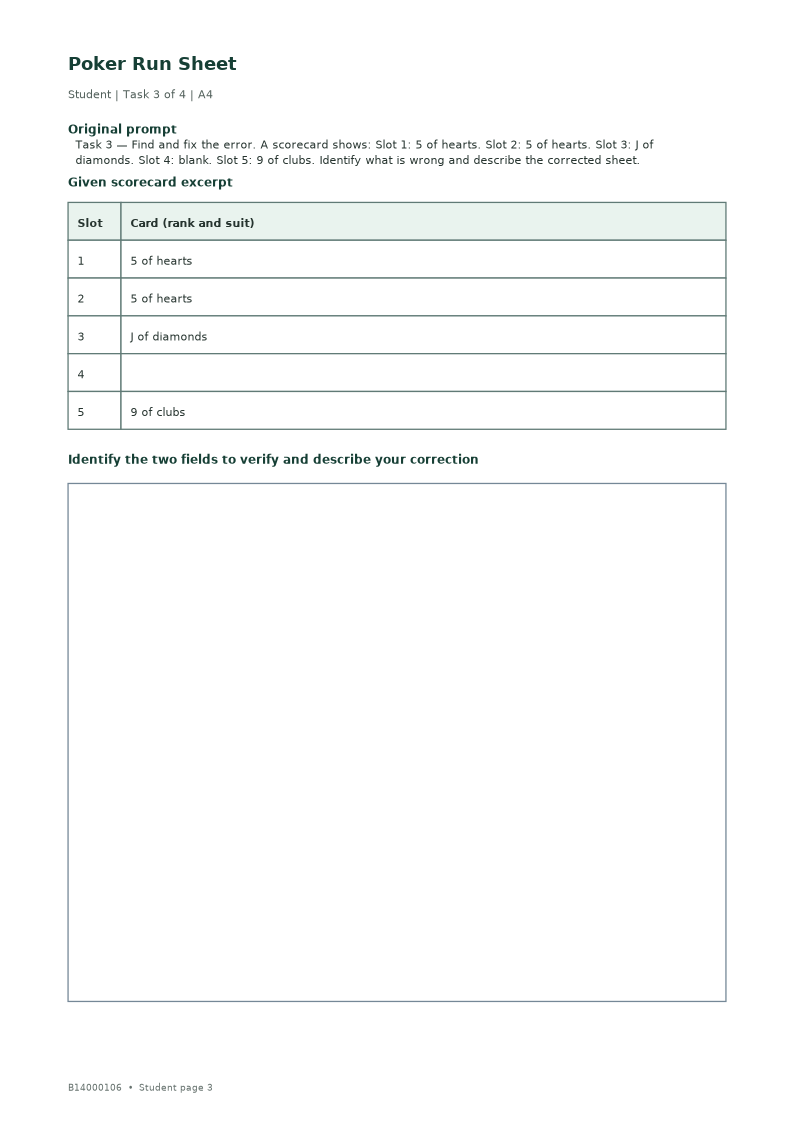
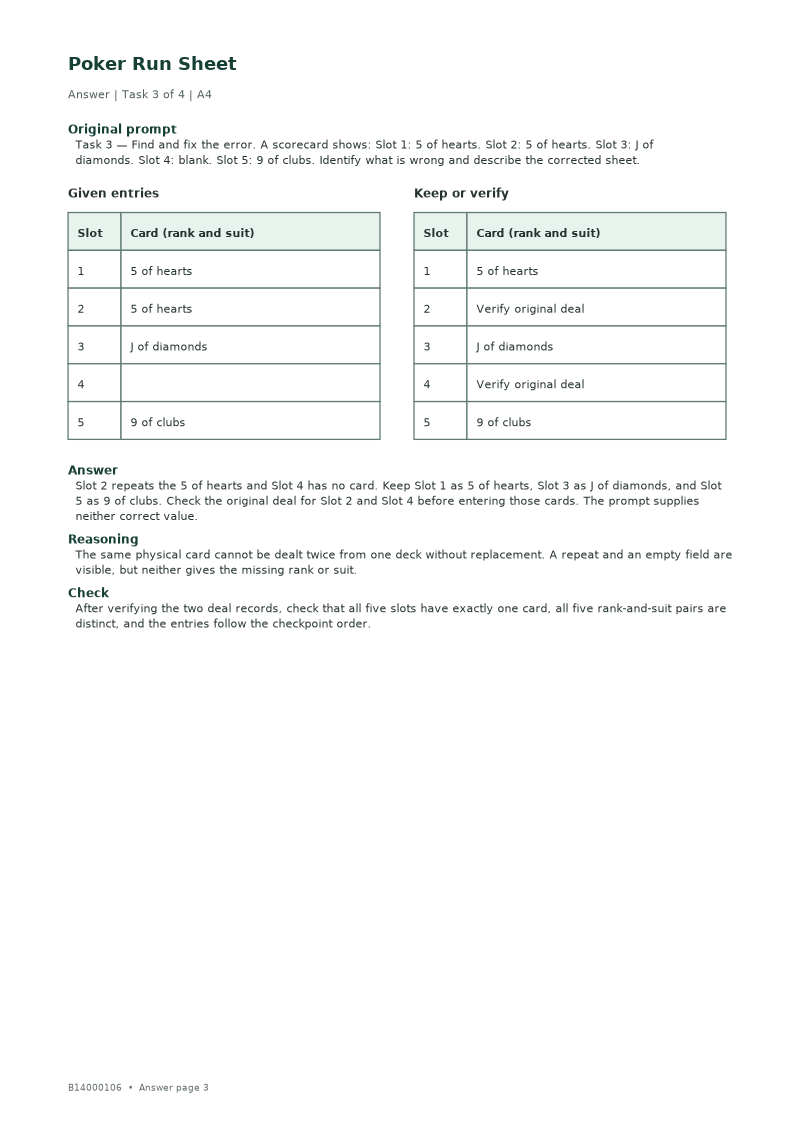
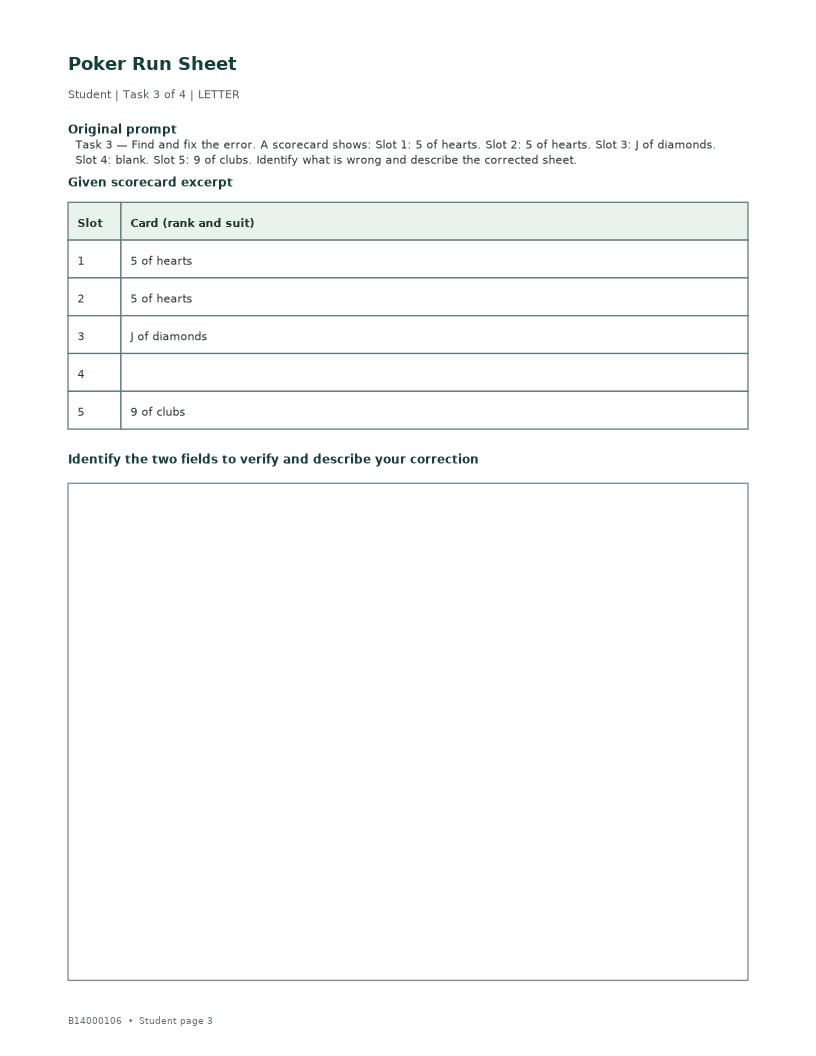
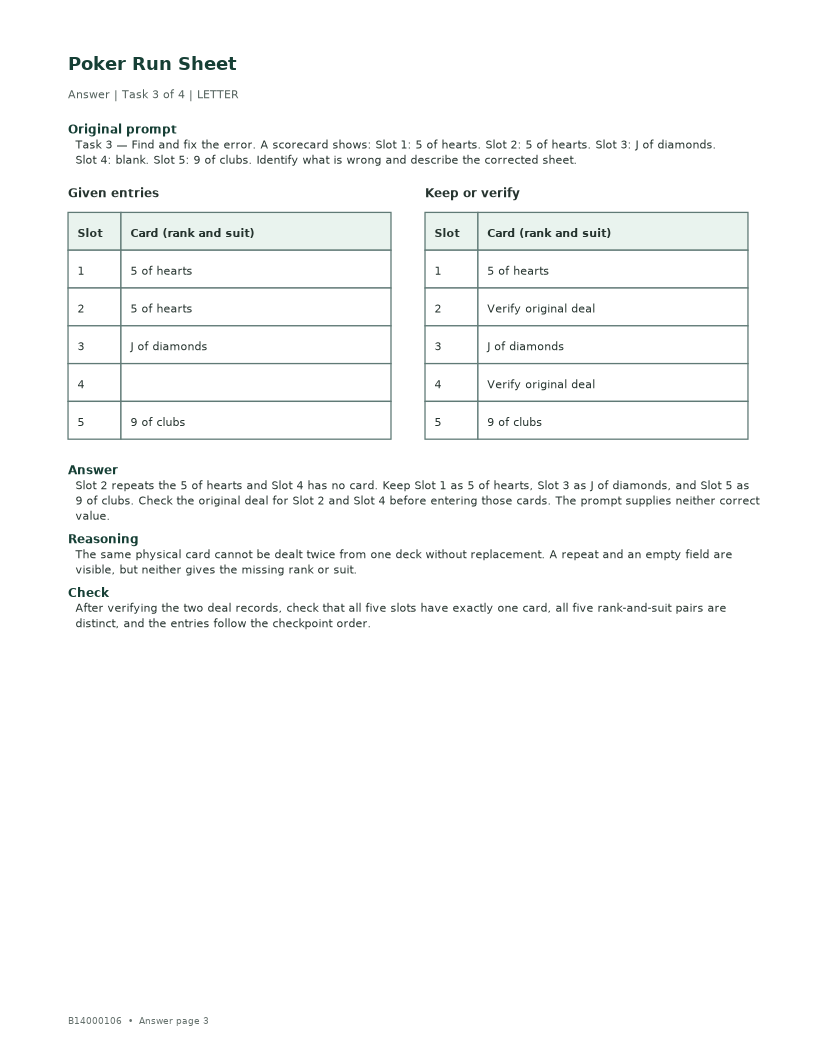
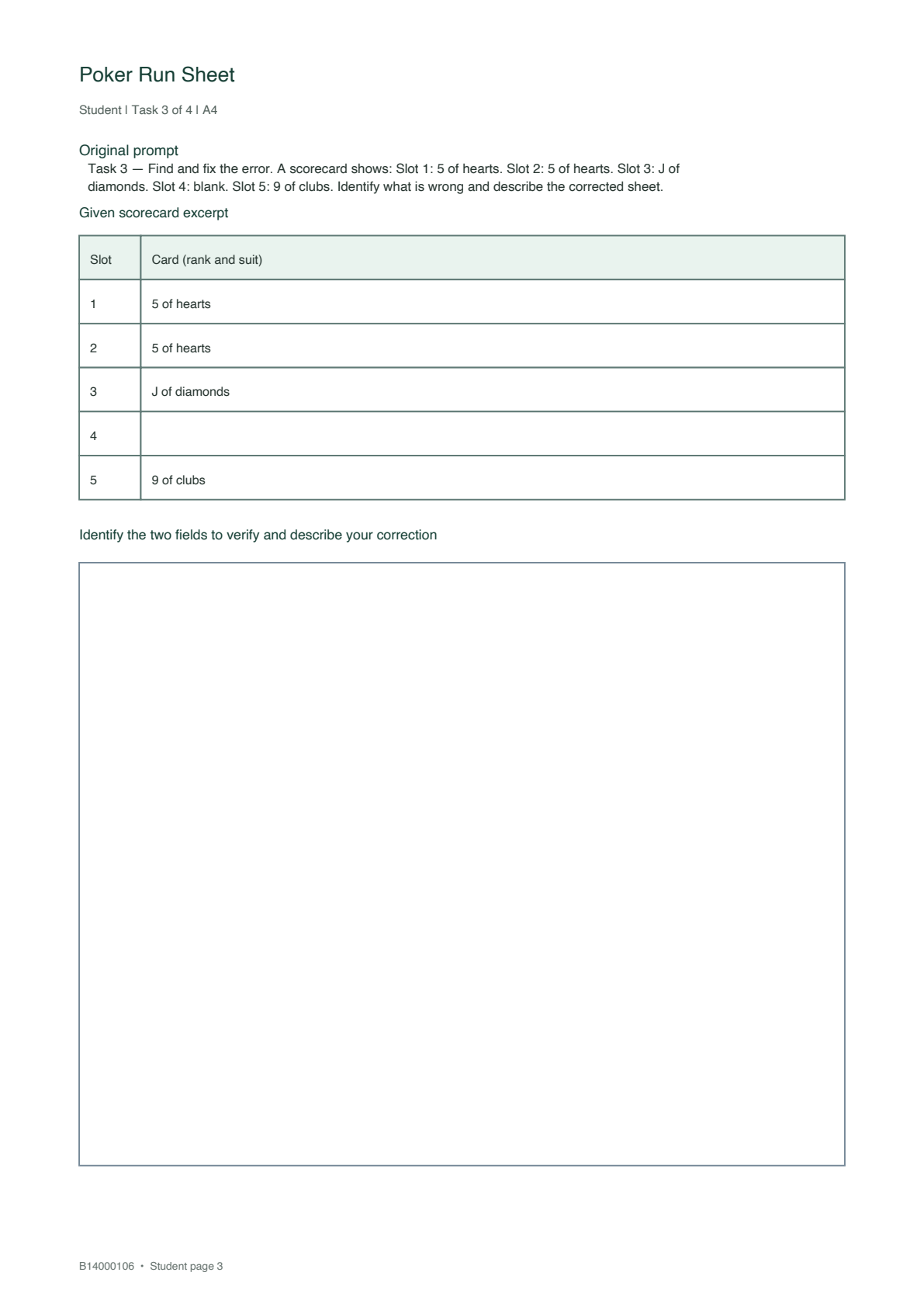
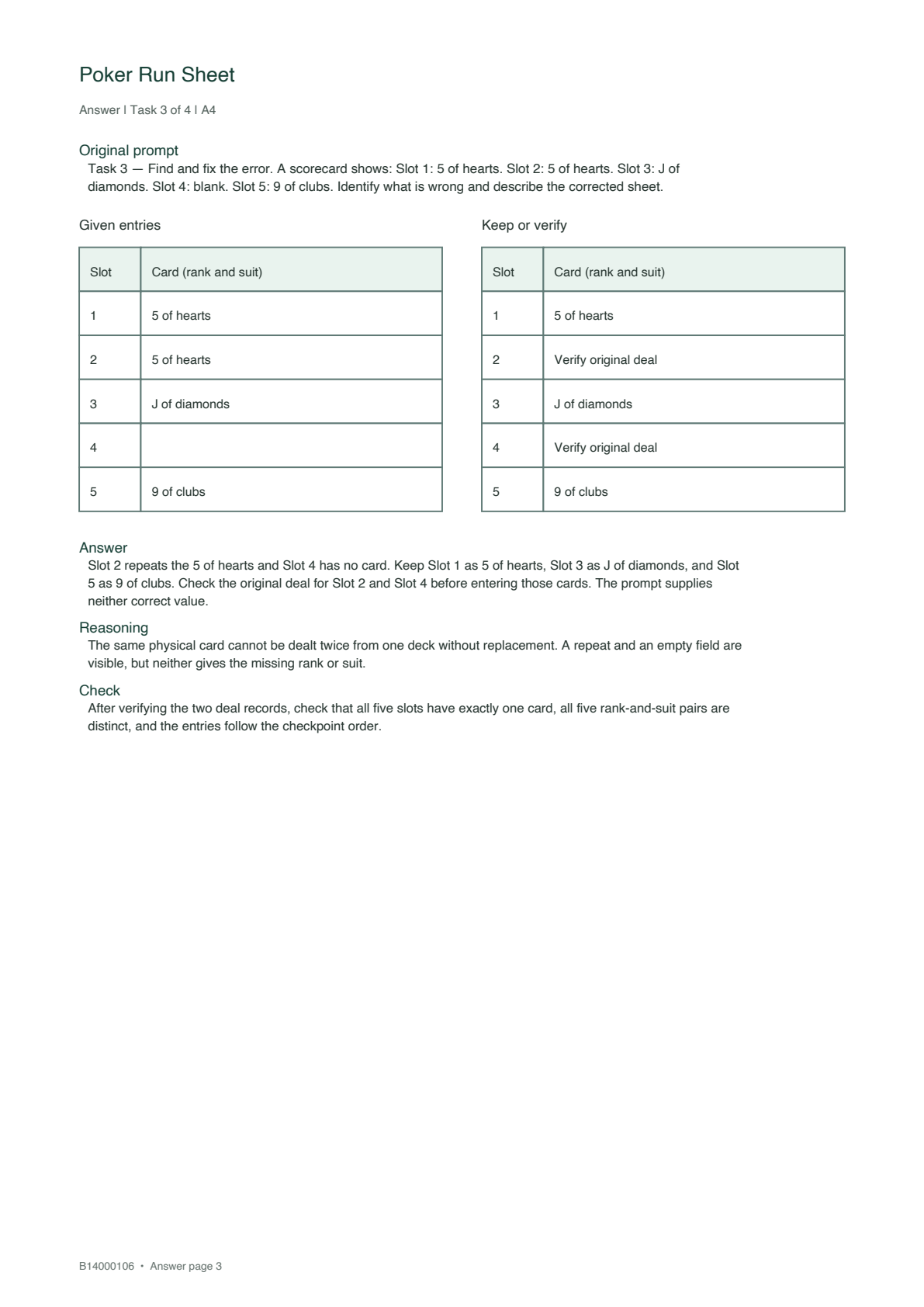
Task 3 — Find and fix the error. A scorecard shows: Slot 1: 5 of hearts. Slot 2: 5 of hearts. Slot 3: J of diamonds. Slot 4: blank. Slot 5: 9 of clubs. Identify what is wrong and describe the corrected sheet.
Show answer 3
Slot 2 repeats the 5 of hearts and Slot 4 has no card. Keep Slot 1 as 5 of hearts, Slot 3 as J of diamonds, and Slot 5 as 9 of clubs. Check the original deal for Slot 2 and Slot 4 before entering those cards. The prompt supplies neither correct value.
The same physical card cannot be dealt twice from one deck without replacement. A repeat and an empty field are visible, but neither gives the missing rank or suit.
Check: After verifying the two deal records, check that all five slots have exactly one card, all five rank-and-suit pairs are distinct, and the entries follow the checkpoint order.
Task 4
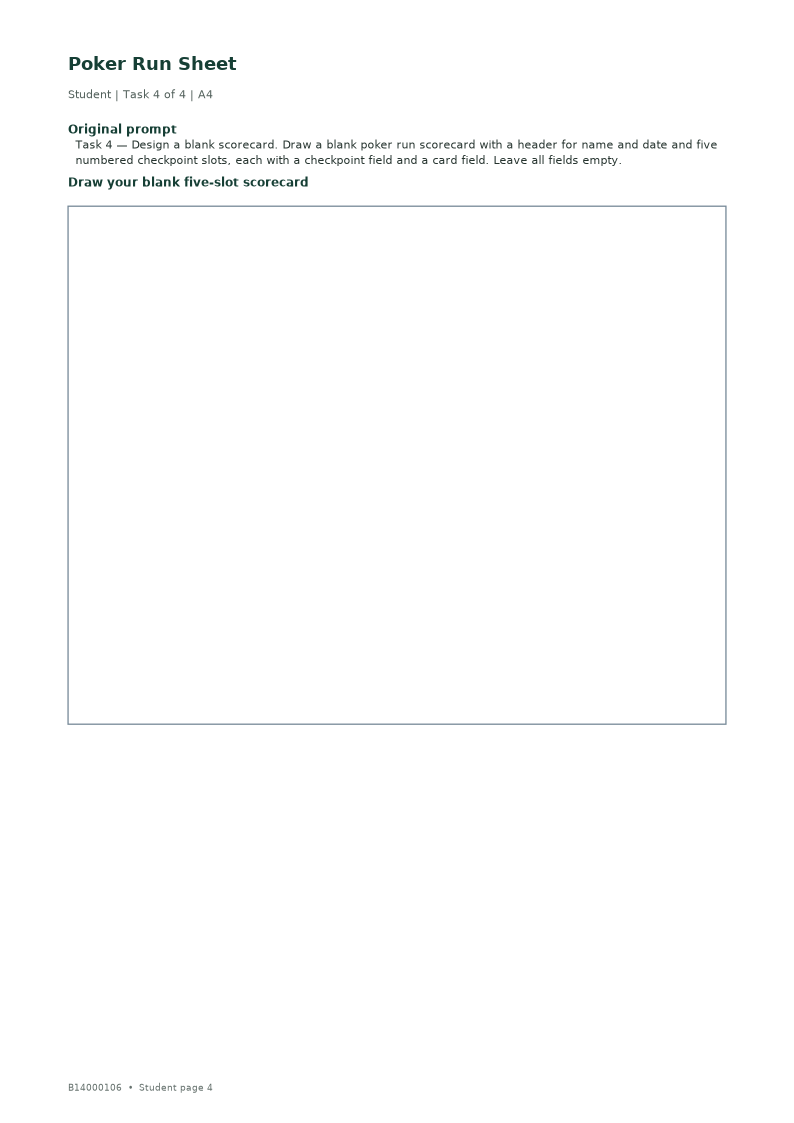
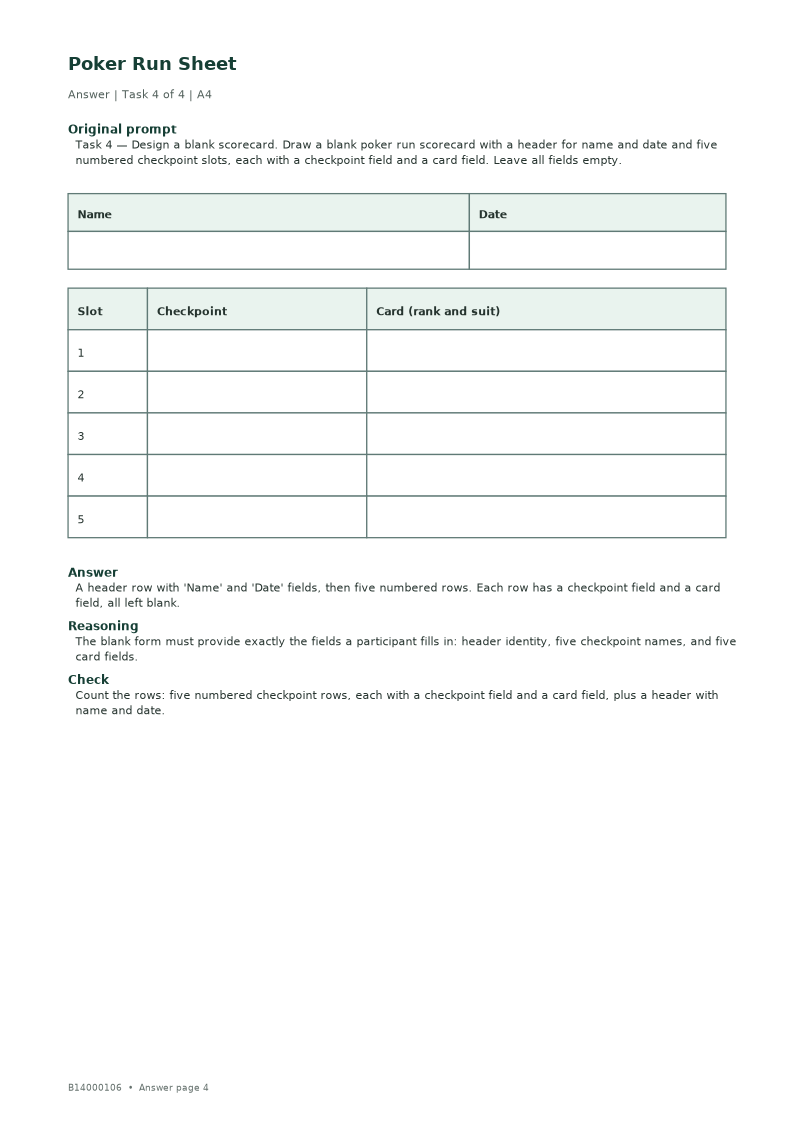
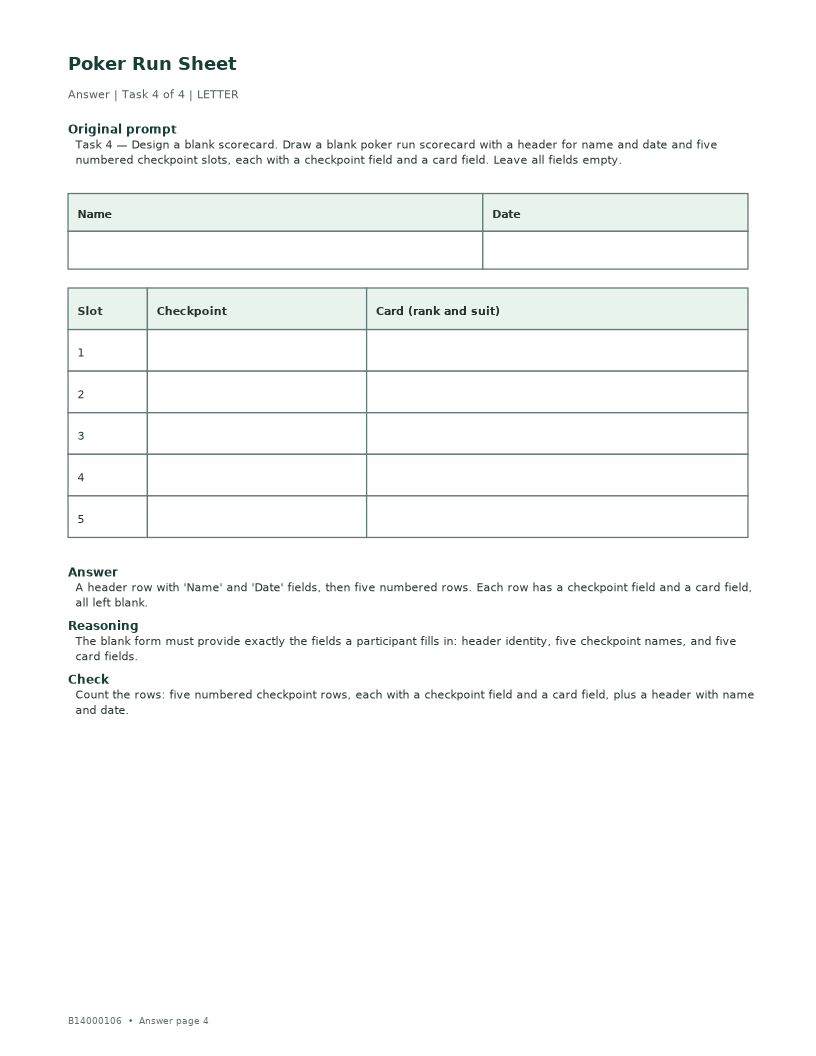
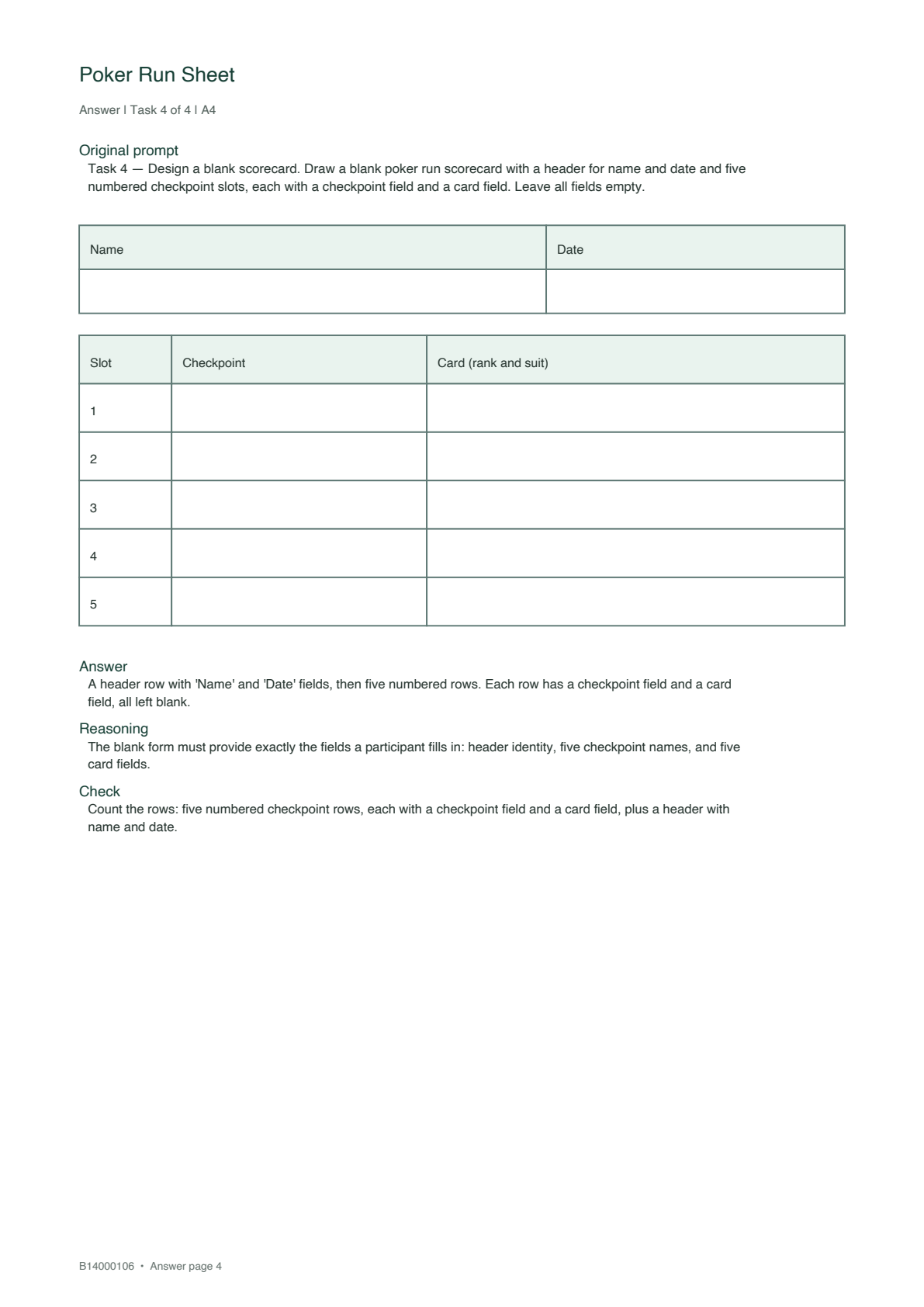
Task 4 — Design a blank scorecard. Draw a blank poker run scorecard with a header for name and date and five numbered checkpoint slots, each with a checkpoint field and a card field. Leave all fields empty.

Show answer 4
A header row with 'Name' and 'Date' fields, then five numbered rows. Each row has a checkpoint field and a card field, all left blank.
The blank form must provide exactly the fields a participant fills in: header identity, five checkpoint names, and five card fields.
Check: Count the rows: five numbered checkpoint rows, each with a checkpoint field and a card field, plus a header with name and date.
Useful checks
- Writing two cards in one slot. Each slot holds exactly one card; a second card belongs to a different checkpoint.
- Leaving a slot blank on a completed sheet. Every checkpoint slot must hold one card before the sheet is handed in.
- Writing a card without its suit. Record both rank and suit, for example '7 of hearts', so the card is unambiguous.
Questions about this resource
How many checkpoints does the scorecard have?
Five, matching the five-card hand the run collects.
What goes in a card field?
The rank and suit of the single card dealt at that checkpoint.