Free original lessons
Draw One-Point Perspective Curtains
Draw one window and two stylized gathered curtains. Choose a horizon and a vanishing point, then build the window and its recess. For this exercise, lay the selected pleat marks along the depth direction so they converge with the window reveal.
Letter & A4
PDF & SVG
The construction rule
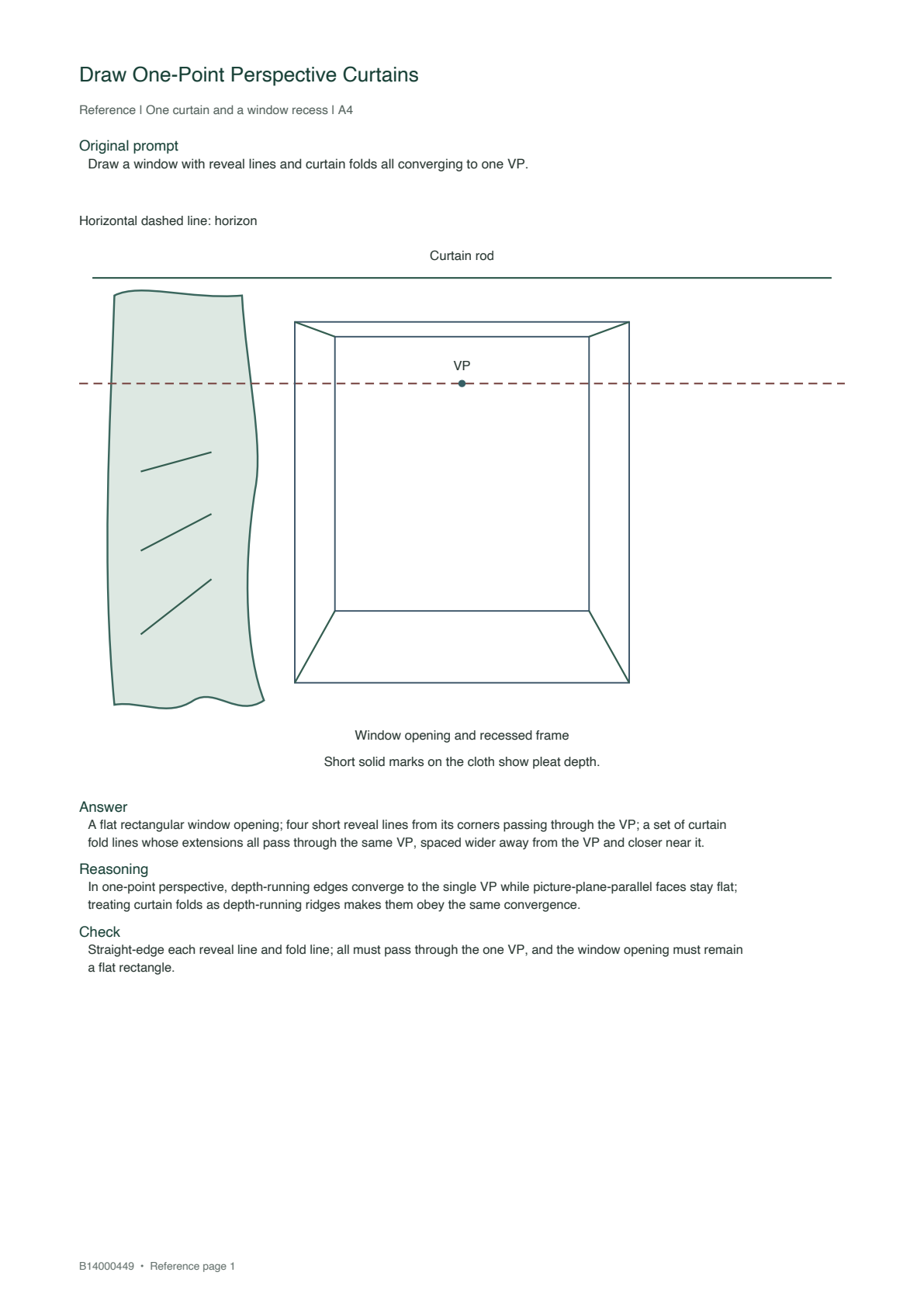
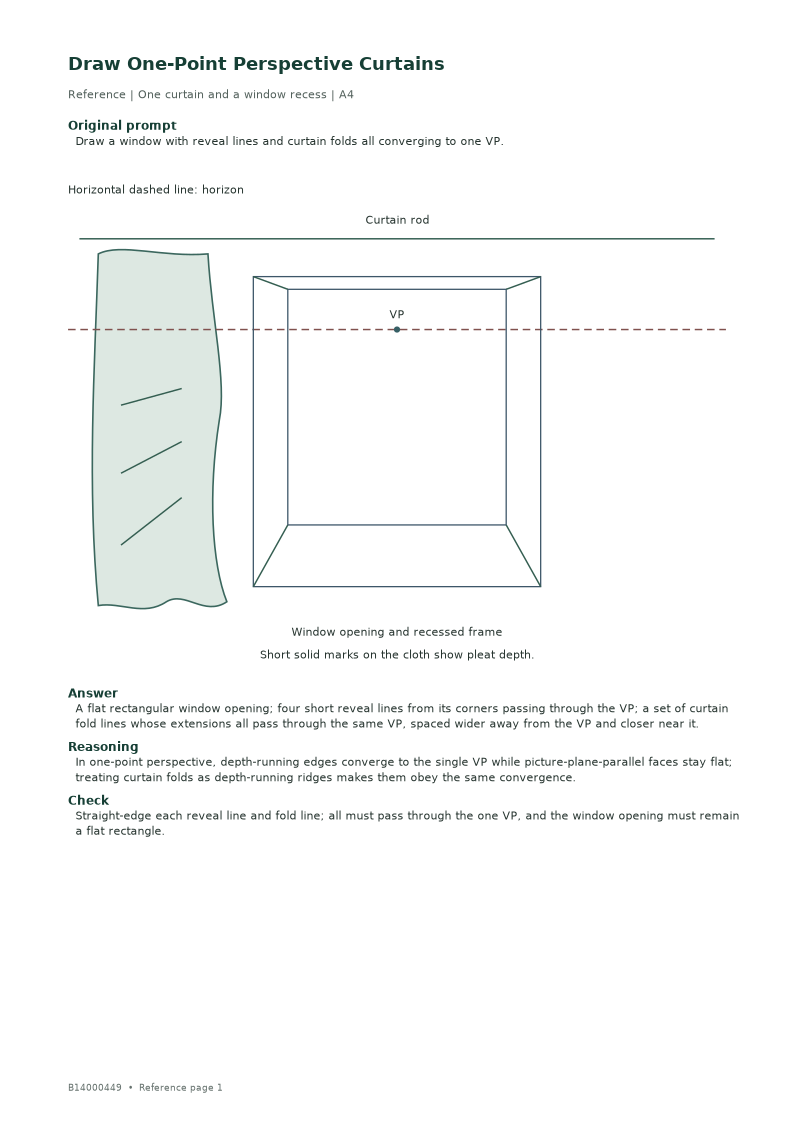
Lines perpendicular to the picture plane converge at the vanishing point on the horizon. A window face parallel to the picture plane can stay a rectangle. Its reveal edges run into depth and converge when extended.
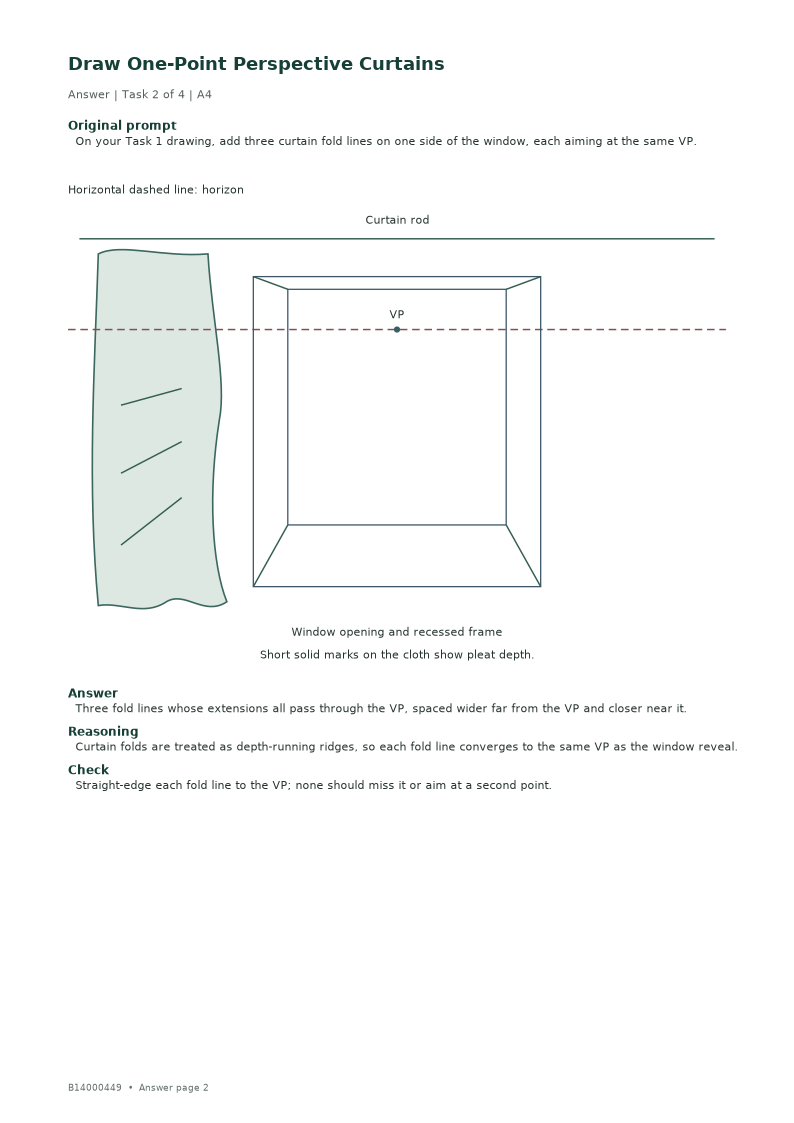
The shaded curtain panels show front and back edges. In this drawing, the short pleat edges connecting them run into depth and align with the same vanishing point. The hanging edges and rounded hems help describe the fabric.
Worked example
Step 1: Draw a horizon line and mark one VP on it. Step 2: Draw the window opening as a flat rectangle on the wall (sides vertical, top and bottom horizontal). Step 3: From the corners of the opening, draw short reveal lines toward the VP to show the wall thickness. Step 4: Draw the curtain as a set of fold lines; each fold line, extended, aims at the VP. Step 5: Check by laying a straight edge along each fold line and each reveal line: all should pass through the single VP.
Practice tasks
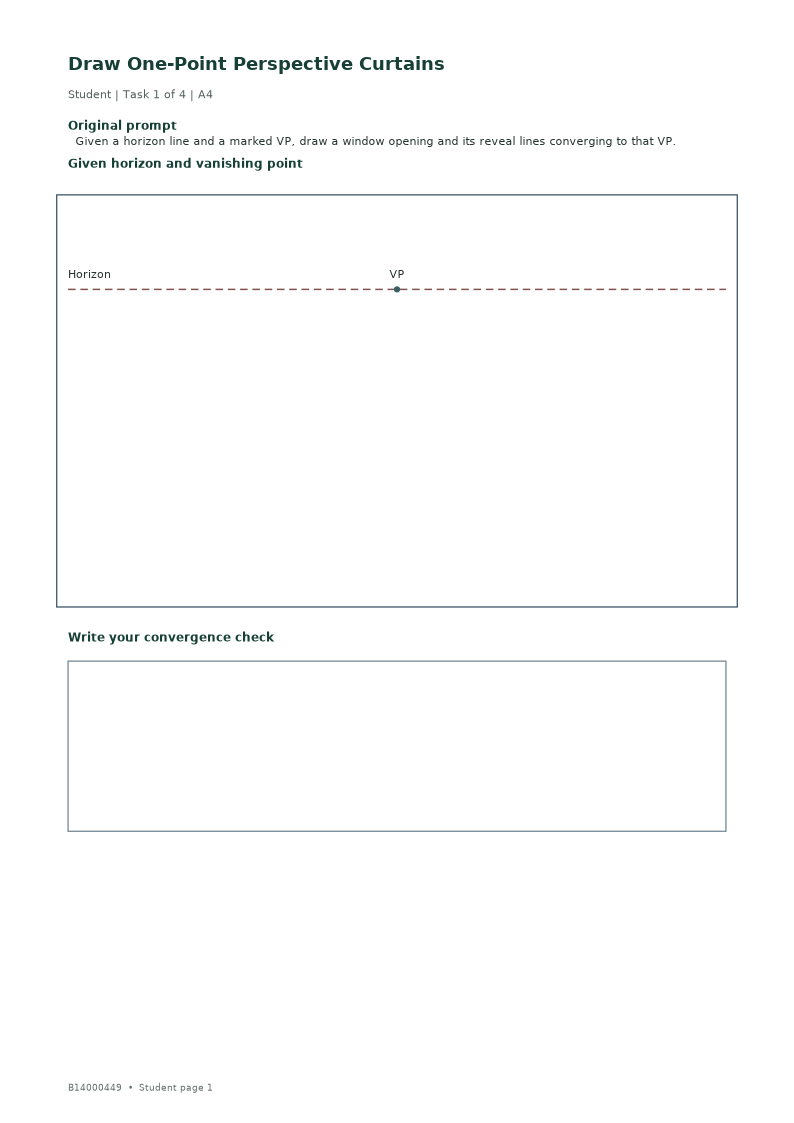
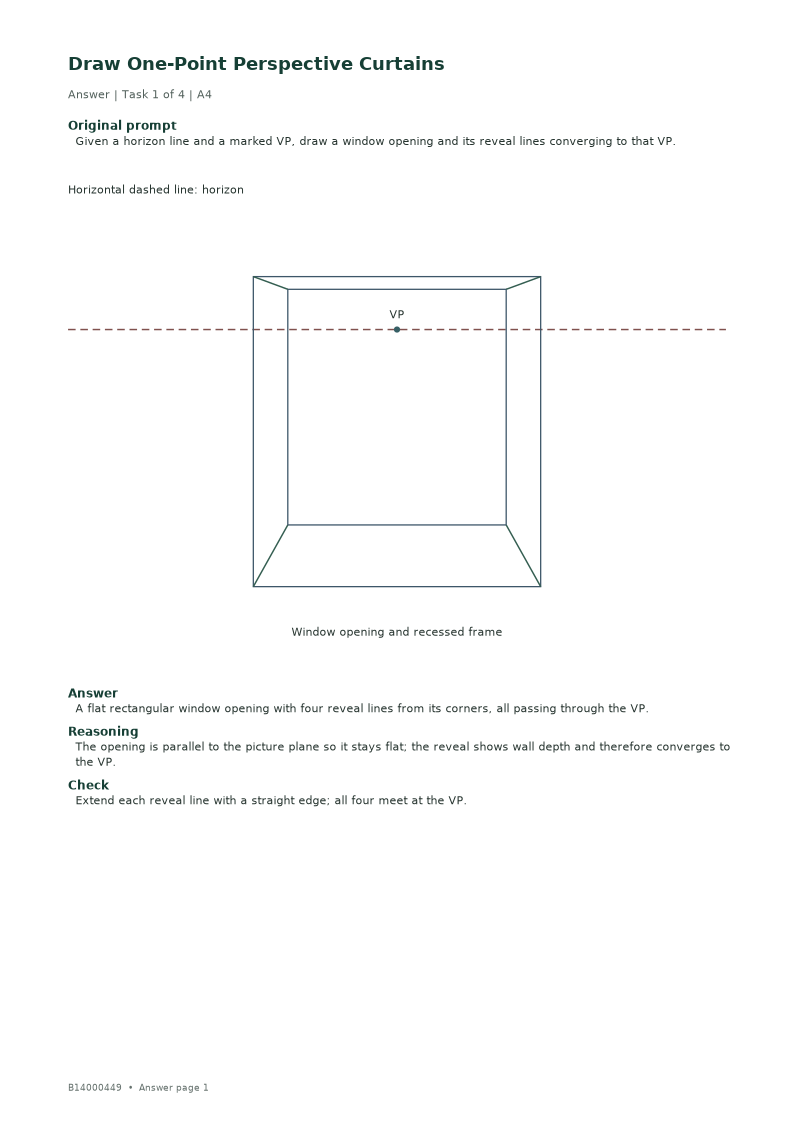
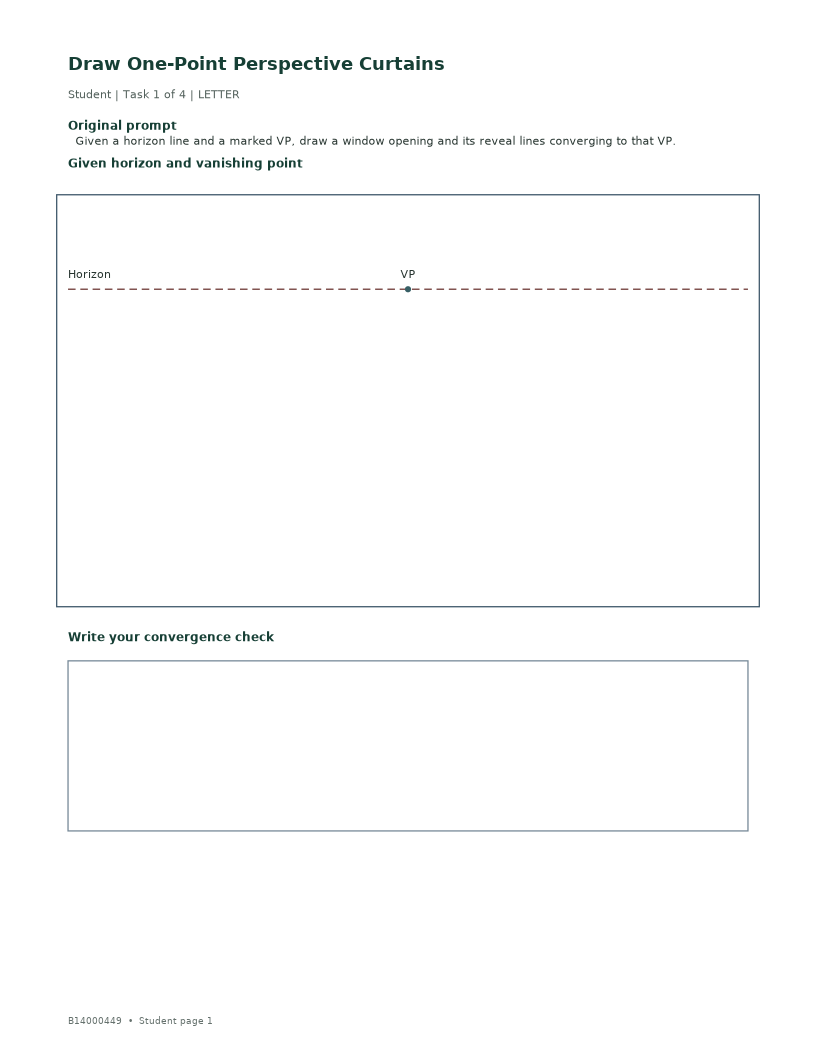
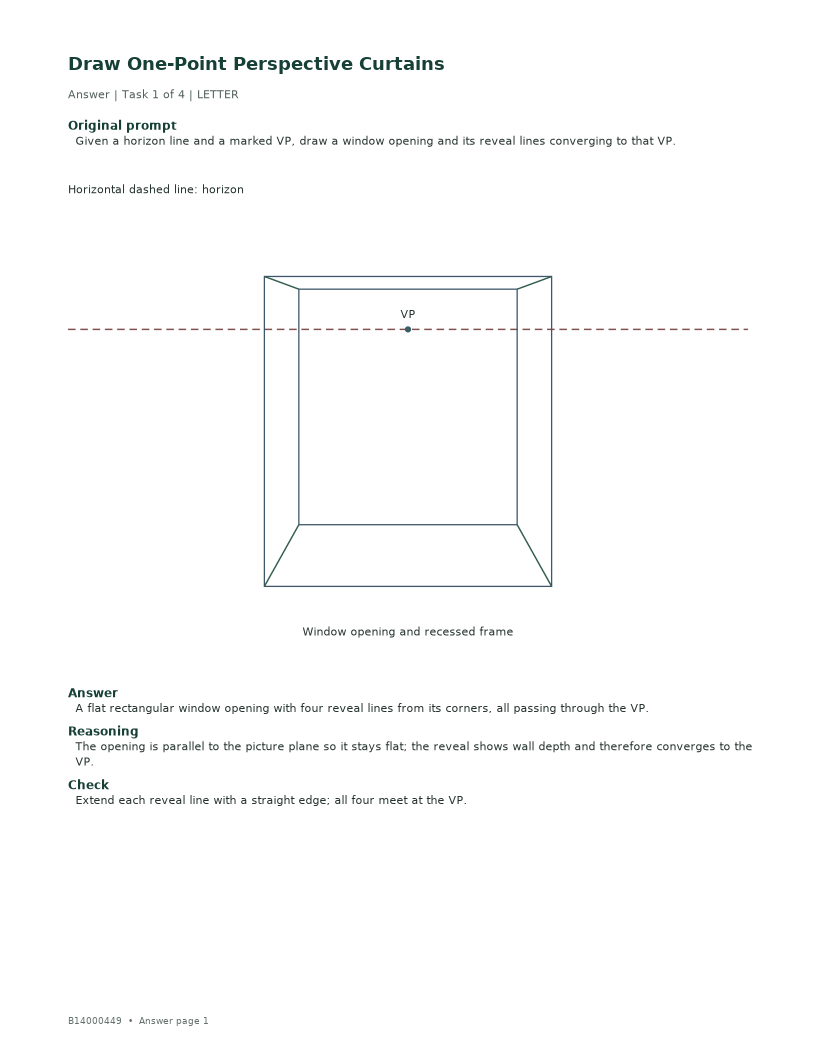
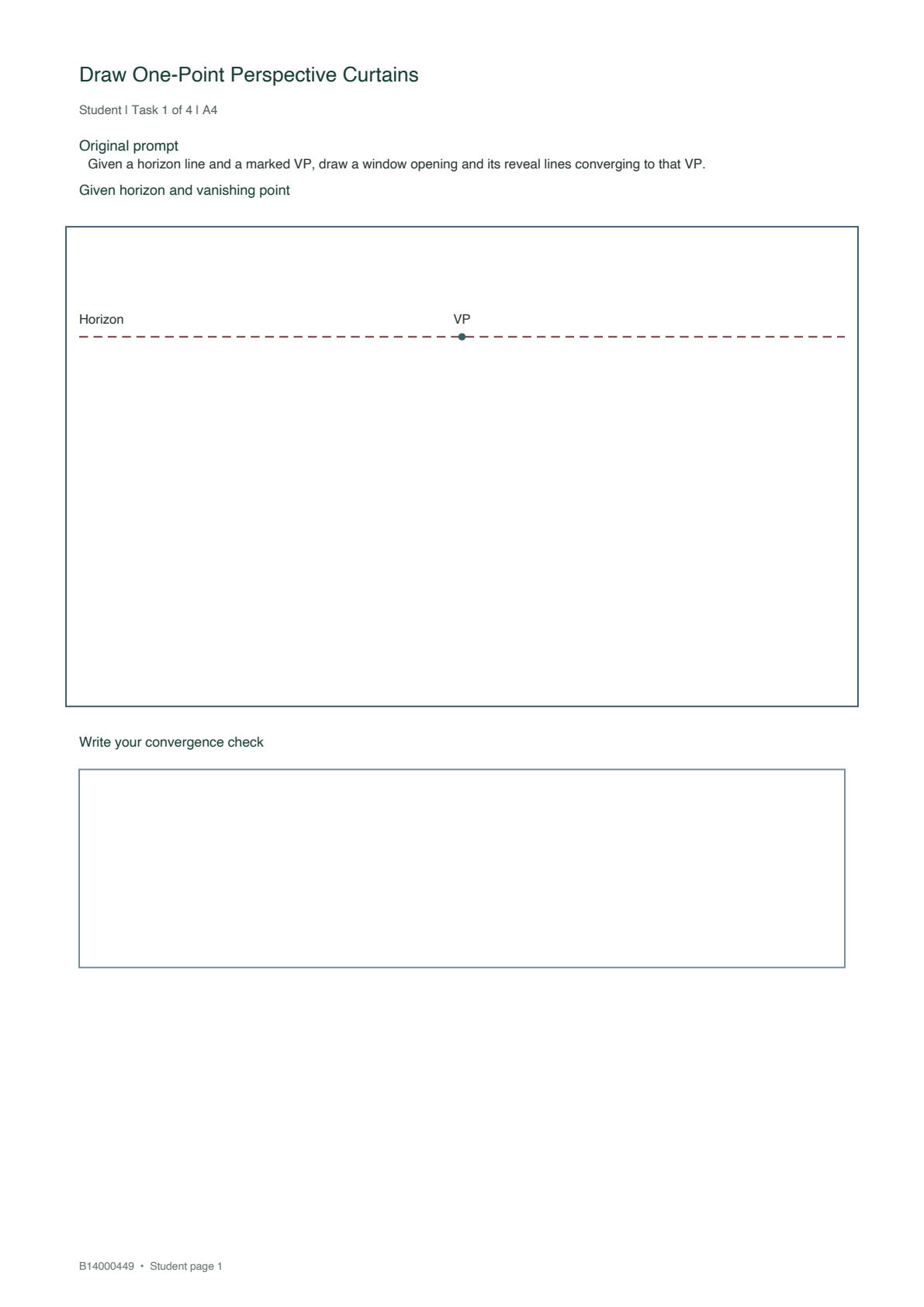
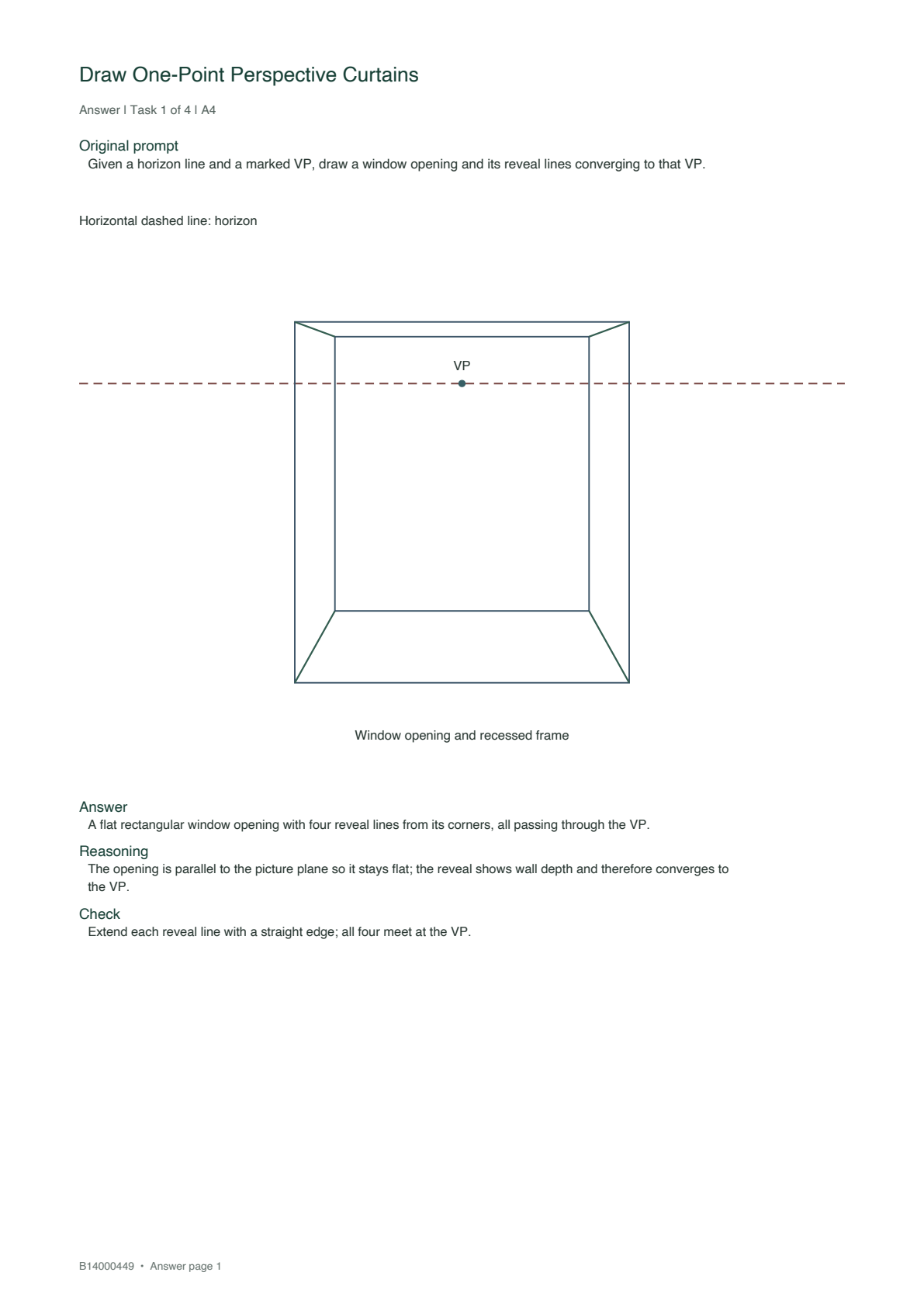
Task 1: Given a horizon line and a marked VP, draw a window opening and its reveal lines converging to that VP. Answer: the opening is a flat rectangle; the four reveal lines from its corners all pass through the VP. Check: extend each reveal line with a straight edge; all meet at the VP.
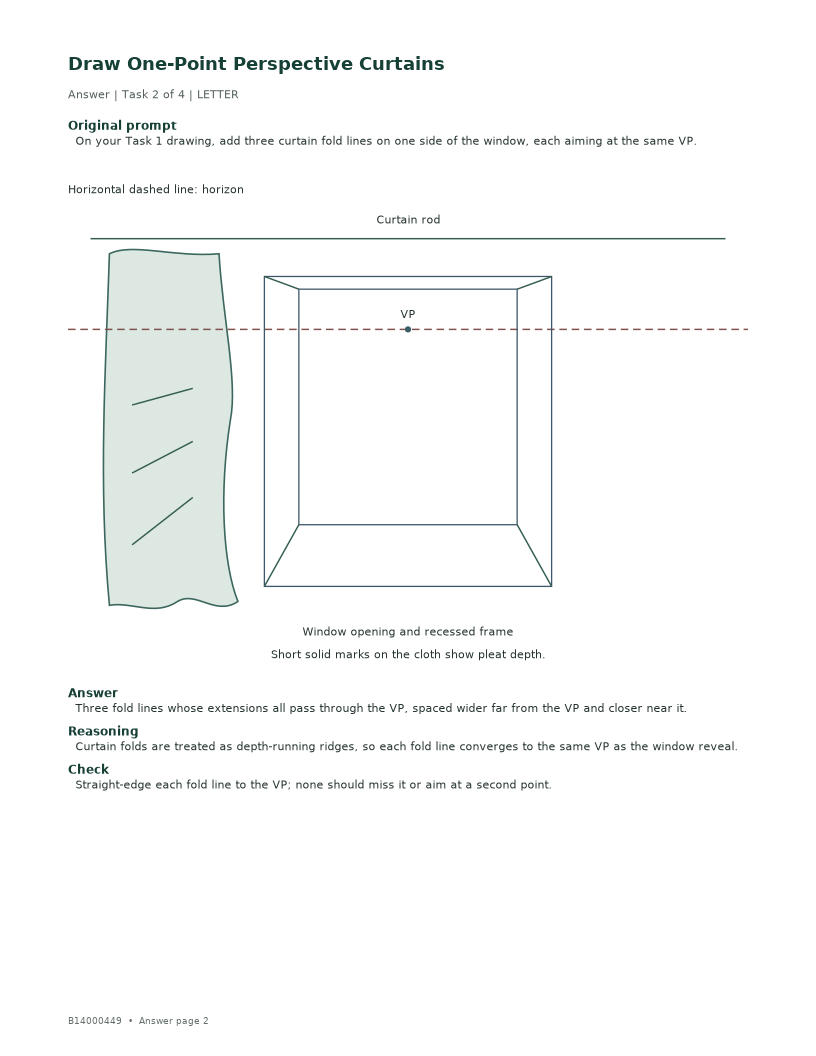
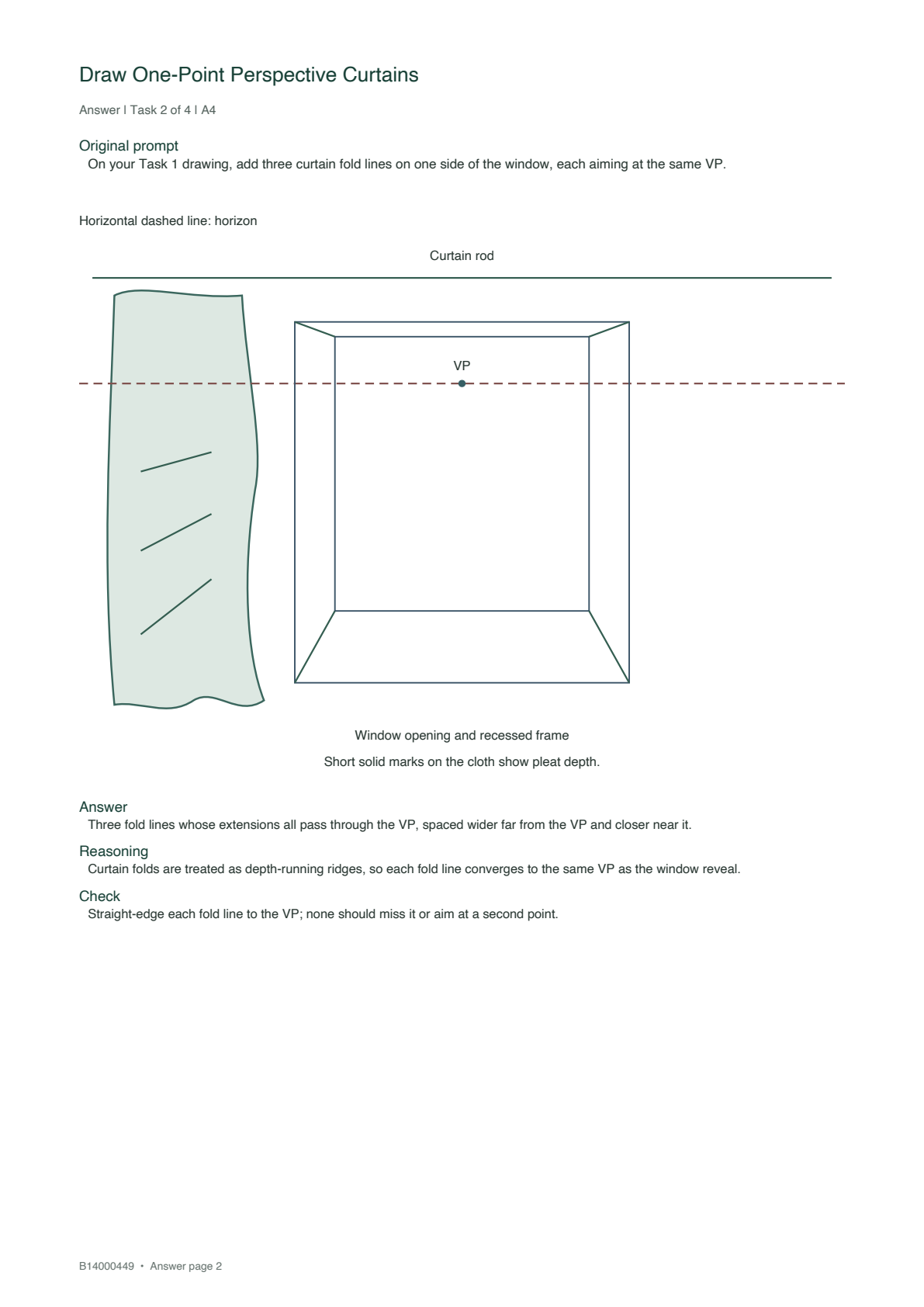
Task 2: On your Task 1 drawing, add three curtain fold lines on one side of the window, each aiming at the same VP. Answer: three fold lines whose extensions all pass through the VP, spaced wider far from the VP and closer near it. Check: straight-edge each fold line to the VP; none should miss it or aim at a second point. (Three folds is a classroom choice for this exercise, not a standard.)
Practice tasks (continued)
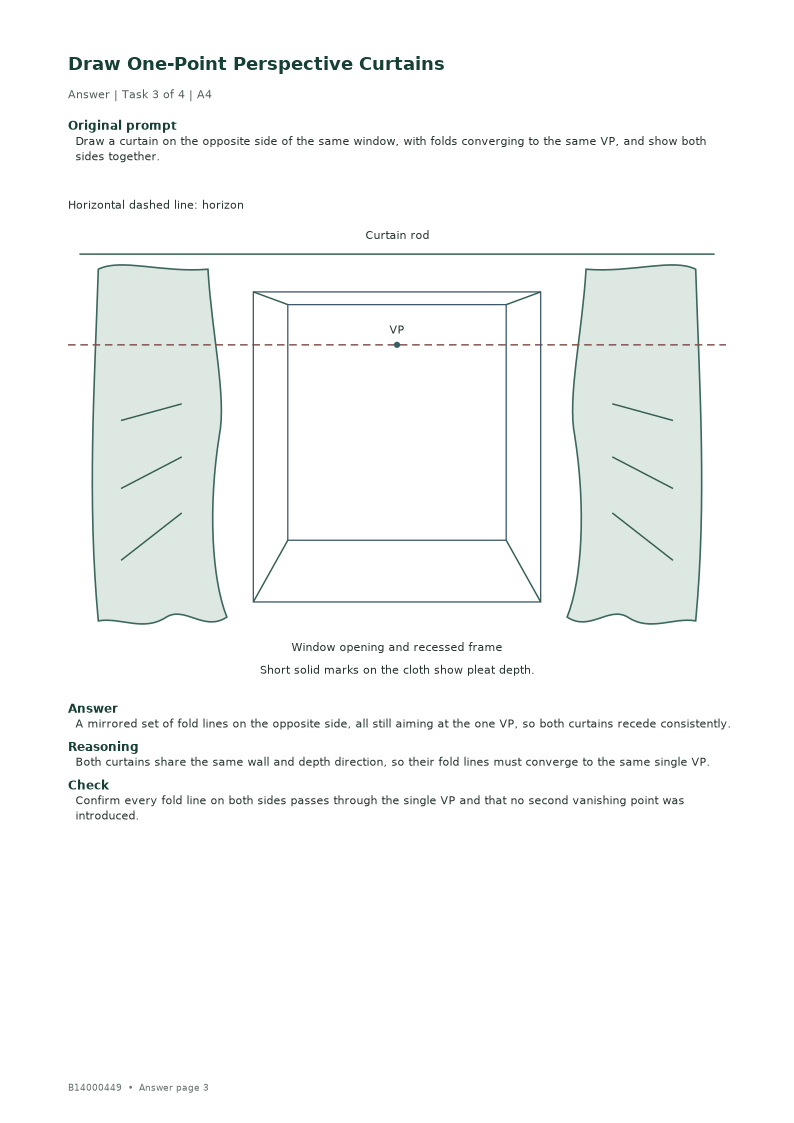
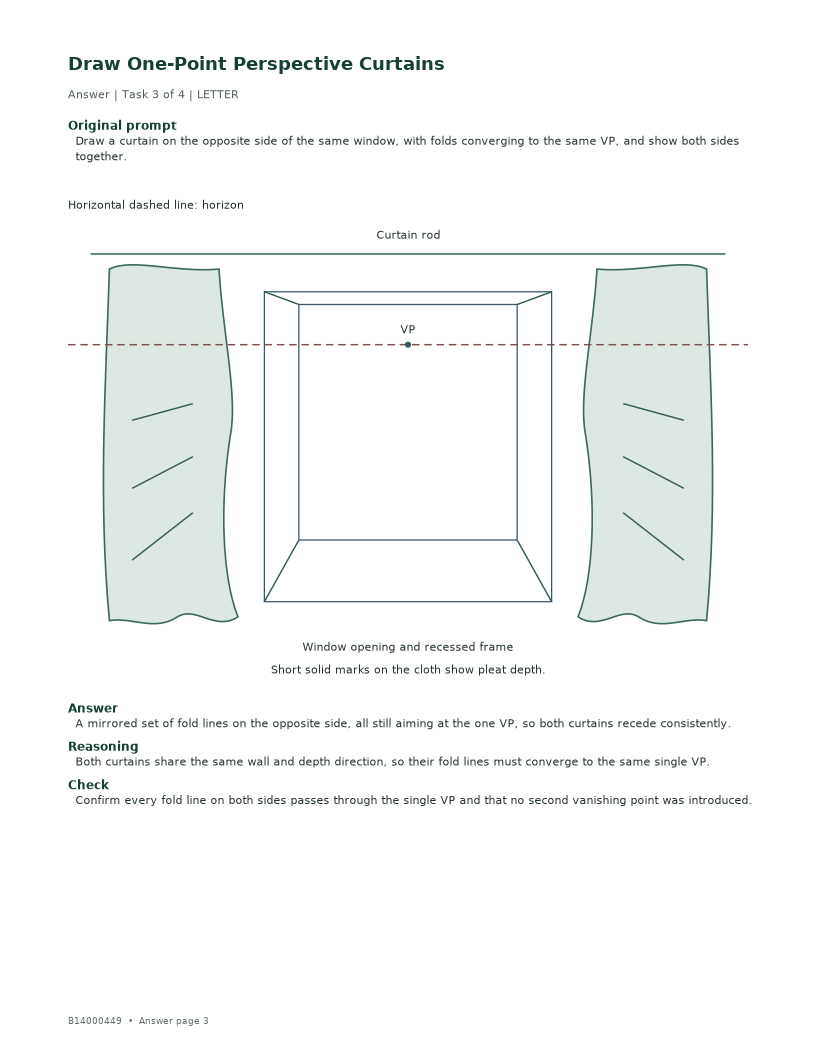
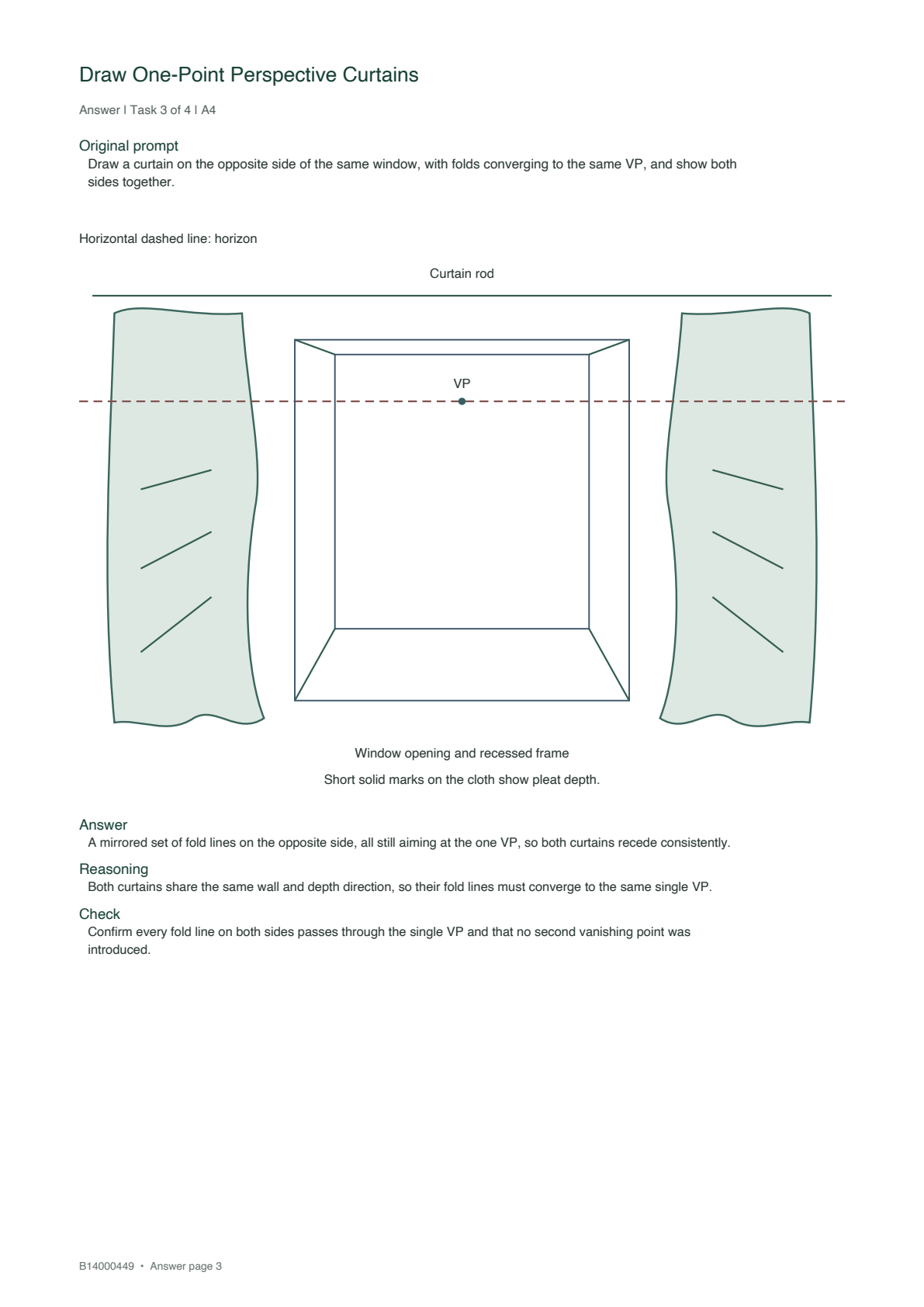
Task 3: Draw a curtain on the opposite side of the same window, with folds converging to the same VP, and show the two sides together. Answer: a mirrored set of fold lines, all still aiming at the one VP, so both curtains recede consistently. Check: confirm every fold line on both sides passes through the single VP and that no second vanishing point was introduced.
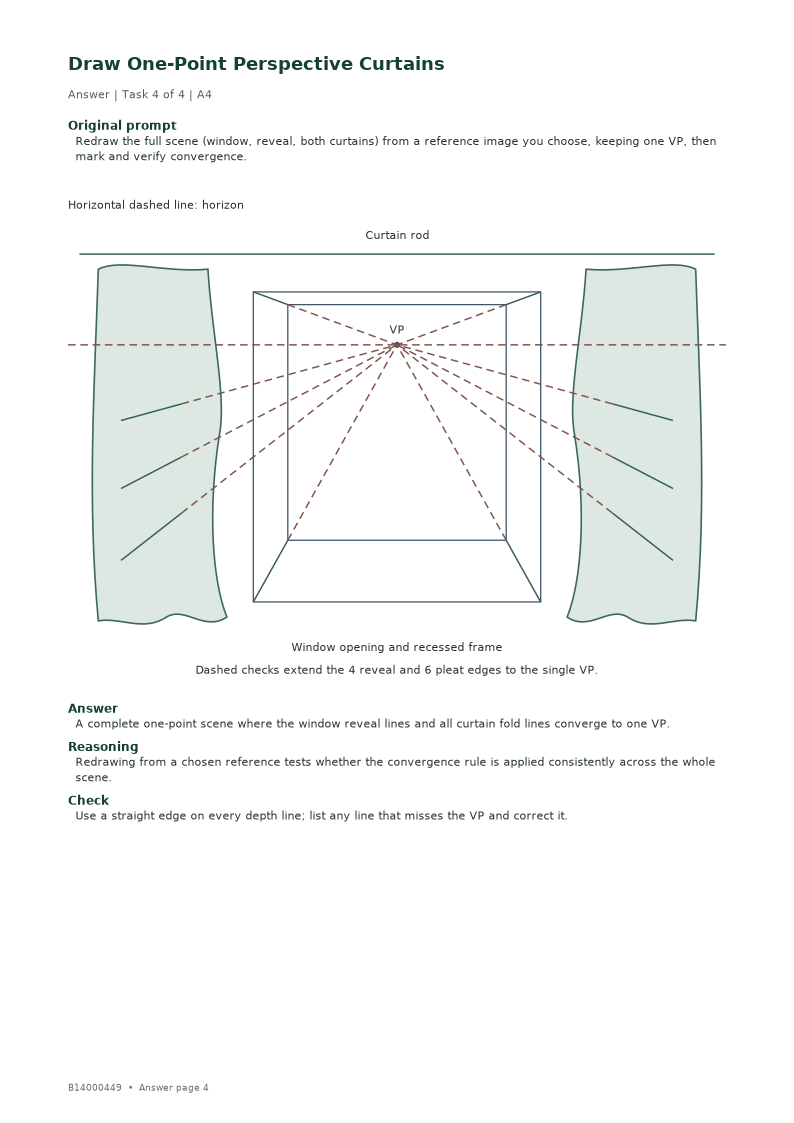
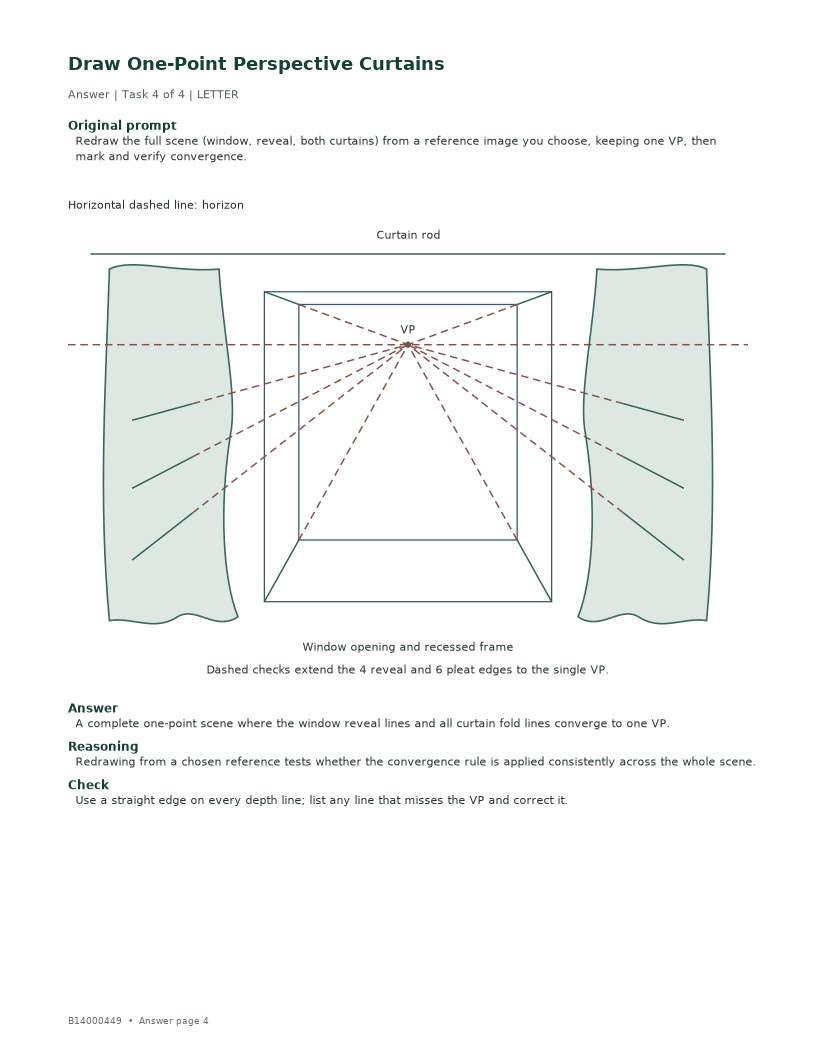
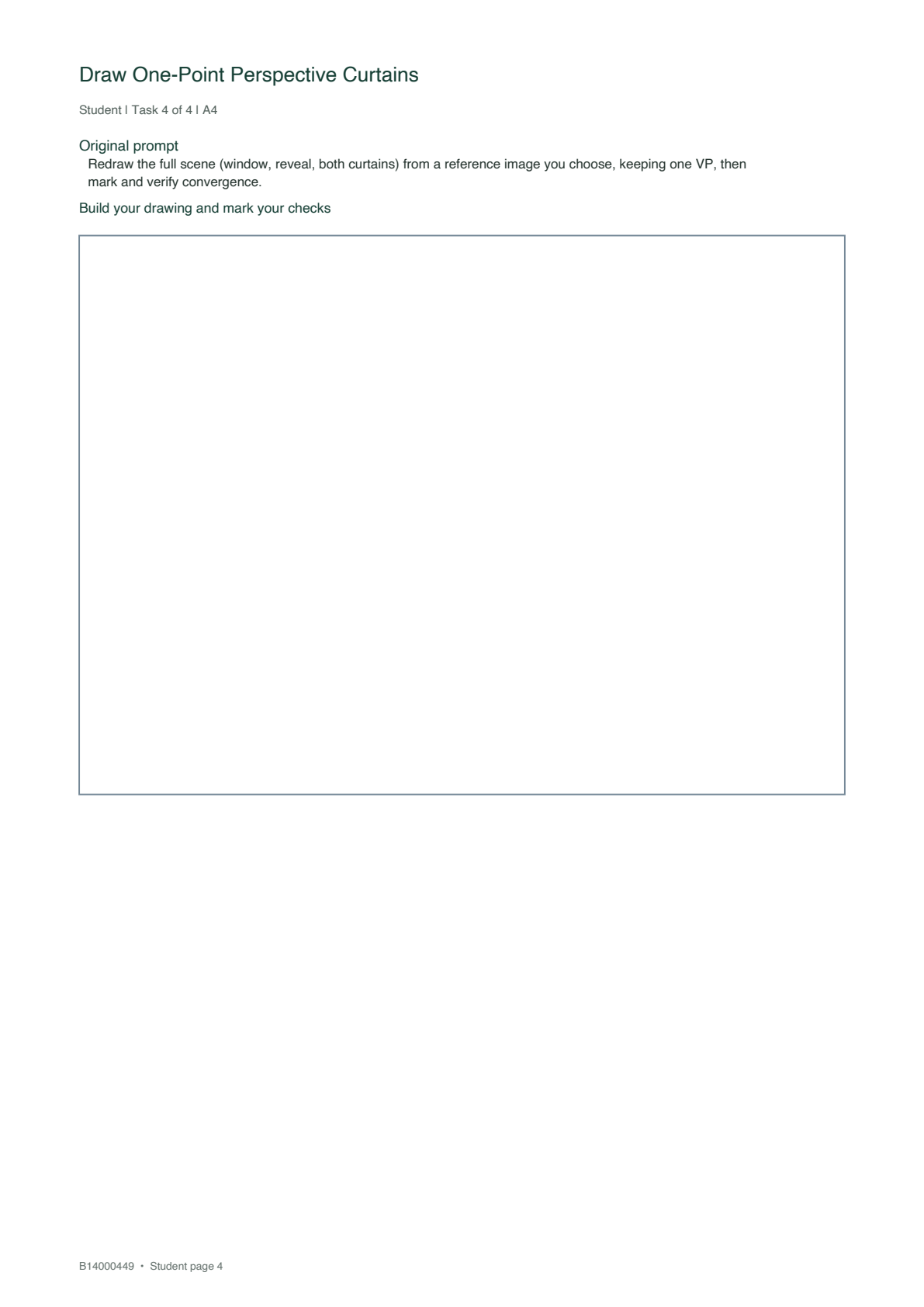
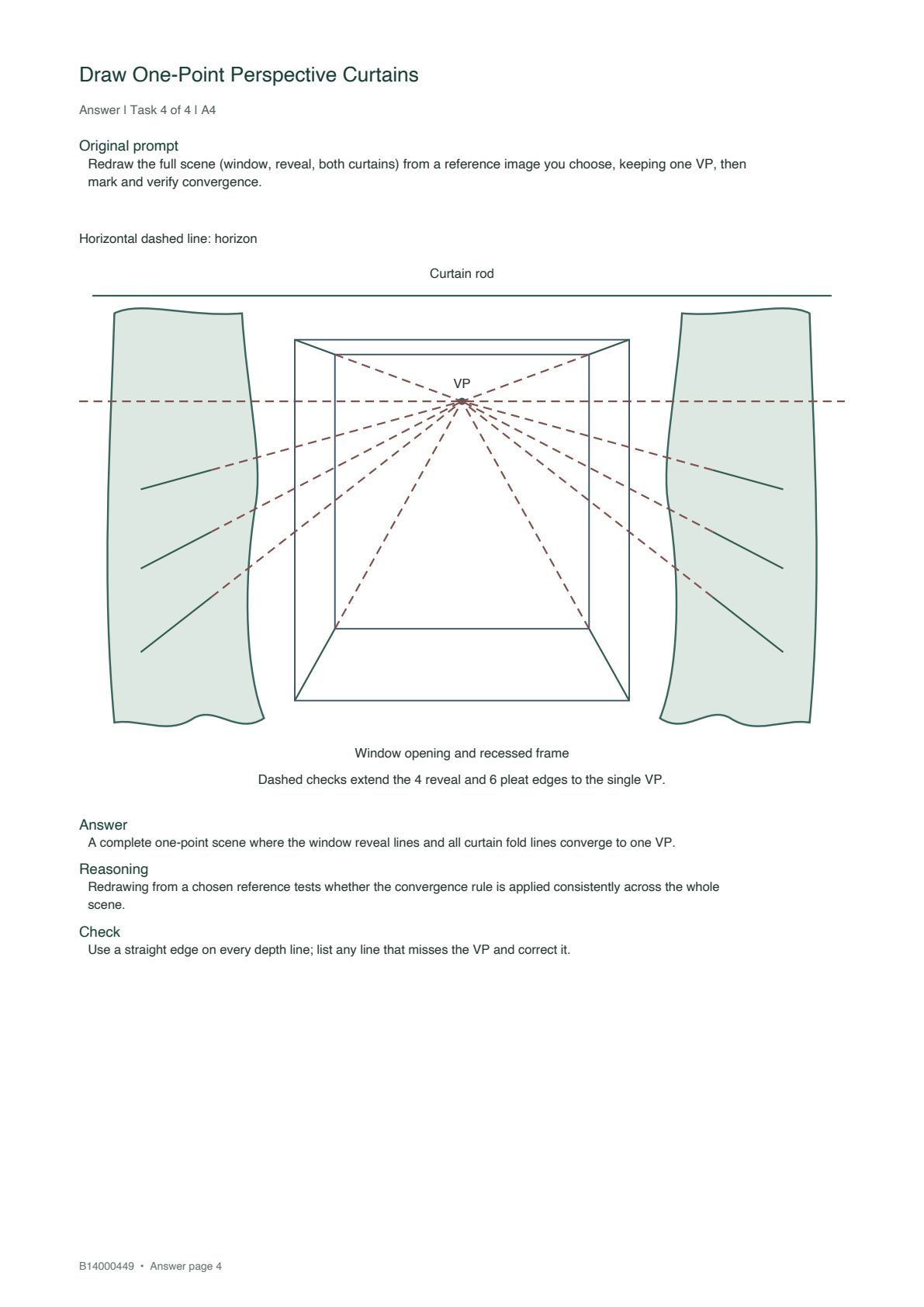
Task 4: Redraw the full scene (window, reveal, both curtains) from a reference image you choose, keeping one VP, then mark and verify convergence. Answer: a complete one-point scene where window reveal lines and all curtain fold lines converge to one VP. Check: use a straight edge on every depth line; list any line that misses the VP and correct it. (The reference image is your own choice; no specific source is required.)
Visual check
The single reliable check is convergence: lay a straight edge along each depth line (reveal lines and fold lines) and confirm it passes through the one VP. Flat faces (the window opening) should stay parallel to the picture plane. If a fold line aims at a different point, redraw it toward the VP.
Download the complete resource pack
All individual SVG pages (18)
- A4 reference page 1
- A4 student page 1
- A4 student page 2
- A4 student page 3
- A4 student page 4
- A4 answer page 1
- A4 answer page 2
- A4 answer page 3
- A4 answer page 4
- LETTER reference page 1
- LETTER student page 1
- LETTER student page 2
- LETTER student page 3
- LETTER student page 4
- LETTER answer page 1
- LETTER answer page 2
- LETTER answer page 3
- LETTER answer page 4
Print at 100% / actual size. Use the stated scale on any schematic diagram; physical cutting templates are identified separately. A4 and US Letter are separate files. Free access, no signup; CC BY 4.0.
How to use these pages
- The construction rule
- Worked example
- Practice tasks
- Practice tasks (continued)
- Visual check
Worked example
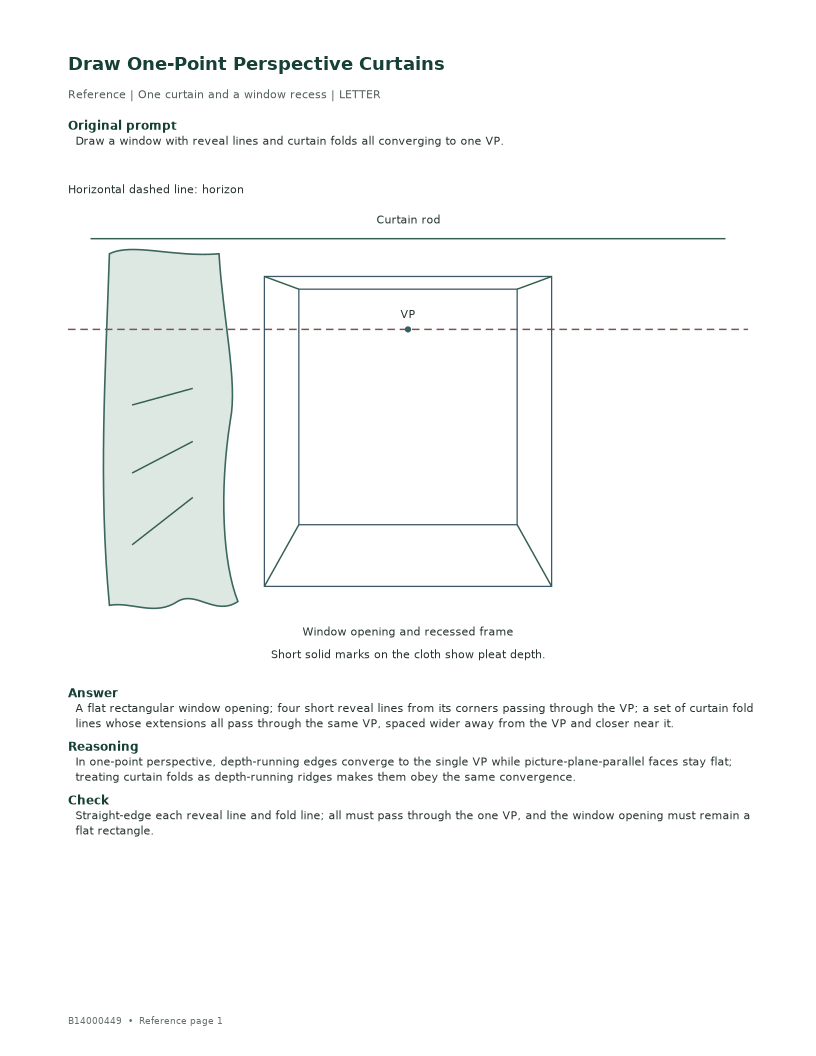
Example: Draw a window with reveal lines and curtain folds all converging to one VP.
Answer: A flat rectangular window opening; four short reveal lines from its corners passing through the VP; a set of curtain fold lines whose extensions all pass through the same VP, spaced wider away from the VP and closer near it.
Reasoning: In one-point perspective, depth-running edges converge to the single VP while picture-plane-parallel faces stay flat; treating curtain folds as depth-running ridges makes them obey the same convergence.
Check: Straight-edge each reveal line and fold line; all must pass through the one VP, and the window opening must remain a flat rectangle.
Four practice tasks and complete answers
Task 1
Given a horizon line and a marked VP, draw a window opening and its reveal lines converging to that VP.
Show answer 1
A flat rectangular window opening with four reveal lines from its corners, all passing through the VP.
The opening is parallel to the picture plane so it stays flat; the reveal shows wall depth and therefore converges to the VP.
Check: Extend each reveal line with a straight edge; all four meet at the VP.
Task 2
On your Task 1 drawing, add three curtain fold lines on one side of the window, each aiming at the same VP.
Show answer 2
Three fold lines whose extensions all pass through the VP, spaced wider far from the VP and closer near it.
Curtain folds are treated as depth-running ridges, so each fold line converges to the same VP as the window reveal.
Check: Straight-edge each fold line to the VP; none should miss it or aim at a second point.
Task 3
Draw a curtain on the opposite side of the same window, with folds converging to the same VP, and show both sides together.
Show answer 3
A mirrored set of fold lines on the opposite side, all still aiming at the one VP, so both curtains recede consistently.
Both curtains share the same wall and depth direction, so their fold lines must converge to the same single VP.
Check: Confirm every fold line on both sides passes through the single VP and that no second vanishing point was introduced.
Task 4
Redraw the full scene (window, reveal, both curtains) from a reference image you choose, keeping one VP, then mark and verify convergence.
Show answer 4
A complete one-point scene where the window reveal lines and all curtain fold lines converge to one VP.
Redrawing from a chosen reference tests whether the convergence rule is applied consistently across the whole scene.
Check: Use a straight edge on every depth line; list any line that misses the VP and correct it.
Useful checks
- Treating a vertical hanging edge as a line running into depth. Use the vanishing point for the short depth-running pleat marks. Keep an upright hanging edge vertical.
- Using a second vanishing point for the curtains. Keep one VP for the whole scene; re-aim any fold line that points elsewhere.
- Making the window opening converge like a depth face. Keep the opening a flat rectangle parallel to the picture plane; only the reveal converges.
Questions about this resource
Do I need exact measurements?
No. This is a qualitative drawing task; correctness is judged by convergence to the single VP, not by measured lengths.
How many folds should I draw?
Task 2 gives three short pleat marks on one side. Repeat that arrangement on the other side for Task 3 and use the same vanishing point.