Free original lessons
World History Timeline Template
Read dates from oldest on the left to newest on the right. Each event belongs in the date band that contains it. The three equal-width bands group dates for this class. The time spans they cover differ.
Letter & A4
PDF & SVG
What the strip is
A world-history timeline strip is a single horizontal band read left to right, oldest to newest. It is divided into dated era bands, and each era band contains fillable event boxes.
The bands are classroom choices for grouping. For 1200 BCE or 500 CE, use the band that begins at that printed date. The Great Pyramid label uses c. for an approximate date from Khufu's era. The Olympic label refers to the first surviving written mention in 776 BCE. The Norman Conquest is dated here to 1066 CE.
How to build the strip
Step 1: Draw the strip as one long horizontal band. Step 2: Divide it into era bands from left to right, oldest to newest, and label each band with its date range.
Step 3: Inside each era band, draw fillable event boxes. Step 4: In each box, leave a line for a date and a line for a short event label.
How to fill and check it
Fill each event box with a date and a short event label. Place the box inside the era band whose date range contains that date.
Check the strip by reading left to right: dates should increase, and each box should sit inside the correct era band. A box outside its matching band is a placement error.
Download the complete resource pack
All individual SVG pages (18)
- A4 reference page 1
- A4 student page 1
- A4 student page 2
- A4 student page 3
- A4 student page 4
- A4 answer page 1
- A4 answer page 2
- A4 answer page 3
- A4 answer page 4
- LETTER reference page 1
- LETTER student page 1
- LETTER student page 2
- LETTER student page 3
- LETTER student page 4
- LETTER answer page 1
- LETTER answer page 2
- LETTER answer page 3
- LETTER answer page 4
Print at 100% / actual size. Use the stated scale on any schematic diagram; physical cutting templates are identified separately. A4 and US Letter are separate files. Free access, no signup; CC BY 4.0.
How to use these pages
- What the strip is
- How to build the strip
- How to fill and check it
Worked example
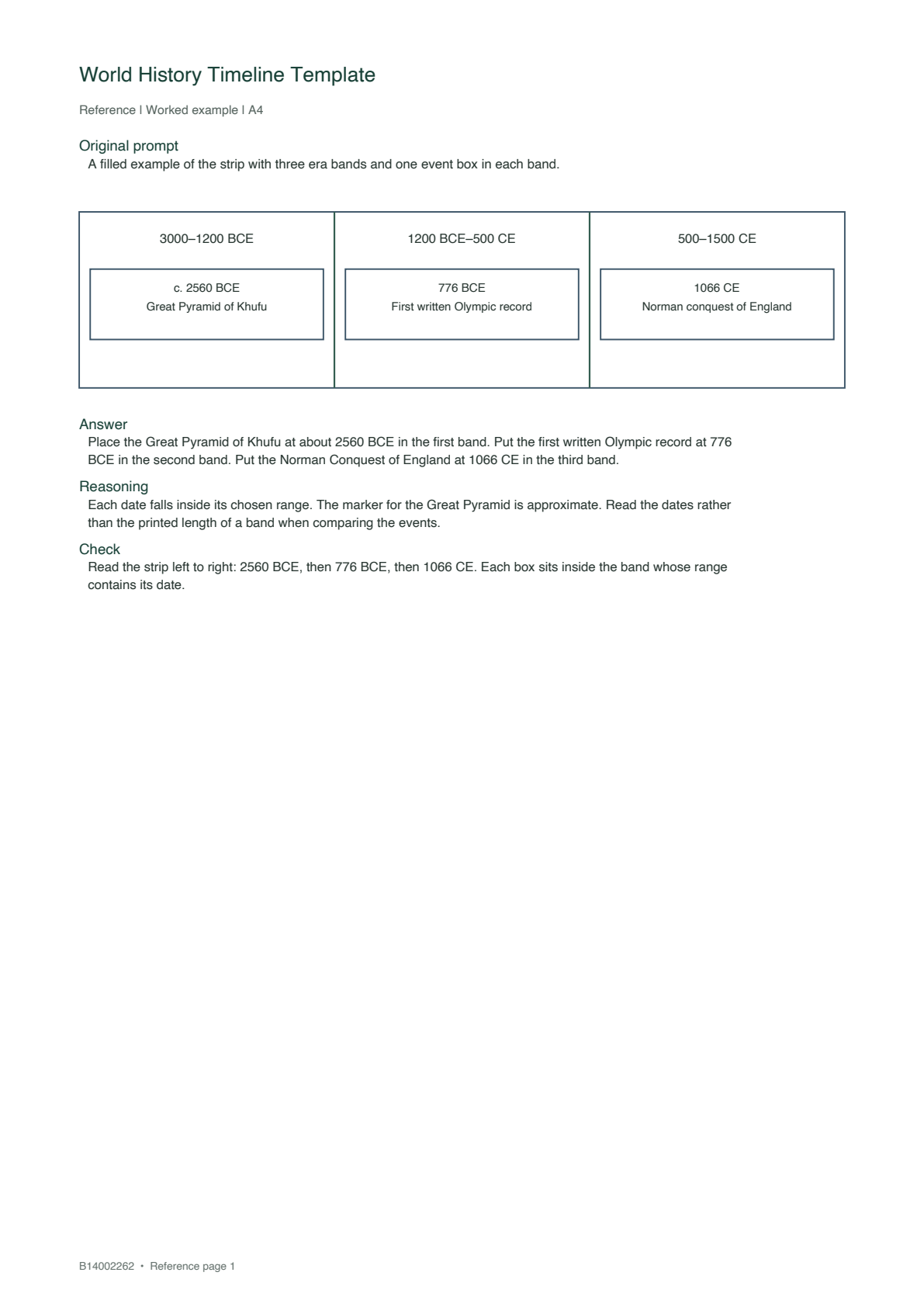
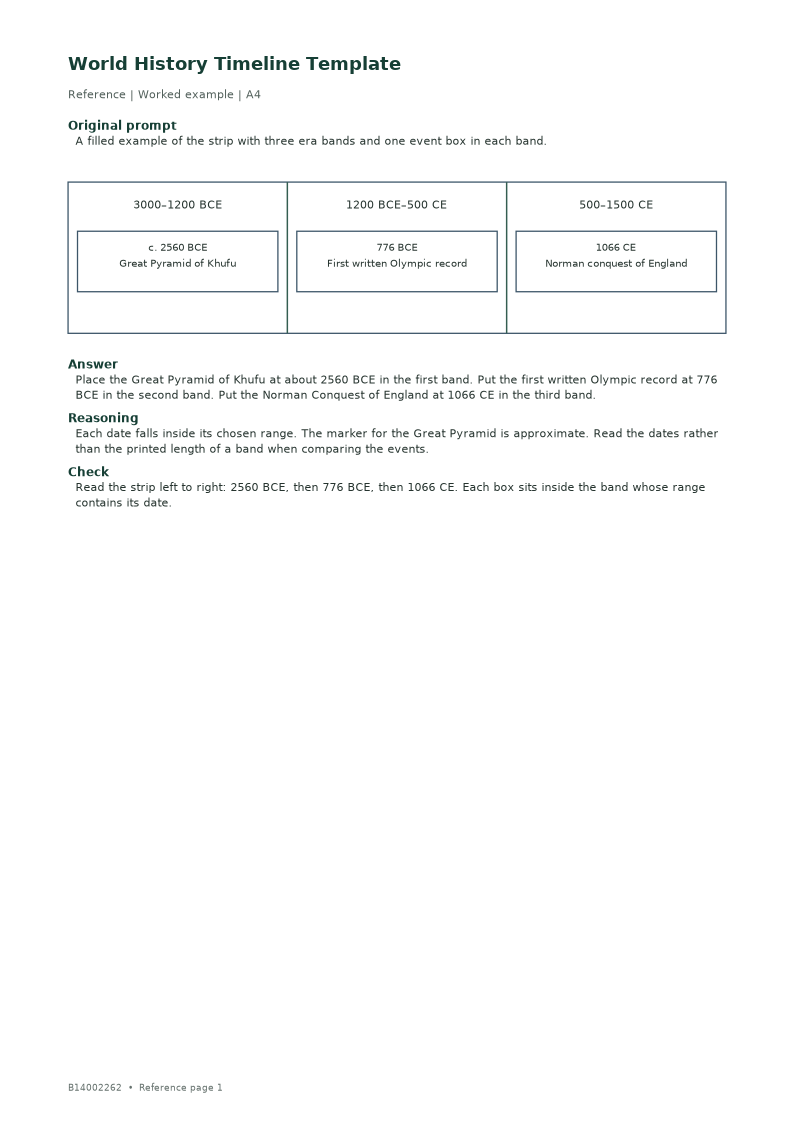
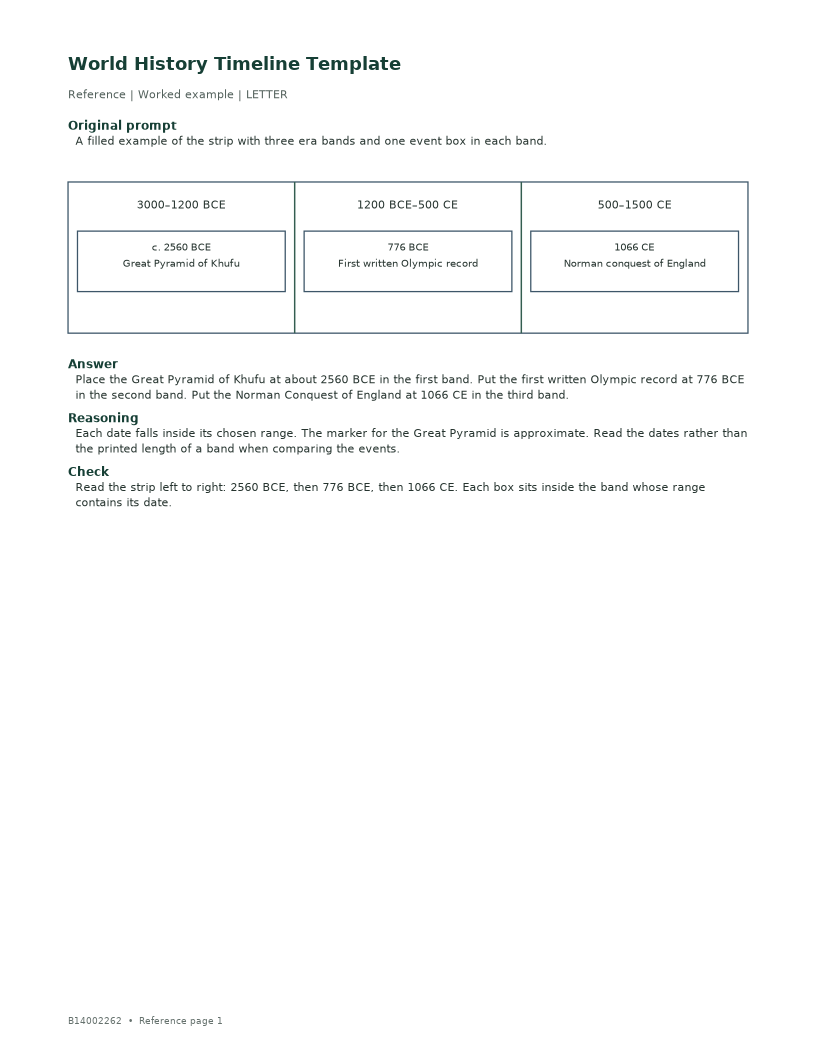
Example: A filled example of the strip with three era bands and one event box in each band.
Answer: Place the Great Pyramid of Khufu at about 2560 BCE in the first band. Put the first written Olympic record at 776 BCE in the second band. Put the Norman Conquest of England at 1066 CE in the third band.
Reasoning: Each date falls inside its chosen range. The marker for the Great Pyramid is approximate. Read the dates rather than the printed length of a band when comparing the events.
Check: Read the strip left to right: 2560 BCE, then 776 BCE, then 1066 CE. Each box sits inside the band whose range contains its date.
Four practice tasks and complete answers
Task 1
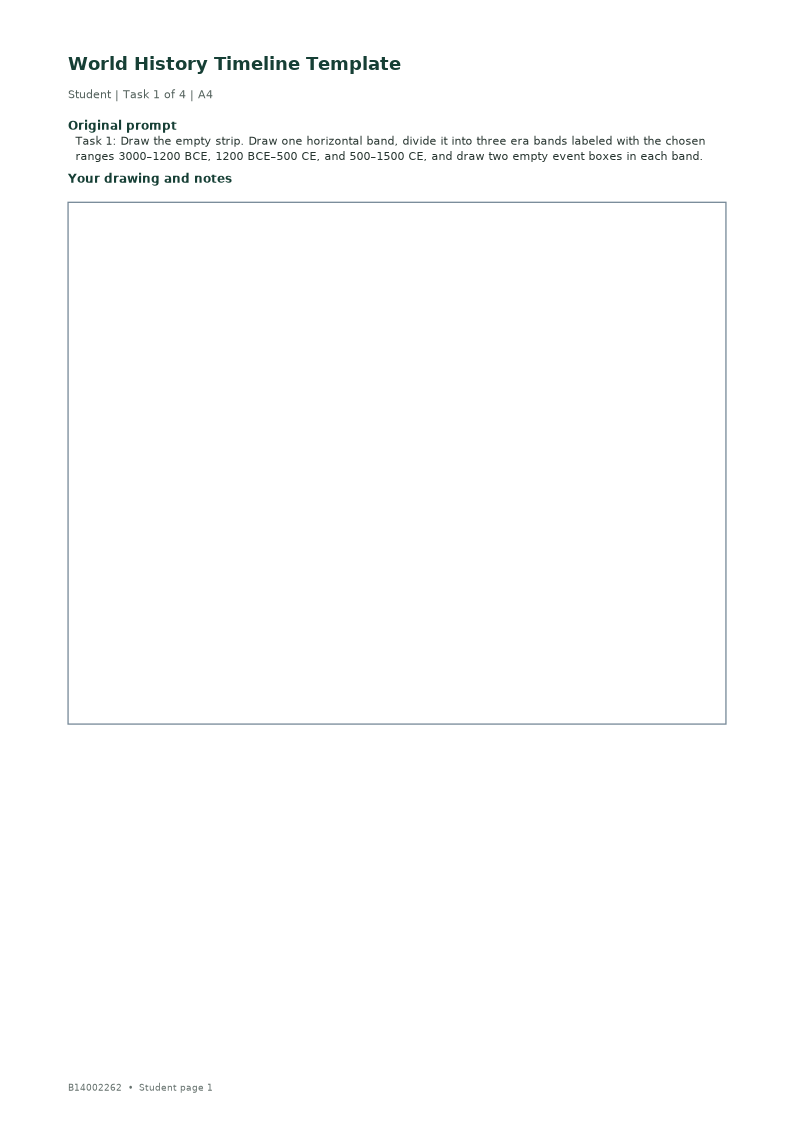
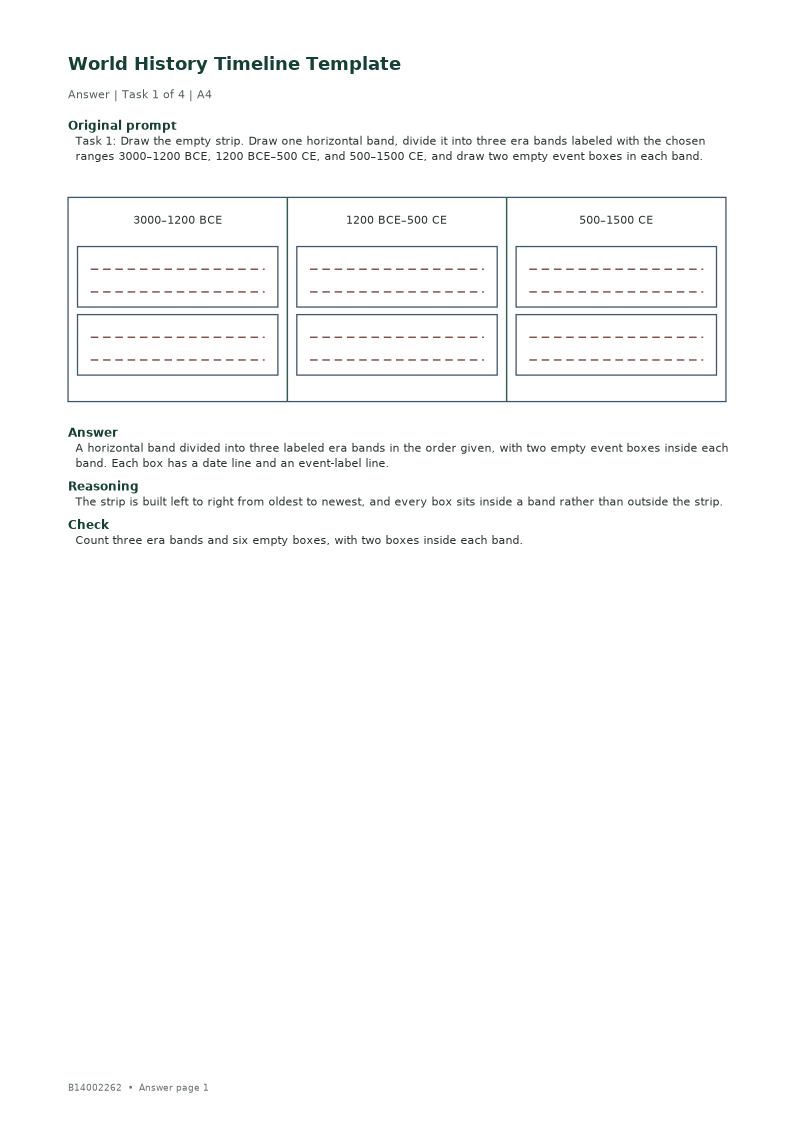
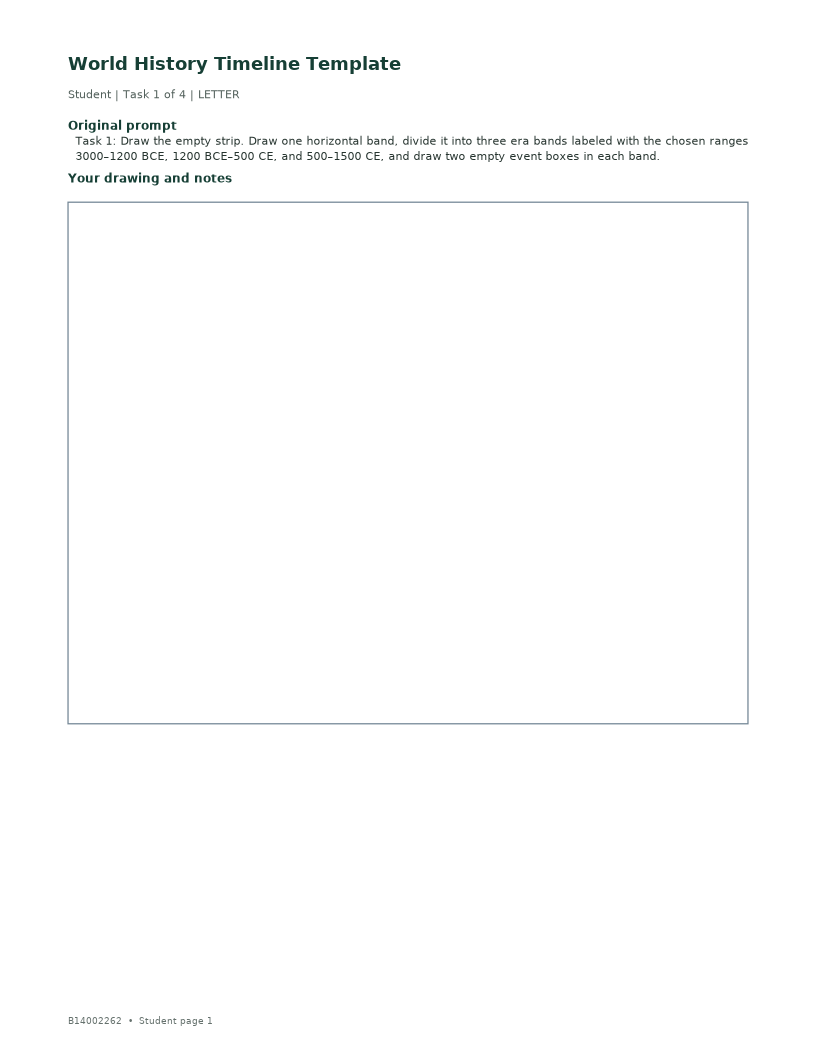
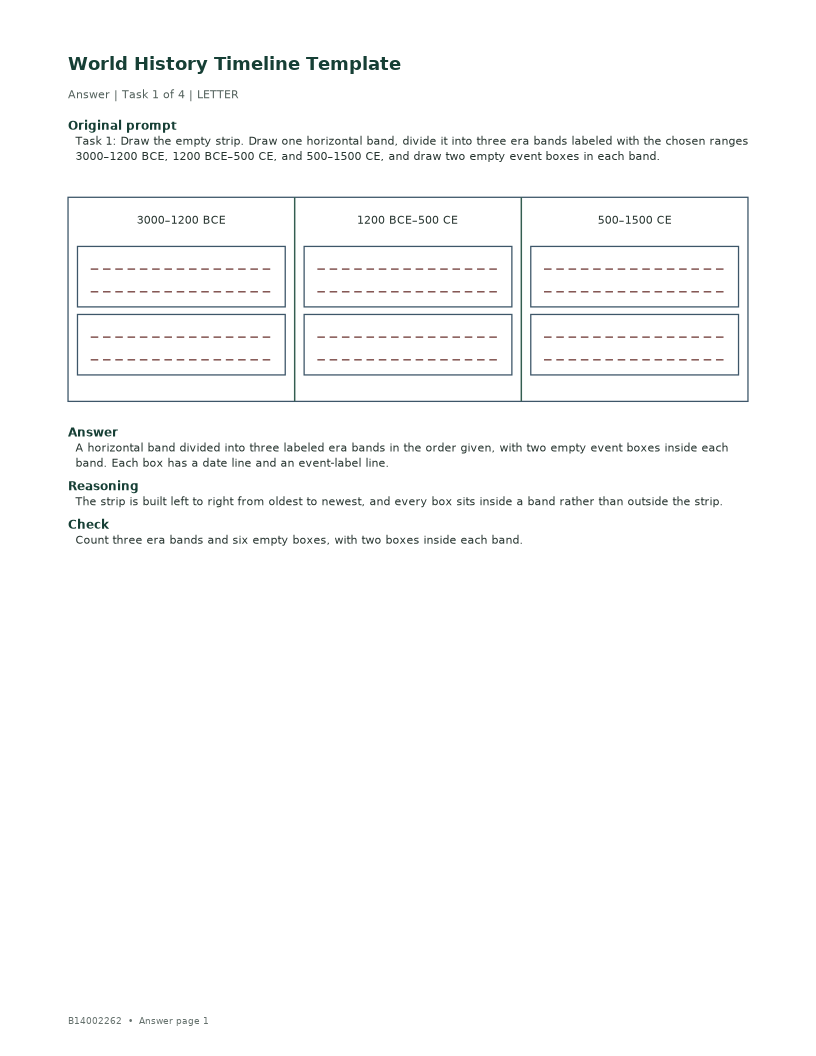
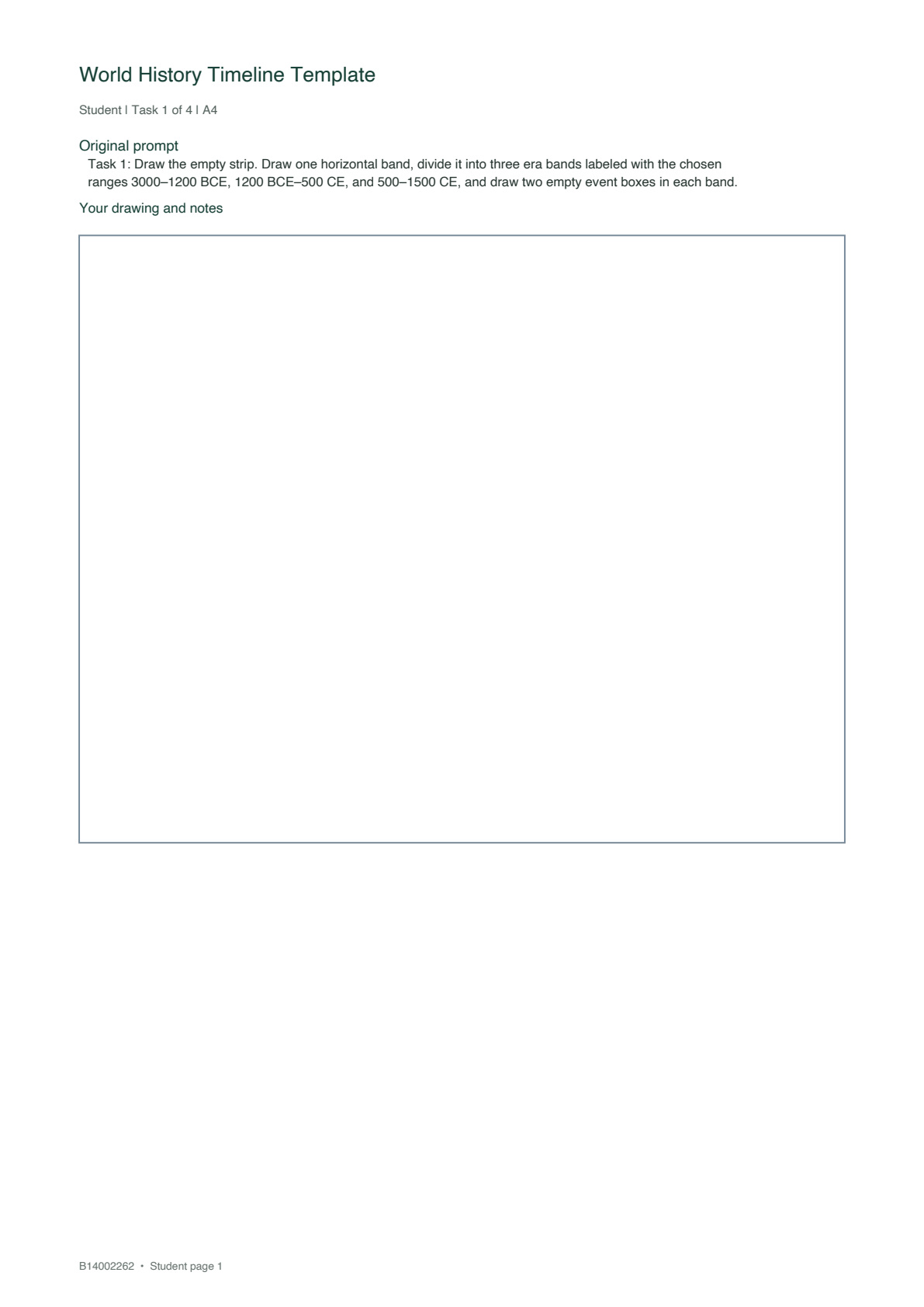
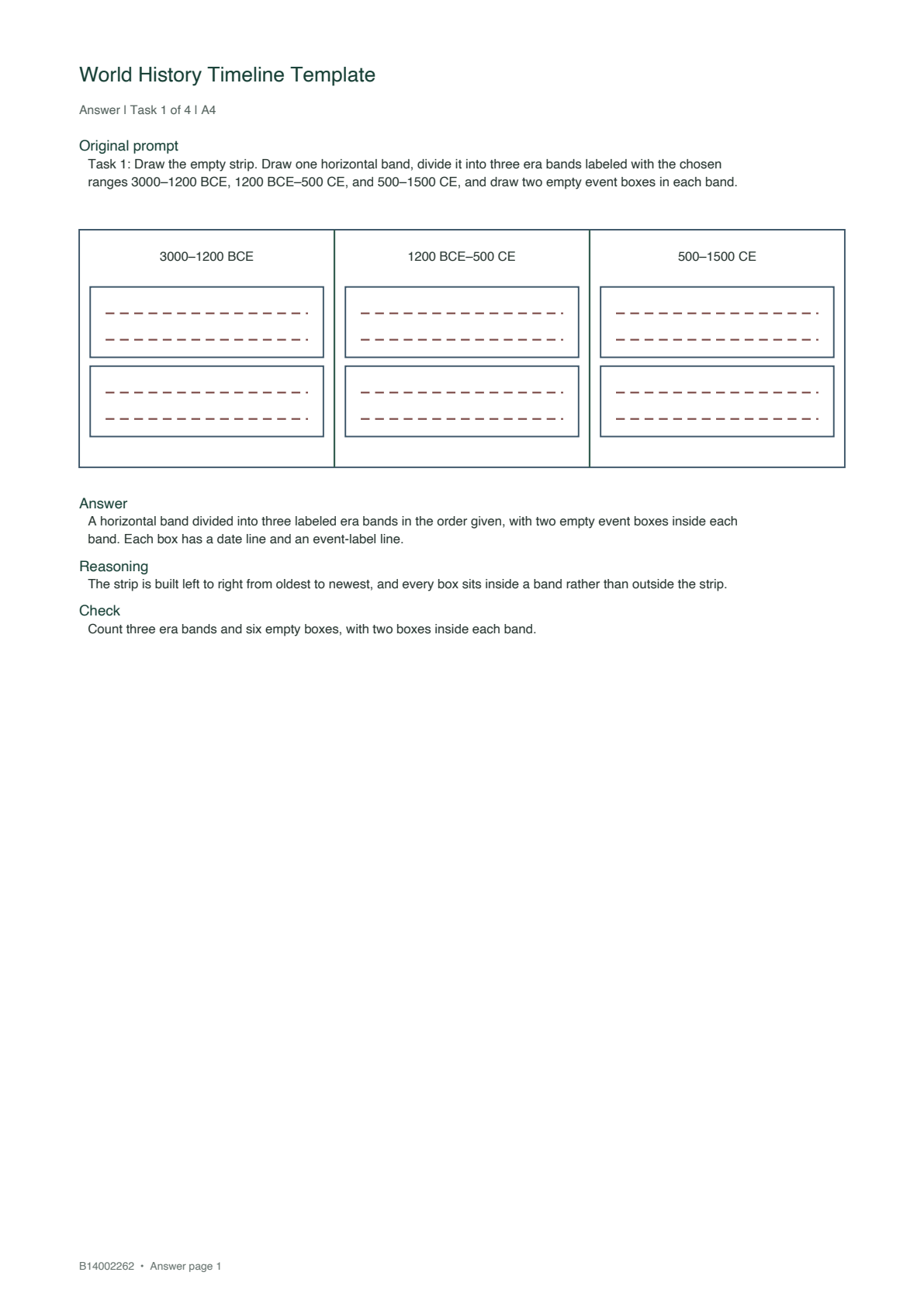
Task 1: Draw the empty strip. Draw one horizontal band, divide it into three era bands labeled with the chosen ranges 3000–1200 BCE, 1200 BCE–500 CE, and 500–1500 CE, and draw two empty event boxes in each band.
Show answer 1
A horizontal band divided into three labeled era bands in the order given, with two empty event boxes inside each band. Each box has a date line and an event-label line.
The strip is built left to right from oldest to newest, and every box sits inside a band rather than outside the strip.
Check: Count three era bands and six empty boxes, with two boxes inside each band.
Task 2
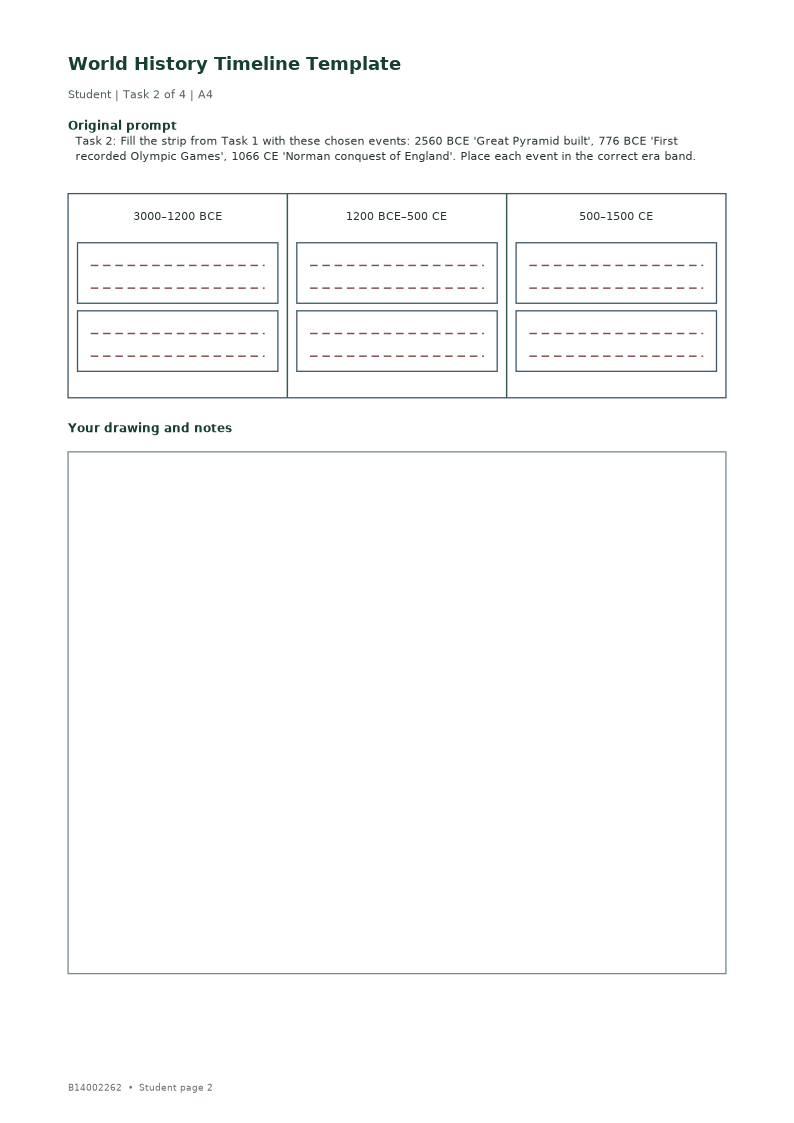
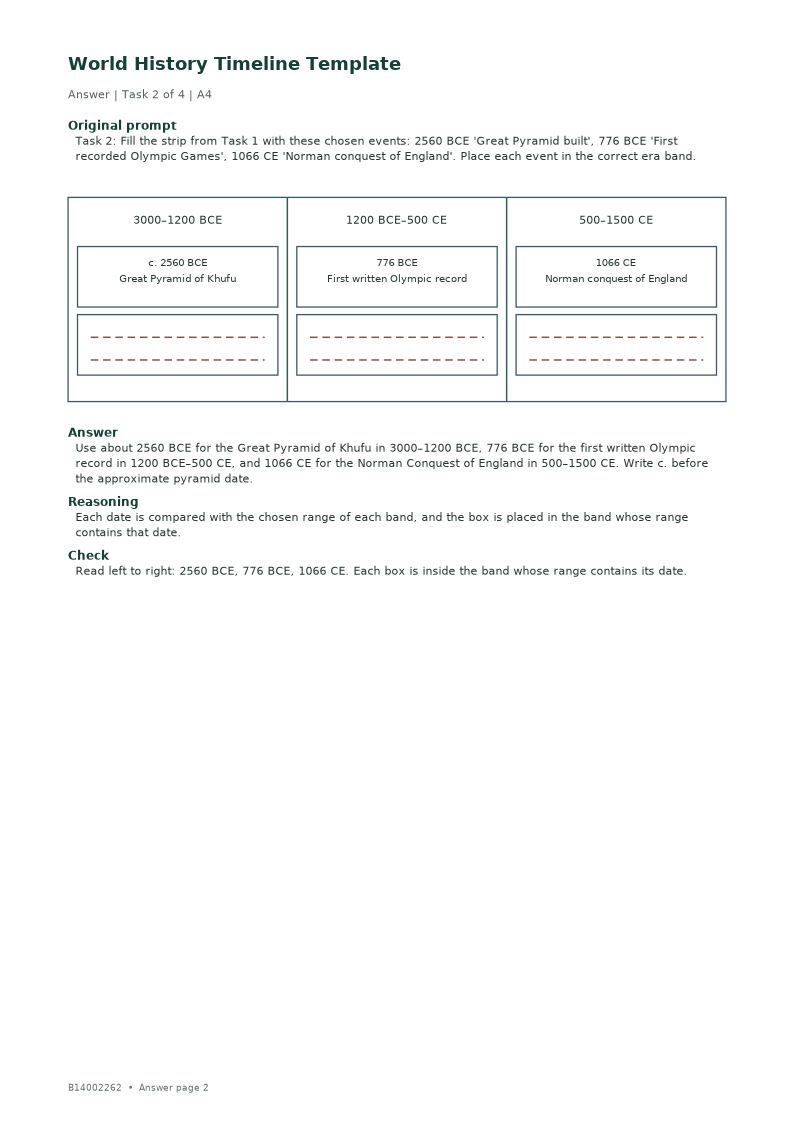
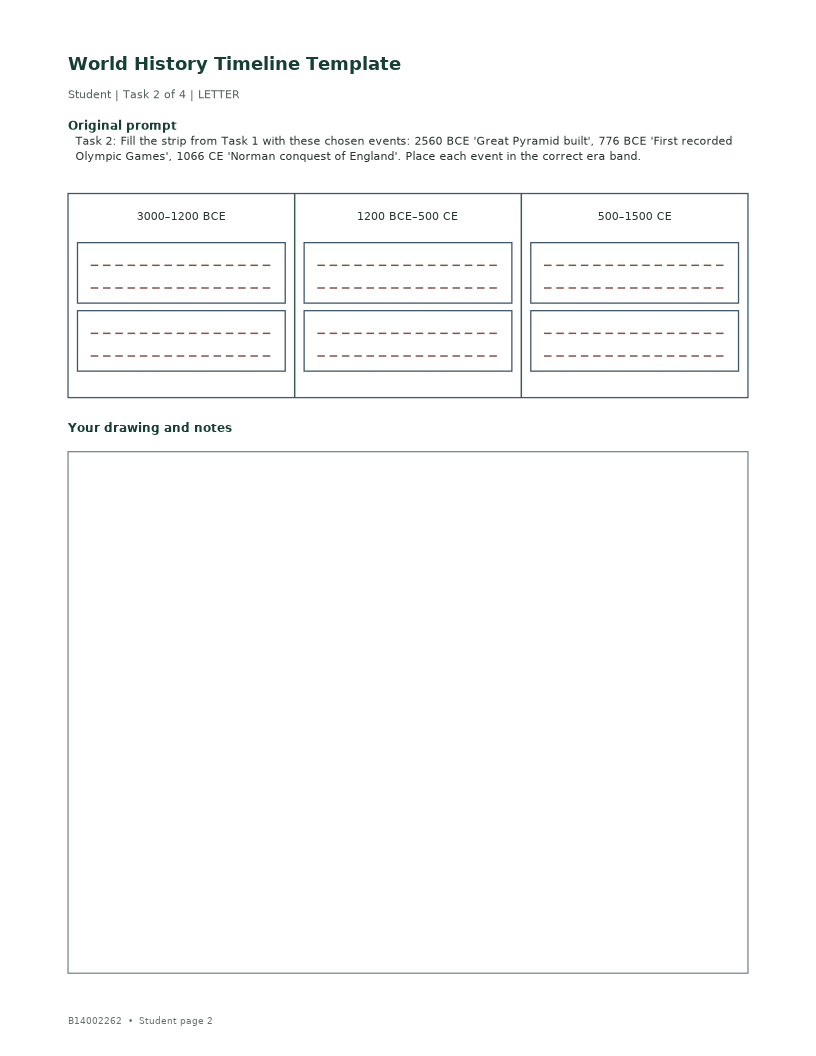
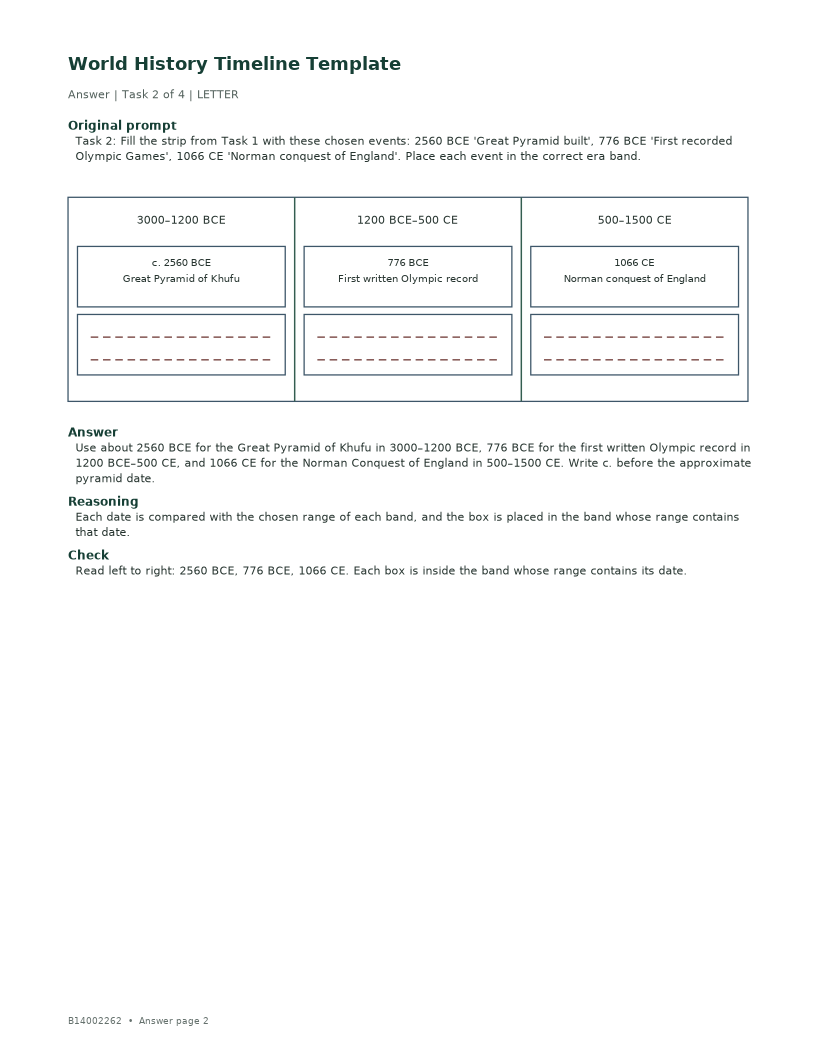
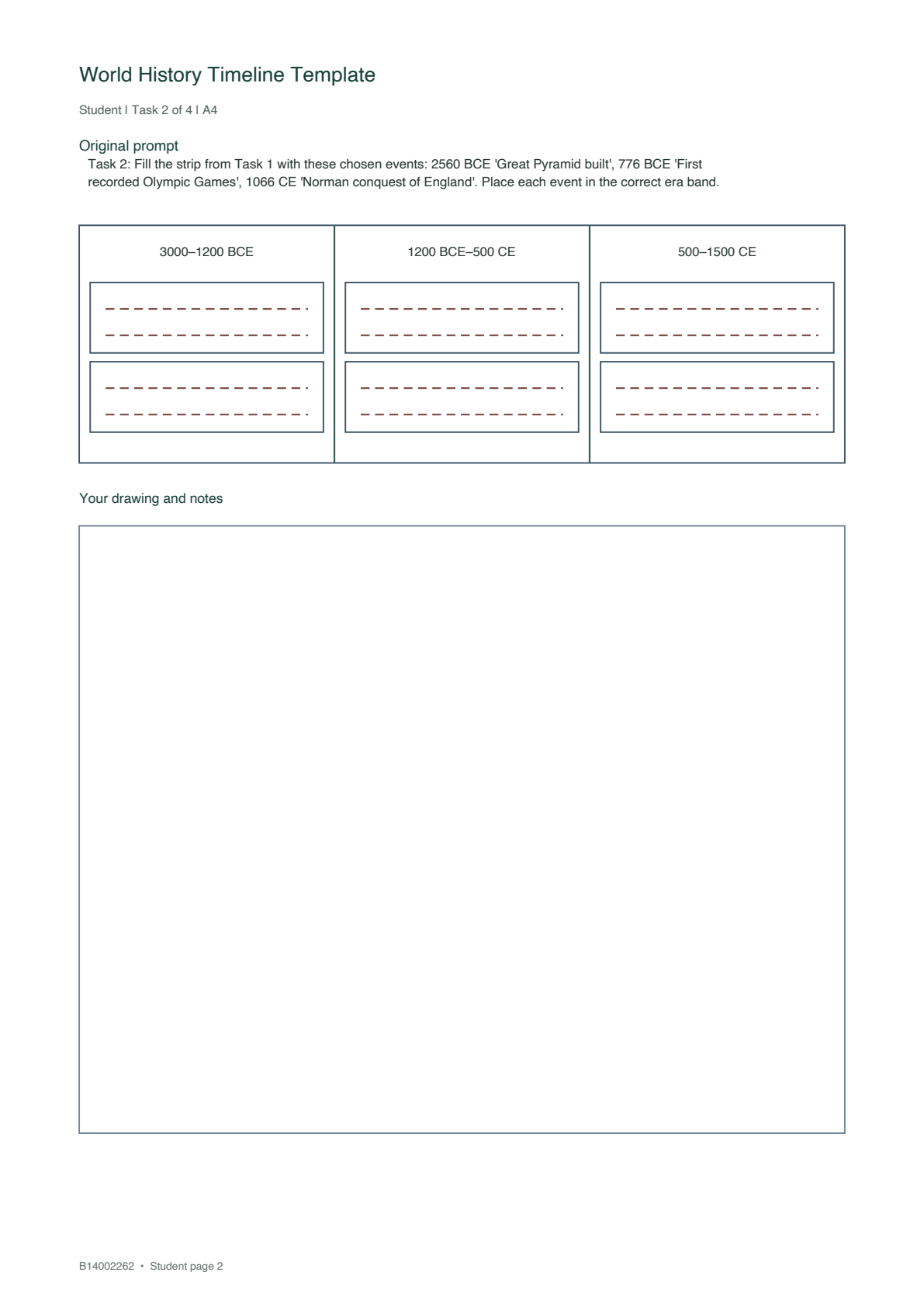
Task 2: Fill the strip from Task 1 with these chosen events: 2560 BCE 'Great Pyramid built', 776 BCE 'First recorded Olympic Games', 1066 CE 'Norman conquest of England'. Place each event in the correct era band.
Show answer 2
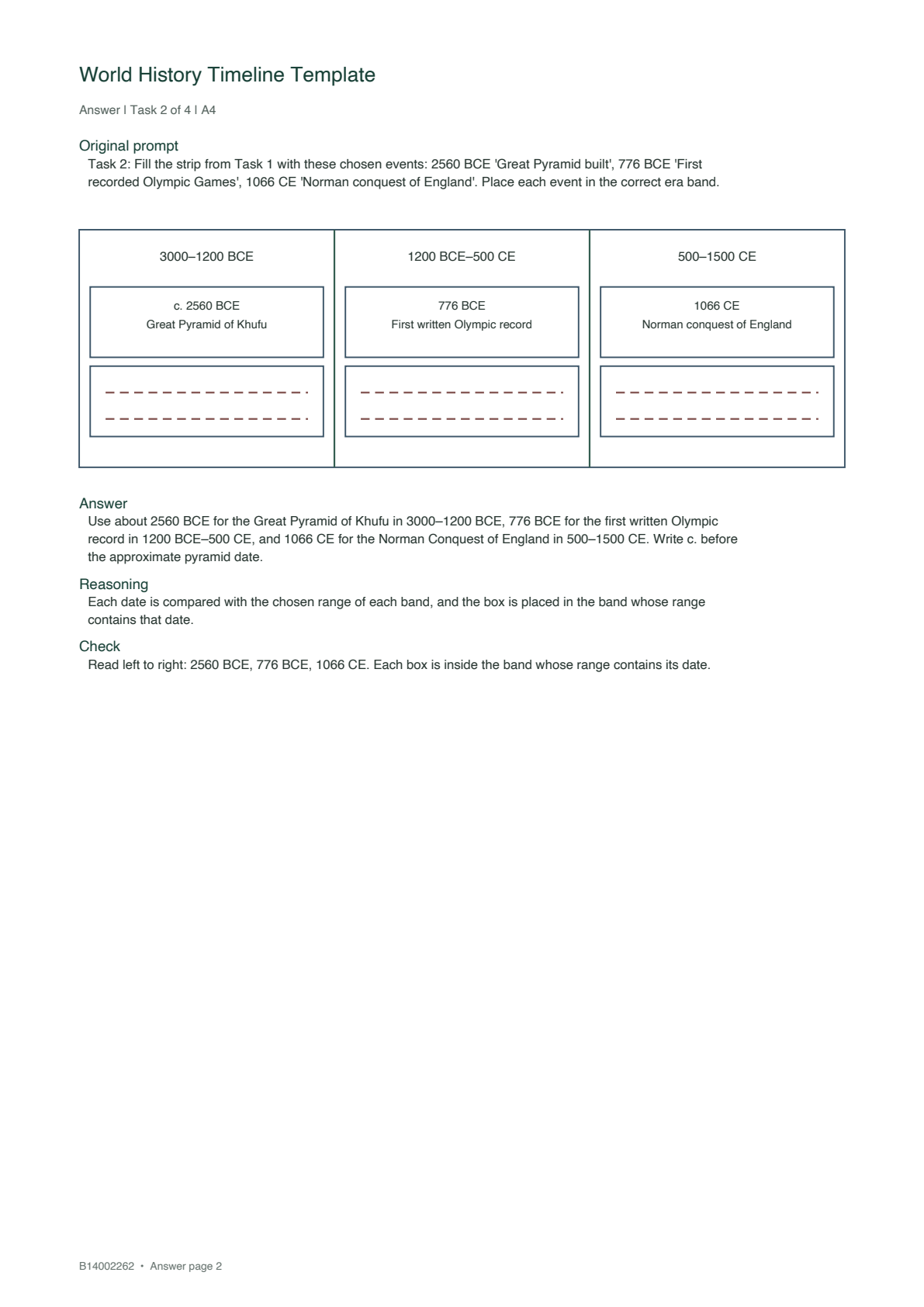
Use about 2560 BCE for the Great Pyramid of Khufu in 3000–1200 BCE, 776 BCE for the first written Olympic record in 1200 BCE–500 CE, and 1066 CE for the Norman Conquest of England in 500–1500 CE. Write c. before the approximate pyramid date.
Each date is compared with the chosen range of each band, and the box is placed in the band whose range contains that date.
Check: Read left to right: 2560 BCE, 776 BCE, 1066 CE. Each box is inside the band whose range contains its date.
Task 3
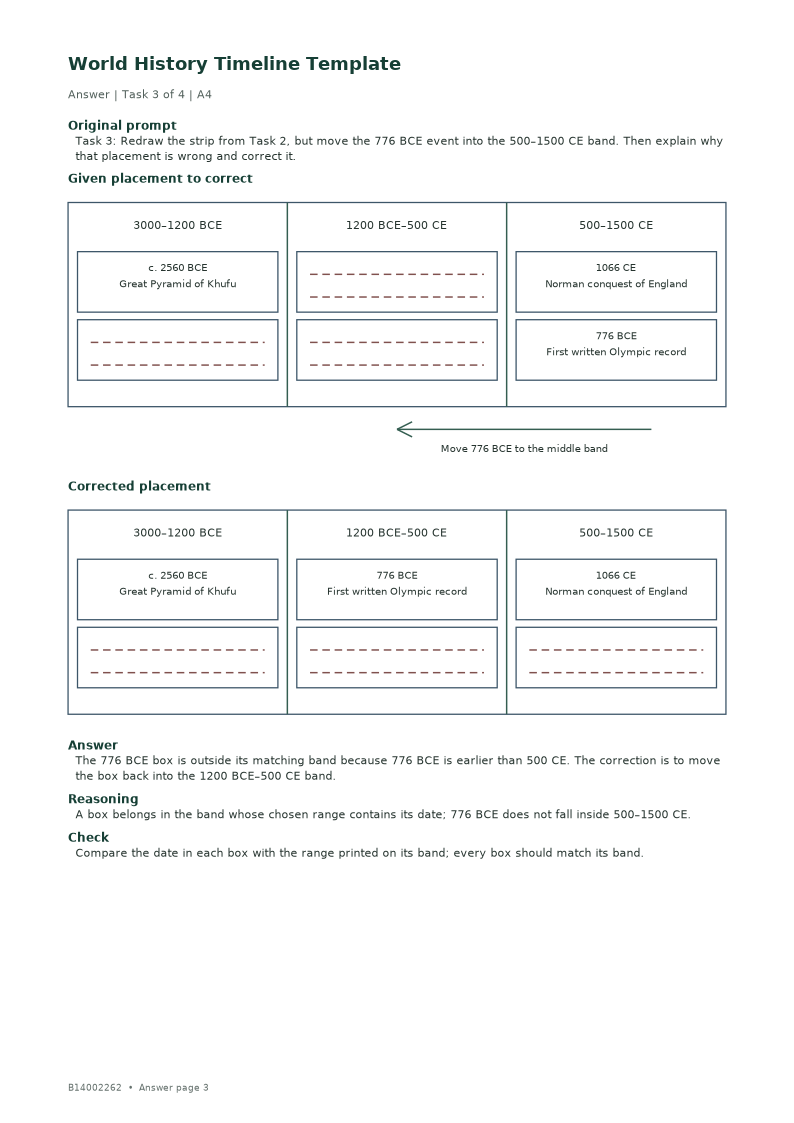
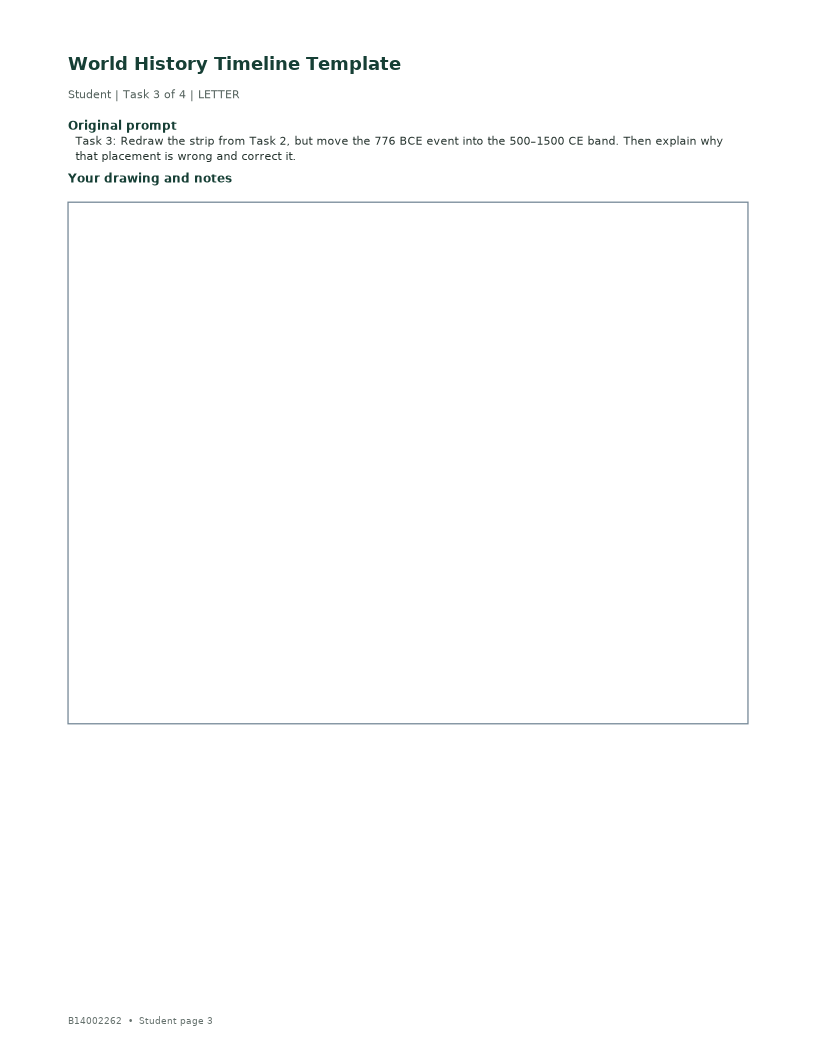
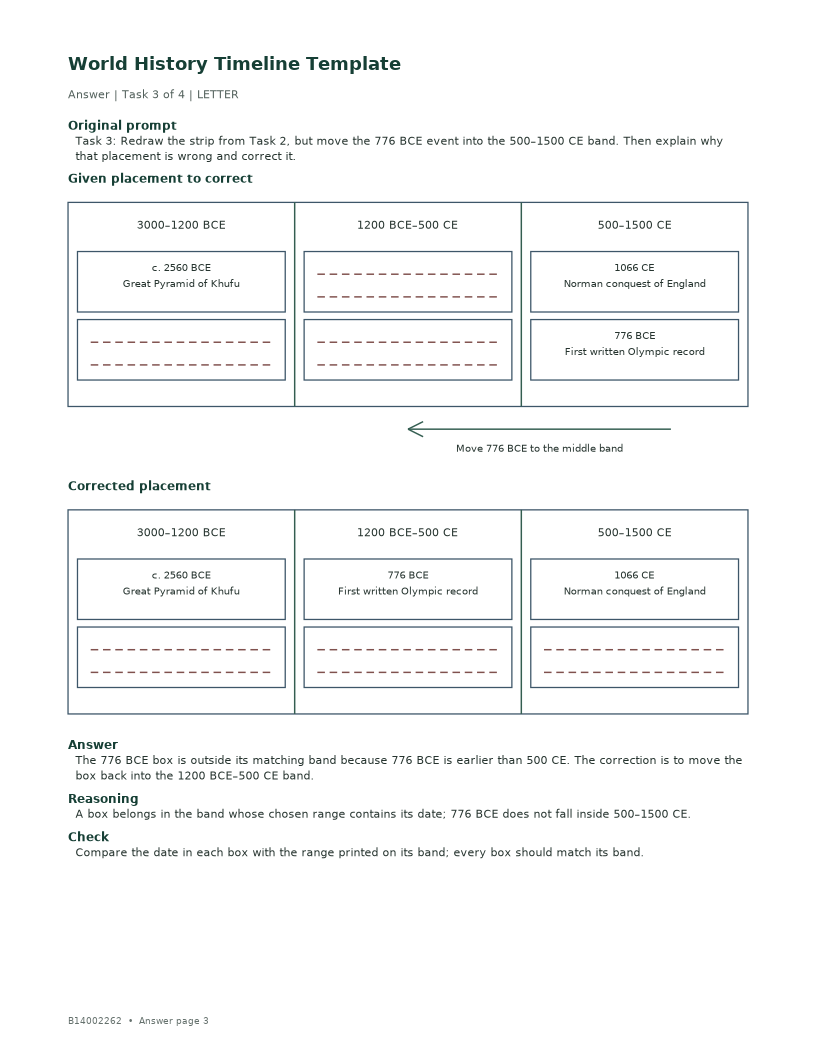
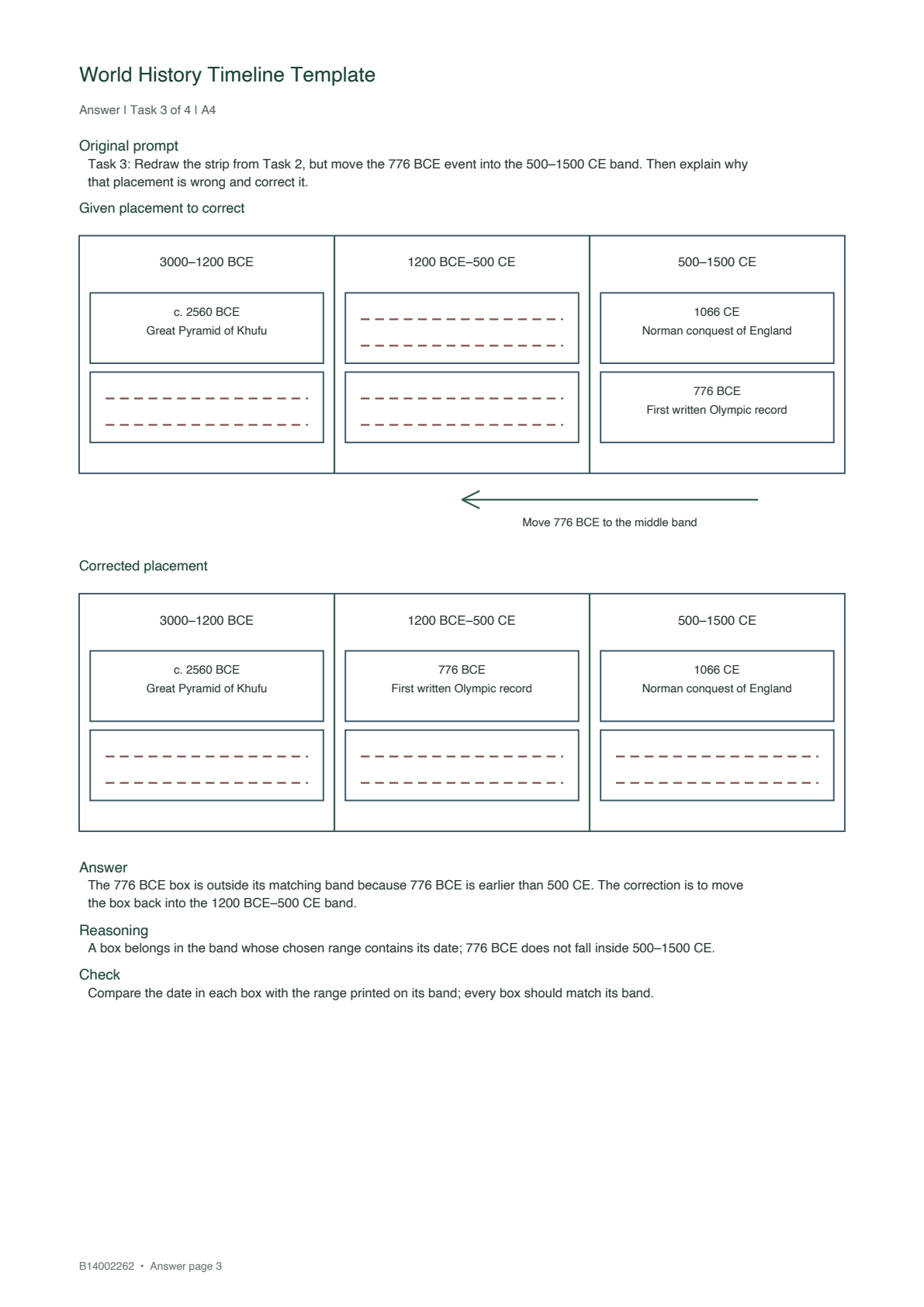
Task 3: Redraw the strip from Task 2, but move the 776 BCE event into the 500–1500 CE band. Then explain why that placement is wrong and correct it.
Show answer 3
The 776 BCE box is outside its matching band because 776 BCE is earlier than 500 CE. The correction is to move the box back into the 1200 BCE–500 CE band.
A box belongs in the band whose chosen range contains its date; 776 BCE does not fall inside 500–1500 CE.
Check: Compare the date in each box with the range printed on its band; every box should match its band.
Task 4
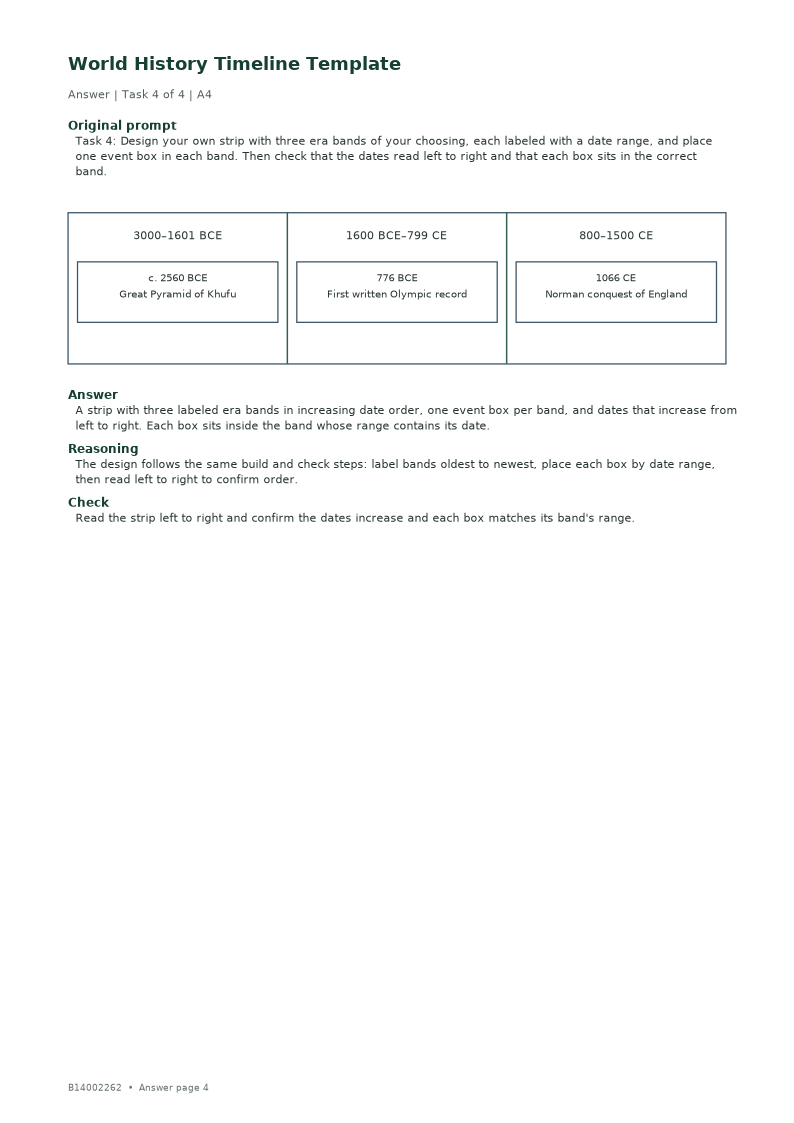
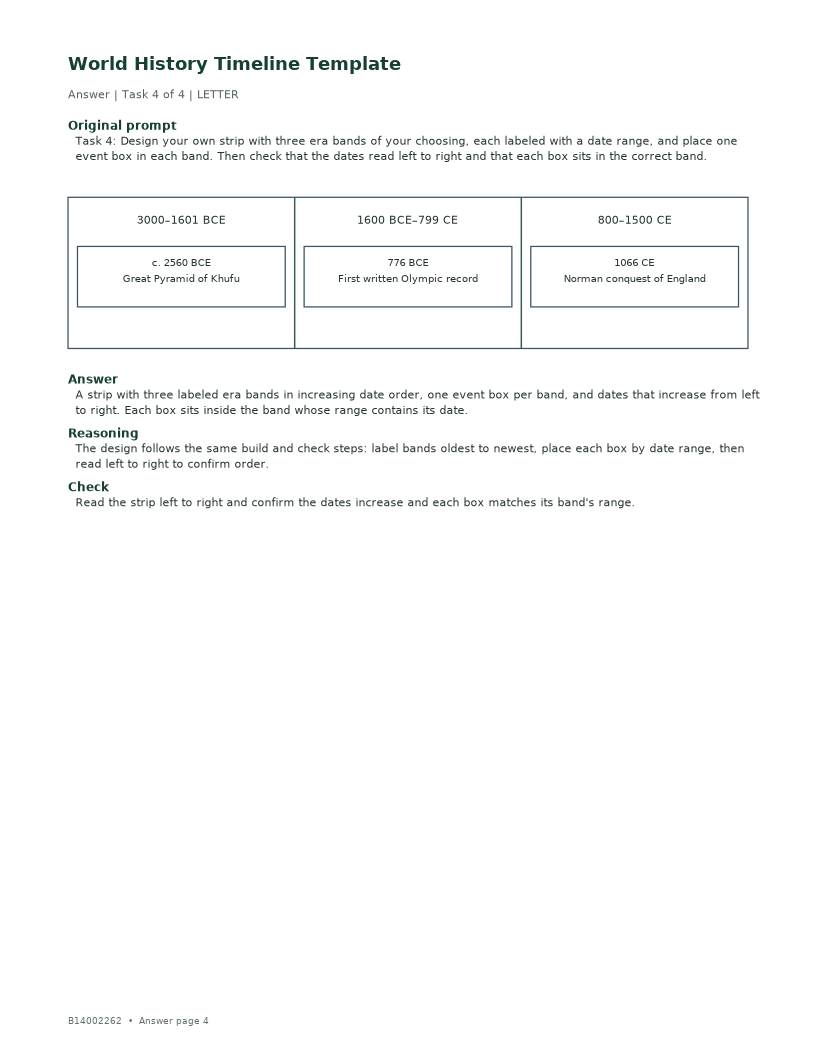
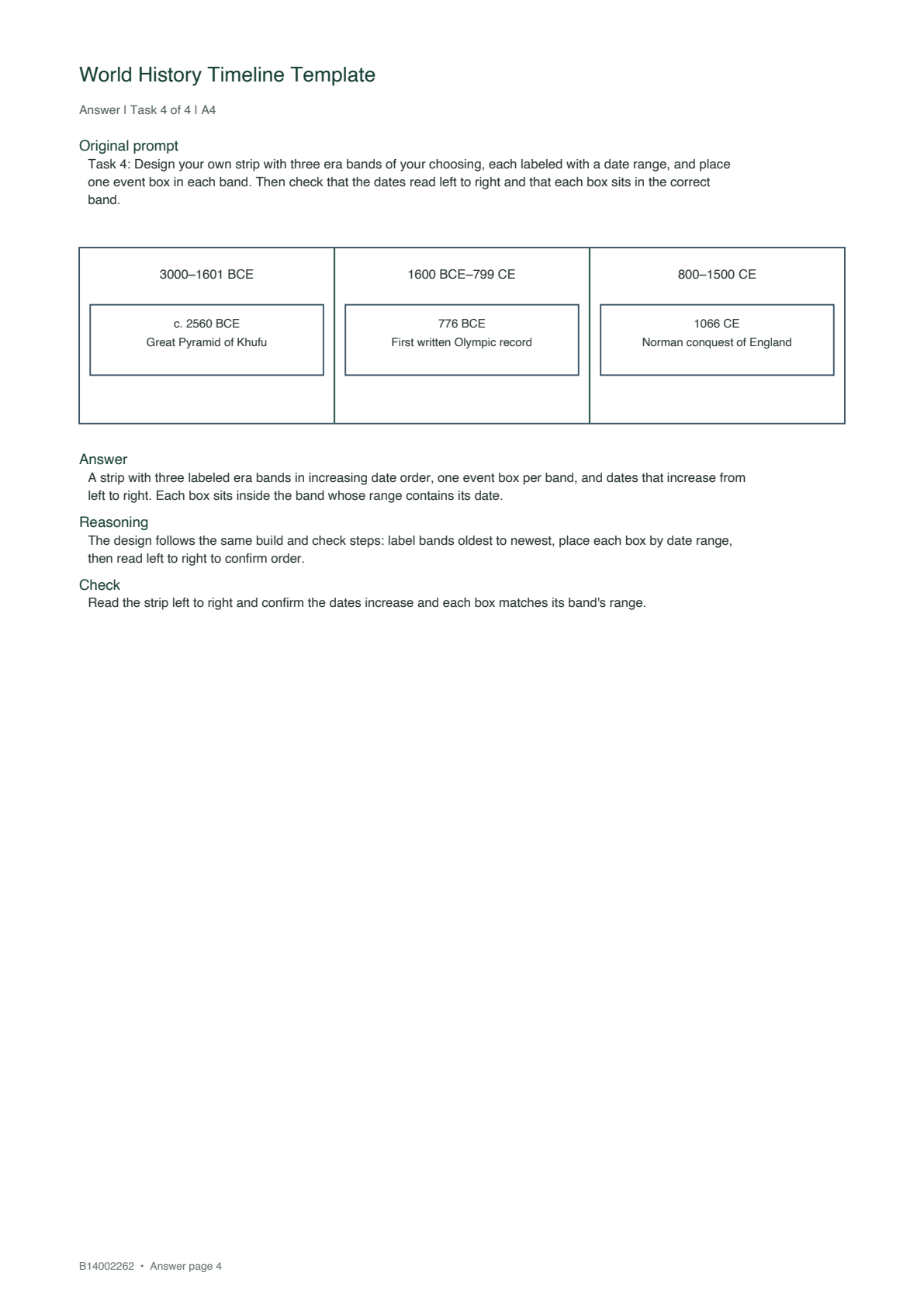
Task 4: Design your own strip with three era bands of your choosing, each labeled with a date range, and place one event box in each band. Then check that the dates read left to right and that each box sits in the correct band.
Show answer 4
A strip with three labeled era bands in increasing date order, one event box per band, and dates that increase from left to right. Each box sits inside the band whose range contains its date.
The design follows the same build and check steps: label bands oldest to newest, place each box by date range, then read left to right to confirm order.
Check: Read the strip left to right and confirm the dates increase and each box matches its band's range.
Useful checks
- Placing an event box outside the era band whose range contains its date. Compare the date with each band's printed range and move the box into the matching band.
- Writing dates out of order from left to right. Reorder the boxes so dates increase from left to right, oldest to newest.
Questions about this resource
Are the era ranges in this pack official historical periods?
No. They are chosen classroom ranges for practice, not a historical or educational standard.
Can I use different era ranges?
Yes. Task 4 asks you to choose your own ranges, as long as the bands read oldest to newest and each box matches its band.