Free original lessons
Pinochle Score Sheet
A Pinochle score sheet records each partnership's meld and trick points in separate columns, then adds them to a running total. This pack teaches the column layout, shows a filled example, and gives four practice tasks with answers.
Letter & A4
PDF & SVG
What the sheet records
Pinochle records meld points for card combinations and trick points from play. Use the points given for these exercises. For a live game, use the scoring rules agreed at your table.
The sheet is a paper form. It does not calculate anything by itself; the scorer writes each entry and adds the two columns to update the total.
Column layout
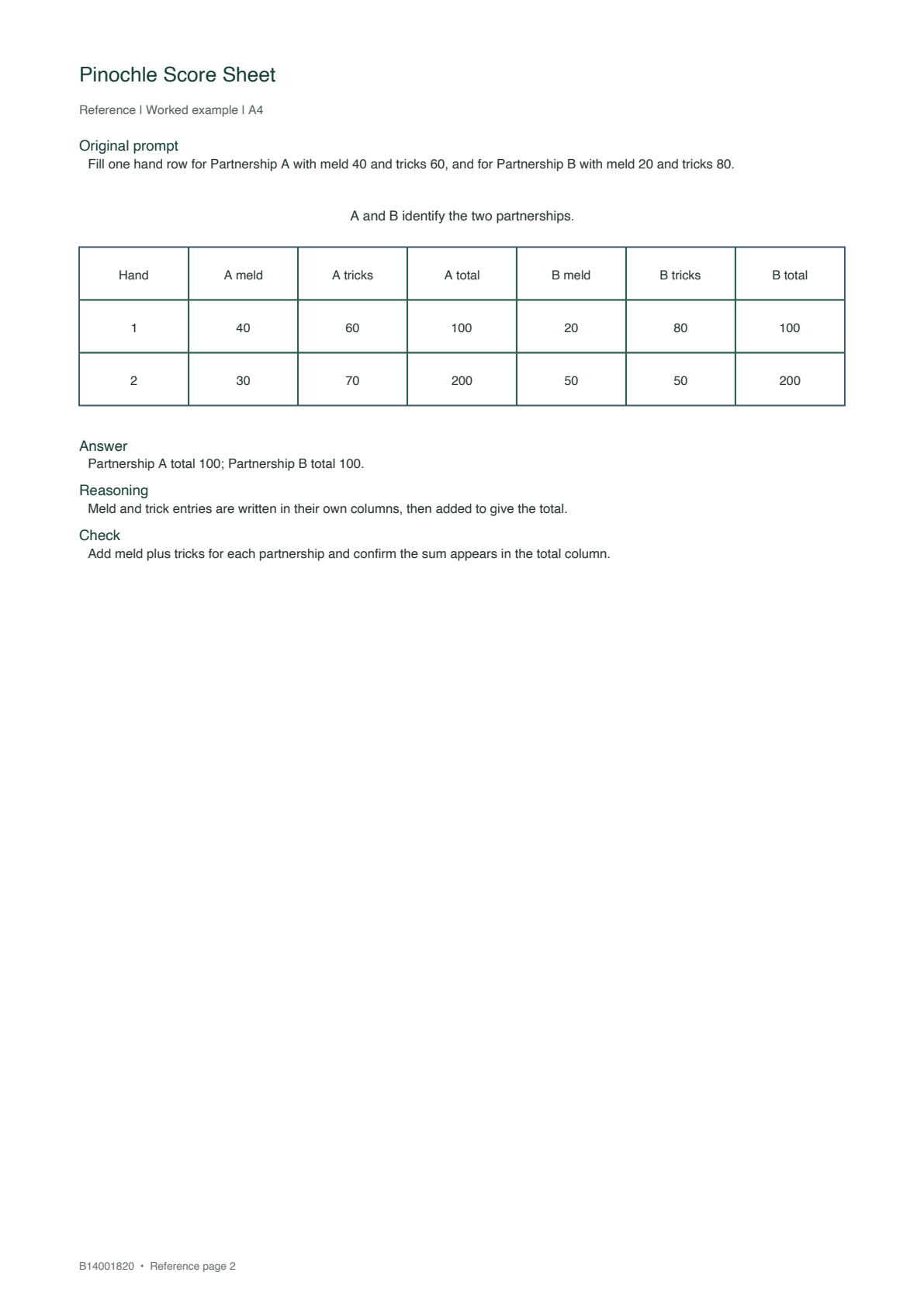
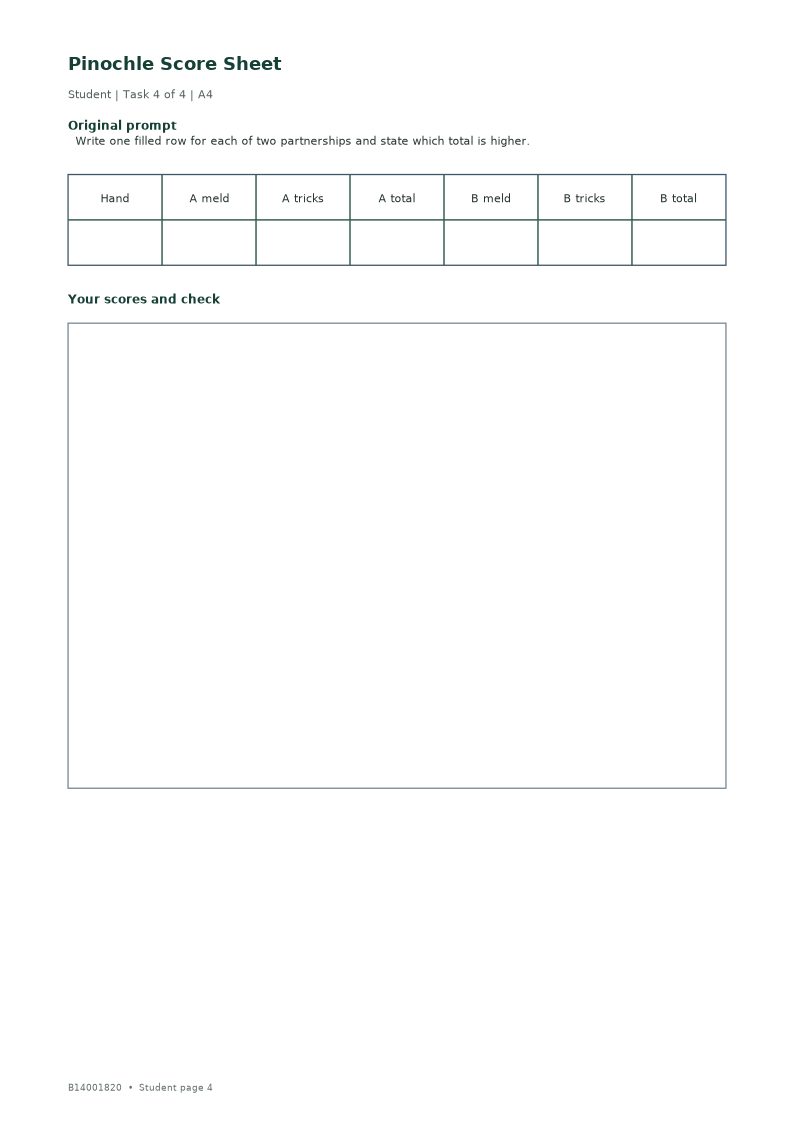
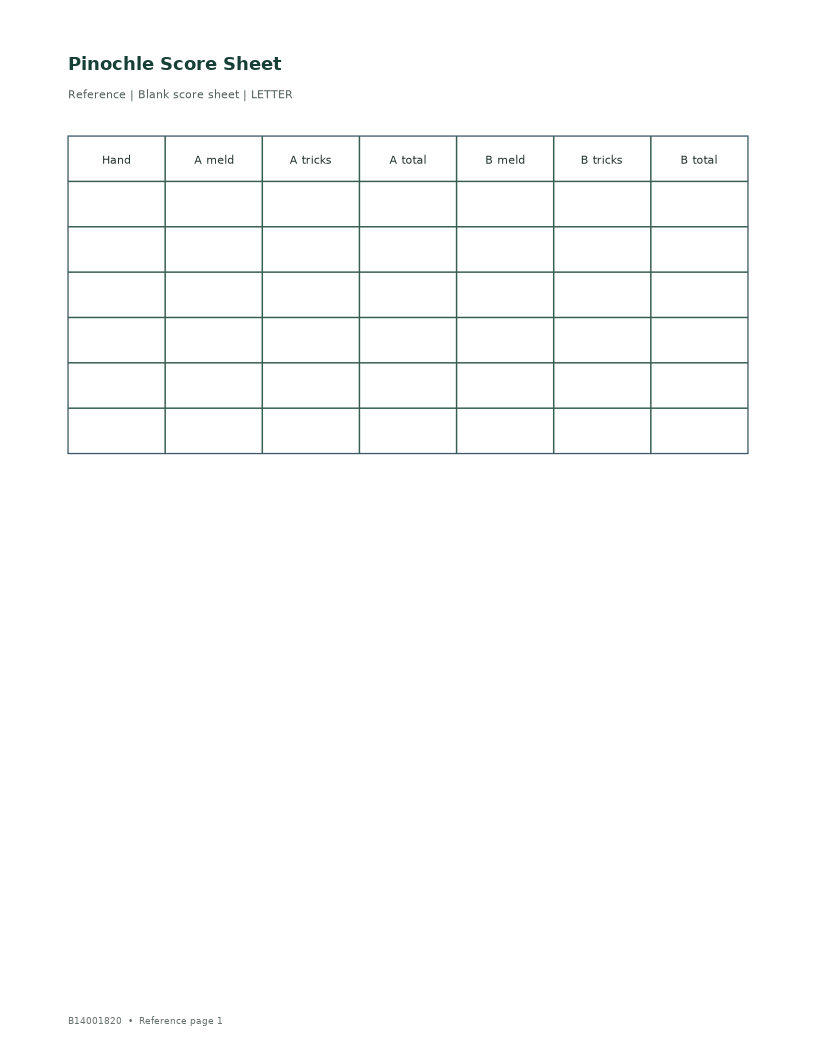
Use a header row with: Hand number, Partnership A meld, Partnership A tricks, Partnership A total, Partnership B meld, Partnership B tricks, Partnership B total.
Each hand occupies one row. Meld and trick entries are written in their own columns, and the total column holds the running sum for that partnership after the hand.
Worked example
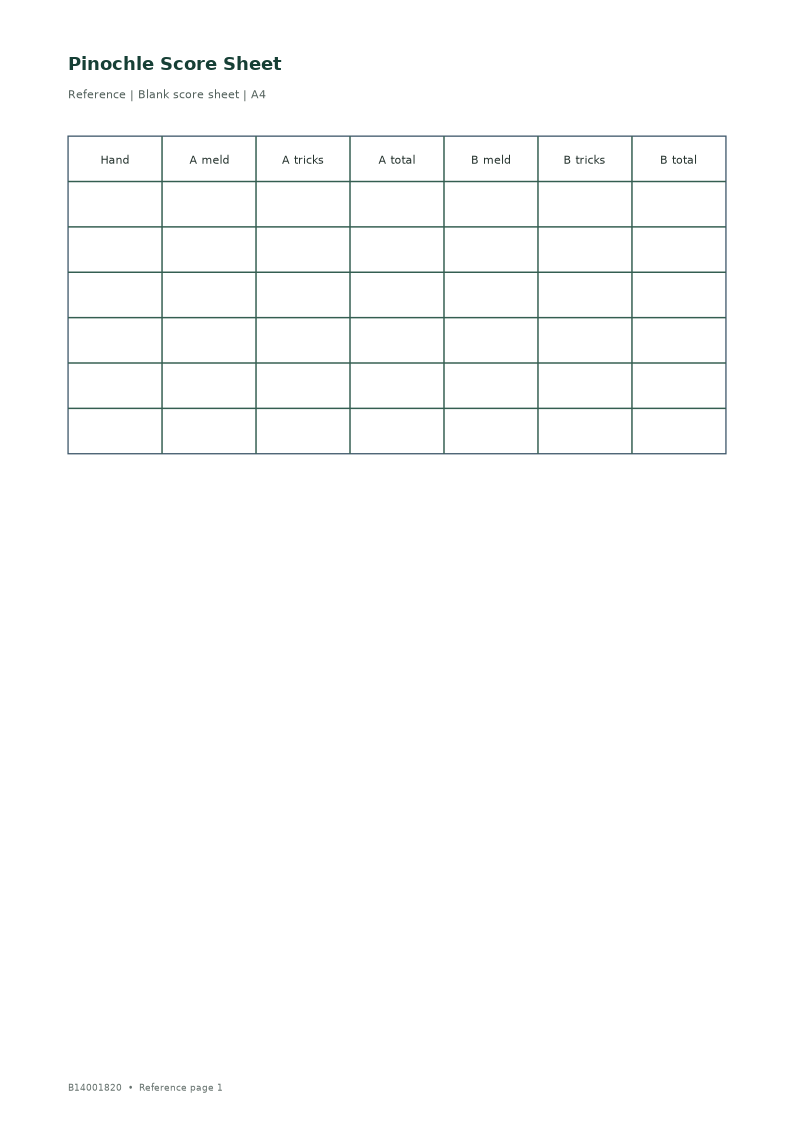
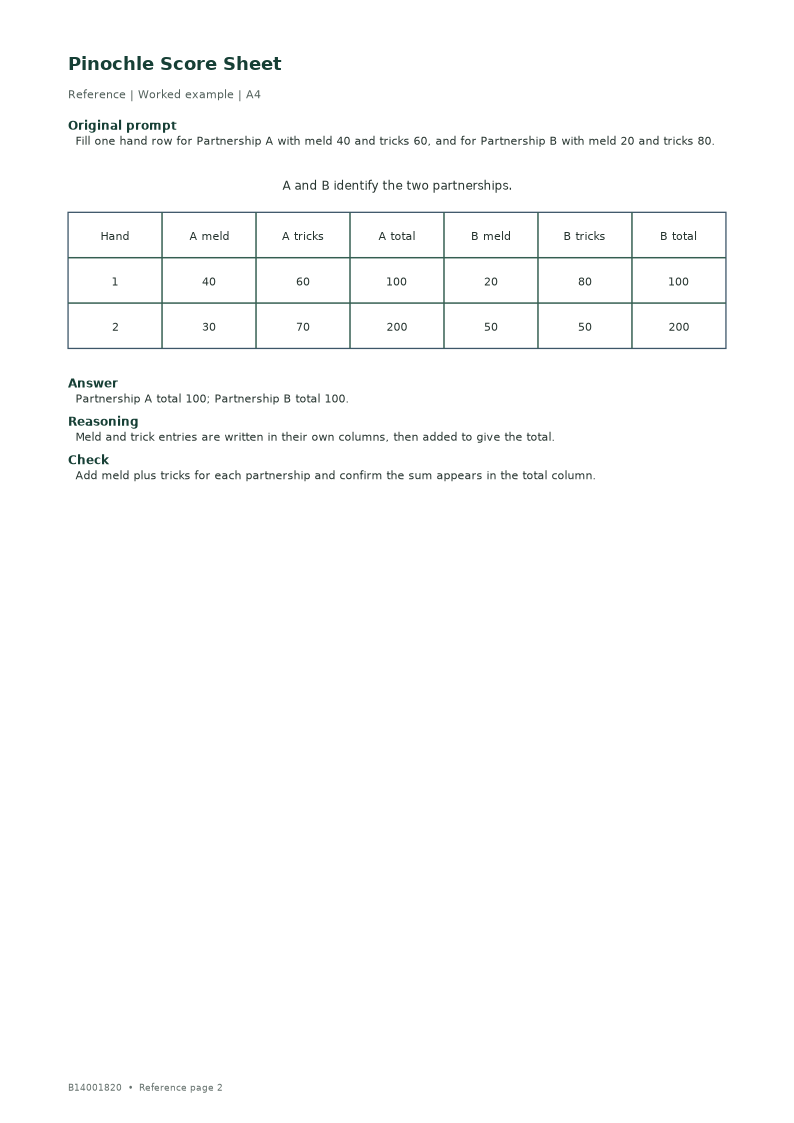
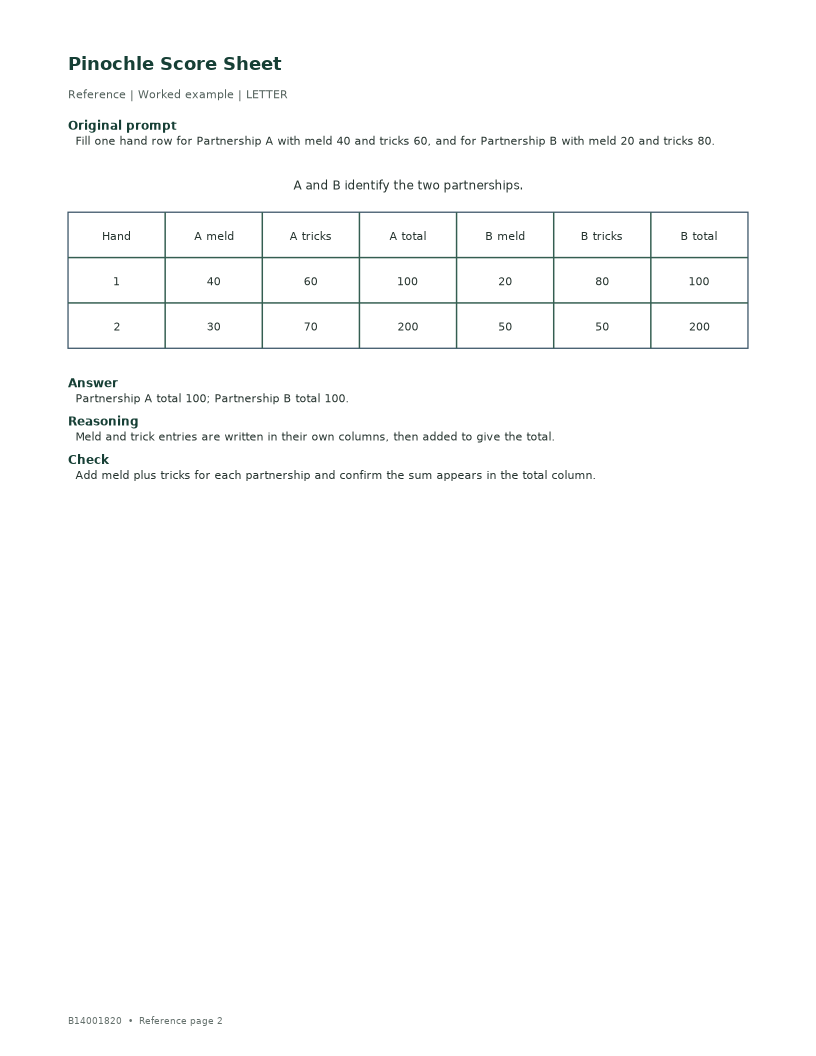
Suppose Partnership A scores 40 meld and 60 tricks on hand 1, and Partnership B scores 20 meld and 80 tricks. Partnership A's total is 100 and Partnership B's total is 100.
On hand 2, Partnership A scores 30 meld and 70 tricks, so its running total becomes 200. Partnership B scores 50 meld and 50 tricks, so its running total becomes 200. The filled row shows each column entry and the updated total.
Practice tasks
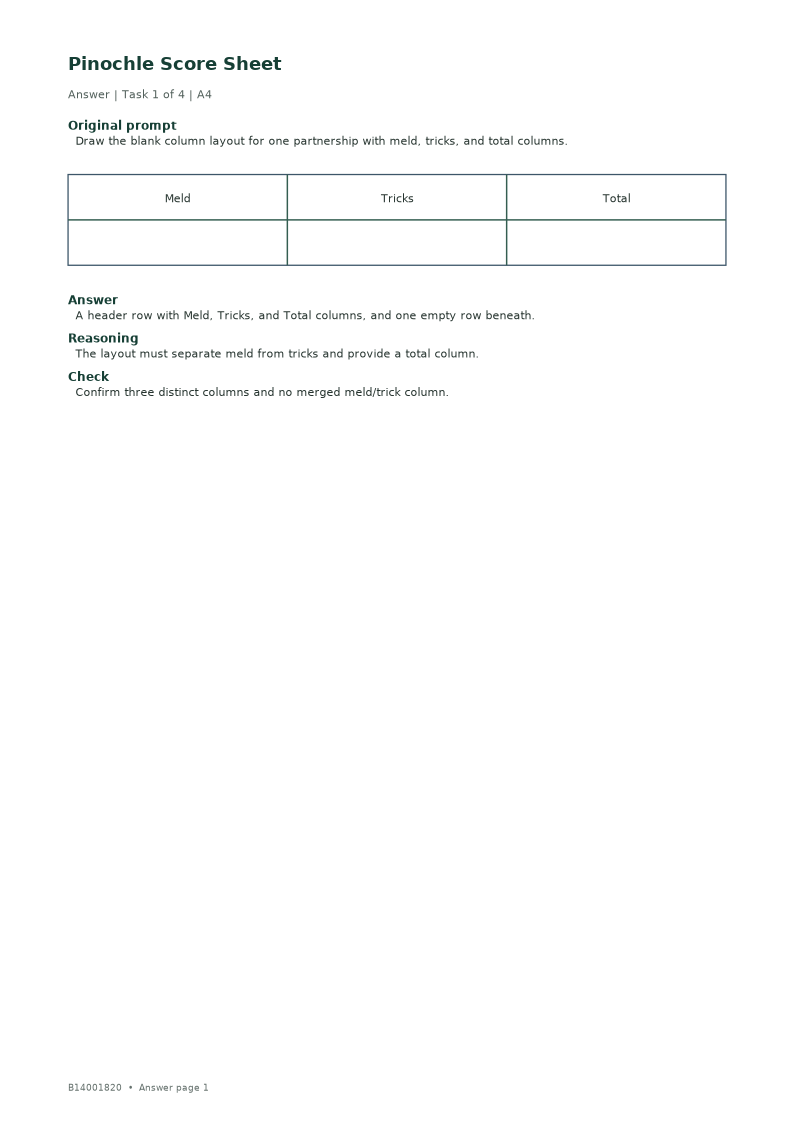
Task 1: Draw the blank column layout for one partnership with meld, tricks, and total columns.
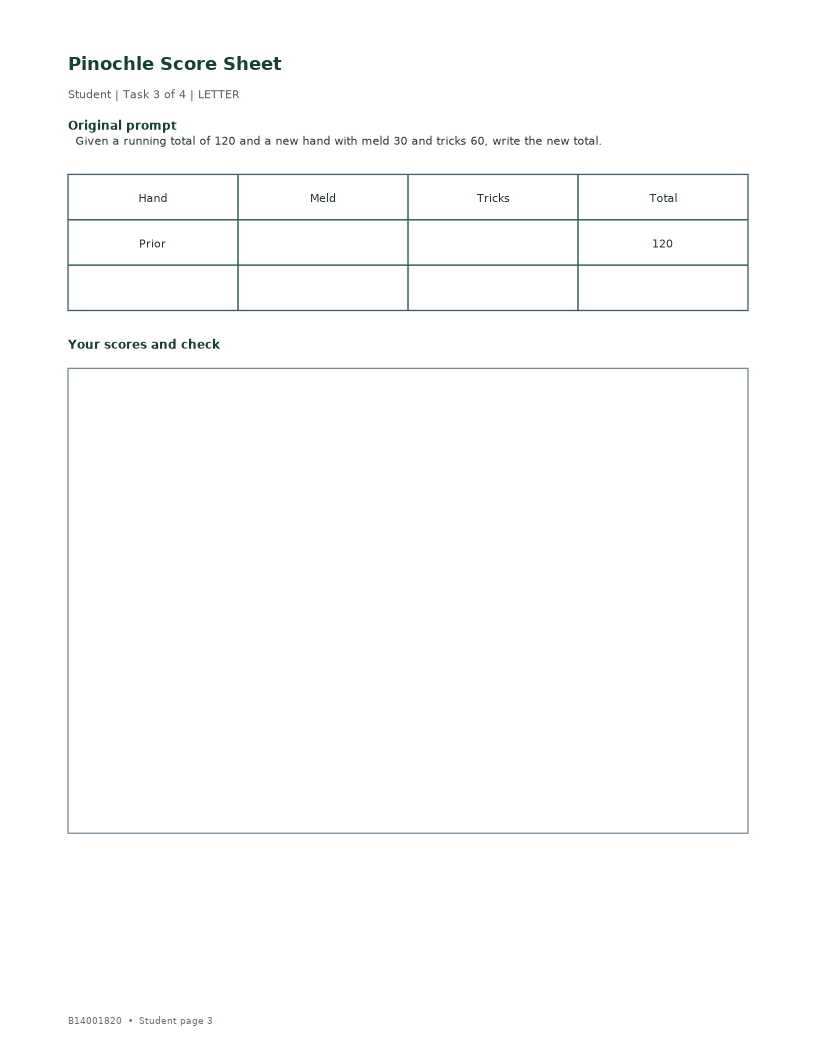
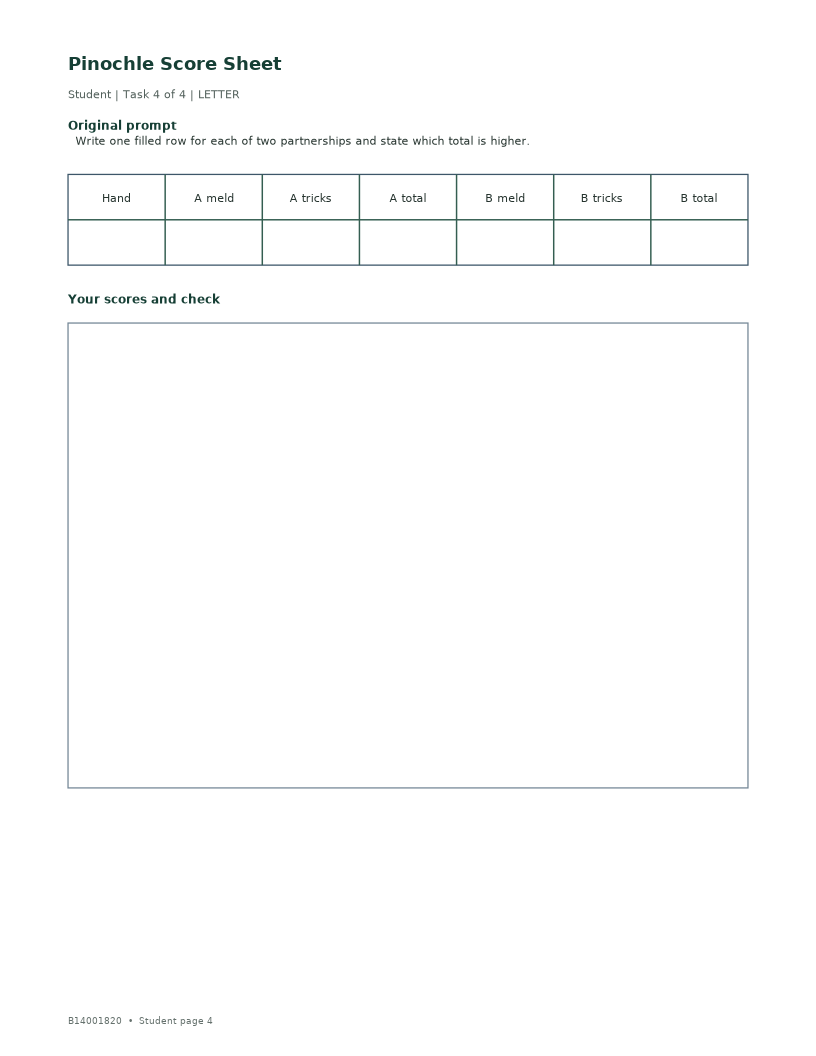
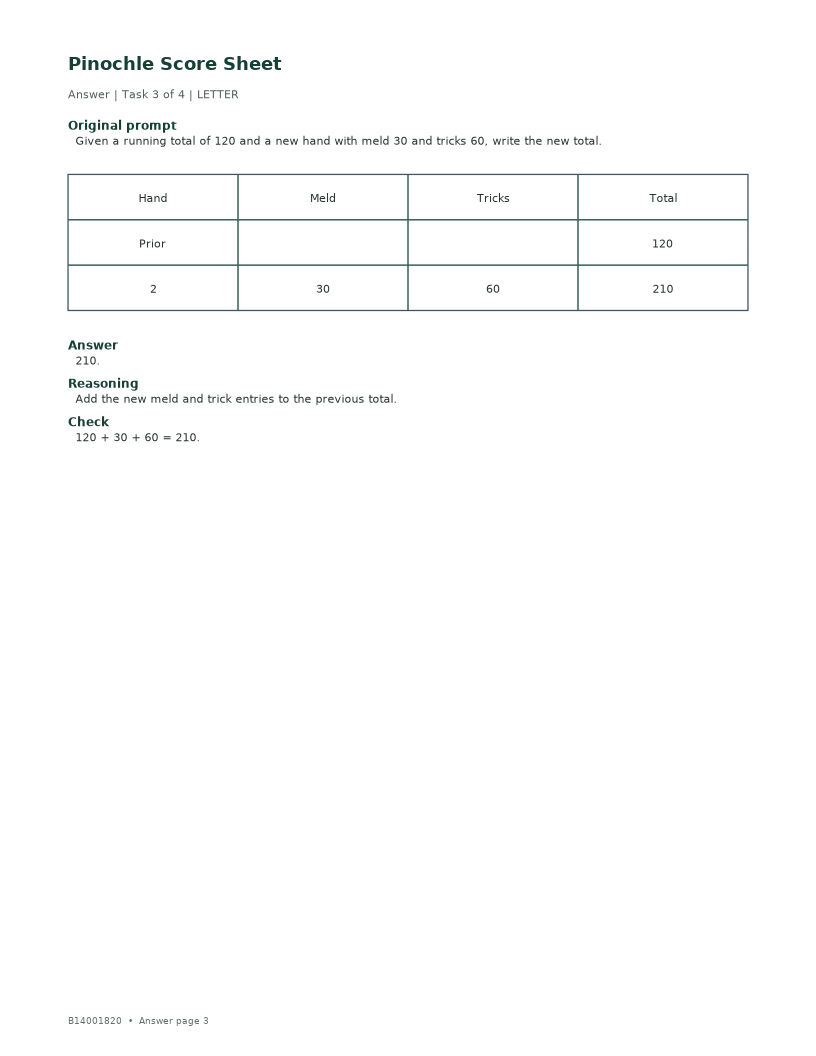
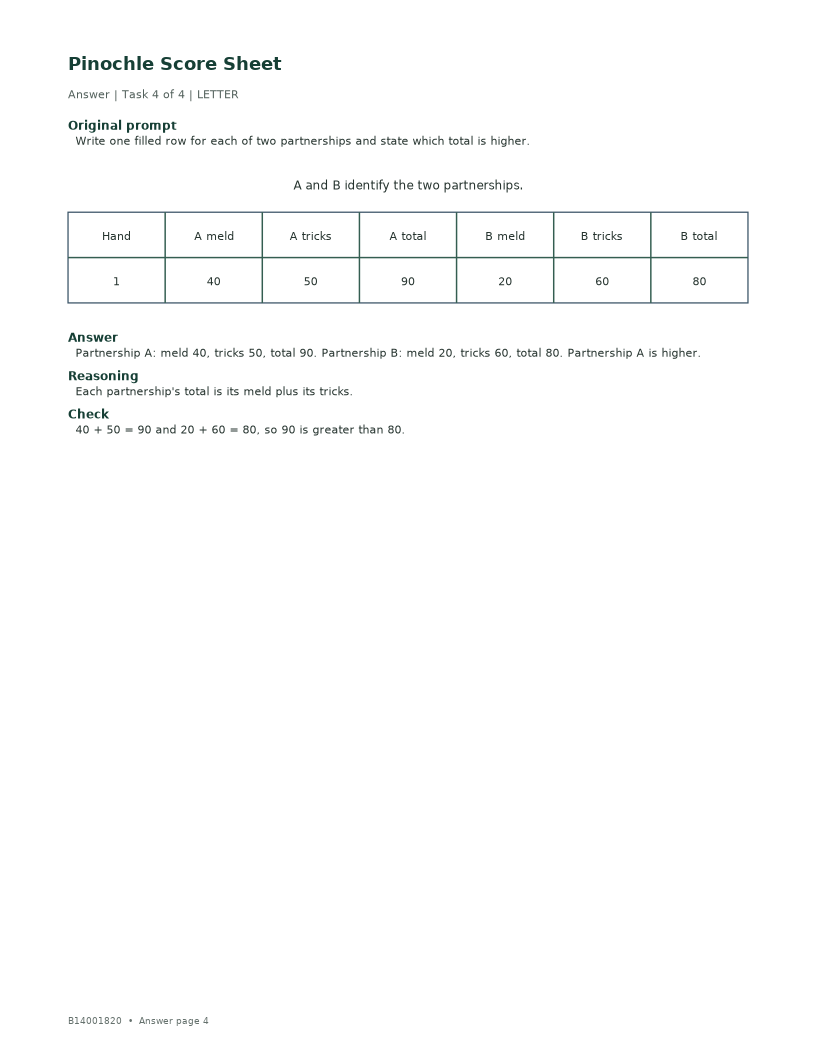
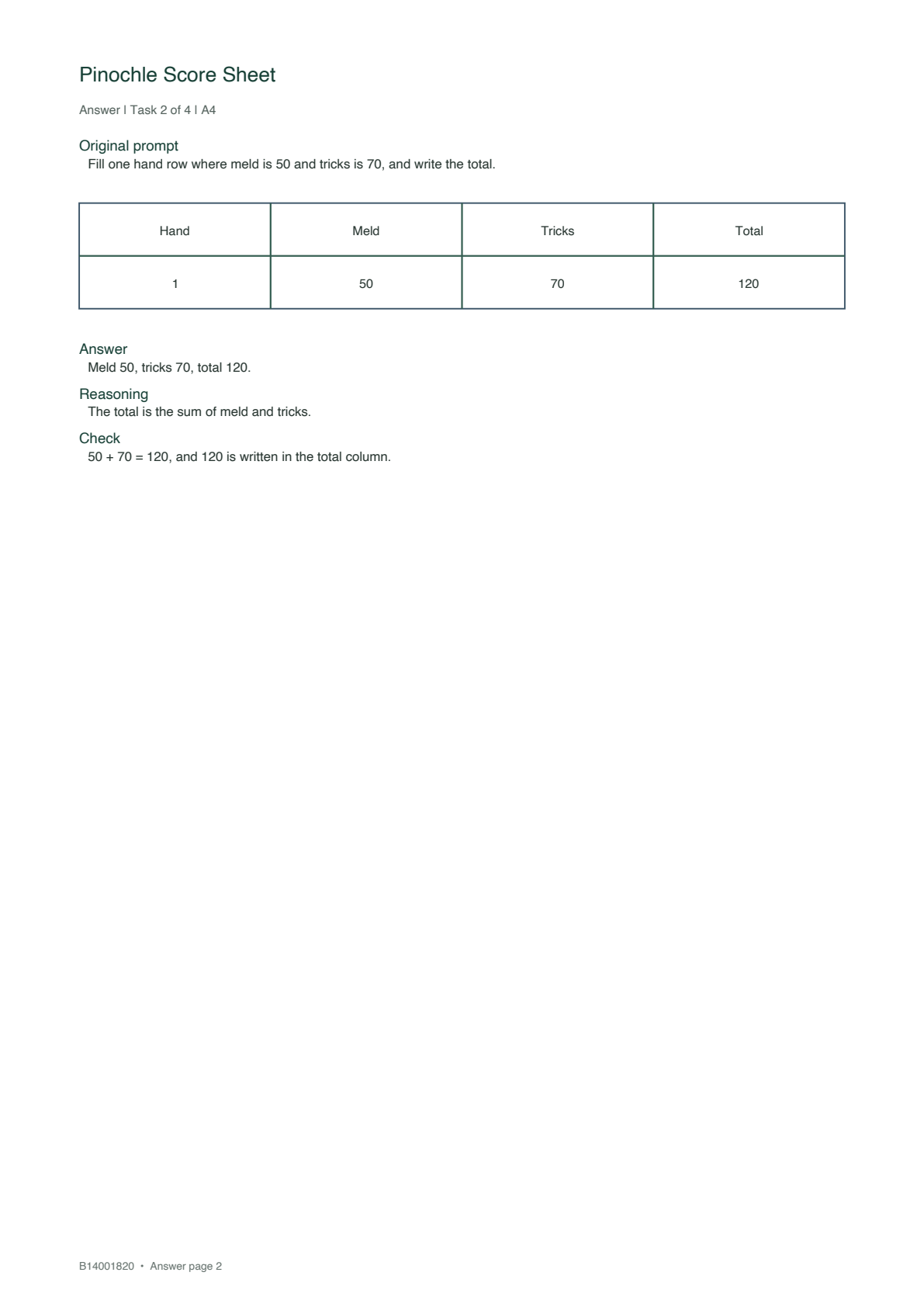
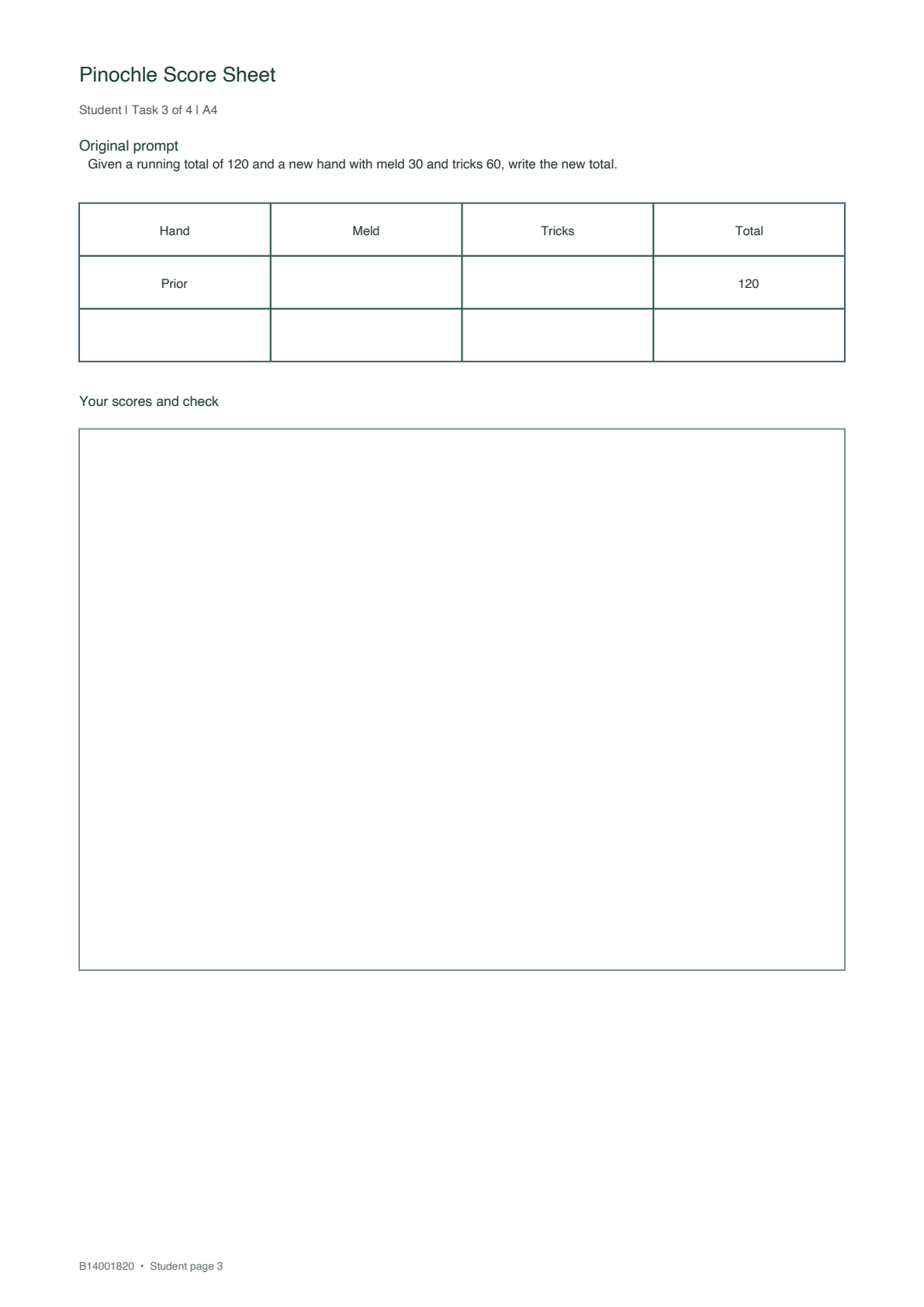
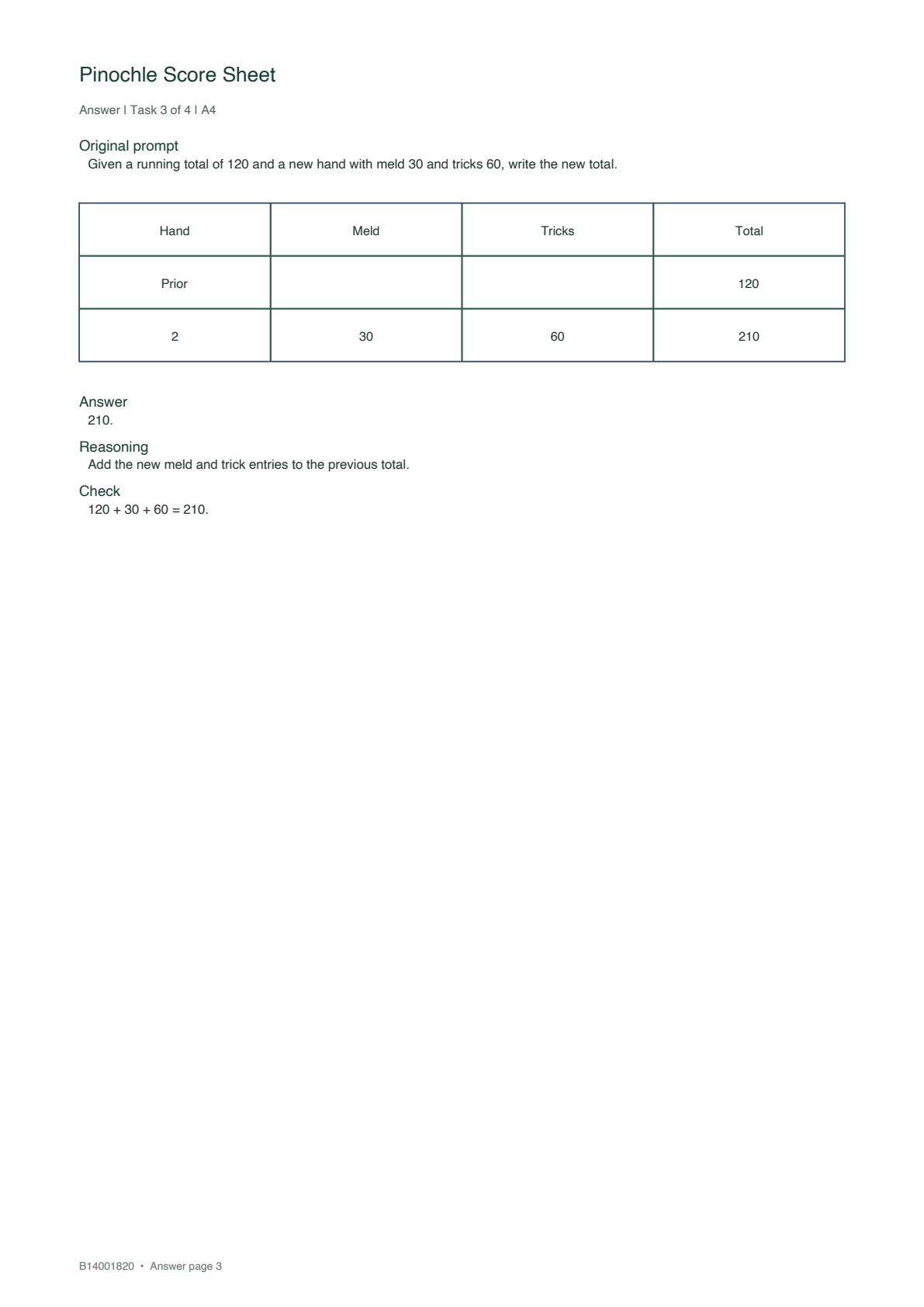
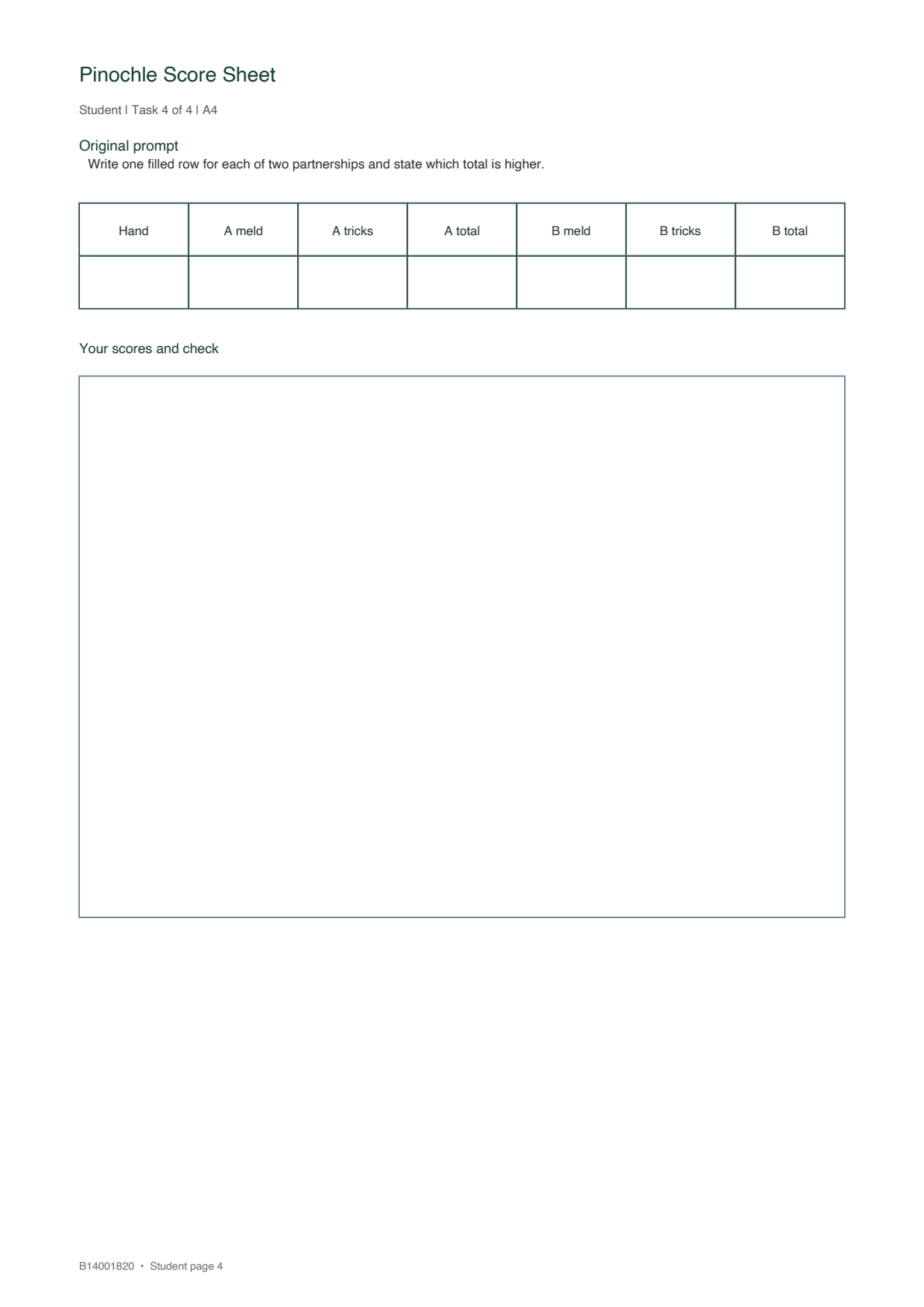
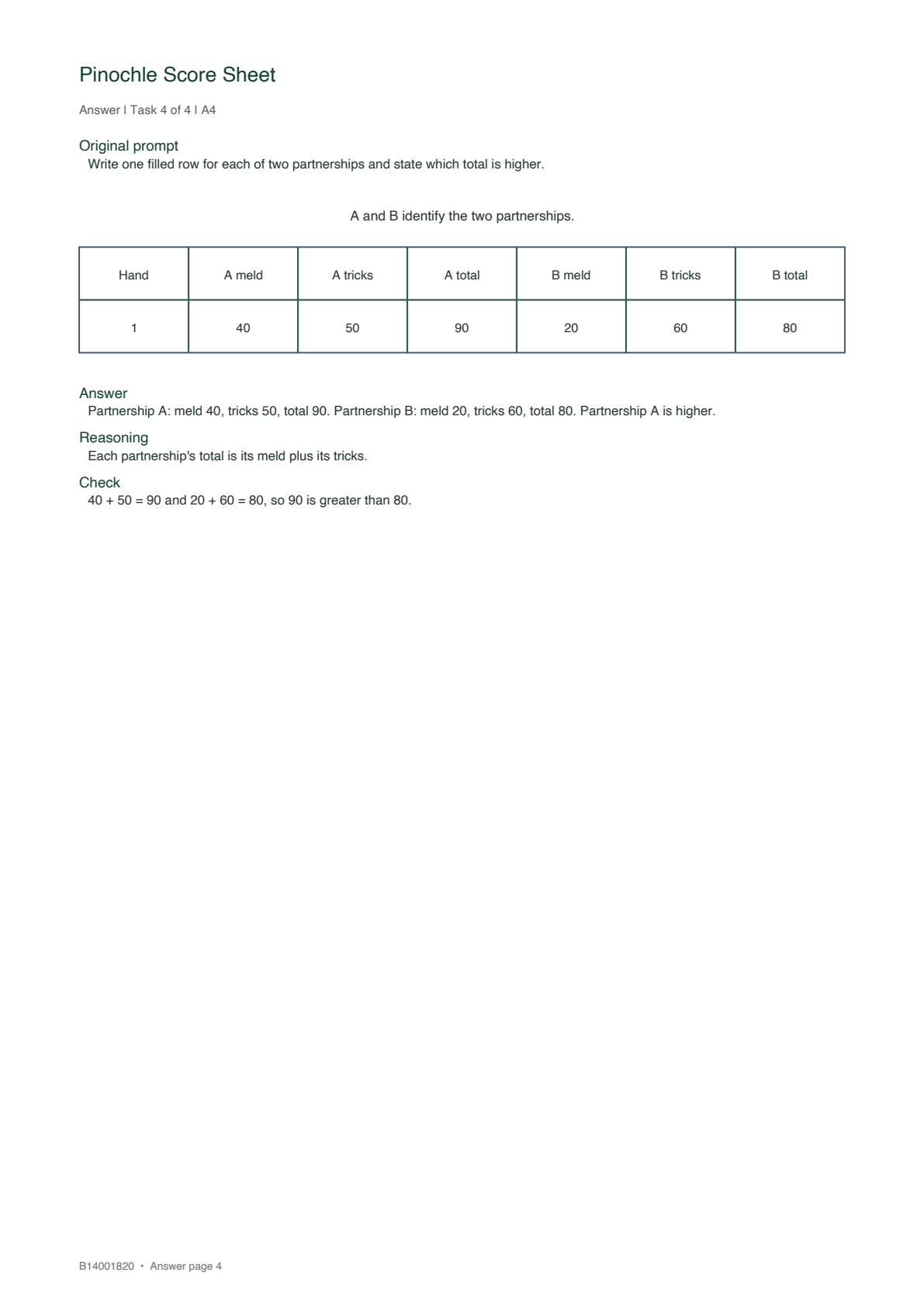
Task 2: Fill one hand row where meld is 50 and tricks is 70, and write the total. Answer: total 120. Check: 50 + 70 = 120, and the total sits in the total column, not in either scoring column. Task 3: Given a running total of 120 and a new hand with meld 30 and tricks 60, write the new total. Answer: 210. Check: 120 + 30 + 60 = 210. Task 4: Two partnerships each have a meld column and a trick column; write one filled row for each and state which total is higher. Answer: Partnership A meld 40, tricks 50, total 90; Partnership B meld 20, tricks 60, total 80; Partnership A is higher. Check: 40 + 50 = 90 and 20 + 60 = 80, so 90 is greater than 80.
Checking your sheet
Check that every hand has one row, that meld and trick entries are in their correct columns, and that each total equals the previous total plus the new meld and trick entries.
A correct sheet never places a trick value in a meld column or omits the running total.
Download the complete resource pack
All individual SVG pages (20)
- A4 reference page 1
- A4 reference page 2
- A4 student page 1
- A4 student page 2
- A4 student page 3
- A4 student page 4
- A4 answer page 1
- A4 answer page 2
- A4 answer page 3
- A4 answer page 4
- LETTER reference page 1
- LETTER reference page 2
- LETTER student page 1
- LETTER student page 2
- LETTER student page 3
- LETTER student page 4
- LETTER answer page 1
- LETTER answer page 2
- LETTER answer page 3
- LETTER answer page 4



Print at 100% / actual size. Use the stated scale on any schematic diagram; physical cutting templates are identified separately. A4 and US Letter are separate files. Free access, no signup; CC BY 4.0.
How to use these pages
- What the sheet records
- Column layout
- Worked example
- Practice tasks
- Checking your sheet
Worked example
Example: Fill one hand row for Partnership A with meld 40 and tricks 60, and for Partnership B with meld 20 and tricks 80.
Answer: Partnership A total 100; Partnership B total 100.
Reasoning: Meld and trick entries are written in their own columns, then added to give the total.
Check: Add meld plus tricks for each partnership and confirm the sum appears in the total column.
Four practice tasks and complete answers
Task 1
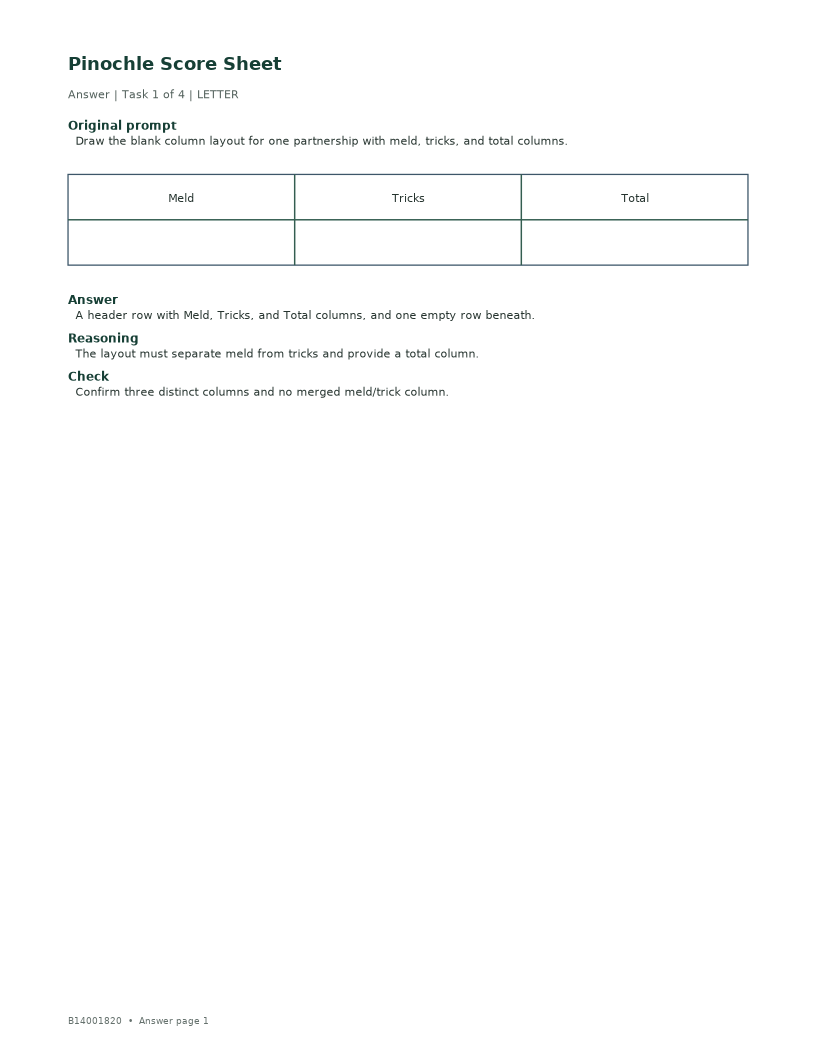
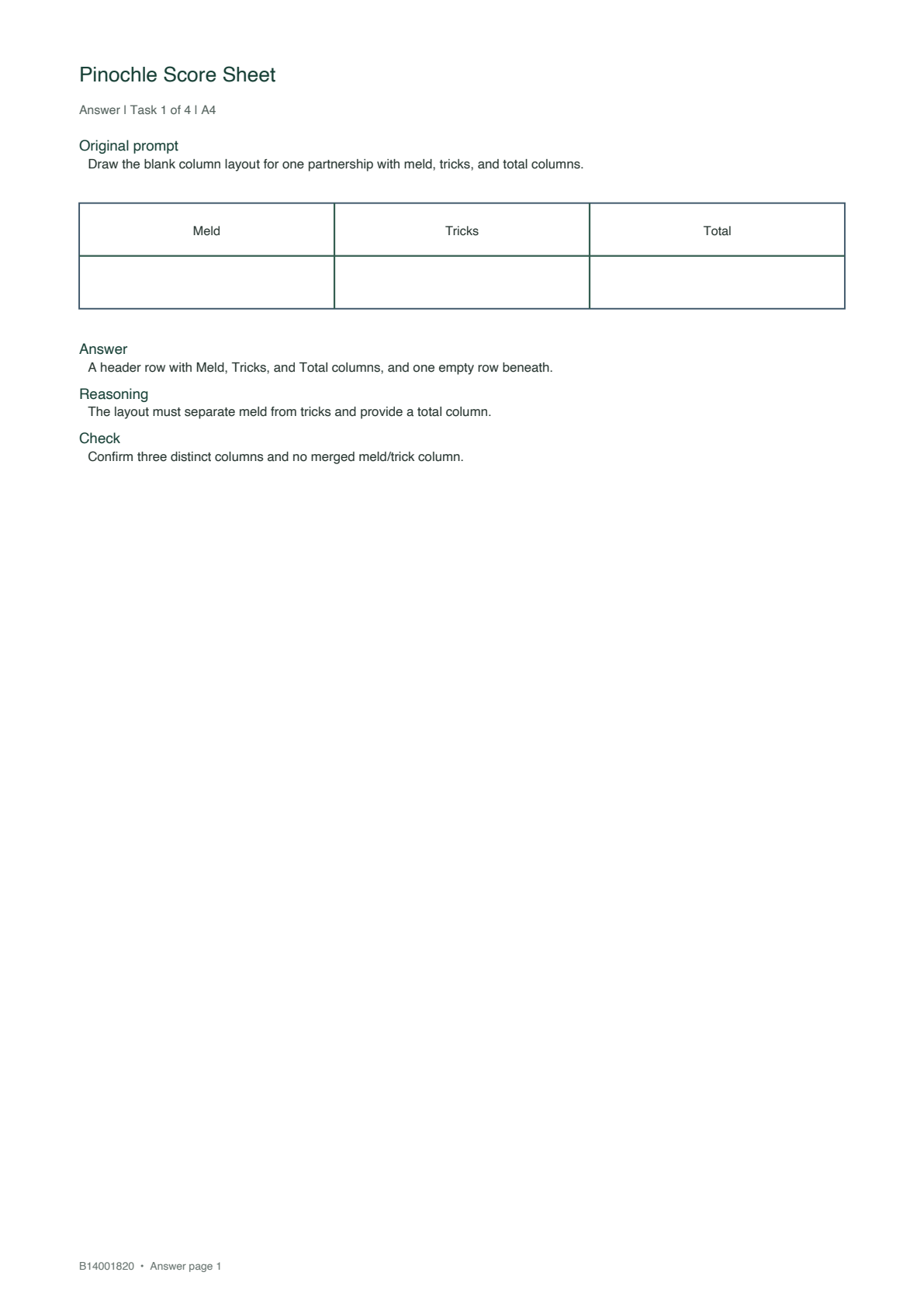
Draw the blank column layout for one partnership with meld, tricks, and total columns.

Show answer 1
A header row with Meld, Tricks, and Total columns, and one empty row beneath.
The layout must separate meld from tricks and provide a total column.
Check: Confirm three distinct columns and no merged meld/trick column.
Task 2
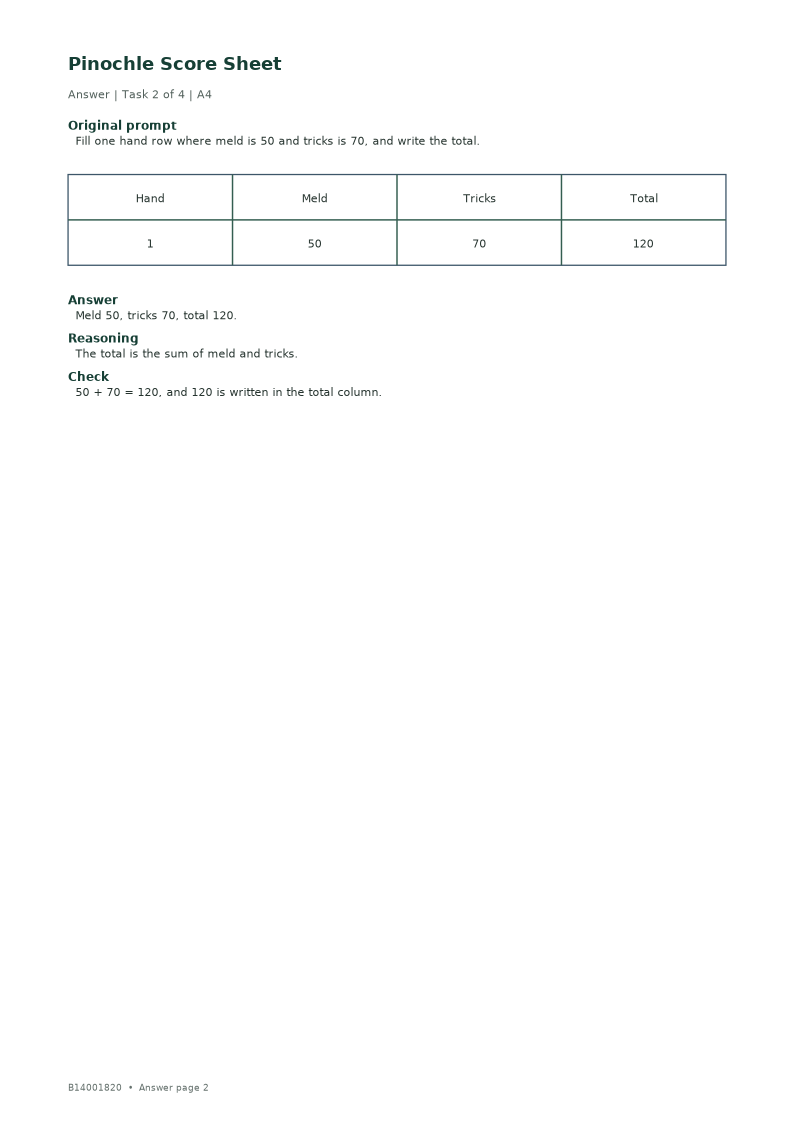
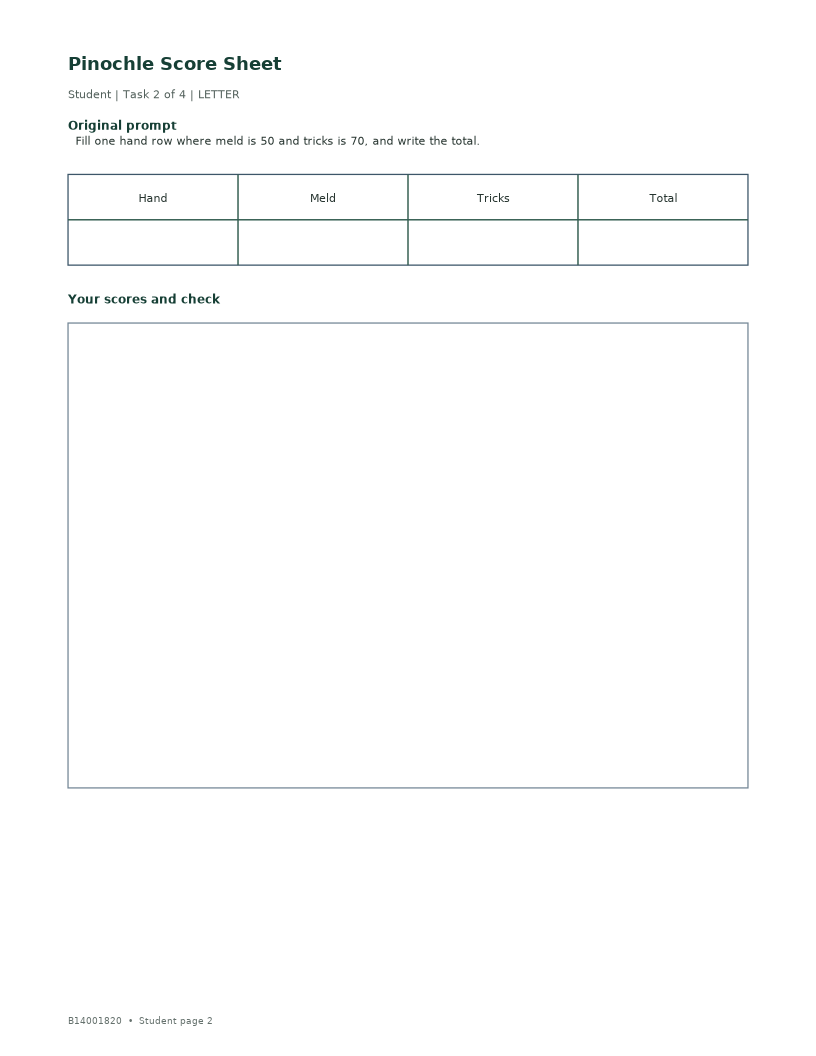
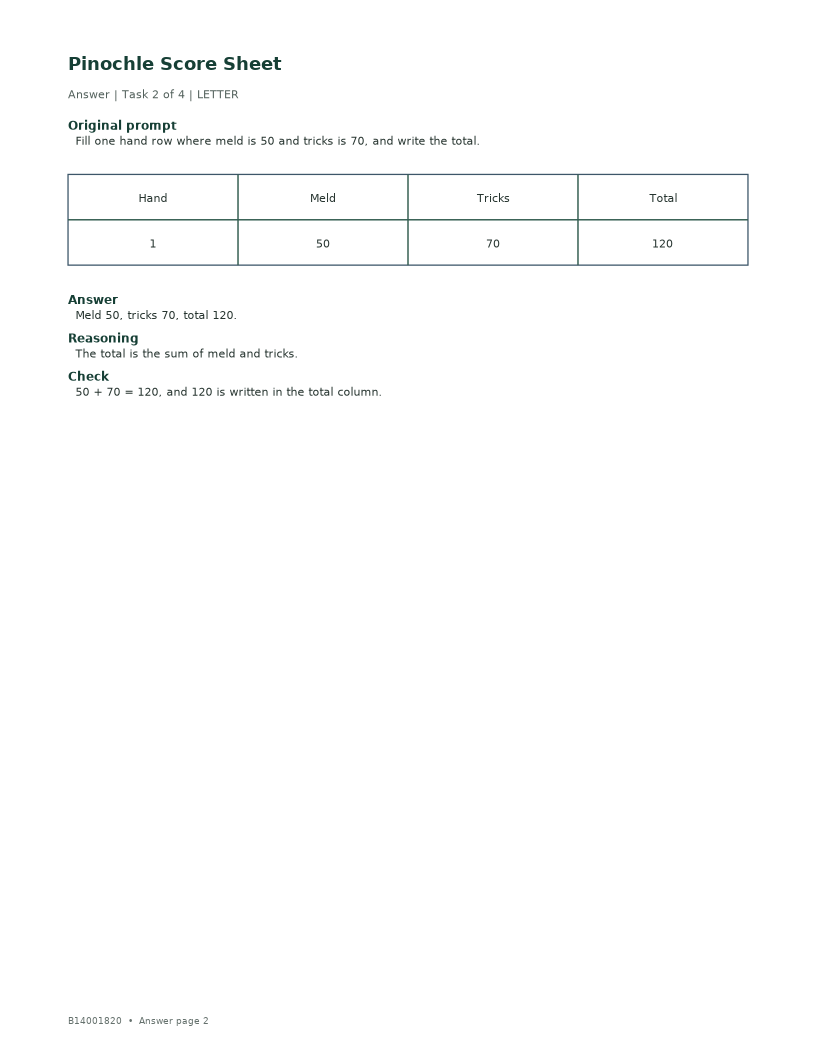
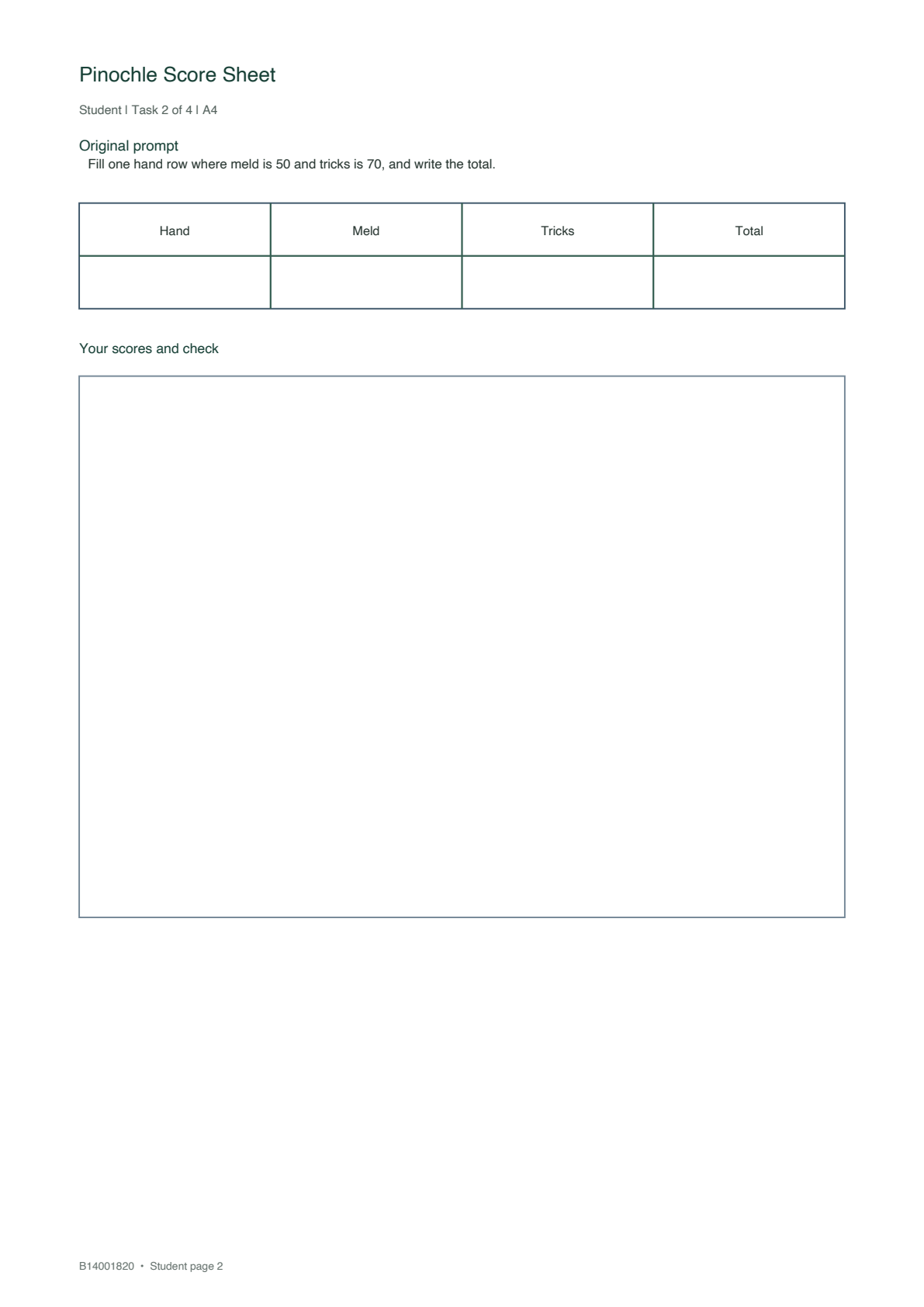
Fill one hand row where meld is 50 and tricks is 70, and write the total.
Show answer 2
Meld 50, tricks 70, total 120.
The total is the sum of meld and tricks.
Check: 50 + 70 = 120, and 120 is written in the total column.
Task 3
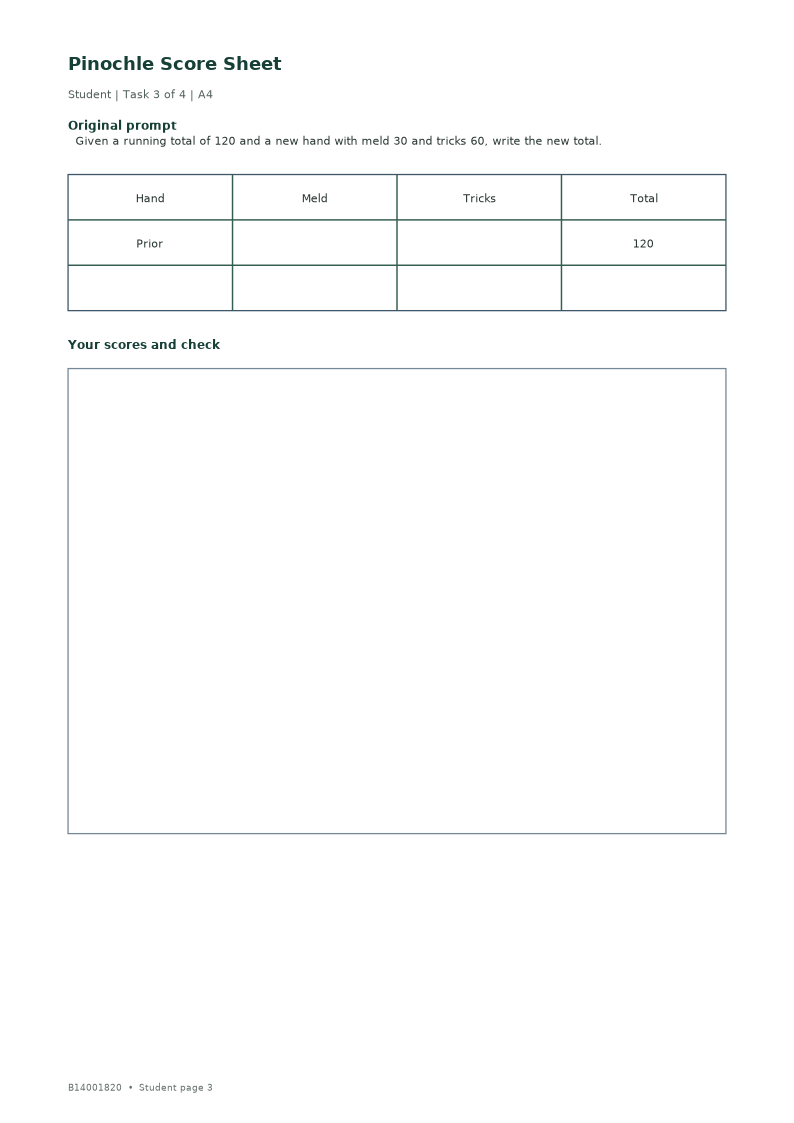
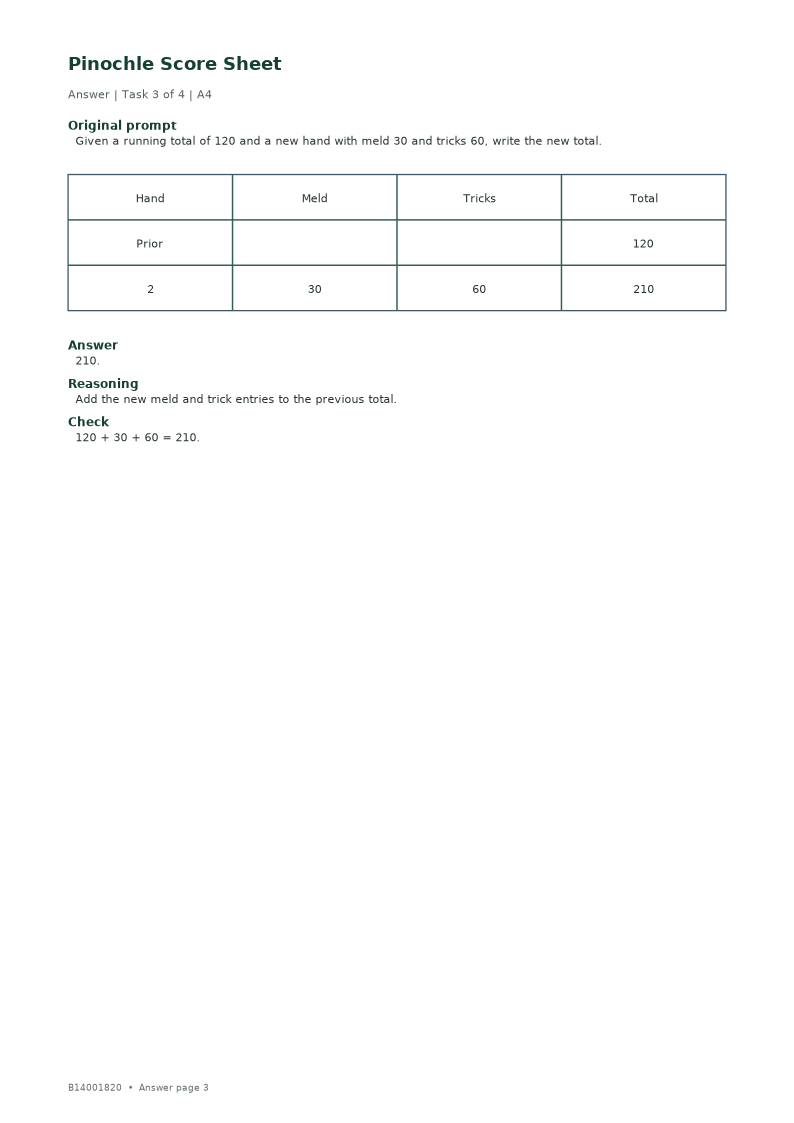
Given a running total of 120 and a new hand with meld 30 and tricks 60, write the new total.
Show answer 3
210.
Add the new meld and trick entries to the previous total.
Check: 120 + 30 + 60 = 210.
Task 4
Write one filled row for each of two partnerships and state which total is higher.
Show answer 4
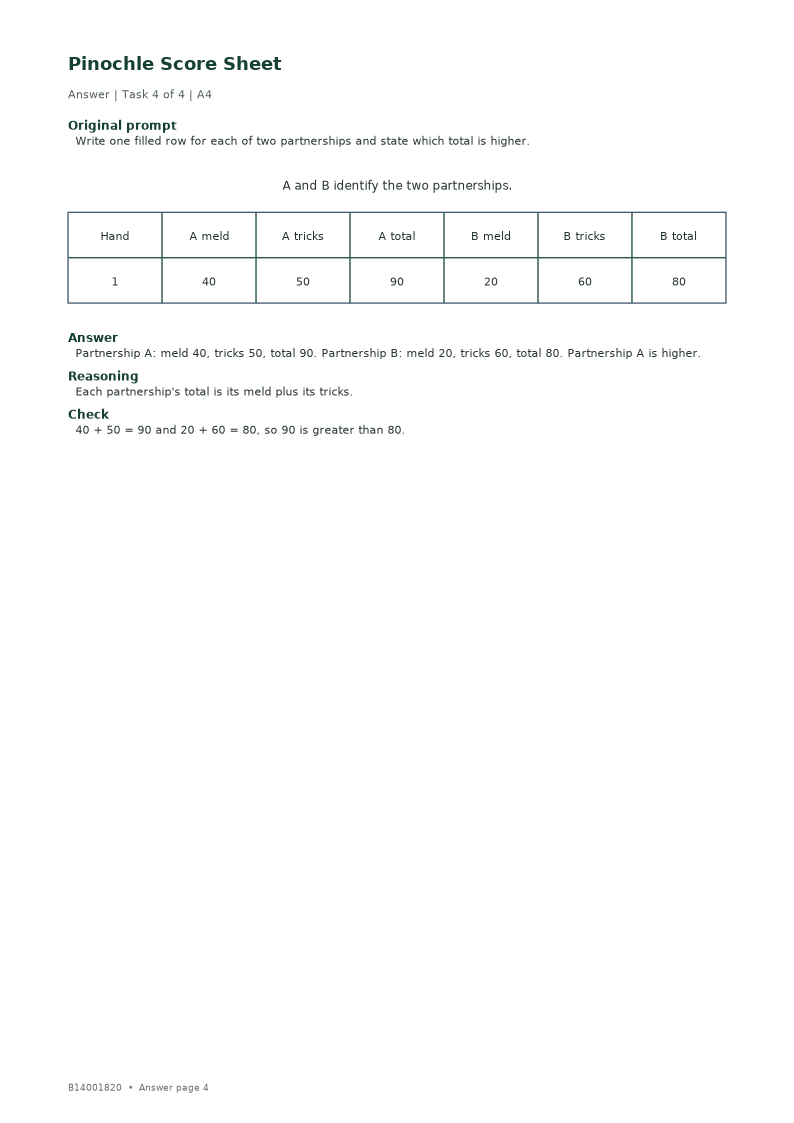
Partnership A: meld 40, tricks 50, total 90. Partnership B: meld 20, tricks 60, total 80. Partnership A is higher.
Each partnership's total is its meld plus its tricks.
Check: 40 + 50 = 90 and 20 + 60 = 80, so 90 is greater than 80.
Useful checks
- Putting trick points in the meld column. Keep meld and trick entries in separate columns and add them only in the total column.
- Forgetting to update the running total. Add the new meld and trick entries to the previous total for each hand.
Questions about this resource
Does the sheet calculate totals automatically?
No. It is a paper form; the scorer writes each entry and adds the columns.
Why separate meld and trick columns?
Pinochle scores meld and trick points differently, so keeping them separate makes each hand's scoring clear.