Free original lessons
Phase 10 Dice Score Sheet
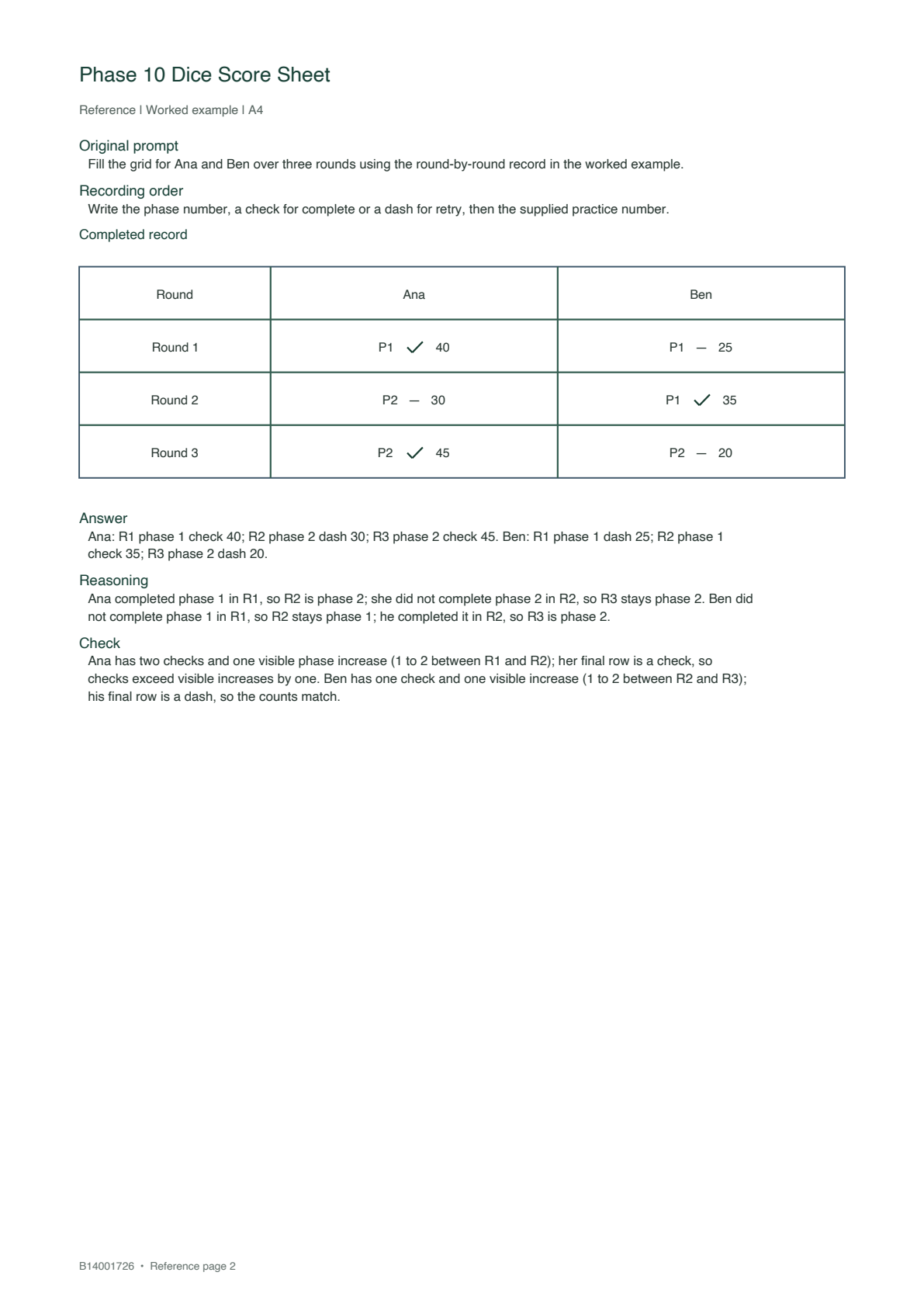
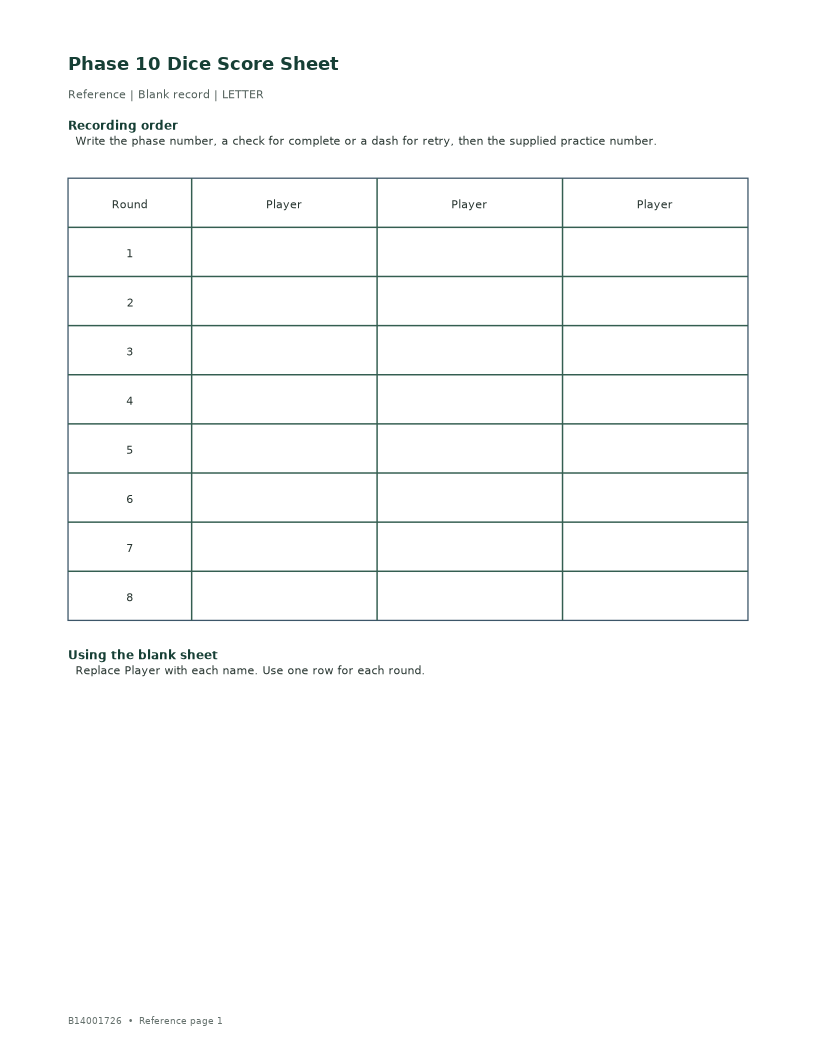
Use one column per player and one row per round. Record the attempted phase, the completion mark and the practice number supplied in the exercise. In a live Phase 10 Dice game, Mattel's scoring rules award points for a turn only if that phase is completed.
Letter & A4
PDF & SVG
What the grid records
Each player cell has three entries: the attempted phase, a check for a completion or a dash for a retry, and the supplied practice number. This record keeps the number visible even on a dash row so you can copy and check the data.
While a player has another phase attempt to record, a check moves the next attempt to the following phase and a dash repeats the same phase.
How to fill one row
Write the round at the left. In each player column, write the phase, the completion mark and the practice number from the given record.
When a phase is completed, the next round's phase number for that player is one higher. When it is not completed, the next round's phase number stays the same.
Worked example
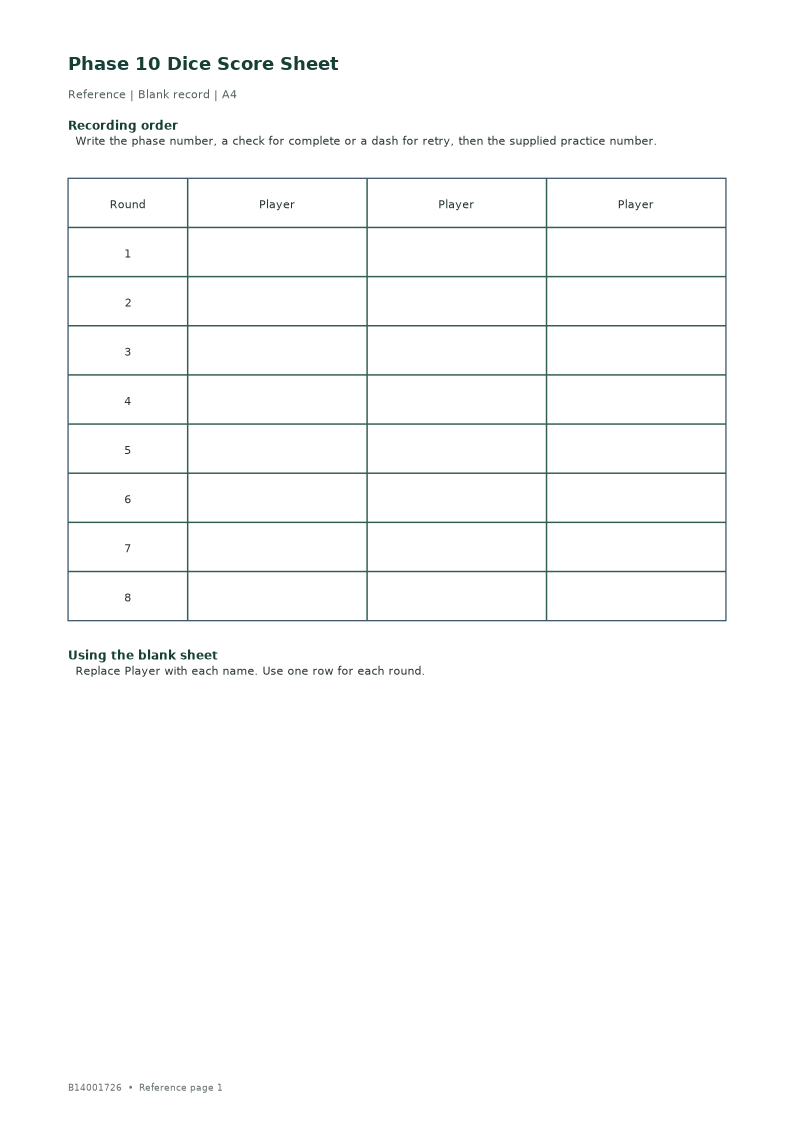
Two players, Ana and Ben, play three rounds. Ana starts on phase 1 and Ben starts on phase 1.
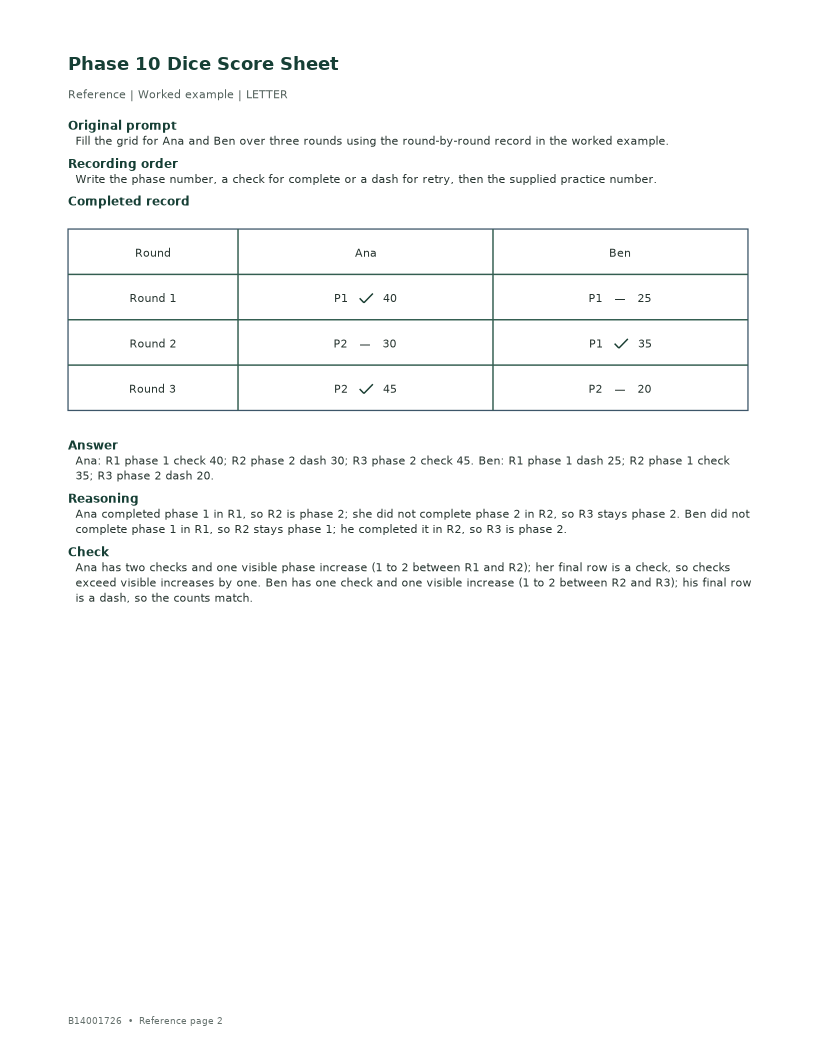
Round 1: Ana completes phase 1 and records 40. Ben retries phase 1 and records 25. Round 2: Ana retries phase 2 and records 30. Ben completes phase 1 and records 35. Round 3: Ana completes phase 2 and records 45. Ben retries phase 2 and records 20. These numbers are exercise inputs.
Checking your grid
After each row, check the next phase against the previous completion mark. Every entry needs a check or dash and the exact practice number supplied for that round.
A quick cross-check: for each player, count the checks in their column and count the phase increases visible between consecutive rows. The two counts are equal when the final row is a dash, and the check count is one higher when the final row is a check, because that last check advances the phase for a round not yet recorded.
Download the complete resource pack
All individual SVG pages (20)
- A4 reference page 1
- A4 reference page 2
- A4 student page 1
- A4 student page 2
- A4 student page 3
- A4 student page 4
- A4 answer page 1
- A4 answer page 2
- A4 answer page 3
- A4 answer page 4
- LETTER reference page 1
- LETTER reference page 2
- LETTER student page 1
- LETTER student page 2
- LETTER student page 3
- LETTER student page 4
- LETTER answer page 1
- LETTER answer page 2
- LETTER answer page 3
- LETTER answer page 4
Print at 100% / actual size. Use the stated scale on any schematic diagram; physical cutting templates are identified separately. A4 and US Letter are separate files. Free access, no signup; CC BY 4.0.
How to use these pages
- What the grid records
- How to fill one row
- Worked example
- Checking your grid
Worked example
Example: Fill the grid for Ana and Ben over three rounds using the round-by-round record in the worked example.
Answer: Ana: R1 phase 1 check 40; R2 phase 2 dash 30; R3 phase 2 check 45. Ben: R1 phase 1 dash 25; R2 phase 1 check 35; R3 phase 2 dash 20.
Reasoning: Ana completed phase 1 in R1, so R2 is phase 2; she did not complete phase 2 in R2, so R3 stays phase 2. Ben did not complete phase 1 in R1, so R2 stays phase 1; he completed it in R2, so R3 is phase 2.
Check: Ana has two checks and one visible phase increase (1 to 2 between R1 and R2); her final row is a check, so checks exceed visible increases by one. Ben has one check and one visible increase (1 to 2 between R2 and R3); his final row is a dash, so the counts match.
Four practice tasks and complete answers
Task 1
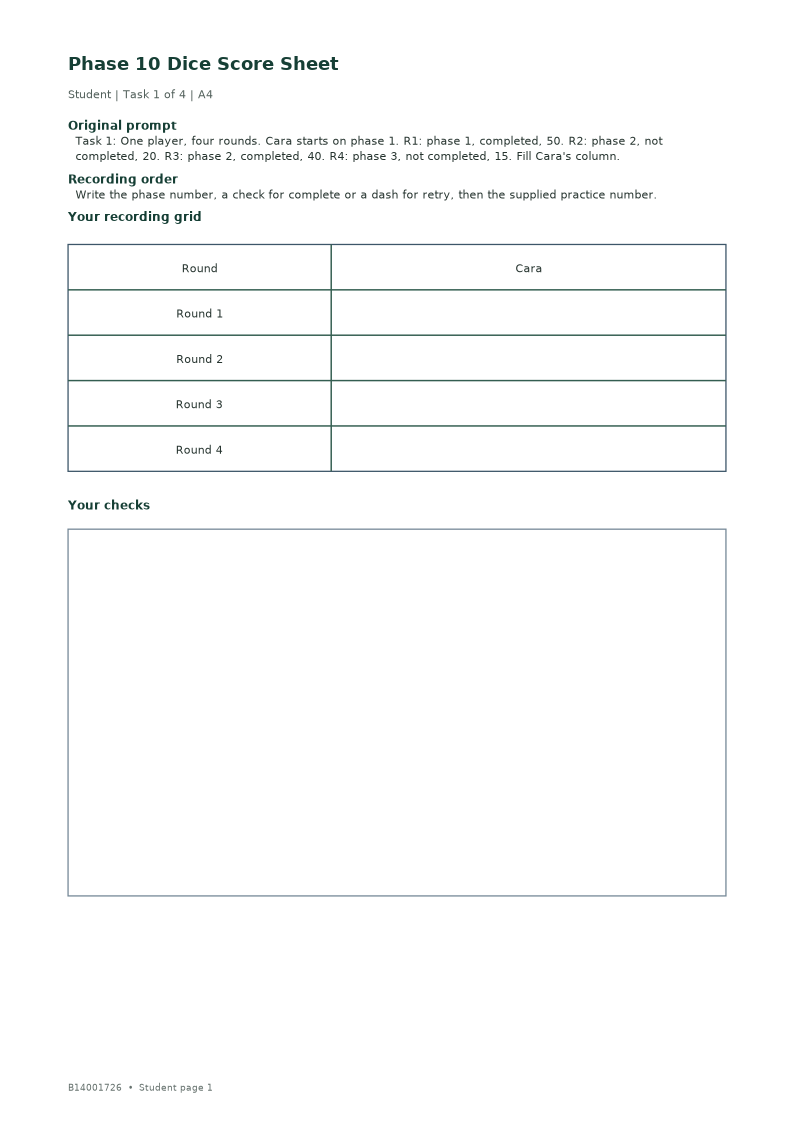
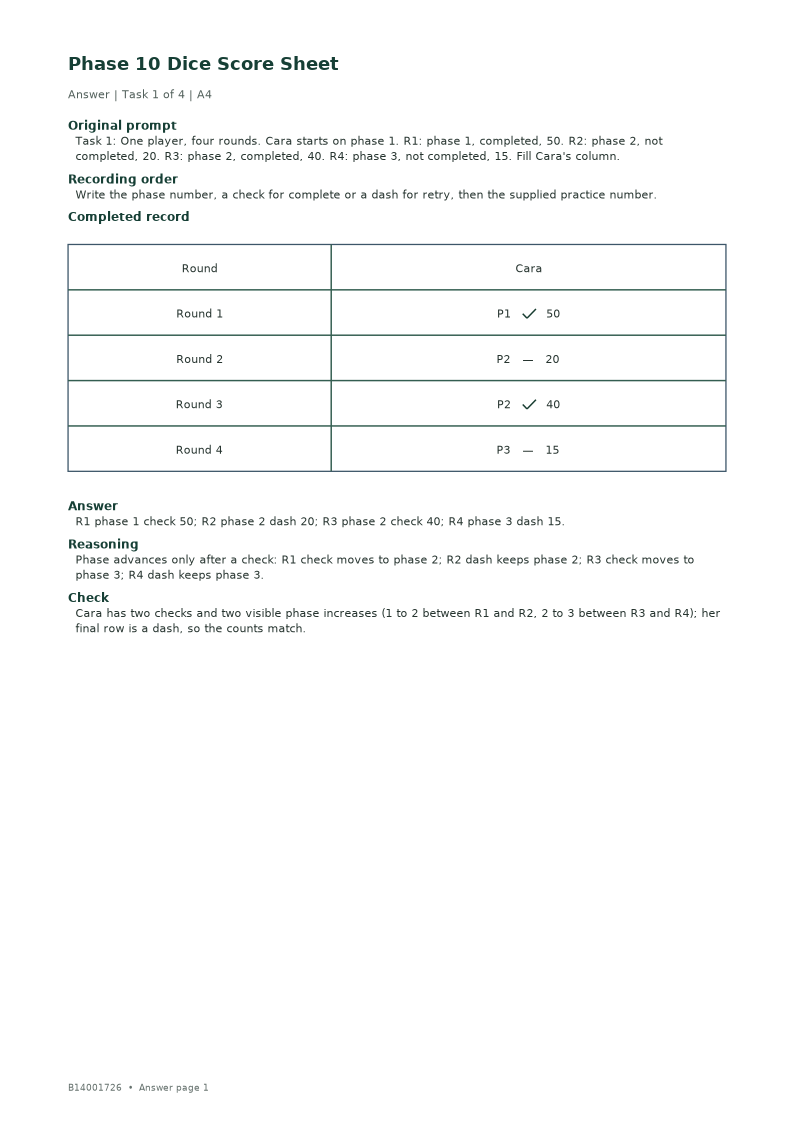
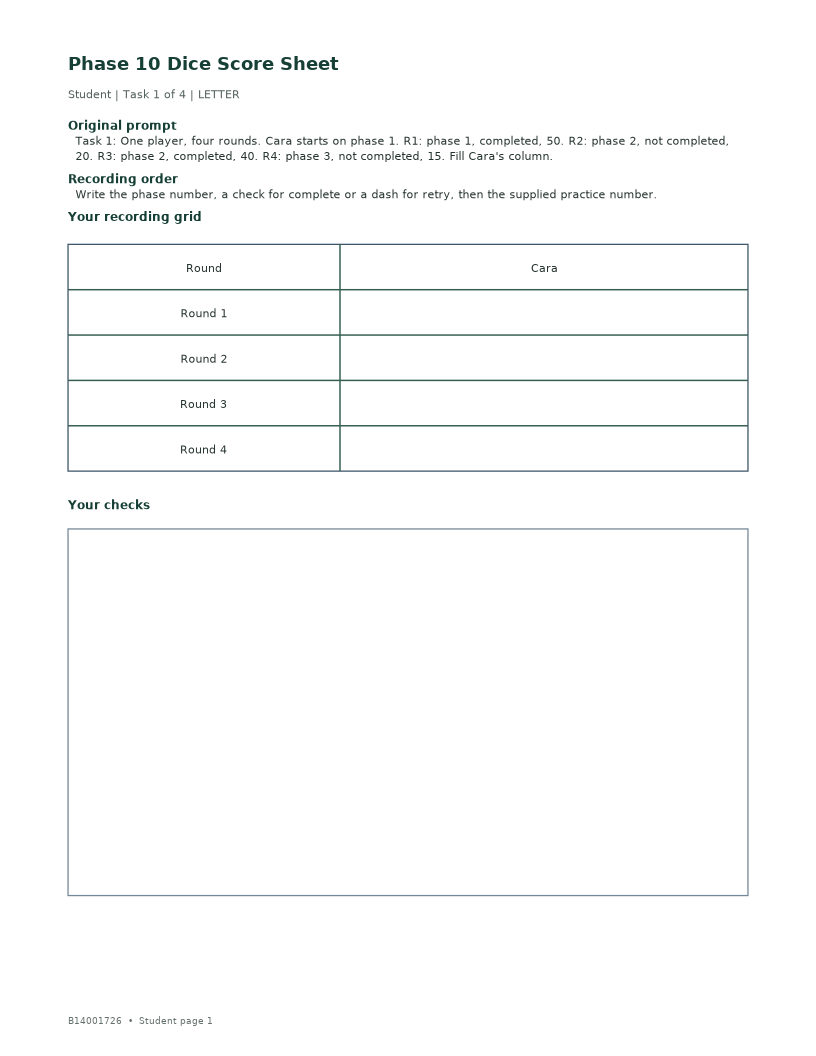
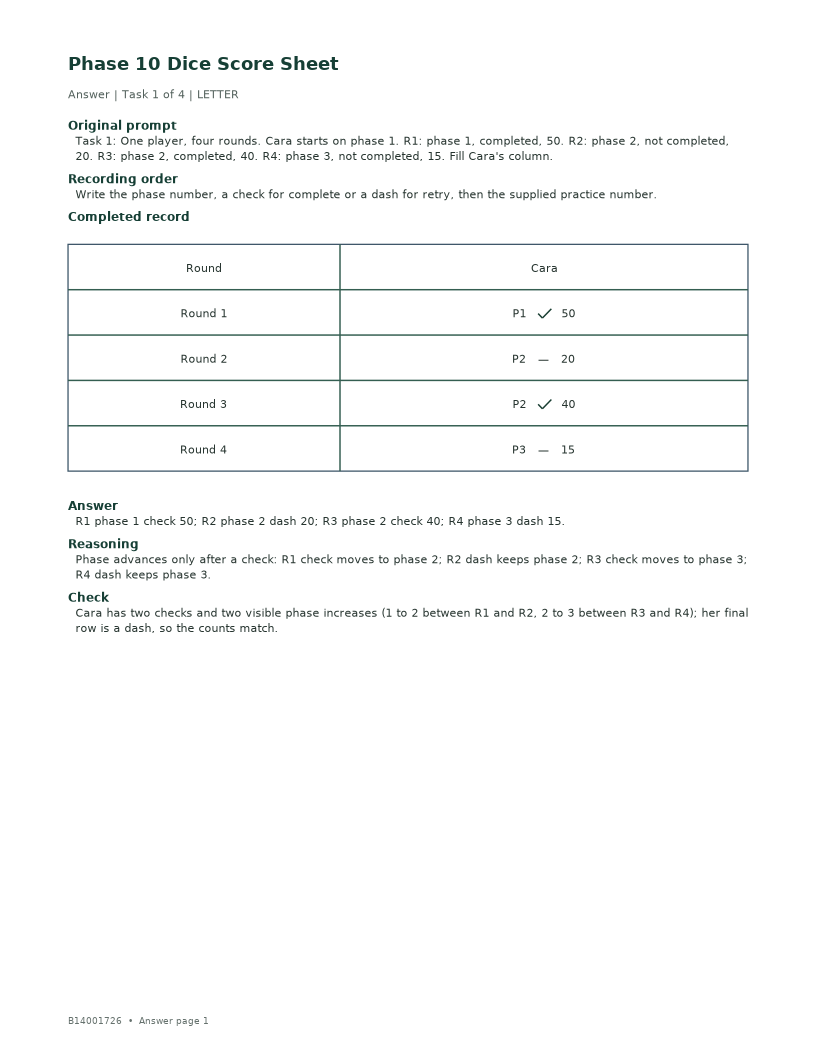
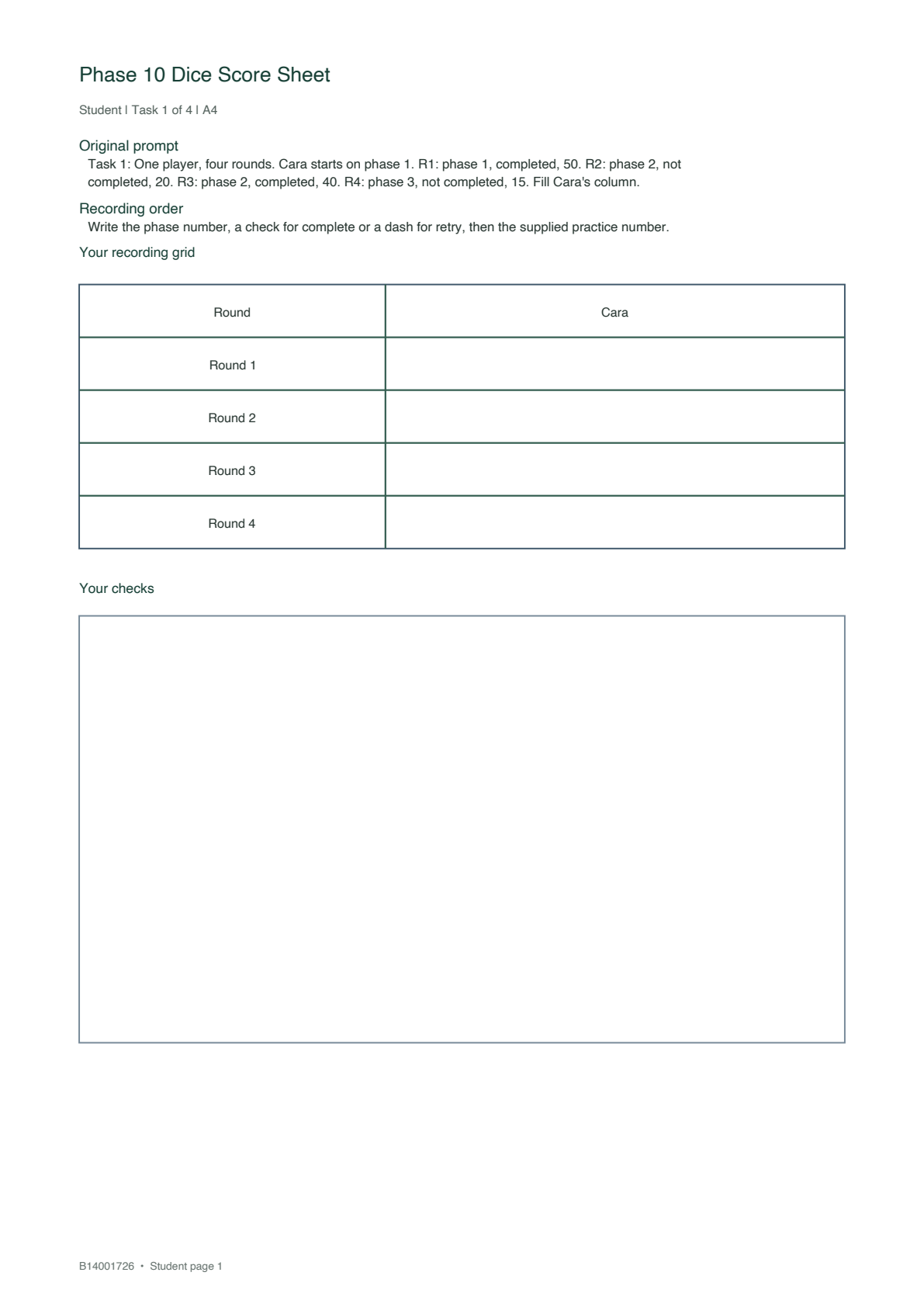
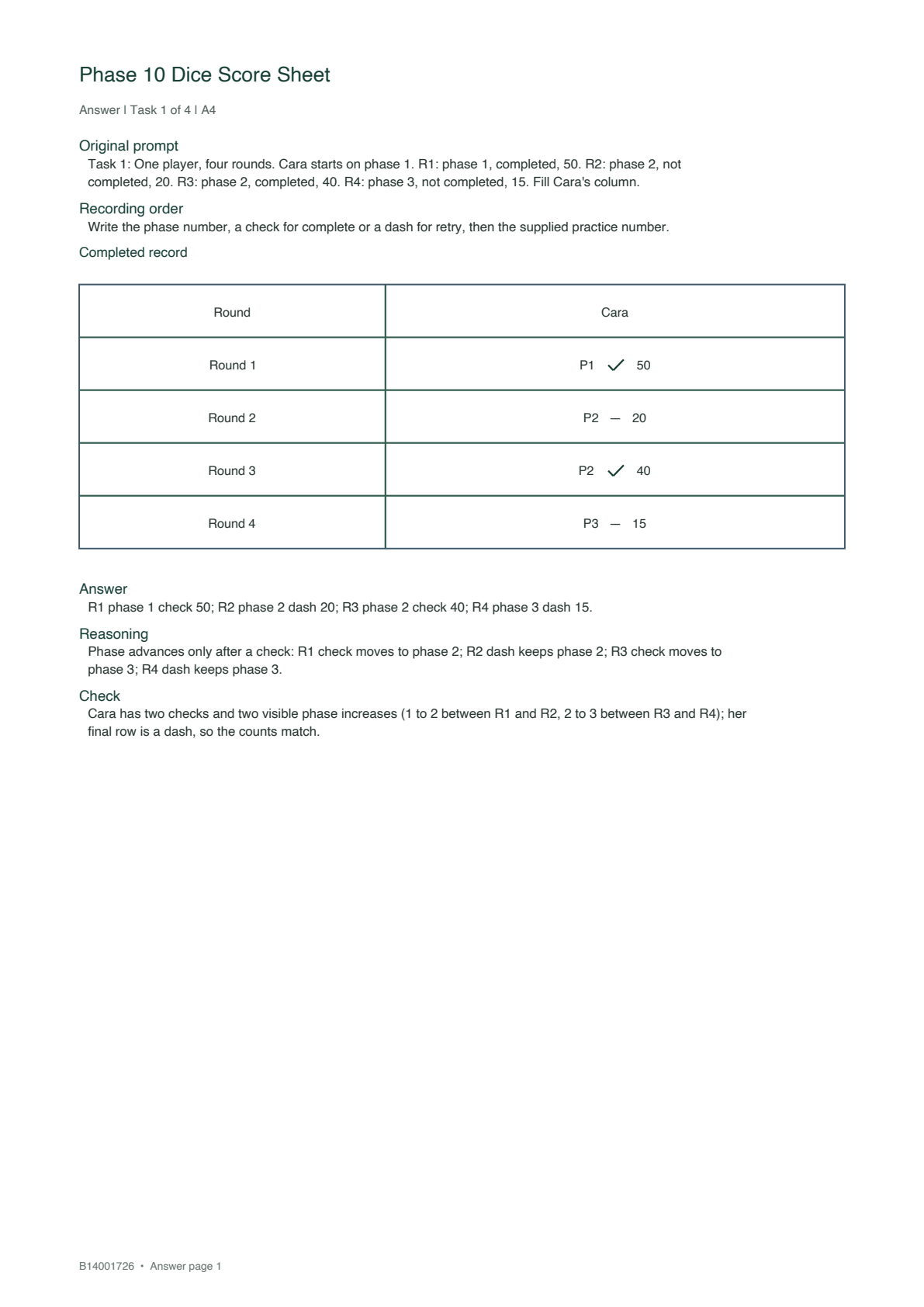
Task 1: One player, four rounds. Cara starts on phase 1. R1: phase 1, completed, 50. R2: phase 2, not completed, 20. R3: phase 2, completed, 40. R4: phase 3, not completed, 15. Fill Cara's column.
Show answer 1
R1 phase 1 check 50; R2 phase 2 dash 20; R3 phase 2 check 40; R4 phase 3 dash 15.
Phase advances only after a check: R1 check moves to phase 2; R2 dash keeps phase 2; R3 check moves to phase 3; R4 dash keeps phase 3.
Check: Cara has two checks and two visible phase increases (1 to 2 between R1 and R2, 2 to 3 between R3 and R4); her final row is a dash, so the counts match.
Task 2
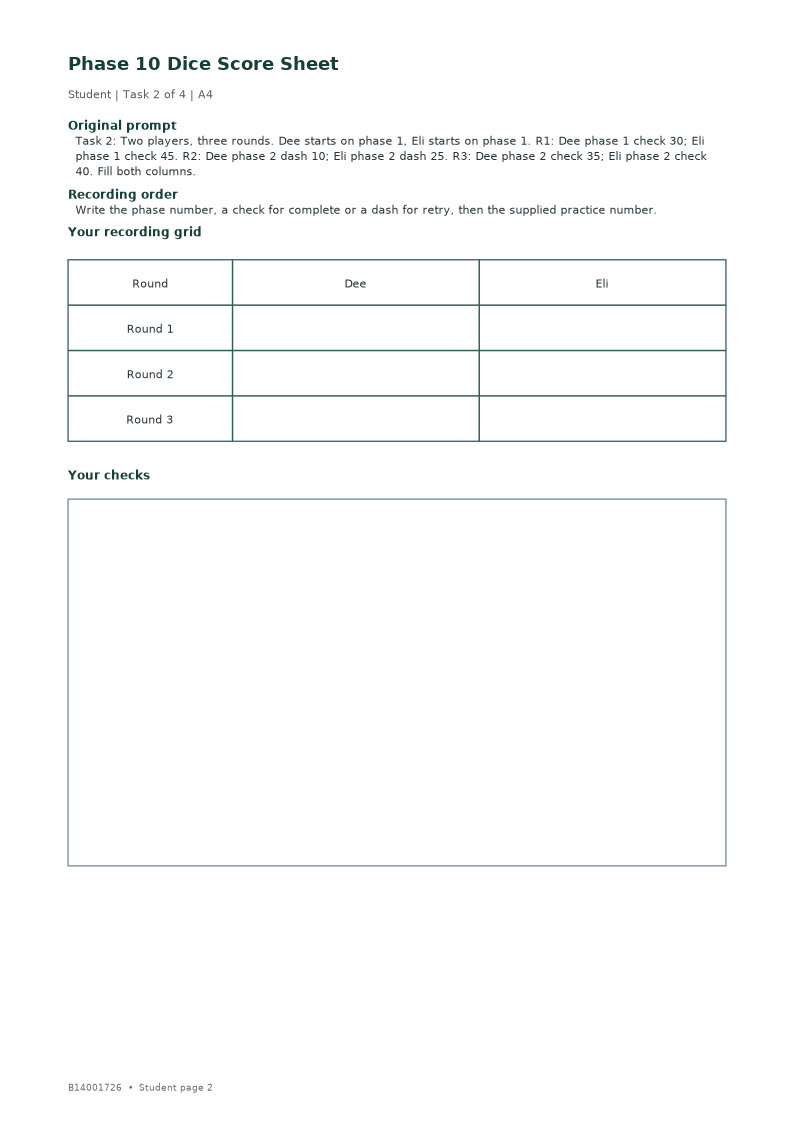
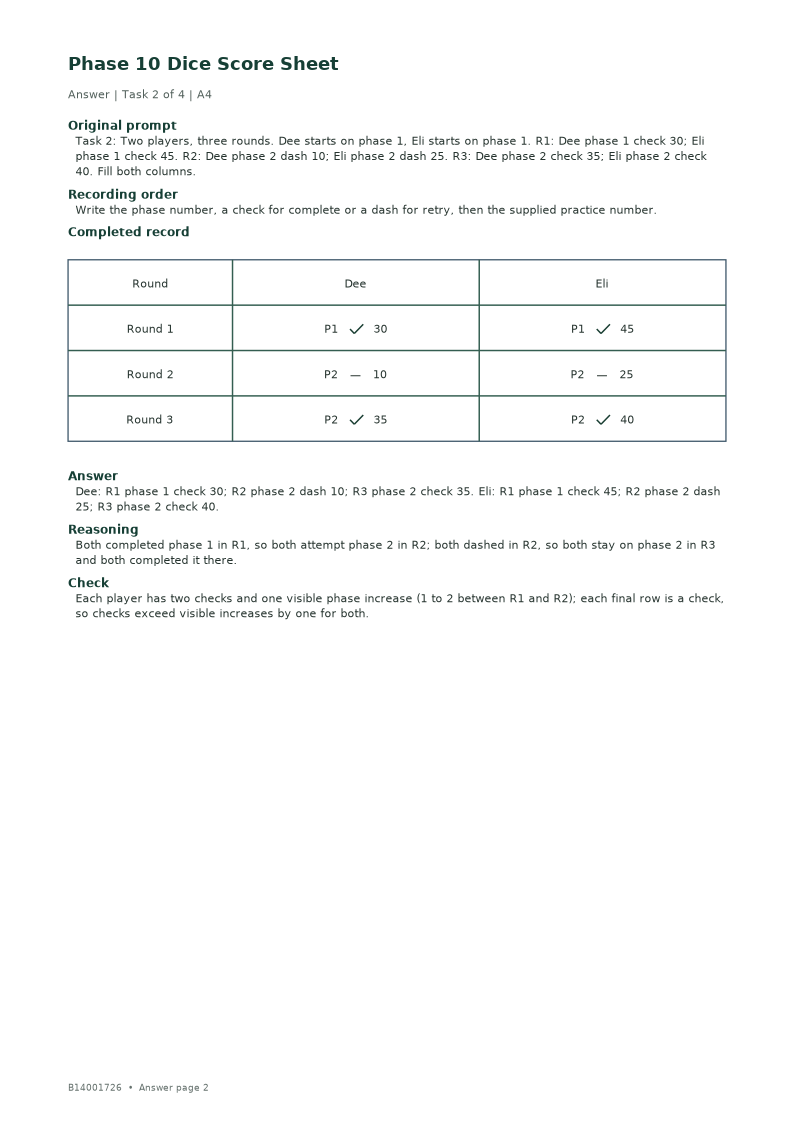
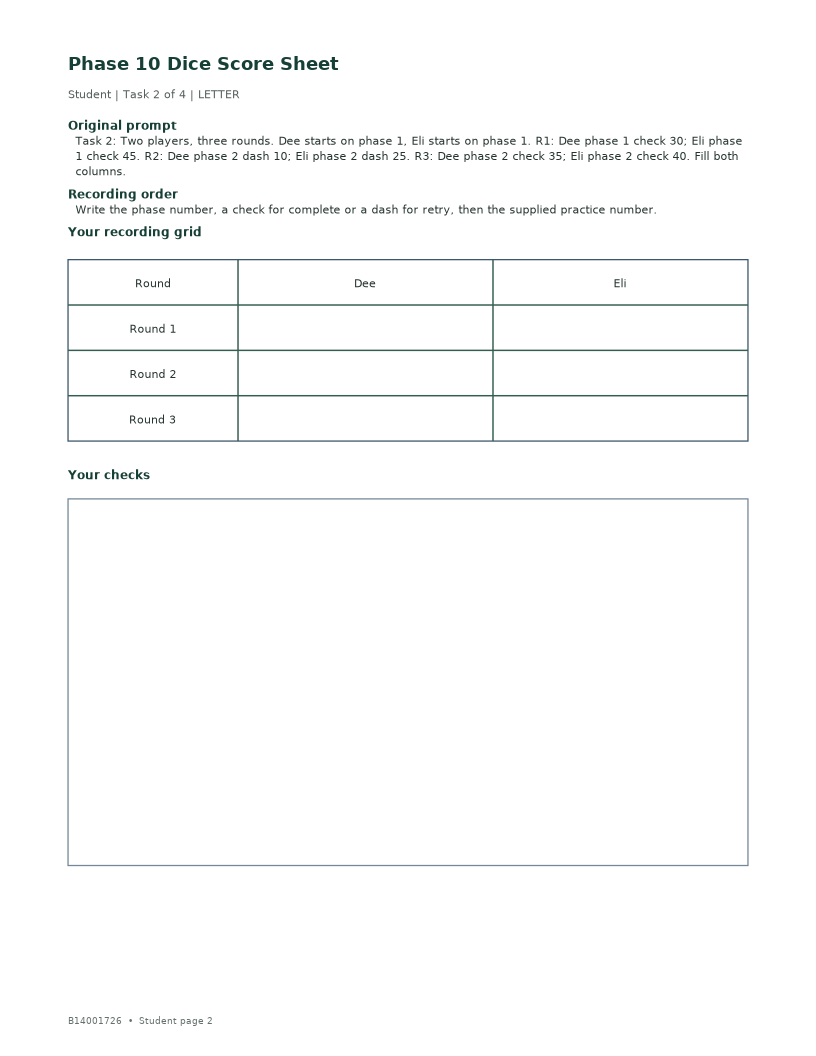
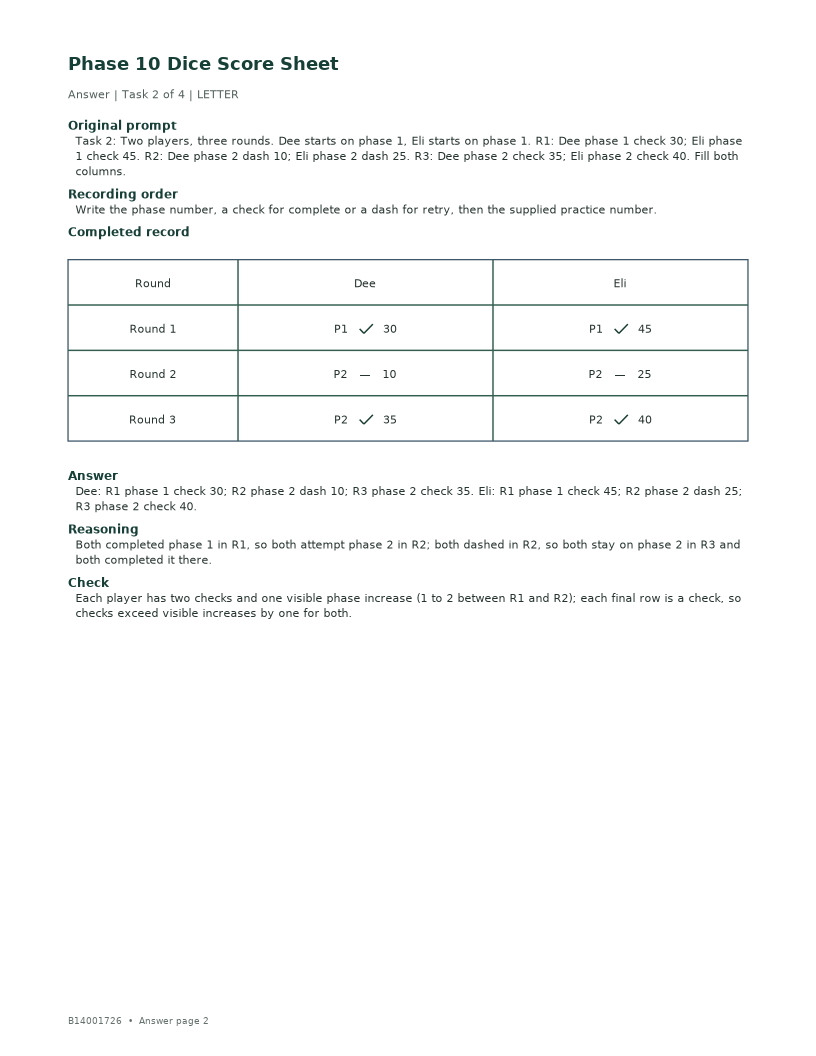
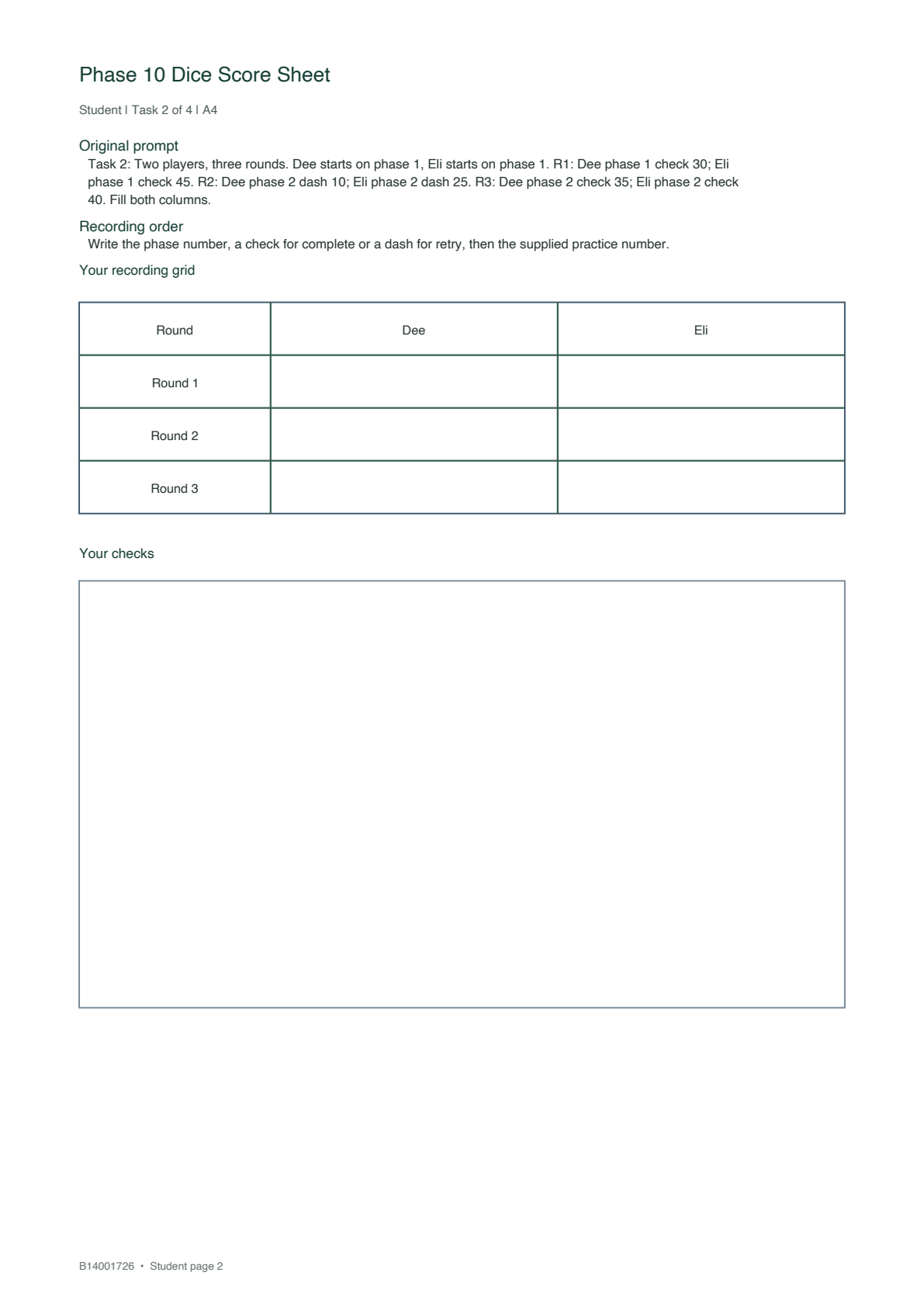
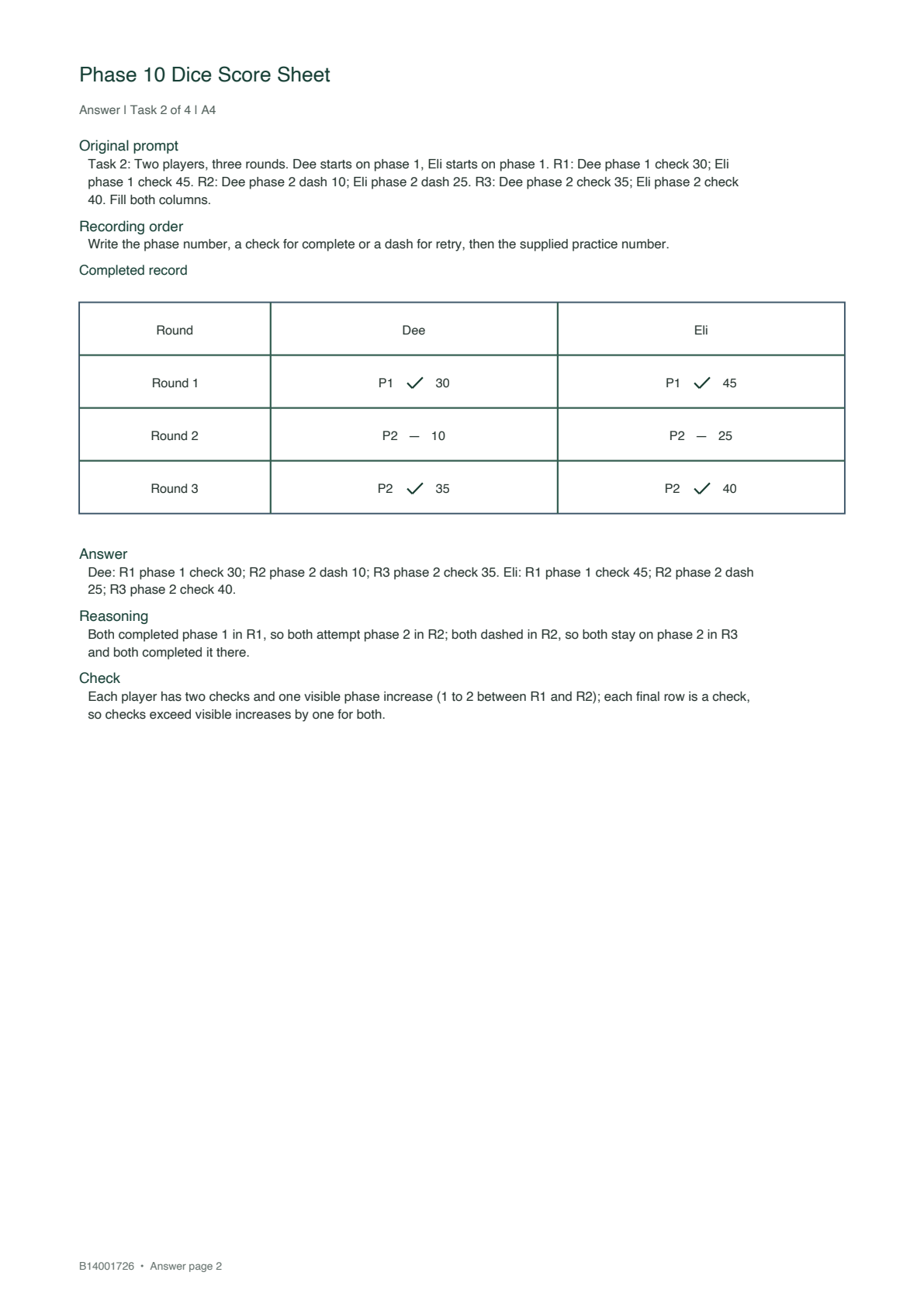
Task 2: Two players, three rounds. Dee starts on phase 1, Eli starts on phase 1. R1: Dee phase 1 check 30; Eli phase 1 check 45. R2: Dee phase 2 dash 10; Eli phase 2 dash 25. R3: Dee phase 2 check 35; Eli phase 2 check 40. Fill both columns.
Show answer 2
Dee: R1 phase 1 check 30; R2 phase 2 dash 10; R3 phase 2 check 35. Eli: R1 phase 1 check 45; R2 phase 2 dash 25; R3 phase 2 check 40.
Both completed phase 1 in R1, so both attempt phase 2 in R2; both dashed in R2, so both stay on phase 2 in R3 and both completed it there.
Check: Each player has two checks and one visible phase increase (1 to 2 between R1 and R2); each final row is a check, so checks exceed visible increases by one for both.
Task 3
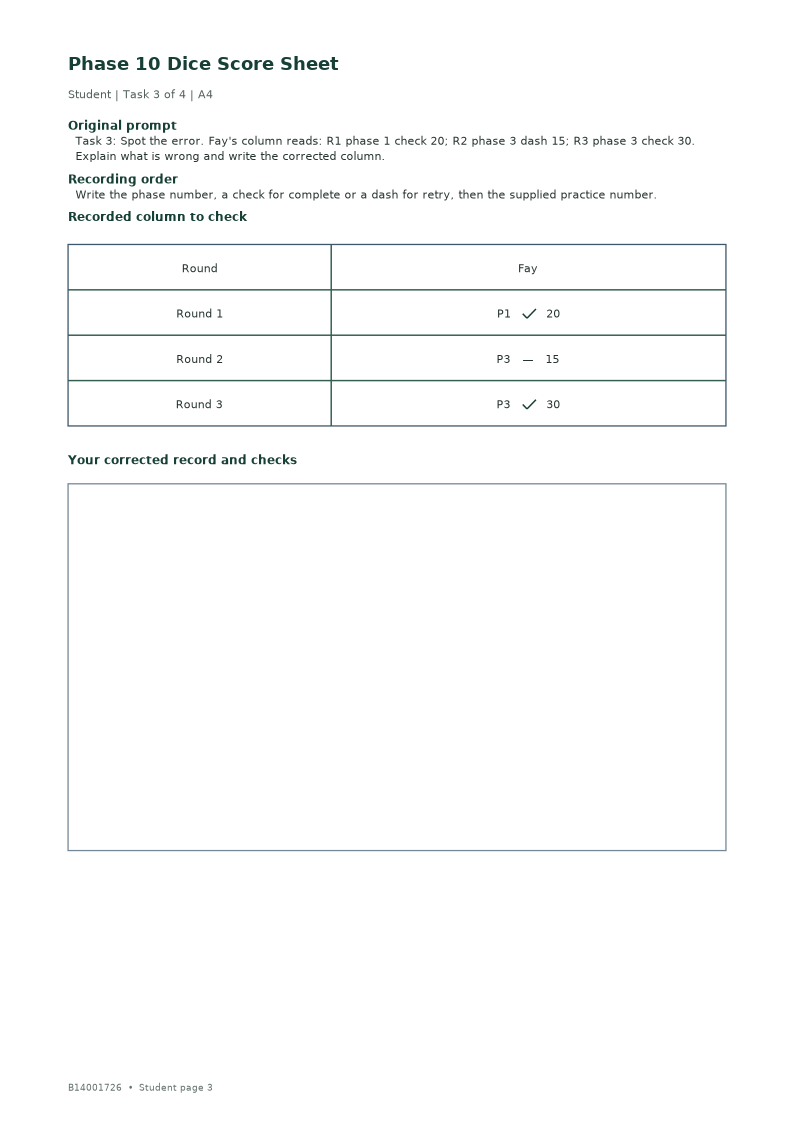
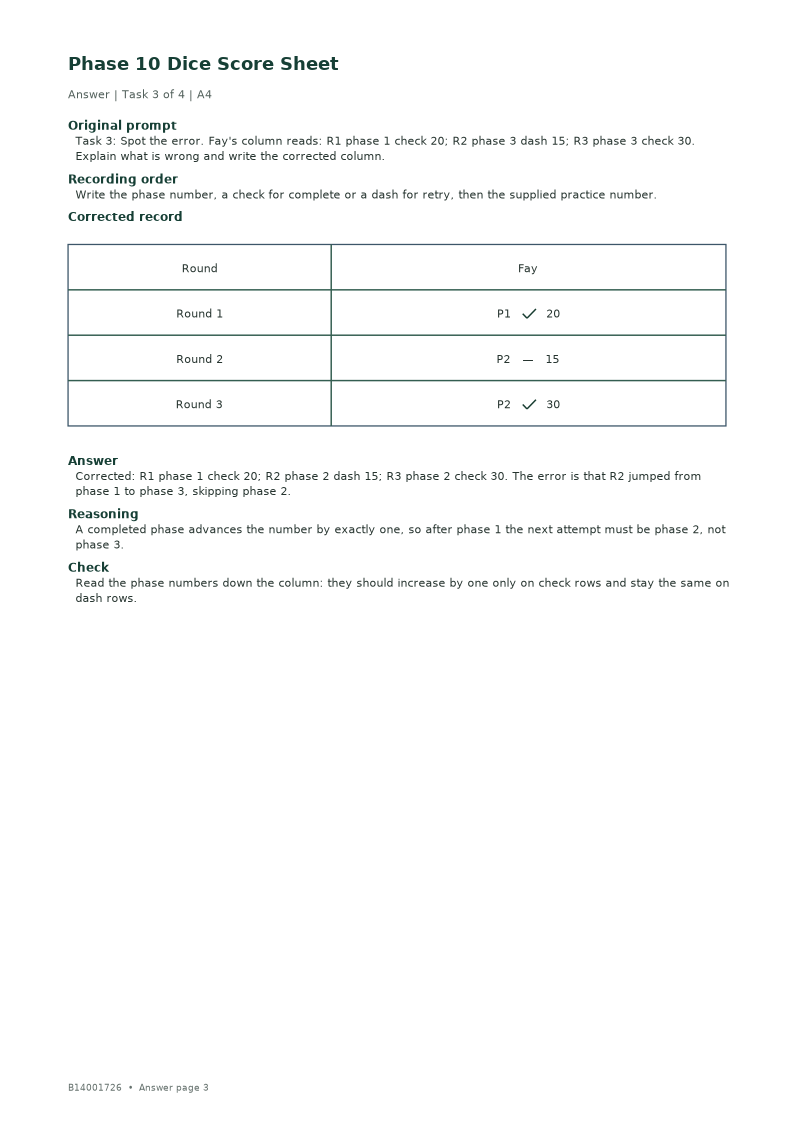
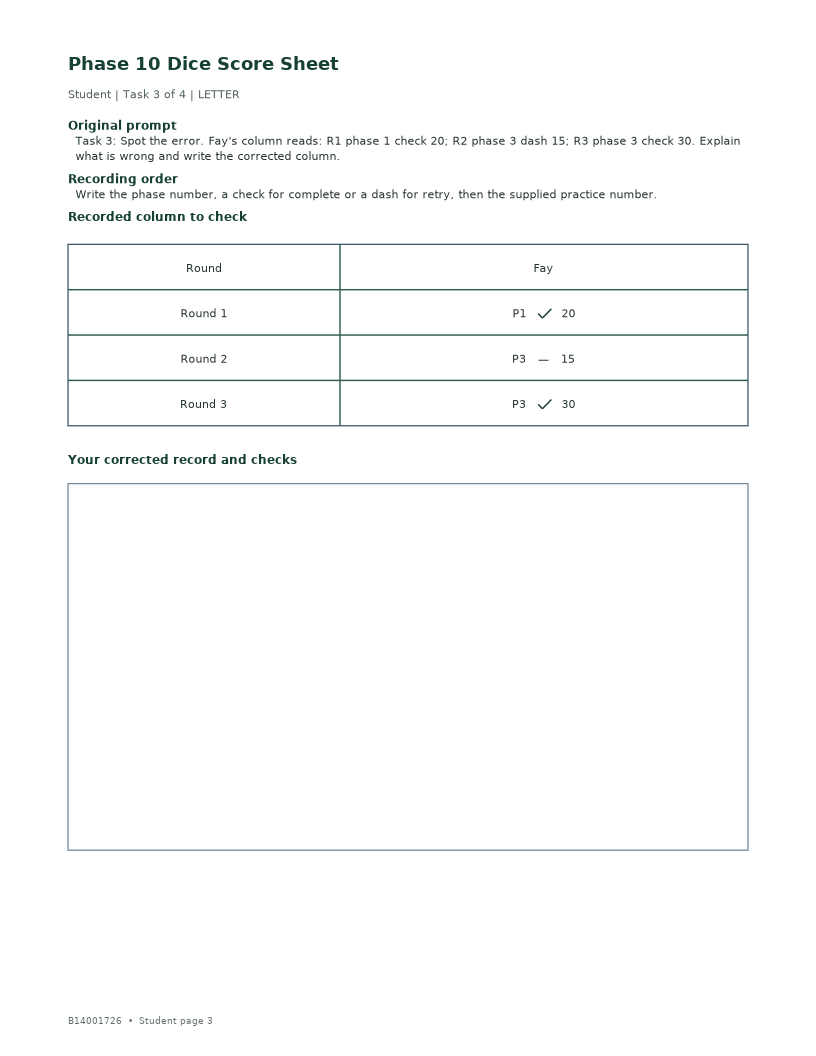
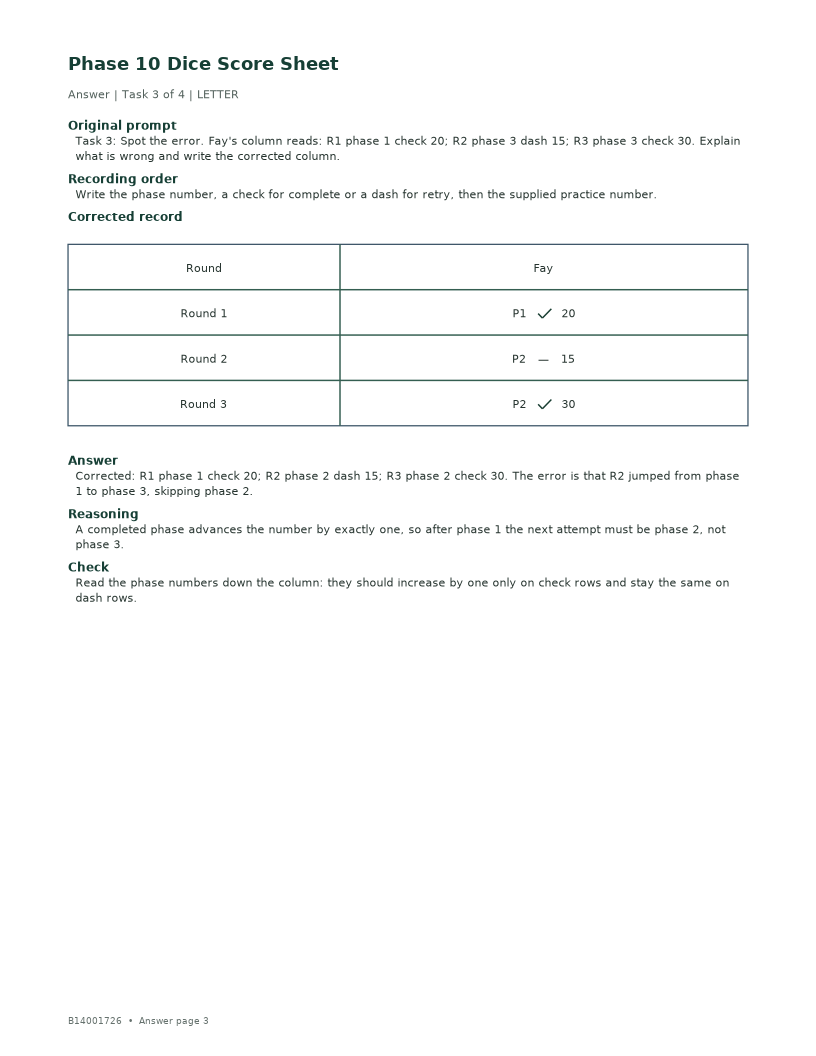
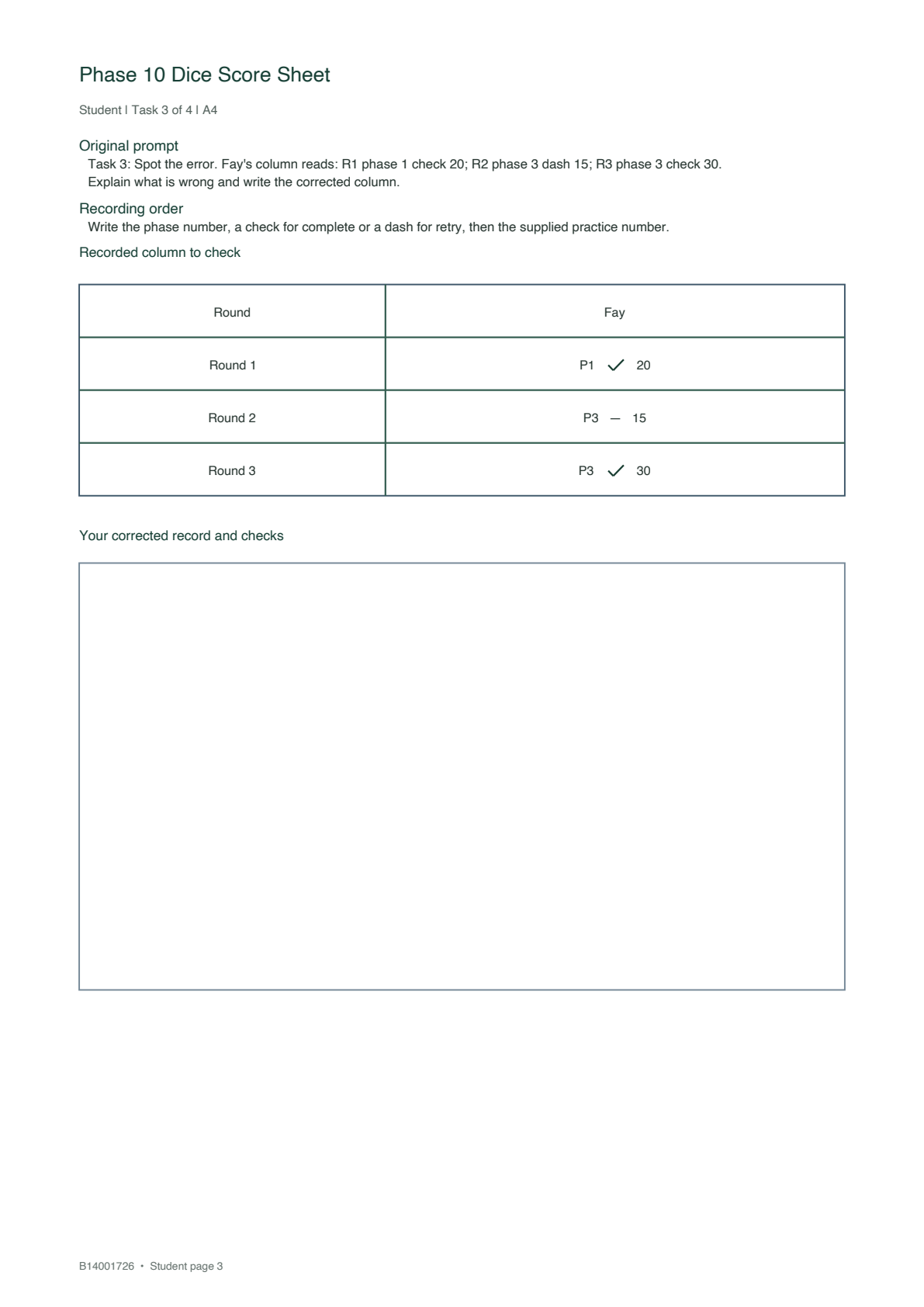
Task 3: Spot the error. Fay's column reads: R1 phase 1 check 20; R2 phase 3 dash 15; R3 phase 3 check 30. Explain what is wrong and write the corrected column.
Show answer 3
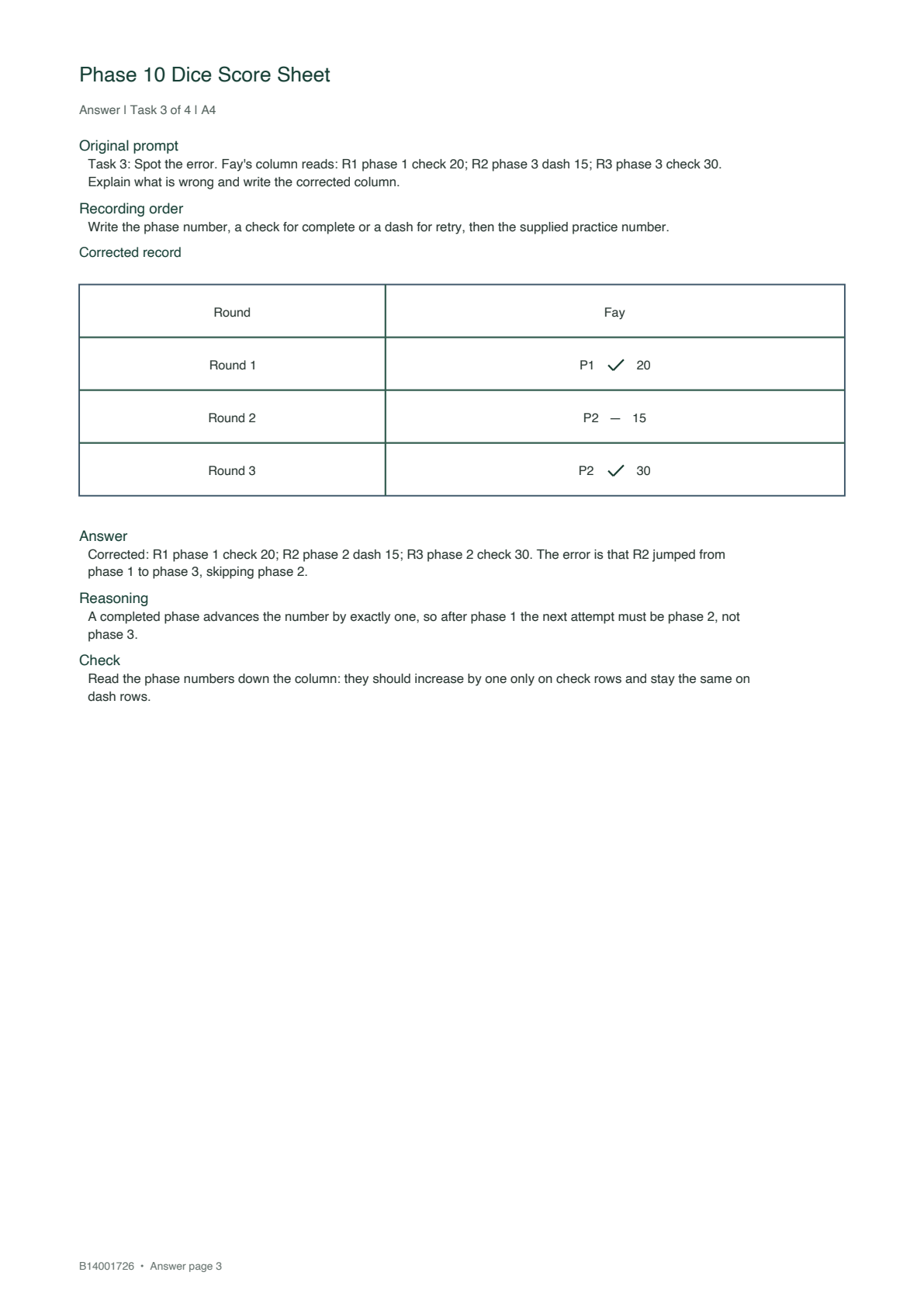
Corrected: R1 phase 1 check 20; R2 phase 2 dash 15; R3 phase 2 check 30. The error is that R2 jumped from phase 1 to phase 3, skipping phase 2.
A completed phase advances the number by exactly one, so after phase 1 the next attempt must be phase 2, not phase 3.
Check: Read the phase numbers down the column: they should increase by one only on check rows and stay the same on dash rows.
Task 4
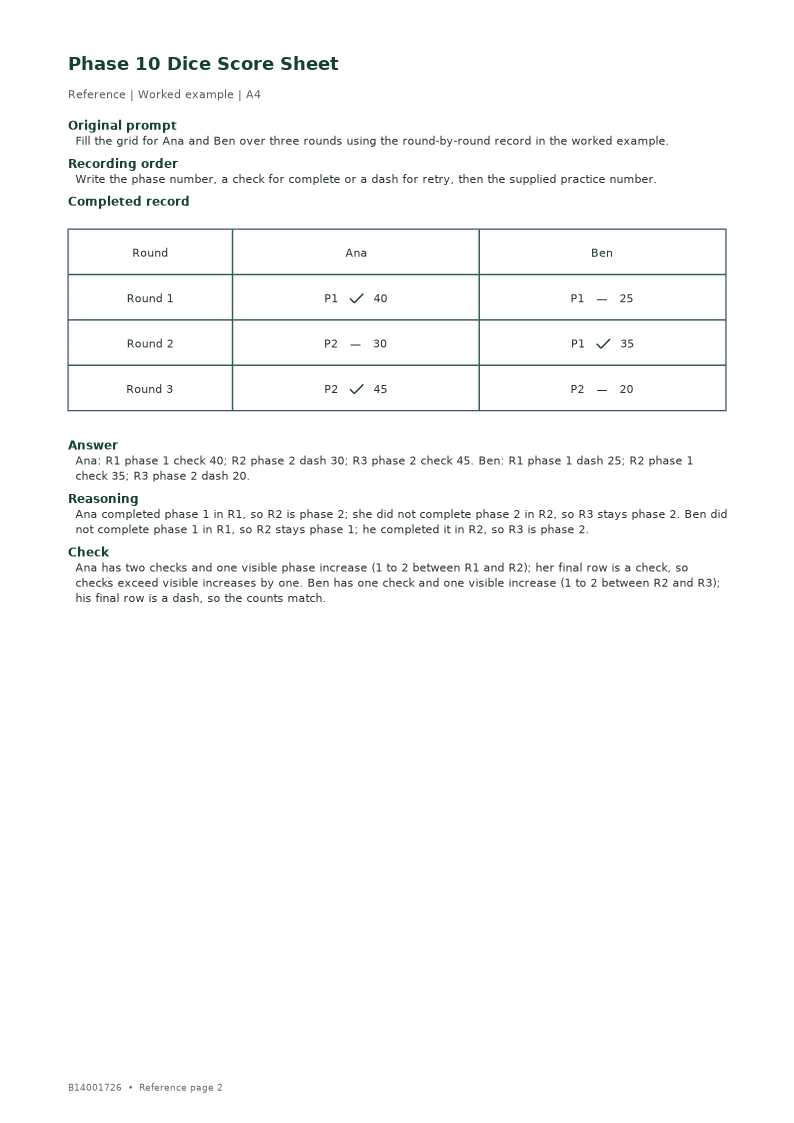
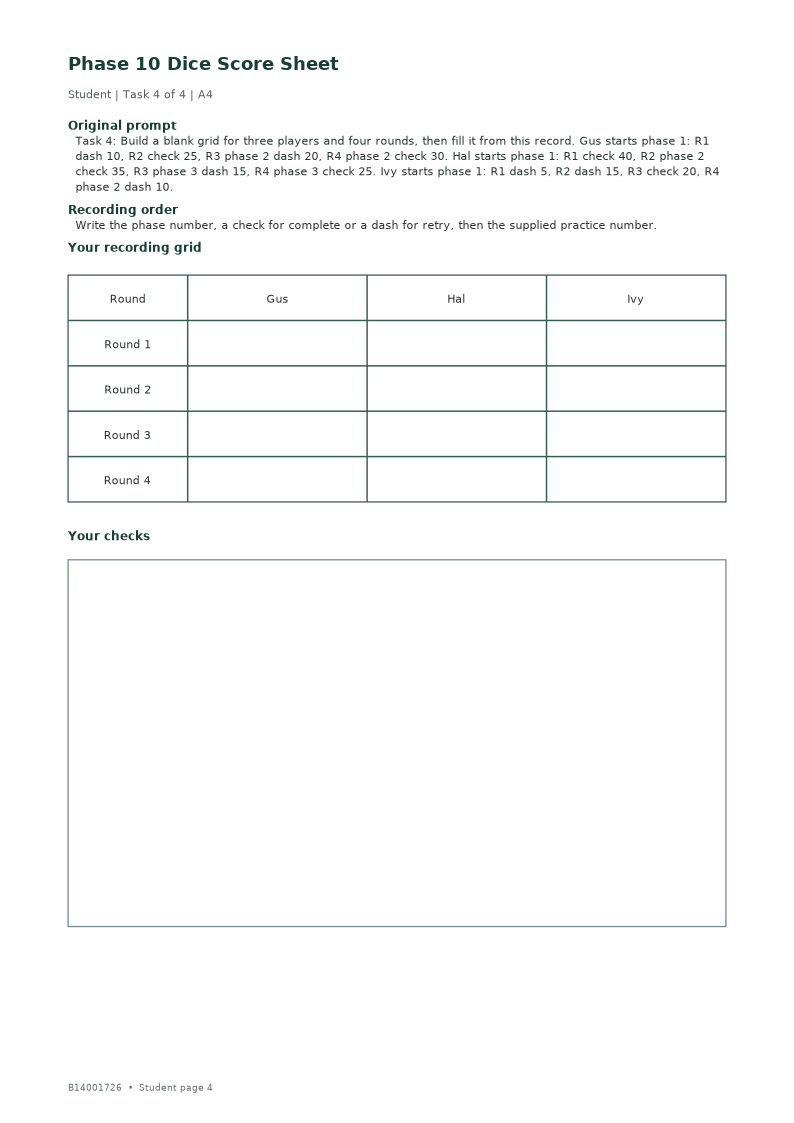
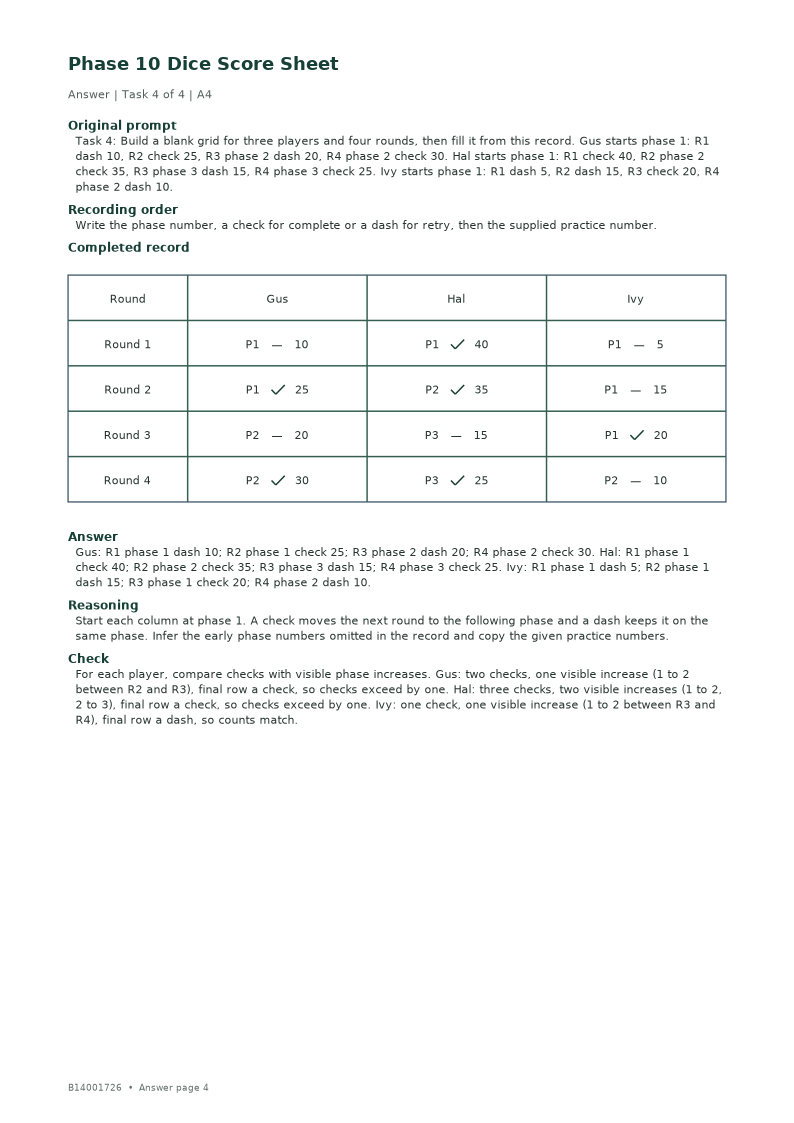
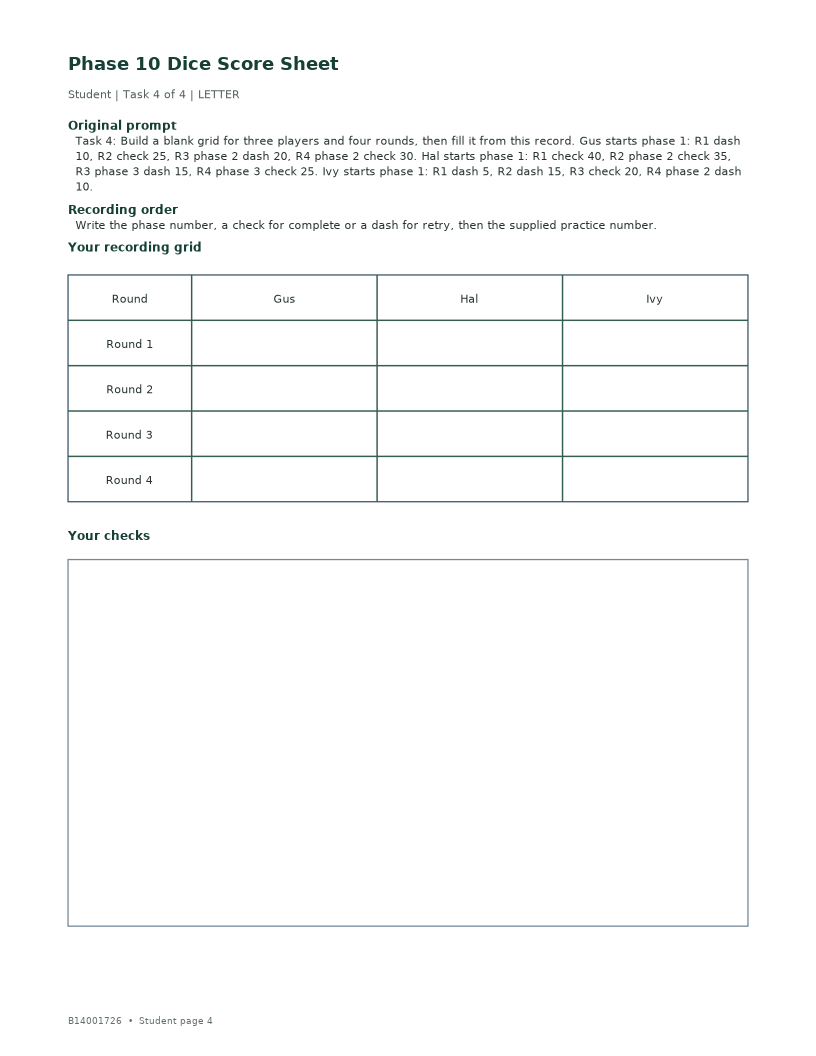
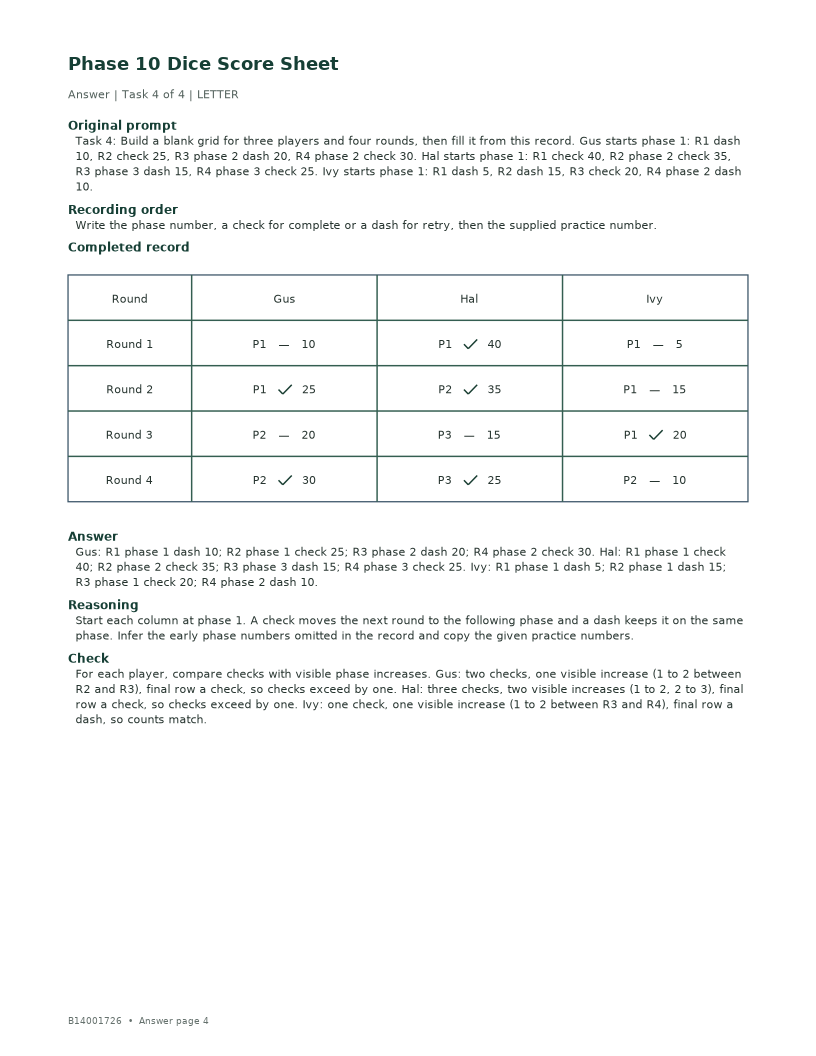
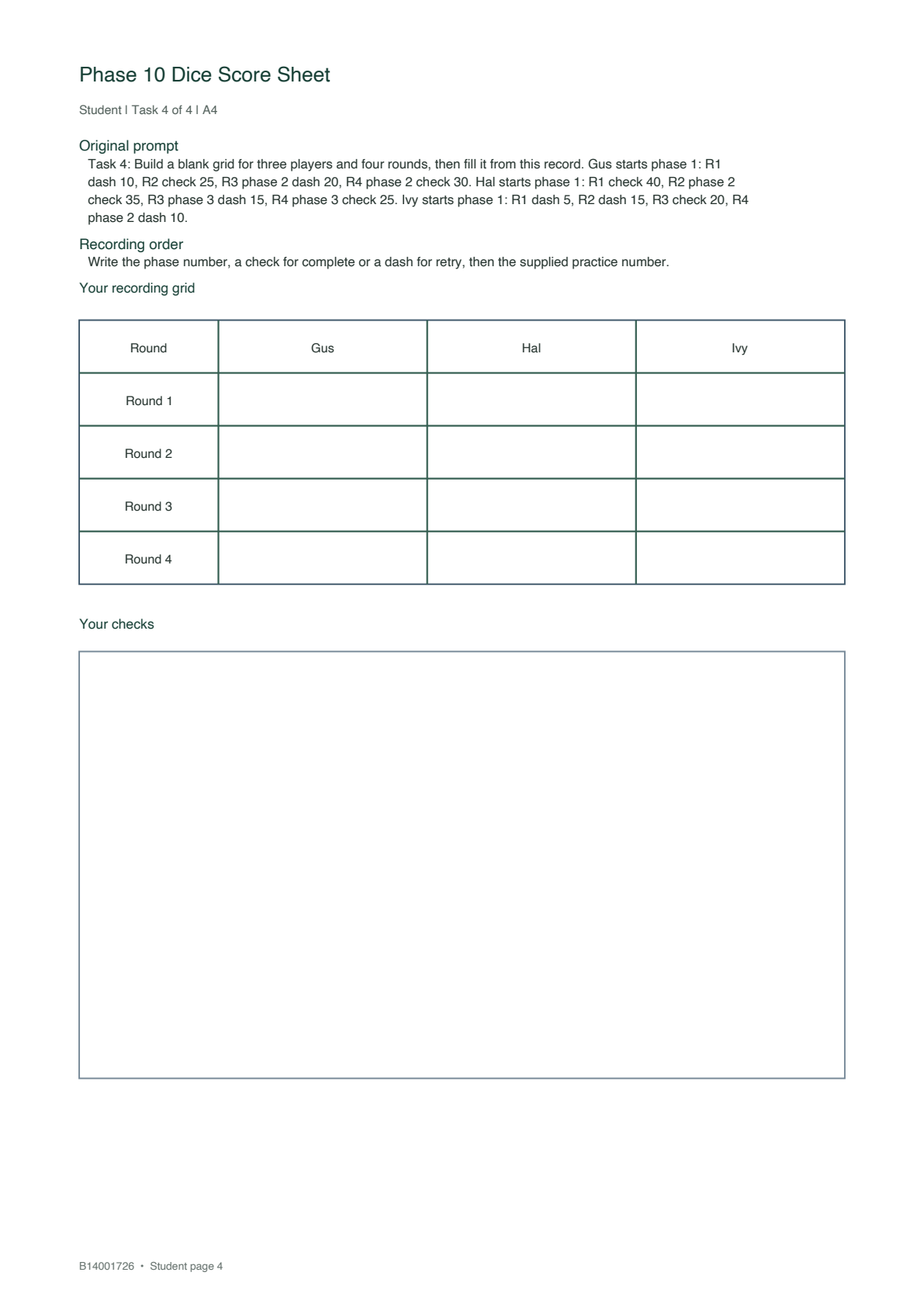
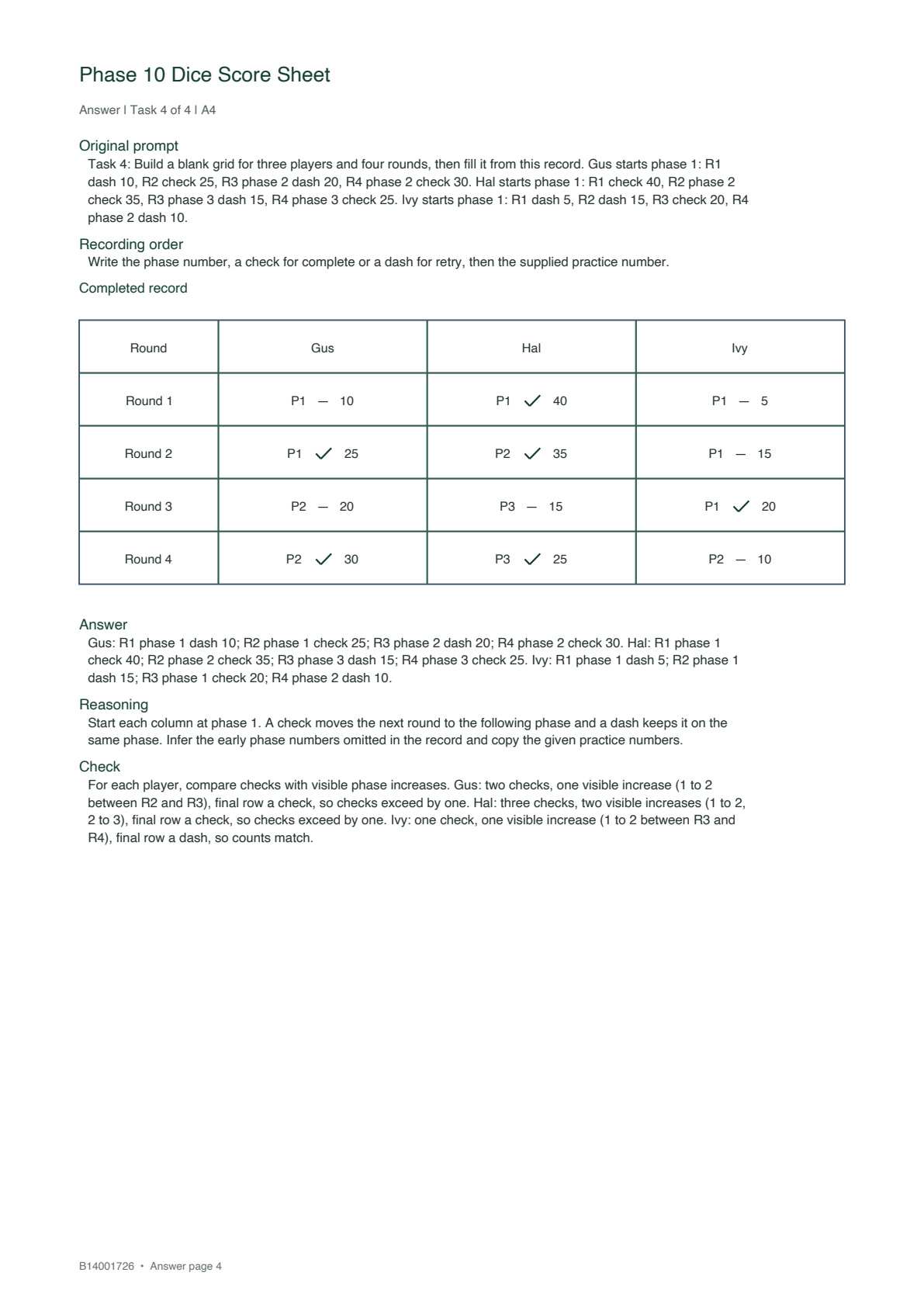
Task 4: Build a blank grid for three players and four rounds, then fill it from this record. Gus starts phase 1: R1 dash 10, R2 check 25, R3 phase 2 dash 20, R4 phase 2 check 30. Hal starts phase 1: R1 check 40, R2 phase 2 check 35, R3 phase 3 dash 15, R4 phase 3 check 25. Ivy starts phase 1: R1 dash 5, R2 dash 15, R3 check 20, R4 phase 2 dash 10.
Show answer 4
Gus: R1 phase 1 dash 10; R2 phase 1 check 25; R3 phase 2 dash 20; R4 phase 2 check 30. Hal: R1 phase 1 check 40; R2 phase 2 check 35; R3 phase 3 dash 15; R4 phase 3 check 25. Ivy: R1 phase 1 dash 5; R2 phase 1 dash 15; R3 phase 1 check 20; R4 phase 2 dash 10.
Start each column at phase 1. A check moves the next round to the following phase and a dash keeps it on the same phase. Infer the early phase numbers omitted in the record and copy the given practice numbers.
Check: For each player, compare checks with visible phase increases. Gus: two checks, one visible increase (1 to 2 between R2 and R3), final row a check, so checks exceed by one. Hal: three checks, two visible increases (1 to 2, 2 to 3), final row a check, so checks exceed by one. Ivy: one check, one visible increase (1 to 2 between R3 and R4), final row a dash, so counts match.
Useful checks
- Advancing the phase number after a dash. A dash means the phase was not completed, so the next round keeps the same phase number.
- Skipping a phase number after a check. A check advances the phase number by exactly one, never by two.
- Leaving a supplied number out of the practice grid. Copy the exercise number even on a dash row. In Mattel's live scoring, a failed attempt earns zero points.
Questions about this resource
Does the grid decide the rules of Phase 10 Dice?
The grid records phase attempts and supplied practice numbers. Follow Mattel's instructions for earning points in a live game.
Can I use the grid for the card game Phase 10?
This grid is built for the dice game's round-and-phase structure. The card game's score sheet tracks card points differently, so use a card-game sheet for that.