Free original lessons
Cricket Score Sheet
This pack teaches you to build and use a cricket score sheet with three linked sections: batting, bowling, and extras. You will read a reference score sheet, copy its column structure, fill a worked example, then complete four practice tasks using the same structure.
Letter & A4
PDF & SVG
What a cricket score sheet must record
A cricket score sheet is a paper form that records a match innings by innings. The batting section lists each batter, how they were dismissed, and their runs; the bowling section lists each bowler, their overs, runs conceded and wickets; the extras section records runs not scored by the bat.
Reconcile the team total by adding batting runs and extras. When there are no separate penalty runs, the sum of bowler runs plus byes and leg byes gives the same total. Count all dismissals for the team wicket total. A run-out adds a team wicket without crediting a bowler.
Layout specification
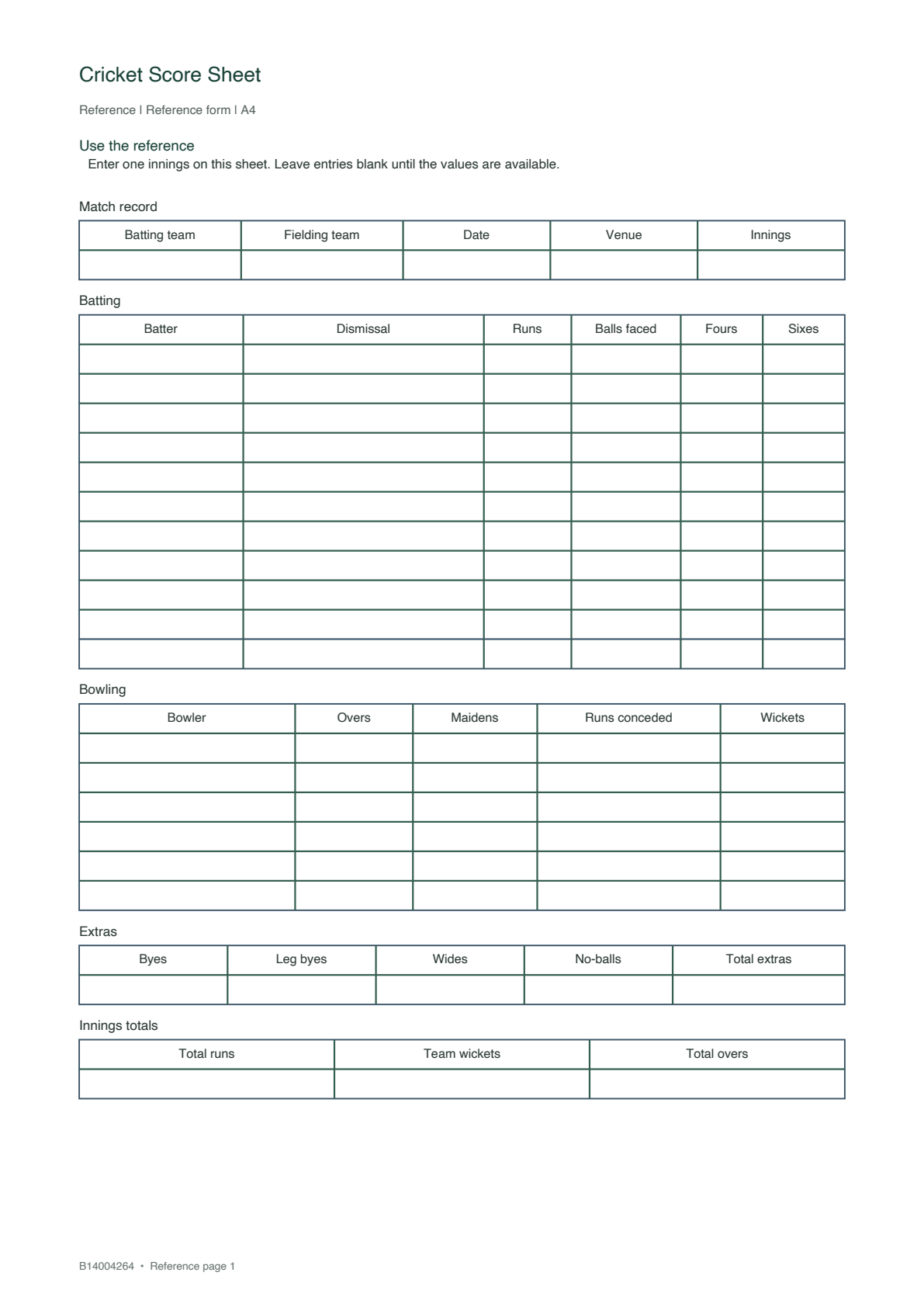
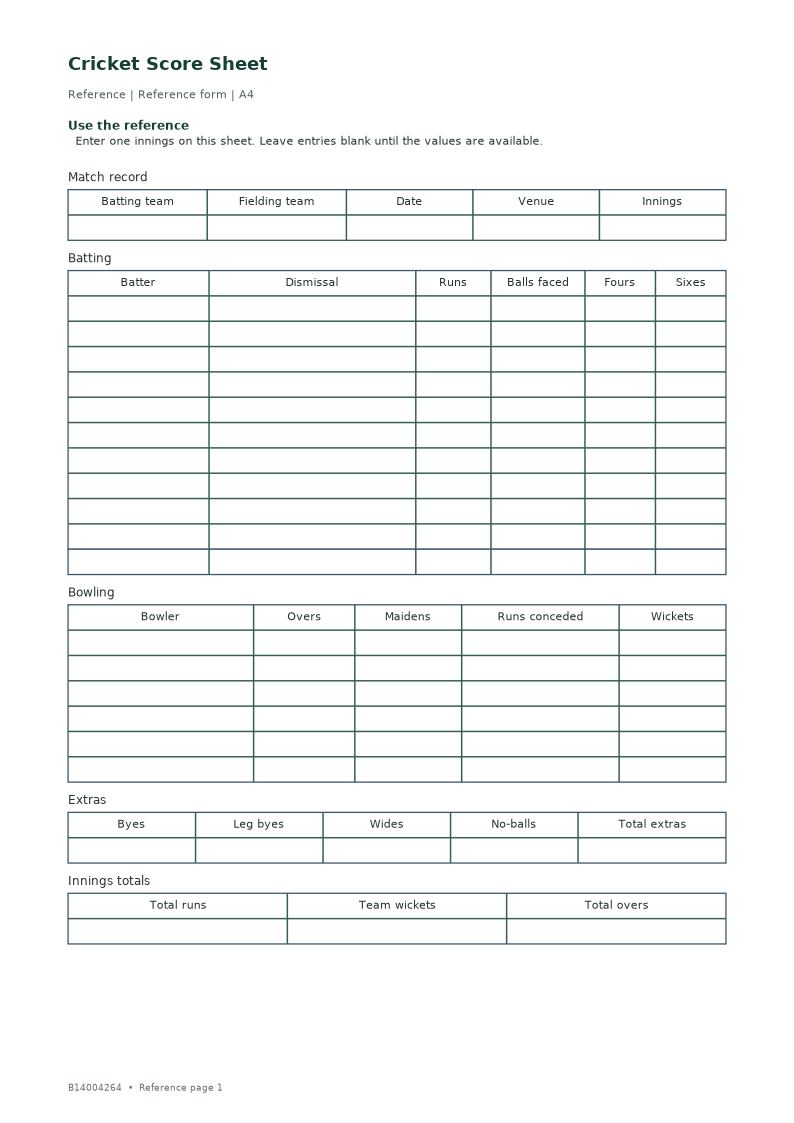
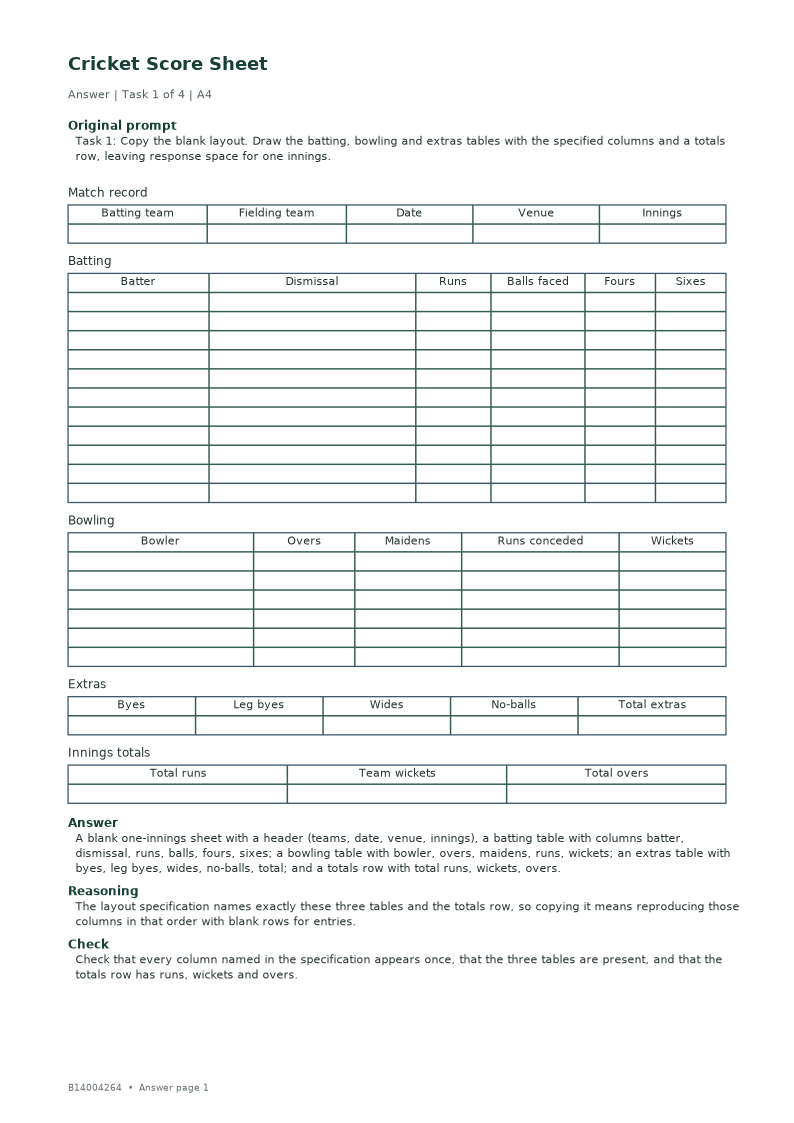
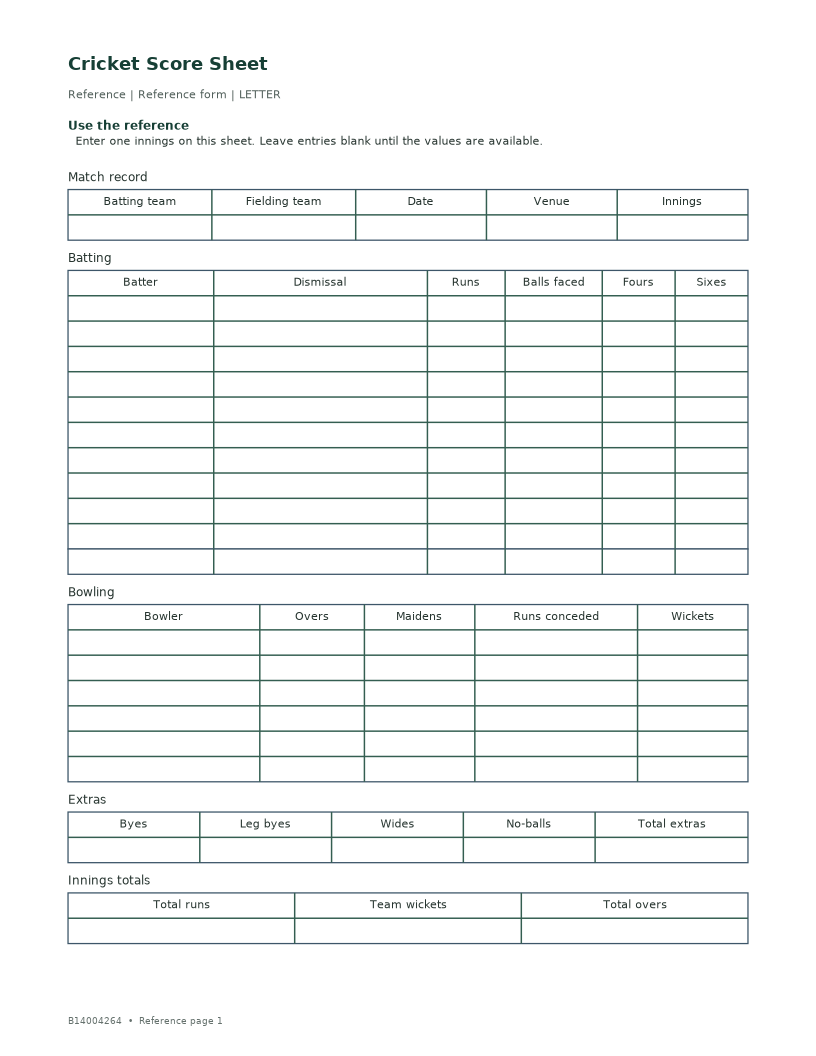
Use one page per innings. At the top write team names, date, venue, and innings number. Below that, place the batting table, then the bowling table, then the extras table, then a totals row.
Batting table columns: batter name, dismissal, runs, balls faced, fours, sixes. Bowling table columns: bowler name, overs, maidens, runs conceded, wickets. Extras table columns: byes, leg byes, wides, no-balls, total extras. Totals row: total runs, total wickets, total overs.
Worked example
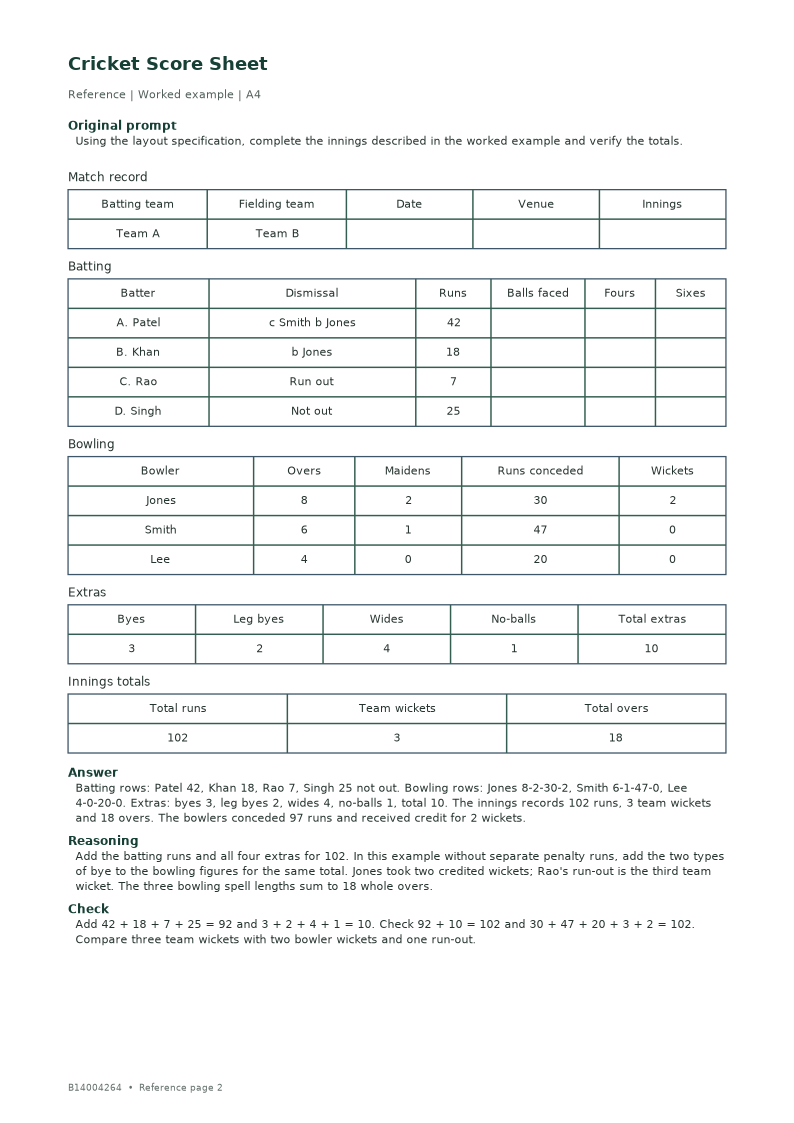
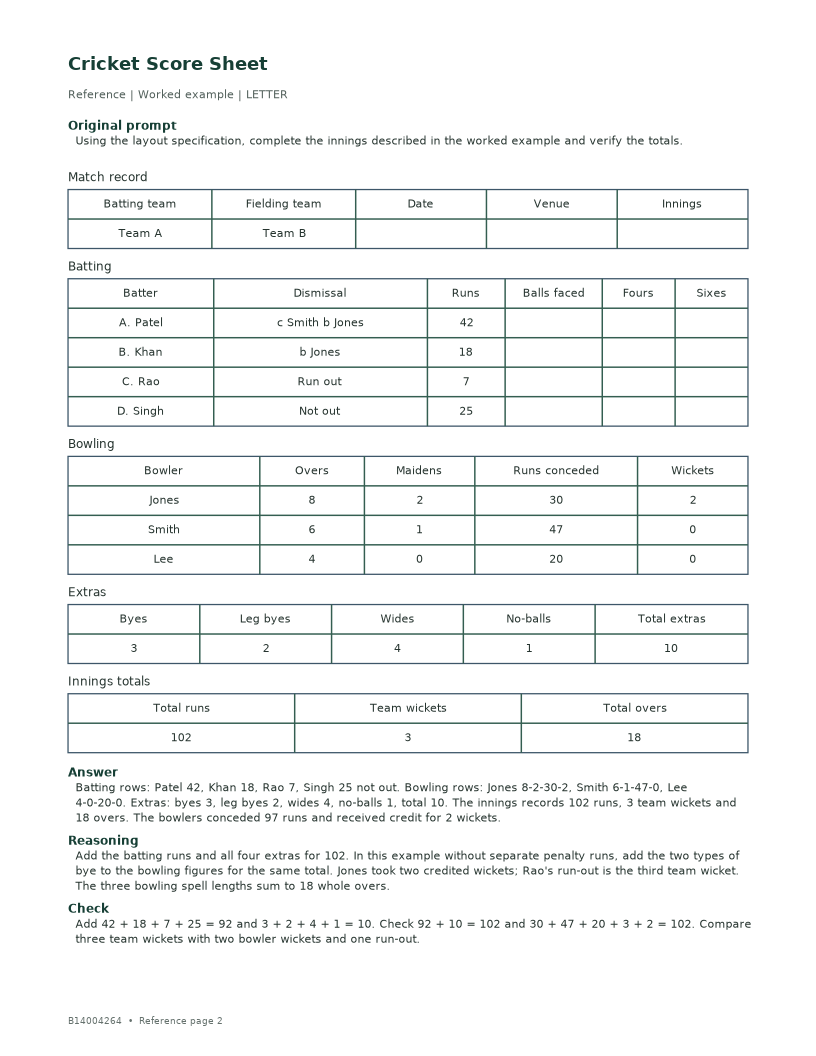
A completed innings for Team A against Team B. Batting: A. Patel c Smith b Jones 42; B. Khan b Jones 18; C. Rao run out 7; D. Singh not out 25. Batting runs = 42 + 18 + 7 + 25 = 92.
Bowling: Jones 8 overs, 2 maidens, 30 runs, 2 wickets. Smith 6 overs, 1 maiden, 47 runs, 0 wickets. Lee 4 overs, 0 maidens, 20 runs, 0 wickets. The bowlers concede 97 runs. Extras: byes 3, leg byes 2, wides 4, no-balls 1, total extras = 10. Total runs = 92 + 10 = 102. The same total is 97 + 3 + 2. Wickets = 3, of which one is Rao's run-out. Overs = 18.
Practice tasks
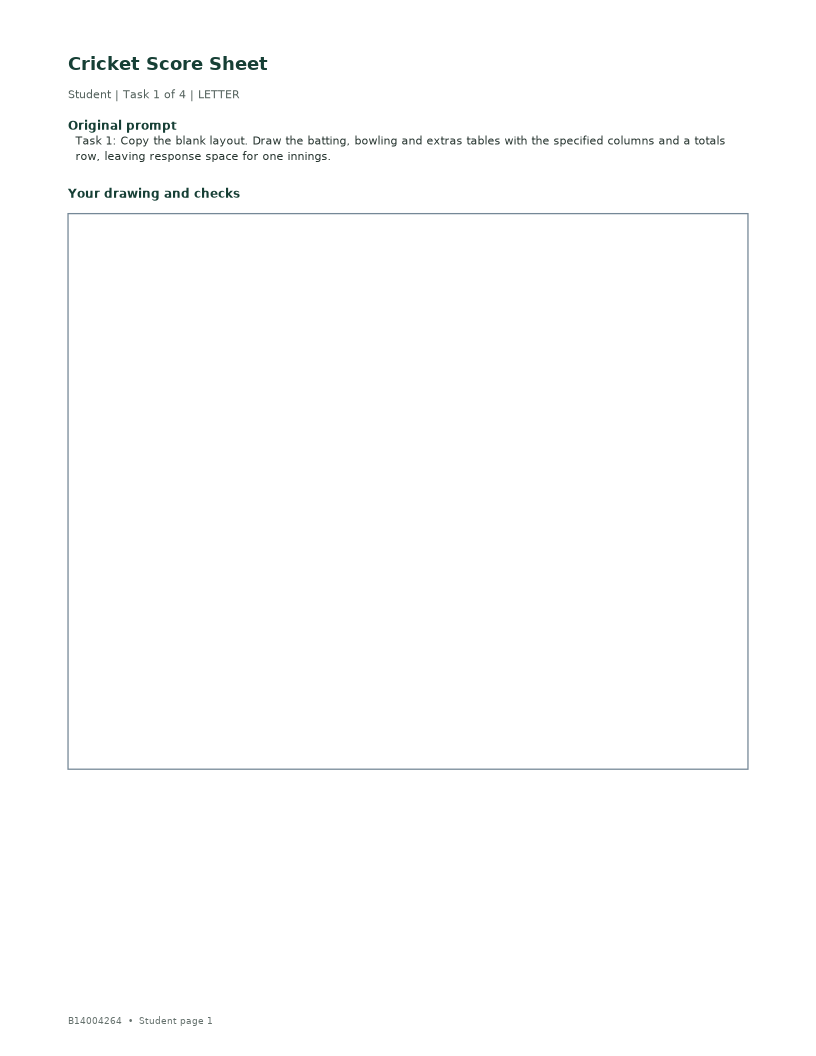
Task 1: Copy the blank layout. Draw the three tables with the specified columns and a totals row, leaving response space for one innings.
Use the batting values in Task 2 again in Task 4. Task 3 uses a separate bowling record and does not enter the Task 4 total.
Download the complete resource pack
All individual SVG pages (20)
- A4 reference page 1
- A4 reference page 2
- A4 student page 1
- A4 student page 2
- A4 student page 3
- A4 student page 4
- A4 answer page 1
- A4 answer page 2
- A4 answer page 3
- A4 answer page 4
- LETTER reference page 1
- LETTER reference page 2
- LETTER student page 1
- LETTER student page 2
- LETTER student page 3
- LETTER student page 4
- LETTER answer page 1
- LETTER answer page 2
- LETTER answer page 3
- LETTER answer page 4
Print at 100% / actual size. Use the stated scale on any schematic diagram; physical cutting templates are identified separately. A4 and US Letter are separate files. Free access, no signup; CC BY 4.0.
How to use these pages
- What a cricket score sheet must record
- Layout specification
- Worked example
- Practice tasks
Worked example
Example: Using the layout specification, complete the innings described in the worked example and verify the totals.
Answer: Batting rows: Patel 42, Khan 18, Rao 7, Singh 25 not out. Bowling rows: Jones 8-2-30-2, Smith 6-1-47-0, Lee 4-0-20-0. Extras: byes 3, leg byes 2, wides 4, no-balls 1, total 10. The innings records 102 runs, 3 team wickets and 18 overs. The bowlers conceded 97 runs and received credit for 2 wickets.
Reasoning: Add the batting runs and all four extras for 102. In this example without separate penalty runs, add the two types of bye to the bowling figures for the same total. Jones took two credited wickets; Rao's run-out is the third team wicket. The three bowling spell lengths sum to 18 whole overs.
Check: Add 42 + 18 + 7 + 25 = 92 and 3 + 2 + 4 + 1 = 10. Check 92 + 10 = 102 and 30 + 47 + 20 + 3 + 2 = 102. Compare three team wickets with two bowler wickets and one run-out.
Four practice tasks and complete answers
Task 1
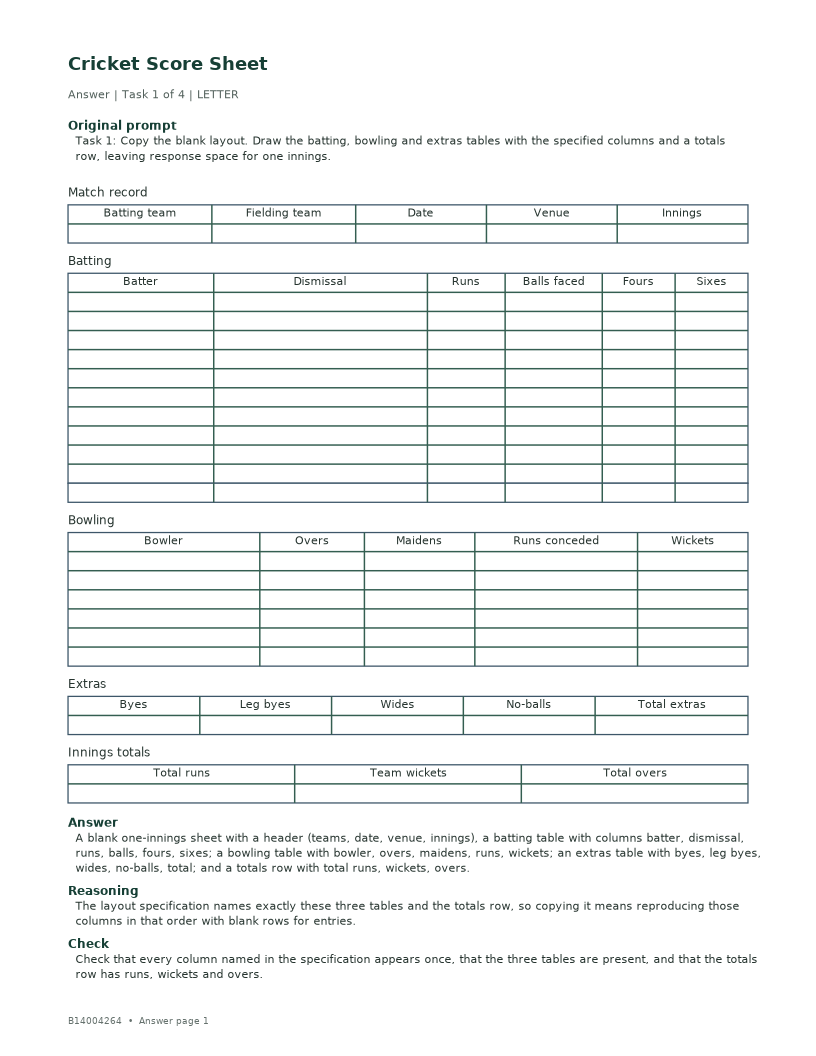
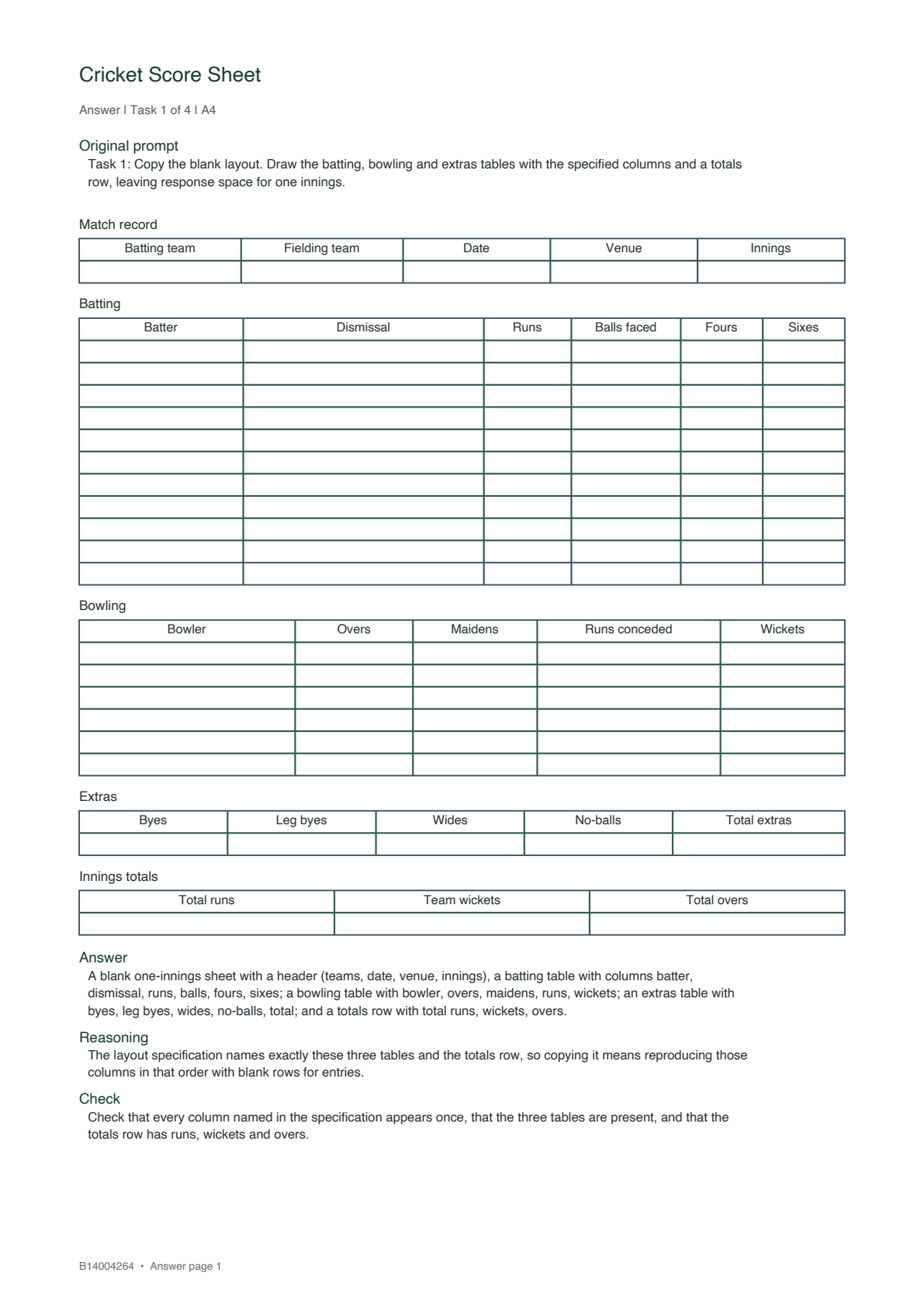
Task 1: Copy the blank layout. Draw the batting, bowling and extras tables with the specified columns and a totals row, leaving response space for one innings.
Show answer 1
A blank one-innings sheet with a header (teams, date, venue, innings), a batting table with columns batter, dismissal, runs, balls, fours, sixes; a bowling table with bowler, overs, maidens, runs, wickets; an extras table with byes, leg byes, wides, no-balls, total; and a totals row with total runs, wickets, overs.
The layout specification names exactly these three tables and the totals row, so copying it means reproducing those columns in that order with blank rows for entries.
Check: Check that every column named in the specification appears once, that the three tables are present, and that the totals row has runs, wickets and overs.
Task 2
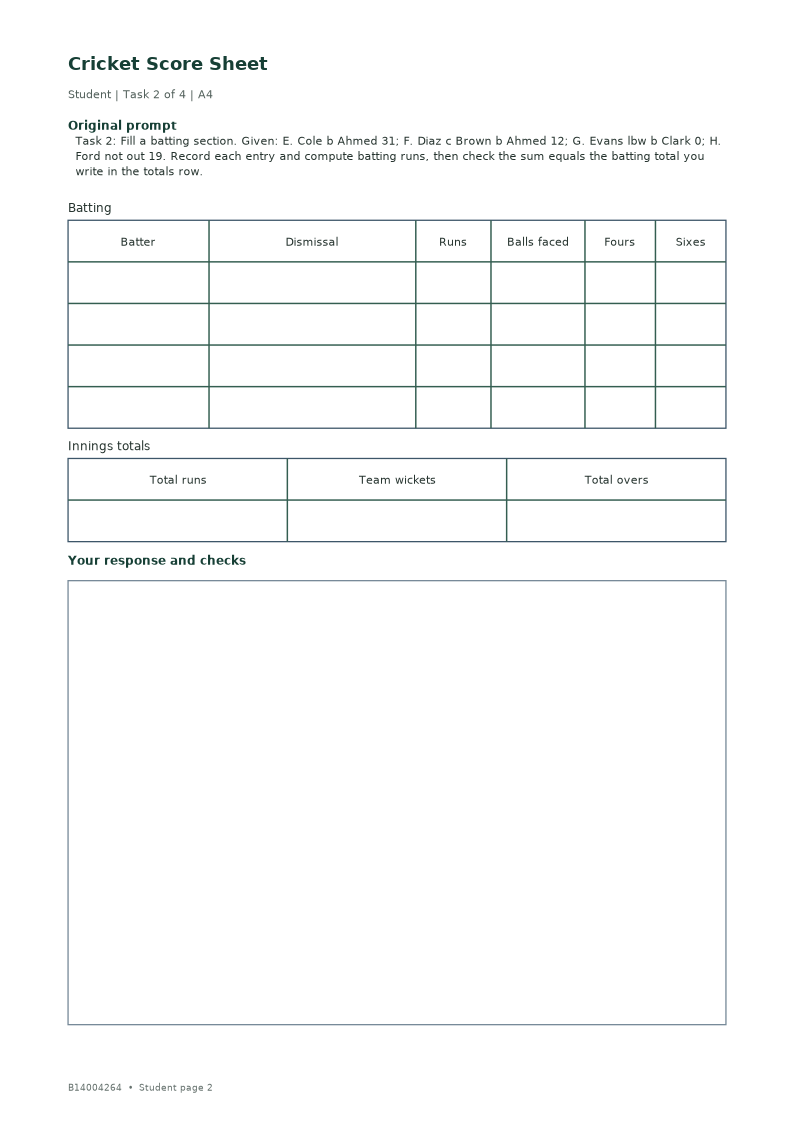
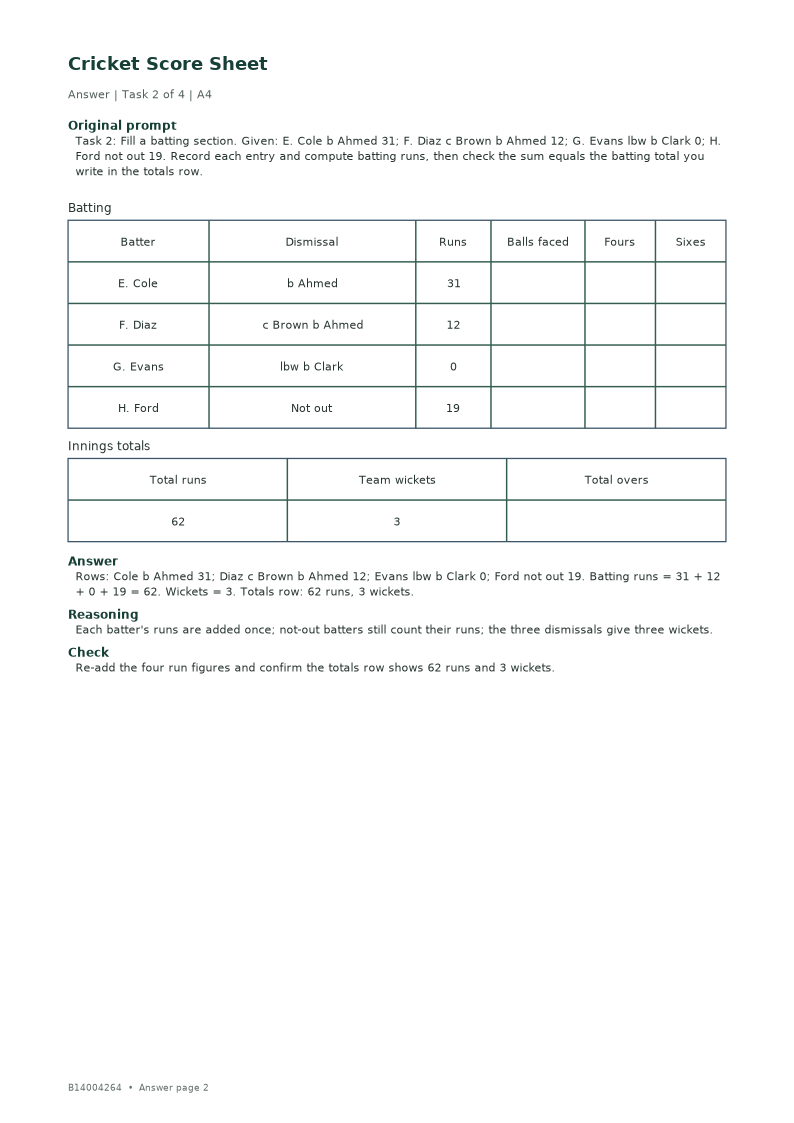
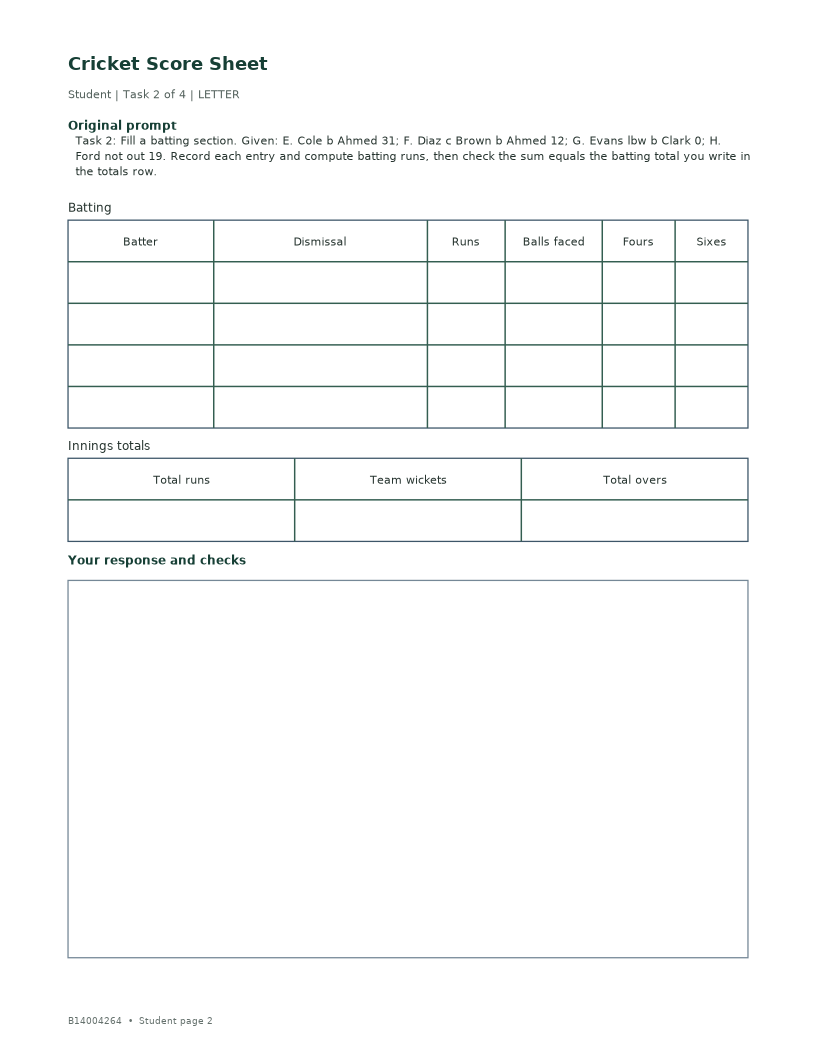
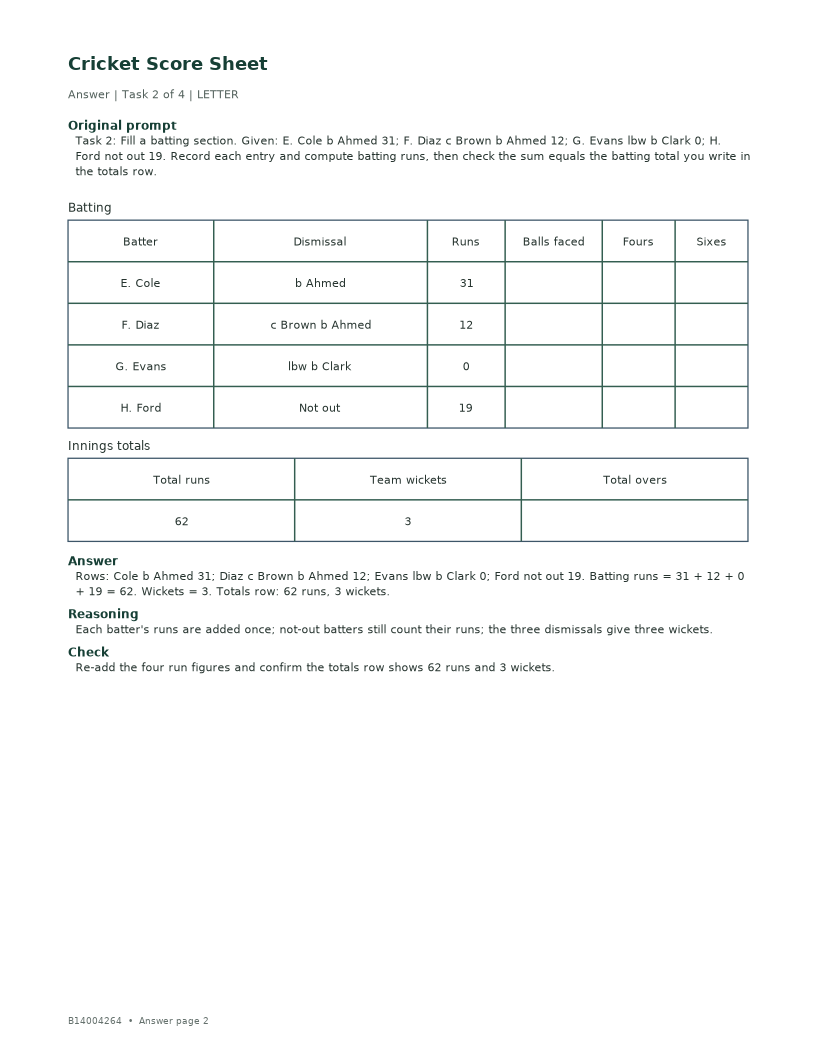
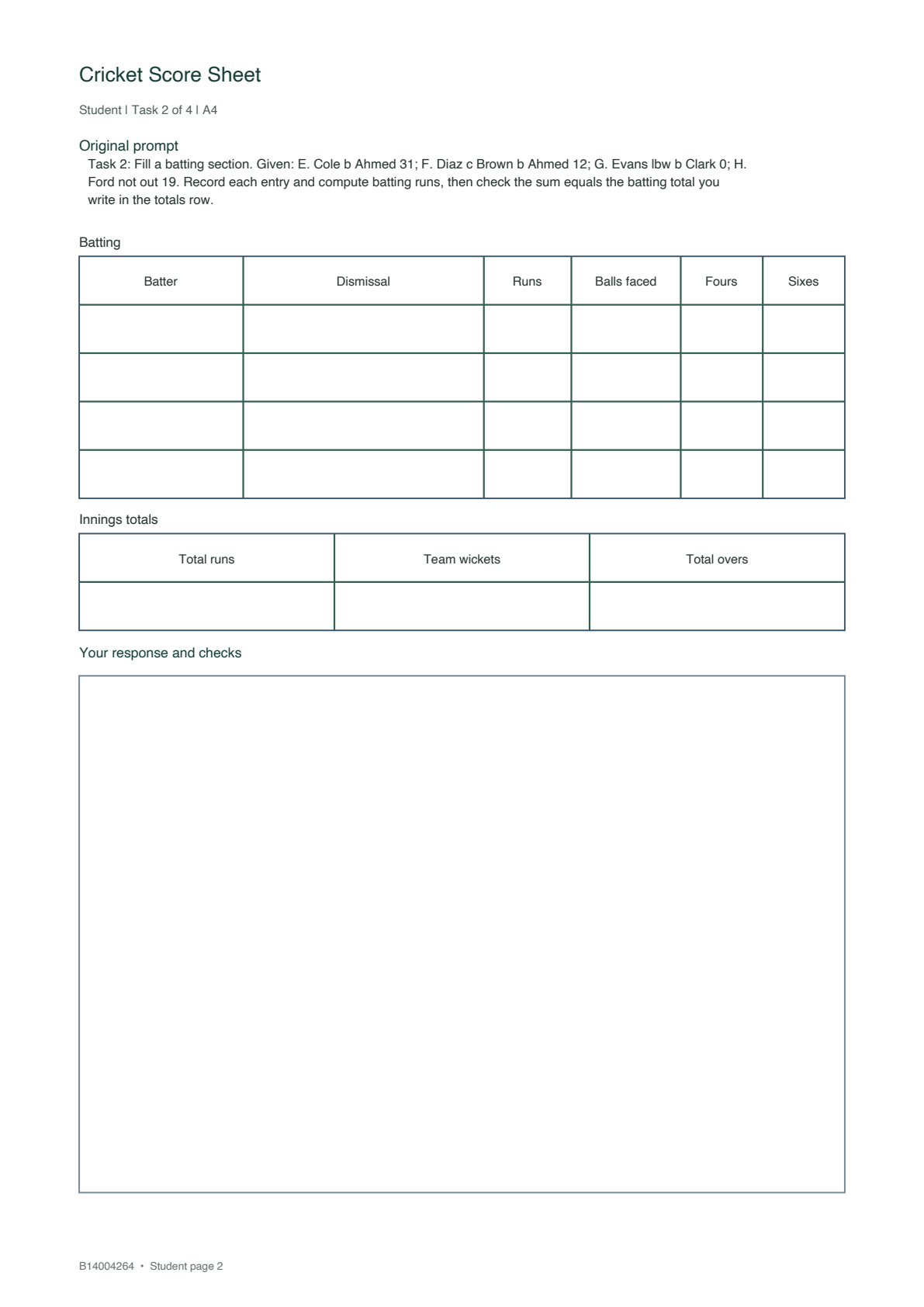
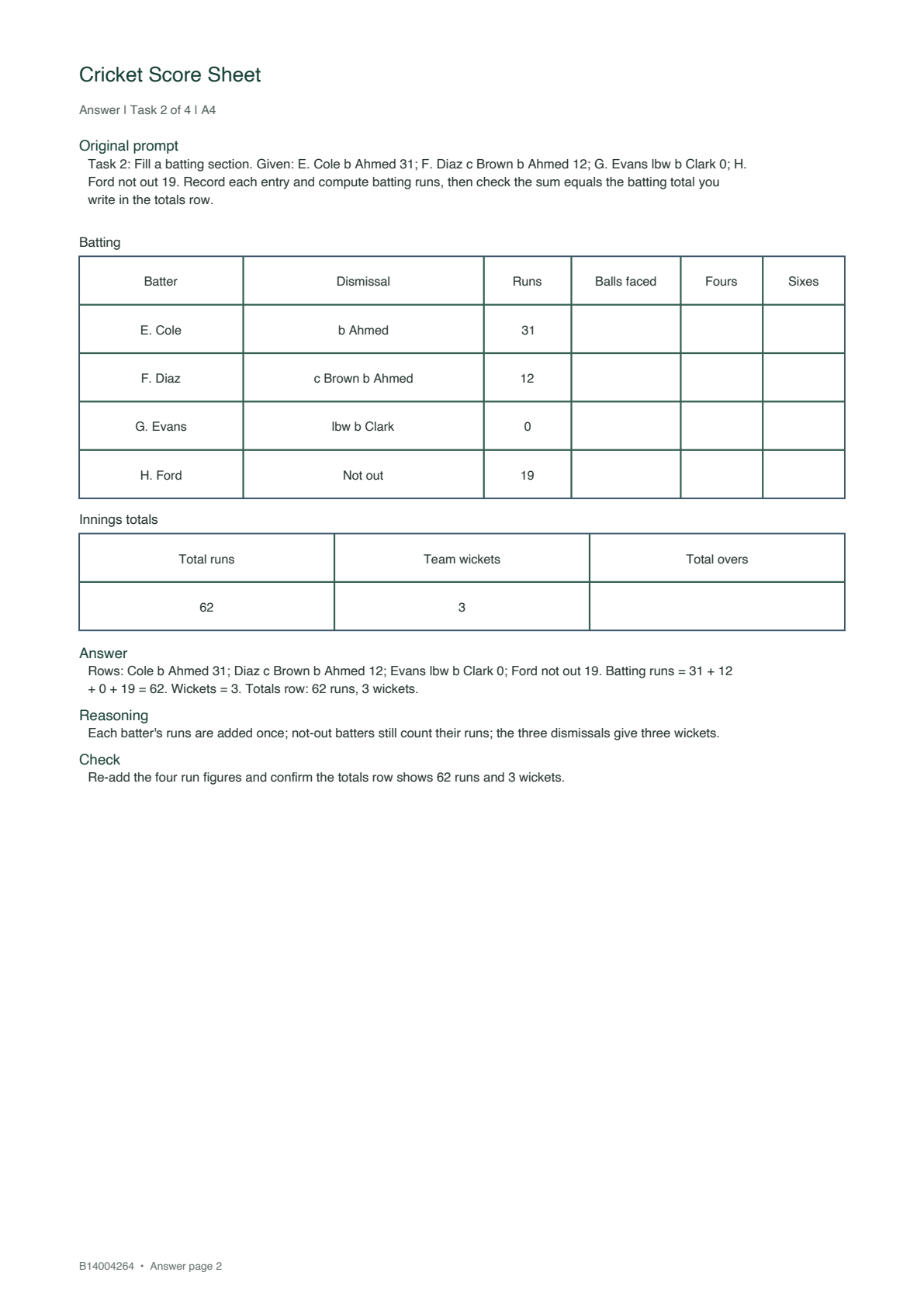
Task 2: Fill a batting section. Given: E. Cole b Ahmed 31; F. Diaz c Brown b Ahmed 12; G. Evans lbw b Clark 0; H. Ford not out 19. Record each entry and compute batting runs, then check the sum equals the batting total you write in the totals row.
Show answer 2
Rows: Cole b Ahmed 31; Diaz c Brown b Ahmed 12; Evans lbw b Clark 0; Ford not out 19. Batting runs = 31 + 12 + 0 + 19 = 62. Wickets = 3. Totals row: 62 runs, 3 wickets.
Each batter's runs are added once; not-out batters still count their runs; the three dismissals give three wickets.
Check: Re-add the four run figures and confirm the totals row shows 62 runs and 3 wickets.
Task 3
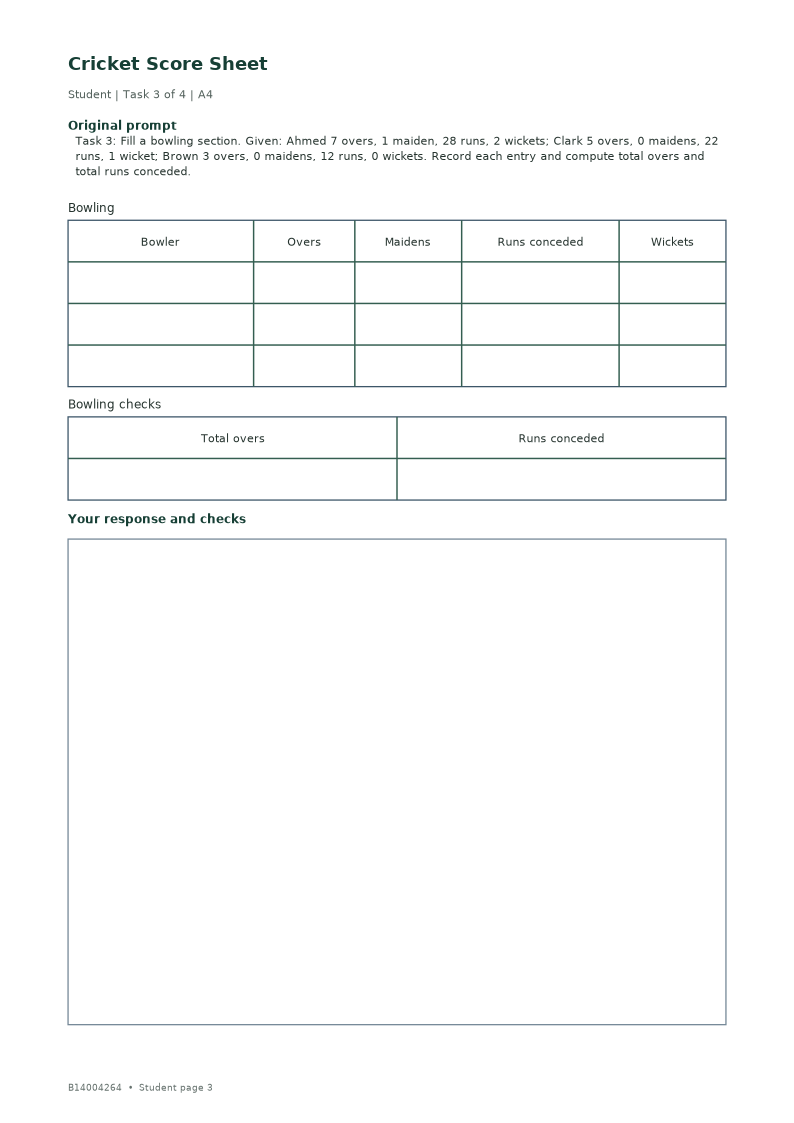
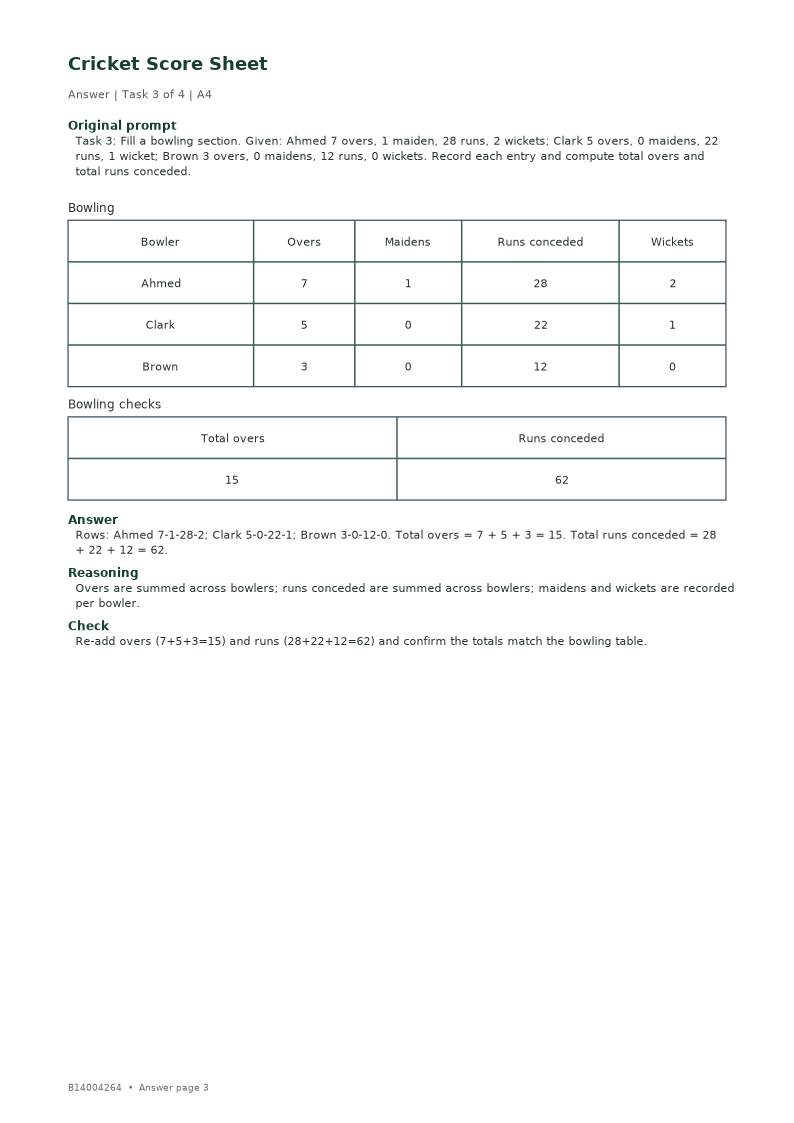
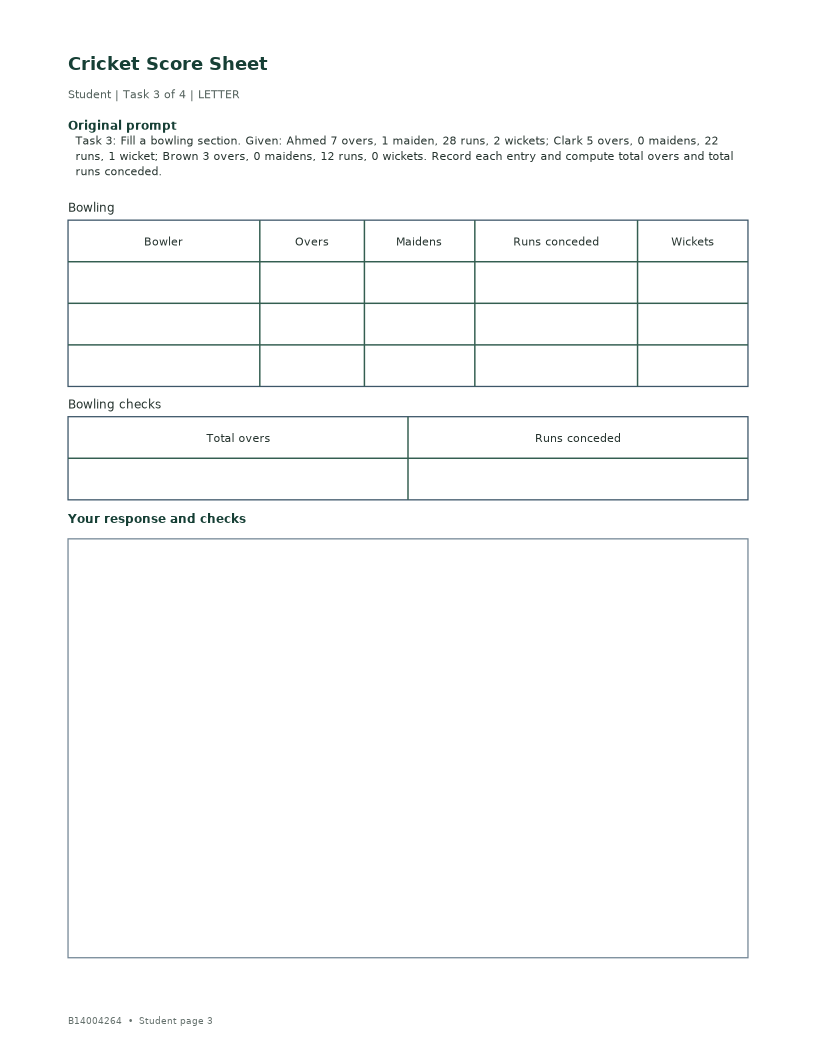
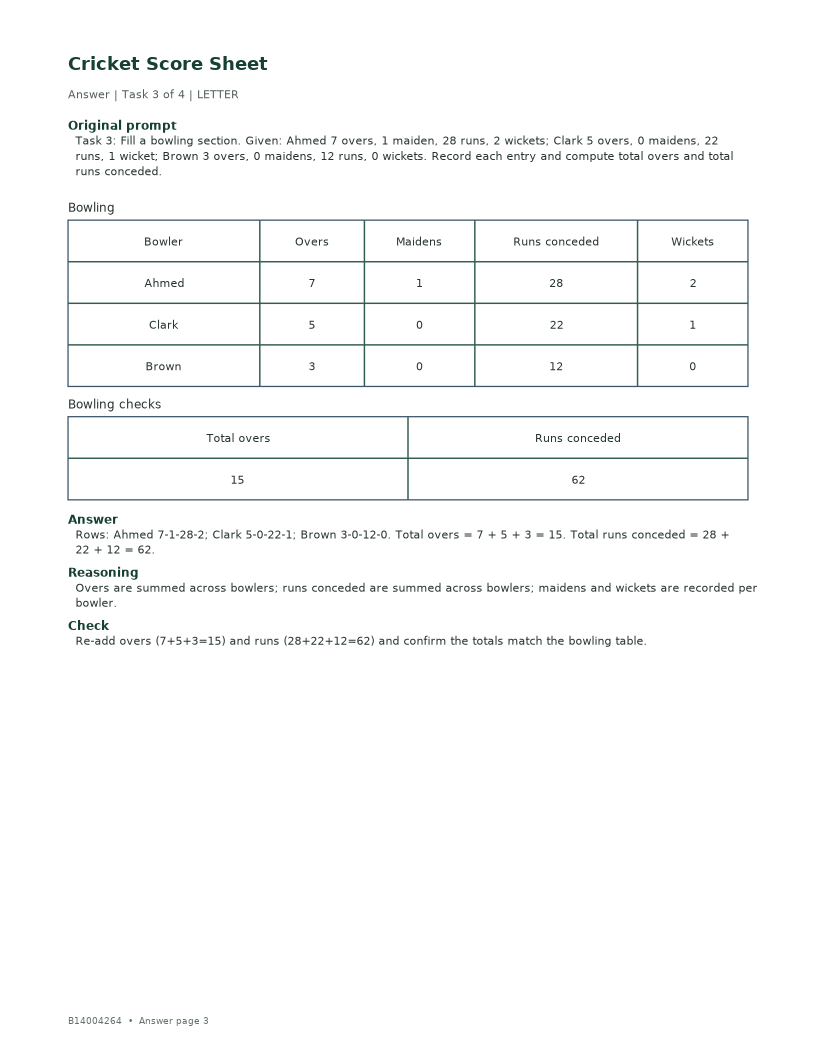
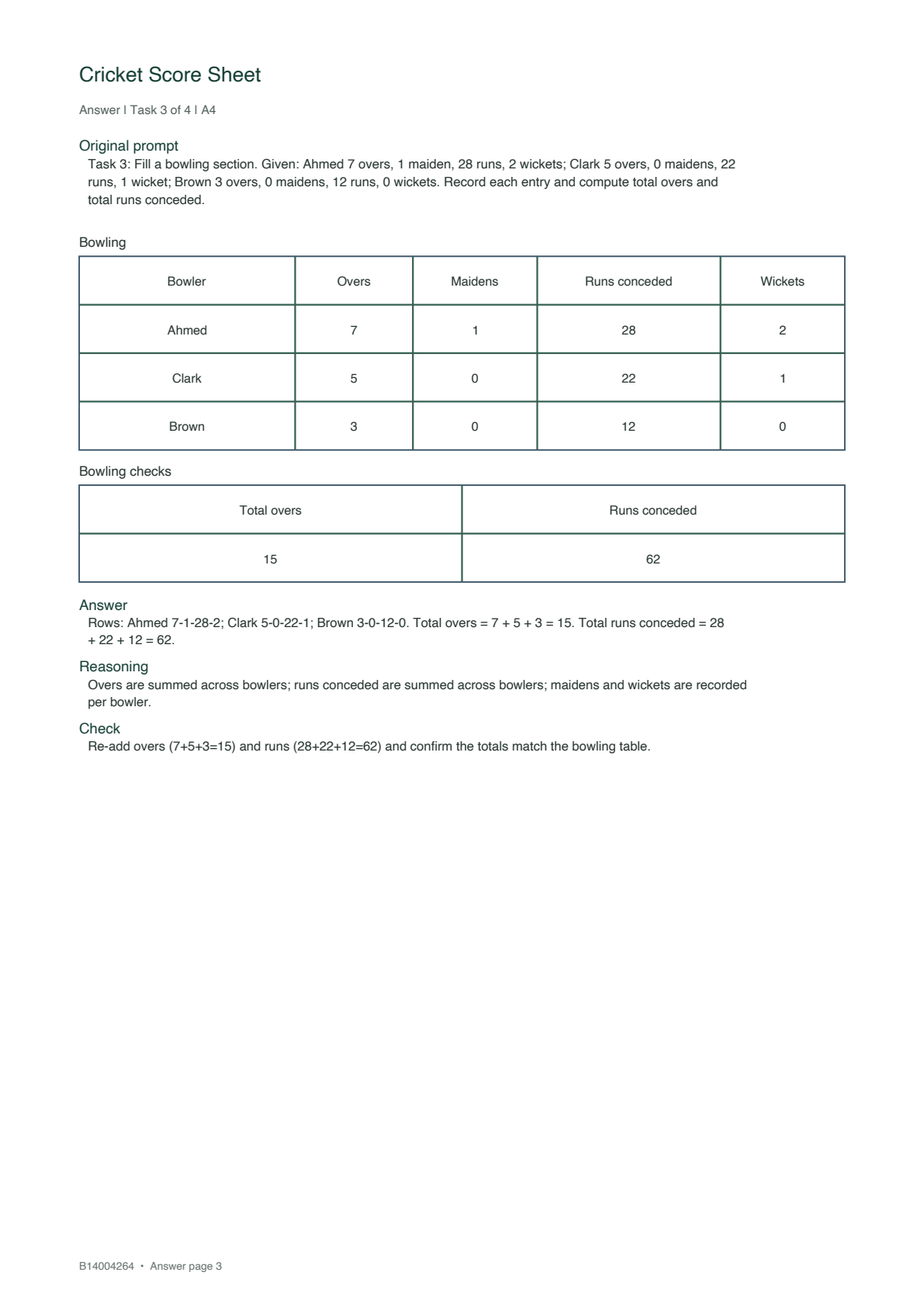
Task 3: Fill a bowling section. Given: Ahmed 7 overs, 1 maiden, 28 runs, 2 wickets; Clark 5 overs, 0 maidens, 22 runs, 1 wicket; Brown 3 overs, 0 maidens, 12 runs, 0 wickets. Record each entry and compute total overs and total runs conceded.
Show answer 3
Rows: Ahmed 7-1-28-2; Clark 5-0-22-1; Brown 3-0-12-0. Total overs = 7 + 5 + 3 = 15. Total runs conceded = 28 + 22 + 12 = 62.
Overs are summed across bowlers; runs conceded are summed across bowlers; maidens and wickets are recorded per bowler.
Check: Re-add overs (7+5+3=15) and runs (28+22+12=62) and confirm the totals match the bowling table.
Task 4
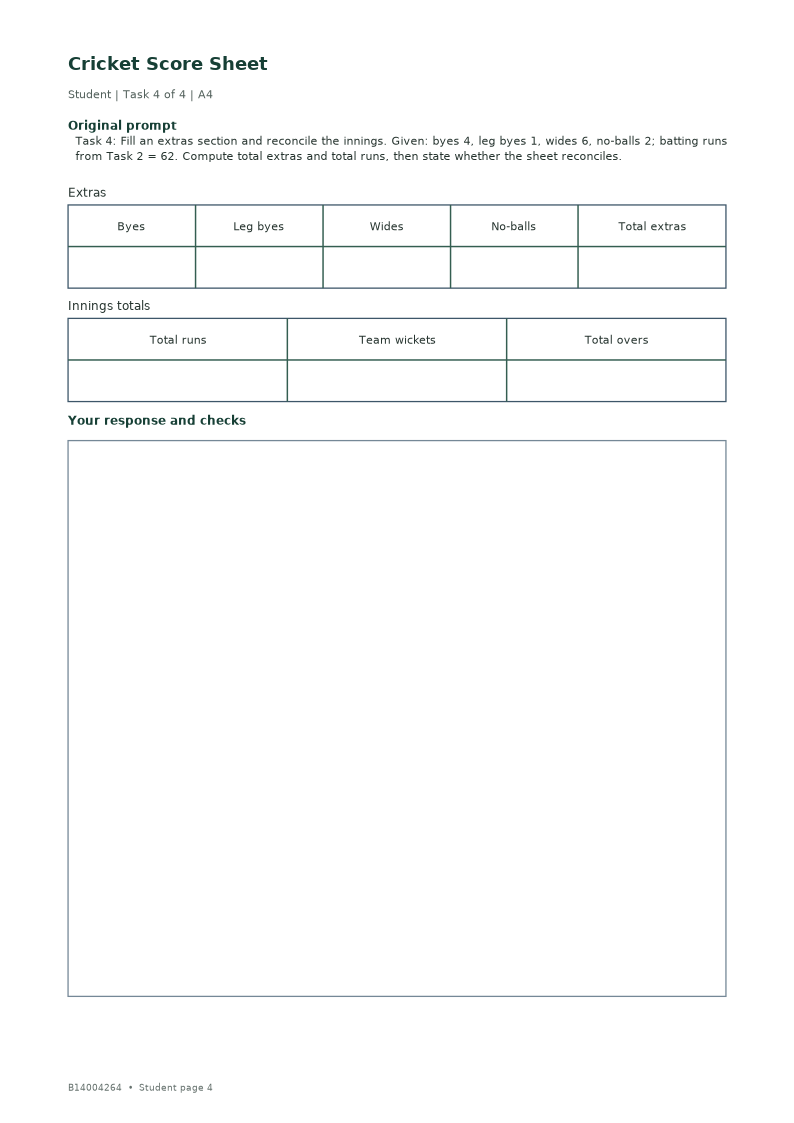
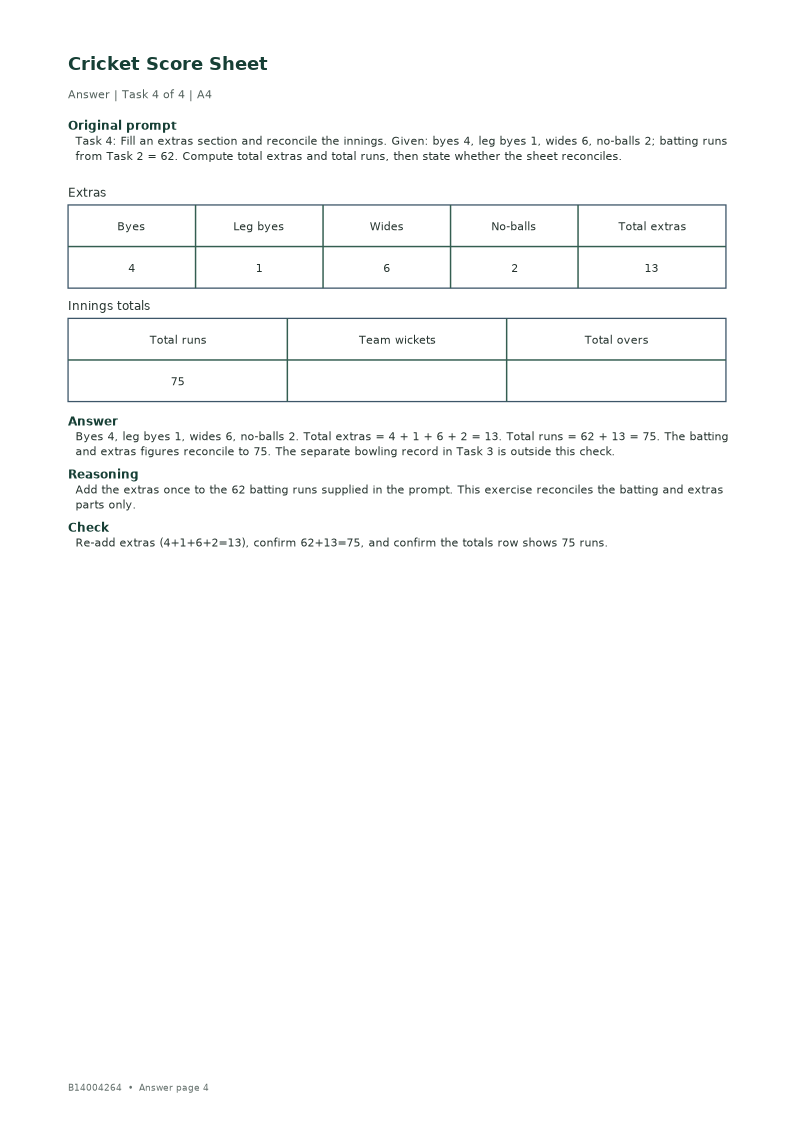
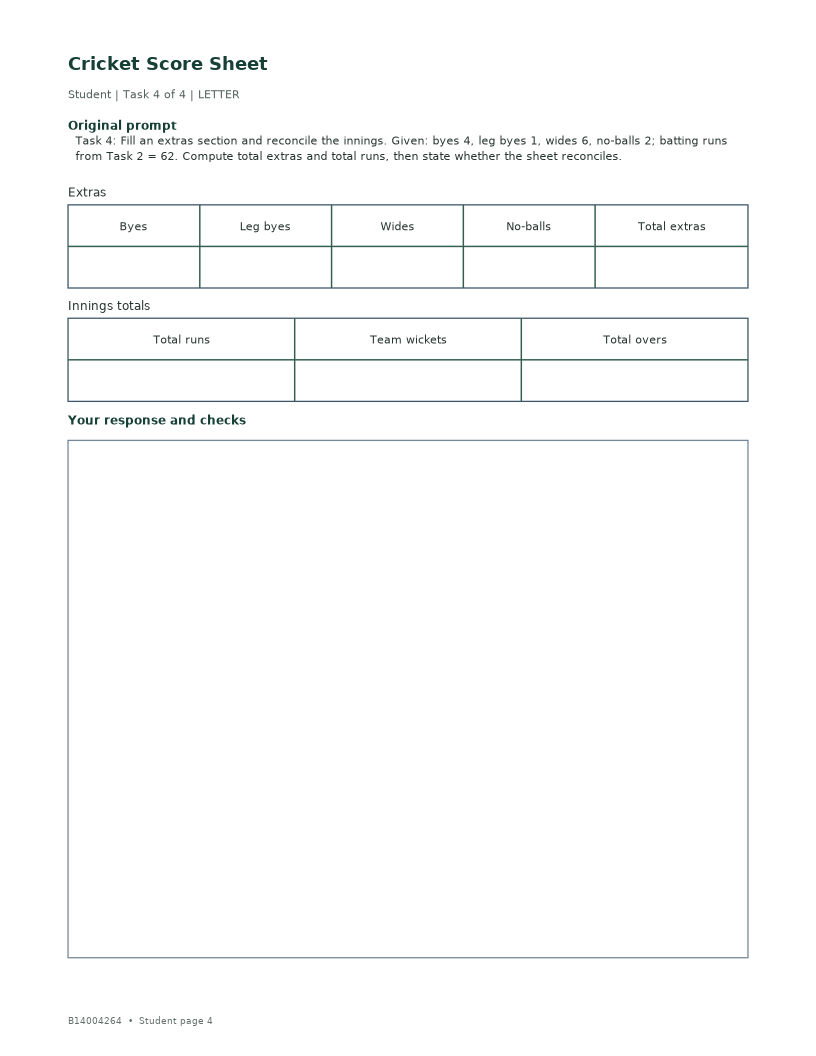
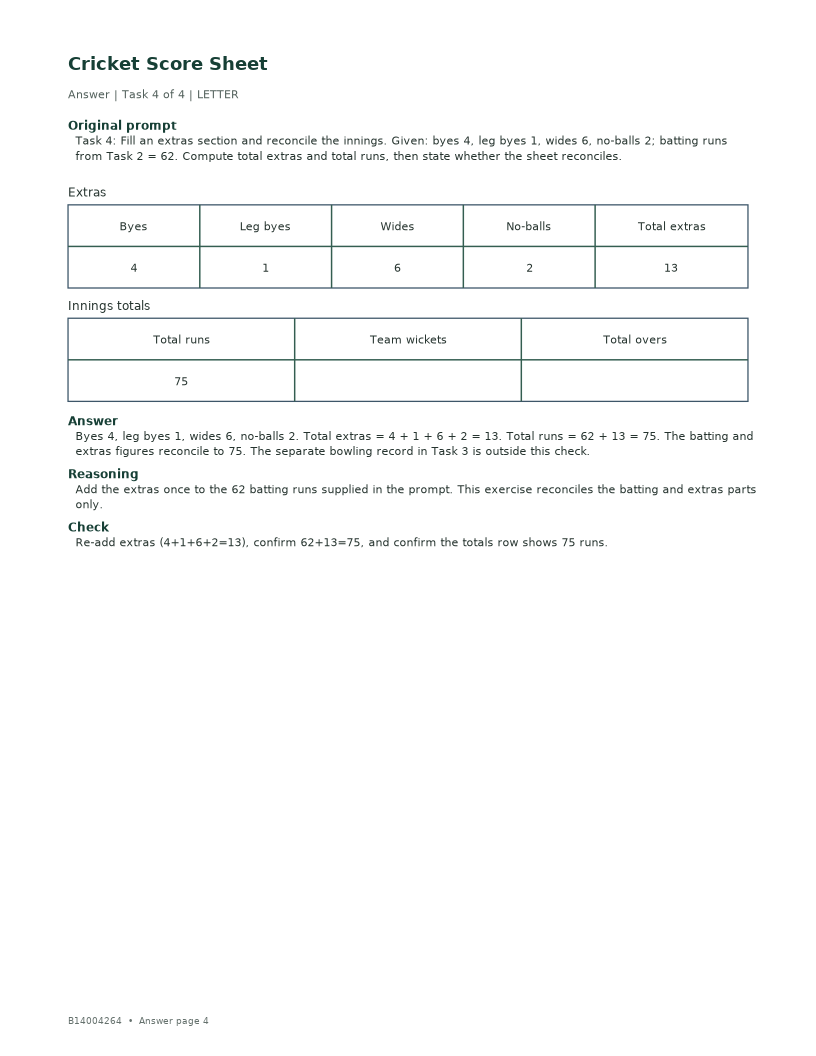
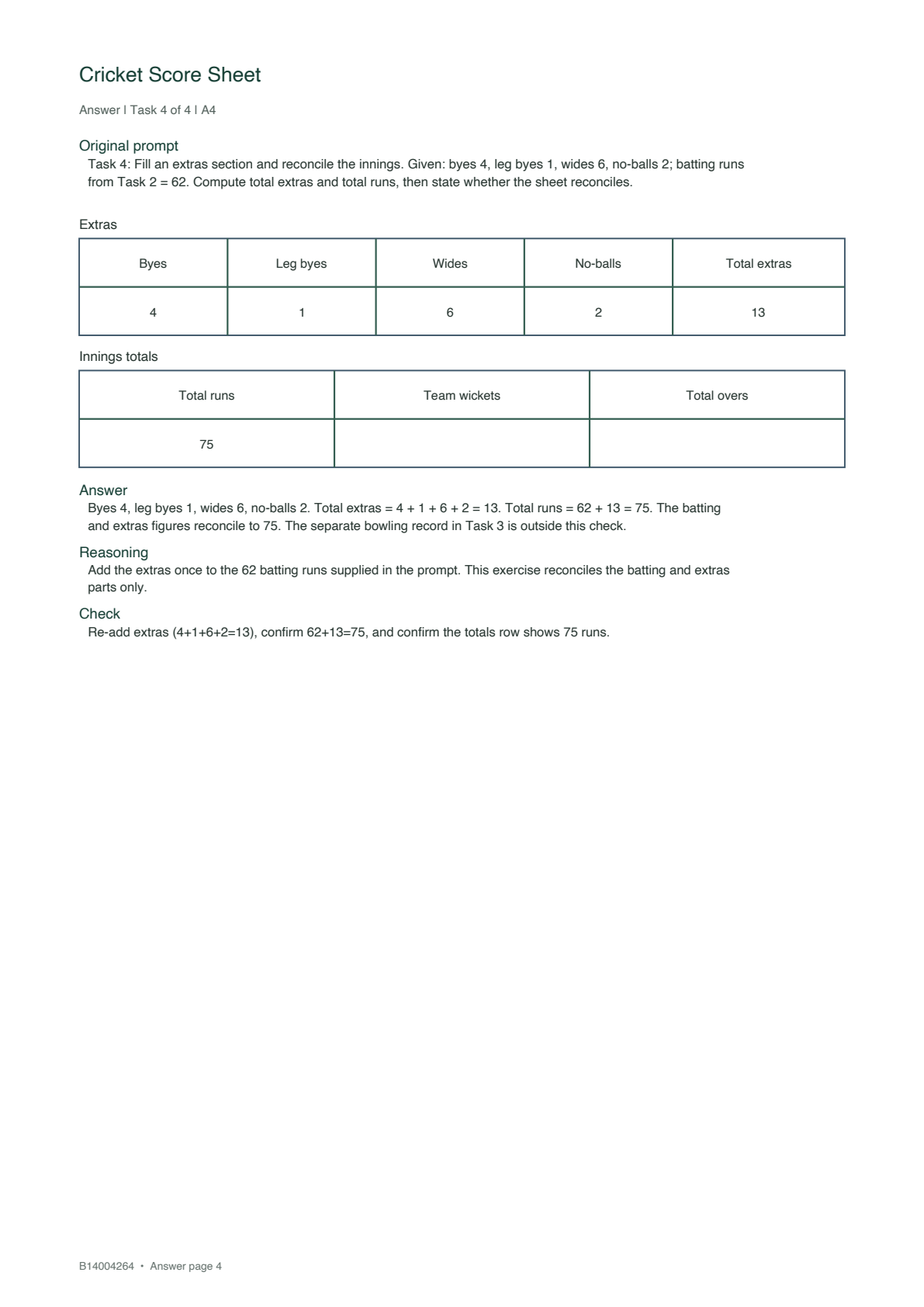
Task 4: Fill an extras section and reconcile the innings. Given: byes 4, leg byes 1, wides 6, no-balls 2; batting runs from Task 2 = 62. Compute total extras and total runs, then state whether the sheet reconciles.
Show answer 4
Byes 4, leg byes 1, wides 6, no-balls 2. Total extras = 4 + 1 + 6 + 2 = 13. Total runs = 62 + 13 = 75. The batting and extras figures reconcile to 75. The separate bowling record in Task 3 is outside this check.
Add the extras once to the 62 batting runs supplied in the prompt. This exercise reconciles the batting and extras parts only.
Check: Re-add extras (4+1+6+2=13), confirm 62+13=75, and confirm the totals row shows 75 runs.
Useful checks
- Adding extras to batting runs twice, or omitting not-out batters' runs. Sum batting runs once across all batters including not-out ones, then add extras once to get total runs.
- Recording wickets from the bowling table without matching them to dismissals in the batting table. Count dismissals for the team total, then match the bowling wickets only to dismissals credited to bowlers. A run-out contributes to the team total.
Questions about this resource
Do I need a separate sheet for each innings?
Yes; the layout specification says one page per innings, so each innings gets its own batting, bowling and extras tables.
What if a batter is not out?
Record 'not out' in the dismissal column and still count their runs in the batting total.