Free original lessons
Drawing Materials Guide
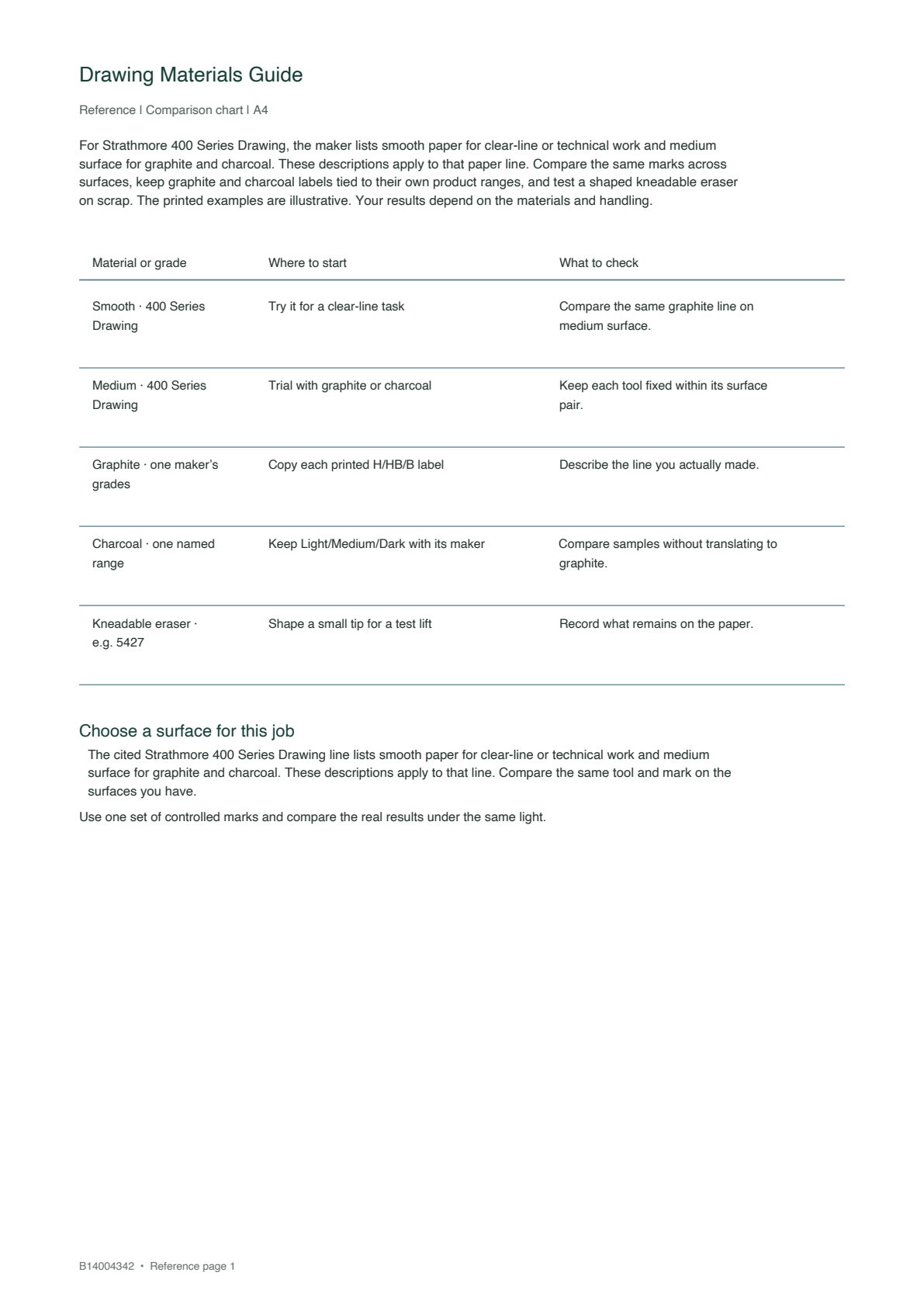
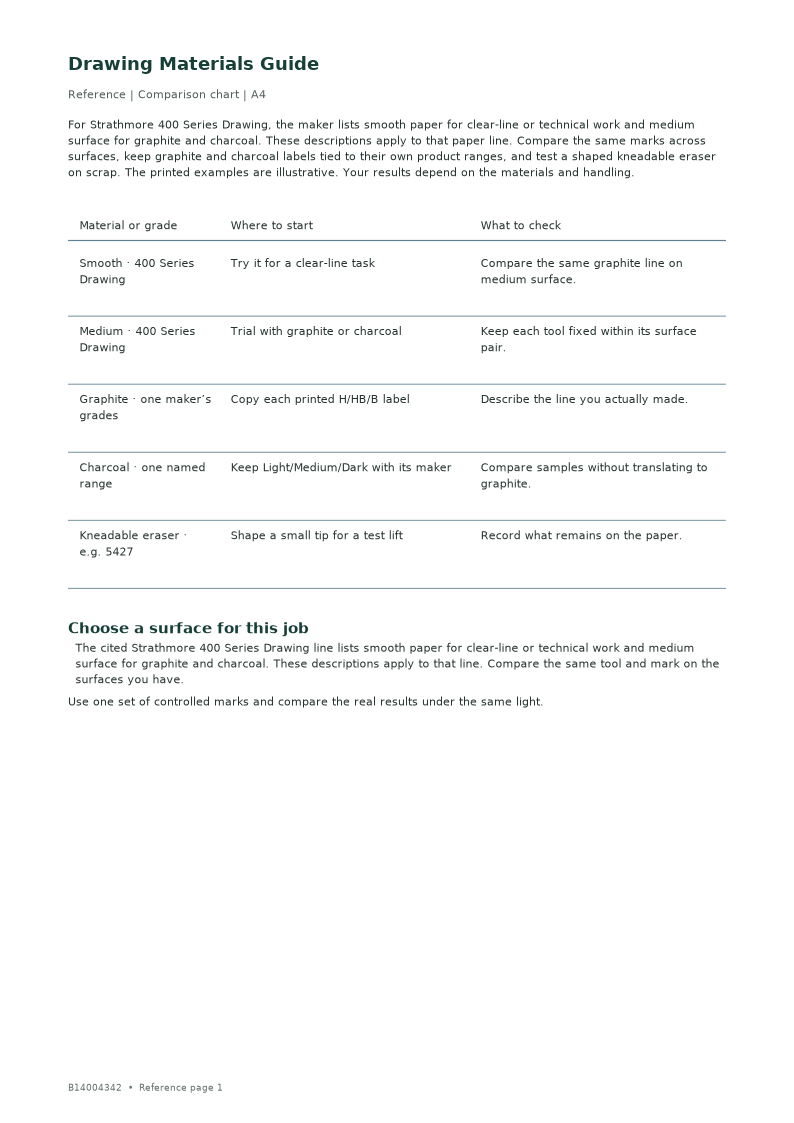
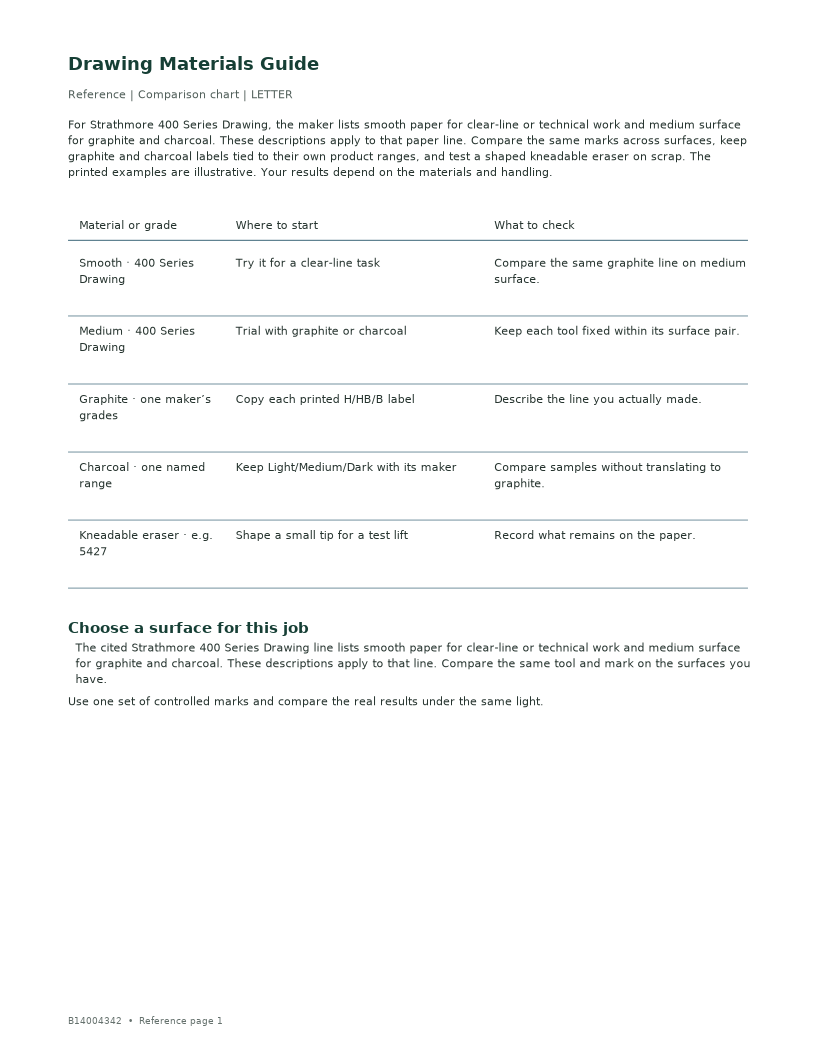
For Strathmore 400 Series Drawing, the maker lists smooth paper for clear-line or technical work and medium surface for graphite and charcoal. These descriptions apply to that paper line. Compare the same marks across surfaces, keep graphite and charcoal labels tied to their own product ranges, and test a shaped kneadable eraser on scrap. The printed examples are illustrative. Your results depend on the materials and handling.
Letter & A4
PDF & SVG
Choose a surface for this job
The cited Strathmore 400 Series Drawing line lists smooth paper for clear-line or technical work and medium surface for graphite and charcoal. These descriptions apply to that line. Compare the same tool and mark on the surfaces you have.
Keep material labels attached
Faber-Castell describes H grades as harder, B grades as softer and HB as medium within a maker’s graphite range. Exact grade equivalence varies across manufacturers. Derwent’s cited charcoal pencil set uses Light, Medium and Dark as labels in that product range. Keep those names with that charcoal set and use H/B notation for graphite.
Test a kneadable eraser
The cited STAEDTLER 5427 is described as a kneadable eraser that can be shaped to lift graphite and charcoal. Try a small press-lift on scrap and record what remains. Results vary with the surface, pressure and mark.
Download the complete resource pack
All individual SVG pages (20)
- A4 reference page 1
- A4 reference page 2
- A4 student page 1
- A4 student page 2
- A4 student page 3
- A4 student page 4
- A4 answer page 1
- A4 answer page 2
- A4 answer page 3
- A4 answer page 4
- LETTER reference page 1
- LETTER reference page 2
- LETTER student page 1
- LETTER student page 2
- LETTER student page 3
- LETTER student page 4
- LETTER answer page 1
- LETTER answer page 2
- LETTER answer page 3
- LETTER answer page 4
Print at 100% / actual size. Use the stated scale on any schematic diagram; physical cutting templates are identified separately. A4 and US Letter are separate files. Free access, no signup; CC BY 4.0.
How to use these pages
- Choose a surface for this job
- Keep material labels attached
- Test a kneadable eraser
Worked example
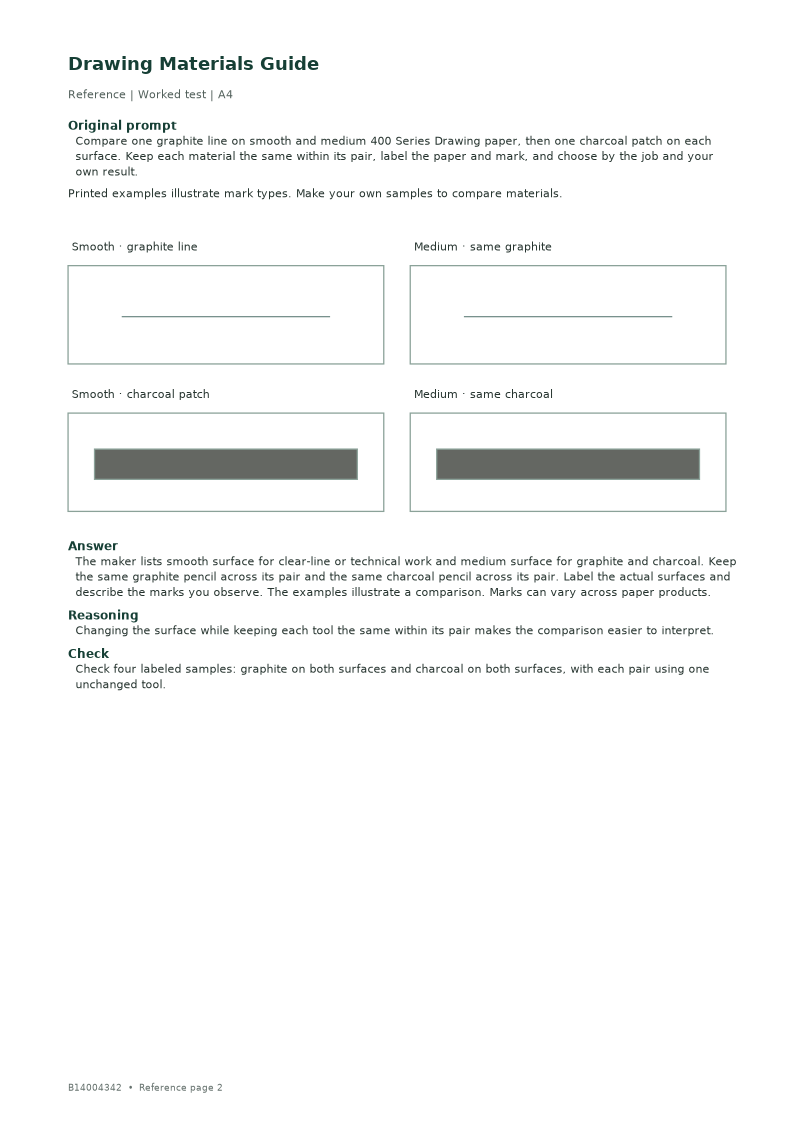
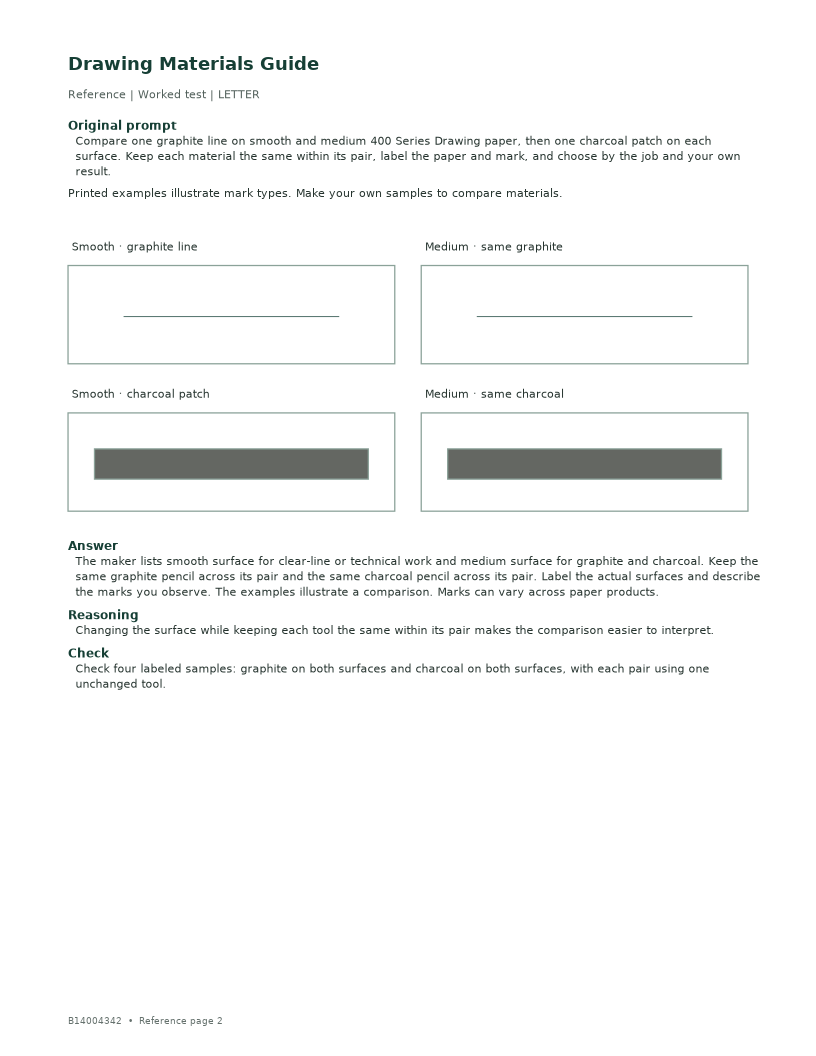
Example: Compare one graphite line on smooth and medium 400 Series Drawing paper, then one charcoal patch on each surface. Keep each material the same within its pair, label the paper and mark, and choose by the job and your own result.
Answer: The maker lists smooth surface for clear-line or technical work and medium surface for graphite and charcoal. Keep the same graphite pencil across its pair and the same charcoal pencil across its pair. Label the actual surfaces and describe the marks you observe. The examples illustrate a comparison. Marks can vary across paper products.
Reasoning: Changing the surface while keeping each tool the same within its pair makes the comparison easier to interpret.
Check: Check four labeled samples: graphite on both surfaces and charcoal on both surfaces, with each pair using one unchanged tool.
Four practice tasks and complete answers
Task 1
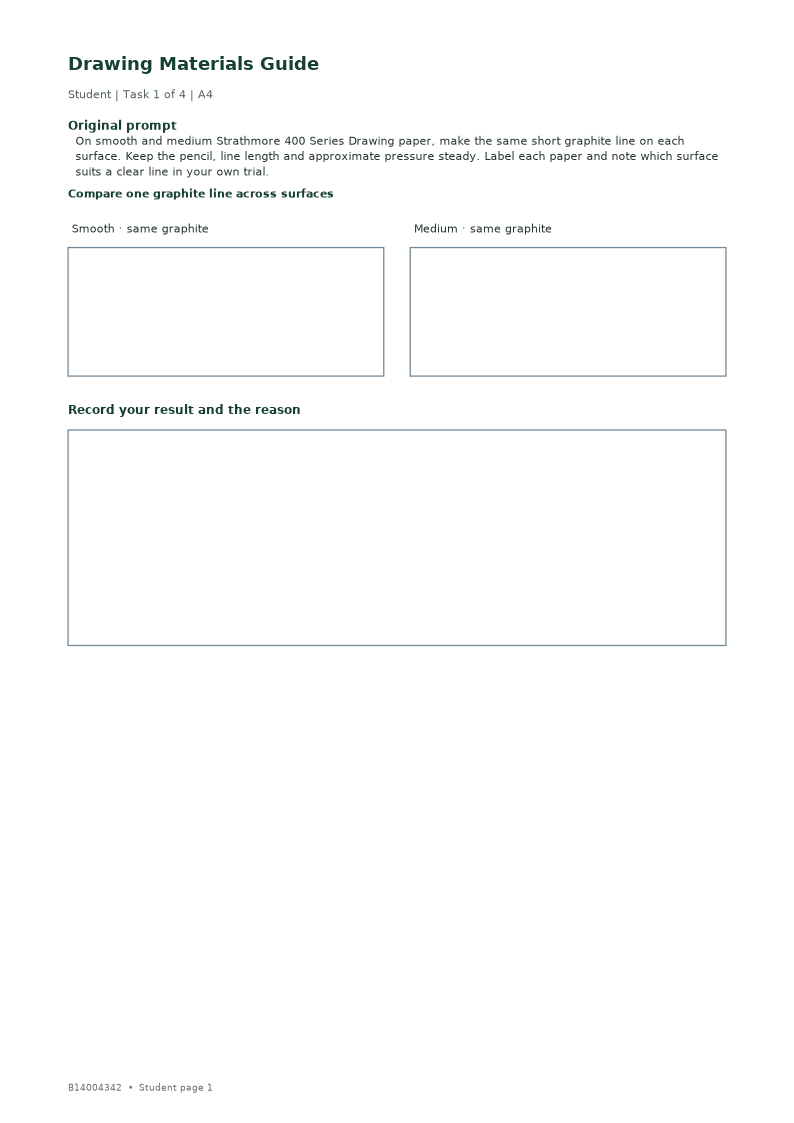
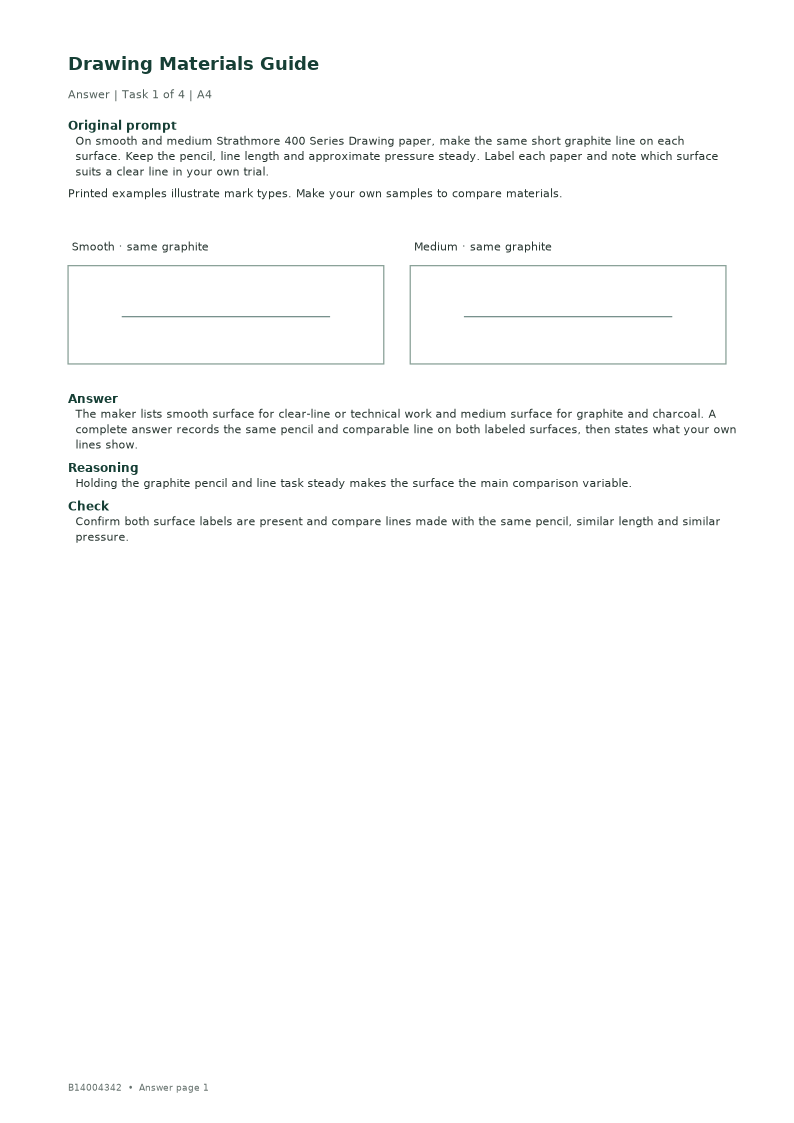
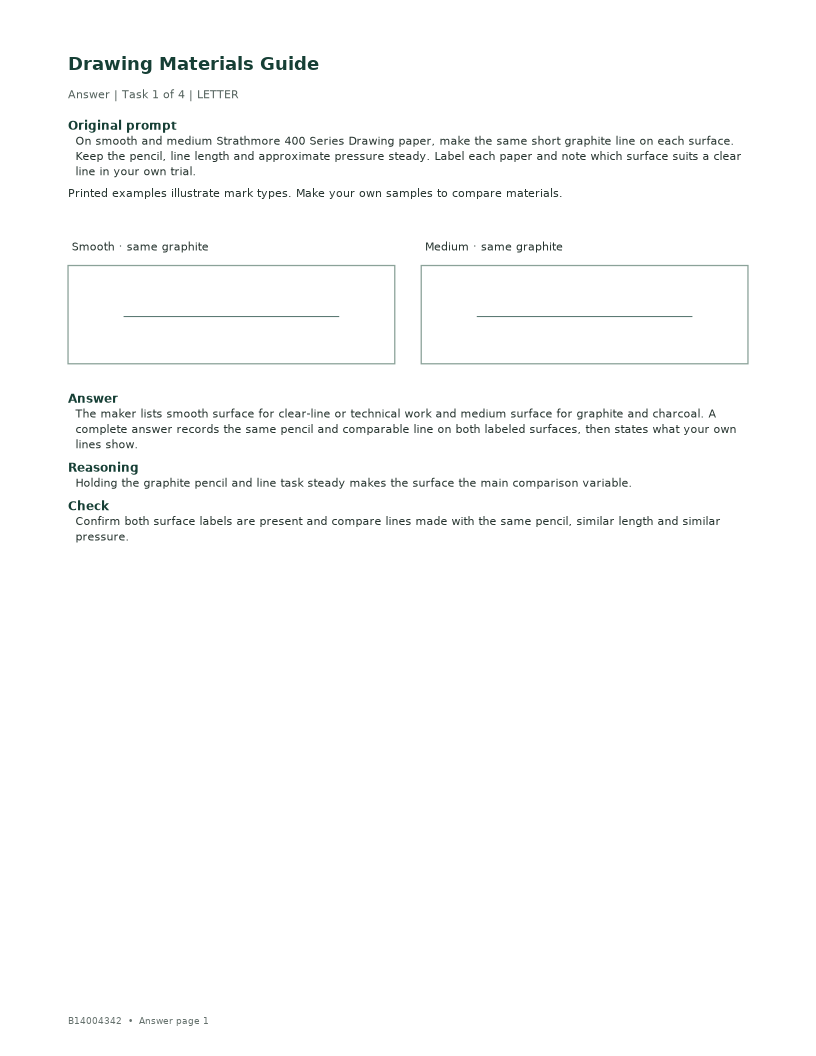
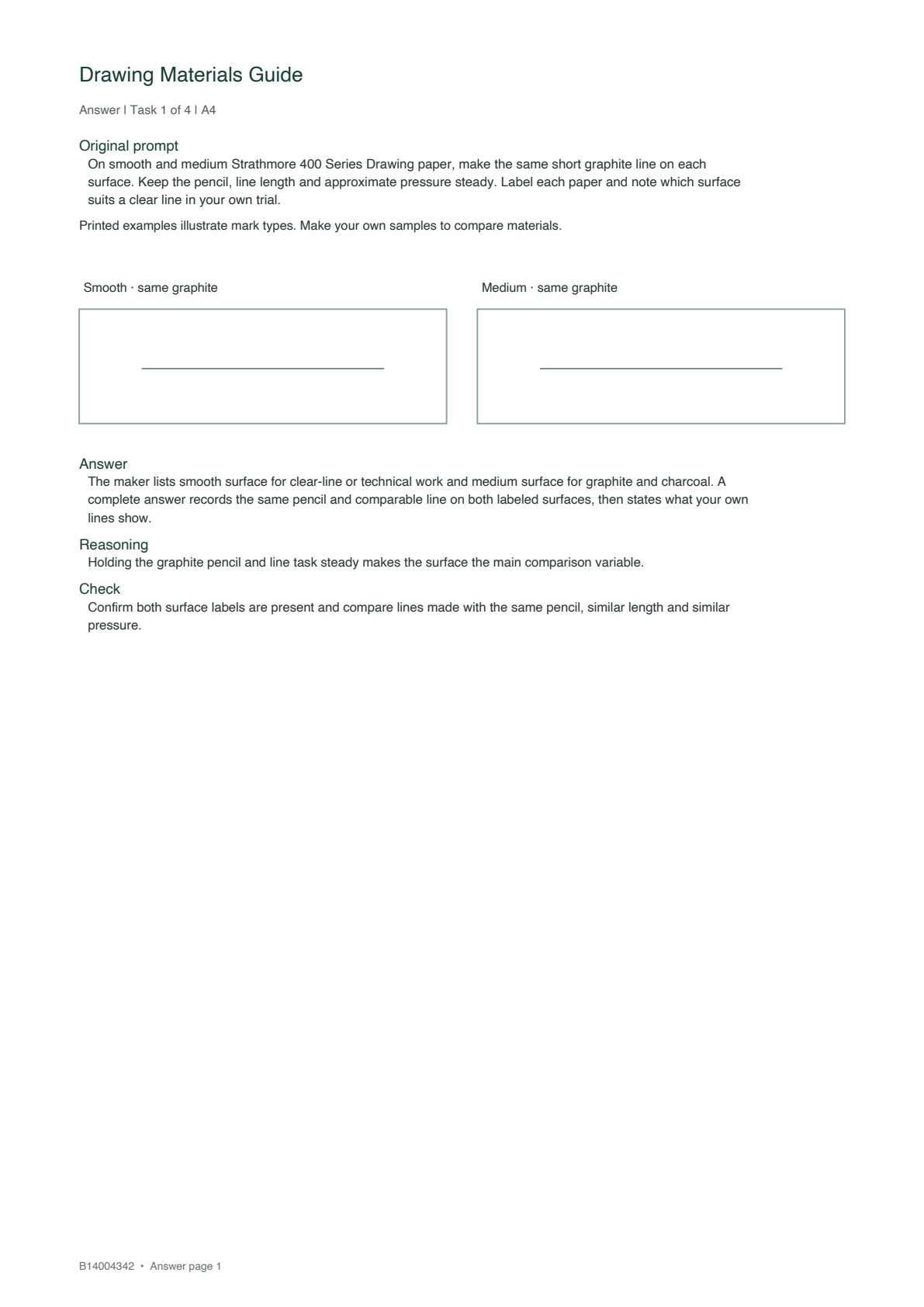
On smooth and medium Strathmore 400 Series Drawing paper, make the same short graphite line on each surface. Keep the pencil, line length and approximate pressure steady. Label each paper and note which surface suits a clear line in your own trial.
Show answer 1
The maker lists smooth surface for clear-line or technical work and medium surface for graphite and charcoal. A complete answer records the same pencil and comparable line on both labeled surfaces, then states what your own lines show.
Holding the graphite pencil and line task steady makes the surface the main comparison variable.
Check: Confirm both surface labels are present and compare lines made with the same pencil, similar length and similar pressure.
Task 2
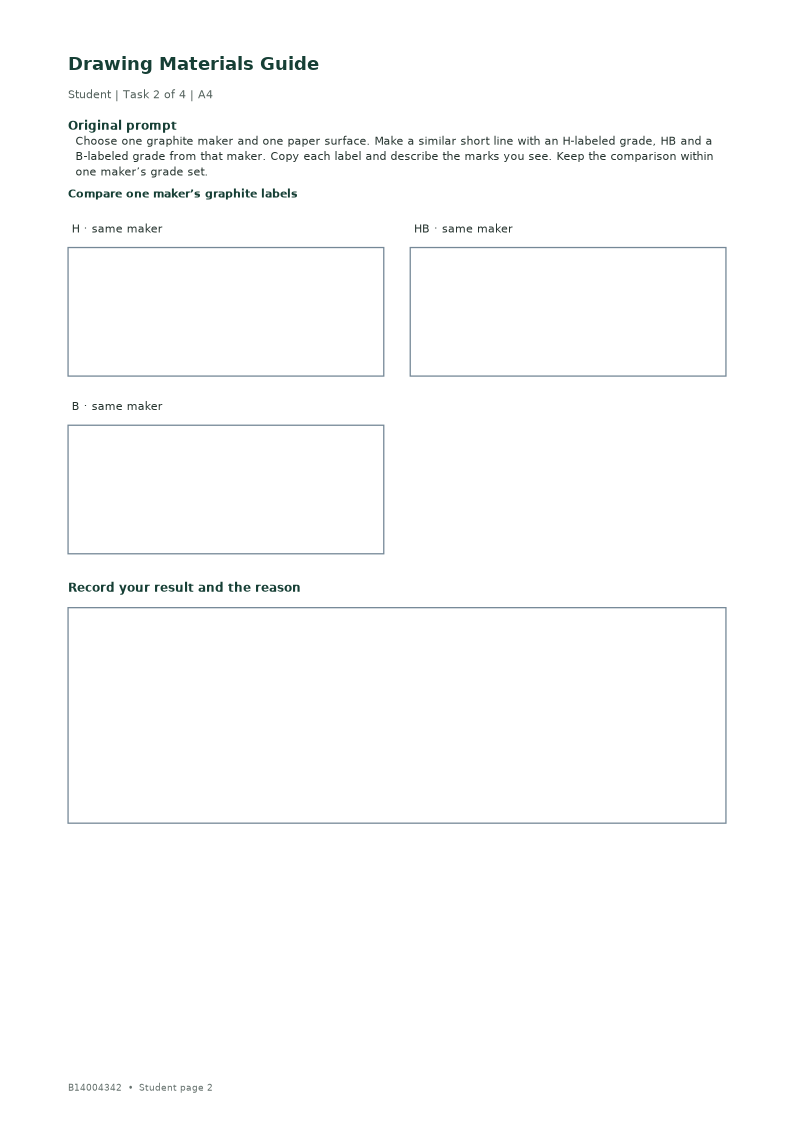
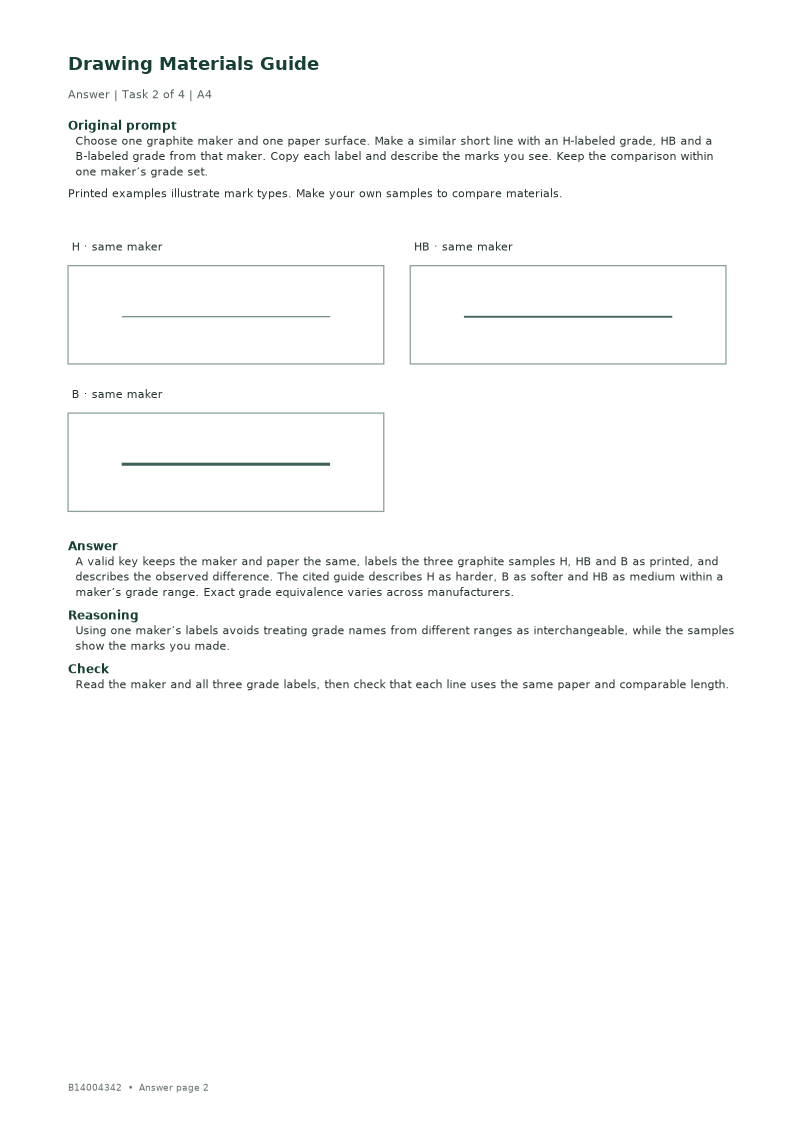
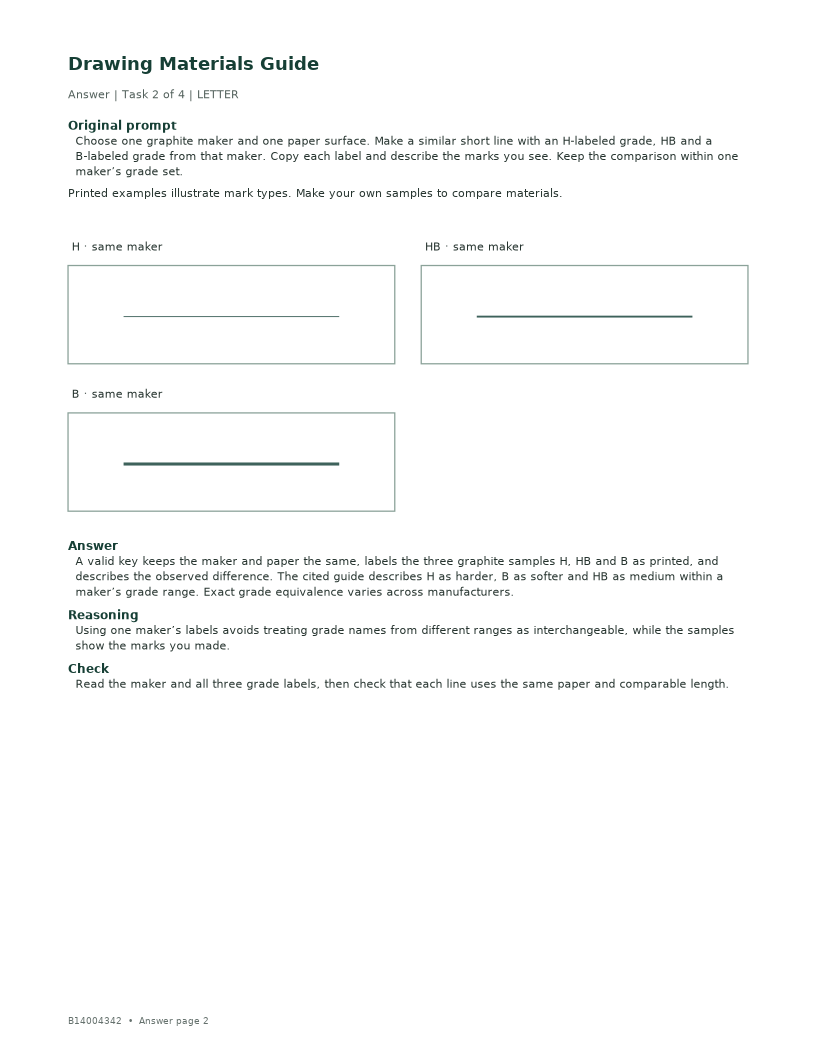
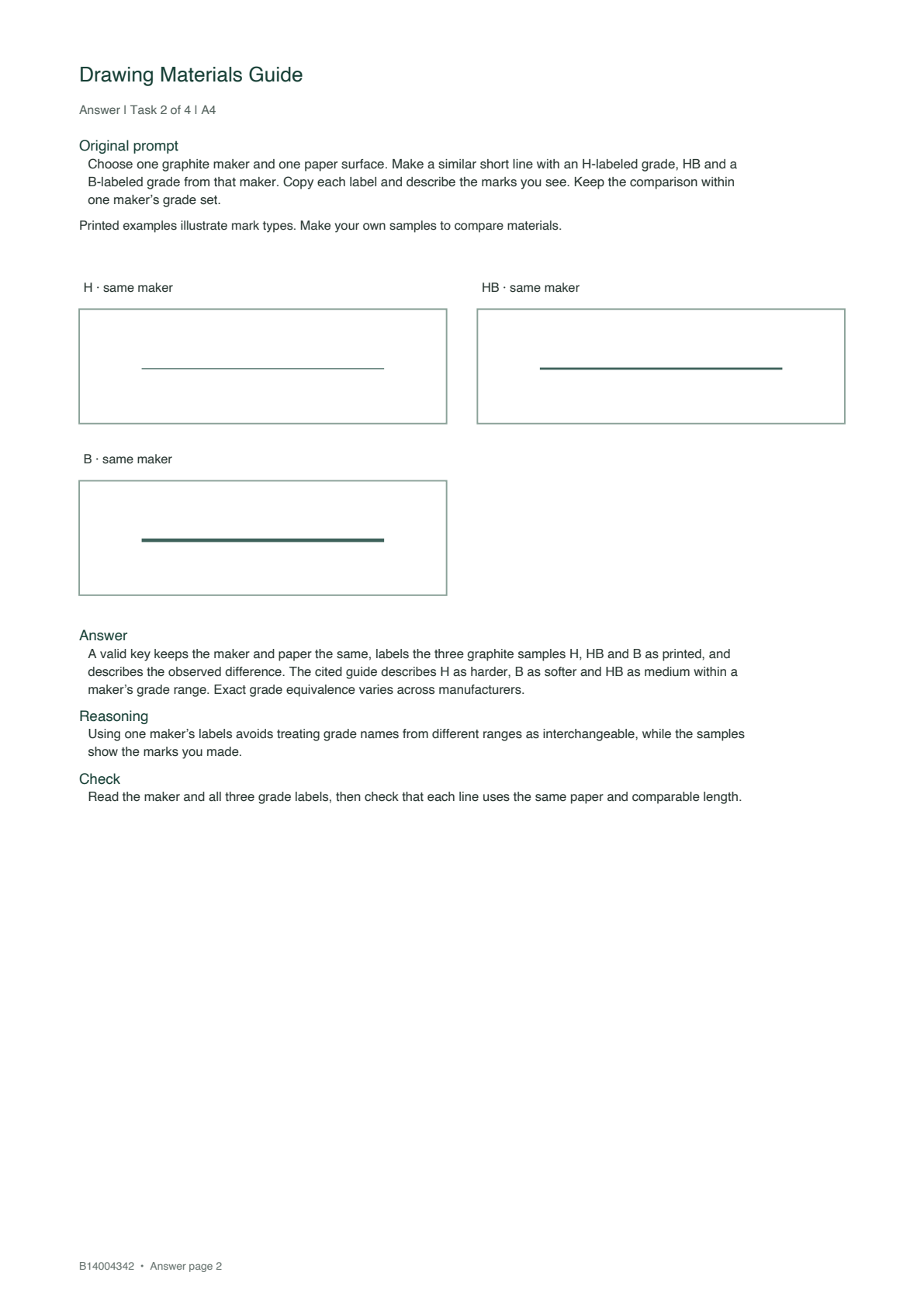
Choose one graphite maker and one paper surface. Make a similar short line with an H-labeled grade, HB and a B-labeled grade from that maker. Copy each label and describe the marks you see. Keep the comparison within one maker’s grade set.
Show answer 2
A valid key keeps the maker and paper the same, labels the three graphite samples H, HB and B as printed, and describes the observed difference. The cited guide describes H as harder, B as softer and HB as medium within a maker’s grade range. Exact grade equivalence varies across manufacturers.
Using one maker’s labels avoids treating grade names from different ranges as interchangeable, while the samples show the marks you made.
Check: Read the maker and all three grade labels, then check that each line uses the same paper and comparable length.
Task 3
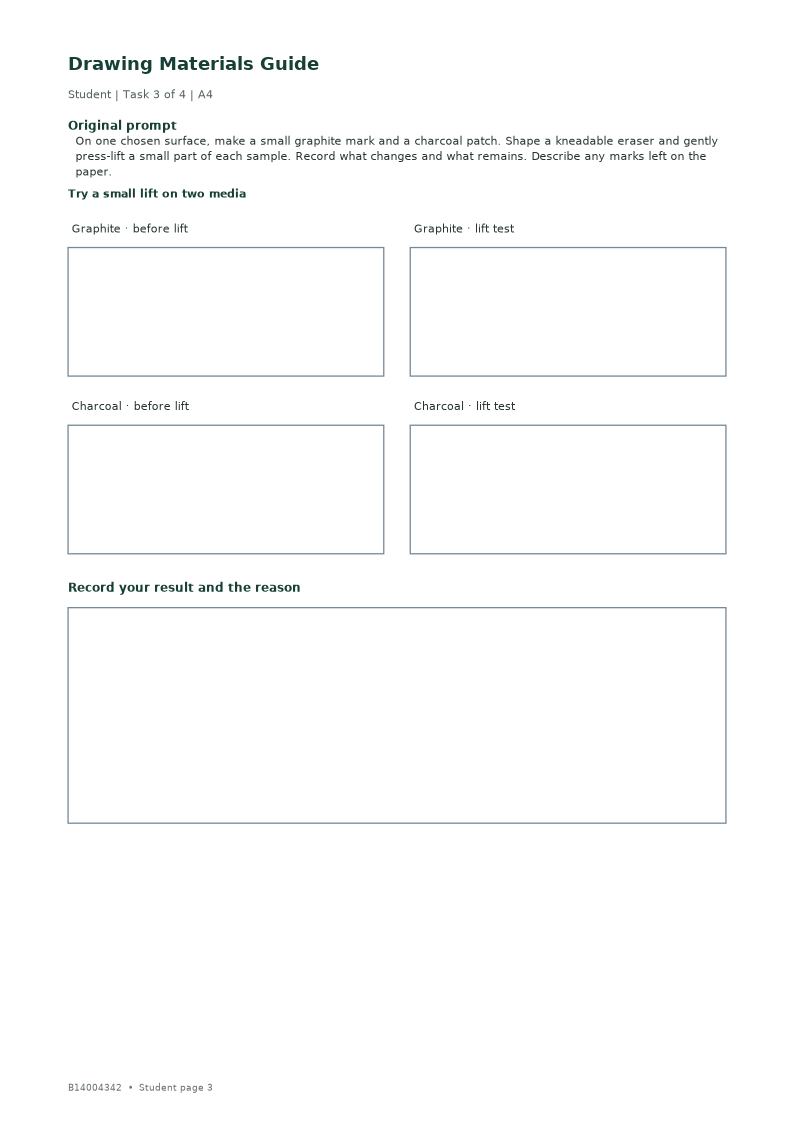
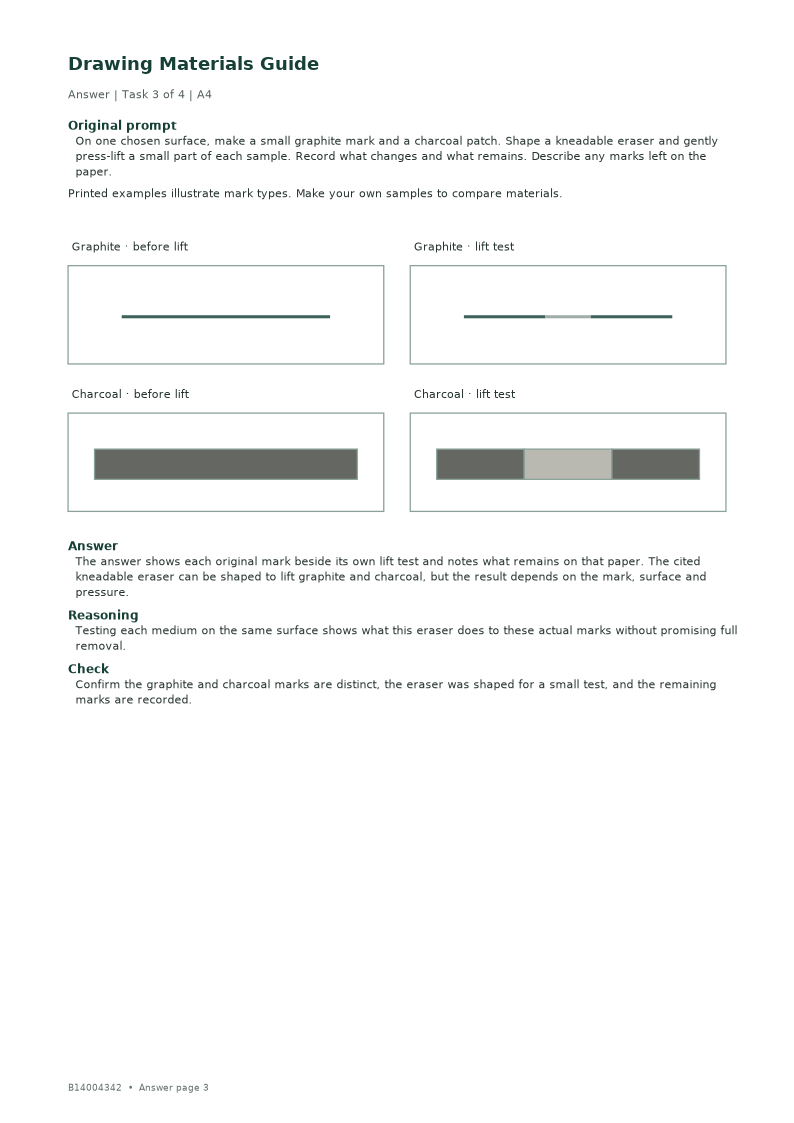
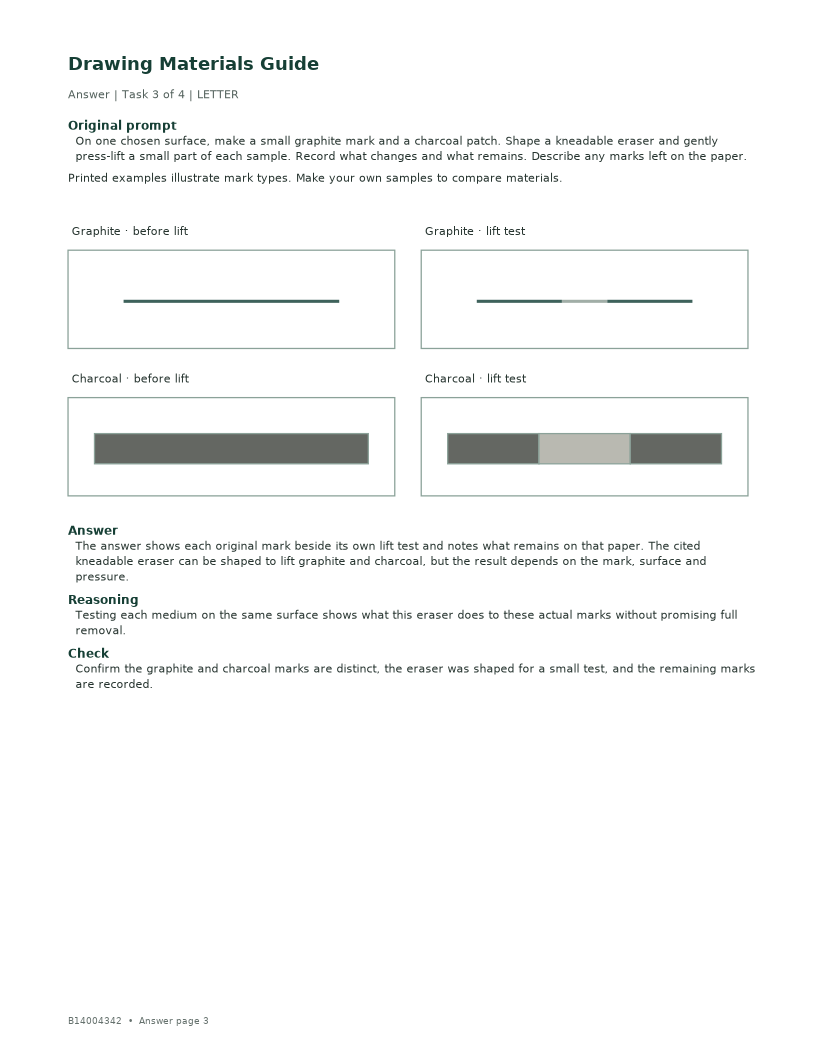
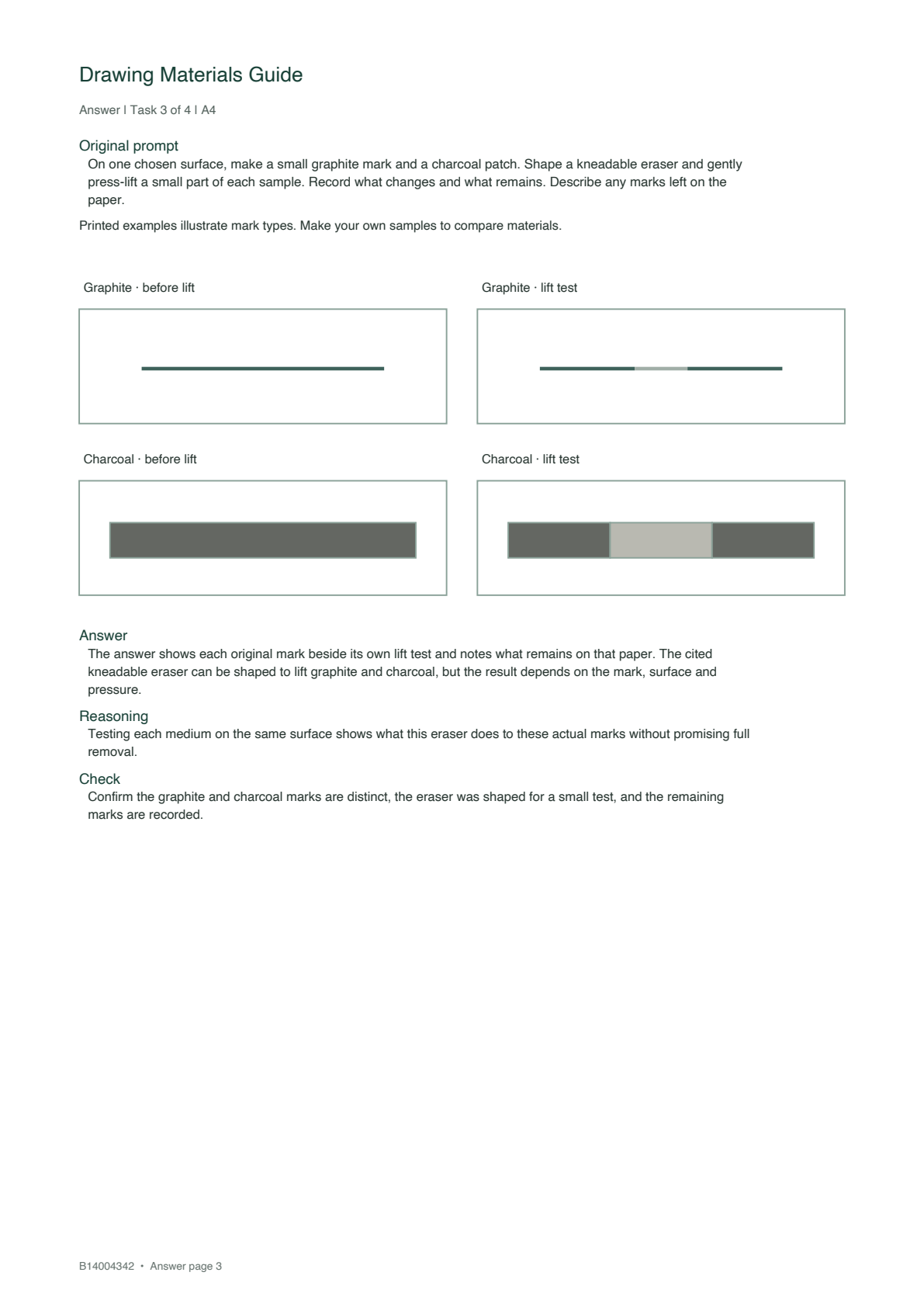
On one chosen surface, make a small graphite mark and a charcoal patch. Shape a kneadable eraser and gently press-lift a small part of each sample. Record what changes and what remains. Describe any marks left on the paper.
Show answer 3
The answer shows each original mark beside its own lift test and notes what remains on that paper. The cited kneadable eraser can be shaped to lift graphite and charcoal, but the result depends on the mark, surface and pressure.
Testing each medium on the same surface shows what this eraser does to these actual marks without promising full removal.
Check: Confirm the graphite and charcoal marks are distinct, the eraser was shaped for a small test, and the remaining marks are recorded.
Task 4
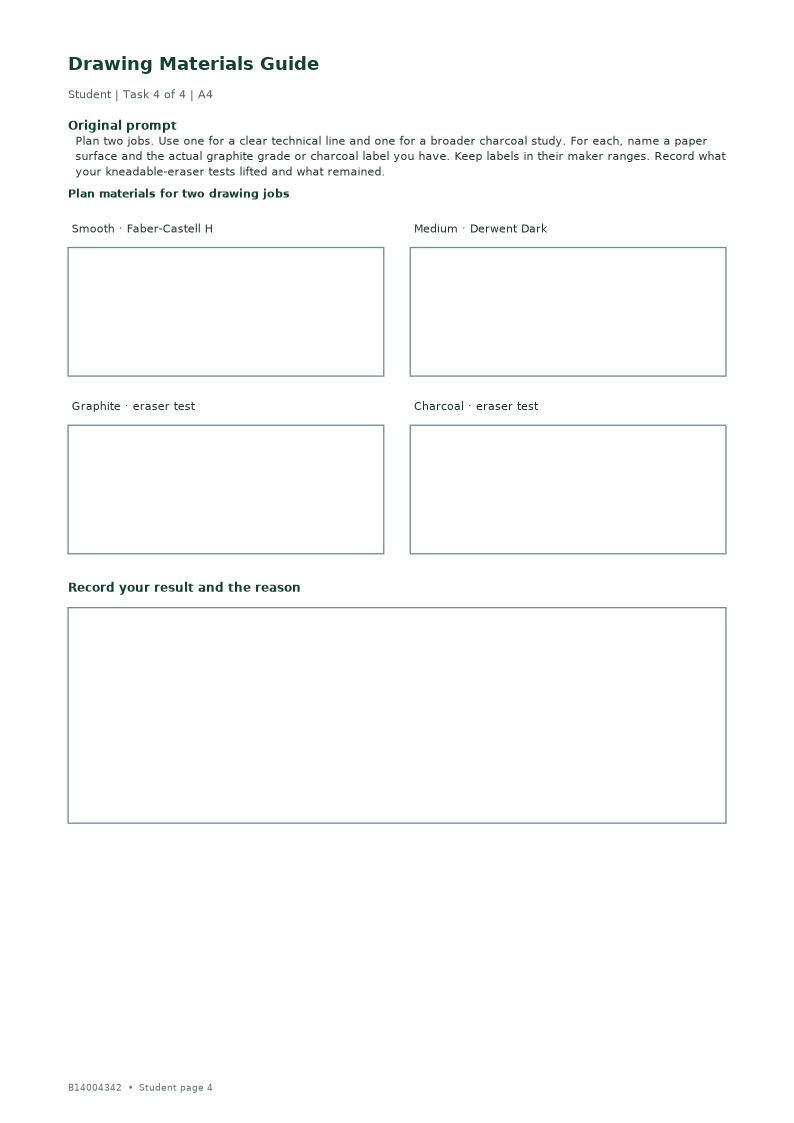
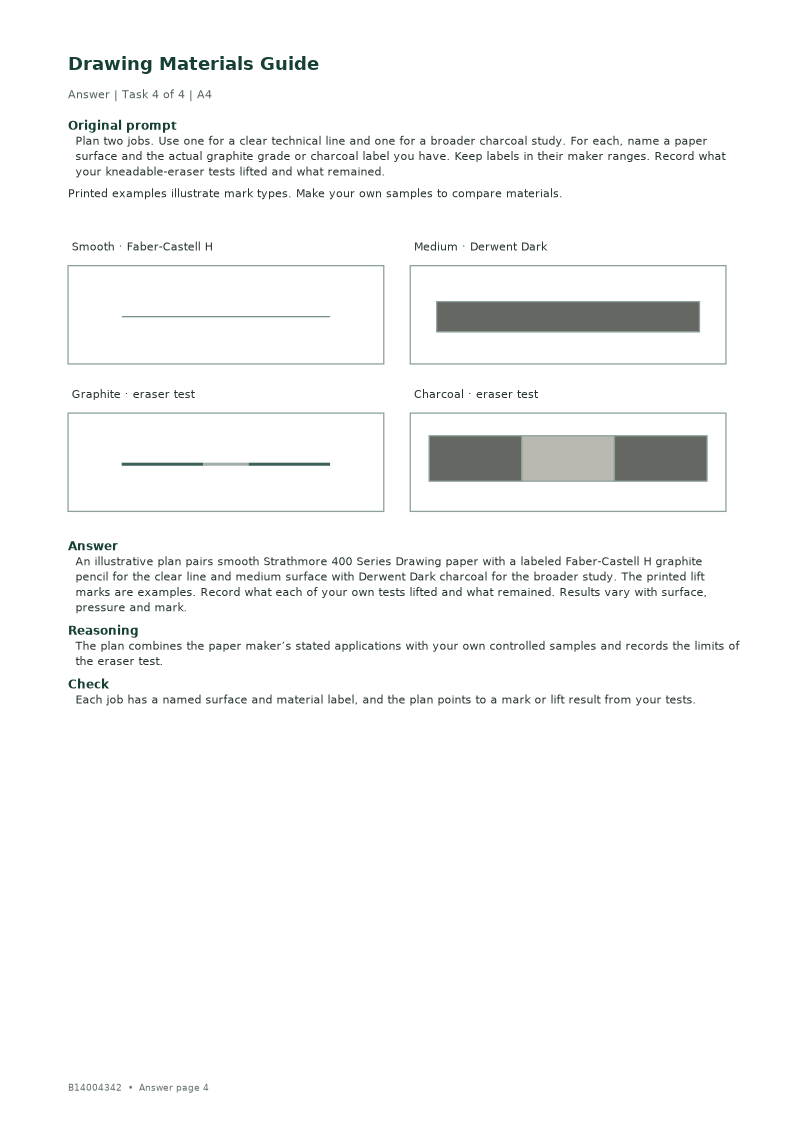
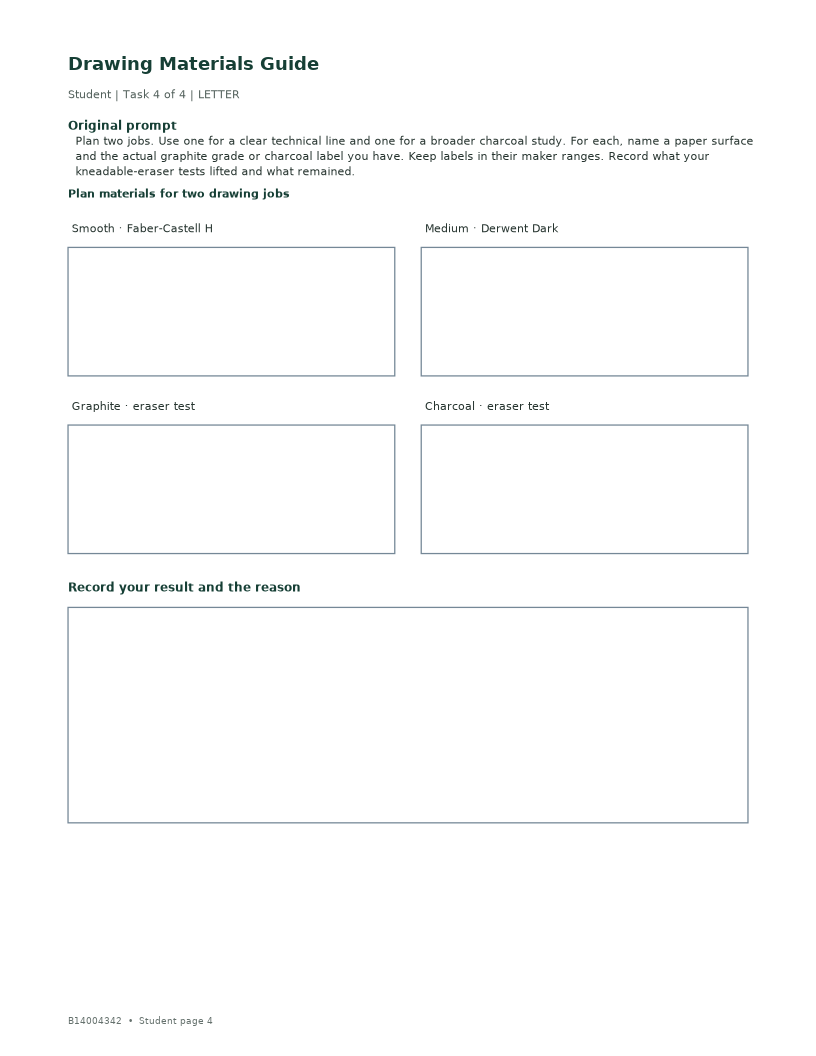
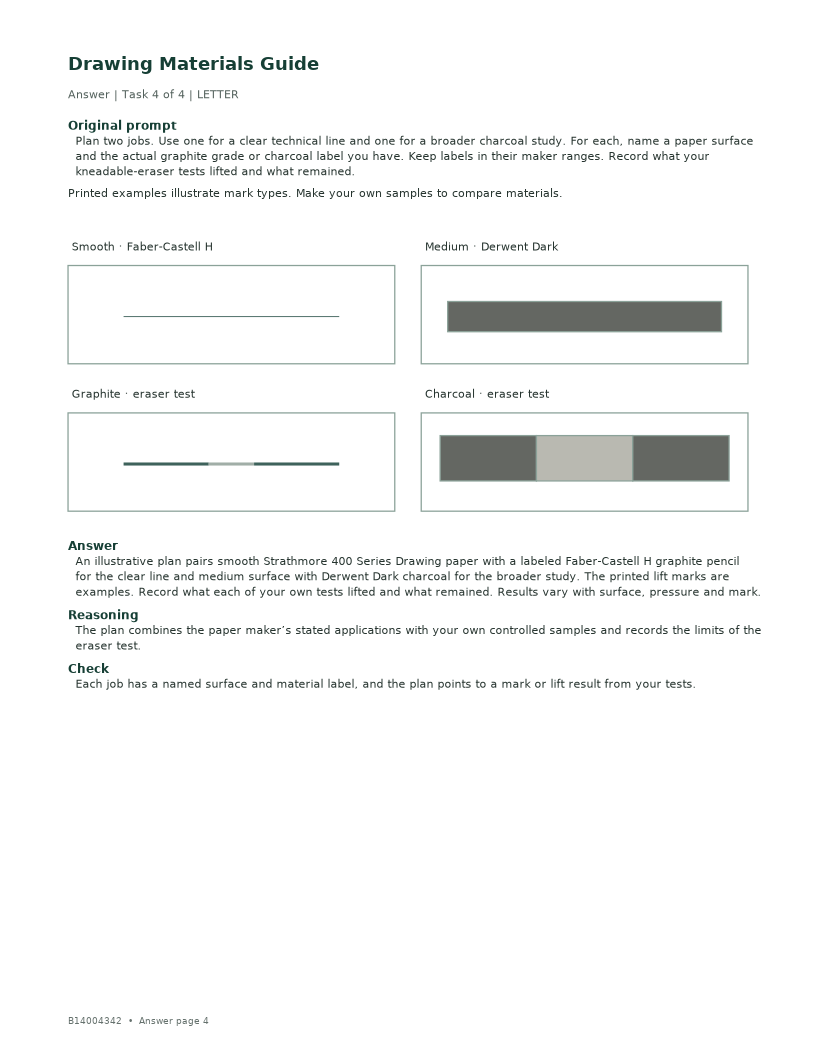
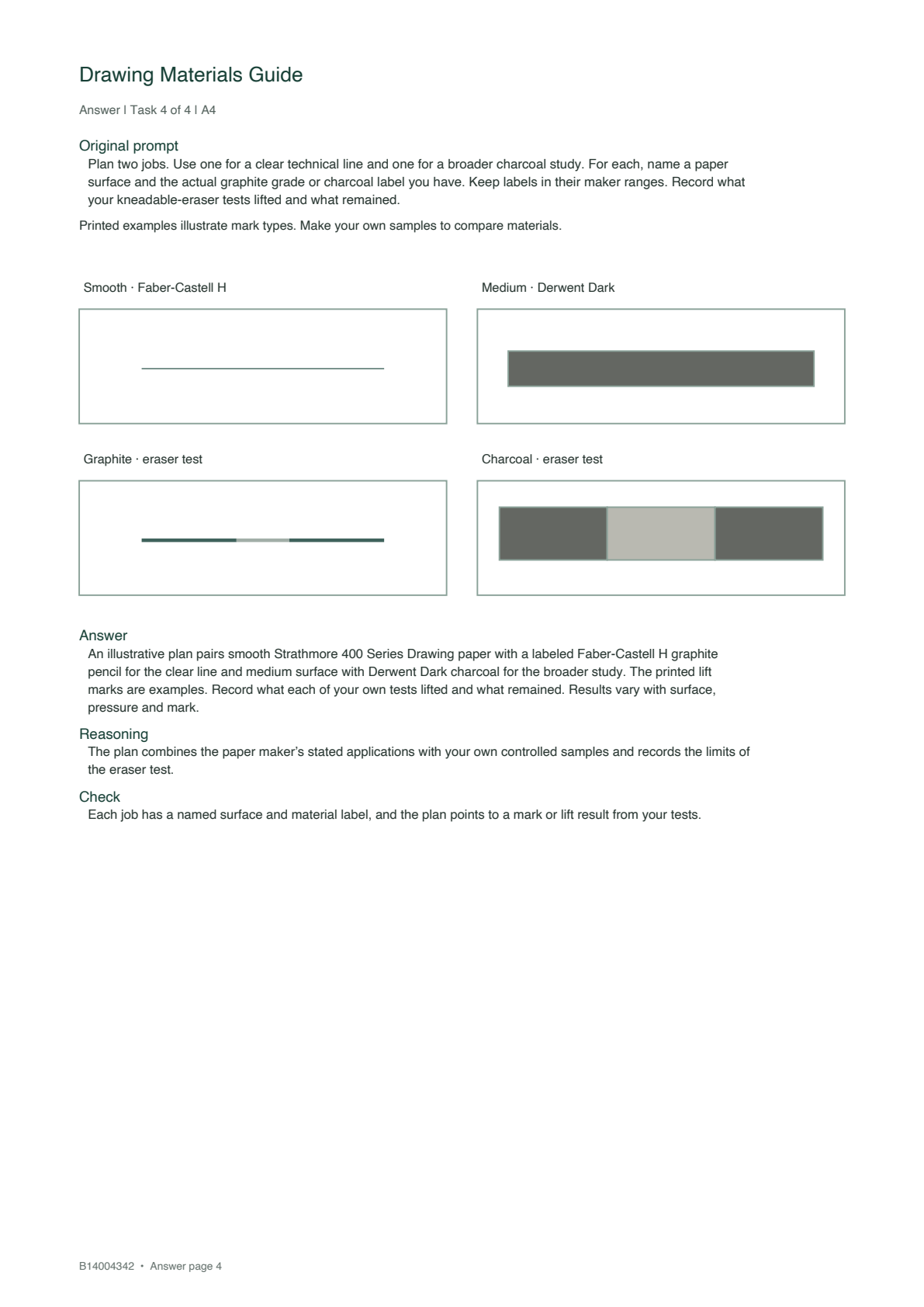
Plan two jobs. Use one for a clear technical line and one for a broader charcoal study. For each, name a paper surface and the actual graphite grade or charcoal label you have. Keep labels in their maker ranges. Record what your kneadable-eraser tests lifted and what remained.
Show answer 4
An illustrative plan pairs smooth Strathmore 400 Series Drawing paper with a labeled Faber-Castell H graphite pencil for the clear line and medium surface with Derwent Dark charcoal for the broader study. The printed lift marks are examples. Record what each of your own tests lifted and what remained. Results vary with surface, pressure and mark.
The plan combines the paper maker’s stated applications with your own controlled samples and records the limits of the eraser test.
Check: Each job has a named surface and material label, and the plan points to a mark or lift result from your tests.
Useful checks
- Changing both paper and pencil while comparing the surface. Hold the medium constant within each surface pair and label the actual paper.
- Combining charcoal Light/Medium/Dark labels with graphite H/B grades and treating every lift as complete removal. Keep each maker’s labels in its own range. Record what your small eraser test changes and what remains.
Questions about this resource
How should I read smooth and medium surface descriptions?
The cited Strathmore 400 Series Drawing page uses those surface descriptions for that product line. Check your paper and compare your own marks.
What should I expect from a kneadable eraser?
The cited maker describes a kneadable eraser that can be shaped to lift graphite and charcoal. Test on scrap and record what remains. Results vary with paper, pressure and the mark.