Free original lessons
Scoring Board Template
This pack teaches you to read, build and check a numbered tally scoring board. You will study a filled example, then construct your own board, redraw a given score, and verify tallies against totals.
Letter & A4
PDF & SVG
What a numbered tally scoring board is
A scoring board template is a paper form with numbered columns where each player or team records points as tally marks. Each column is labelled with a number so scores can be read and added quickly.
Tally marks are grouped in fives: four upright strokes and a fifth diagonal stroke across them. This grouping makes counting fast and reduces errors.
Reading the filled example
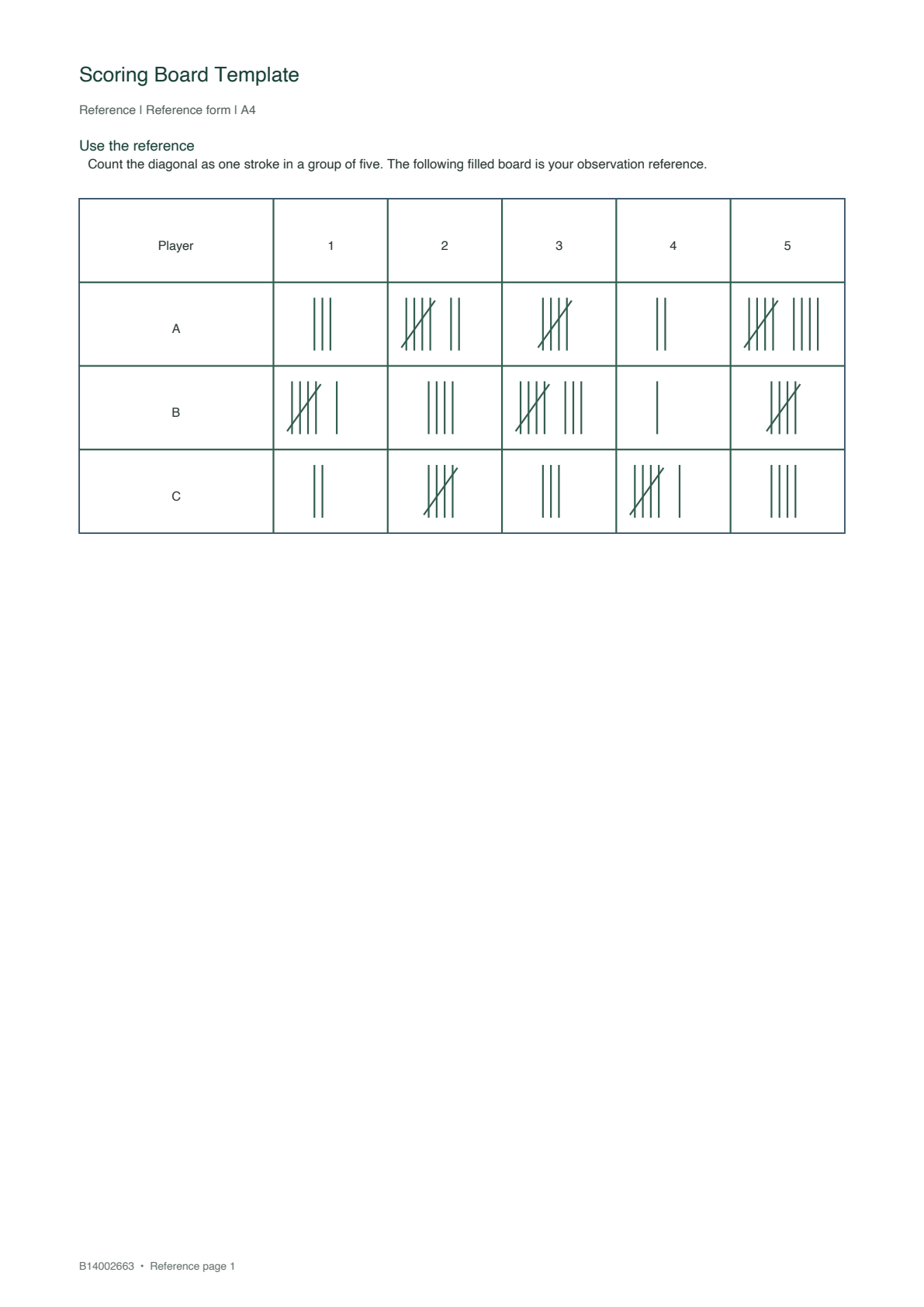
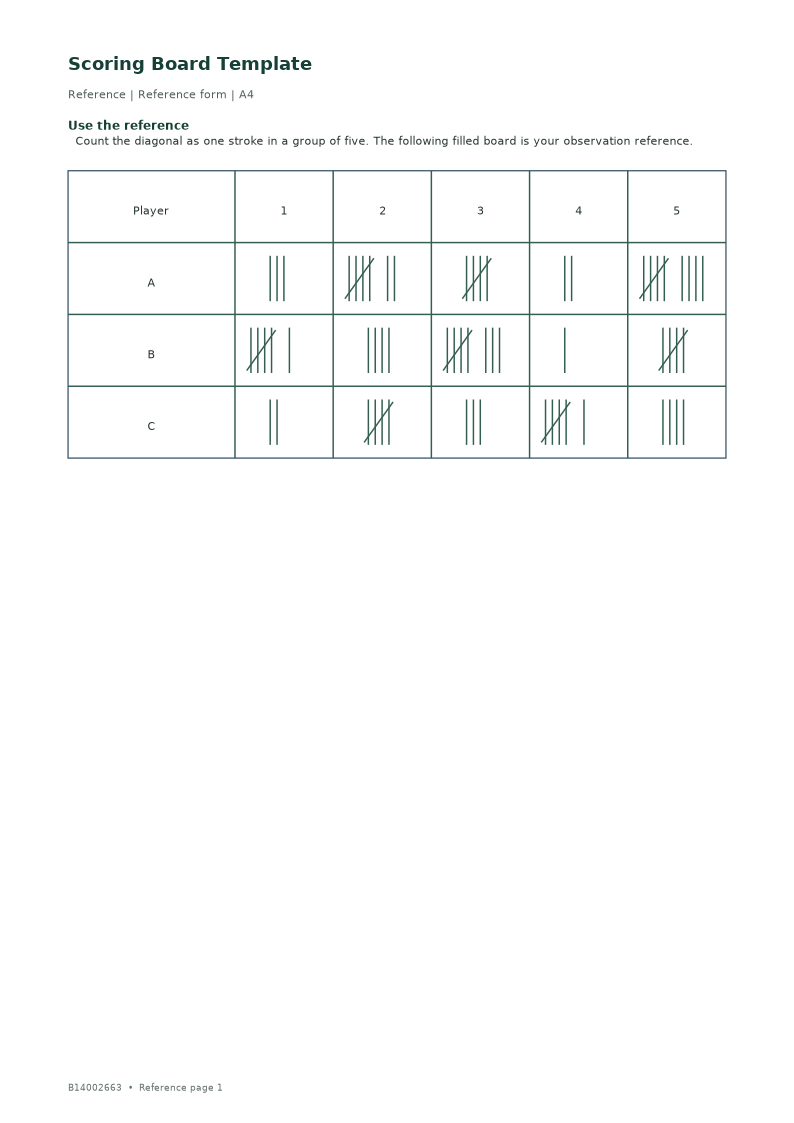
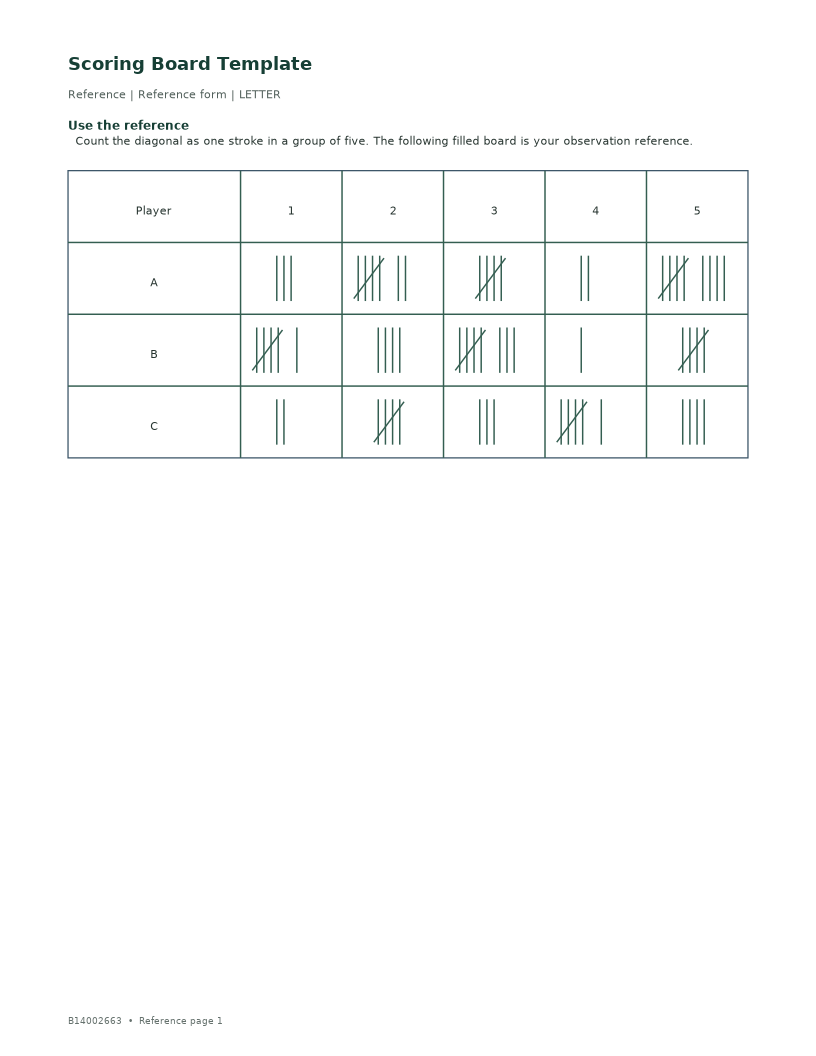
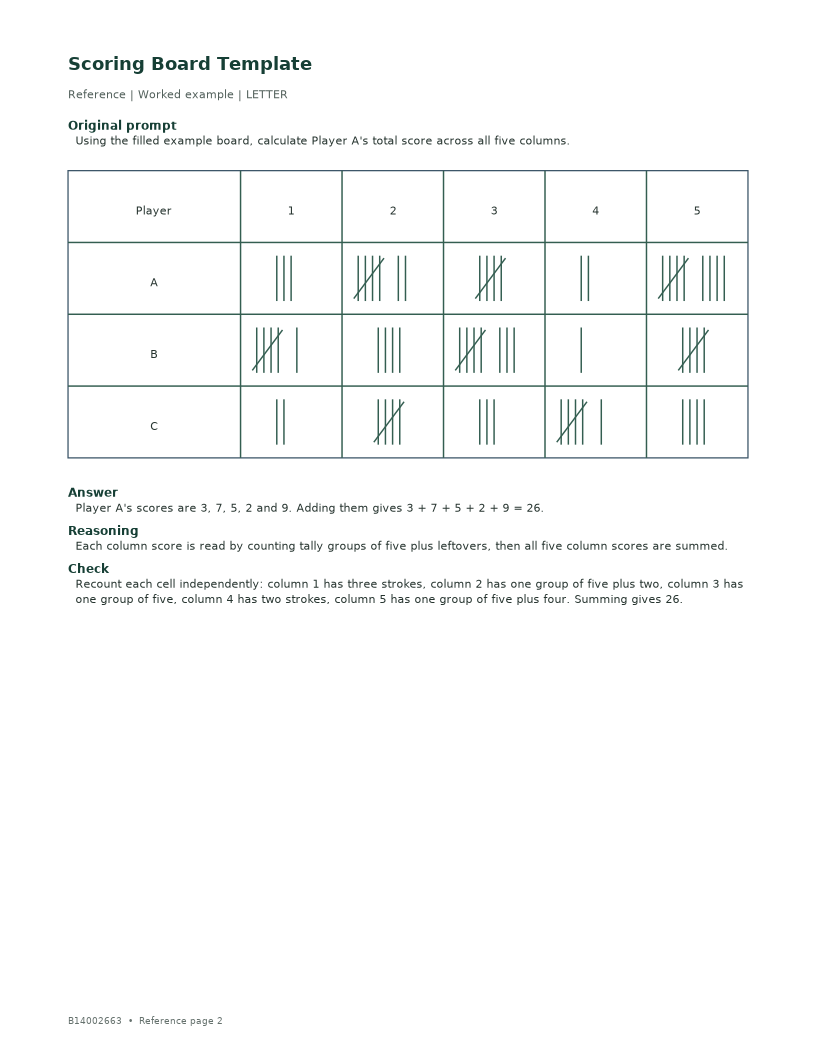
The worked example below shows a board with five numbered columns (1 to 5) and three rows for players A, B and C. Each cell contains tally marks representing that player's score in that column.
To read a cell, count the complete groups of five first, then add any leftover strokes. For example, a cell with one full group of five and two extra strokes equals seven.
Worked example
Player A scores: column 1 = 3, column 2 = 7, column 3 = 5, column 4 = 2, column 5 = 9. Total = 3 + 7 + 5 + 2 + 9 = 26.
Player B scores: column 1 = 6, column 2 = 4, column 3 = 8, column 4 = 1, column 5 = 5. Total = 6 + 4 + 8 + 1 + 5 = 24.
Practice Task 1: Observe and count
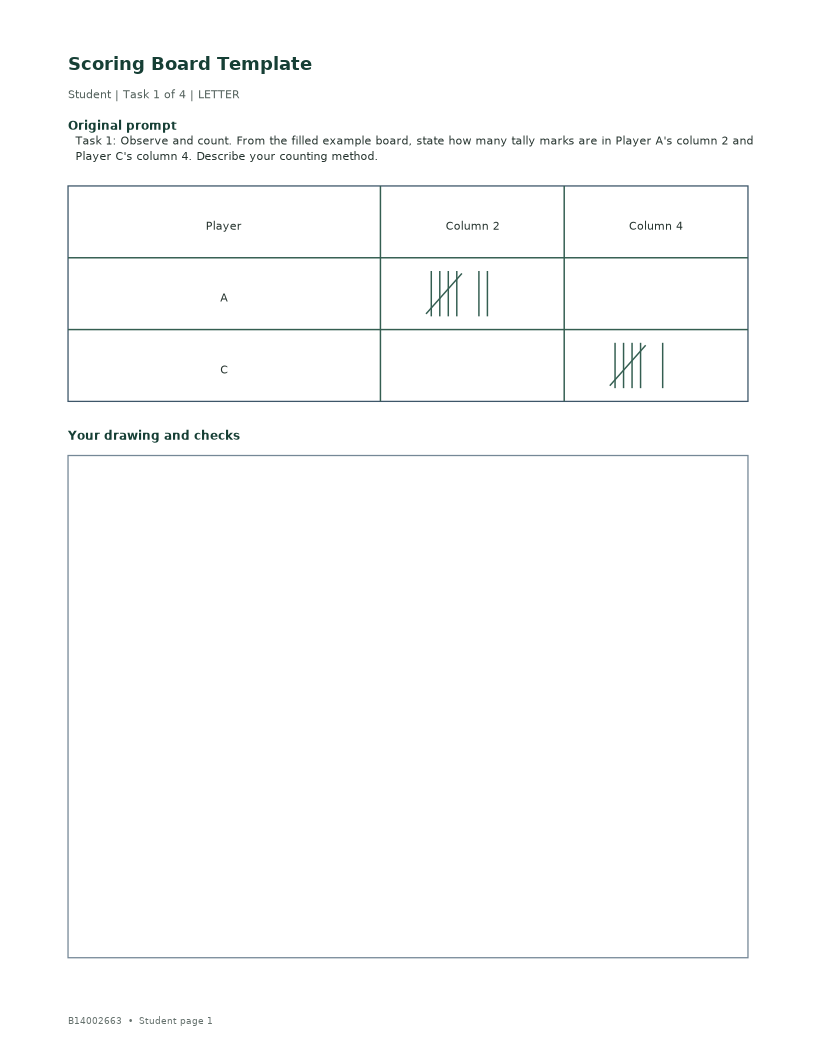
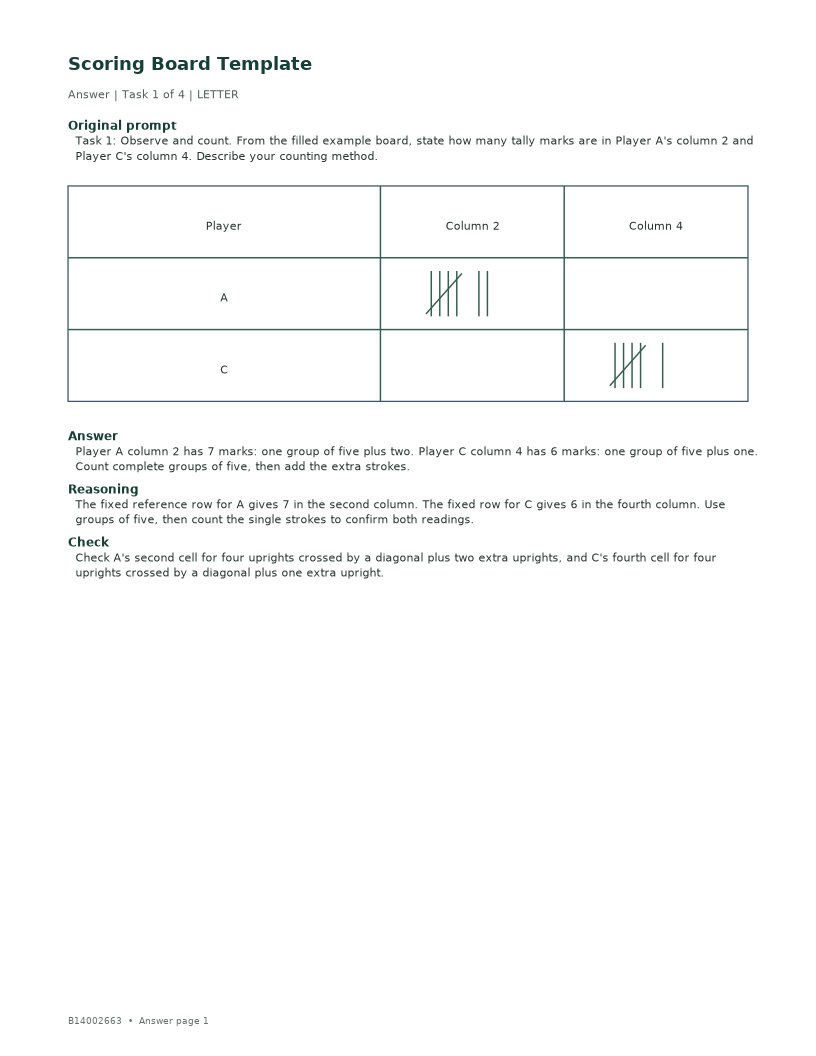
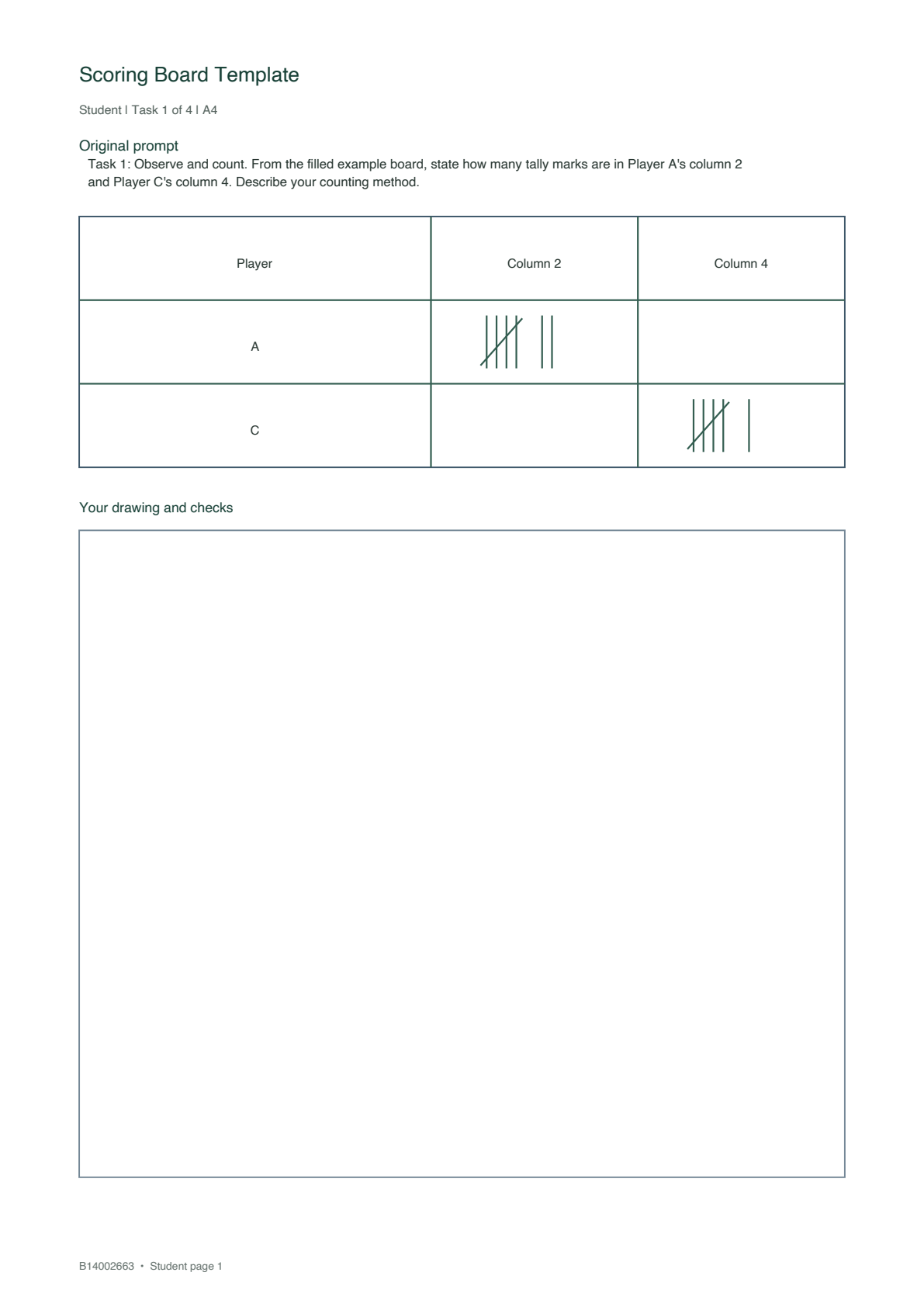
Use the filled board to count Player A's marks in column 2 and Player C's marks in column 4. Count complete groups of five first and then any leftover strokes.
Player A's second cell contains one group of five and two extra strokes. Player C's fourth cell contains one group of five and one extra stroke.
Practice Task 2: Construct a blank board
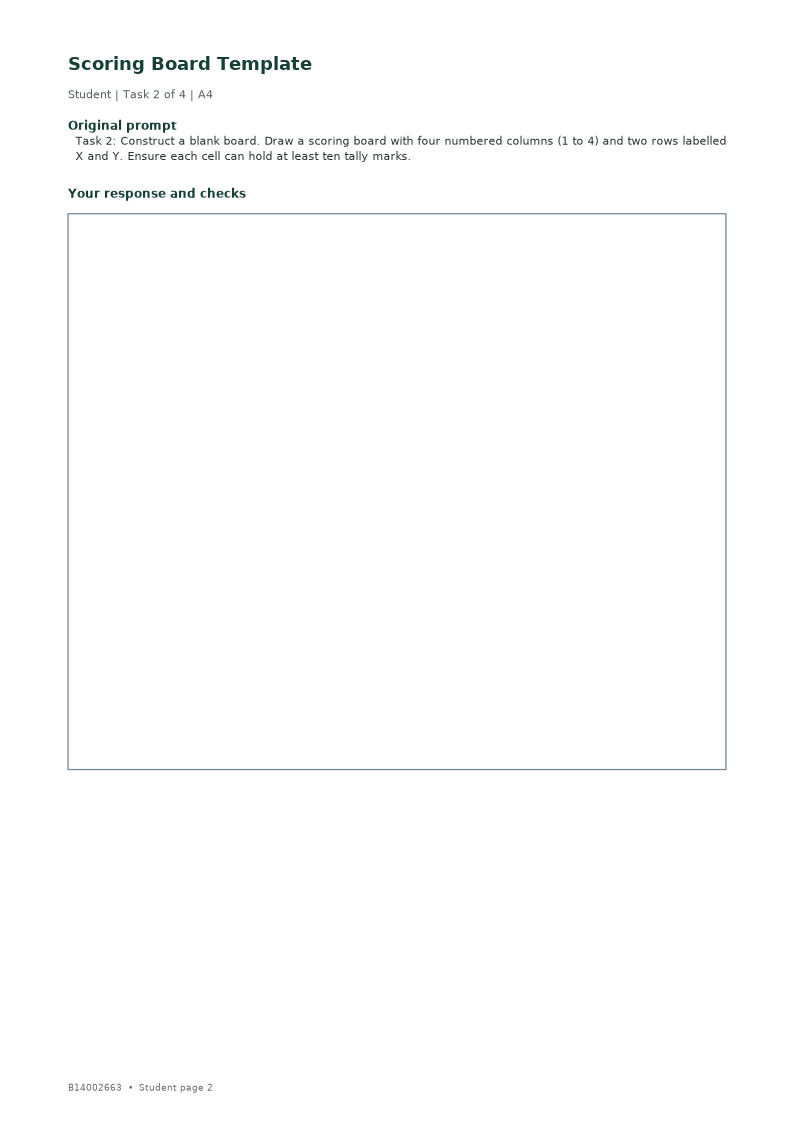
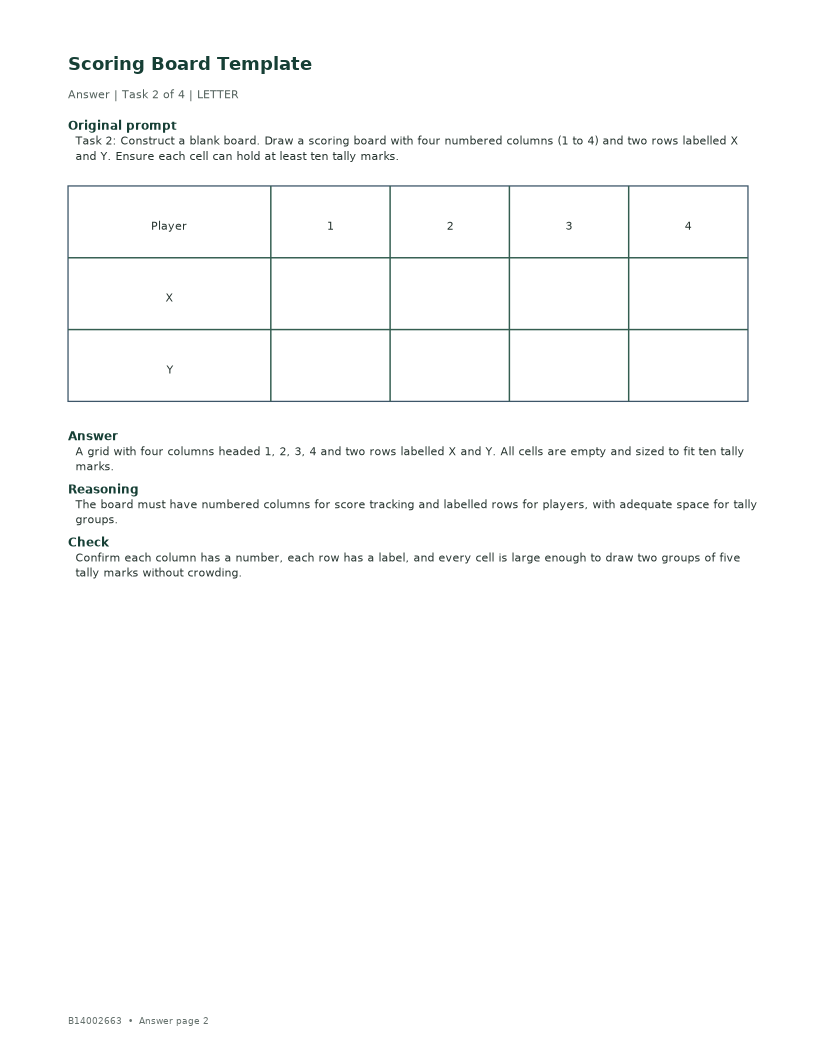
Draw a blank practice board with four numbered columns, 1 to 4, and two rows labeled X and Y. Leave space in each cell for two groups of five.
The five-column board above is the observation example. Keep the four columns and two rows requested for this practice board.
Download the complete resource pack
All individual SVG pages (20)
- A4 reference page 1
- A4 reference page 2
- A4 student page 1
- A4 student page 2
- A4 student page 3
- A4 student page 4
- A4 answer page 1
- A4 answer page 2
- A4 answer page 3
- A4 answer page 4
- LETTER reference page 1
- LETTER reference page 2
- LETTER student page 1
- LETTER student page 2
- LETTER student page 3
- LETTER student page 4
- LETTER answer page 1
- LETTER answer page 2
- LETTER answer page 3
- LETTER answer page 4

Print at 100% / actual size. Use the stated scale on any schematic diagram; physical cutting templates are identified separately. A4 and US Letter are separate files. Free access, no signup; CC BY 4.0.
How to use these pages
- What a numbered tally scoring board is
- Reading the filled example
- Worked example
- Practice Task 1: Observe and count
- Practice Task 2: Construct a blank board
Worked example
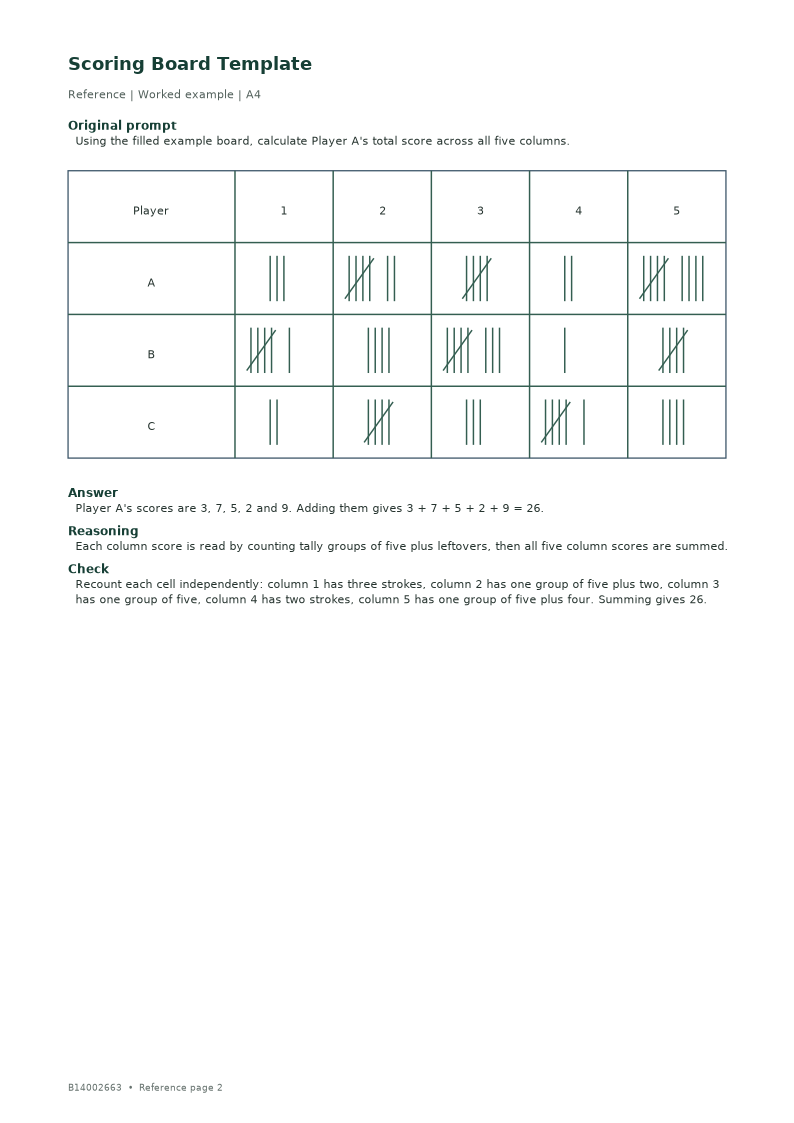
Example: Using the filled example board, calculate Player A's total score across all five columns.
Answer: Player A's scores are 3, 7, 5, 2 and 9. Adding them gives 3 + 7 + 5 + 2 + 9 = 26.
Reasoning: Each column score is read by counting tally groups of five plus leftovers, then all five column scores are summed.
Check: Recount each cell independently: column 1 has three strokes, column 2 has one group of five plus two, column 3 has one group of five, column 4 has two strokes, column 5 has one group of five plus four. Summing gives 26.
Four practice tasks and complete answers
Task 1
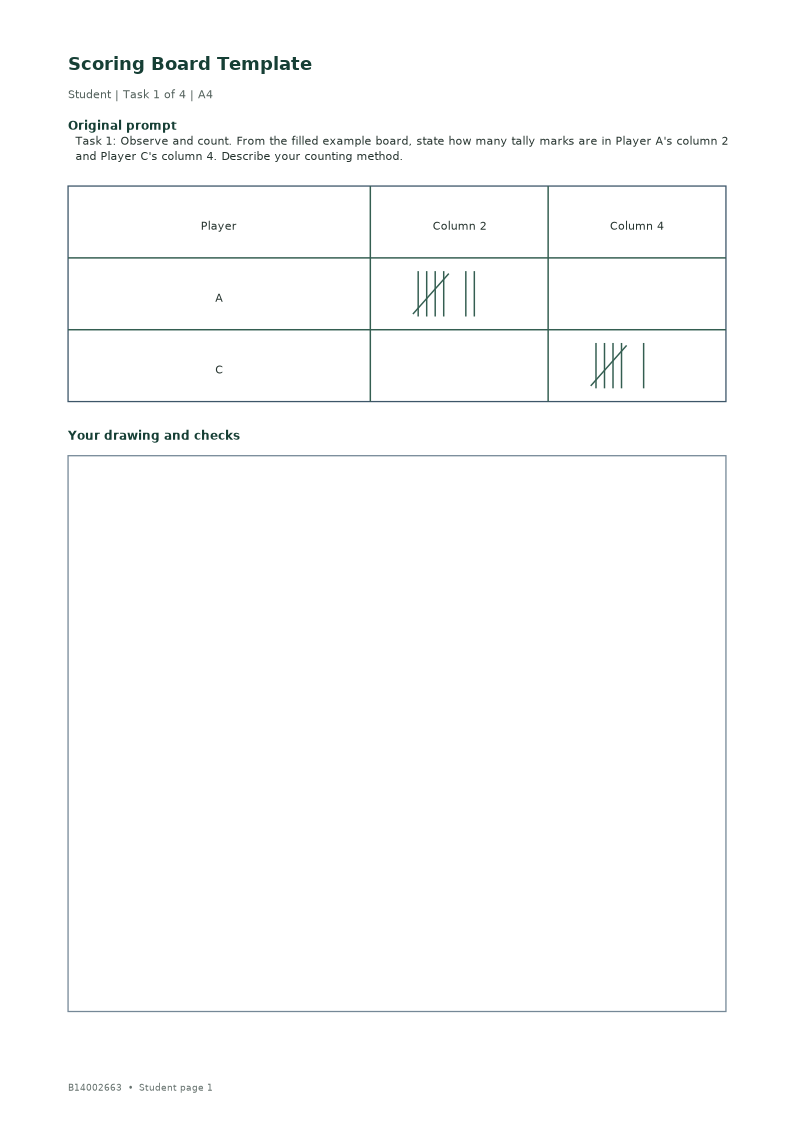
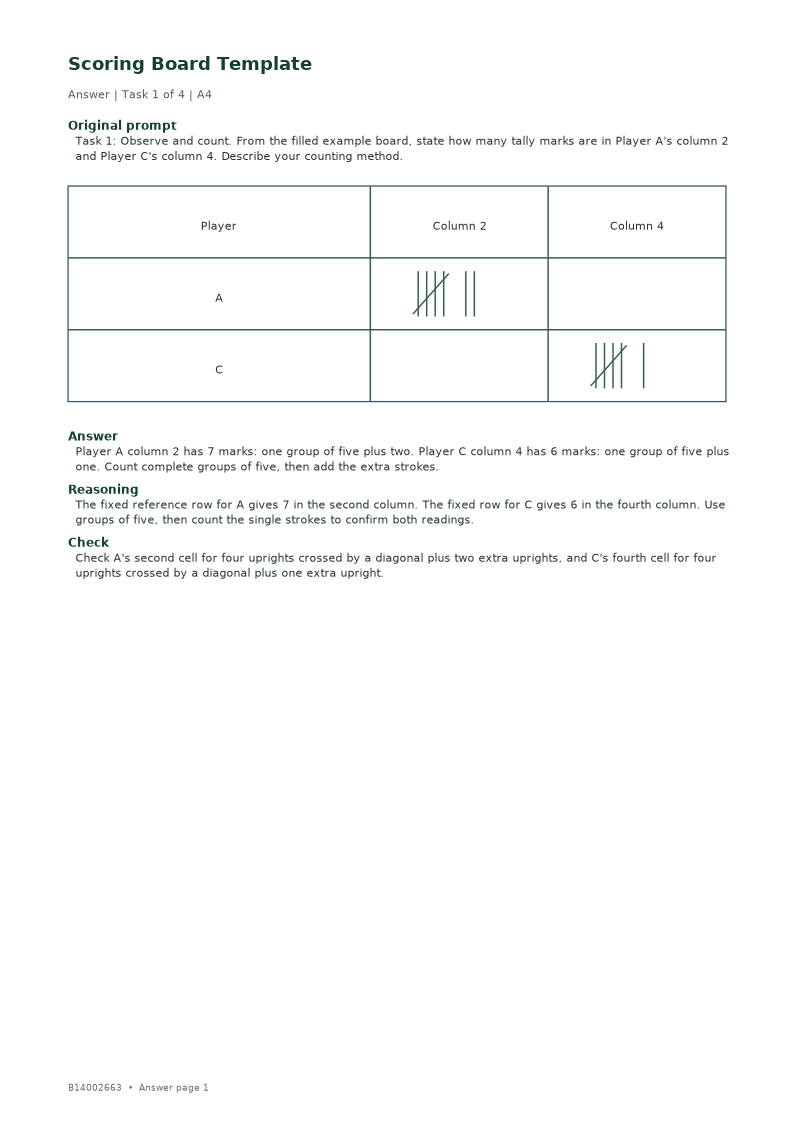
Task 1: Observe and count. From the filled example board, state how many tally marks are in Player A's column 2 and Player C's column 4. Describe your counting method.
Show answer 1
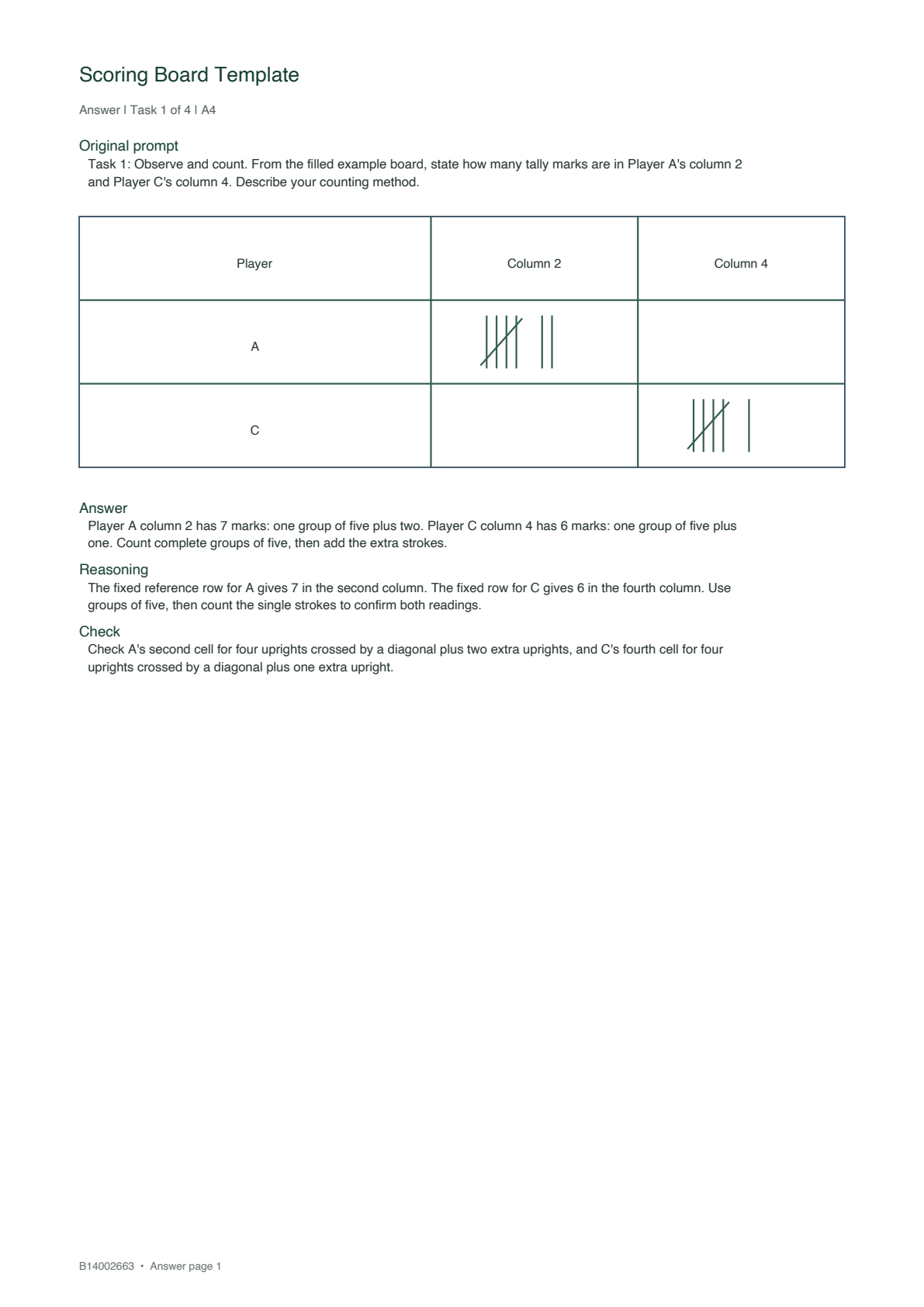
Player A column 2 has 7 marks: one group of five plus two. Player C column 4 has 6 marks: one group of five plus one. Count complete groups of five, then add the extra strokes.
The fixed reference row for A gives 7 in the second column. The fixed row for C gives 6 in the fourth column. Use groups of five, then count the single strokes to confirm both readings.
Check: Check A's second cell for four uprights crossed by a diagonal plus two extra uprights, and C's fourth cell for four uprights crossed by a diagonal plus one extra upright.
Task 2
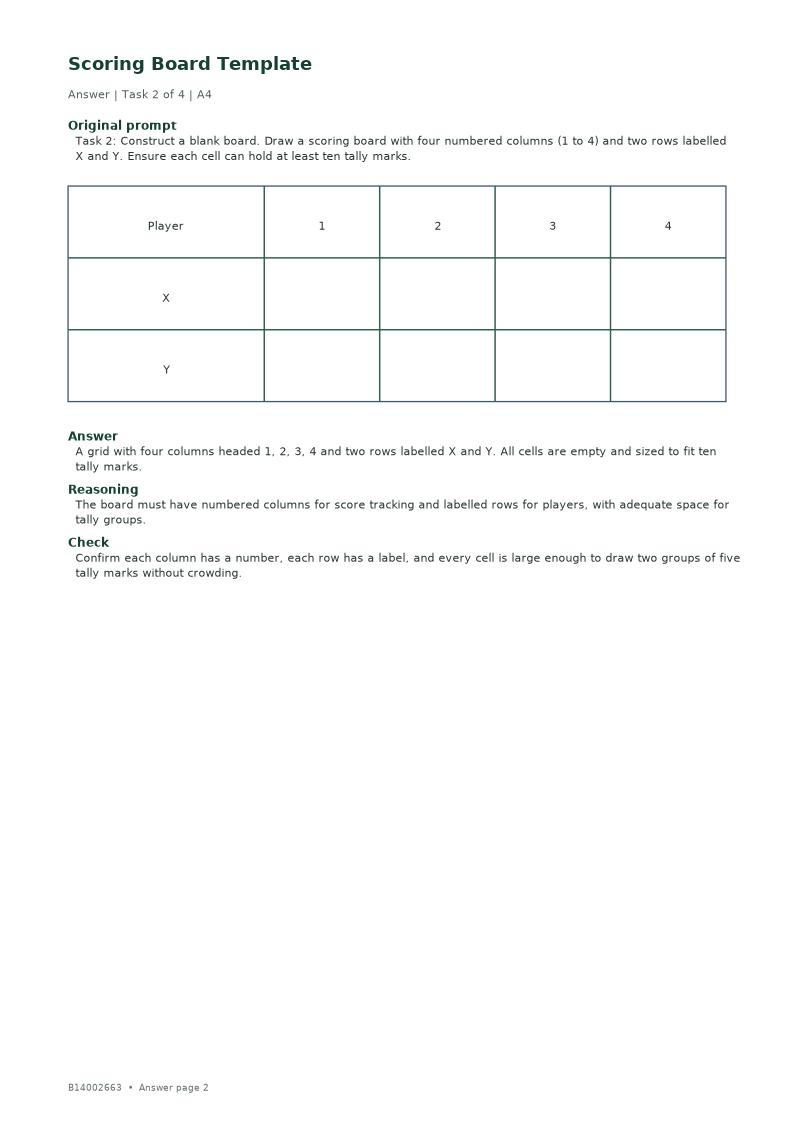
Task 2: Construct a blank board. Draw a scoring board with four numbered columns (1 to 4) and two rows labelled X and Y. Ensure each cell can hold at least ten tally marks.

Show answer 2
A grid with four columns headed 1, 2, 3, 4 and two rows labelled X and Y. All cells are empty and sized to fit ten tally marks.
The board must have numbered columns for score tracking and labelled rows for players, with adequate space for tally groups.
Check: Confirm each column has a number, each row has a label, and every cell is large enough to draw two groups of five tally marks without crowding.
Task 3
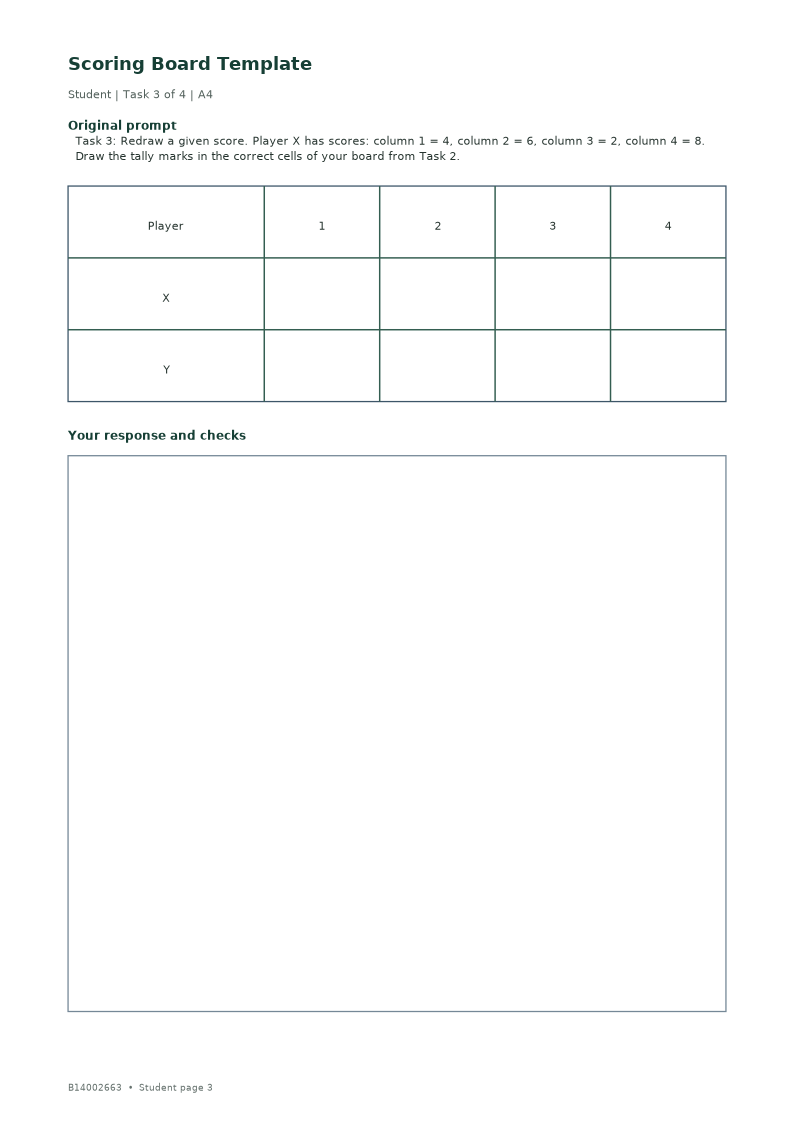
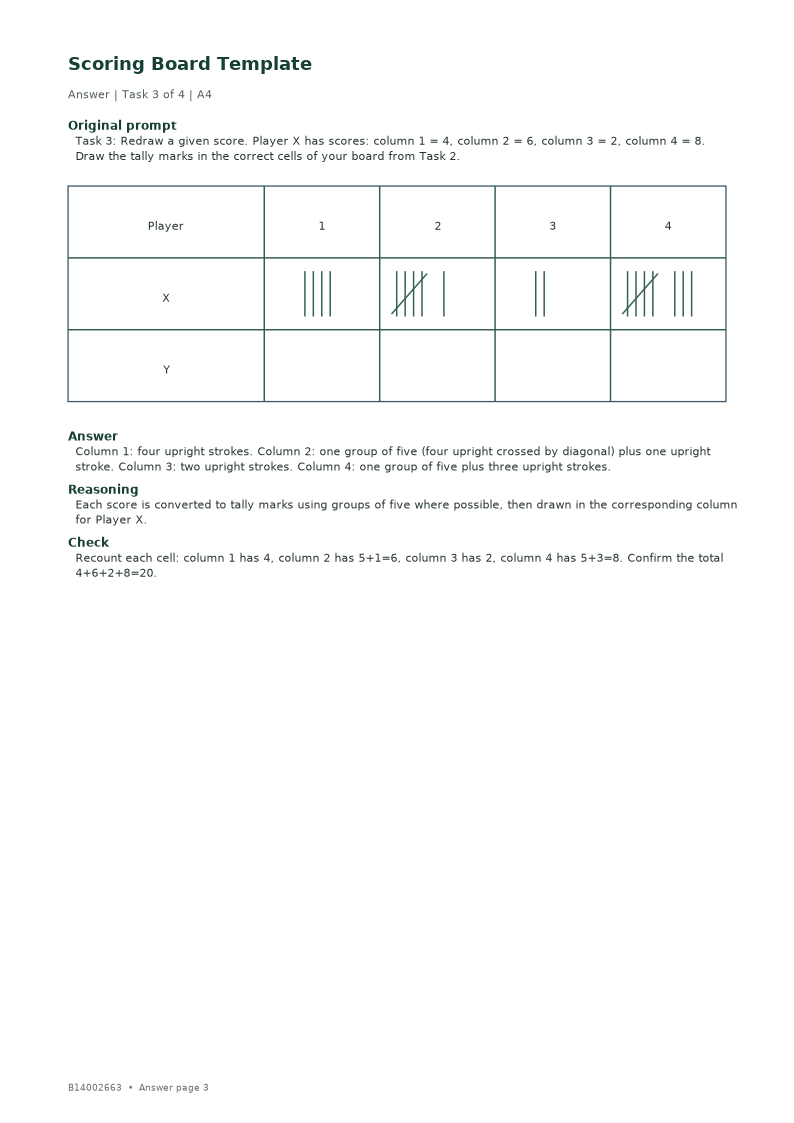
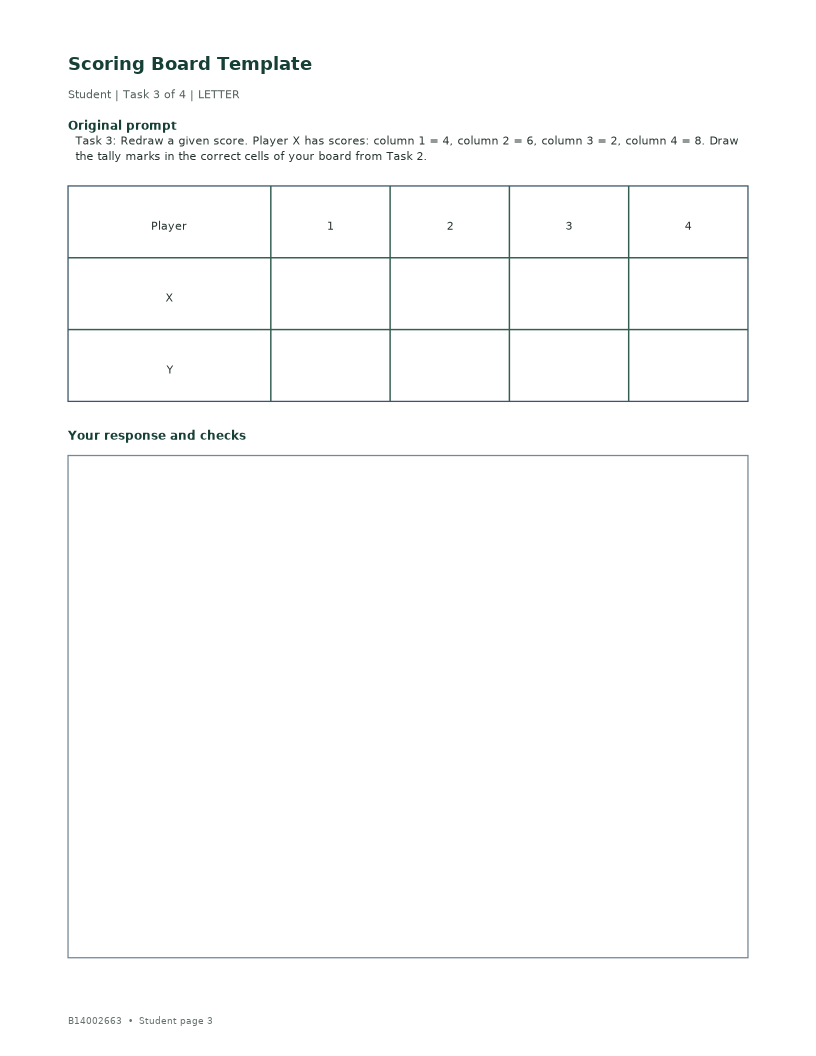
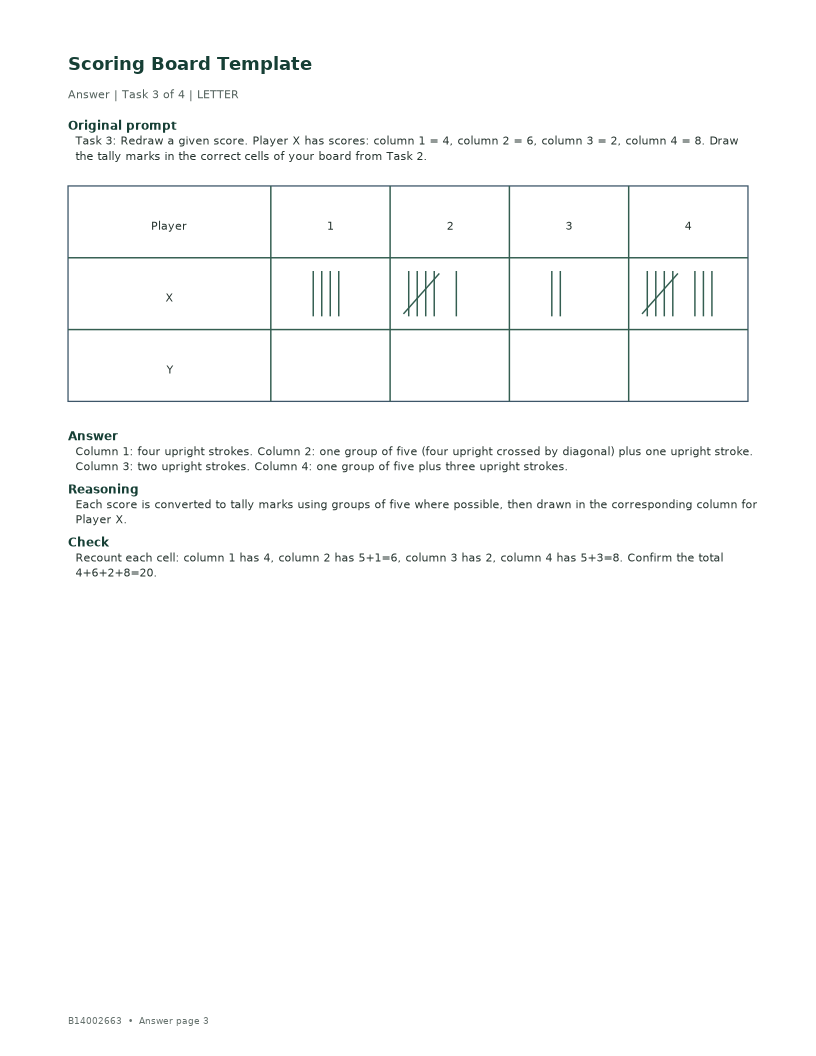
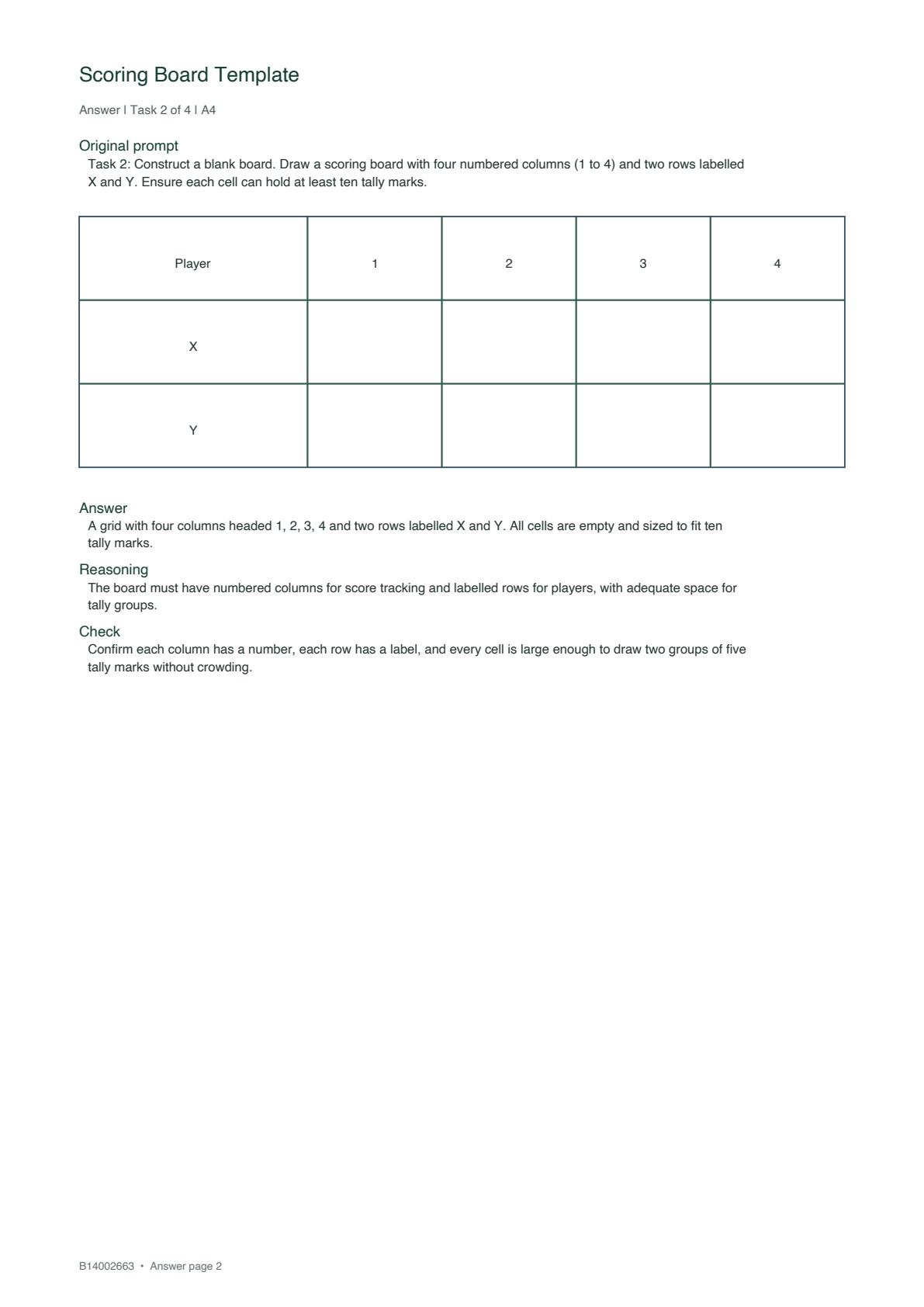
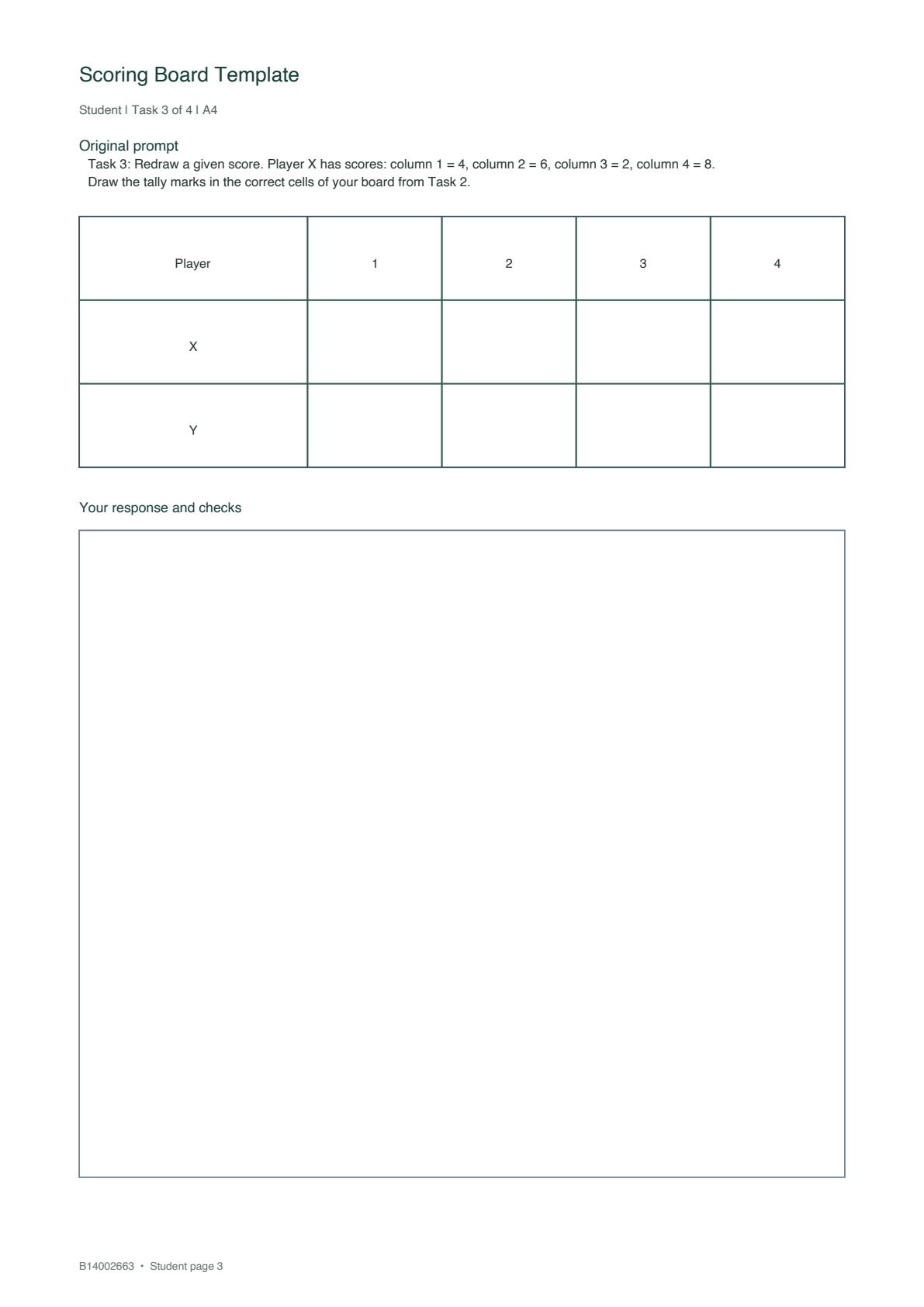
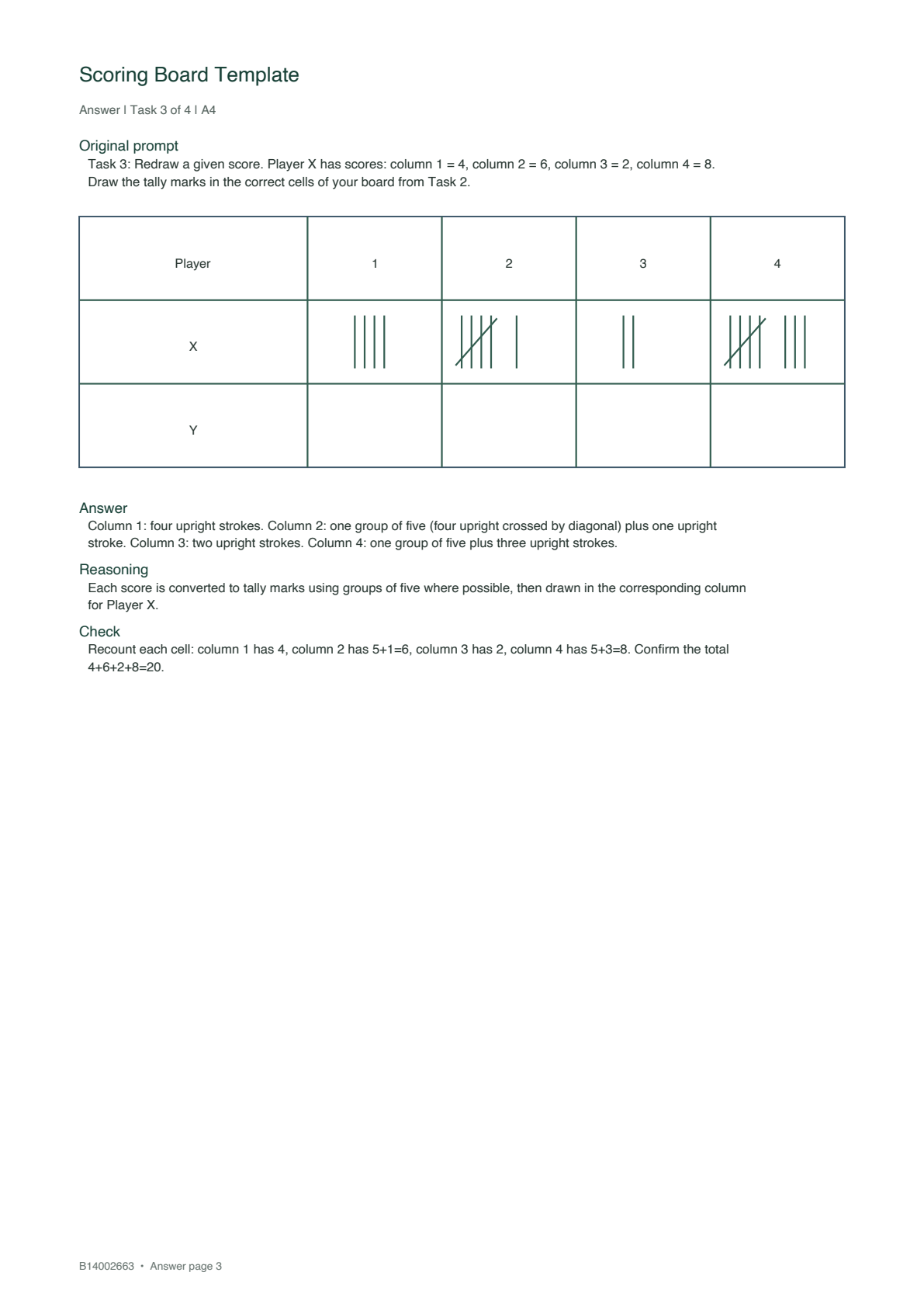
Task 3: Redraw a given score. Player X has scores: column 1 = 4, column 2 = 6, column 3 = 2, column 4 = 8. Draw the tally marks in the correct cells of your board from Task 2.
Show answer 3
Column 1: four upright strokes. Column 2: one group of five (four upright crossed by diagonal) plus one upright stroke. Column 3: two upright strokes. Column 4: one group of five plus three upright strokes.
Each score is converted to tally marks using groups of five where possible, then drawn in the corresponding column for Player X.
Check: Recount each cell: column 1 has 4, column 2 has 5+1=6, column 3 has 2, column 4 has 5+3=8. Confirm the total 4+6+2+8=20.
Task 4
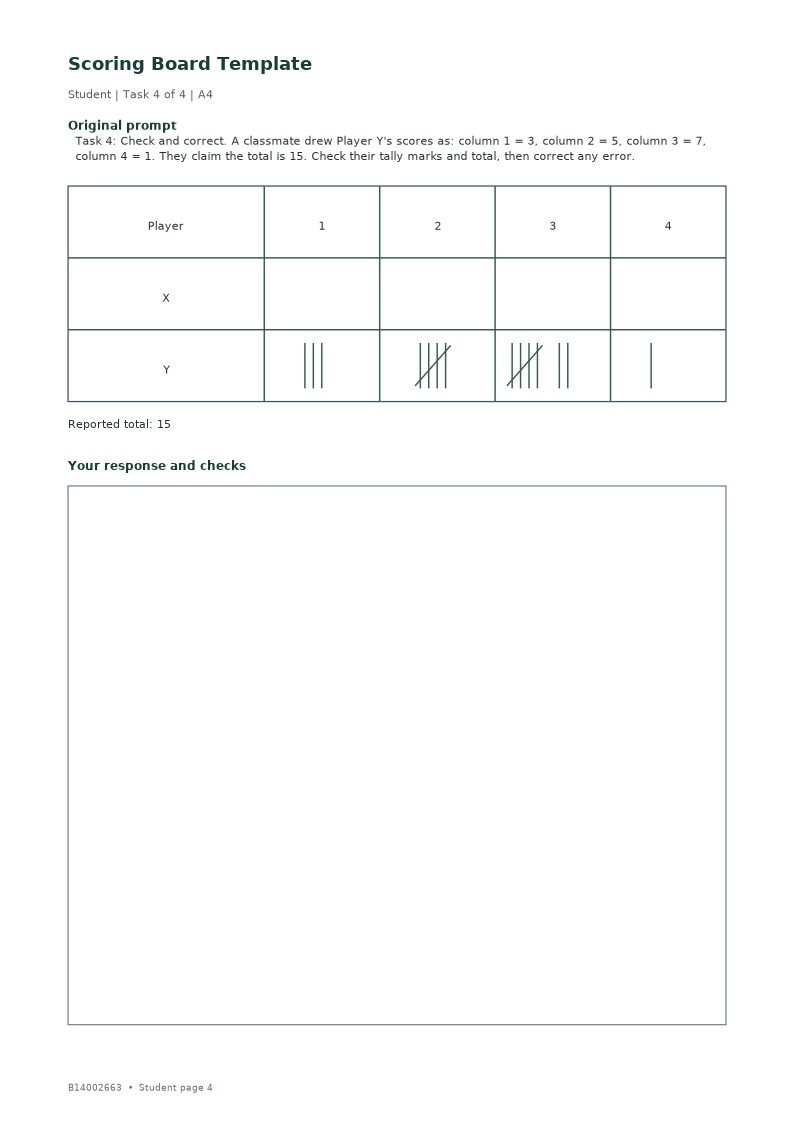
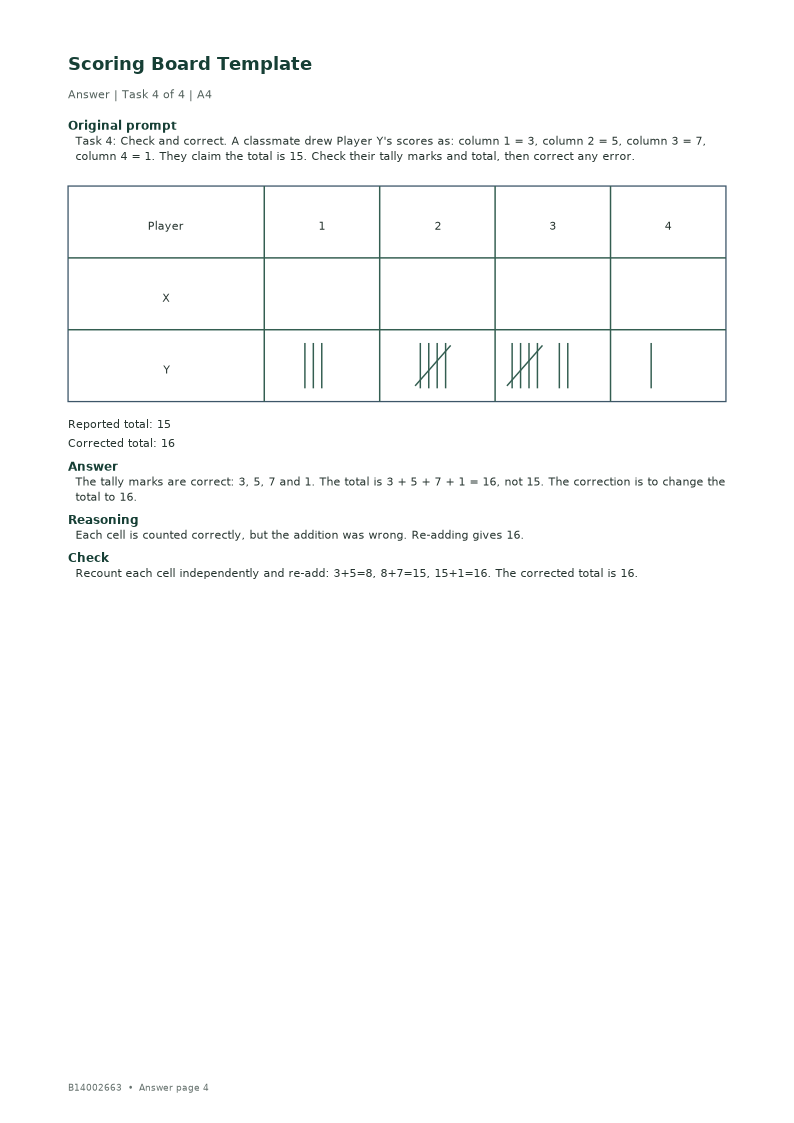
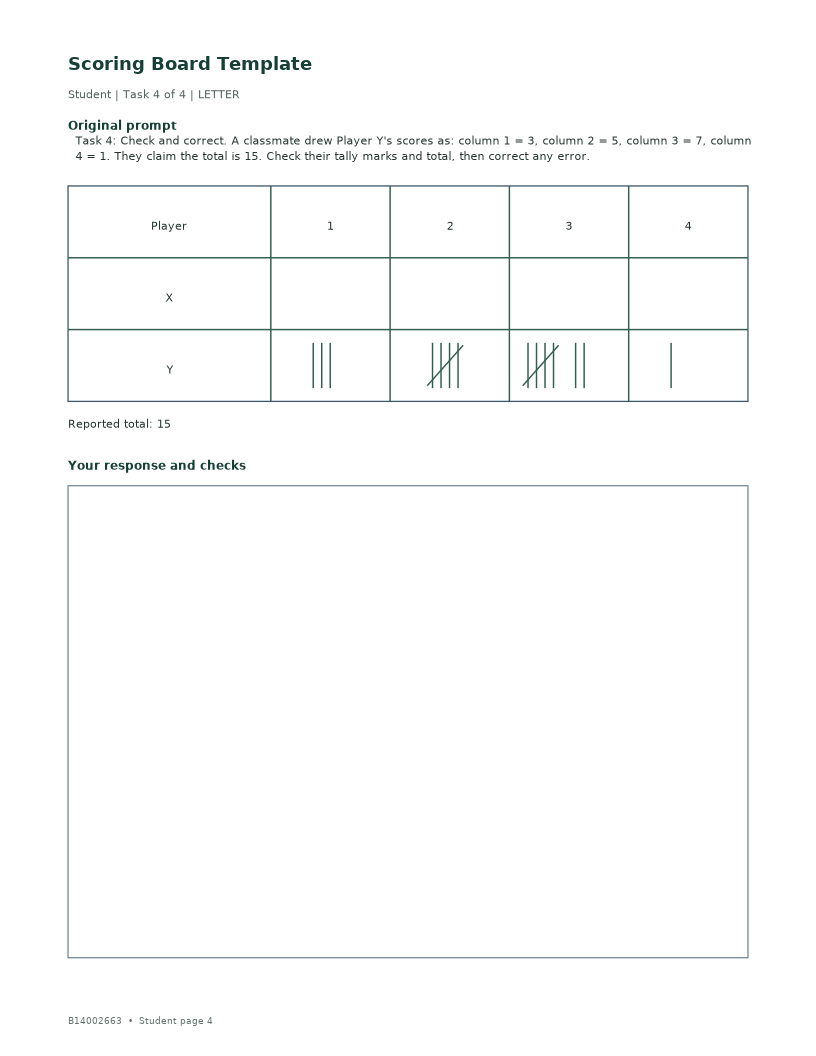
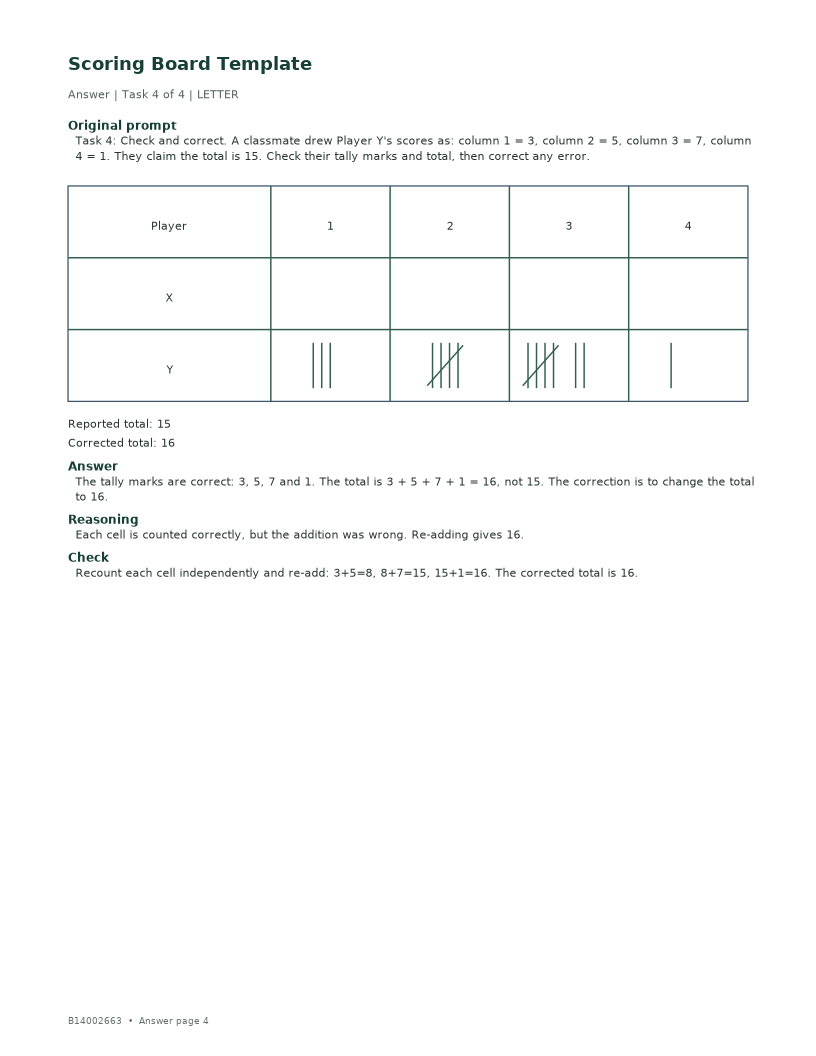
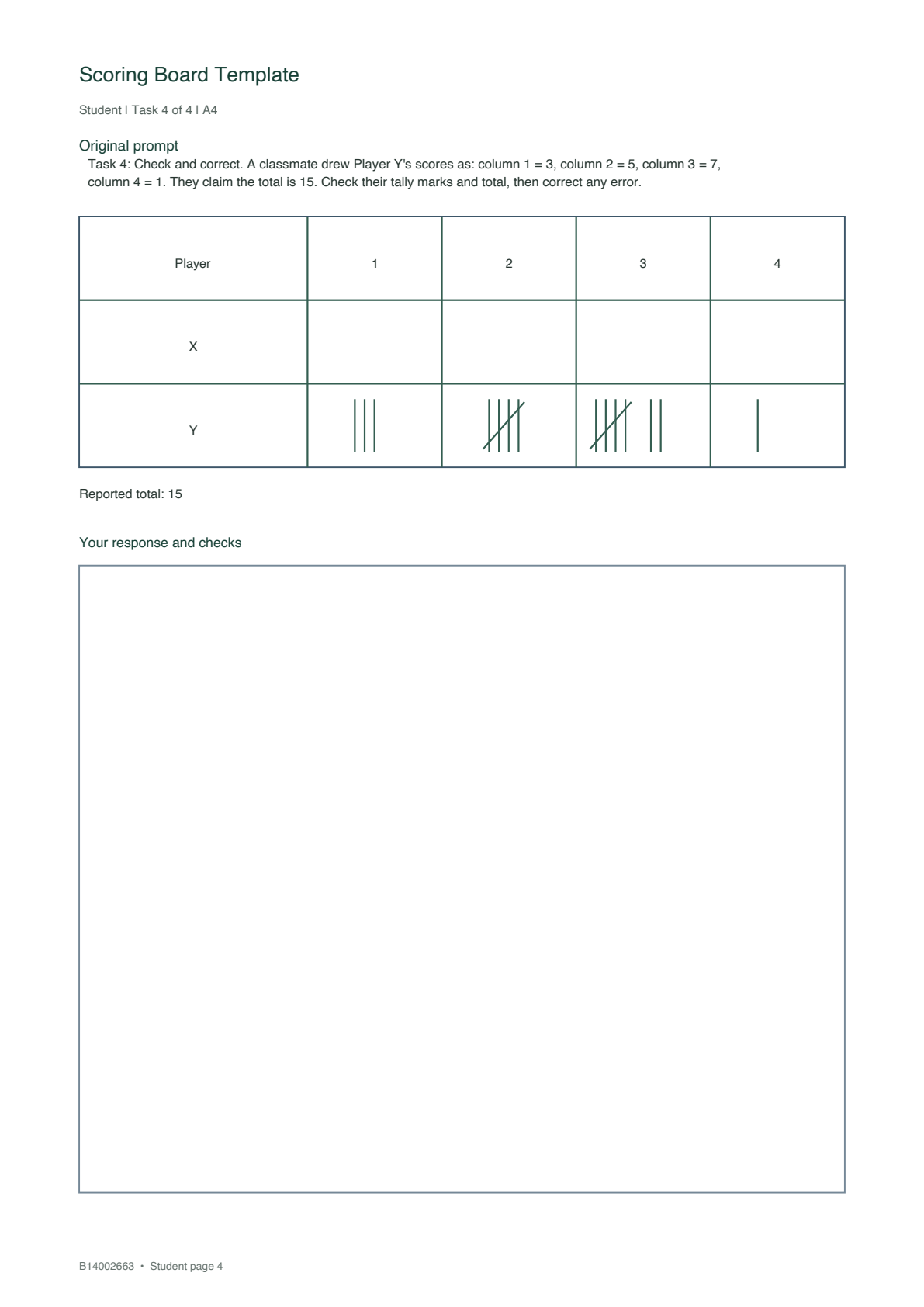
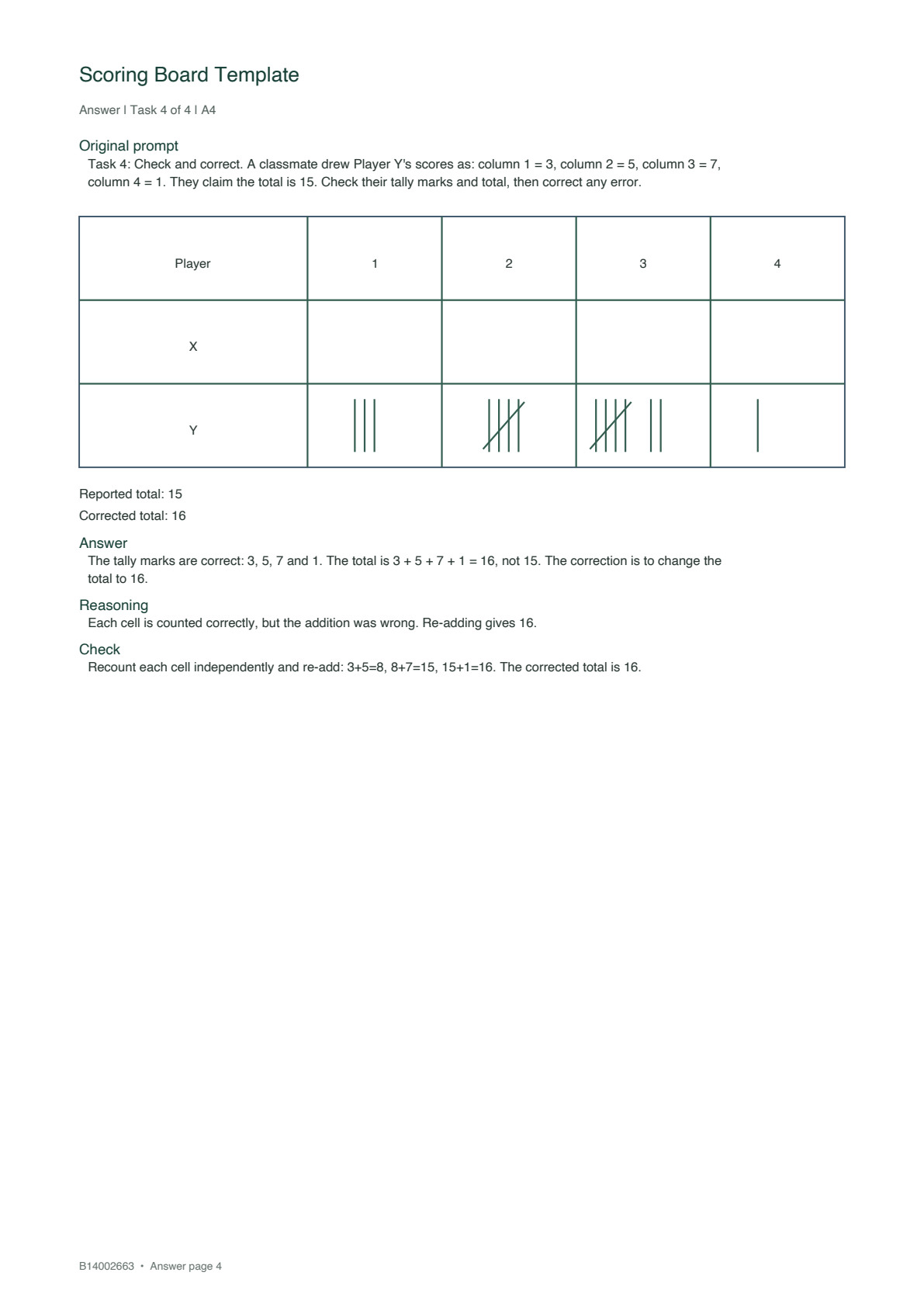
Task 4: Check and correct. A classmate drew Player Y's scores as: column 1 = 3, column 2 = 5, column 3 = 7, column 4 = 1. They claim the total is 15. Check their tally marks and total, then correct any error.
Show answer 4
The tally marks are correct: 3, 5, 7 and 1. The total is 3 + 5 + 7 + 1 = 16, not 15. The correction is to change the total to 16.
Each cell is counted correctly, but the addition was wrong. Re-adding gives 16.
Check: Recount each cell independently and re-add: 3+5=8, 8+7=15, 15+1=16. The corrected total is 16.
Useful checks
- Counting a group of five as four because the diagonal stroke is missed. Always include the diagonal stroke when counting a complete tally group.
- Adding column scores without recounting tally marks, leading to arithmetic errors. Recount each cell independently before summing, and re-add the totals as a check.
Questions about this resource
Why group tally marks in fives?
Grouping in fives makes counting faster and reduces errors because you can count groups instead of individual strokes.
Can I use this board for any game?
It is a general tally layout for games or other activities that use point counts. Label the rows for players and the columns for rounds or categories.