Free original lessons
Draw What You Hear Worksheet
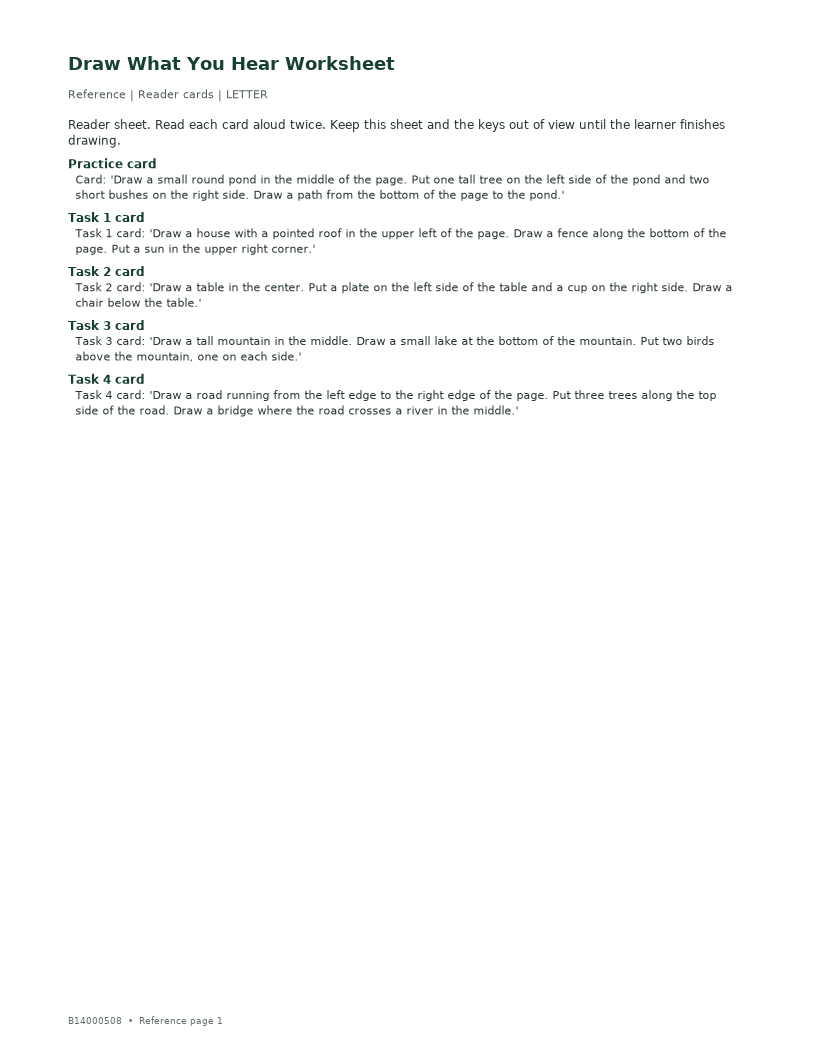
This worksheet trains listening comprehension and visual translation. The teacher reads a description card aloud twice; learners draw only what the words say, without seeing the card. After drawing, learners compare their sketch with the card text and with a partner's sketch, then revise. The skill is not artistic accuracy but faithful translation of heard details into a drawing.
Letter & A4
PDF & SVG
How to use this worksheet
Each task has a description card (read aloud by the teacher or a partner), a blank sketch box, and a comparison prompt. Read the card slowly twice; learners draw during the second reading. Do not show the card until the sketch is finished.
After sketching, learners answer the comparison prompt in one or two sentences, then check their sketch against the card text using the checklist: Did I include every object named? Did I place things where the words said? Did I show the stated size or position relationship? Revise the sketch if a detail is missing.
Worked example
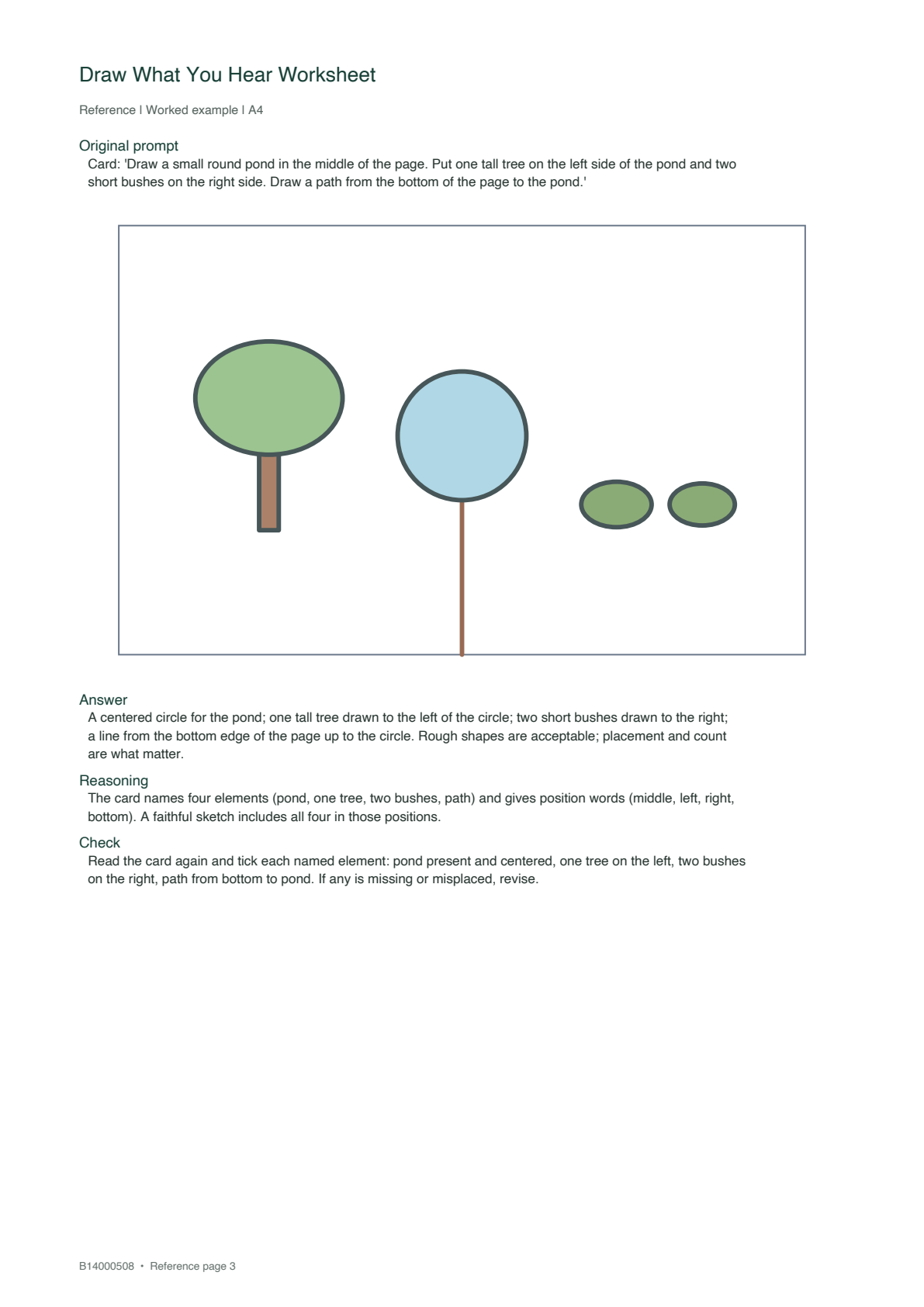
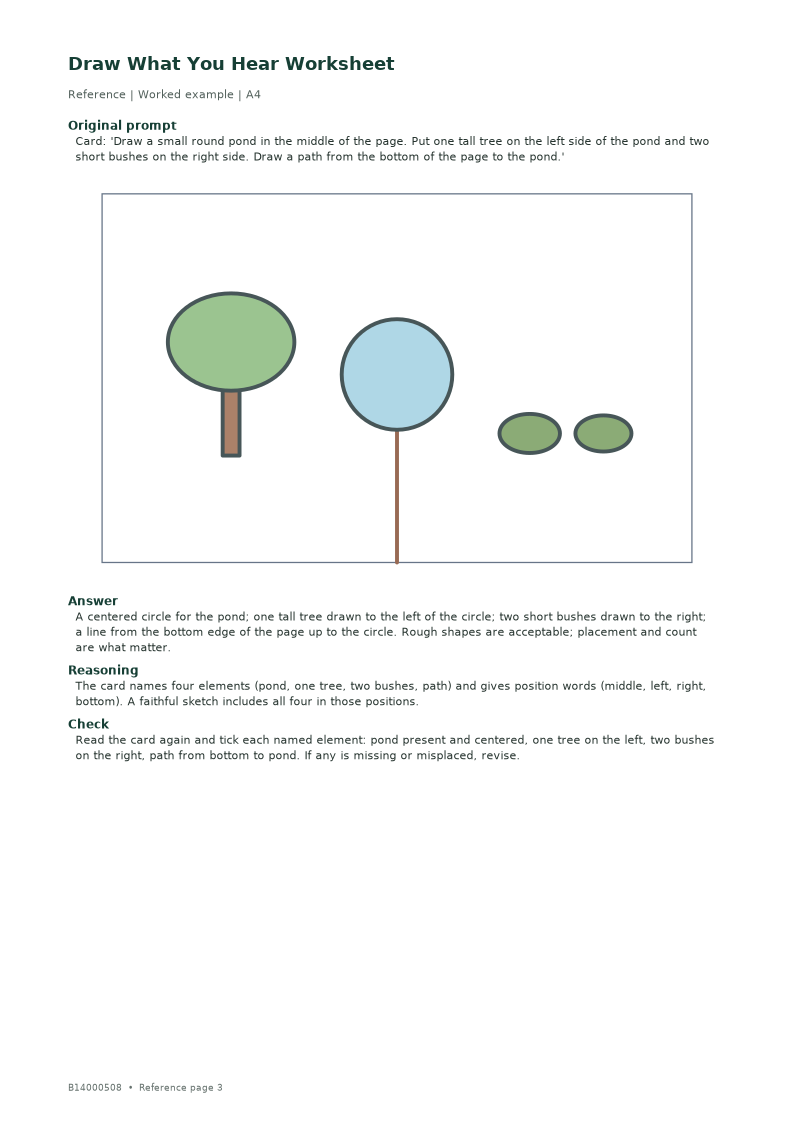
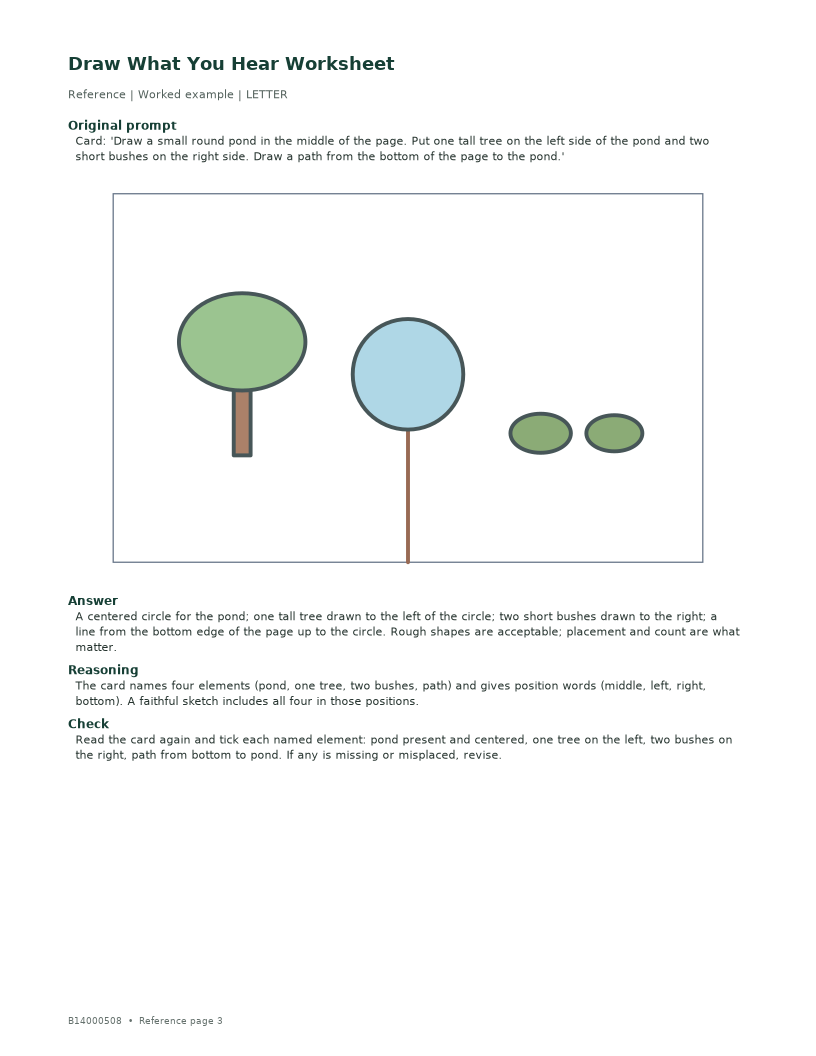
Card: 'Draw a small round pond in the middle of the page. Put one tall tree on the left side of the pond and two short bushes on the right side. Draw a path from the bottom of the page to the pond.'
A correct sketch shows a circle (pond) centered, one tall tree left of it, two short bushes right of it, and a line (path) from the bottom edge up to the pond. The sketch is correct if all four elements are present and placed as described, even if the drawing is rough.
Task 1
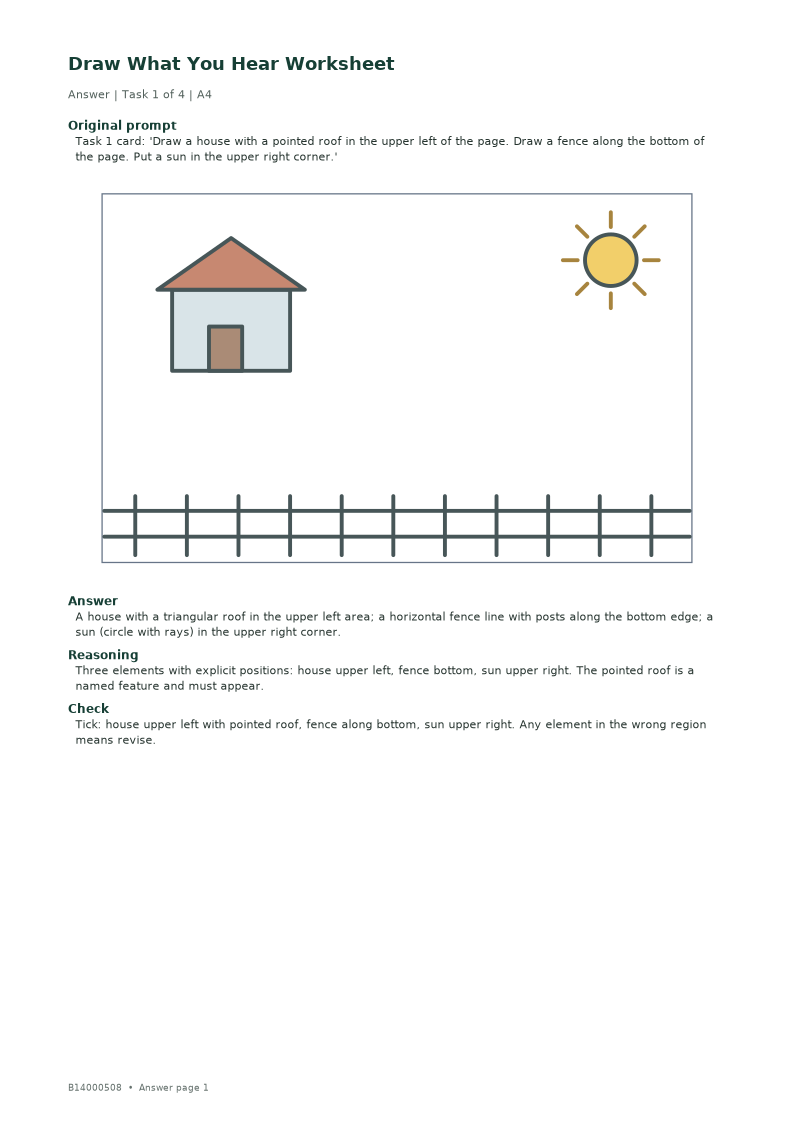
Card: 'Draw a house with a pointed roof in the upper left of the page. Draw a fence along the bottom of the page. Put a sun in the upper right corner.'
Comparison prompt: Which element did you place first, and why? Check that the house is upper left, the fence runs along the bottom, and the sun is upper right.
Task 2
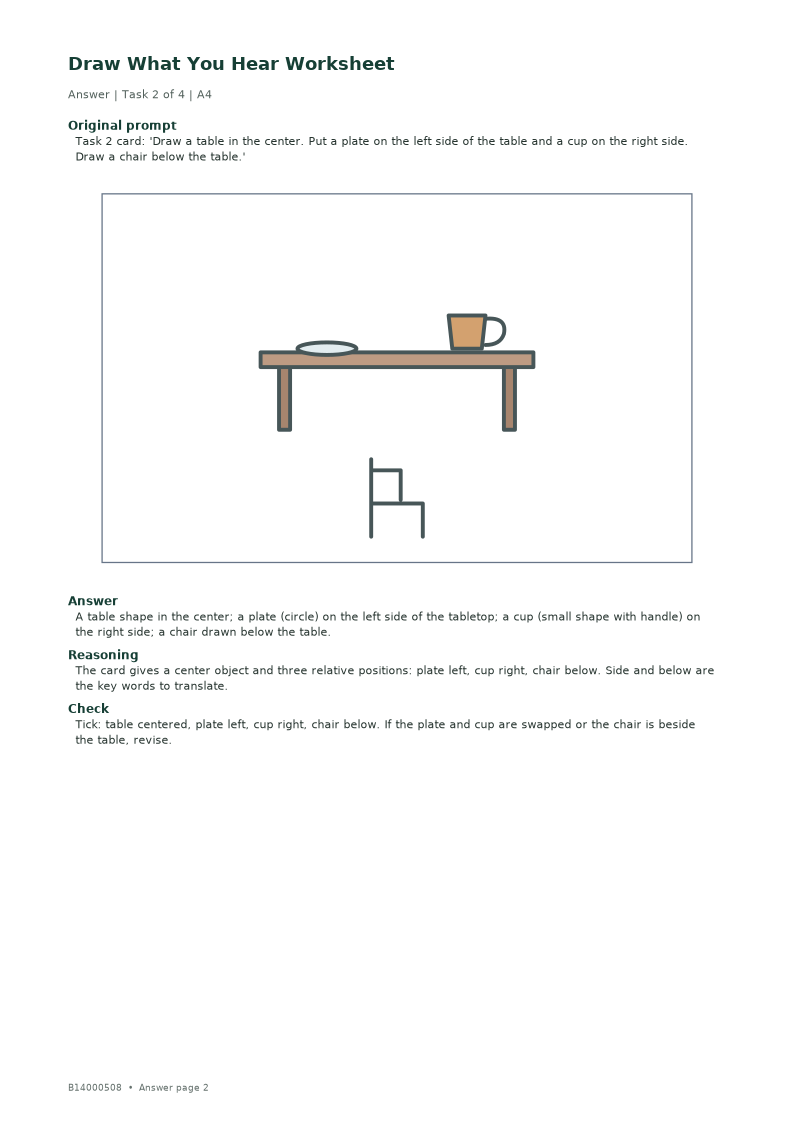
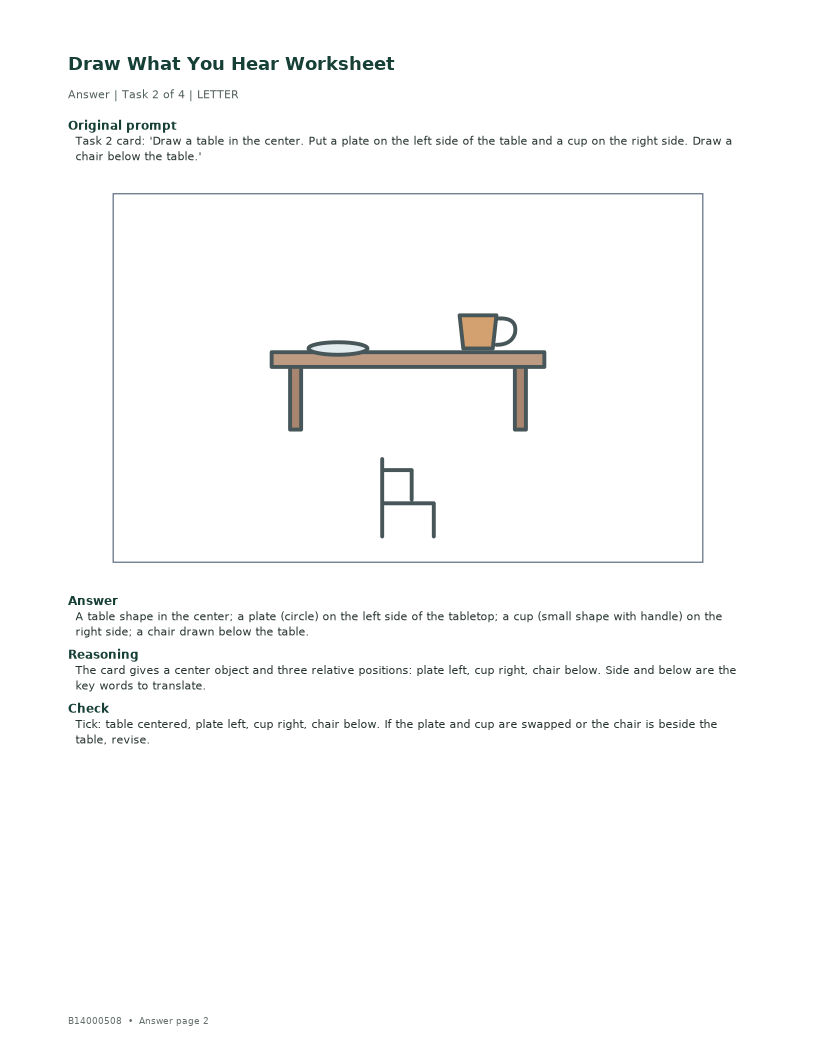
Card: 'Draw a table in the center. Put a plate on the left side of the table and a cup on the right side. Draw a chair below the table.'
Comparison prompt: Did you put the plate and cup on the correct sides? Check that the chair is below, not beside, the table.
Task 3
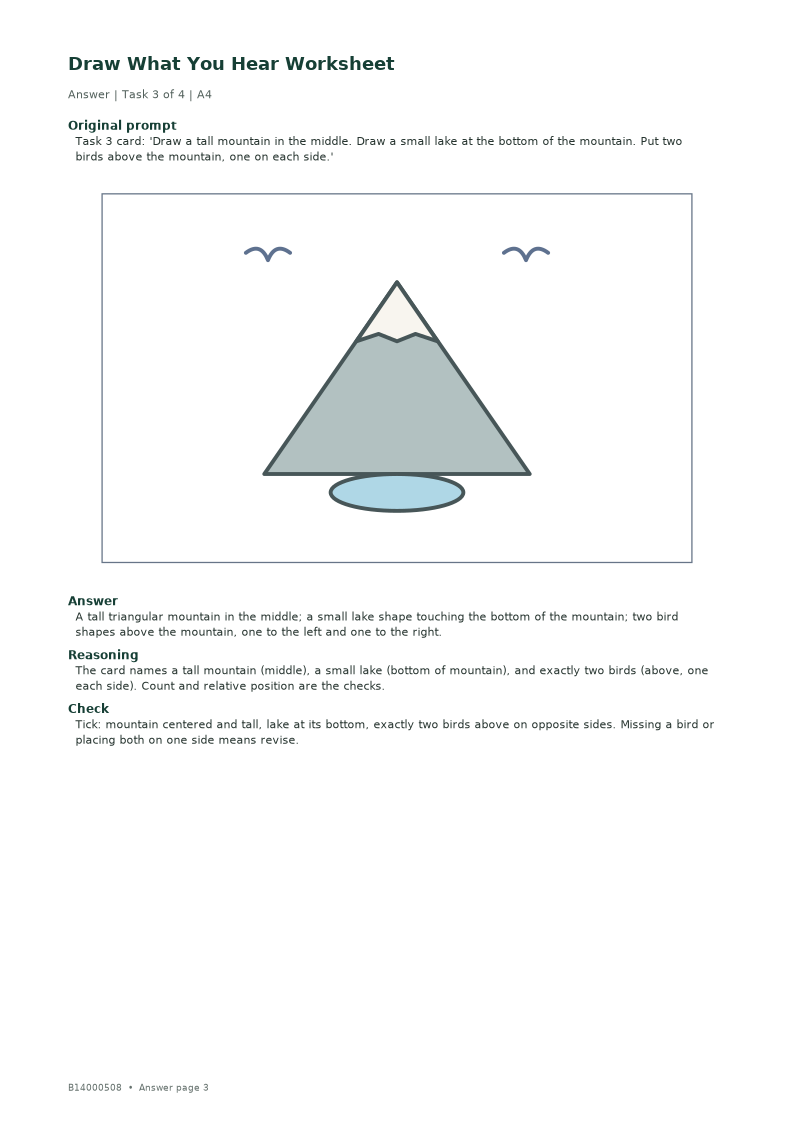
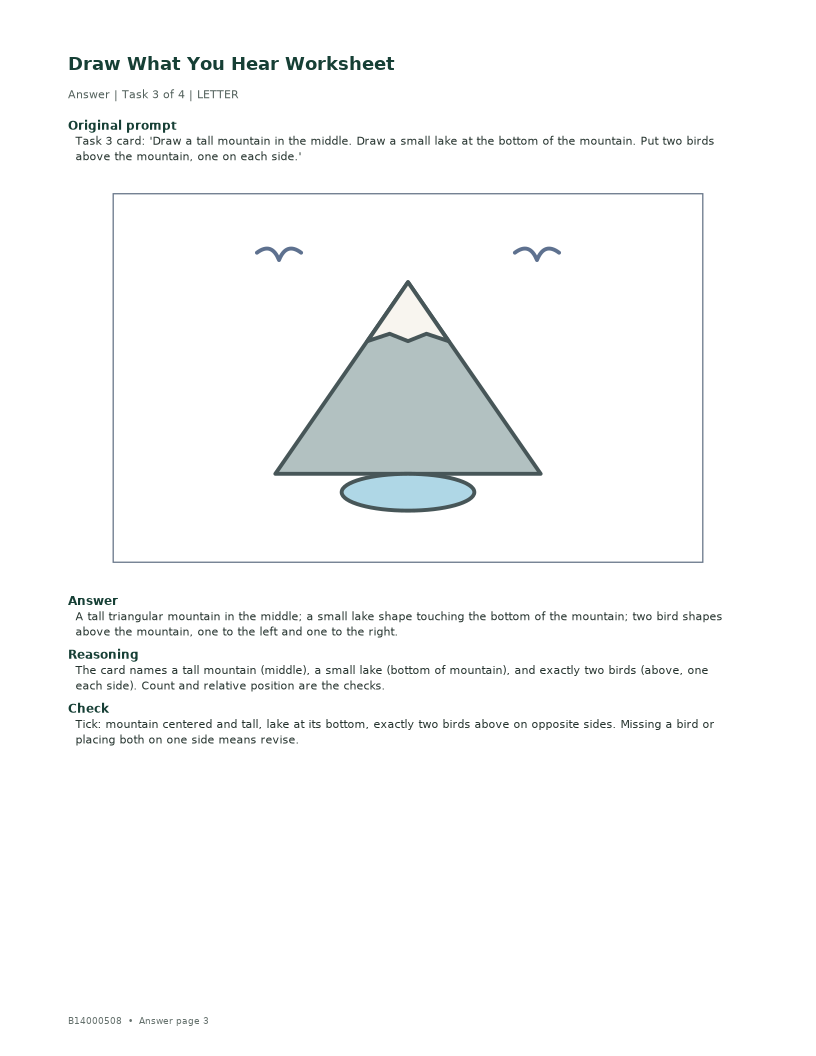
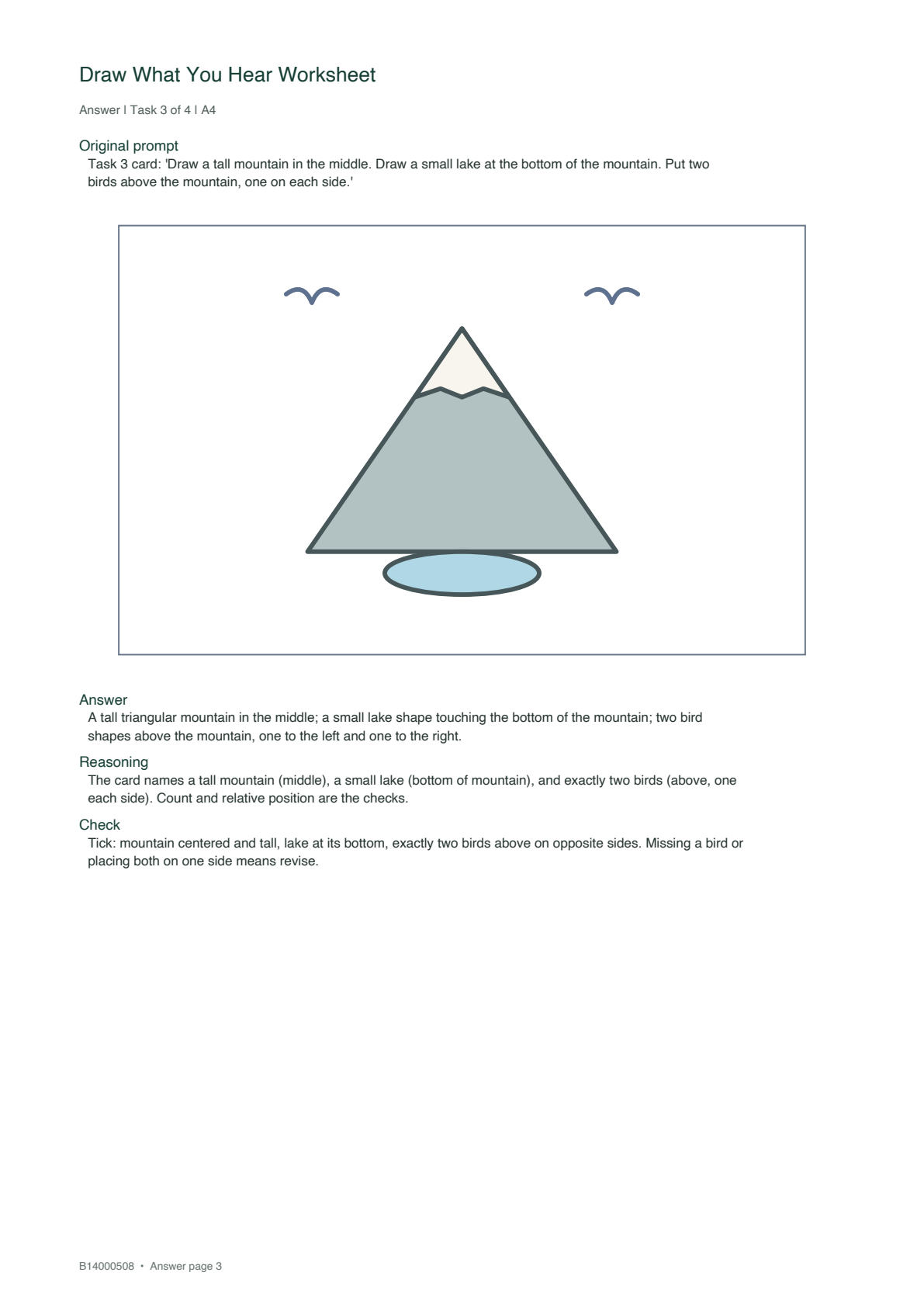
Card: 'Draw a tall mountain in the middle. Draw a small lake at the bottom of the mountain. Put two birds above the mountain, one on each side.'
Comparison prompt: Are the birds above the mountain and on opposite sides? Check that the lake touches the bottom of the mountain.
Download the complete resource pack
All individual SVG pages (22)
- A4 reference page 1
- A4 reference page 2
- A4 reference page 3
- A4 answer page 1
- A4 answer page 2
- A4 answer page 3
- A4 answer page 4
- LETTER reference page 1
- LETTER reference page 2
- LETTER reference page 3
- LETTER answer page 1
- LETTER answer page 2
- LETTER answer page 3
- LETTER answer page 4
- A4 student page 1
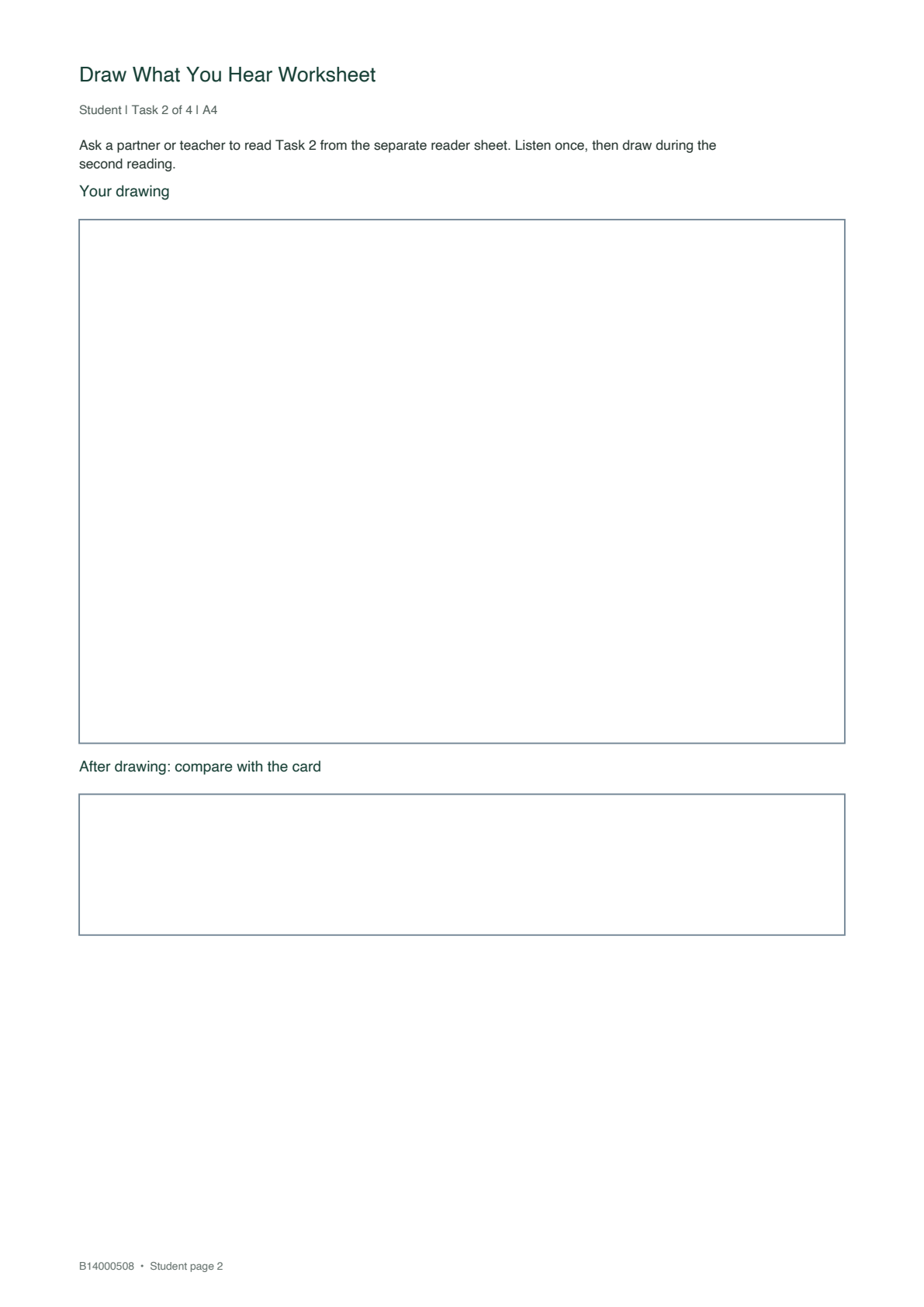
- A4 student page 2
- A4 student page 3
- A4 student page 4
- LETTER student page 1
- LETTER student page 2
- LETTER student page 3
- LETTER student page 4
Print at 100% / actual size. Use the stated scale on any schematic diagram; physical cutting templates are identified separately. A4 and US Letter are separate files. Free access, no signup; CC BY 4.0.
How to use these pages
- How to use this worksheet
- Worked example
- Task 1
- Task 2
- Task 3
Worked example
Example: Card: 'Draw a small round pond in the middle of the page. Put one tall tree on the left side of the pond and two short bushes on the right side. Draw a path from the bottom of the page to the pond.'
Answer: A centered circle for the pond; one tall tree drawn to the left of the circle; two short bushes drawn to the right; a line from the bottom edge of the page up to the circle. Rough shapes are acceptable; placement and count are what matter.
Reasoning: The card names four elements (pond, one tree, two bushes, path) and gives position words (middle, left, right, bottom). A faithful sketch includes all four in those positions.
Check: Read the card again and tick each named element: pond present and centered, one tree on the left, two bushes on the right, path from bottom to pond. If any is missing or misplaced, revise.
Four practice tasks and complete answers
Task 1
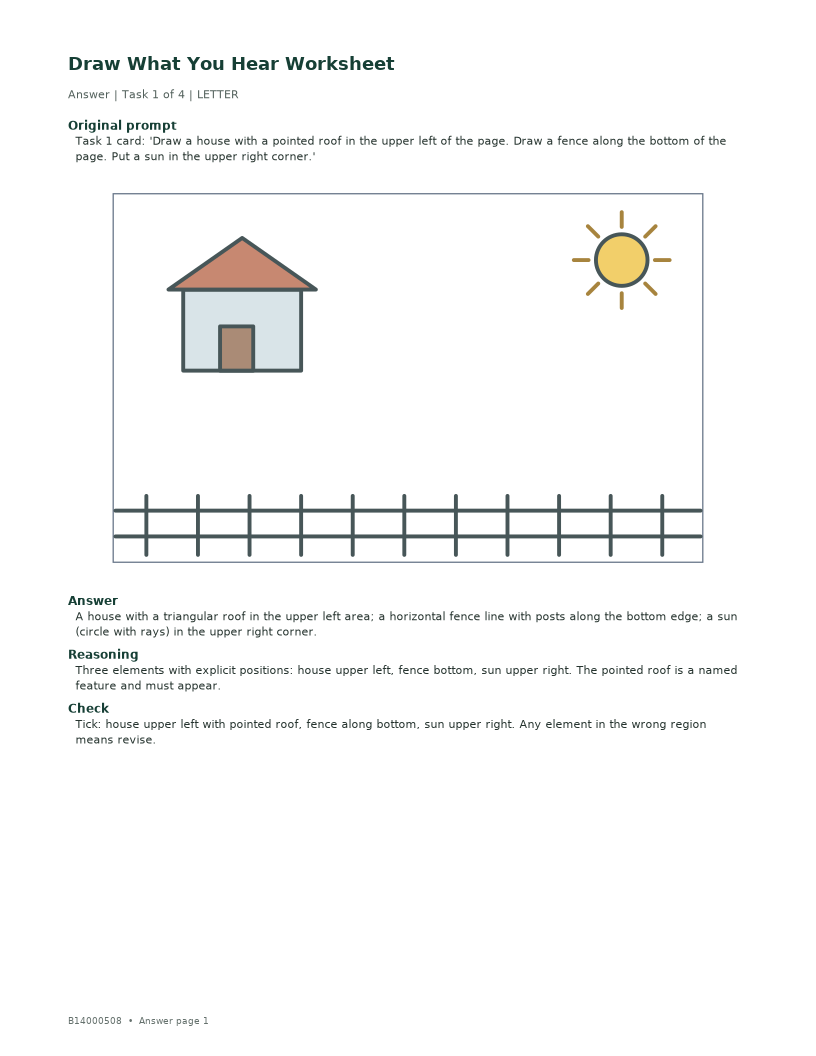
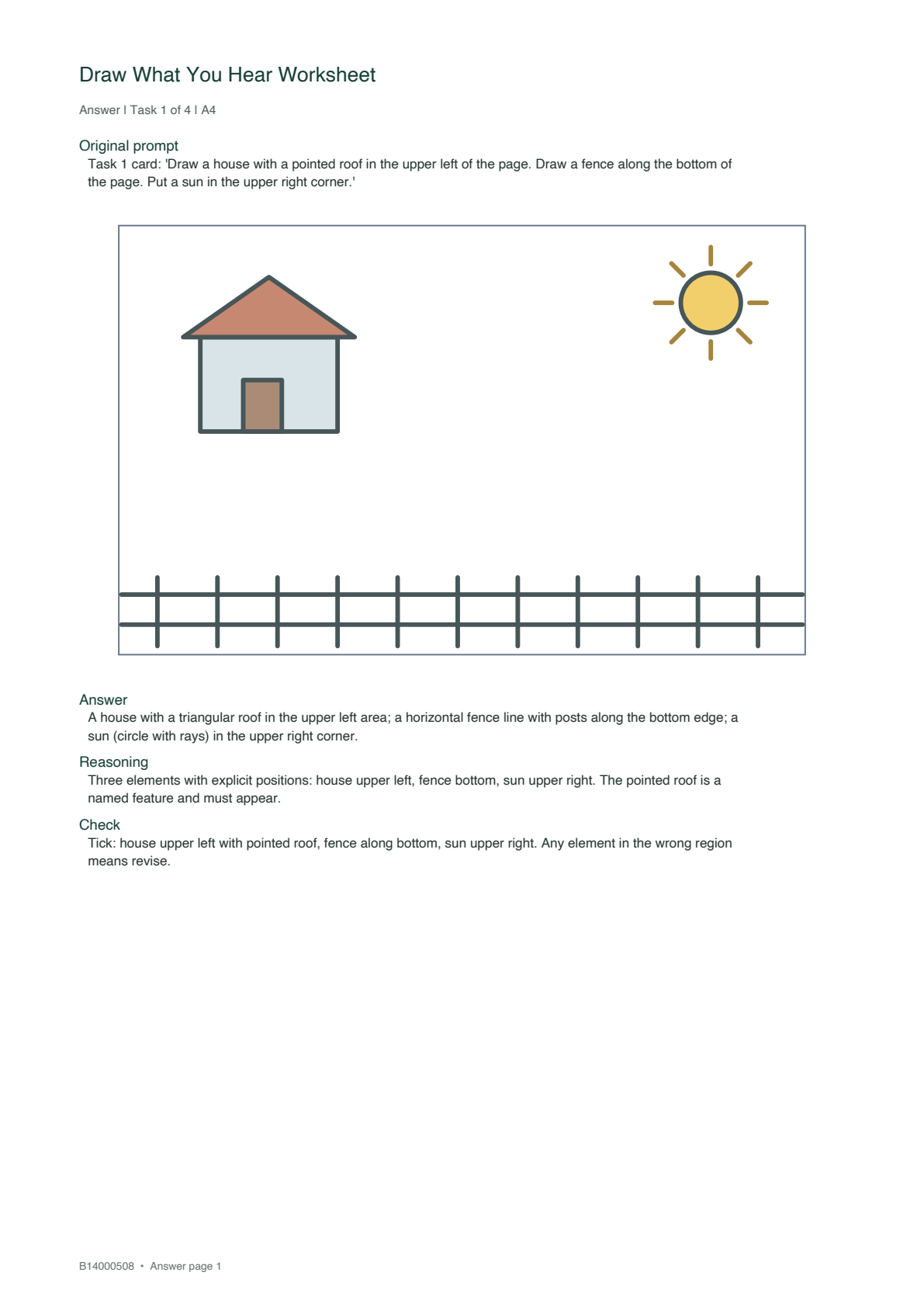
Task 1 card: 'Draw a house with a pointed roof in the upper left of the page. Draw a fence along the bottom of the page. Put a sun in the upper right corner.'
Show answer 1
A house with a triangular roof in the upper left area; a horizontal fence line with posts along the bottom edge; a sun (circle with rays) in the upper right corner.
Three elements with explicit positions: house upper left, fence bottom, sun upper right. The pointed roof is a named feature and must appear.
Check: Tick: house upper left with pointed roof, fence along bottom, sun upper right. Any element in the wrong region means revise.
Task 2
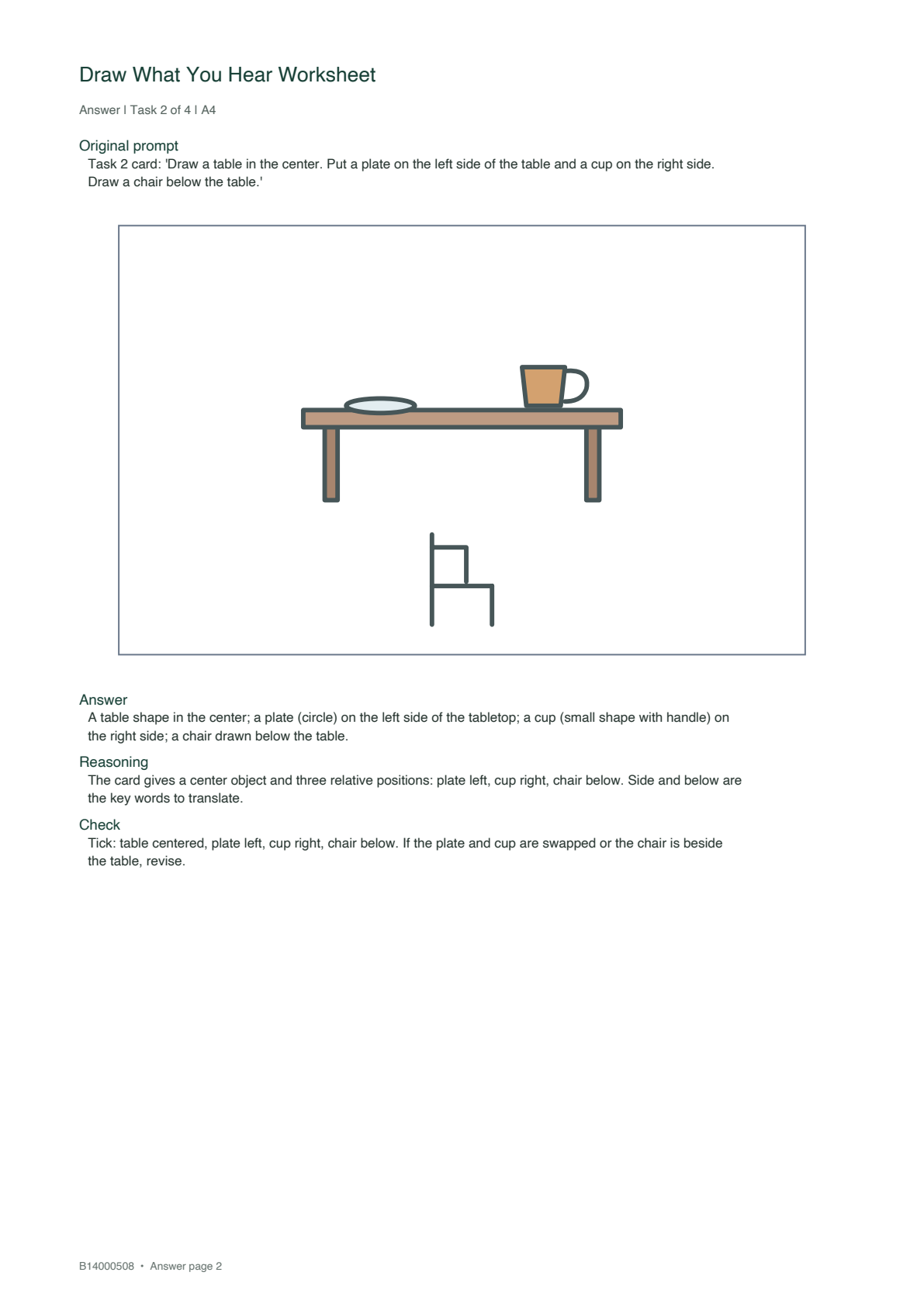
Task 2 card: 'Draw a table in the center. Put a plate on the left side of the table and a cup on the right side. Draw a chair below the table.'
Show answer 2
A table shape in the center; a plate (circle) on the left side of the tabletop; a cup (small shape with handle) on the right side; a chair drawn below the table.
The card gives a center object and three relative positions: plate left, cup right, chair below. Side and below are the key words to translate.
Check: Tick: table centered, plate left, cup right, chair below. If the plate and cup are swapped or the chair is beside the table, revise.
Task 3
Task 3 card: 'Draw a tall mountain in the middle. Draw a small lake at the bottom of the mountain. Put two birds above the mountain, one on each side.'
Show answer 3
A tall triangular mountain in the middle; a small lake shape touching the bottom of the mountain; two bird shapes above the mountain, one to the left and one to the right.
The card names a tall mountain (middle), a small lake (bottom of mountain), and exactly two birds (above, one each side). Count and relative position are the checks.
Check: Tick: mountain centered and tall, lake at its bottom, exactly two birds above on opposite sides. Missing a bird or placing both on one side means revise.
Task 4
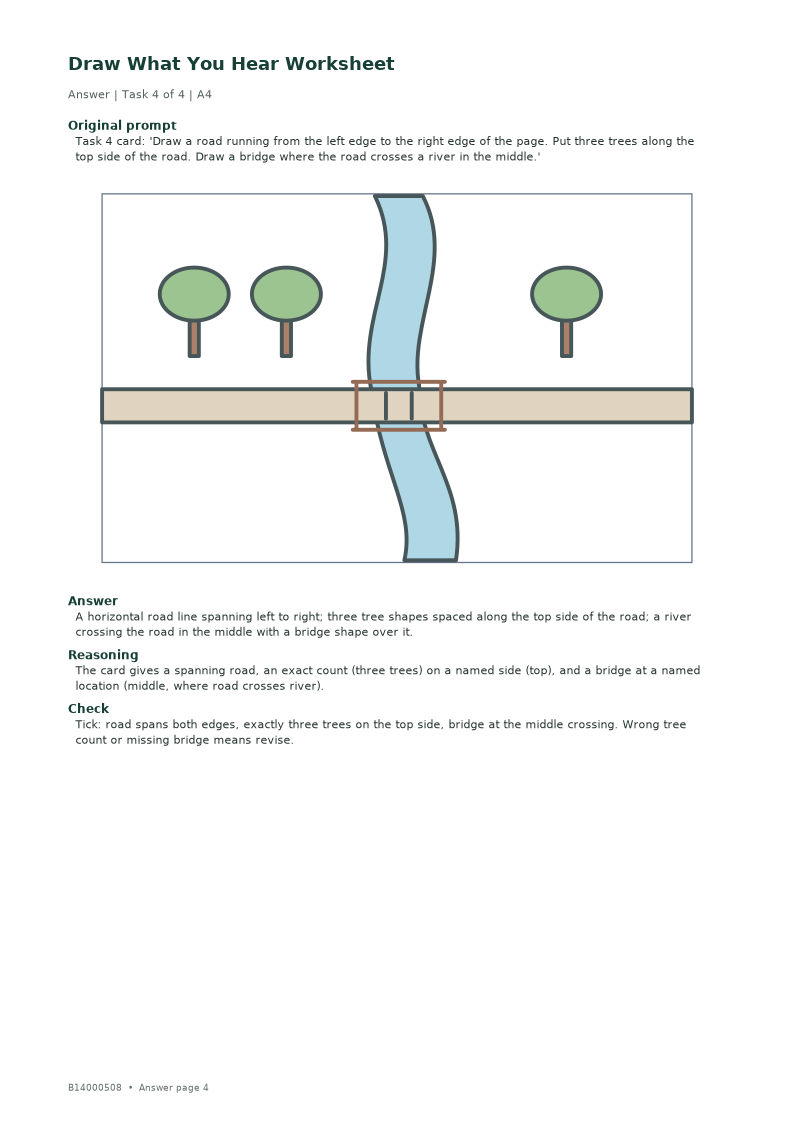
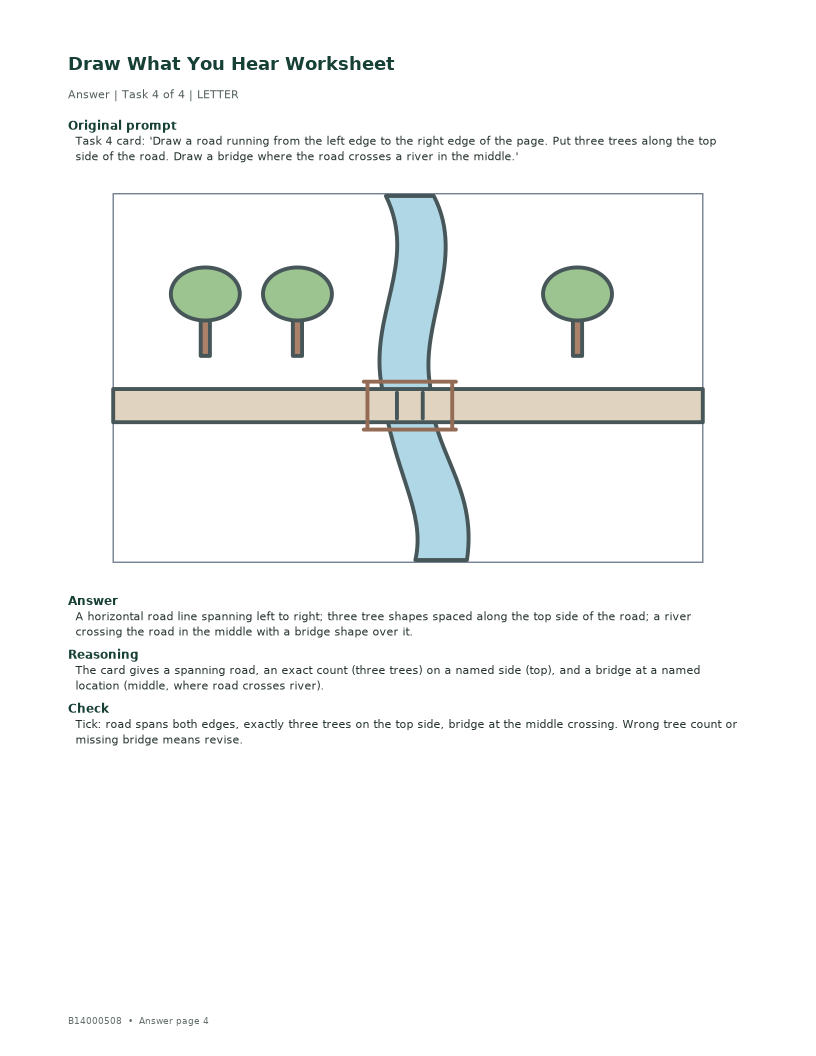
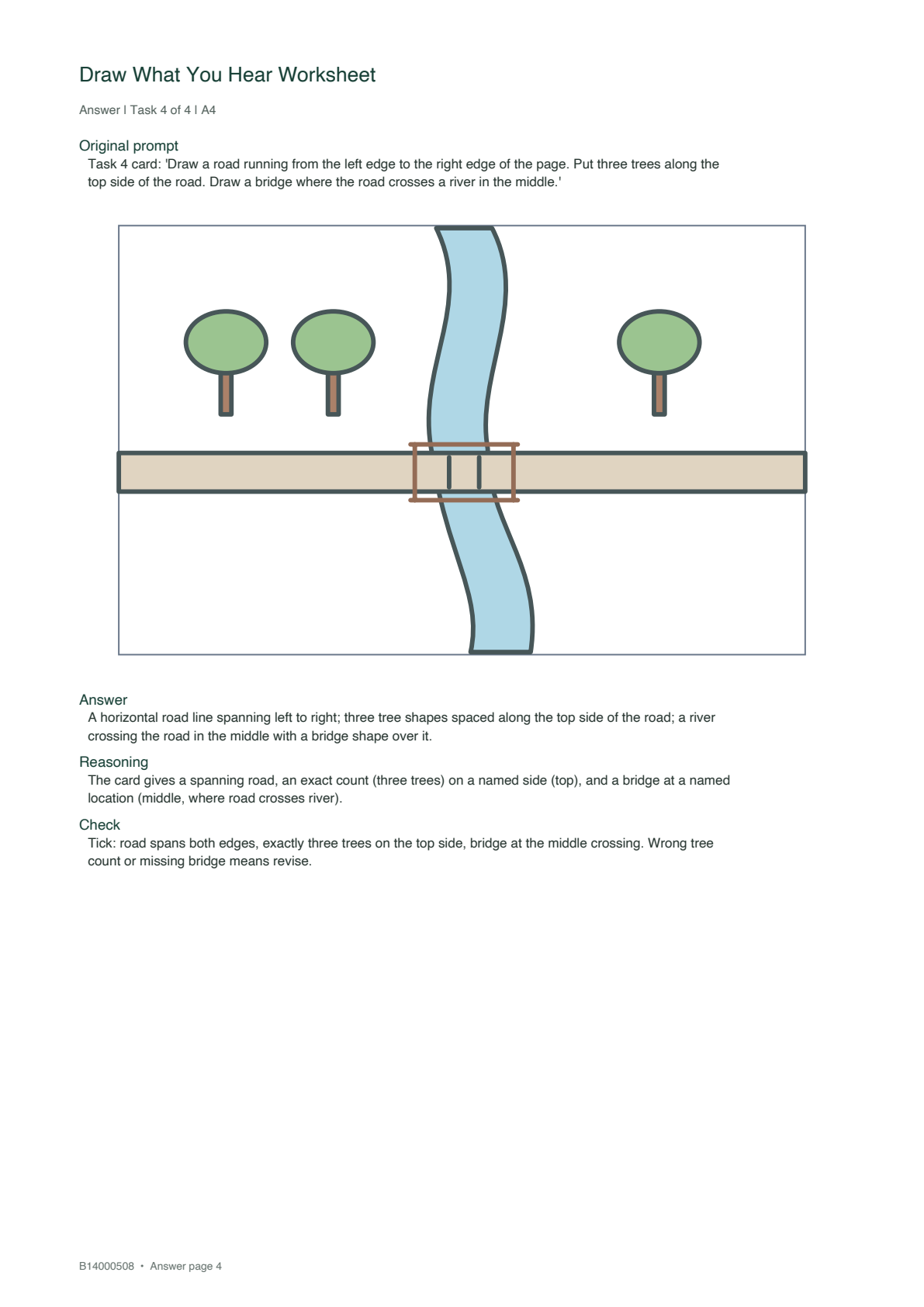
Task 4 card: 'Draw a road running from the left edge to the right edge of the page. Put three trees along the top side of the road. Draw a bridge where the road crosses a river in the middle.'
Show answer 4
A horizontal road line spanning left to right; three tree shapes spaced along the top side of the road; a river crossing the road in the middle with a bridge shape over it.
The card gives a spanning road, an exact count (three trees) on a named side (top), and a bridge at a named location (middle, where road crosses river).
Check: Tick: road spans both edges, exactly three trees on the top side, bridge at the middle crossing. Wrong tree count or missing bridge means revise.
Useful checks
- Drawing from imagination instead of the words heard. Re-read the card and list every named object and position word before revising the sketch.
- Skipping a count word such as 'two birds' or 'three trees'. Circle every number word in the card and count the matching shapes in the sketch.
- Ignoring position words like 'left', 'below', or 'upper right'. Underline each position word and point to where that element sits in the sketch.
Questions about this resource
Does the drawing need to be neat or realistic?
No. The check is whether every named element appears in the stated position and count; rough shapes are acceptable.
Can learners see the card while drawing?
No. The card is read aloud; seeing it would turn the task into copying rather than listening.