Free original lessons
Creative Value Scale Drawing
A creative value-scale plate is a row of shapes that each hold one steady tone, arranged from light to dark. You design the shapes, then shade each one evenly so the plate reads as a smooth progression. This pack gives a reference strip, a worked example, and four practice tasks with answers and visual checks.
Letter & A4
PDF & SVG
What a creative value-scale plate is
A value scale is a graded sequence of tones from light to dark. A creative value-scale plate keeps that progression but replaces plain rectangles with varied band shapes, such as waves, arches, or stepped forms.
Match the reference and the first three tasks with single even fills. The final task intentionally adds a slight directional gradient inside each band while keeping the overall order.
Reference strip
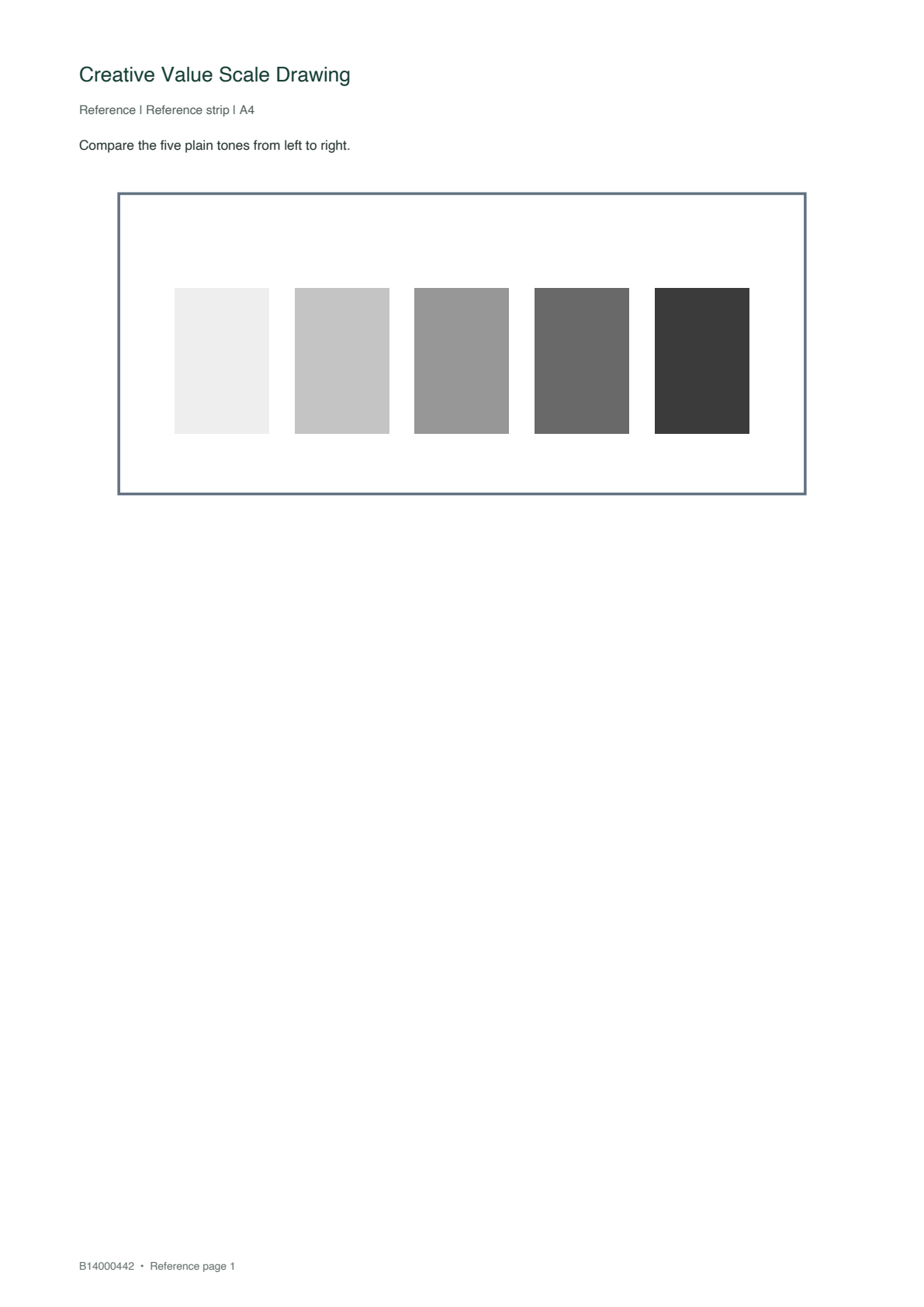
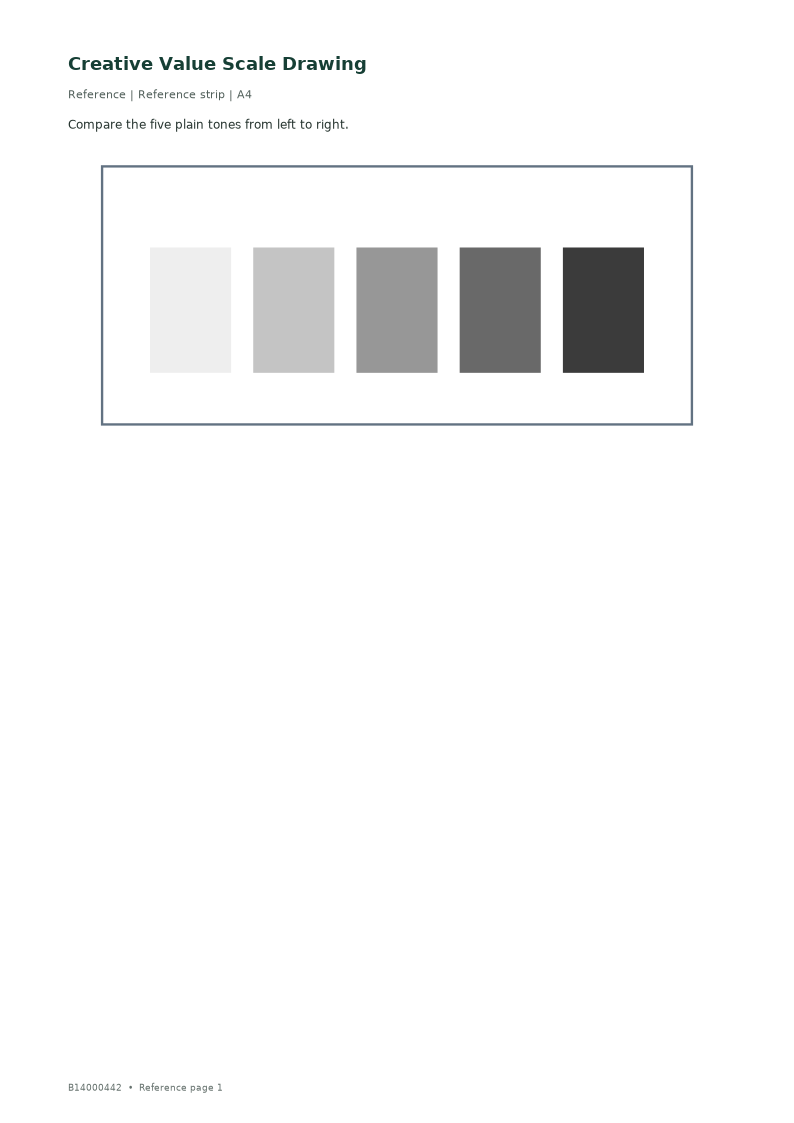
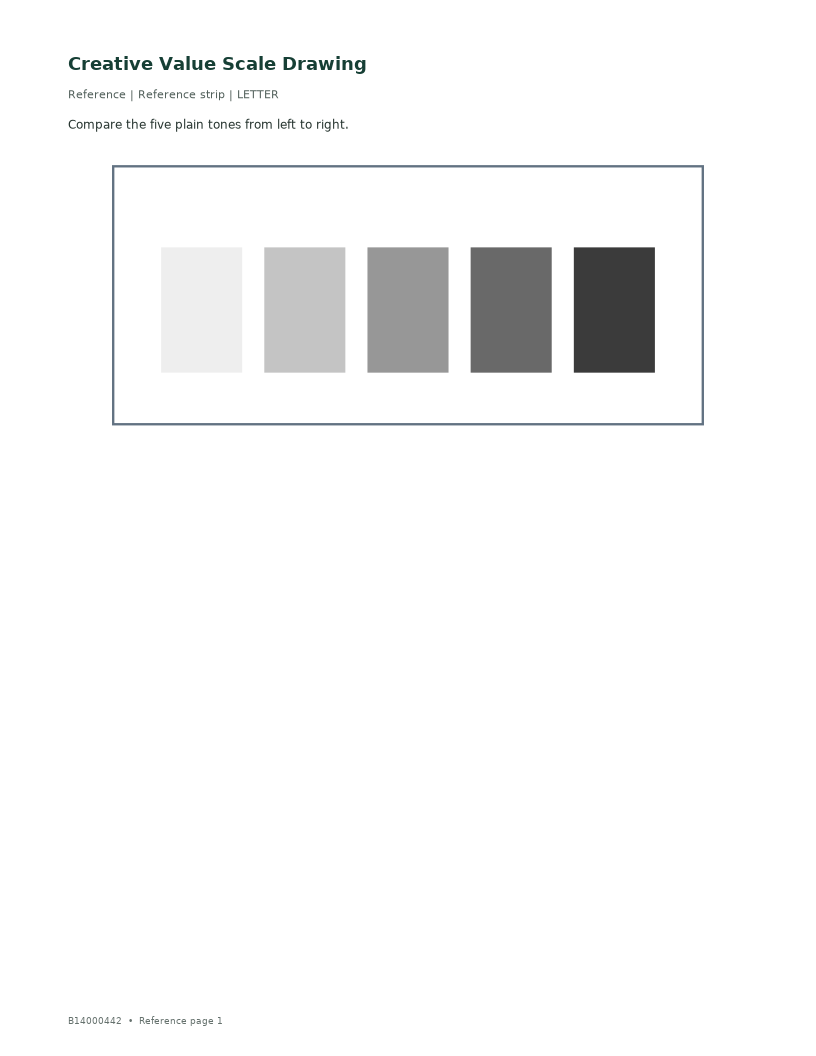
Use the reference strip as your tone guide. It shows a light-to-dark progression in even steps, so you can compare your own bands against it.
Match by eye: hold your band beside the strip and ask whether it is lighter, darker, or the same. Adjust with more or fewer pencil layers rather than pressing harder.
Worked example
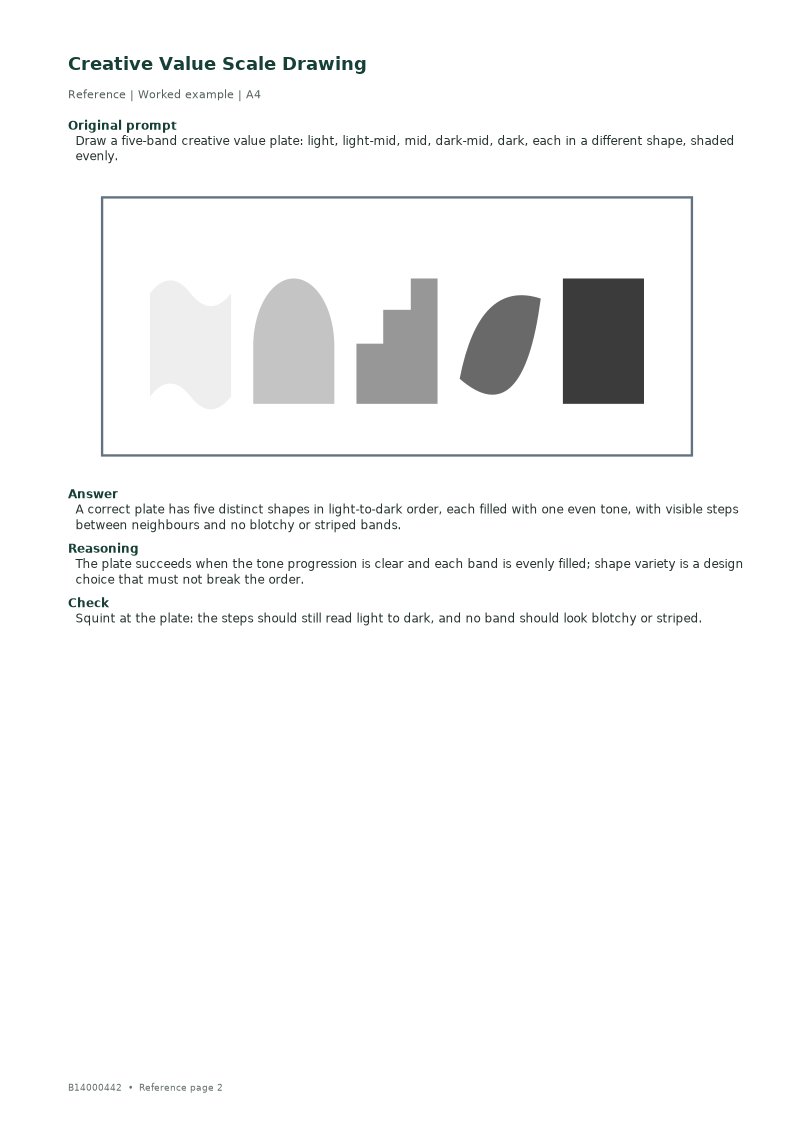
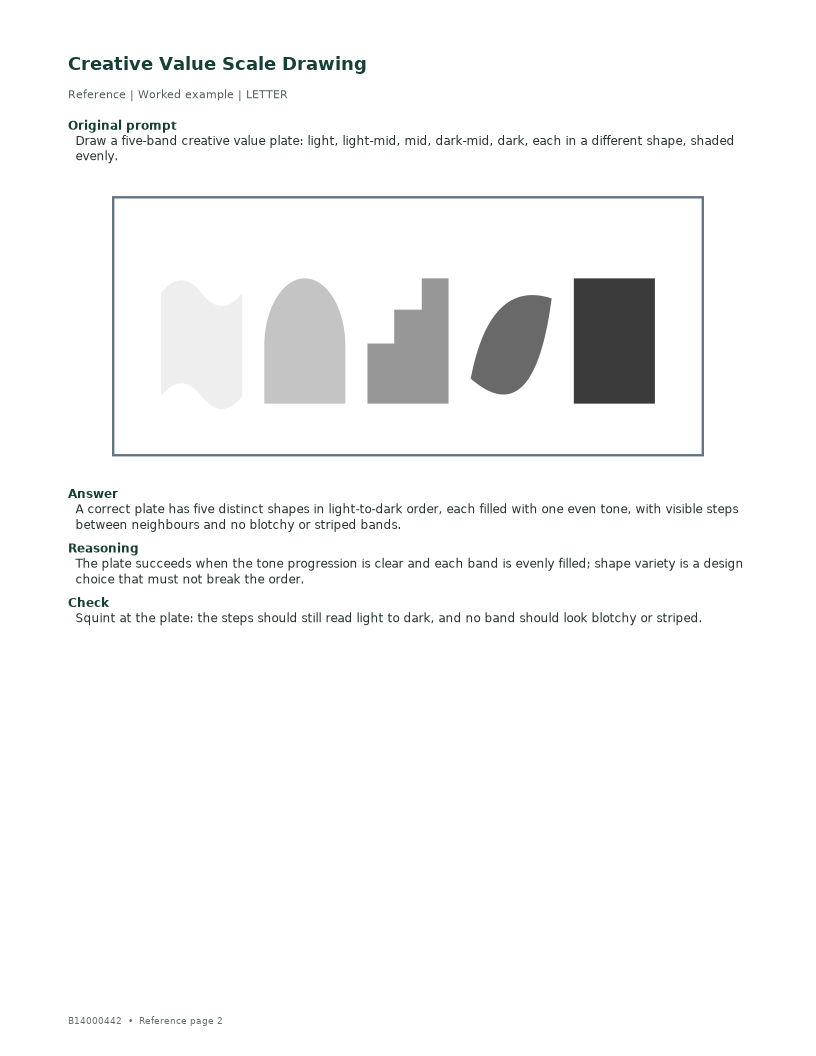
The worked example shows a five-band plate: a light band, a light-mid band, a mid band, a dark-mid band, and a dark band, each in a different shape.
Notice that each band is filled evenly to its edges, the steps between neighbours are visible, and the shapes vary without breaking the light-to-dark order.
How to shade a band evenly
1. Lightly outline the band shape. 2. Fill it with soft, overlapping pencil strokes in one direction. 3. Add a second layer at a slight angle for darker bands. 4. Blend or smooth the surface so no single stroke stands out. 5. Compare the finished band to the reference strip.
Practice tasks
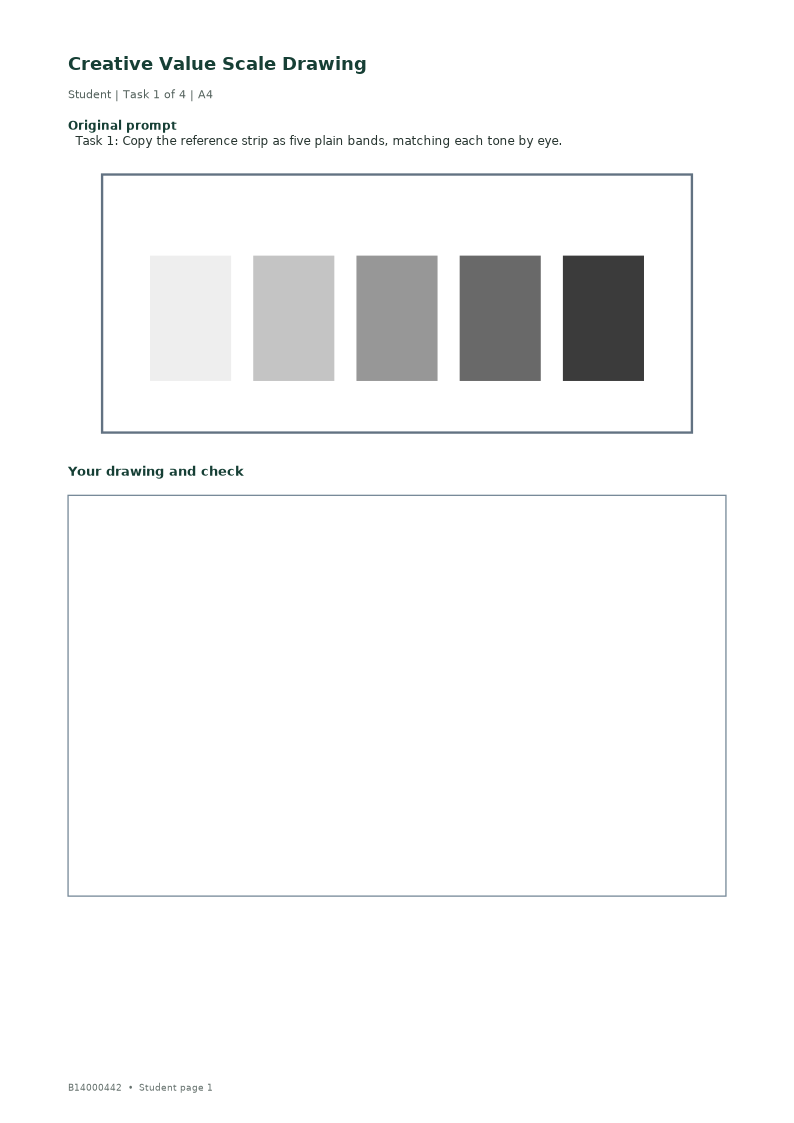
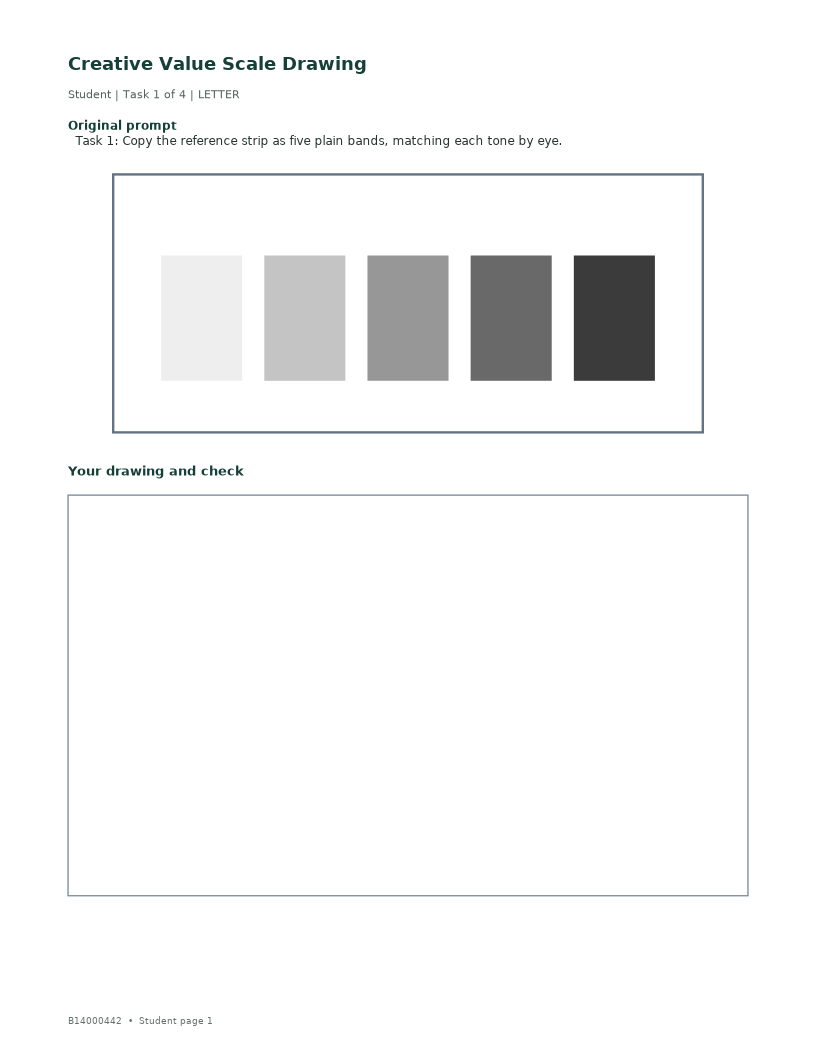
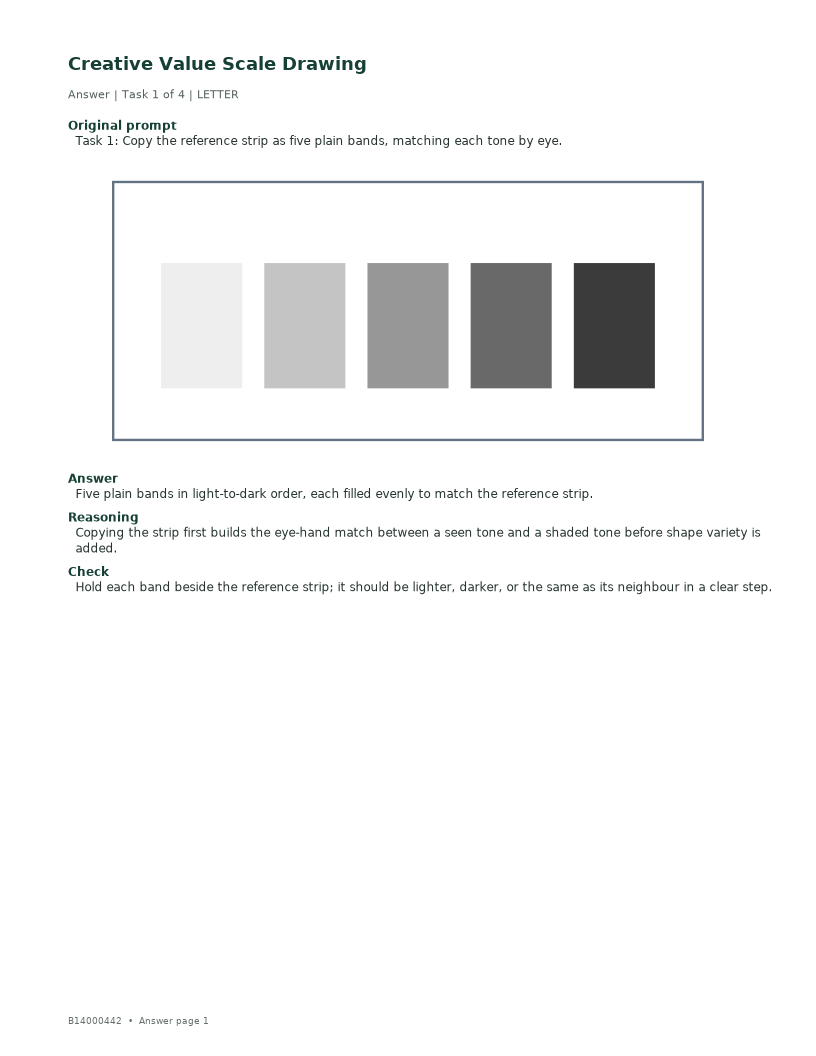
Task 1: Copy the reference strip as five plain bands, matching each tone by eye.
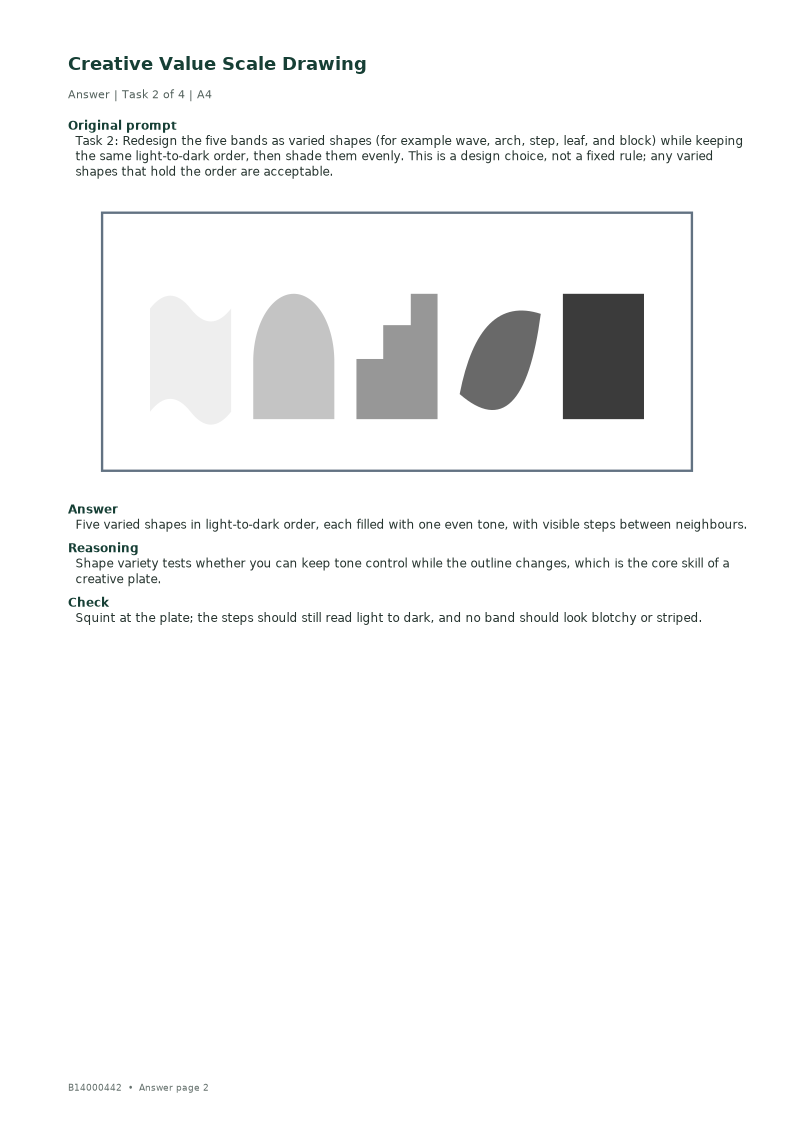
Task 2: Redesign the five bands as varied shapes (for example wave, arch, step, leaf, and block) while keeping the same light-to-dark order, then shade them evenly. This is a design choice, not a fixed rule; any varied shapes that hold the order are acceptable. Squint at the result to check that the steps still read from light to dark and that no band is blotchy or striped.
Download the complete resource pack
All individual SVG pages (20)
- A4 reference page 1
- A4 reference page 2
- A4 student page 1
- A4 student page 2
- A4 student page 3
- A4 student page 4
- A4 answer page 1
- A4 answer page 2
- A4 answer page 3
- A4 answer page 4
- LETTER reference page 1
- LETTER reference page 2
- LETTER student page 1
- LETTER student page 2
- LETTER student page 3
- LETTER student page 4
- LETTER answer page 1
- LETTER answer page 2
- LETTER answer page 3
- LETTER answer page 4
Print at 100% / actual size. Use the stated scale on any schematic diagram; physical cutting templates are identified separately. A4 and US Letter are separate files. Free access, no signup; CC BY 4.0.
How to use these pages
- What a creative value-scale plate is
- Reference strip
- Worked example
- How to shade a band evenly
- Practice tasks
Worked example
Example: Draw a five-band creative value plate: light, light-mid, mid, dark-mid, dark, each in a different shape, shaded evenly.
Answer: A correct plate has five distinct shapes in light-to-dark order, each filled with one even tone, with visible steps between neighbours and no blotchy or striped bands.
Reasoning: The plate succeeds when the tone progression is clear and each band is evenly filled; shape variety is a design choice that must not break the order.
Check: Squint at the plate: the steps should still read light to dark, and no band should look blotchy or striped.
Four practice tasks and complete answers
Task 1
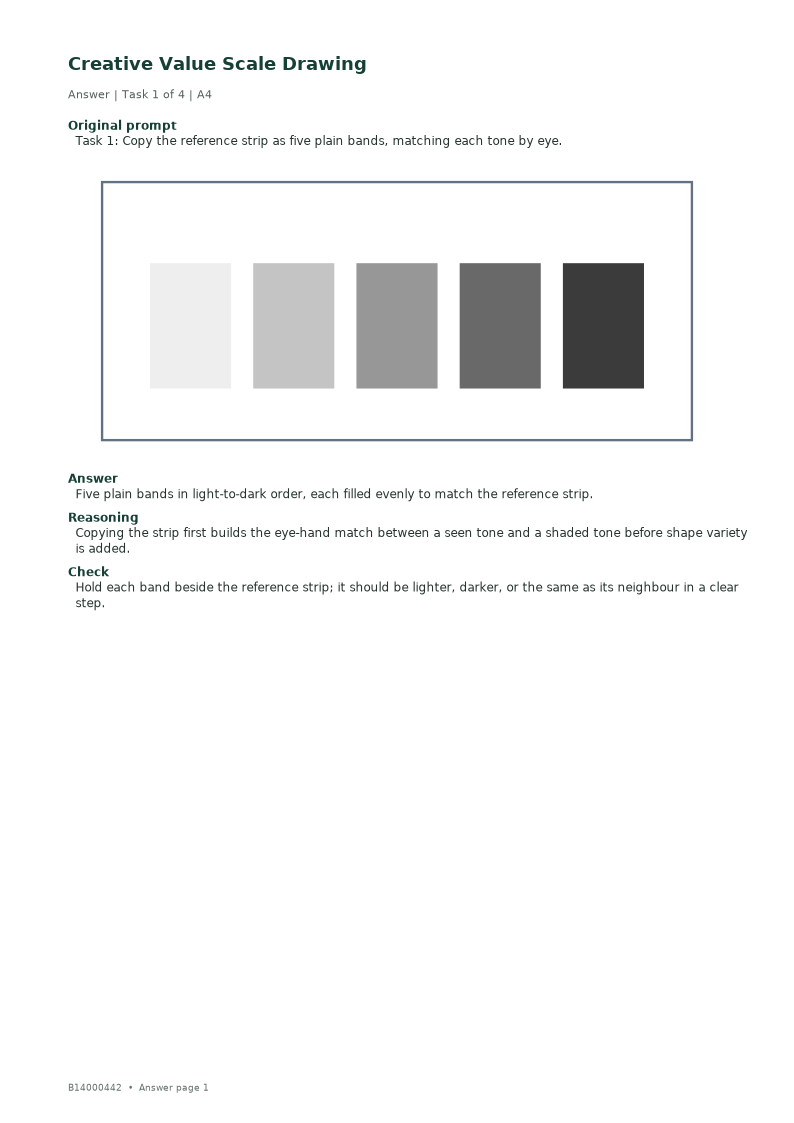
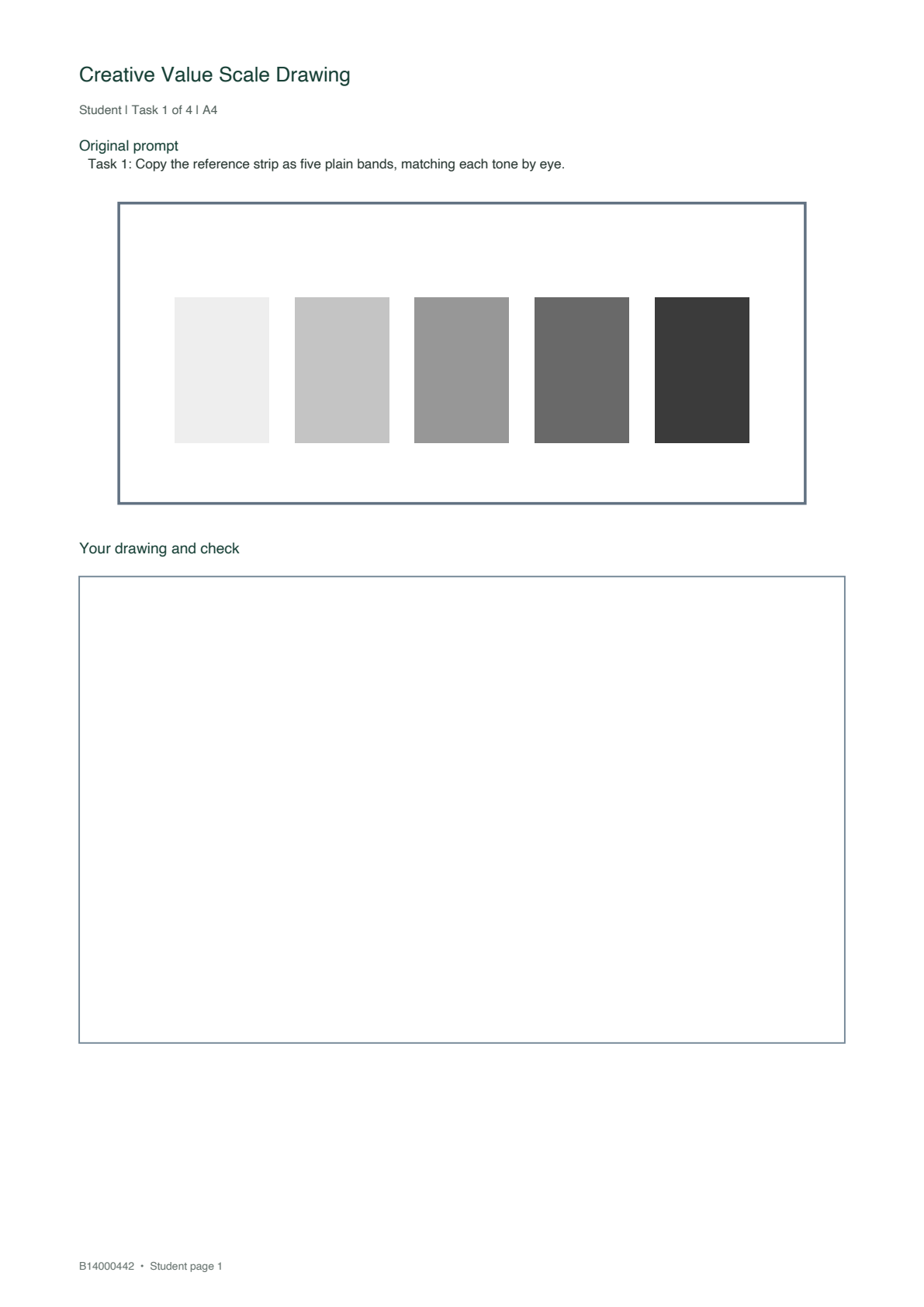
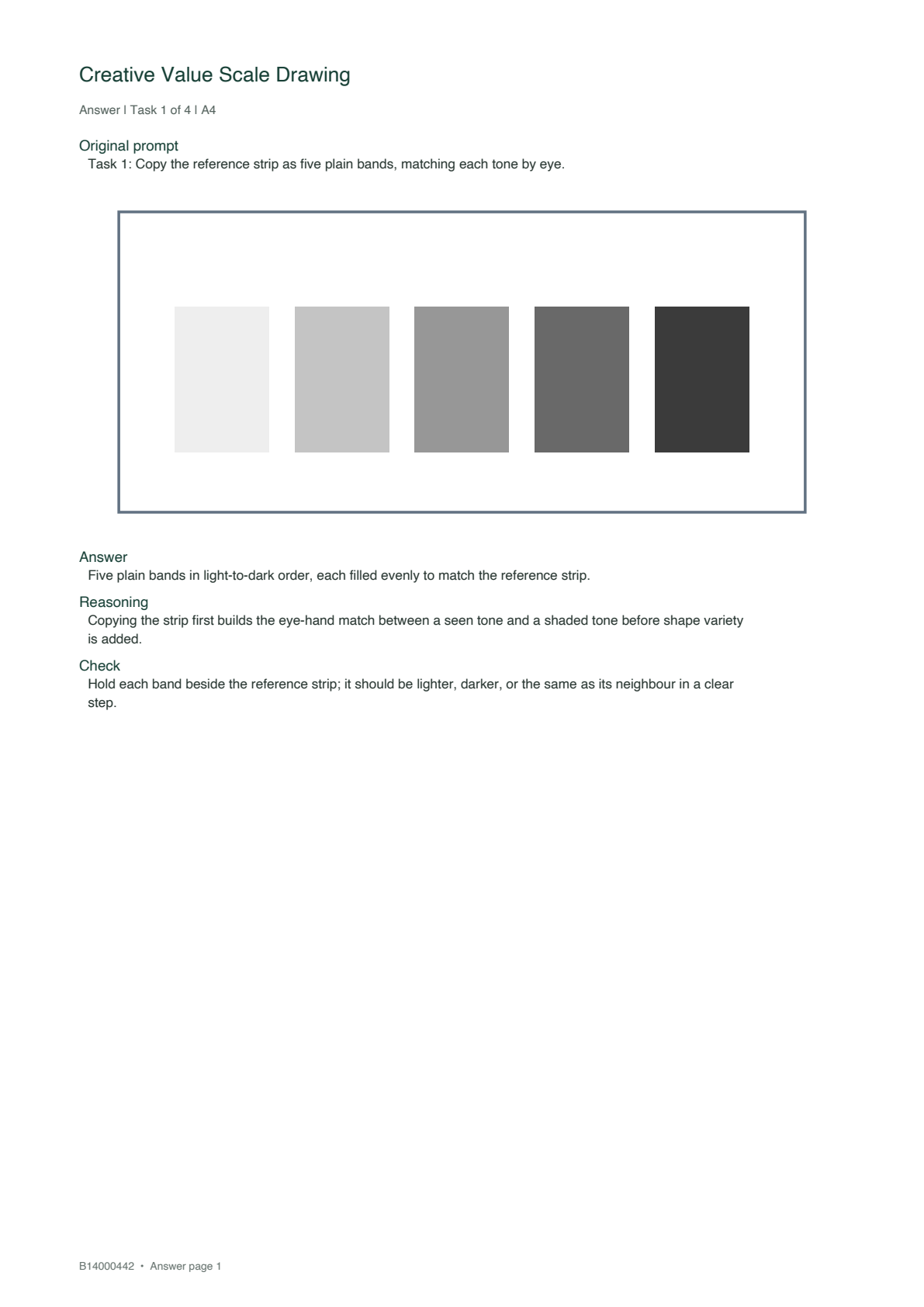
Task 1: Copy the reference strip as five plain bands, matching each tone by eye.
Show answer 1
Five plain bands in light-to-dark order, each filled evenly to match the reference strip.
Copying the strip first builds the eye-hand match between a seen tone and a shaded tone before shape variety is added.
Check: Hold each band beside the reference strip; it should be lighter, darker, or the same as its neighbour in a clear step.
Task 2
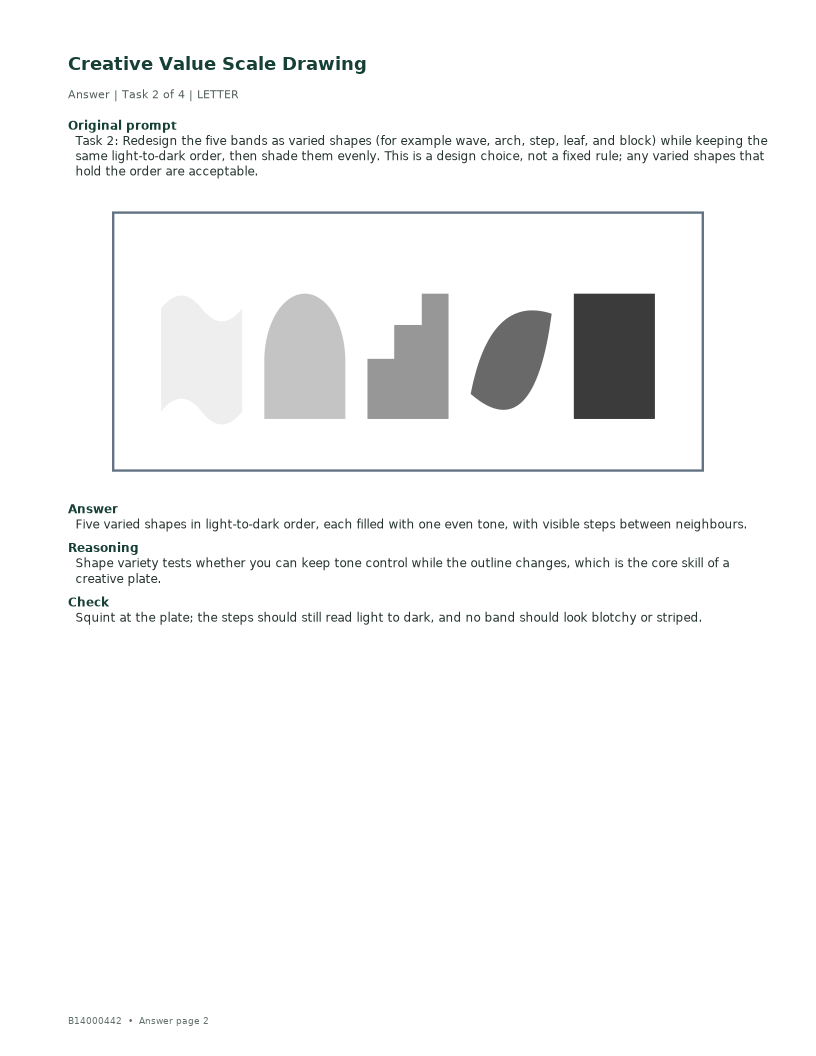
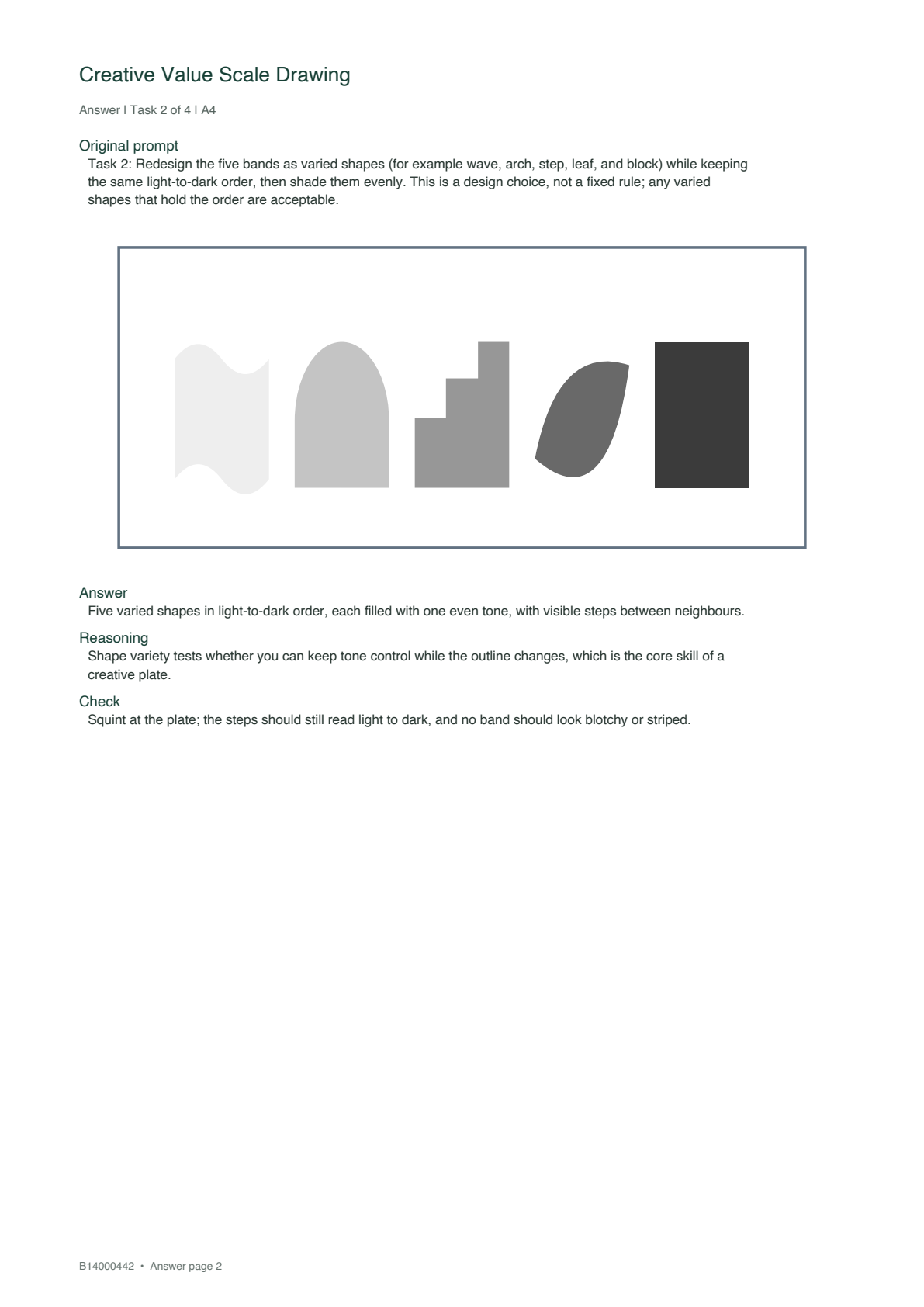
Task 2: Redesign the five bands as varied shapes (for example wave, arch, step, leaf, and block) while keeping the same light-to-dark order, then shade them evenly. This is a design choice, not a fixed rule; any varied shapes that hold the order are acceptable.
Show answer 2
Five varied shapes in light-to-dark order, each filled with one even tone, with visible steps between neighbours.
Shape variety tests whether you can keep tone control while the outline changes, which is the core skill of a creative plate.
Check: Squint at the plate; the steps should still read light to dark, and no band should look blotchy or striped.
Task 3
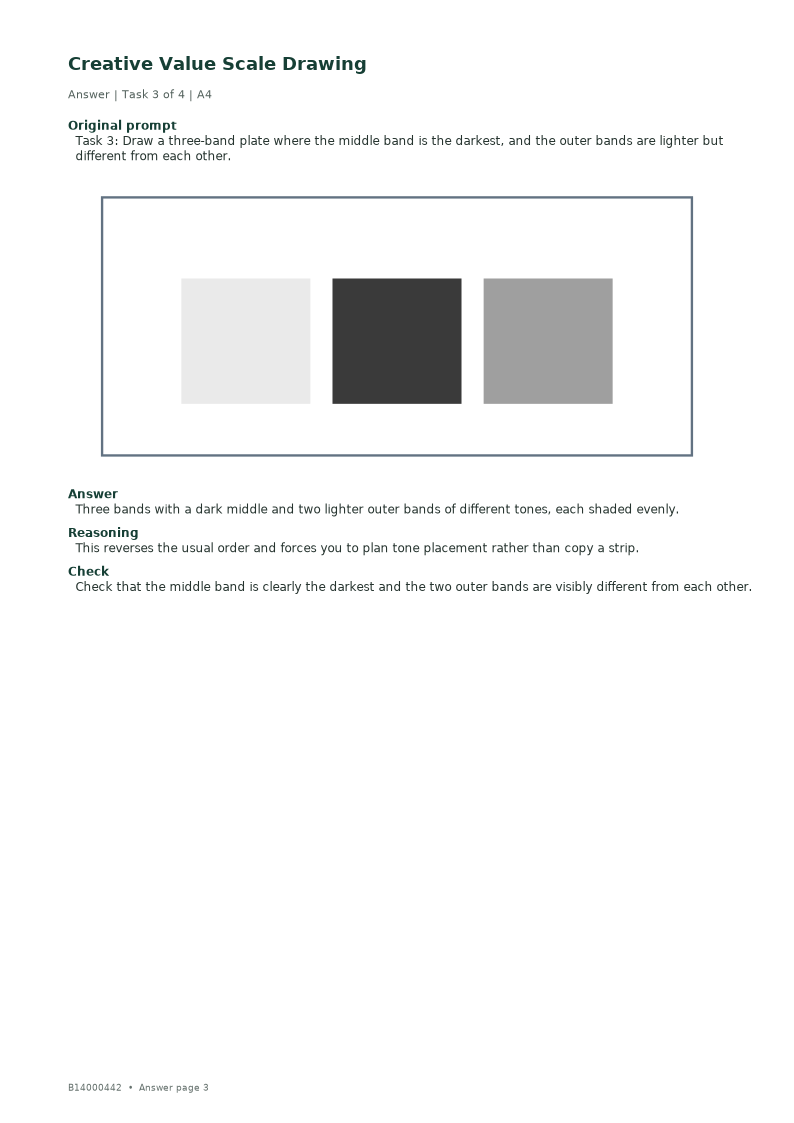
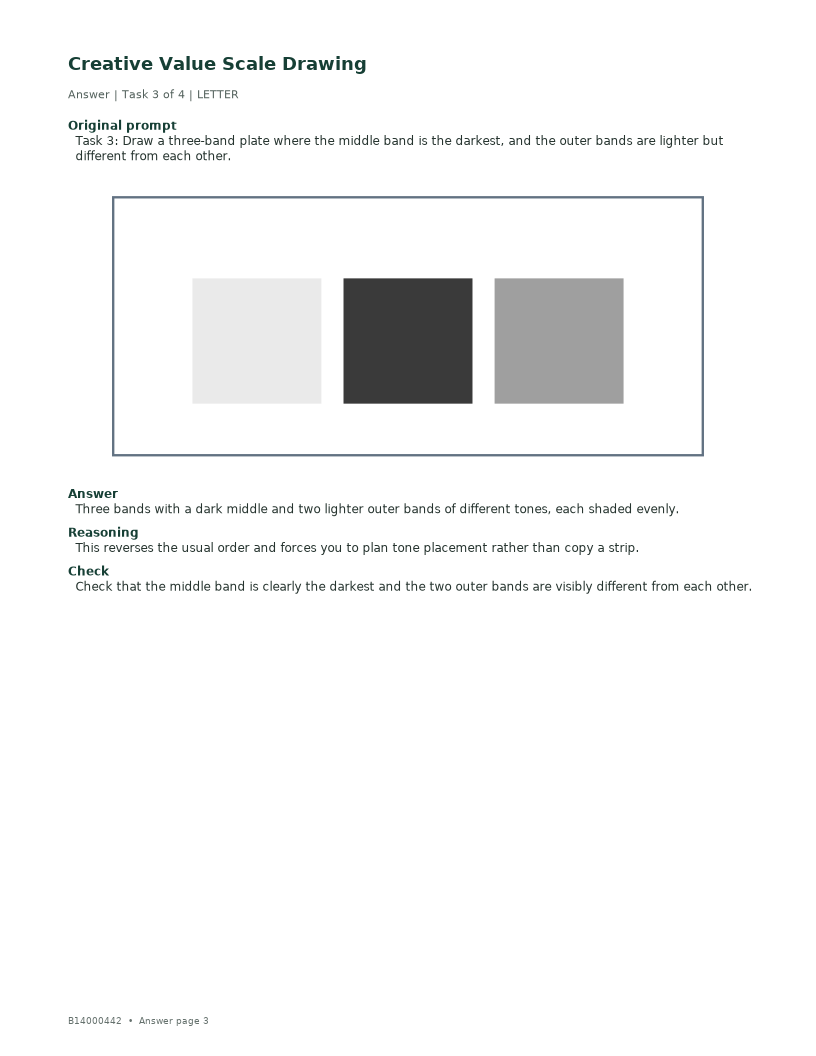
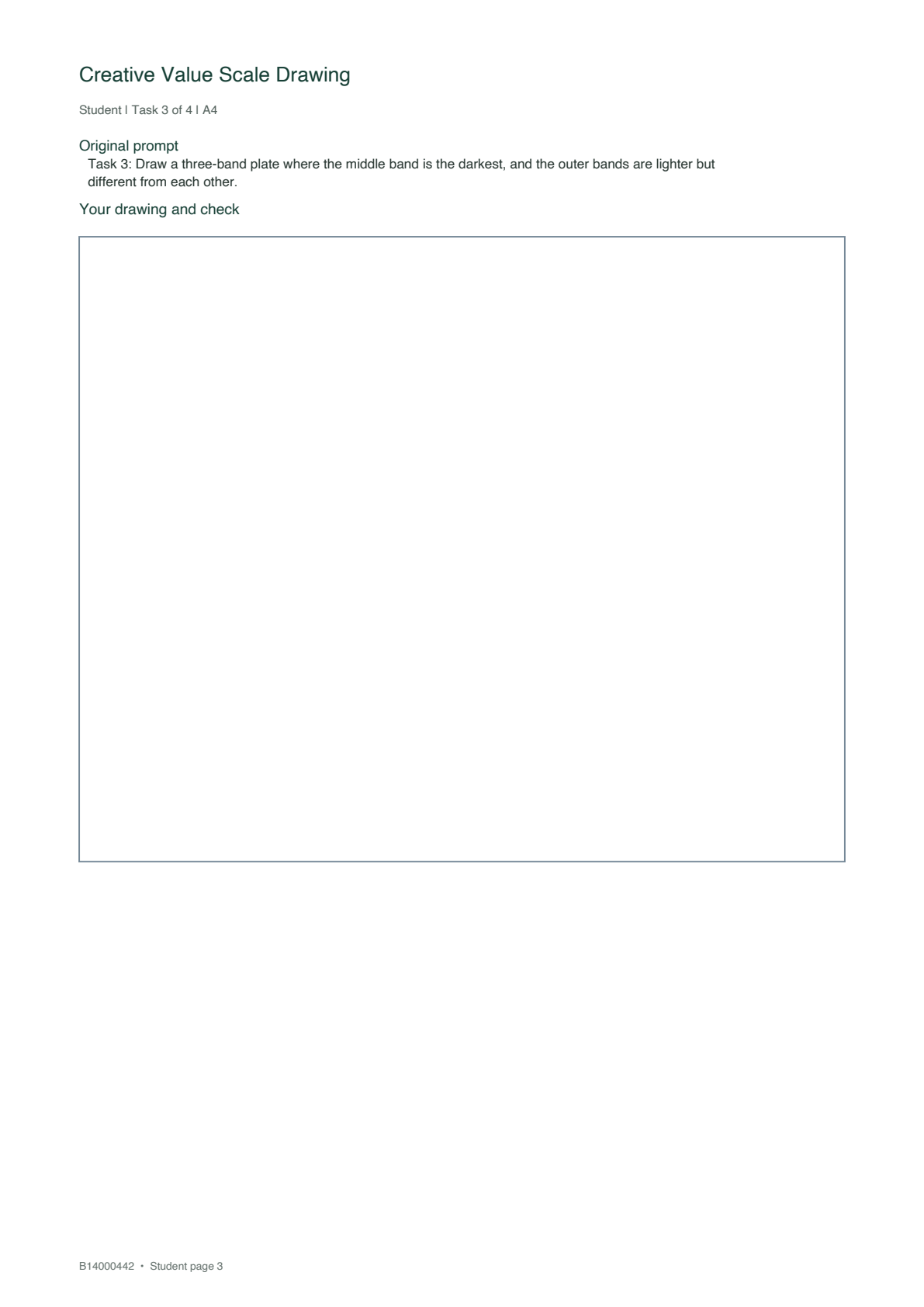
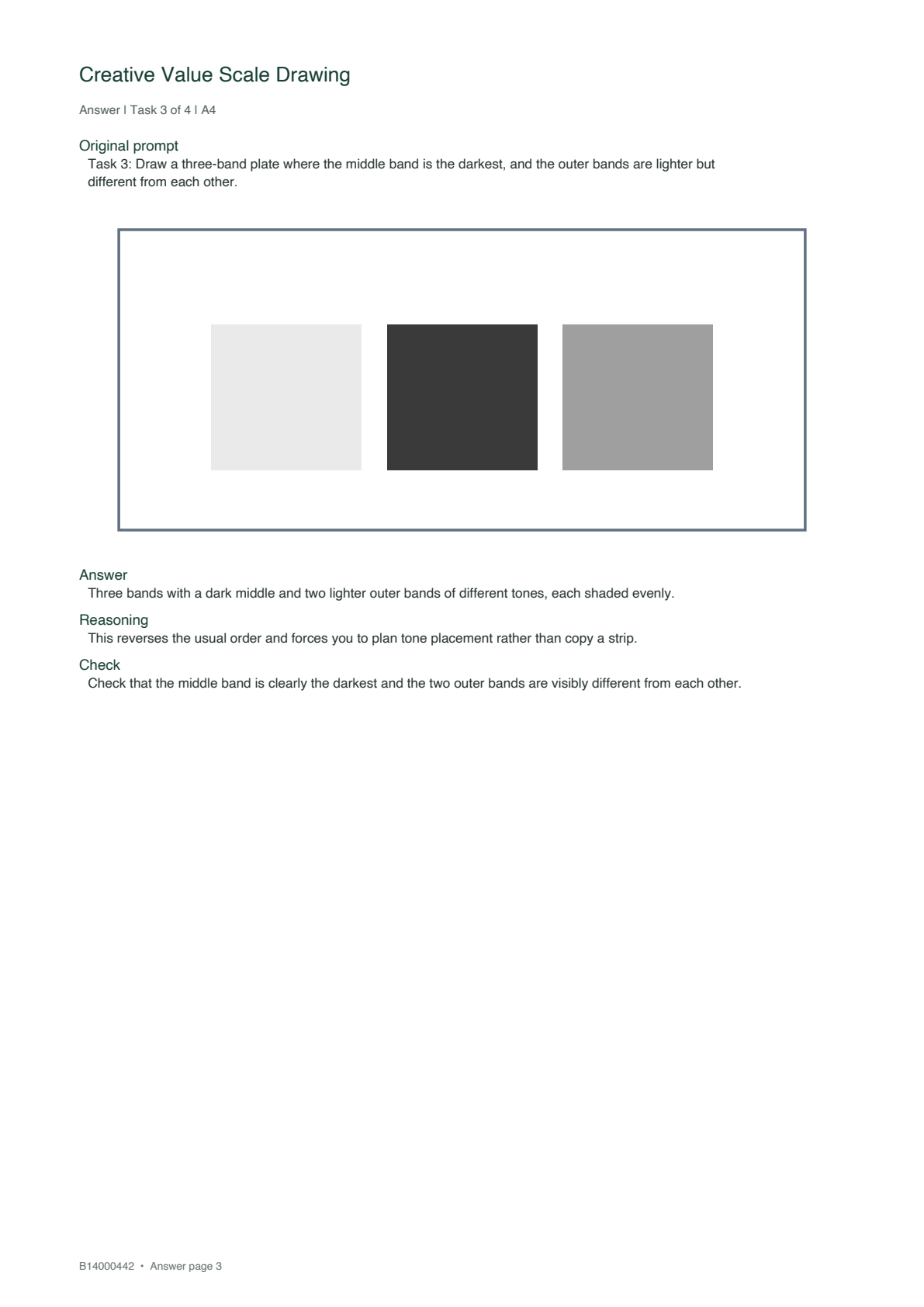
Task 3: Draw a three-band plate where the middle band is the darkest, and the outer bands are lighter but different from each other.
Show answer 3
Three bands with a dark middle and two lighter outer bands of different tones, each shaded evenly.
This reverses the usual order and forces you to plan tone placement rather than copy a strip.
Check: Check that the middle band is clearly the darkest and the two outer bands are visibly different from each other.
Task 4
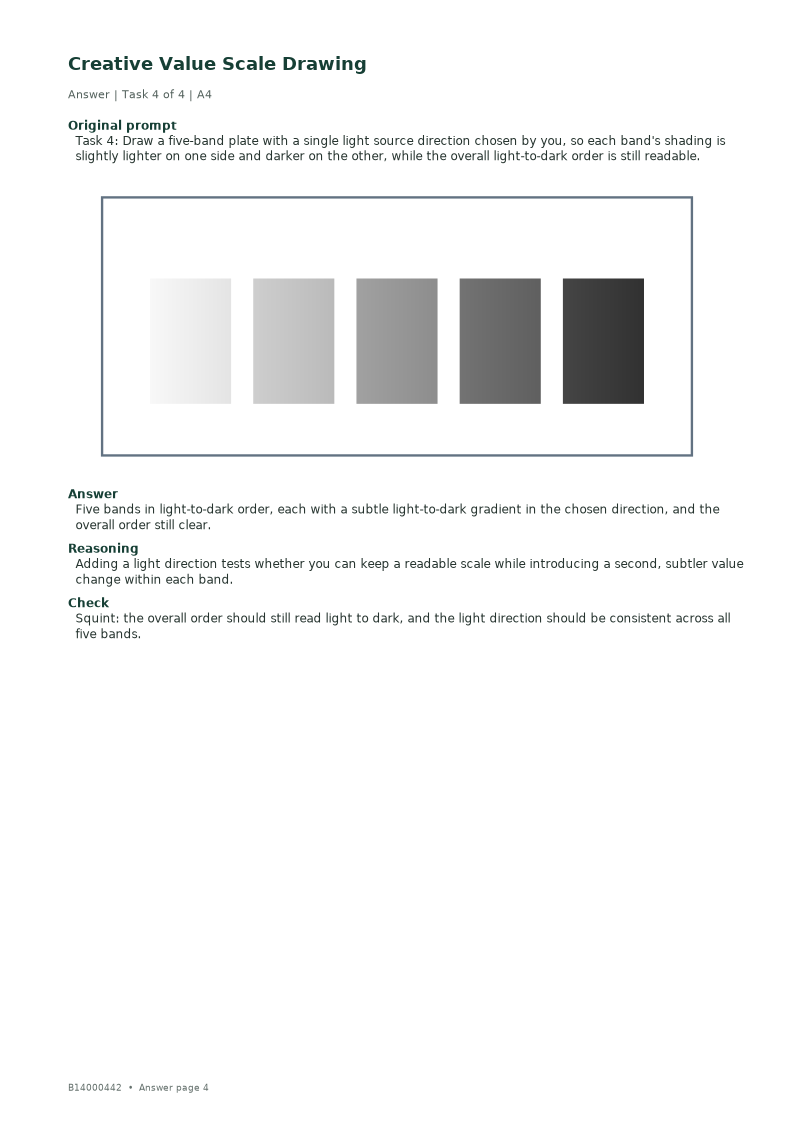
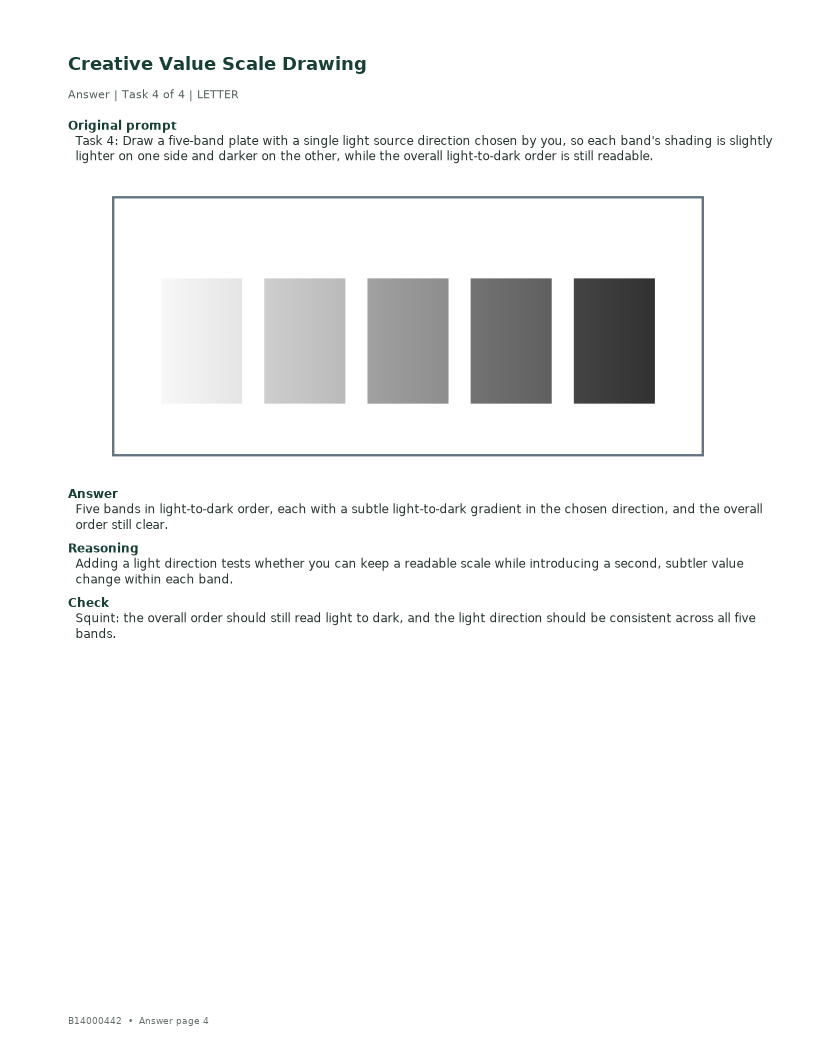
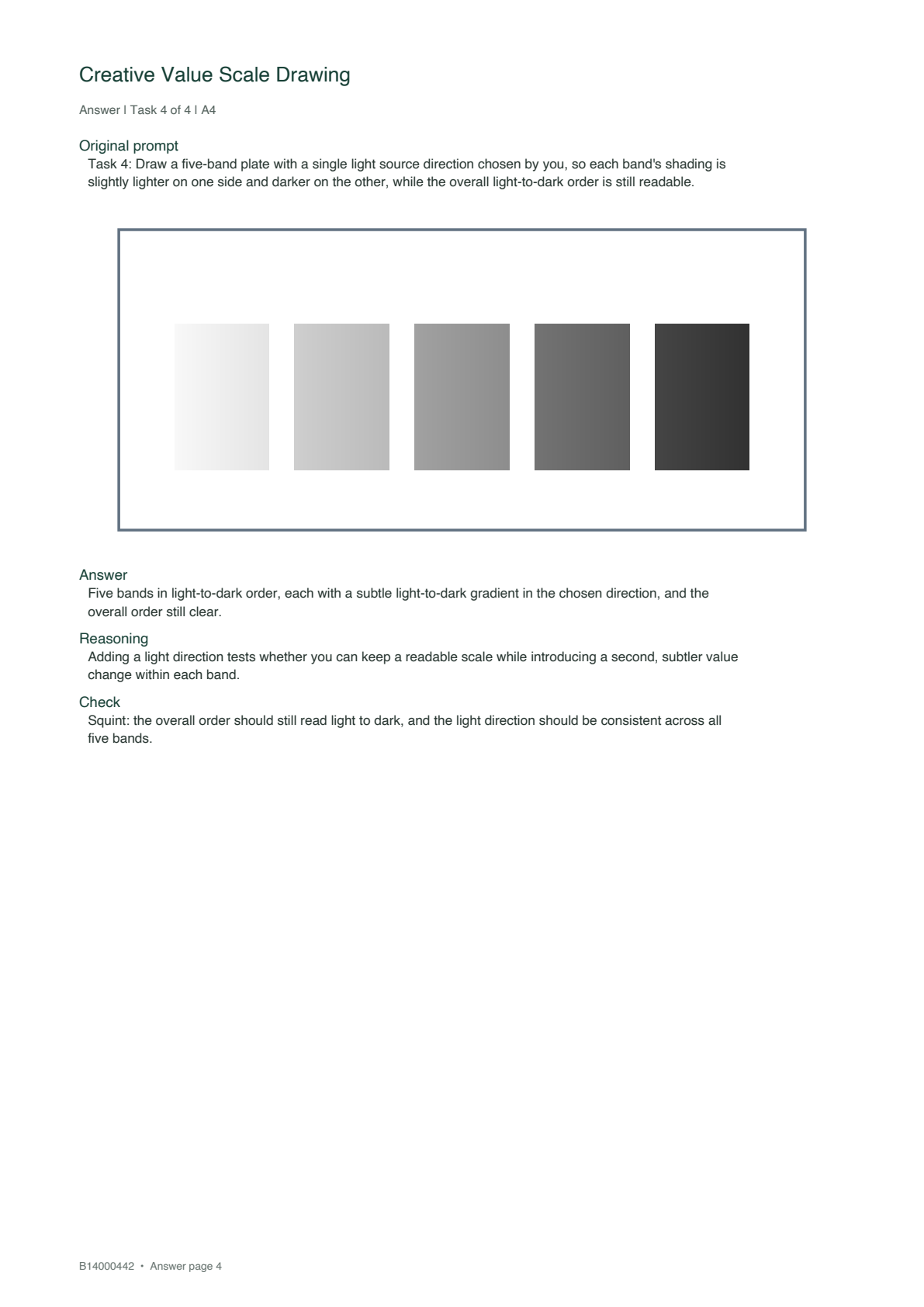
Task 4: Draw a five-band plate with a single light source direction chosen by you, so each band's shading is slightly lighter on one side and darker on the other, while the overall light-to-dark order is still readable.
Show answer 4
Five bands in light-to-dark order, each with a subtle light-to-dark gradient in the chosen direction, and the overall order still clear.
Adding a light direction tests whether you can keep a readable scale while introducing a second, subtler value change within each band.
Check: Squint: the overall order should still read light to dark, and the light direction should be consistent across all five bands.
Useful checks
- Pressing hard to make a band darker instead of adding layers. Use soft, overlapping layers; pressing hard makes the surface shiny and uneven.
- Leaving visible stripes or blotches inside a band. Blend or smooth the surface so no single stroke stands out.
- Breaking the light-to-dark order when shapes vary. Check the order by squinting before adding shape detail.
Questions about this resource
Do I need special paper or tools?
No. A pencil and ordinary paper are enough; the reference strip and your own bands are the only materials needed.
Can I use any shapes?
Yes. Shape variety is a design choice. Keep the overall order readable. Use single even fills in the first three tasks and the deliberate directional gradients in the fourth.