Free original lessons
Tonal Drawing Worksheet
Tonal drawing means controlling how light and dark a mark is, not just where you put it. This worksheet teaches a five-step tonal value scale and then applies it to a shaded sphere, so you can see and reproduce a smooth range from light to dark.
Letter & A4
PDF & SVG
What a tonal value scale is
A tonal value scale is a row of patches that step from the lightest tone you can make to the darkest, with even visual steps between them. In pencil work the lightest tone is usually the bare paper, and the darkest is the strongest pressure or the softest graphite you are using.
The scale is a reference, not a decoration: once you can make five clearly different tones, you can match any part of a shaded object to one of them. The sphere exercise then asks you to place those tones in the right order around a curved form.
How to build the five-step scale
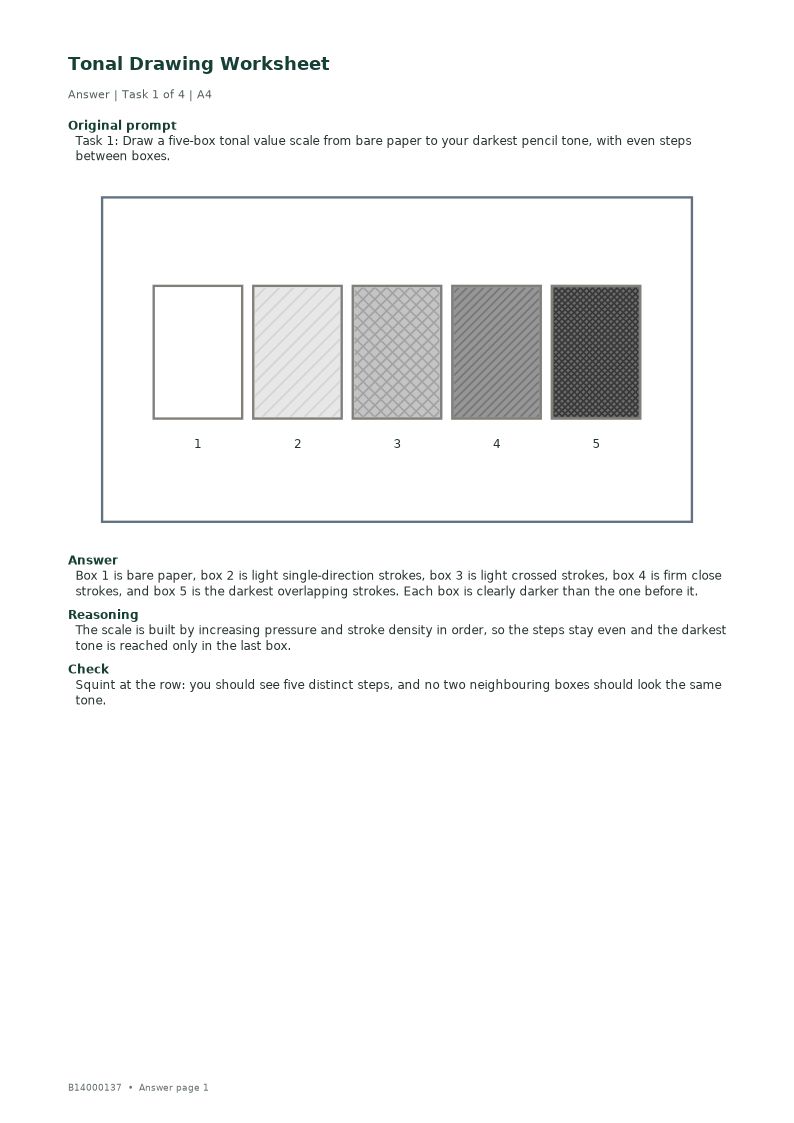
Draw five equal boxes in a row. Leave box 1 as bare paper. In box 2 lay light, even pencil strokes in one direction. In box 3 cross the strokes lightly. In box 4 press harder and keep the strokes close. In box 5 build the darkest tone with firm, overlapping strokes.
Check the scale by squinting: the five boxes should look like five separate steps, not two light boxes and three dark ones. If two boxes look the same, adjust the middle one rather than the ends.
How to shade a sphere
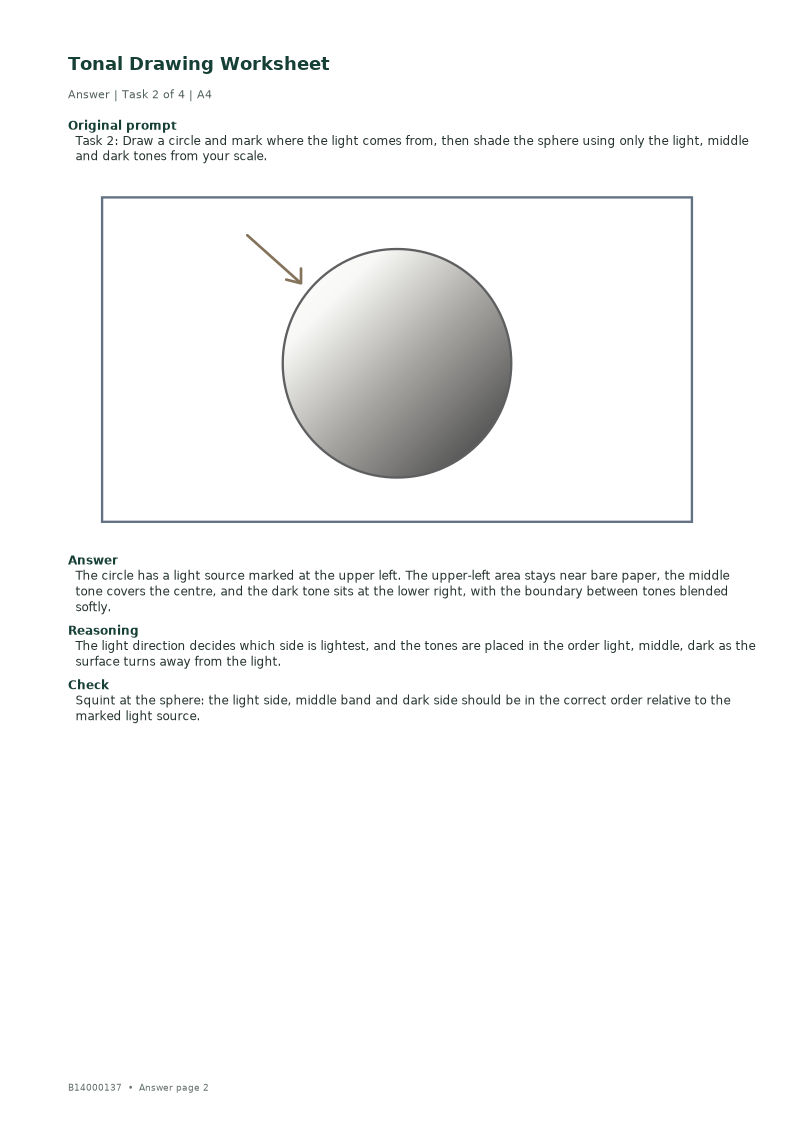
Draw a circle and decide where the light comes from, for example the upper left. The side facing the light is the lightest tone; the side away from it is the darkest. Between them the tone changes gradually, and a soft shadow sits on the surface under the sphere.
Shade in the order of the scale: start with the light tone, add the middle tone, then the dark tone, blending only at the boundaries. Keep the highlight area close to bare paper and let the darkest tone sit opposite the light.
Download the complete resource pack
All individual SVG pages (18)
- A4 reference page 1
- A4 student page 1
- A4 student page 2
- A4 student page 3
- A4 student page 4
- A4 answer page 1
- A4 answer page 2
- A4 answer page 3
- A4 answer page 4
- LETTER reference page 1
- LETTER student page 1
- LETTER student page 2
- LETTER student page 3
- LETTER student page 4
- LETTER answer page 1
- LETTER answer page 2
- LETTER answer page 3
- LETTER answer page 4
Print at 100% / actual size. Use the stated scale on any schematic diagram; physical cutting templates are identified separately. A4 and US Letter are separate files. Free access, no signup; CC BY 4.0.
How to use these pages
- What a tonal value scale is
- How to build the five-step scale
- How to shade a sphere
Worked example
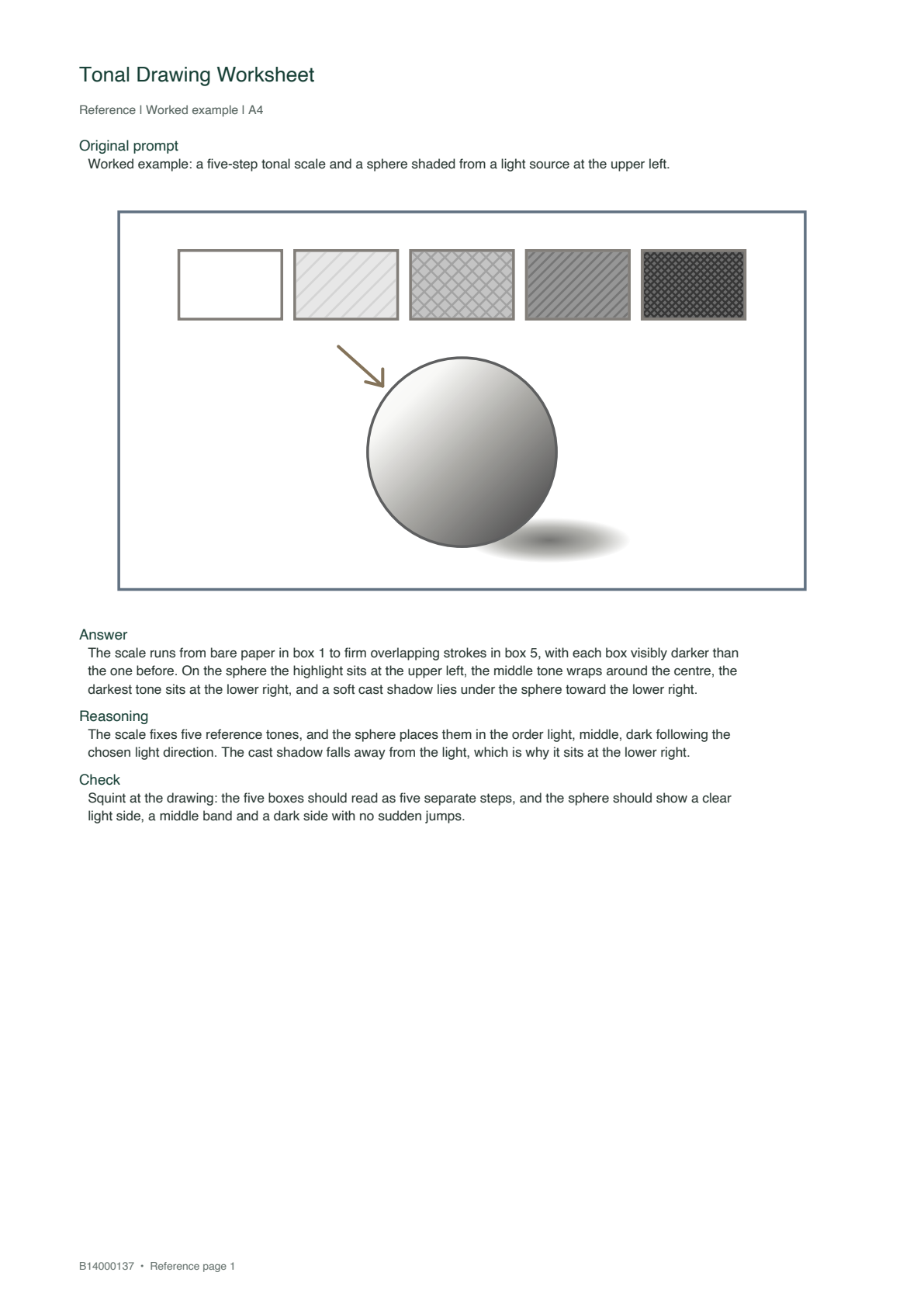
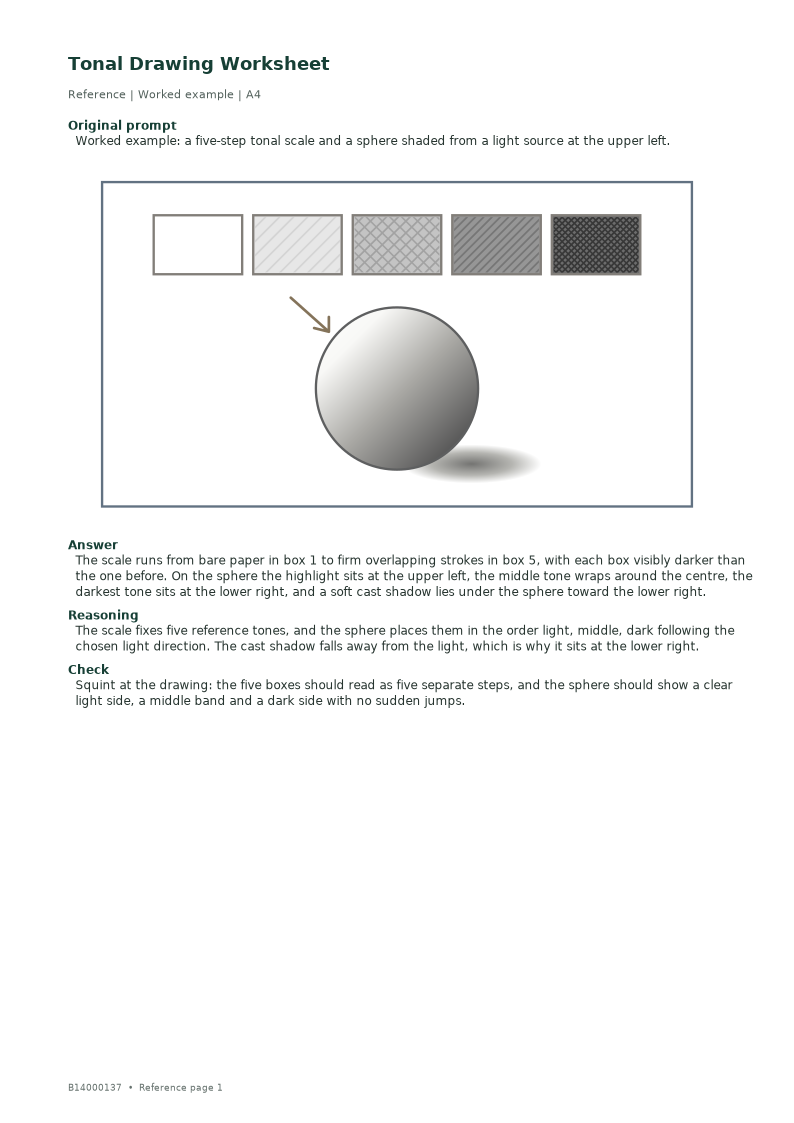
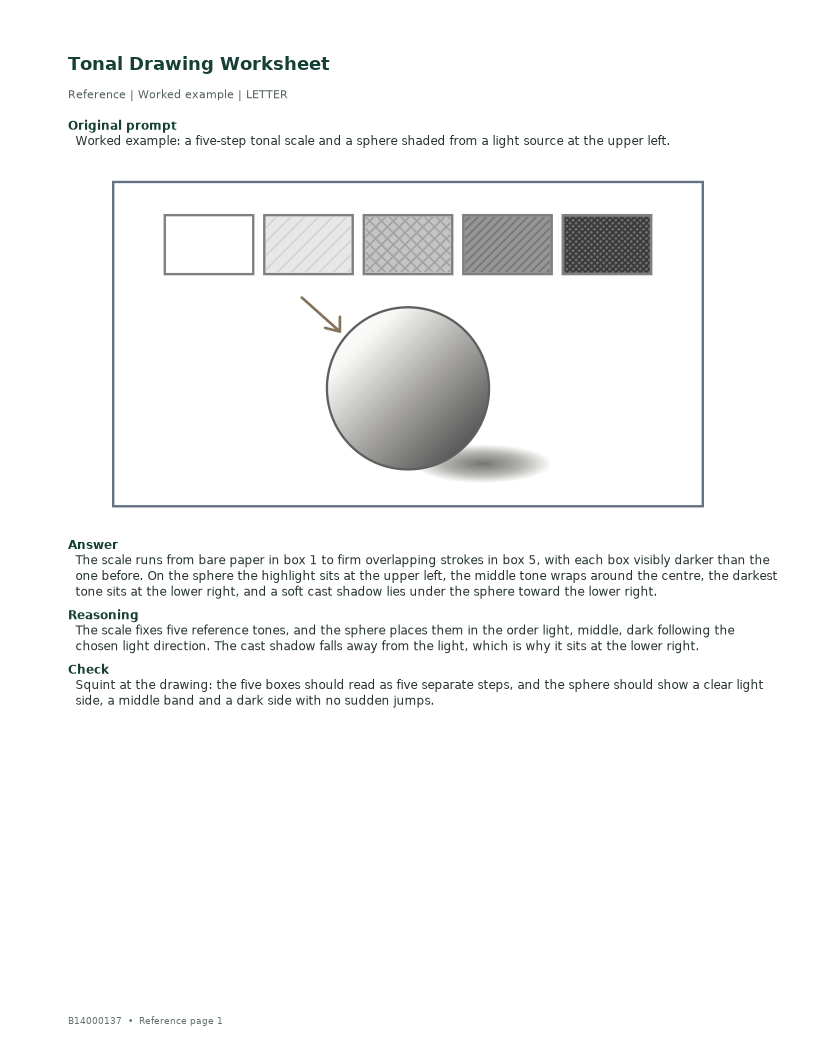
Example: Worked example: a five-step tonal scale and a sphere shaded from a light source at the upper left.
Answer: The scale runs from bare paper in box 1 to firm overlapping strokes in box 5, with each box visibly darker than the one before. On the sphere the highlight sits at the upper left, the middle tone wraps around the centre, the darkest tone sits at the lower right, and a soft cast shadow lies under the sphere toward the lower right.
Reasoning: The scale fixes five reference tones, and the sphere places them in the order light, middle, dark following the chosen light direction. The cast shadow falls away from the light, which is why it sits at the lower right.
Check: Squint at the drawing: the five boxes should read as five separate steps, and the sphere should show a clear light side, a middle band and a dark side with no sudden jumps.
Four practice tasks and complete answers
Task 1
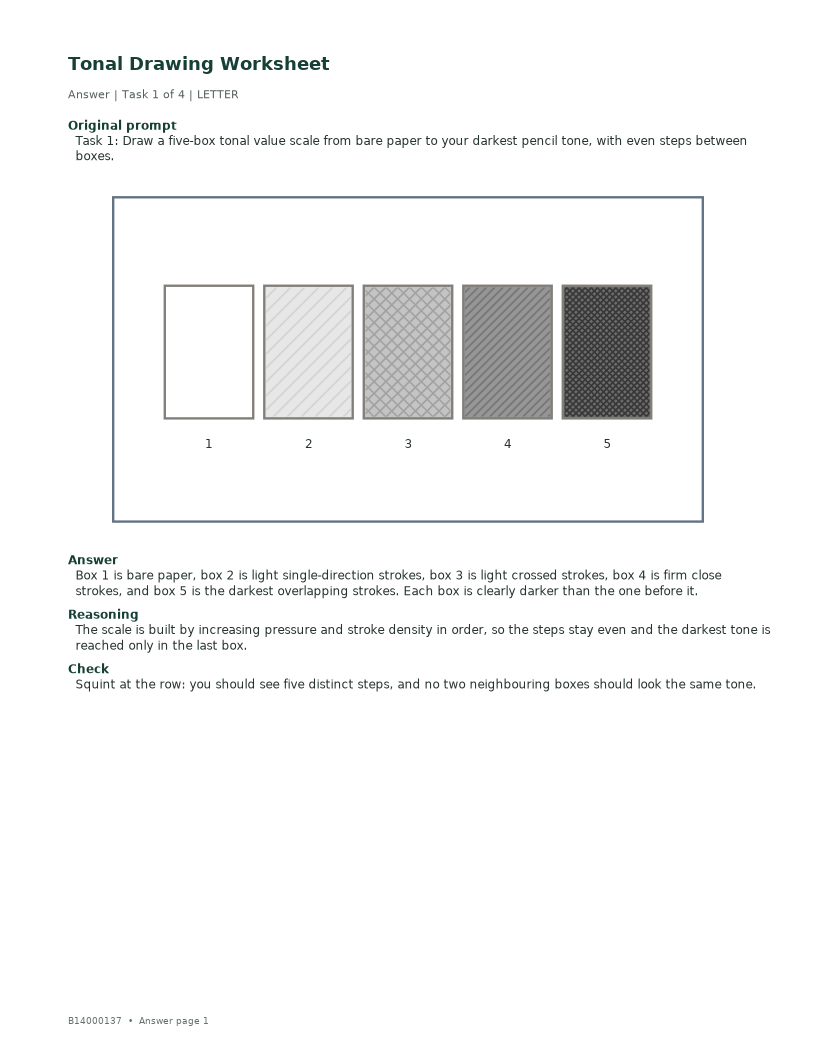
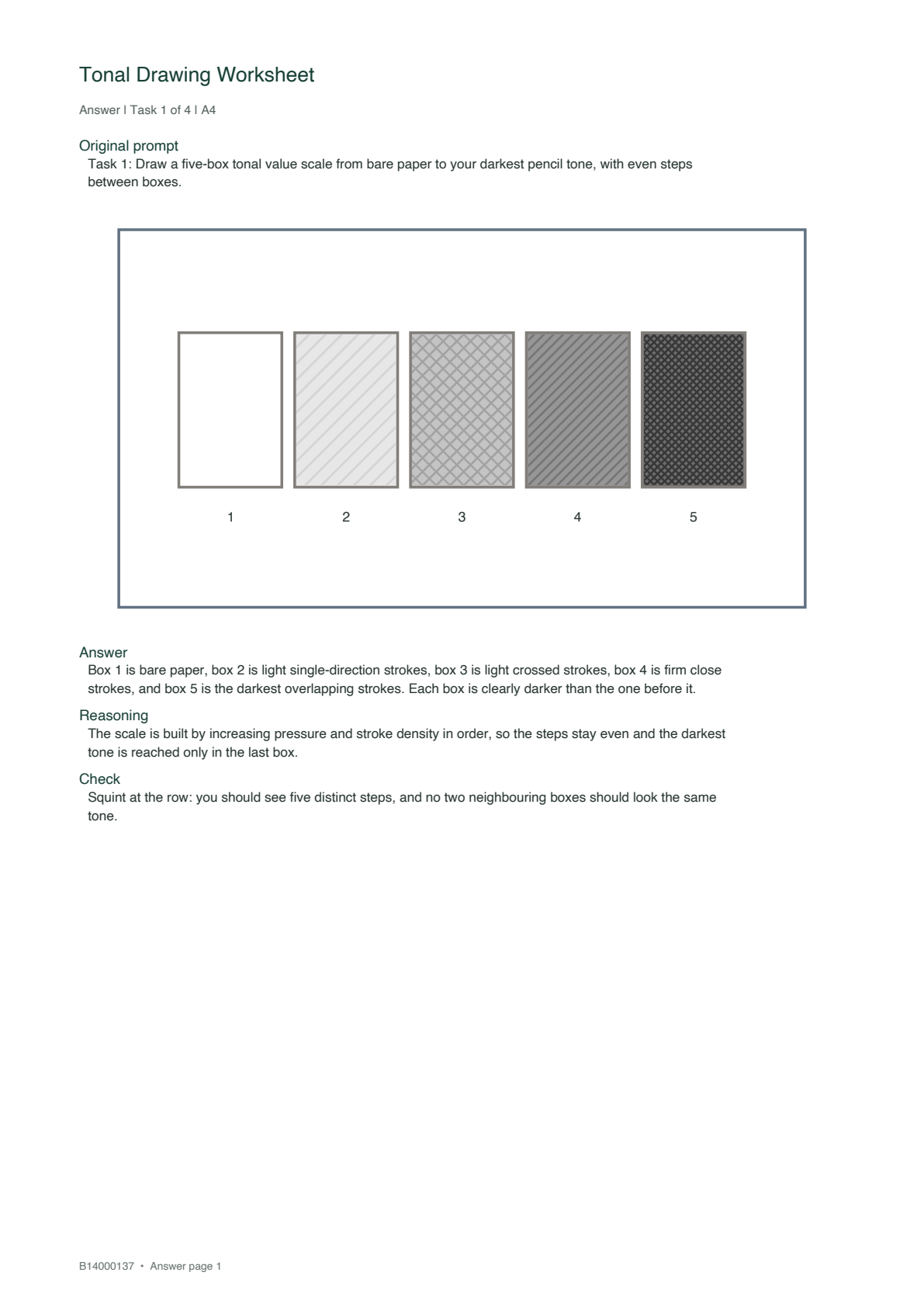
Task 1: Draw a five-box tonal value scale from bare paper to your darkest pencil tone, with even steps between boxes.
Show answer 1
Box 1 is bare paper, box 2 is light single-direction strokes, box 3 is light crossed strokes, box 4 is firm close strokes, and box 5 is the darkest overlapping strokes. Each box is clearly darker than the one before it.
The scale is built by increasing pressure and stroke density in order, so the steps stay even and the darkest tone is reached only in the last box.
Check: Squint at the row: you should see five distinct steps, and no two neighbouring boxes should look the same tone.
Task 2
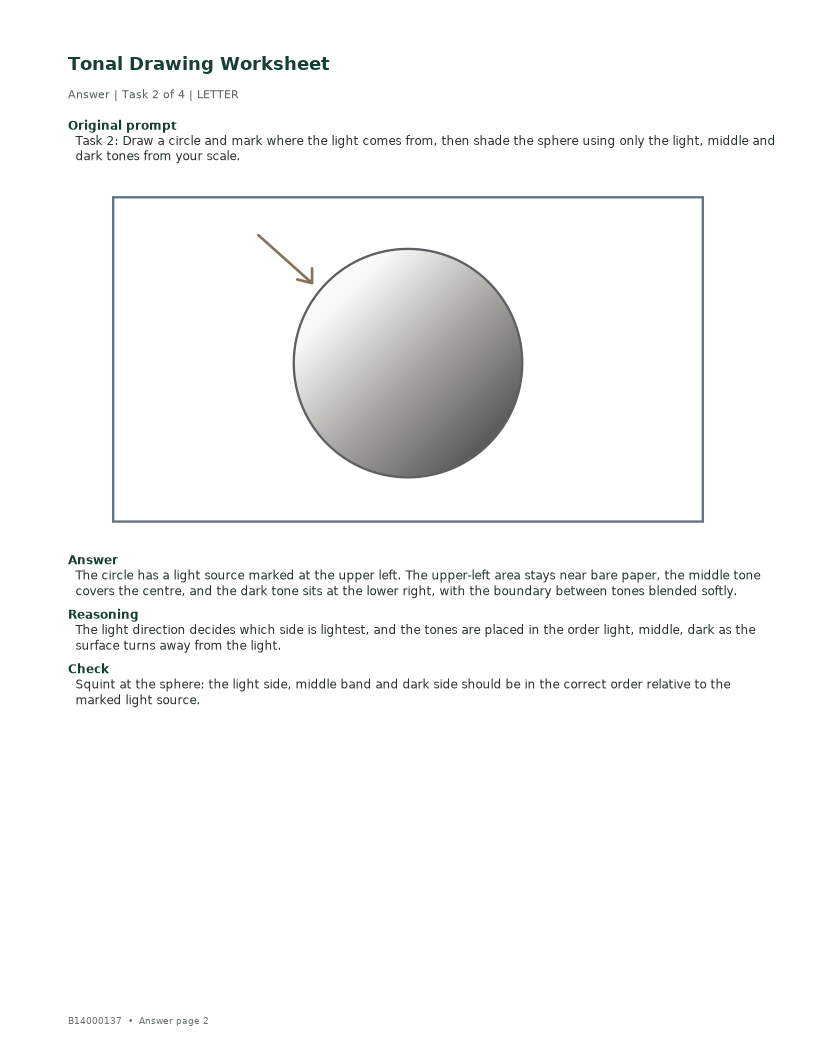
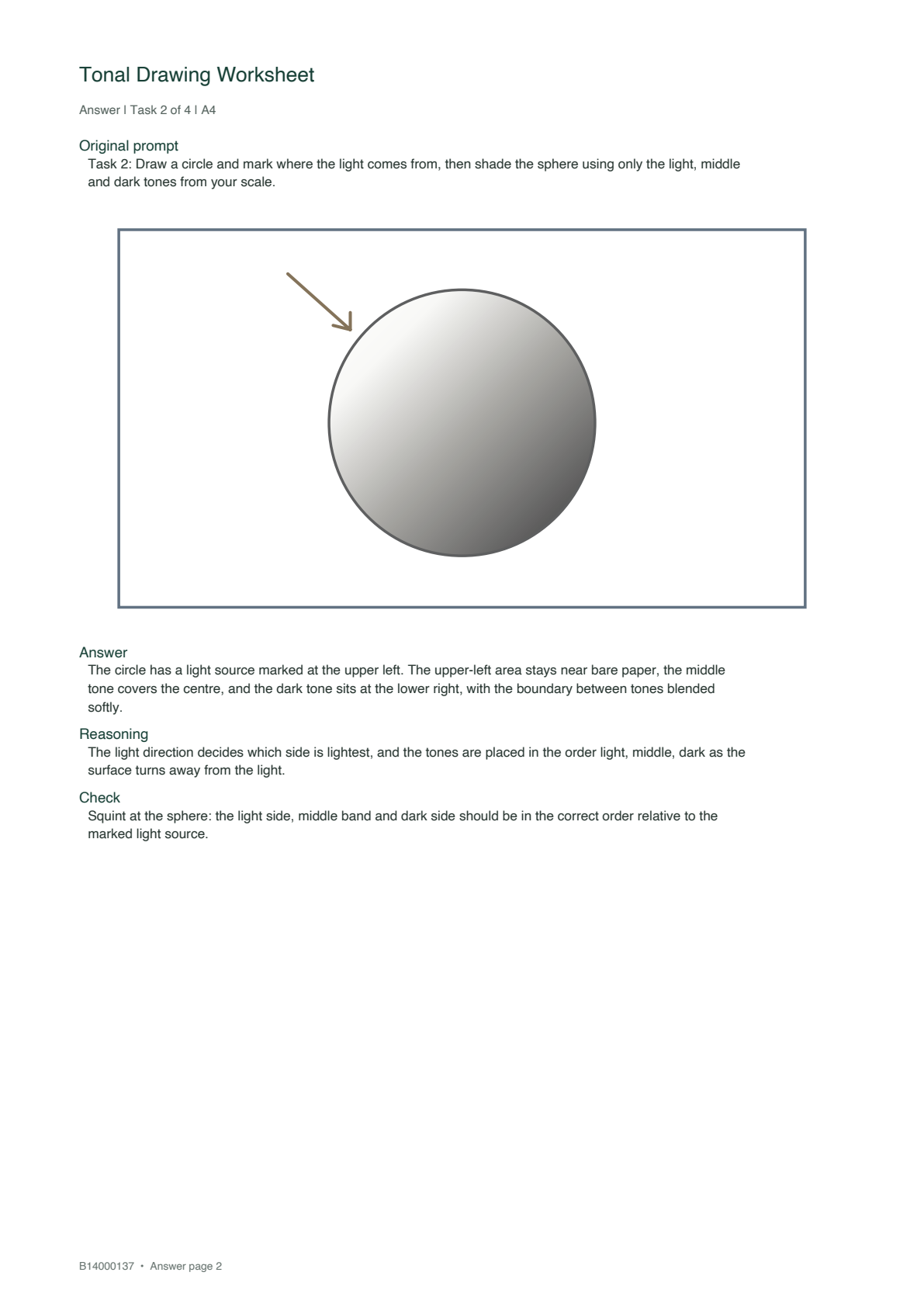
Task 2: Draw a circle and mark where the light comes from, then shade the sphere using only the light, middle and dark tones from your scale.
Show answer 2
The circle has a light source marked at the upper left. The upper-left area stays near bare paper, the middle tone covers the centre, and the dark tone sits at the lower right, with the boundary between tones blended softly.
The light direction decides which side is lightest, and the tones are placed in the order light, middle, dark as the surface turns away from the light.
Check: Squint at the sphere: the light side, middle band and dark side should be in the correct order relative to the marked light source.
Task 3
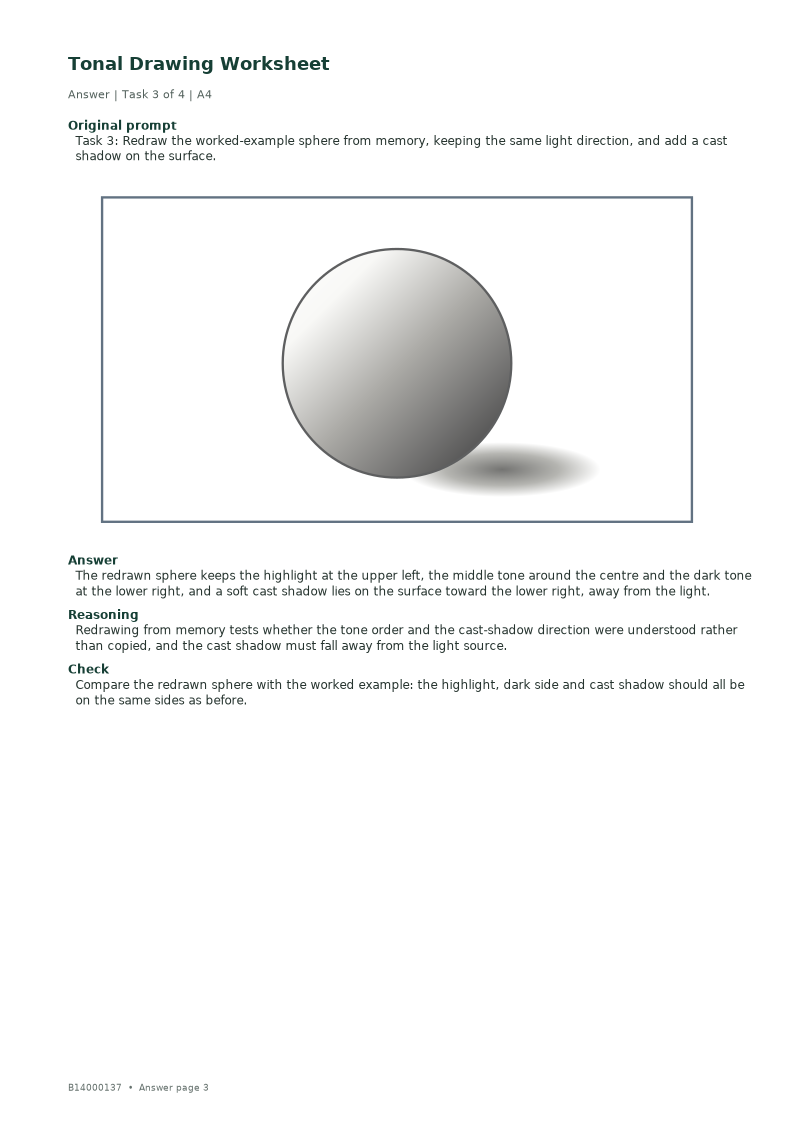
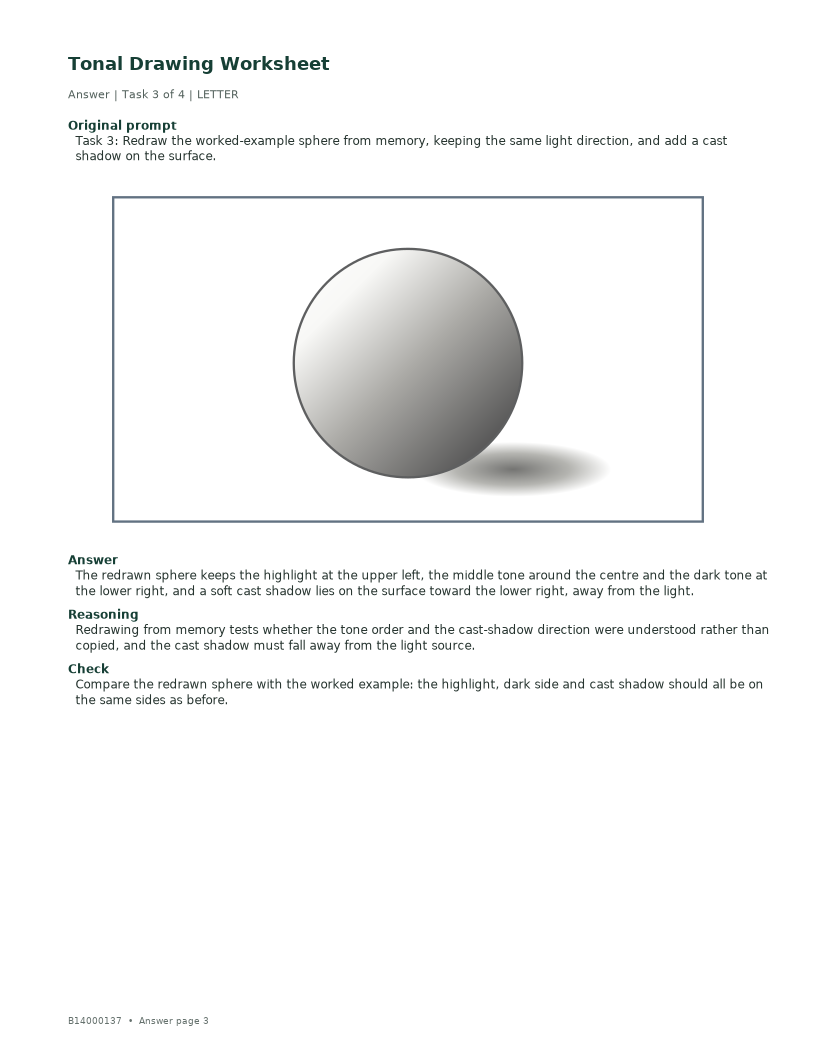
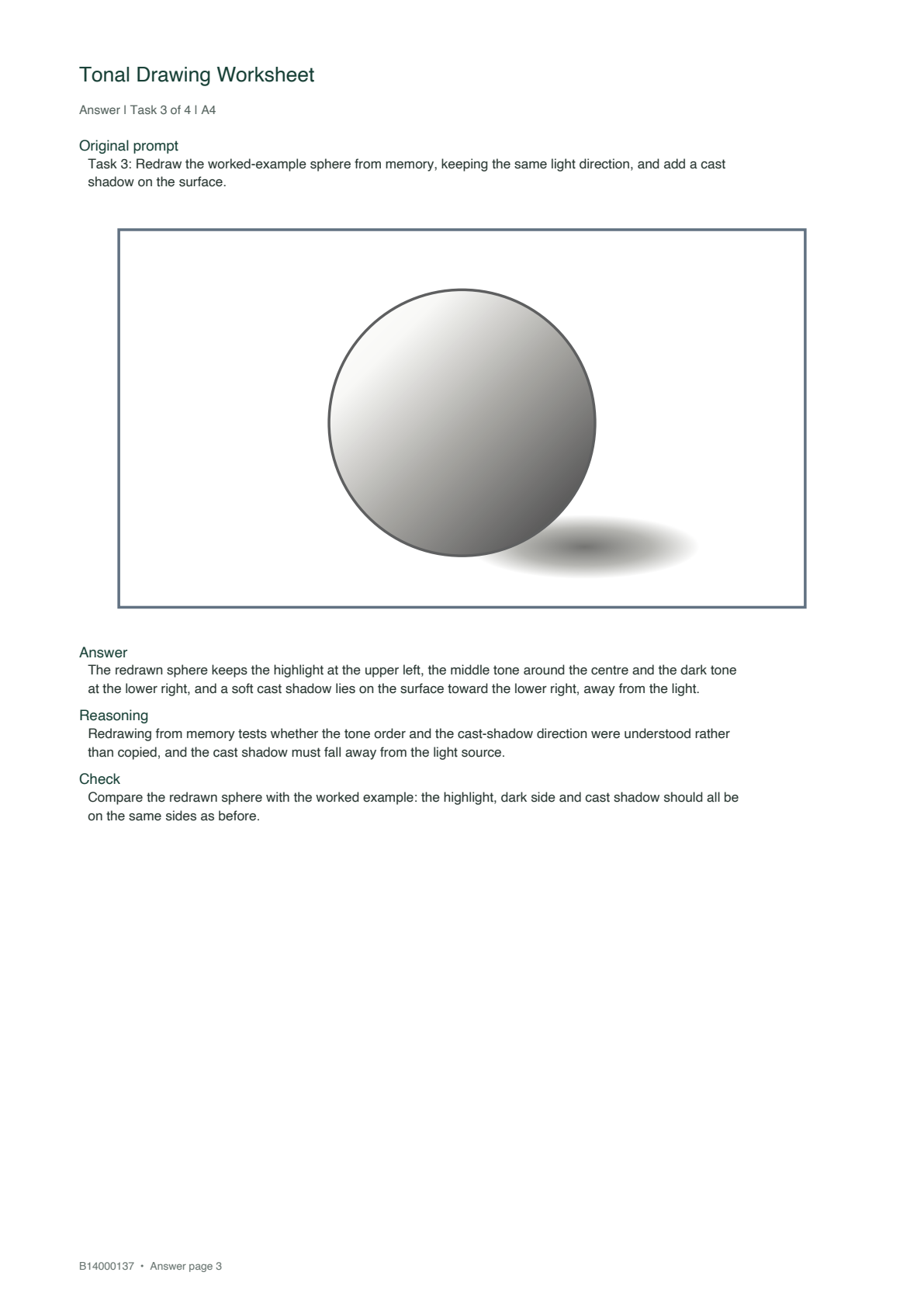
Task 3: Redraw the worked-example sphere from memory, keeping the same light direction, and add a cast shadow on the surface.
Show answer 3
The redrawn sphere keeps the highlight at the upper left, the middle tone around the centre and the dark tone at the lower right, and a soft cast shadow lies on the surface toward the lower right, away from the light.
Redrawing from memory tests whether the tone order and the cast-shadow direction were understood rather than copied, and the cast shadow must fall away from the light source.
Check: Compare the redrawn sphere with the worked example: the highlight, dark side and cast shadow should all be on the same sides as before.
Task 4
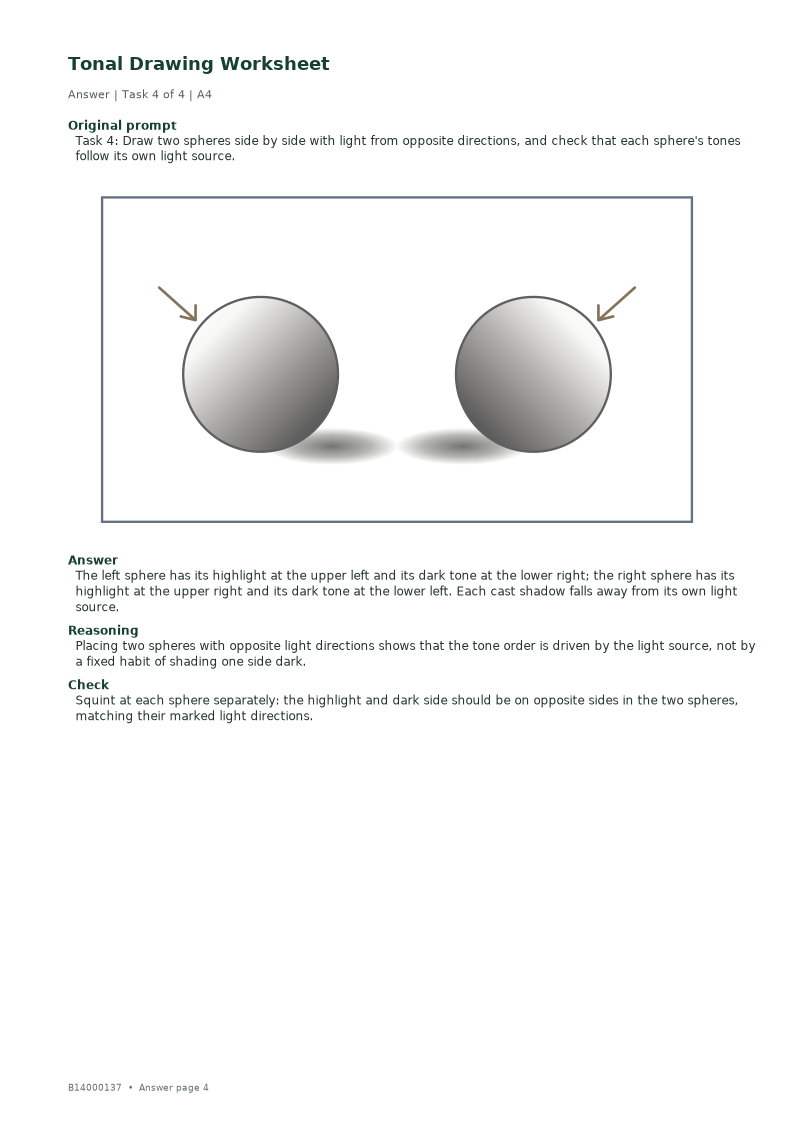
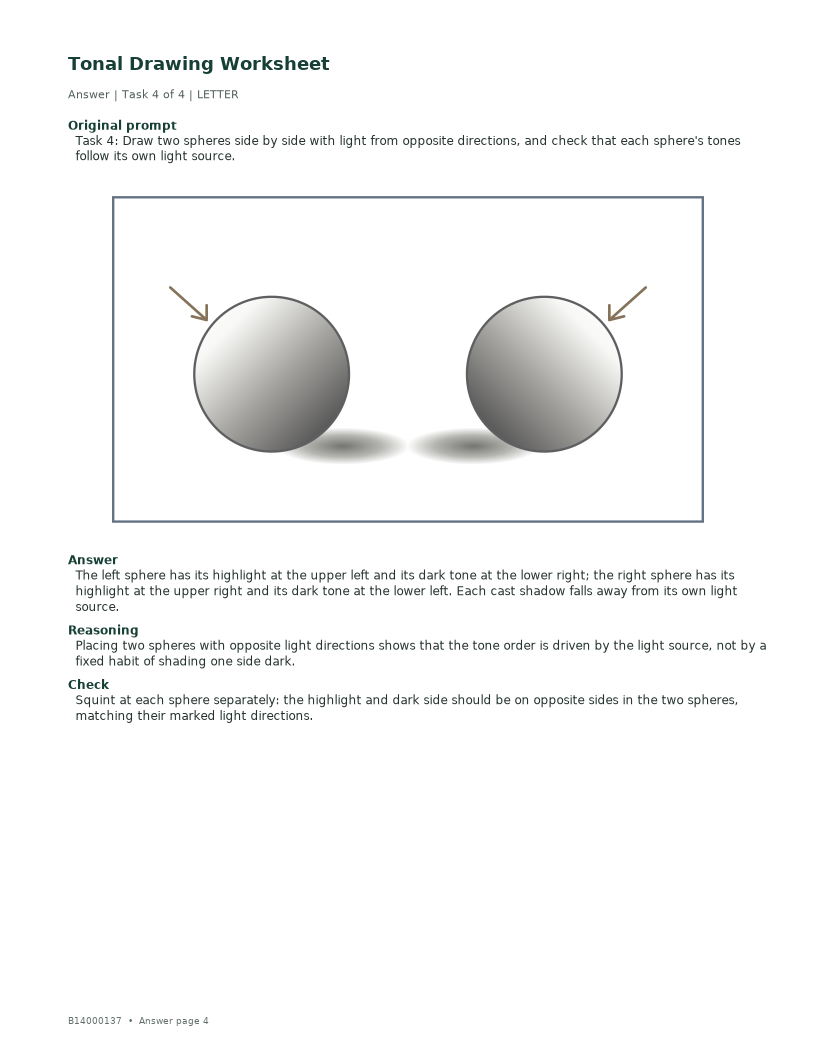
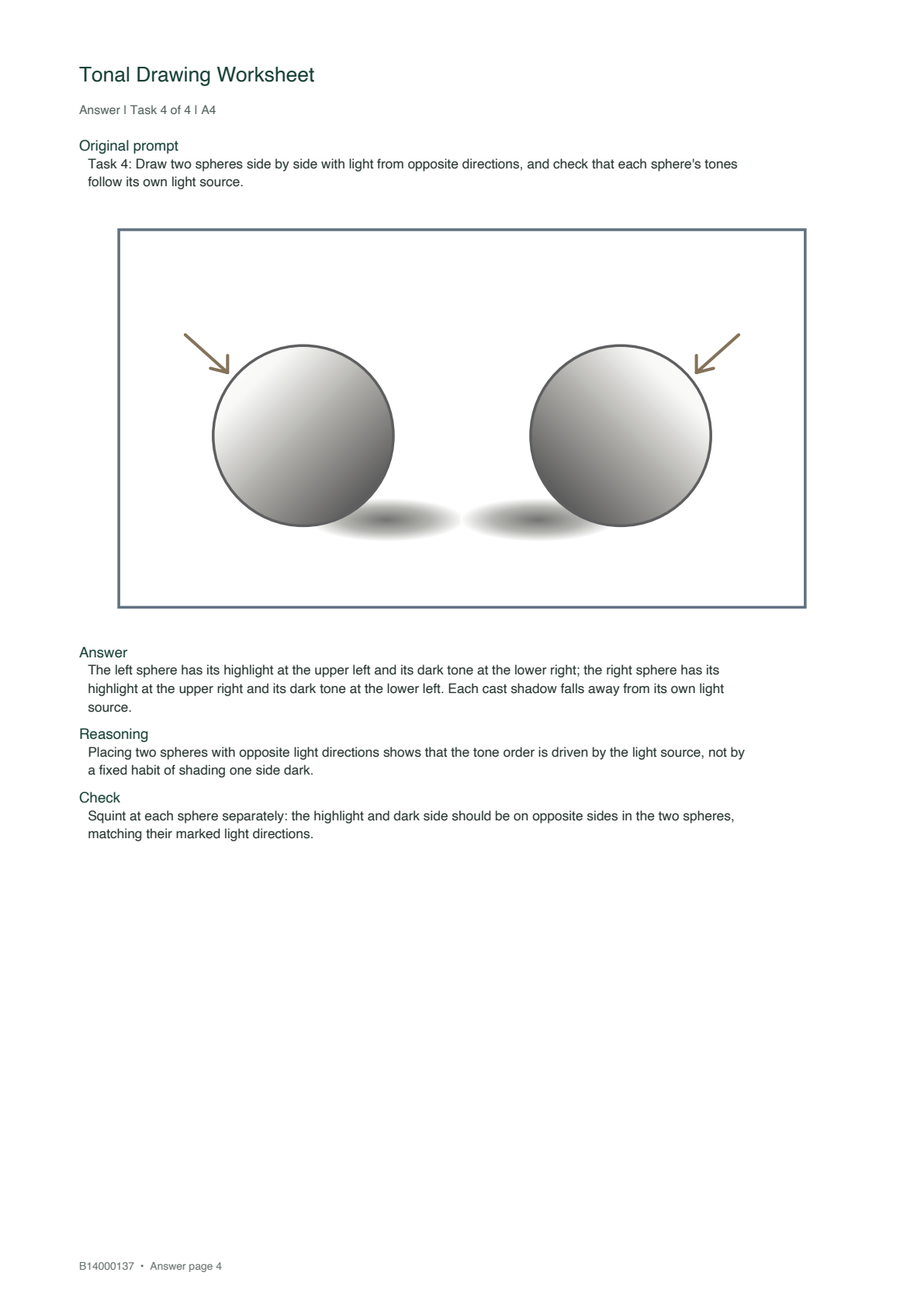
Task 4: Draw two spheres side by side with light from opposite directions, and check that each sphere's tones follow its own light source.
Show answer 4
The left sphere has its highlight at the upper left and its dark tone at the lower right; the right sphere has its highlight at the upper right and its dark tone at the lower left. Each cast shadow falls away from its own light source.
Placing two spheres with opposite light directions shows that the tone order is driven by the light source, not by a fixed habit of shading one side dark.
Check: Squint at each sphere separately: the highlight and dark side should be on opposite sides in the two spheres, matching their marked light directions.
Useful checks
- Making the value scale with only two tones, a light box and a dark box. Build the middle boxes first with light crossed strokes, then darken the last box, so all five steps are visible.
- Shading the sphere evenly all over so it looks flat. Decide the light direction first, keep the highlight near bare paper, and place the dark tone opposite the light.
- Putting the cast shadow on the same side as the light source. The cast shadow always falls away from the light, so place it on the side opposite the highlight.
Questions about this resource
Do I need special pencils for a tonal scale?
No. A single ordinary pencil can make all five tones by changing pressure and stroke density; softer pencils simply reach the dark tone faster.
How do I know my scale steps are even?
Squint at the row and check that each box looks clearly darker than the one before, with no two neighbouring boxes matching.