Free original lessons
Draw a Bed in Perspective
This pack teaches you to draw a bed in perspective by first drawing its front view, then projecting it back to a single vanishing point. You will build the bed as a box, add the mattress and headboard, and check that all receding edges converge correctly.
Letter & A4
PDF & SVG
What you are drawing
A bed in perspective is a box seen from one corner: the front face stays flat and true, while the sides and top recede toward a single vanishing point. The front view is your flat reference; the perspective plate is the same bed pushed back into depth.
You need a horizon line, one vanishing point on it, and a front rectangle for the bed's foot end. Every edge that runs away from you points at that vanishing point.
Step-by-step construction
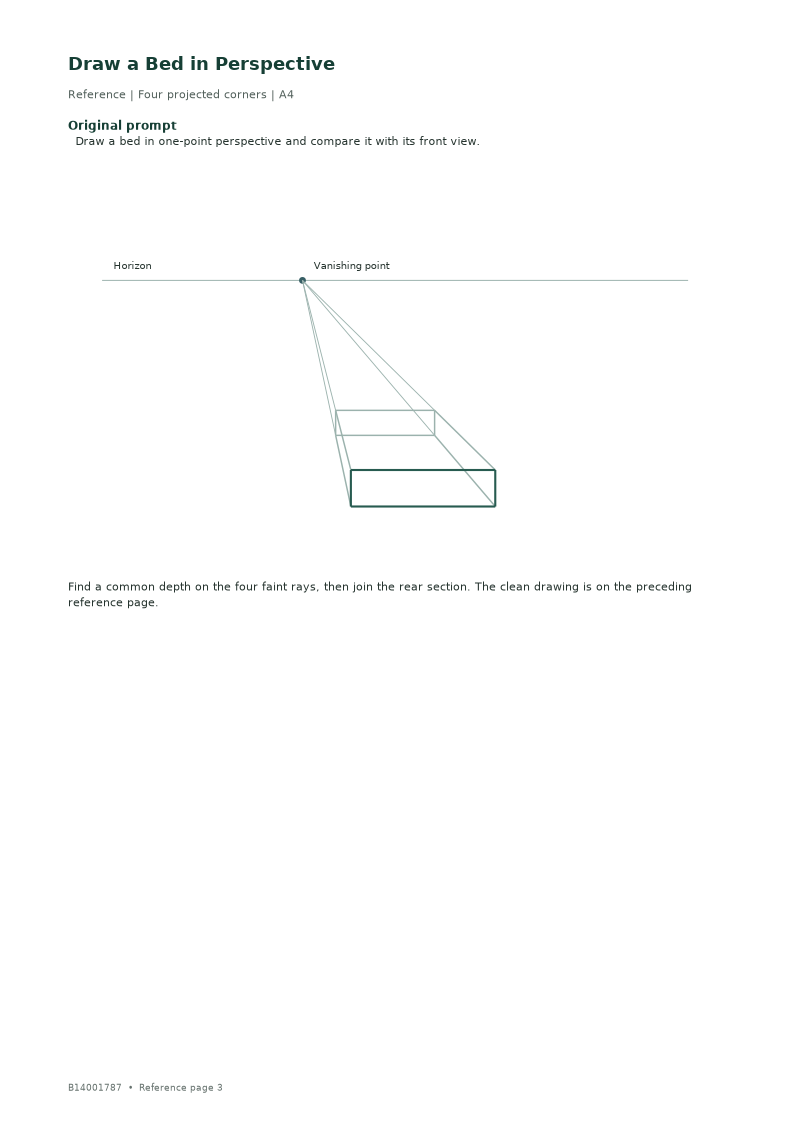
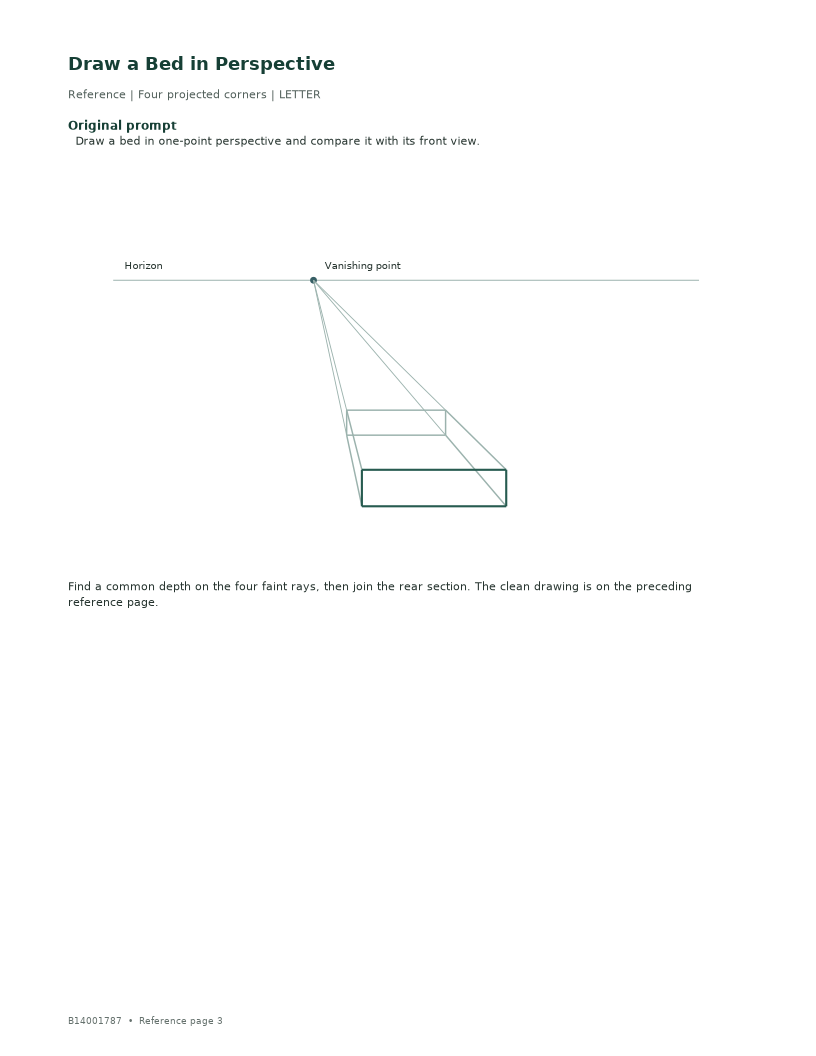
Mark the vanishing point on the horizon. Draw the foot-end rectangle and extend light rays from its four corners. Choose one depth on the rays and close the rear rectangle. Add the shallow mattress, with its lengthwise edges aimed at the same point. Raise the headboard from the rear cross-section. Its face has level and upright edges; any small lengthwise thickness follows the rays. Erase the guides from the final view.
Worked example
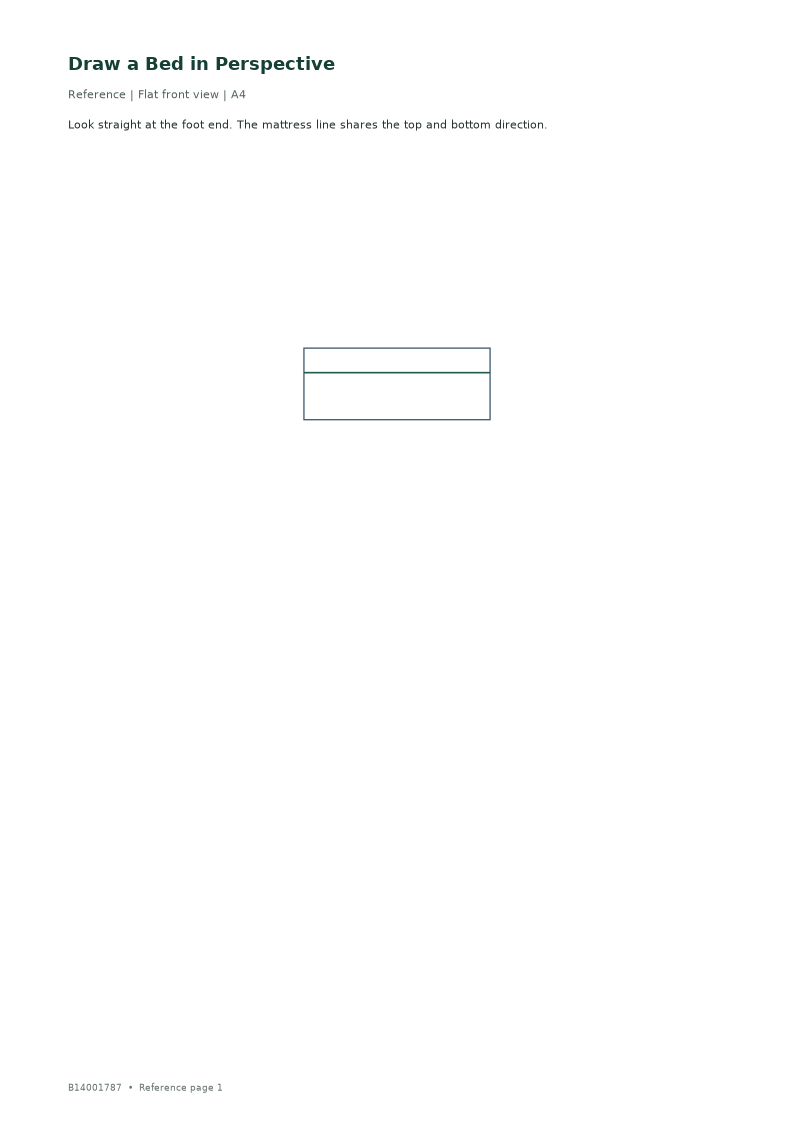
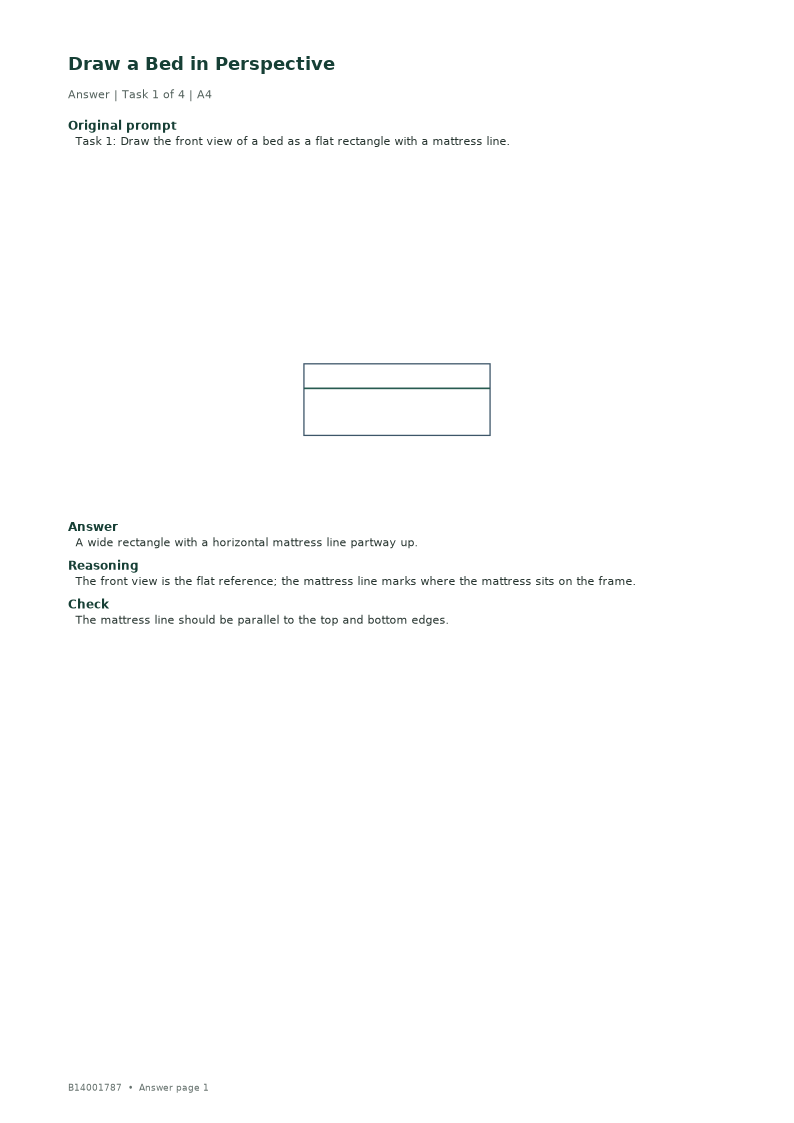
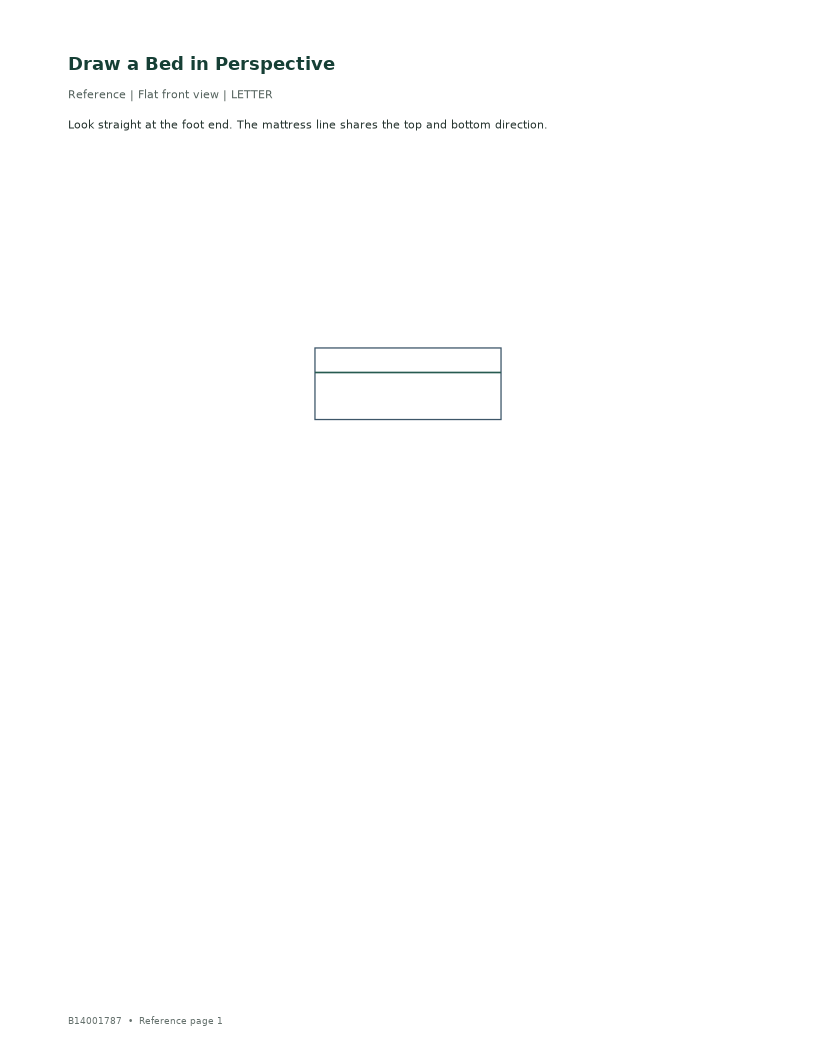
Front view: draw a rectangle wider than it is tall for the bed's foot end, with a low mattress line across it. This is the flat reference.
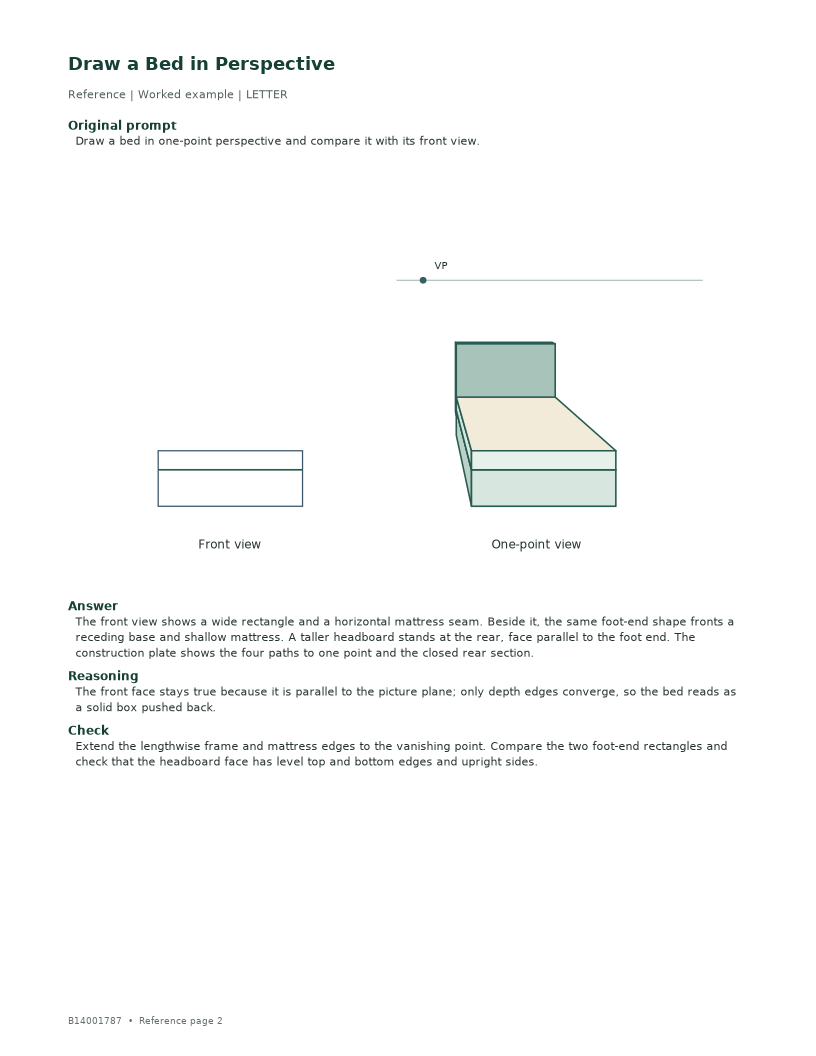
Keep the same front cross-section. Send four guides toward the vanishing point, choose one depth for the rear section, and line up the mattress and headboard with it. The upright headboard faces the camera like the foot end.
Practice tasks
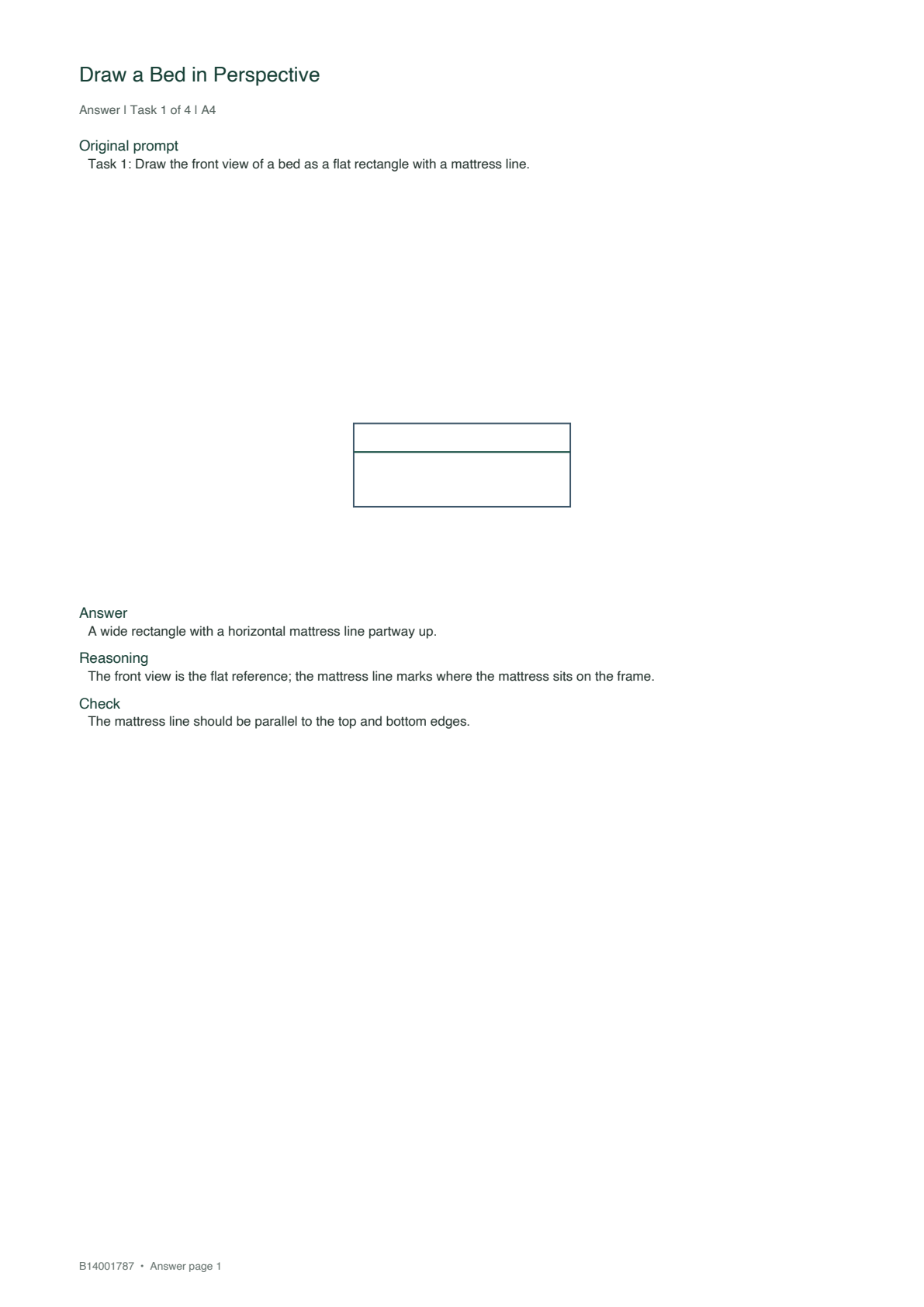
Task 1: Draw the front view of a bed as a flat rectangle with a mattress line. Answer: a wide rectangle with a horizontal line partway up; check that the mattress line is parallel to the top and bottom.
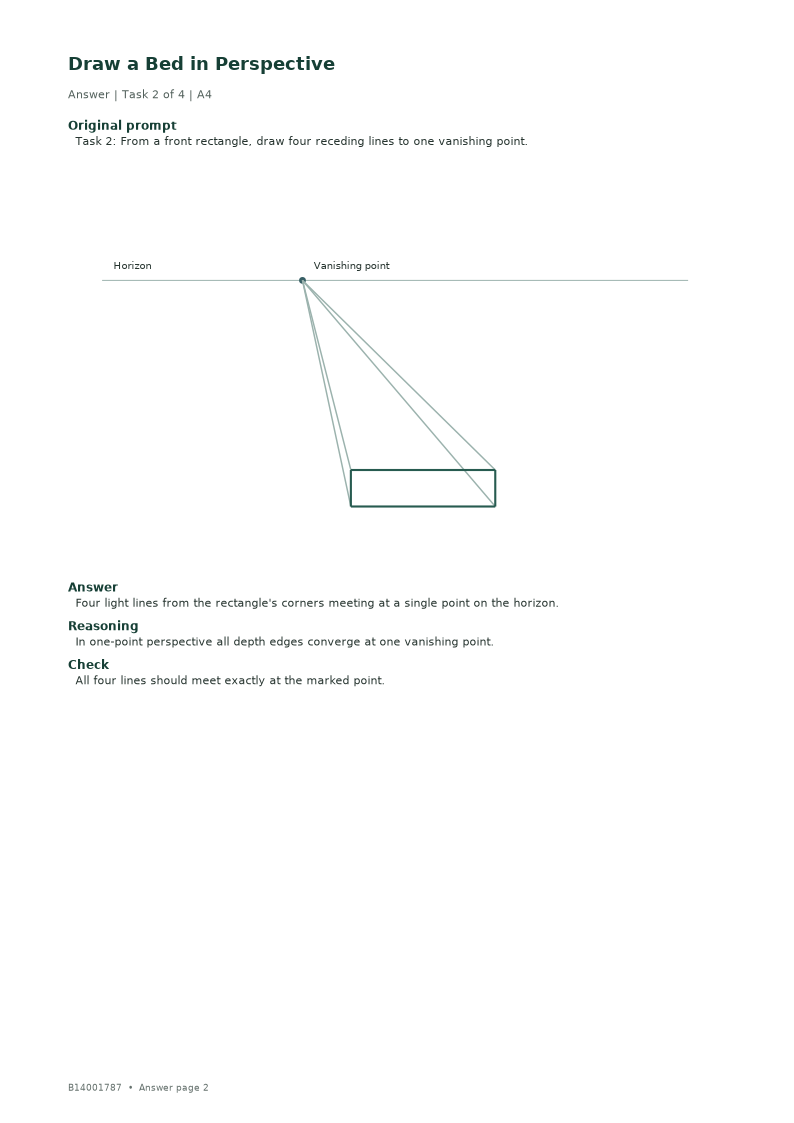
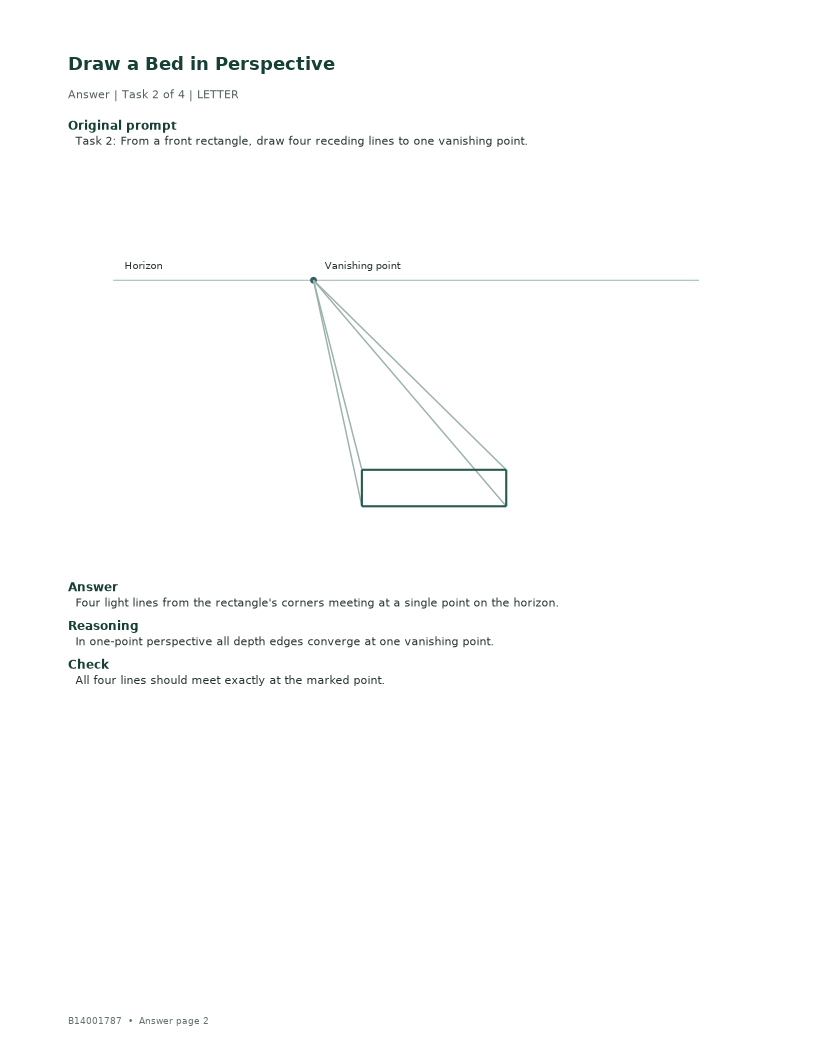
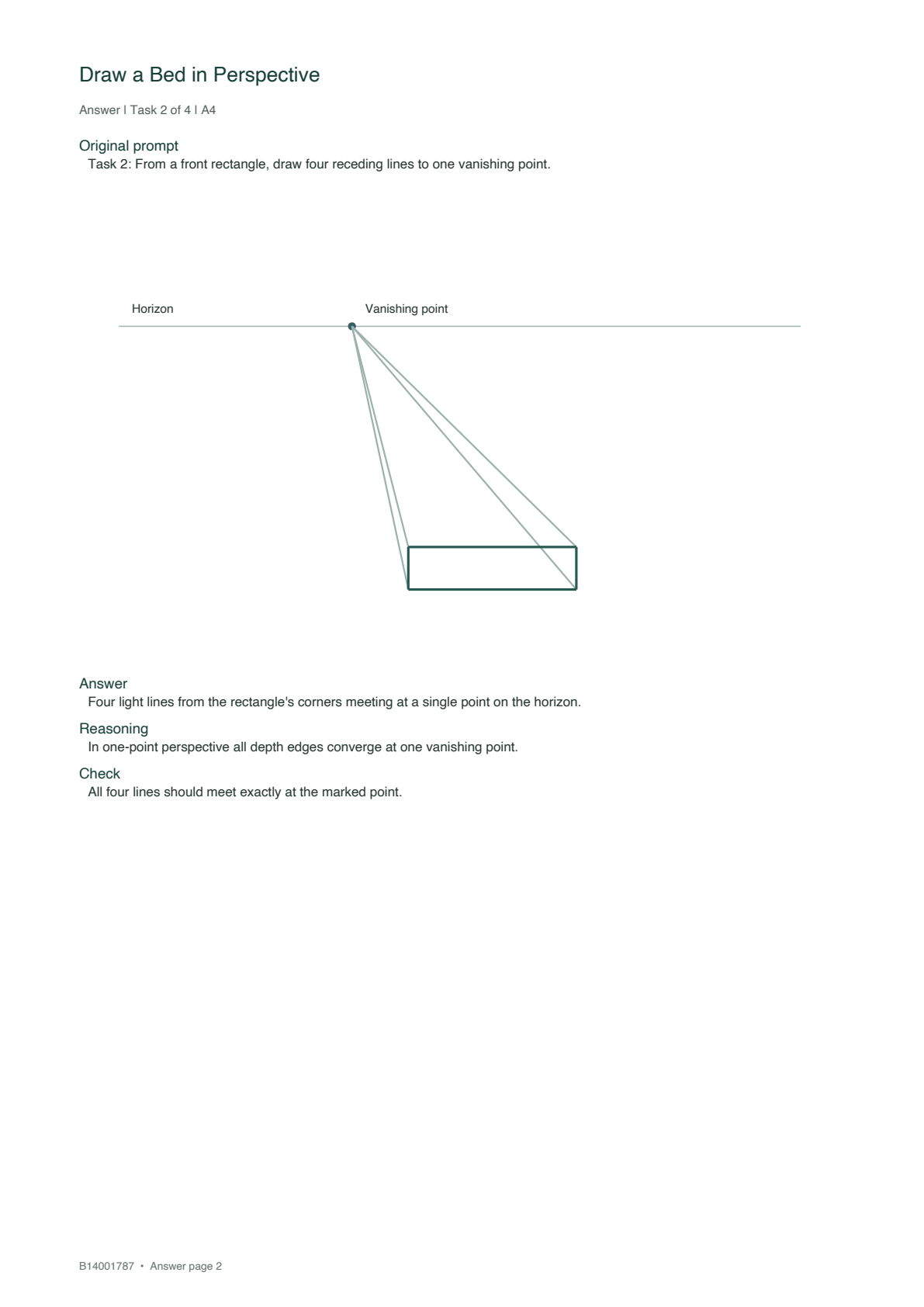
Task 2: From a front rectangle, draw the receding lines to one vanishing point. Answer: four light lines from the corners meeting at the point; check that all four lines actually meet there, not near it.
Download the complete resource pack
All individual SVG pages (22)
- A4 reference page 1
- A4 reference page 2
- A4 reference page 3
- A4 student page 1
- A4 student page 2
- A4 student page 3
- A4 student page 4
- A4 answer page 1
- A4 answer page 2
- A4 answer page 3
- A4 answer page 4
- LETTER reference page 1
- LETTER reference page 2
- LETTER reference page 3
- LETTER student page 1
- LETTER student page 2
- LETTER student page 3
- LETTER student page 4
- LETTER answer page 1
- LETTER answer page 2
- LETTER answer page 3
- LETTER answer page 4
Print at 100% / actual size. Use the stated scale on any schematic diagram; physical cutting templates are identified separately. A4 and US Letter are separate files. Free access, no signup; CC BY 4.0.
How to use these pages
- What you are drawing
- Step-by-step construction
- Worked example
- Practice tasks
Worked example
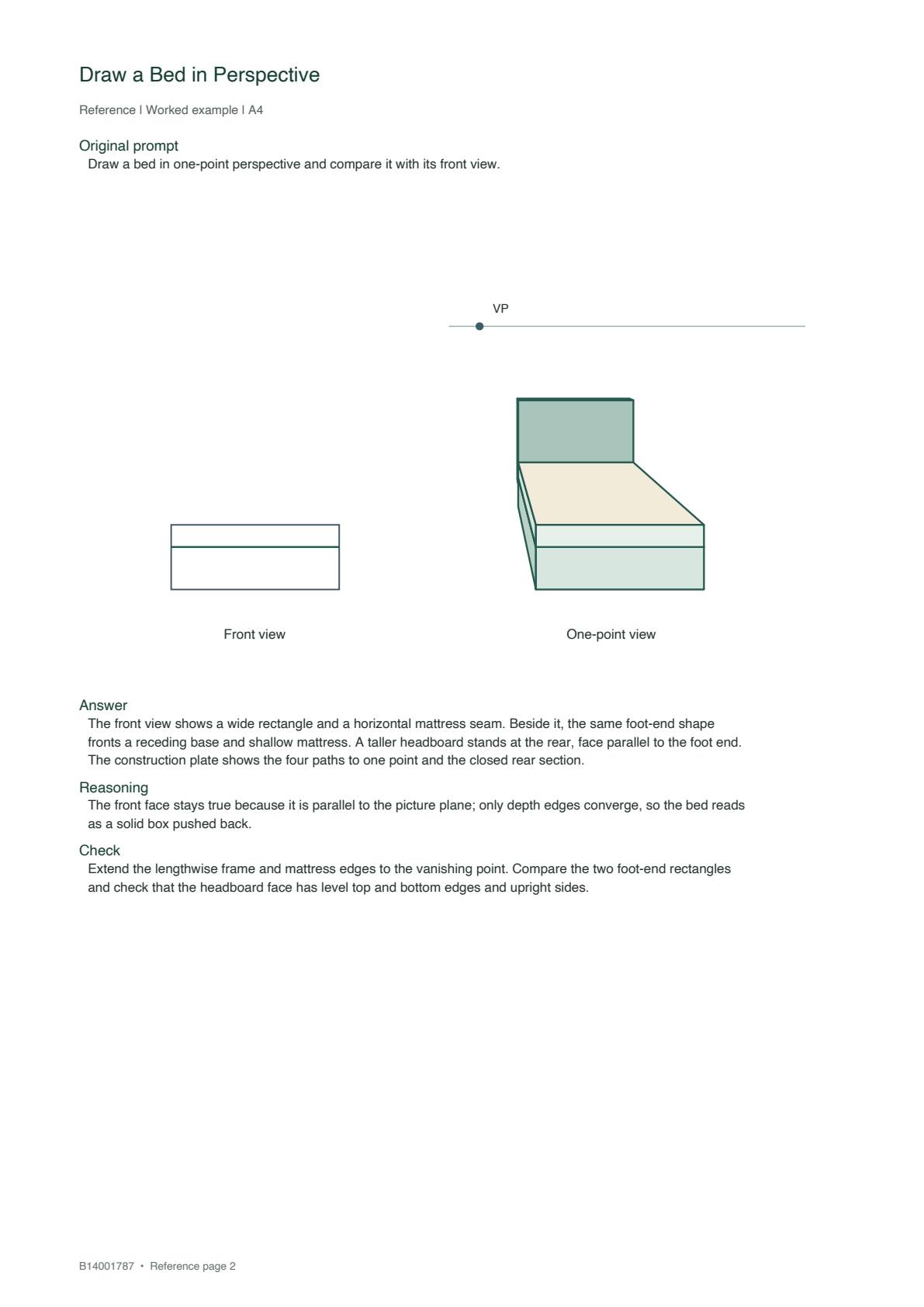
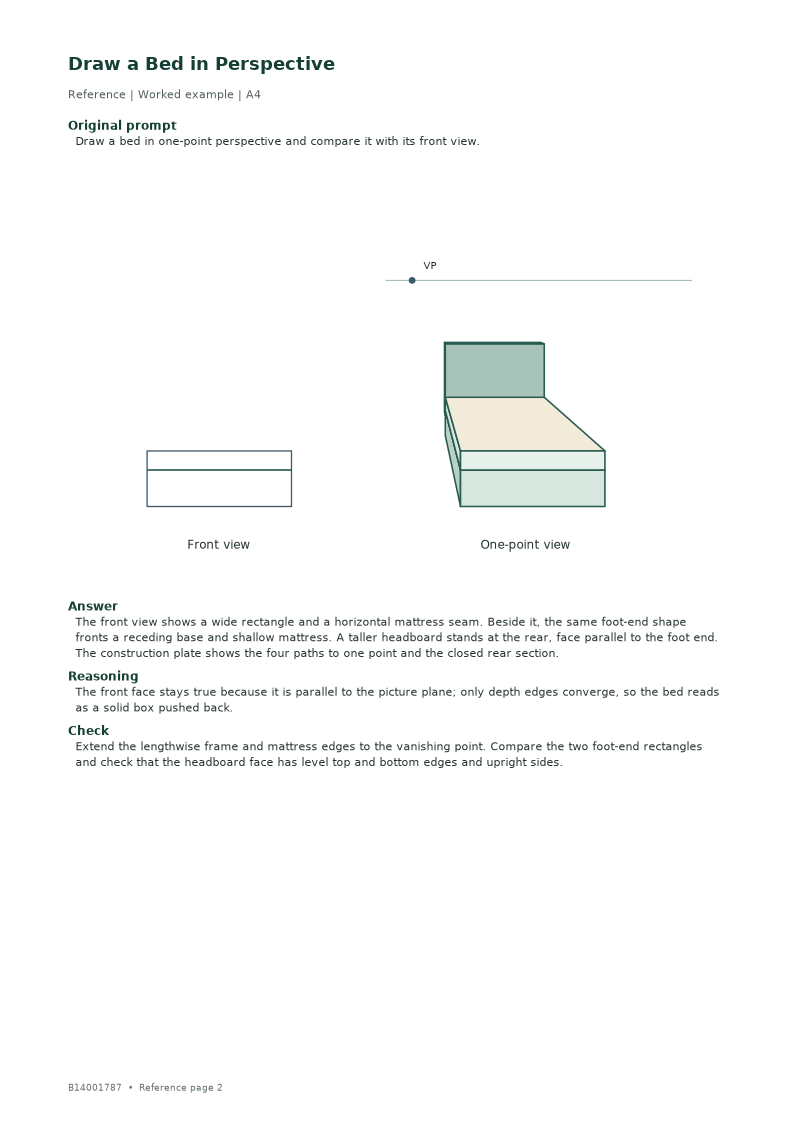
Example: Draw a bed in one-point perspective and compare it with its front view.
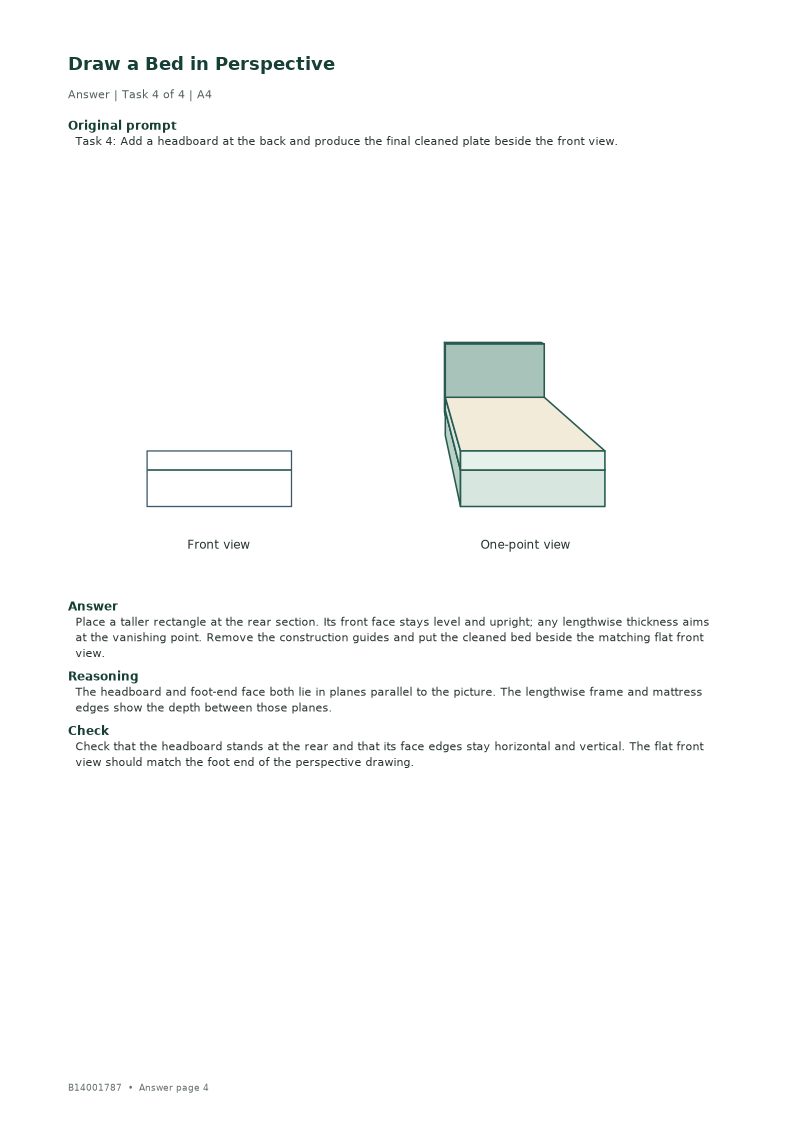
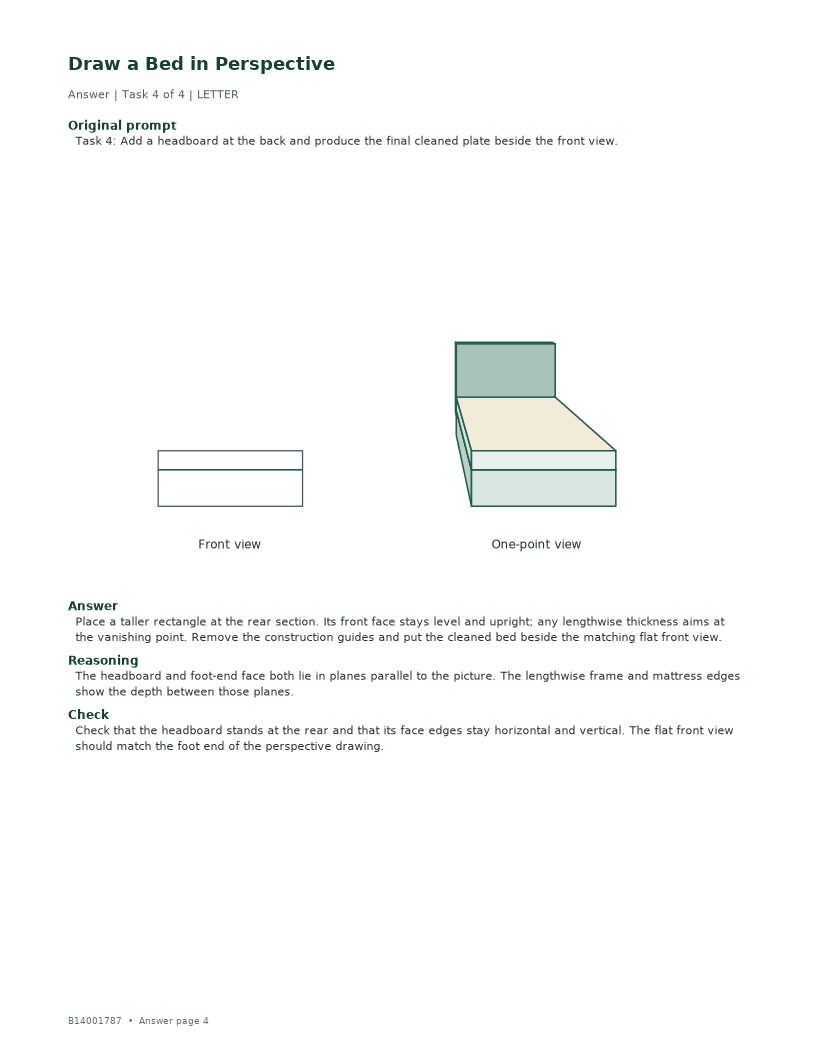
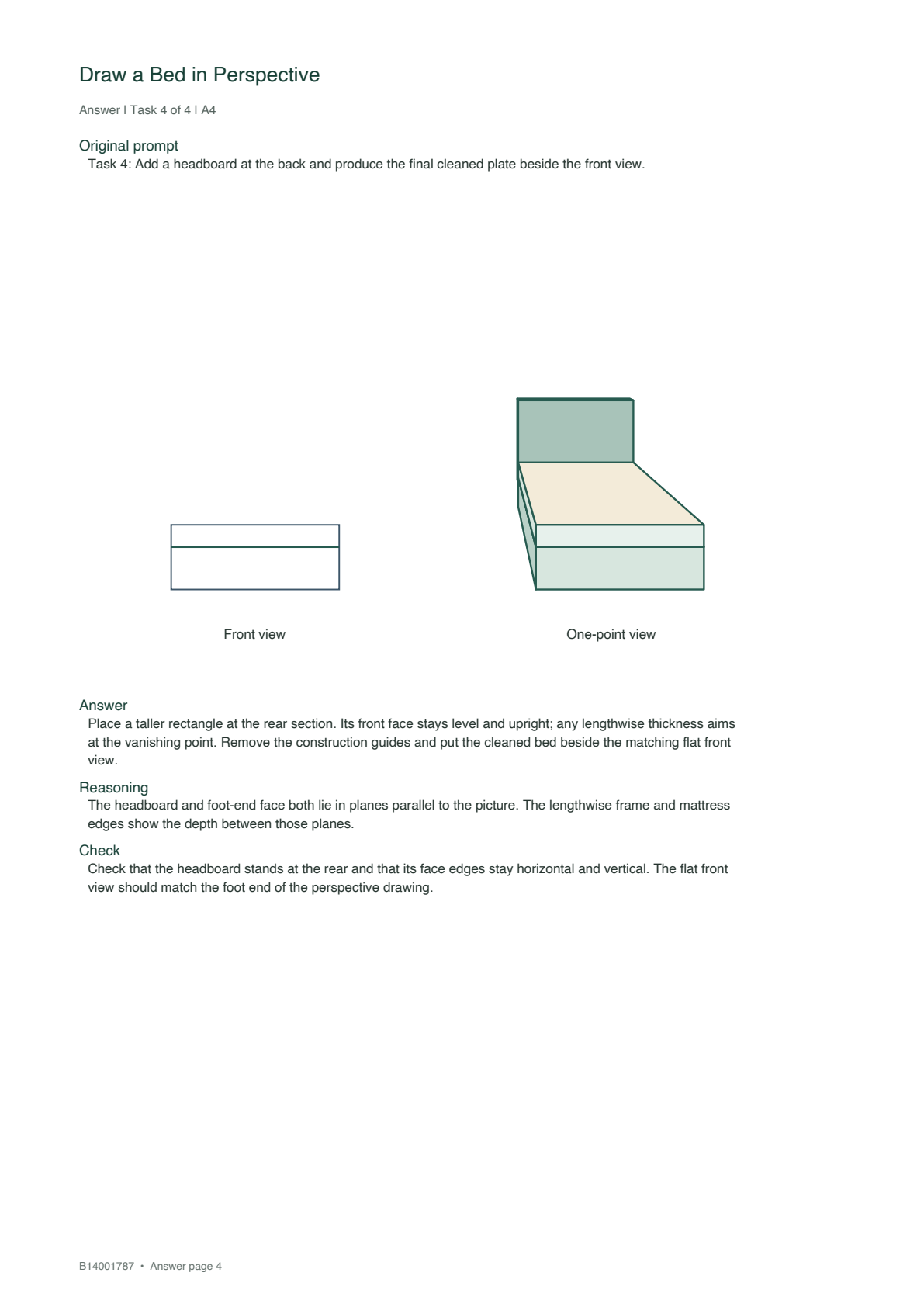
Answer: The front view shows a wide rectangle and a horizontal mattress seam. Beside it, the same foot-end shape fronts a receding base and shallow mattress. A taller headboard stands at the rear, face parallel to the foot end. The construction plate shows the four paths to one point and the closed rear section.
Reasoning: The front face stays true because it is parallel to the picture plane; only depth edges converge, so the bed reads as a solid box pushed back.
Check: Extend the lengthwise frame and mattress edges to the vanishing point. Compare the two foot-end rectangles and check that the headboard face has level top and bottom edges and upright sides.
Four practice tasks and complete answers
Task 1
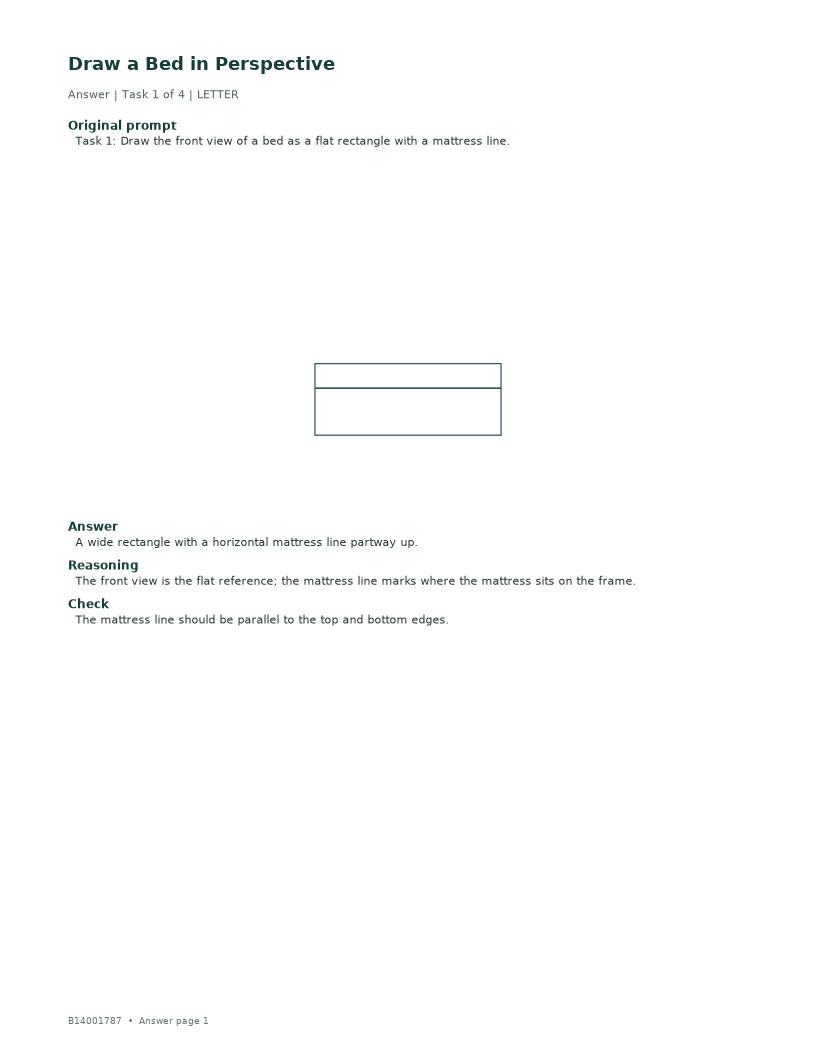
Task 1: Draw the front view of a bed as a flat rectangle with a mattress line.
Show answer 1
A wide rectangle with a horizontal mattress line partway up.
The front view is the flat reference; the mattress line marks where the mattress sits on the frame.
Check: The mattress line should be parallel to the top and bottom edges.
Task 2
Task 2: From a front rectangle, draw four receding lines to one vanishing point.
Show answer 2
Four light lines from the rectangle's corners meeting at a single point on the horizon.
In one-point perspective all depth edges converge at one vanishing point.
Check: All four lines should meet exactly at the marked point.
Task 3
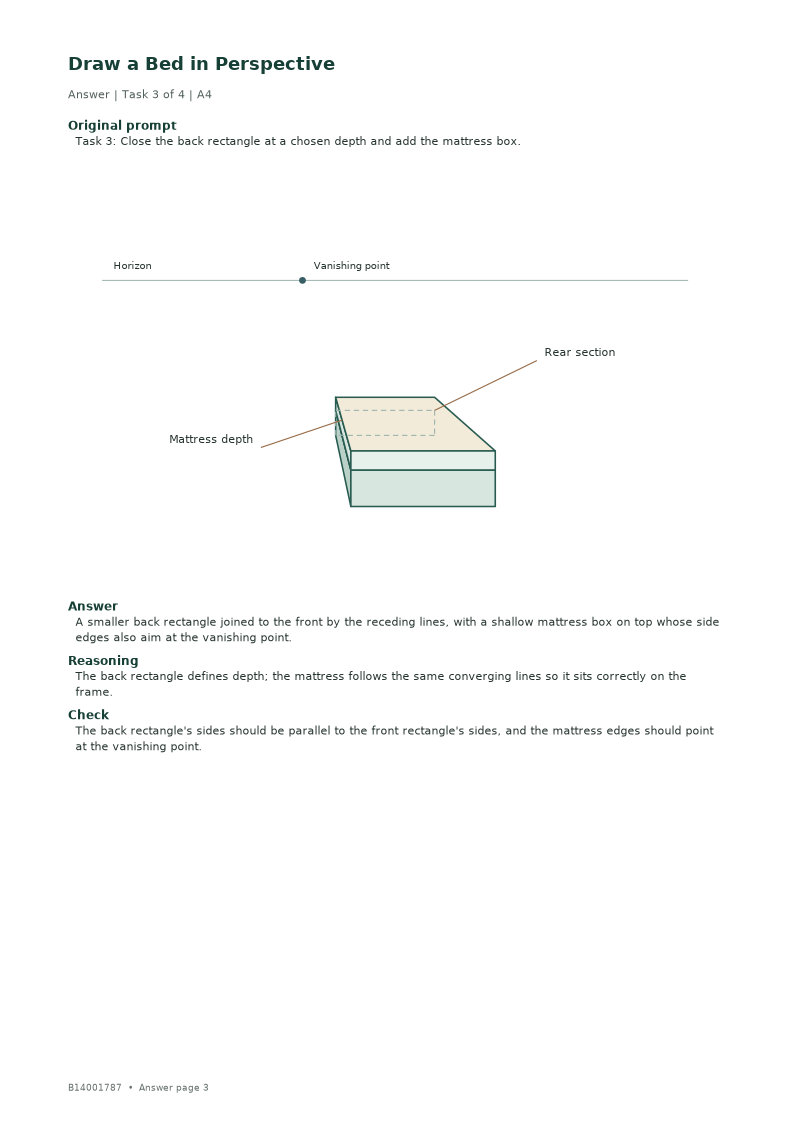
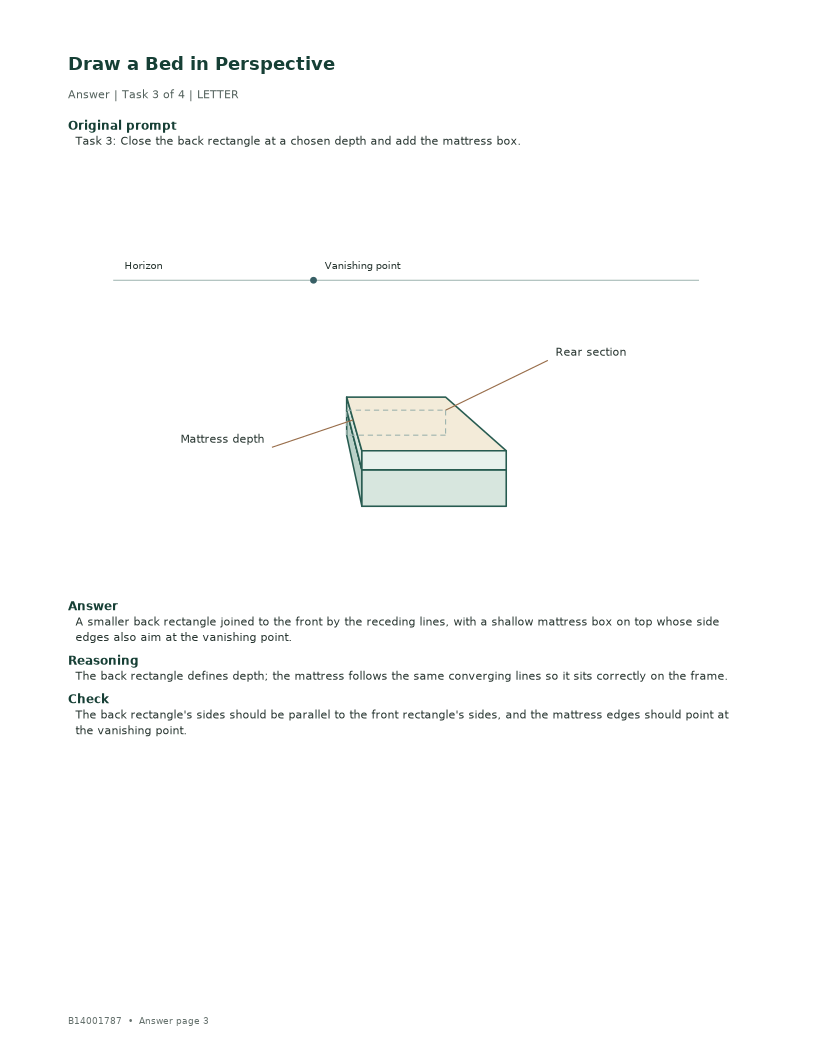
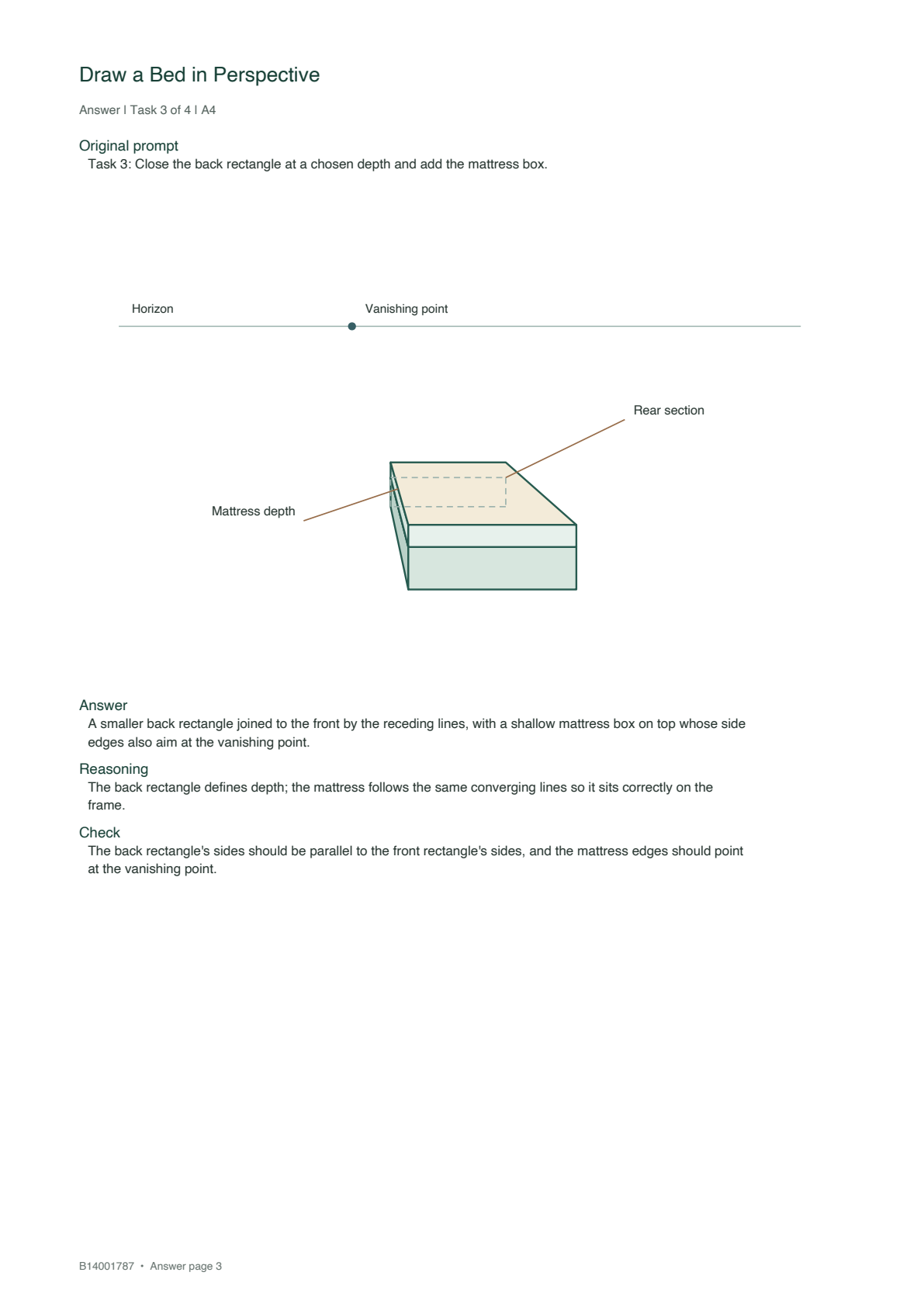
Task 3: Close the back rectangle at a chosen depth and add the mattress box.
Show answer 3
A smaller back rectangle joined to the front by the receding lines, with a shallow mattress box on top whose side edges also aim at the vanishing point.
The back rectangle defines depth; the mattress follows the same converging lines so it sits correctly on the frame.
Check: The back rectangle's sides should be parallel to the front rectangle's sides, and the mattress edges should point at the vanishing point.
Task 4
Task 4: Add a headboard at the back and produce the final cleaned plate beside the front view.
Show answer 4
Place a taller rectangle at the rear section. Its front face stays level and upright; any lengthwise thickness aims at the vanishing point. Remove the construction guides and put the cleaned bed beside the matching flat front view.
The headboard and foot-end face both lie in planes parallel to the picture. The lengthwise frame and mattress edges show the depth between those planes.
Check: Check that the headboard stands at the rear and that its face edges stay horizontal and vertical. The flat front view should match the foot end of the perspective drawing.
Useful checks
- Using two vanishing points for a one-point bed. Keep one vanishing point; only depth edges converge, front edges stay parallel.
- Letting receding lines miss the vanishing point. Extend each light line until it passes exactly through the marked point before darkening.
Questions about this resource
Do I need measurements?
No; this is a qualitative construction. Choose a depth that looks right and check convergence visually.
Why compare front view and perspective?
The front view shows true shape; the perspective plate shows the same shape pushed into depth, making the construction easy to check.