Free original lessons
Draw Text in One-Point Perspective
One-point perspective lettering makes flat letters look like solid blocks receding toward a single vanishing point. You draw the letter's front face, then send every depth edge back to that point and cut the back face where the depth lines stop.
Letter & A4
PDF & SVG
What you are building
A one-point perspective lettering plate has three parts: a front plane holding the letter shapes, a single vanishing point, and depth edges that run from the front letter to that point. The back face is a smaller copy of the front face, placed where the depth edges are cut.
The vanishing point is a chosen point on the horizon line. Every depth edge of every letter must aim at that same point; that shared aim is what makes the letters read as one scene rather than separate drawings.
Step-by-step construction
1. Draw a horizon line and mark one vanishing point on it. 2. Draw each flat front outline. 3. Draw a light ray from each front corner or selected curve point to the vanishing point. 4. Mark the same fraction of the way from its front point to the vanishing point on each ray. 5. Join the marks to make smaller, parallel rear outlines. 6. Erase the guide extensions from the clean view and darken visible edges.
Worked example
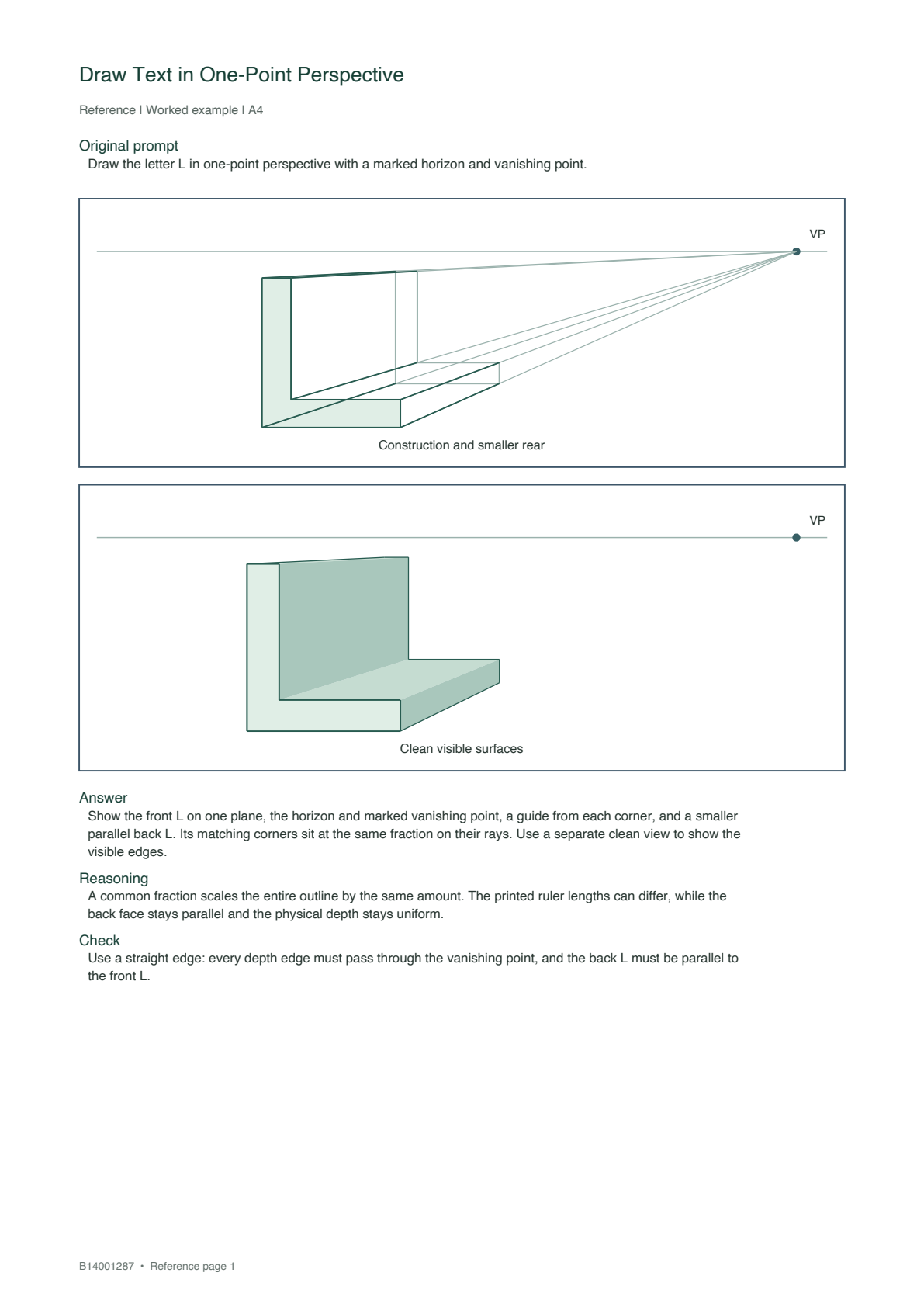
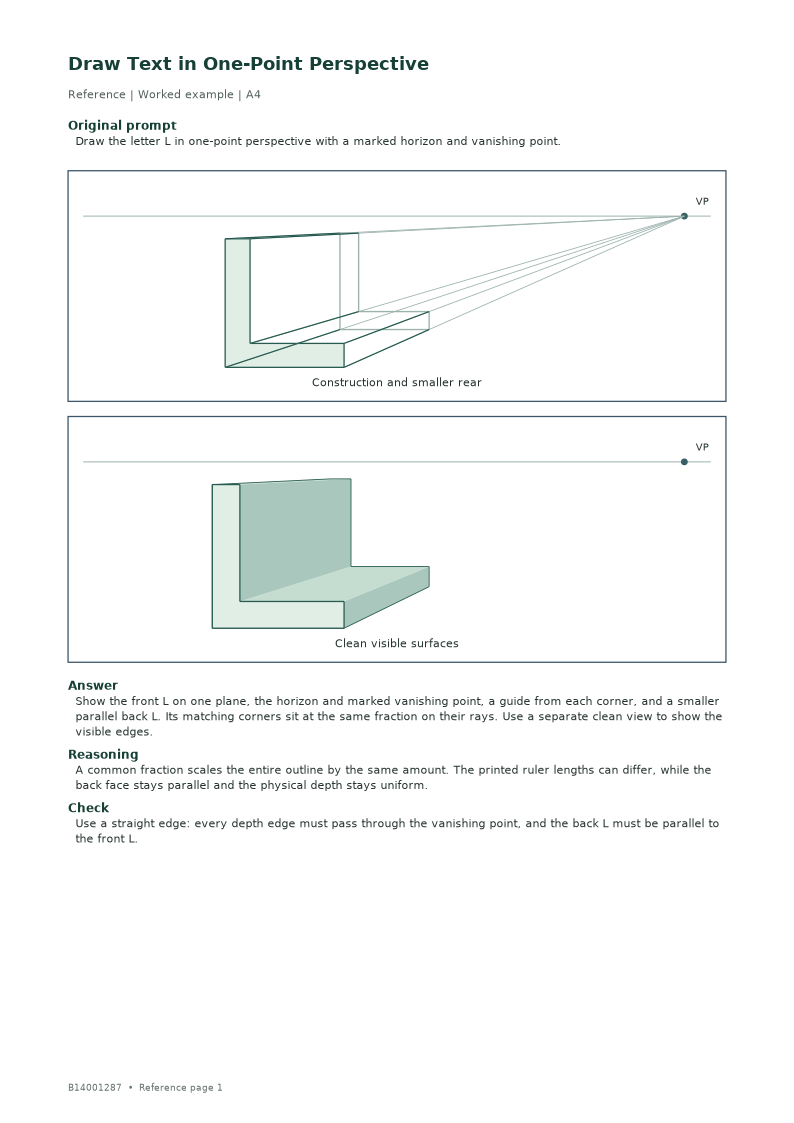
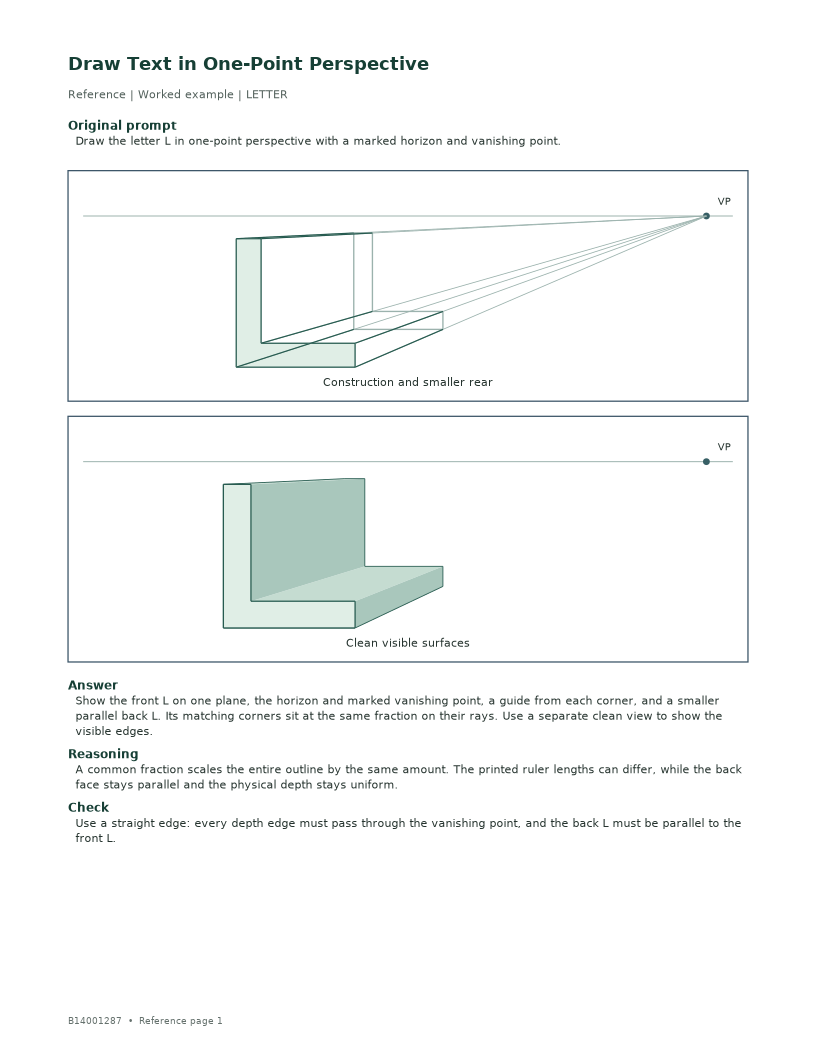
Draw a front L and mark a vanishing point on the horizon. Aim a guide from each of the six corners of the block L to the point. Place each rear corner one quarter of the way along its own ray, then join the marks to make a smaller L. The printed lengths differ where the rays have different lengths.
Check: every depth edge points at the vanishing point, the back L is parallel to the front L, and the visible edges are the front face plus the depth edges that are not hidden.
Practice tasks
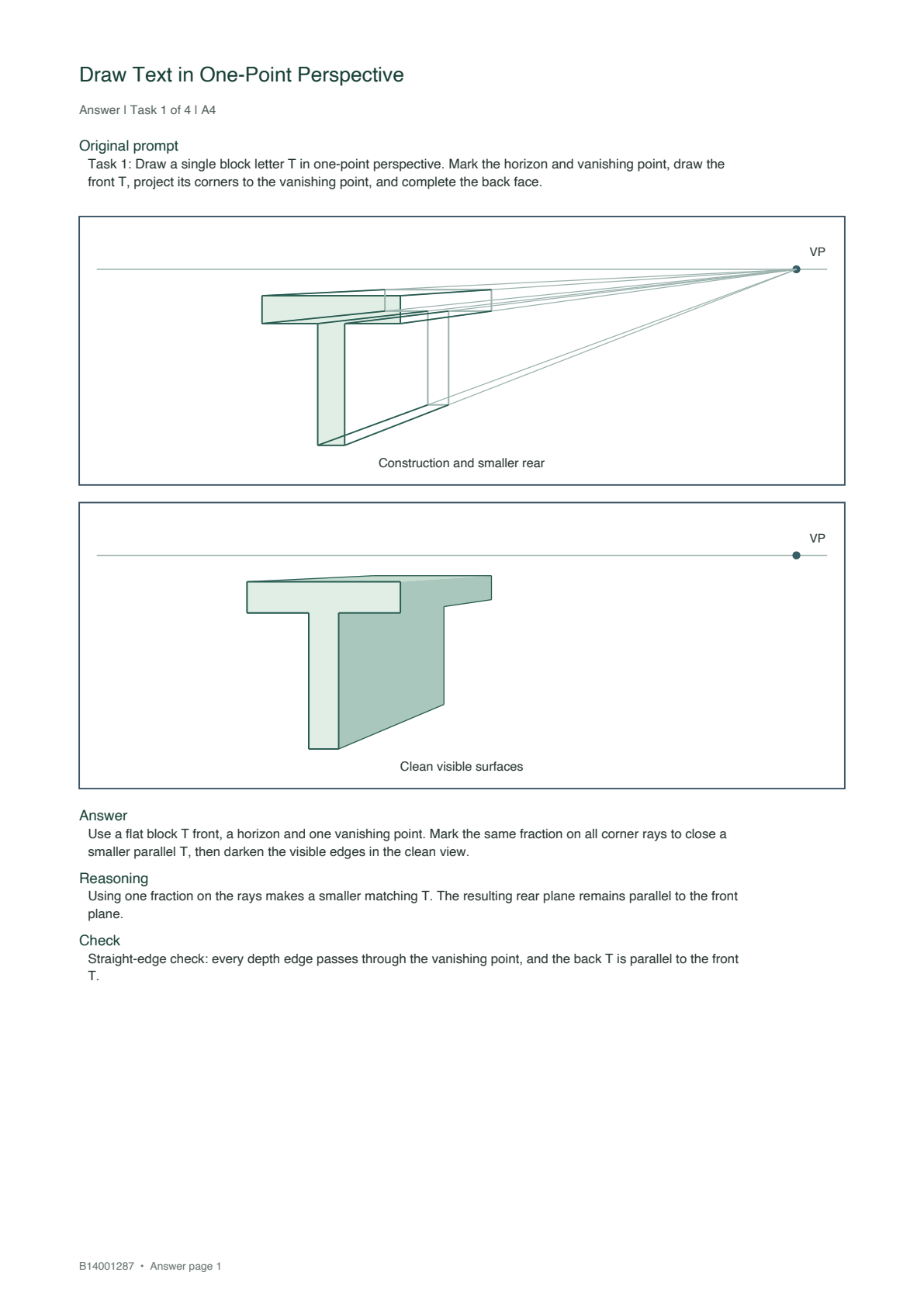
Task 1: Draw a single block letter T in one-point perspective. Mark the horizon and vanishing point, draw the front T, project its corners to the vanishing point, and complete the back face.
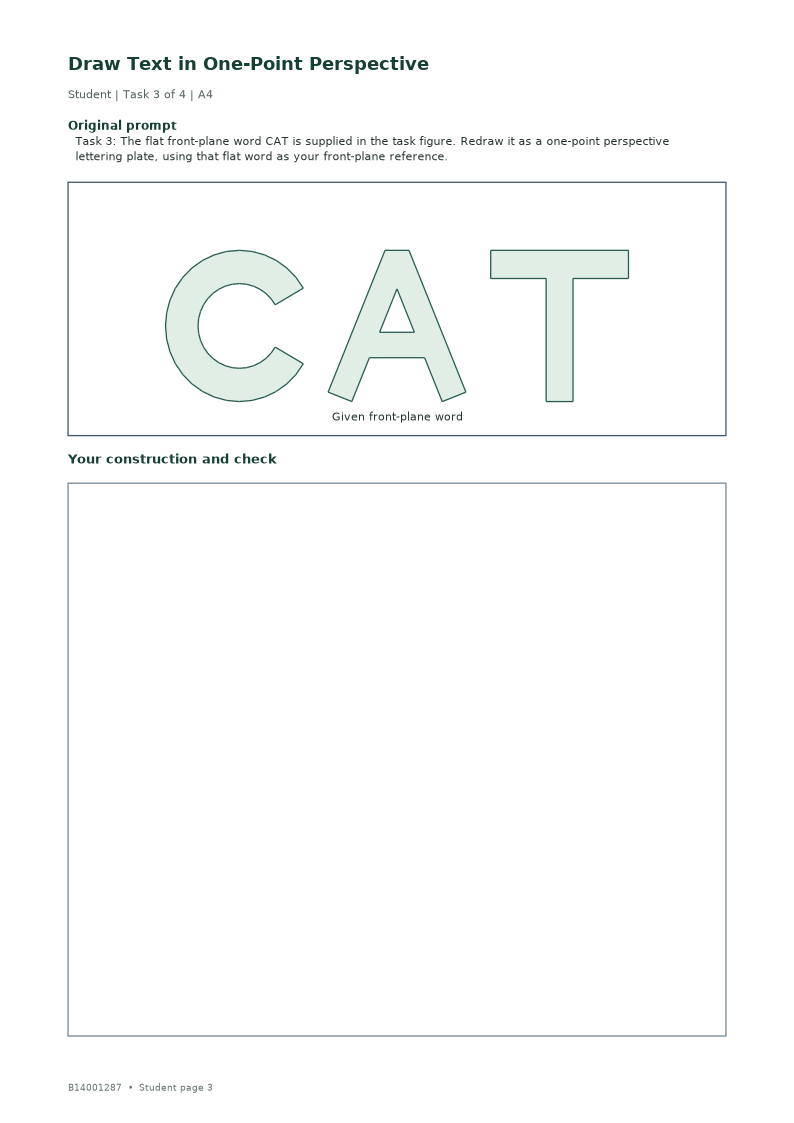
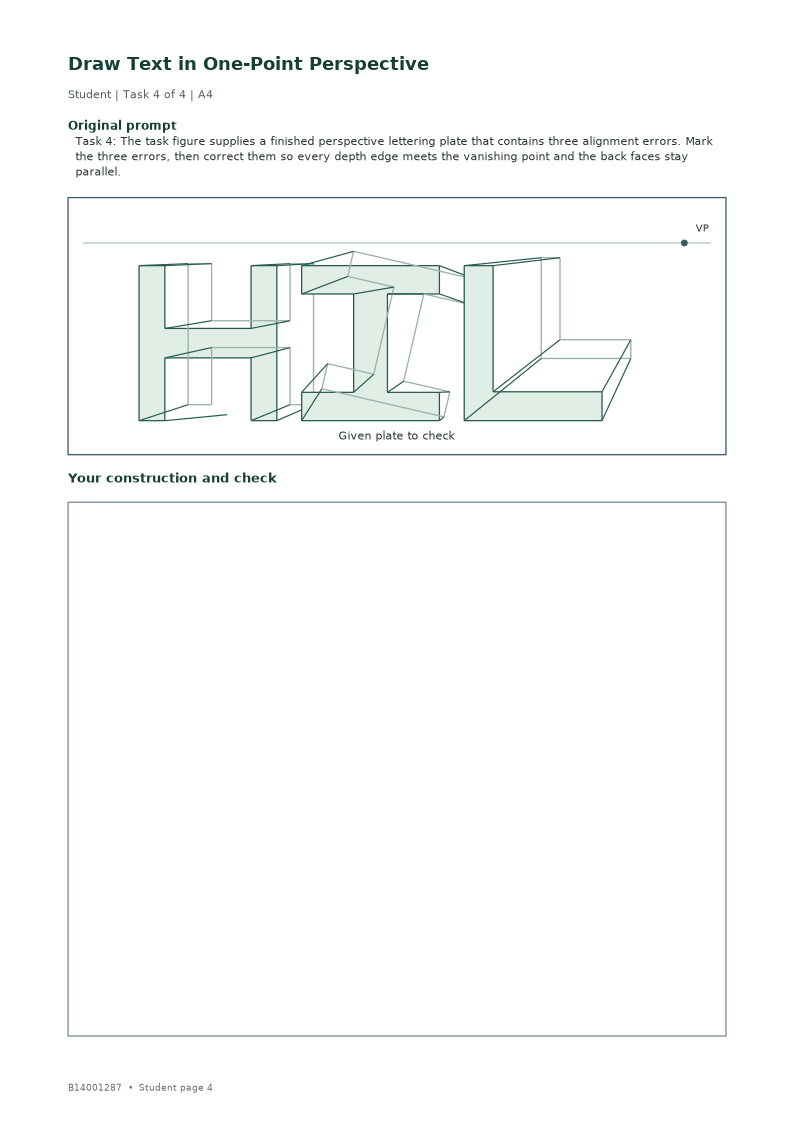
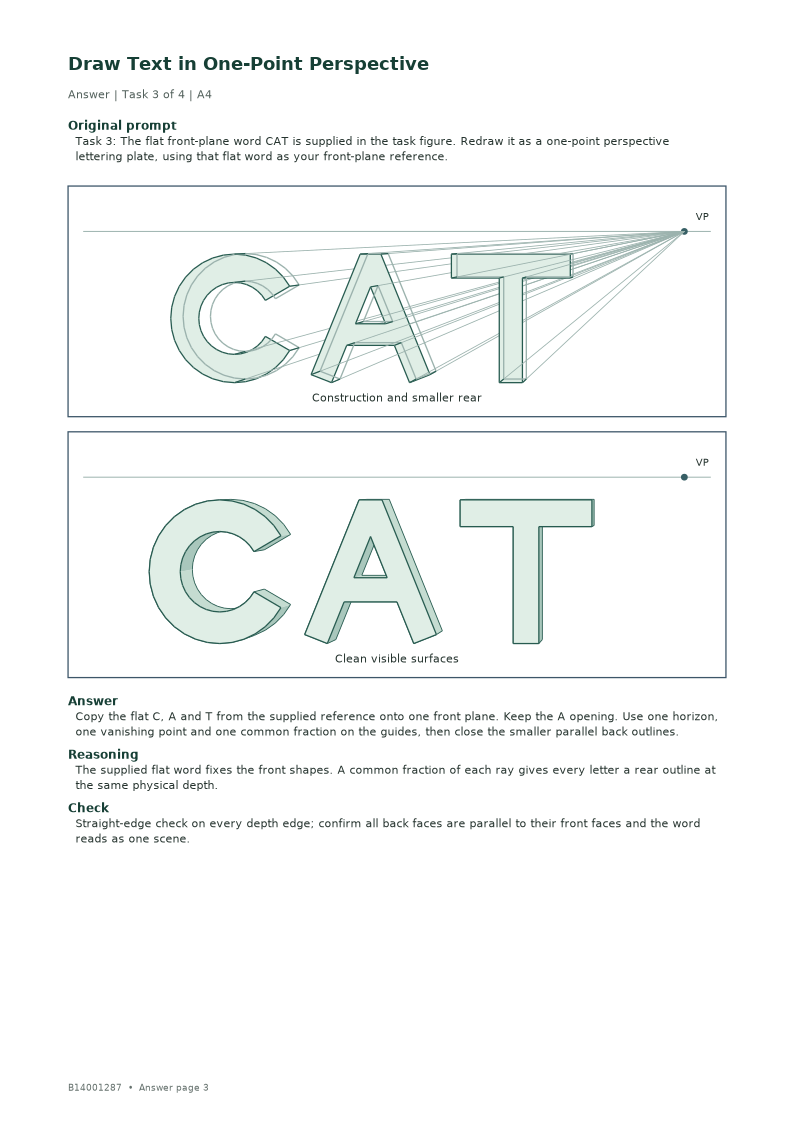
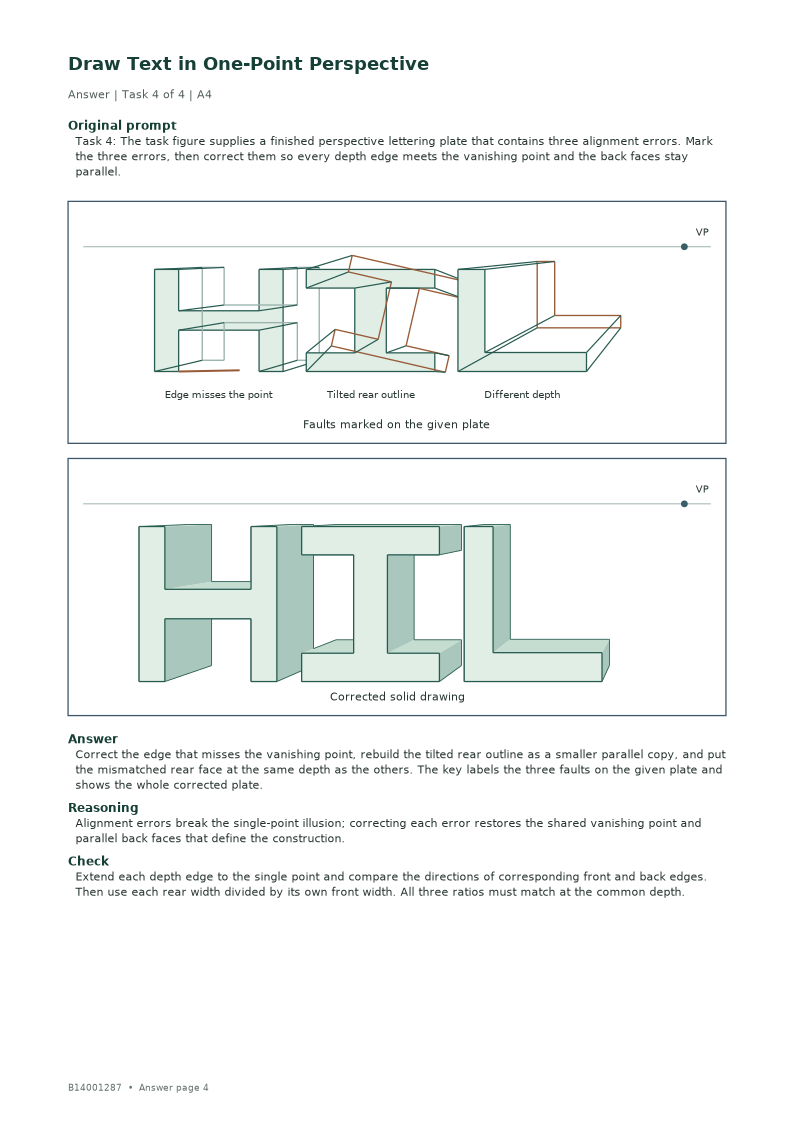
Task 2: Draw two letters, H and I, side by side on the same front plane, both receding to the same vanishing point. Keep their depth distances equal and check that all depth edges aim at the one point. Task 3: The flat front-plane word CAT is supplied in the task figure. Redraw it as a one-point perspective lettering plate, using that flat word as your front-plane reference. Task 4: The task figure supplies a finished perspective lettering plate that contains three alignment errors. Mark the three errors, then correct them so every depth edge meets the vanishing point and the back faces stay parallel.
Checking your plate
Lay a straight edge along each depth edge and confirm it passes through the vanishing point. Confirm each back face is parallel to its front face. Confirm letters share one horizon and one vanishing point. These checks catch the common errors: depth edges aimed at different points, back faces tilted, and letters drawn at inconsistent depths.
Download the complete resource pack
All individual SVG pages (18)
- A4 reference page 1
- A4 student page 1
- A4 student page 2
- A4 student page 3
- A4 student page 4
- A4 answer page 1
- A4 answer page 2
- A4 answer page 3
- A4 answer page 4
- LETTER reference page 1
- LETTER student page 1
- LETTER student page 2
- LETTER student page 3
- LETTER student page 4
- LETTER answer page 1
- LETTER answer page 2
- LETTER answer page 3
- LETTER answer page 4
Print at 100% / actual size. Use the stated scale on any schematic diagram; physical cutting templates are identified separately. A4 and US Letter are separate files. Free access, no signup; CC BY 4.0.
How to use these pages
- What you are building
- Step-by-step construction
- Worked example
- Practice tasks
- Checking your plate
Worked example
Example: Draw the letter L in one-point perspective with a marked horizon and vanishing point.
Answer: Show the front L on one plane, the horizon and marked vanishing point, a guide from each corner, and a smaller parallel back L. Its matching corners sit at the same fraction on their rays. Use a separate clean view to show the visible edges.
Reasoning: A common fraction scales the entire outline by the same amount. The printed ruler lengths can differ, while the back face stays parallel and the physical depth stays uniform.
Check: Use a straight edge: every depth edge must pass through the vanishing point, and the back L must be parallel to the front L.
Four practice tasks and complete answers
Task 1
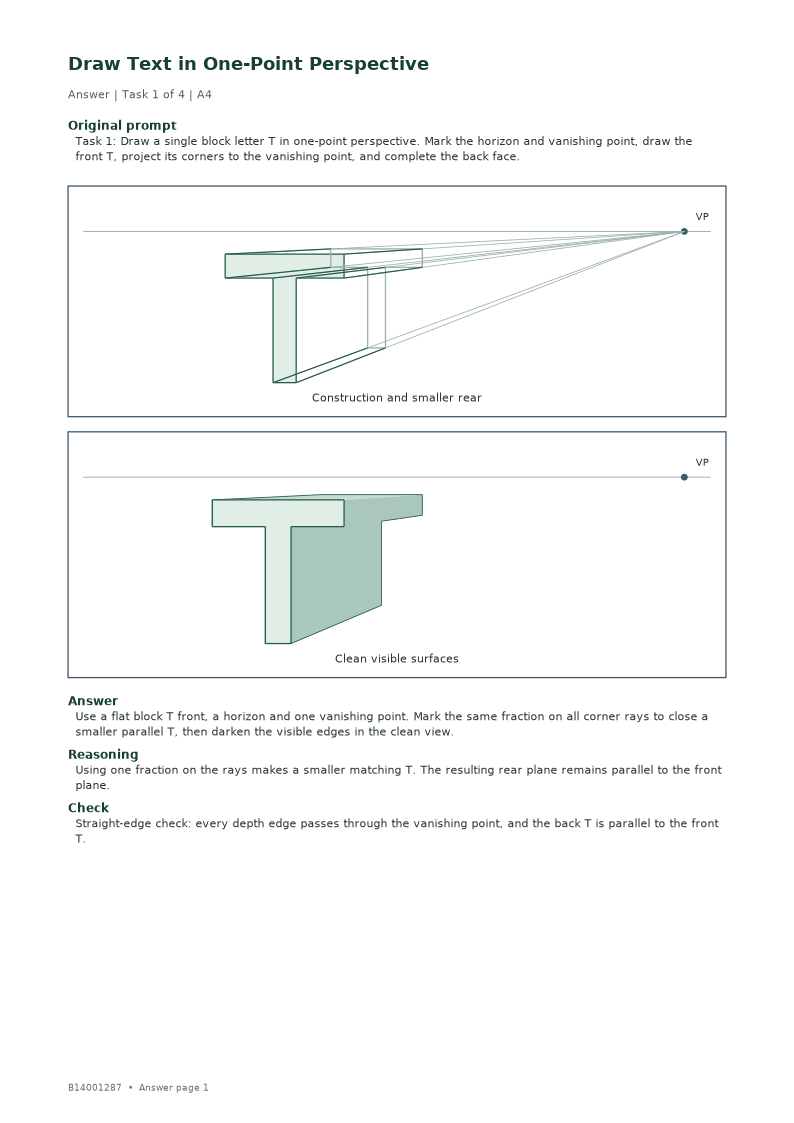
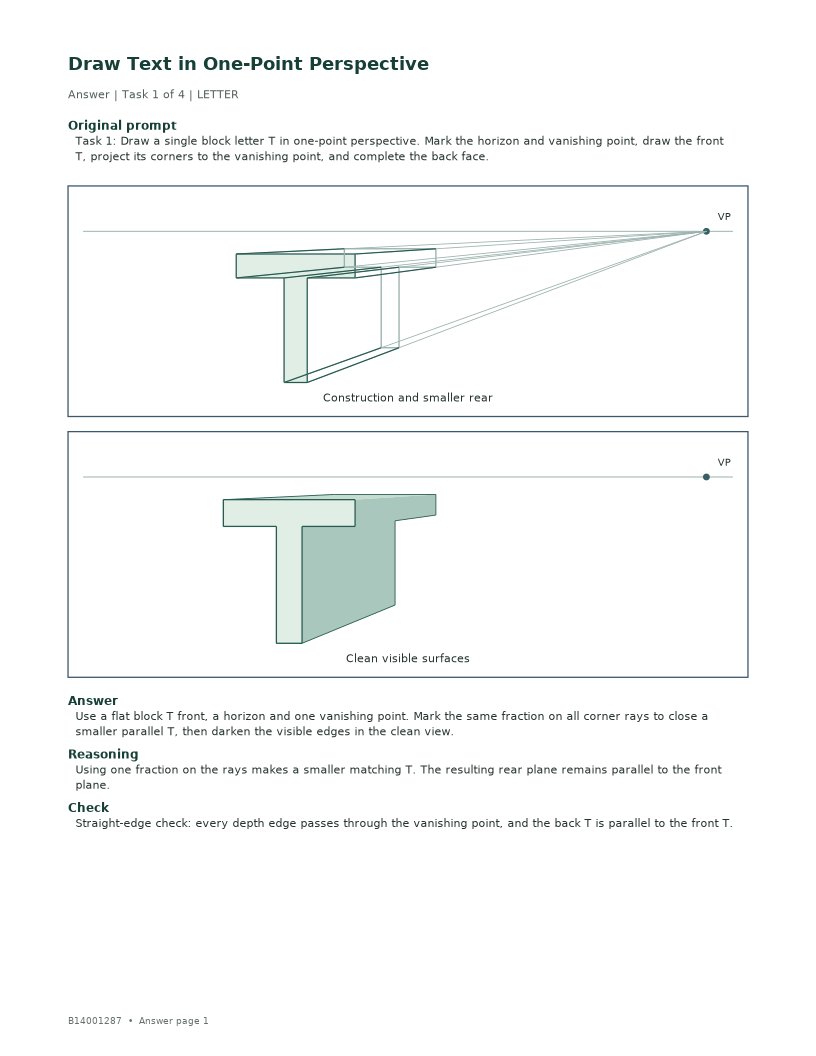
Task 1: Draw a single block letter T in one-point perspective. Mark the horizon and vanishing point, draw the front T, project its corners to the vanishing point, and complete the back face.
Show answer 1
Use a flat block T front, a horizon and one vanishing point. Mark the same fraction on all corner rays to close a smaller parallel T, then darken the visible edges in the clean view.
Using one fraction on the rays makes a smaller matching T. The resulting rear plane remains parallel to the front plane.
Check: Straight-edge check: every depth edge passes through the vanishing point, and the back T is parallel to the front T.
Task 2
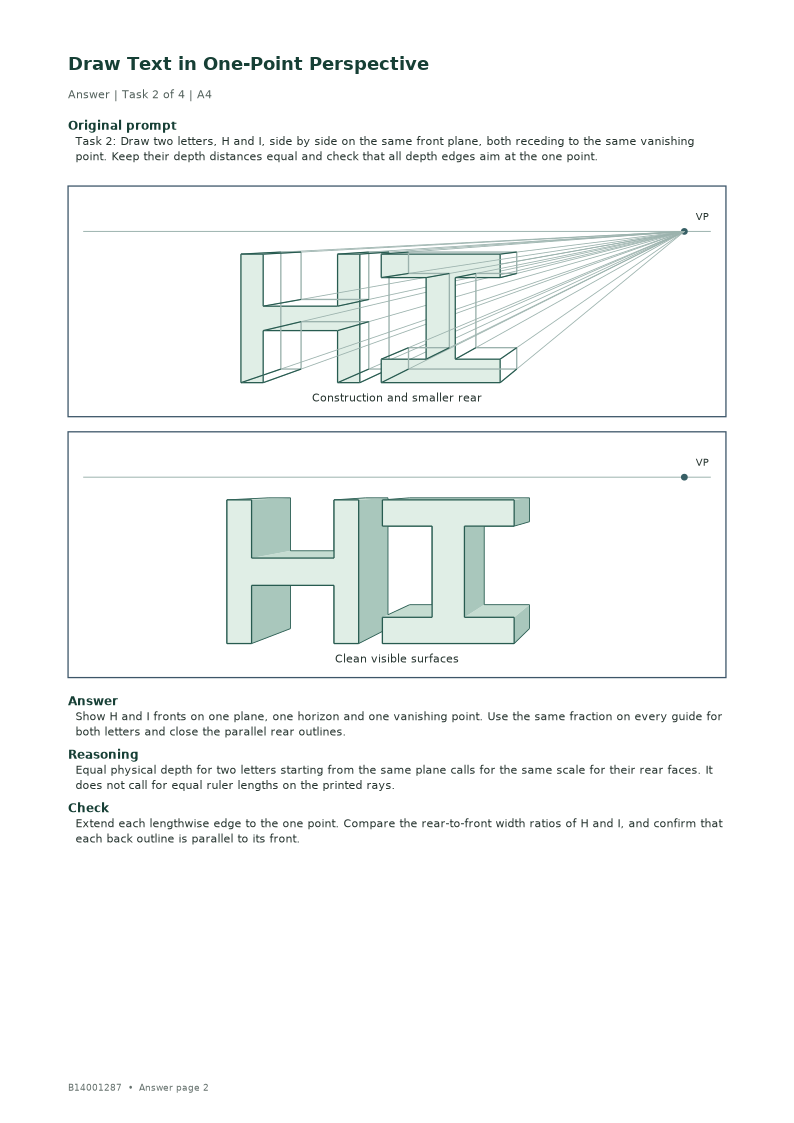
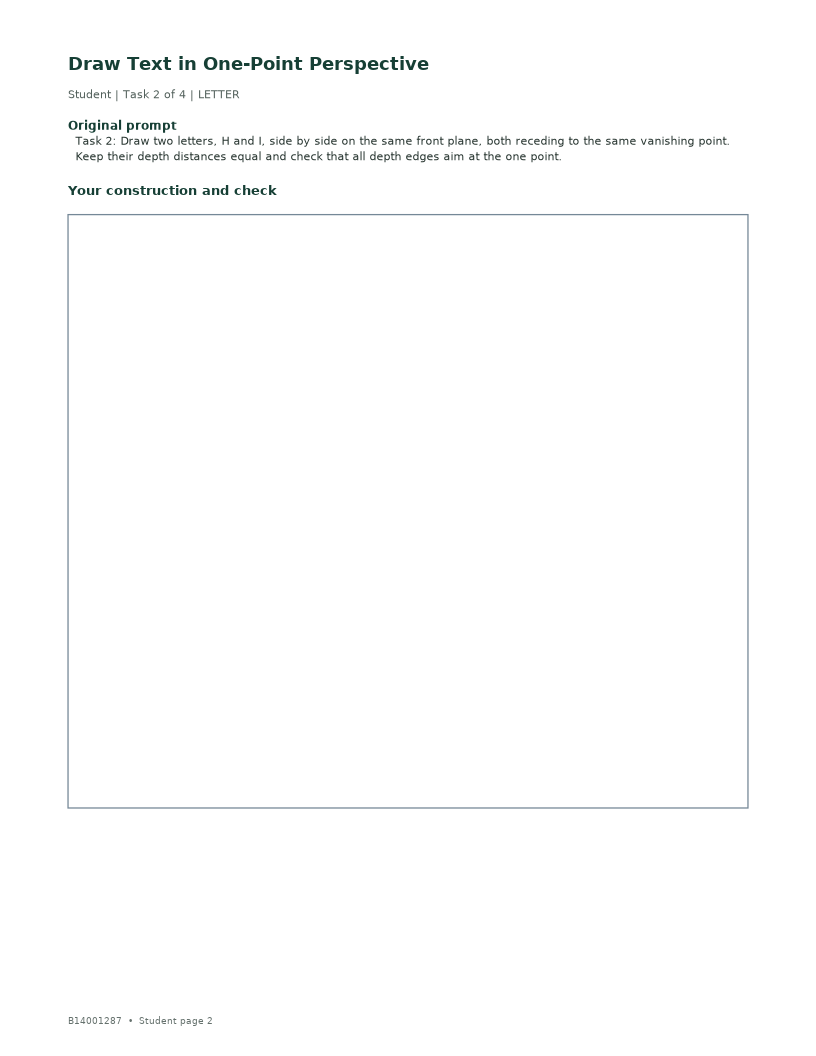
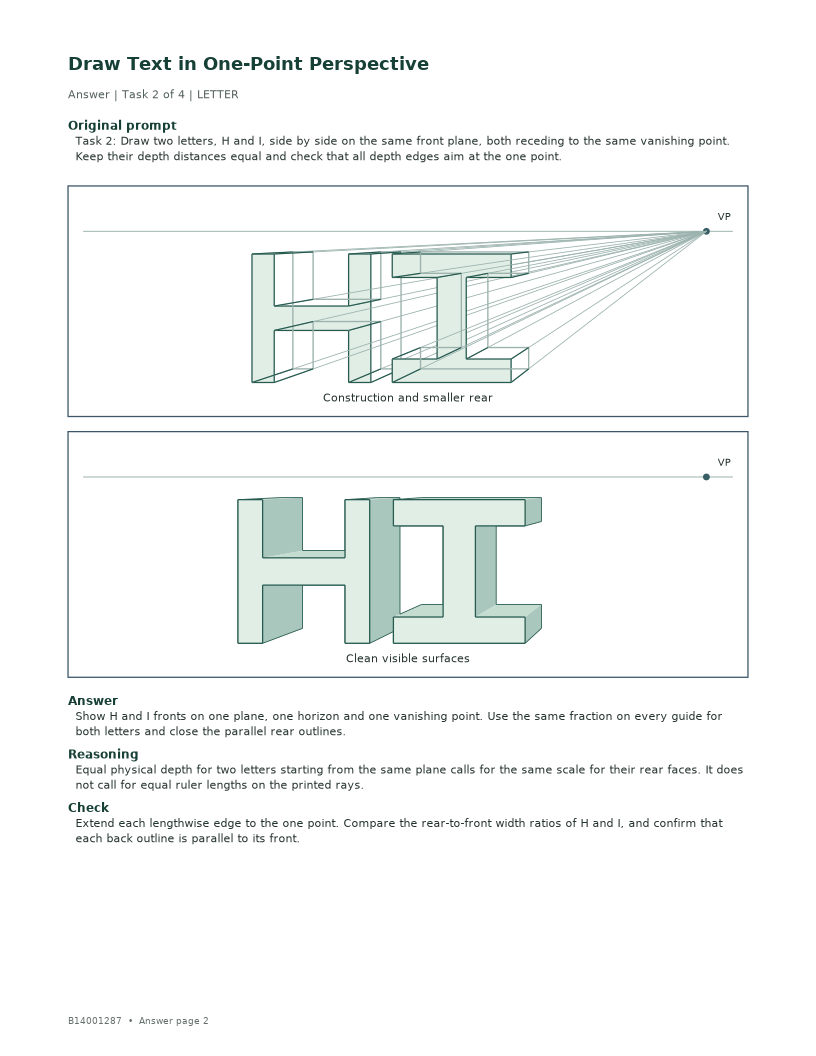
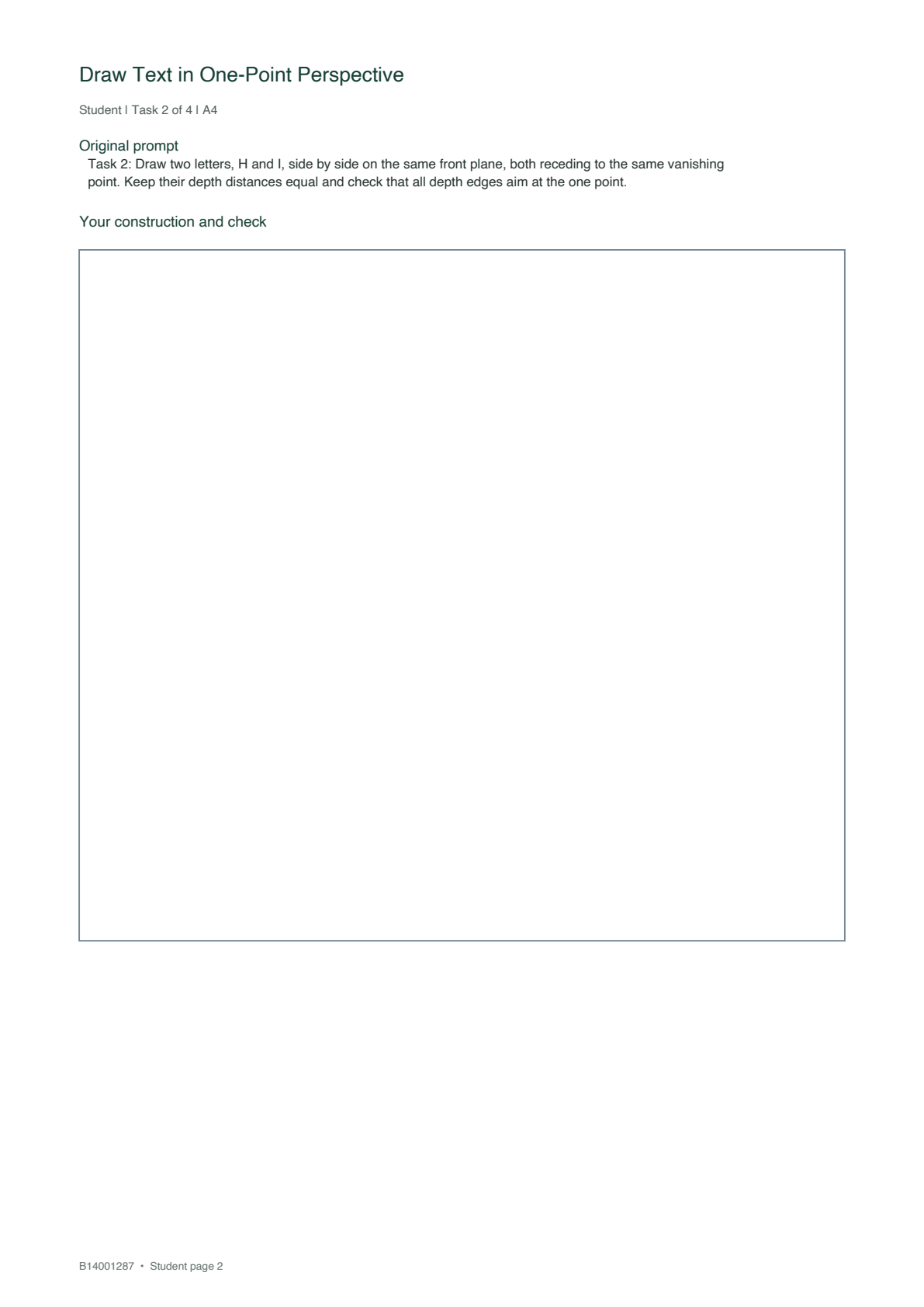
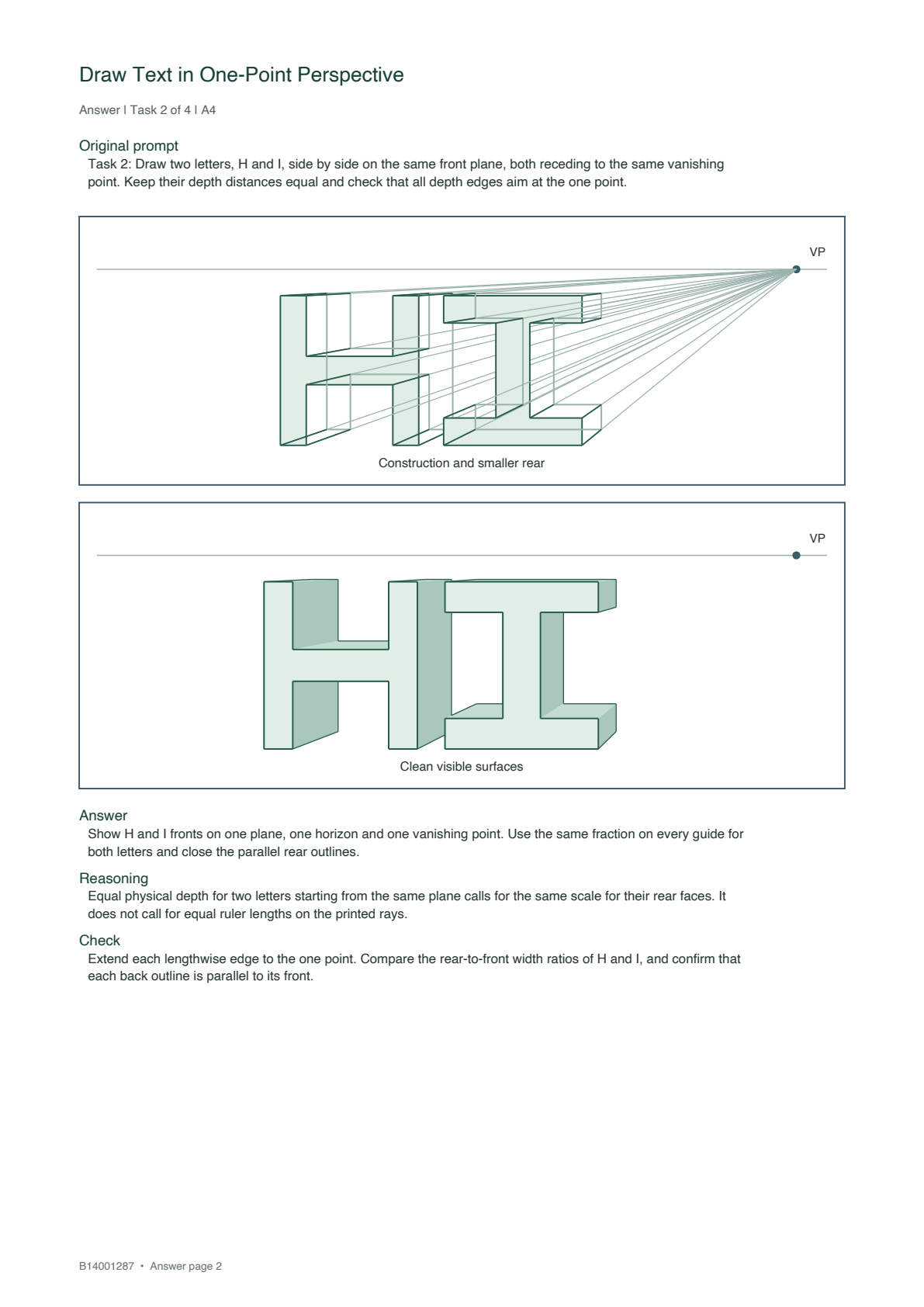
Task 2: Draw two letters, H and I, side by side on the same front plane, both receding to the same vanishing point. Keep their depth distances equal and check that all depth edges aim at the one point.
Show answer 2
Show H and I fronts on one plane, one horizon and one vanishing point. Use the same fraction on every guide for both letters and close the parallel rear outlines.
Equal physical depth for two letters starting from the same plane calls for the same scale for their rear faces. It does not call for equal ruler lengths on the printed rays.
Check: Extend each lengthwise edge to the one point. Compare the rear-to-front width ratios of H and I, and confirm that each back outline is parallel to its front.
Task 3
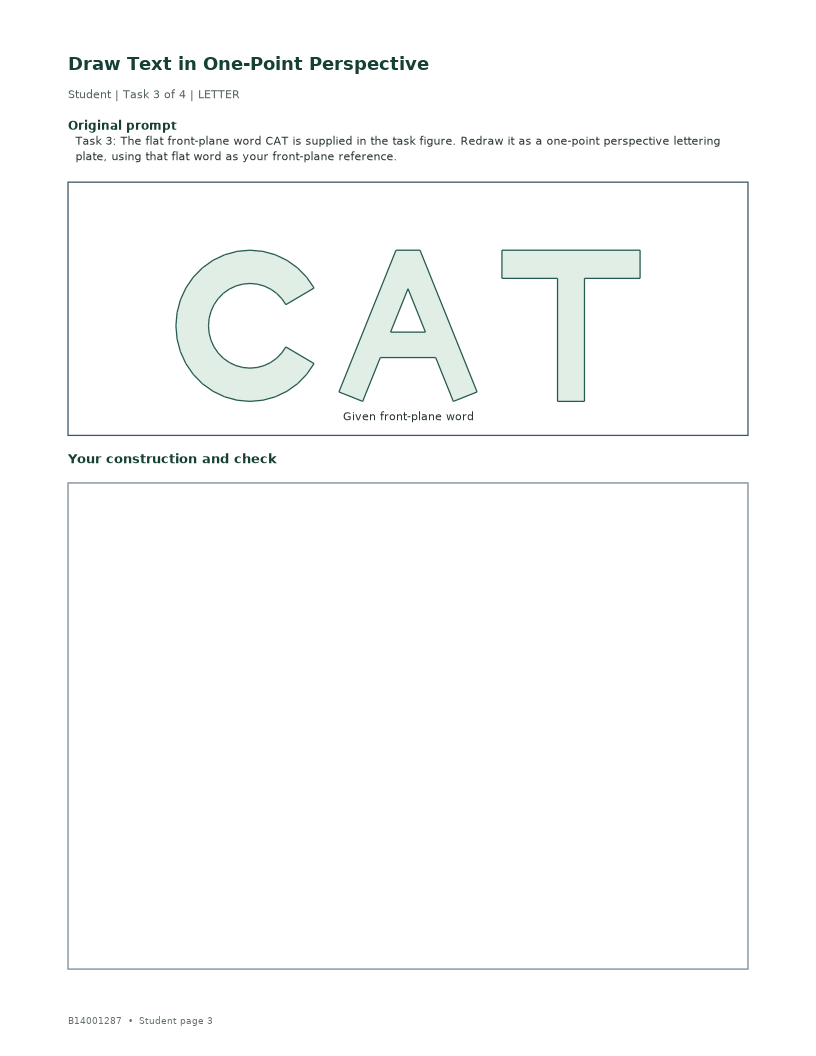
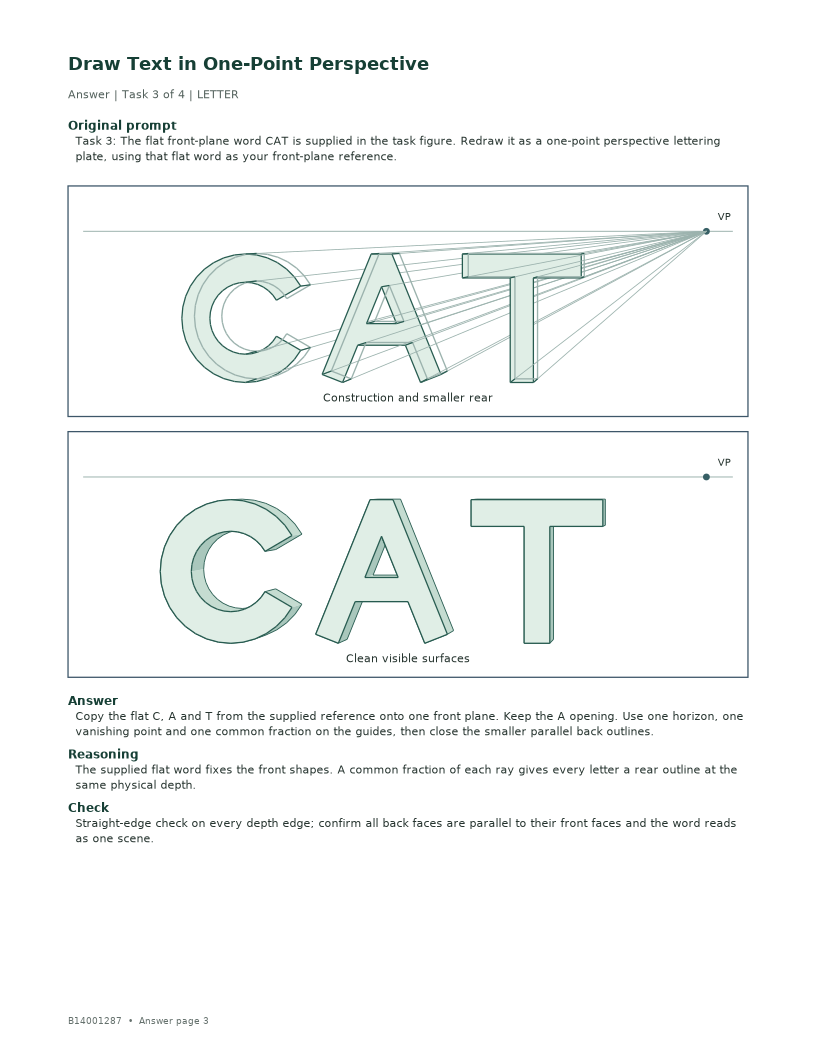
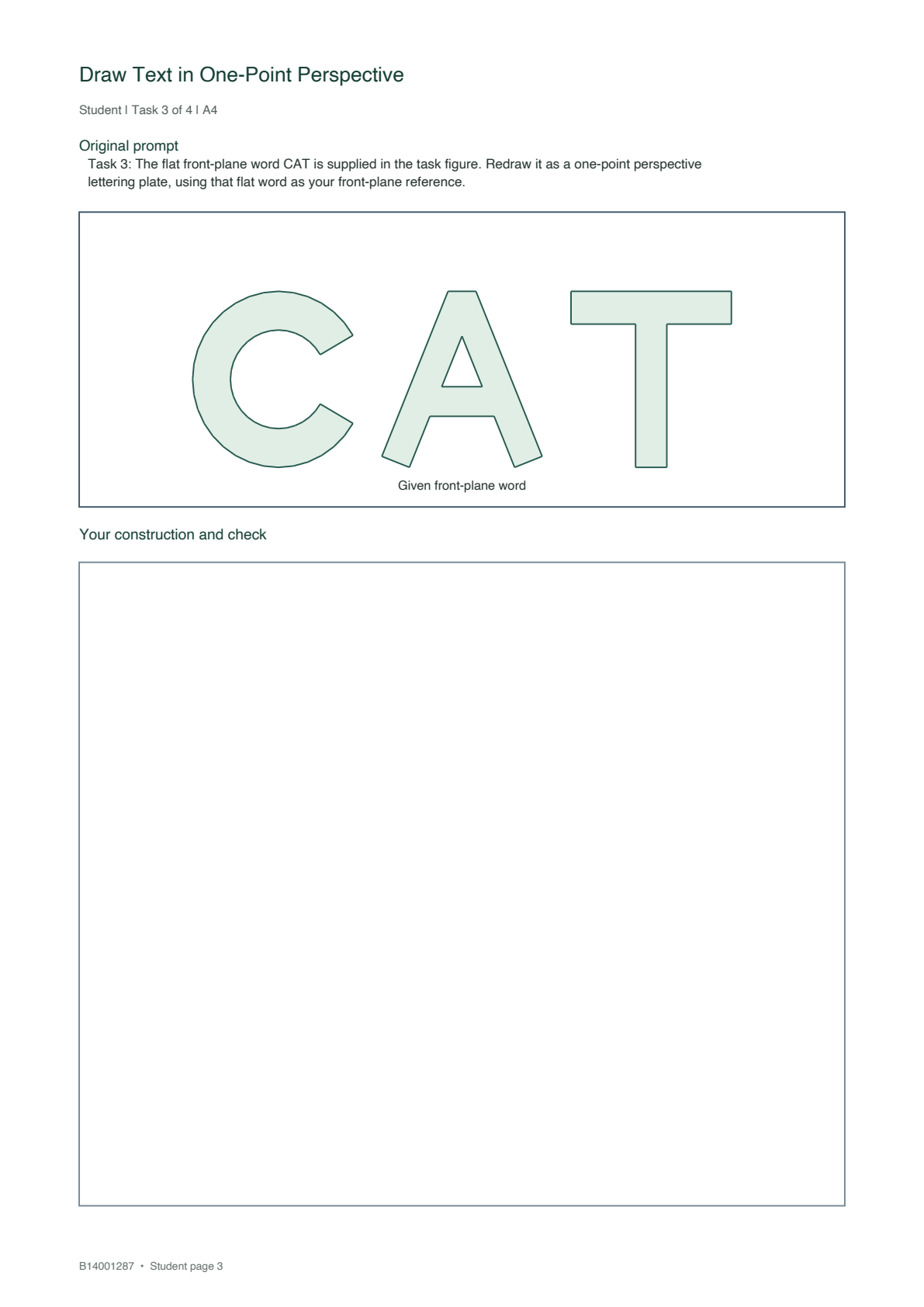
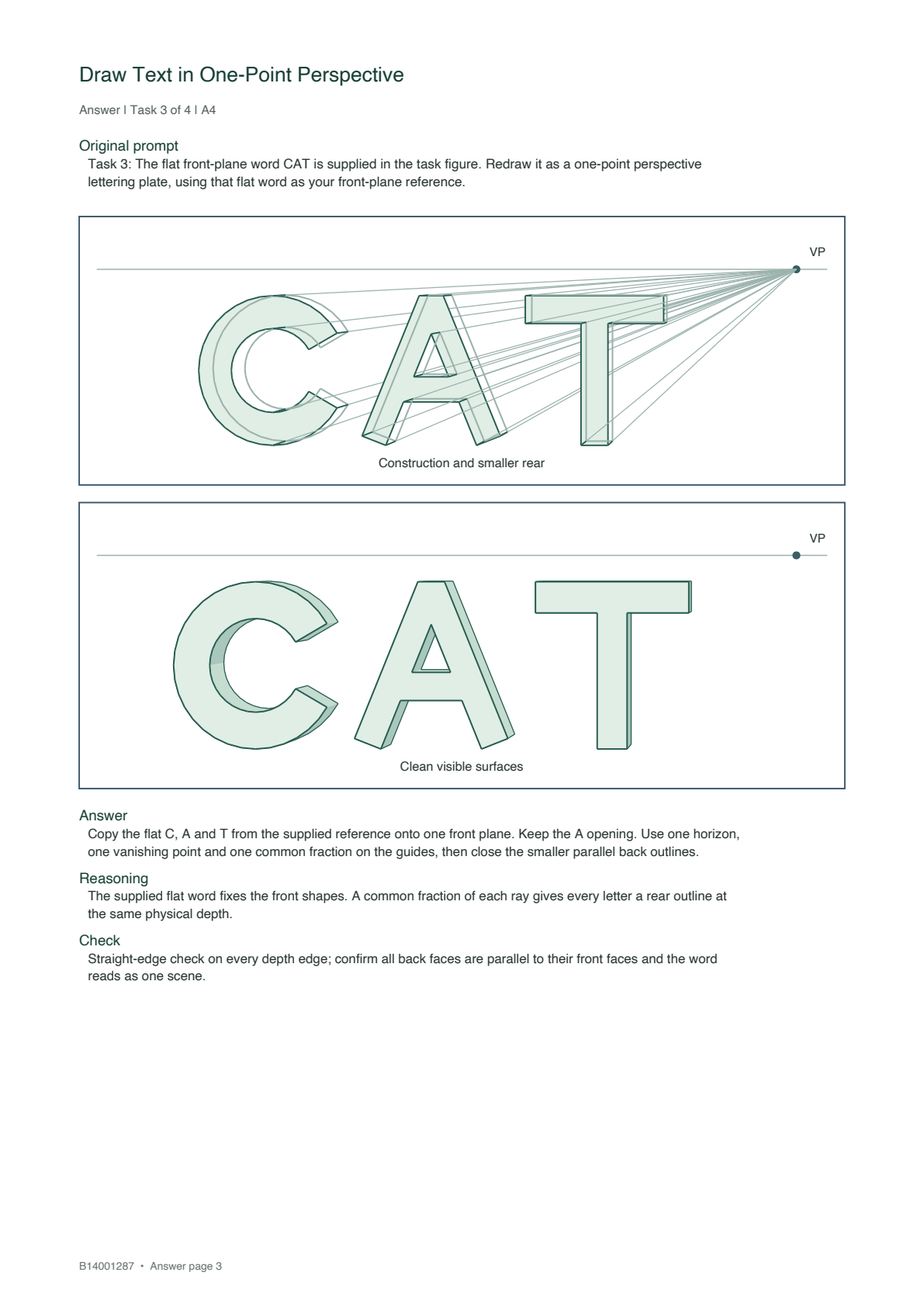
Task 3: The flat front-plane word CAT is supplied in the task figure. Redraw it as a one-point perspective lettering plate, using that flat word as your front-plane reference.
Show answer 3
Copy the flat C, A and T from the supplied reference onto one front plane. Keep the A opening. Use one horizon, one vanishing point and one common fraction on the guides, then close the smaller parallel back outlines.
The supplied flat word fixes the front shapes. A common fraction of each ray gives every letter a rear outline at the same physical depth.
Check: Straight-edge check on every depth edge; confirm all back faces are parallel to their front faces and the word reads as one scene.
Task 4
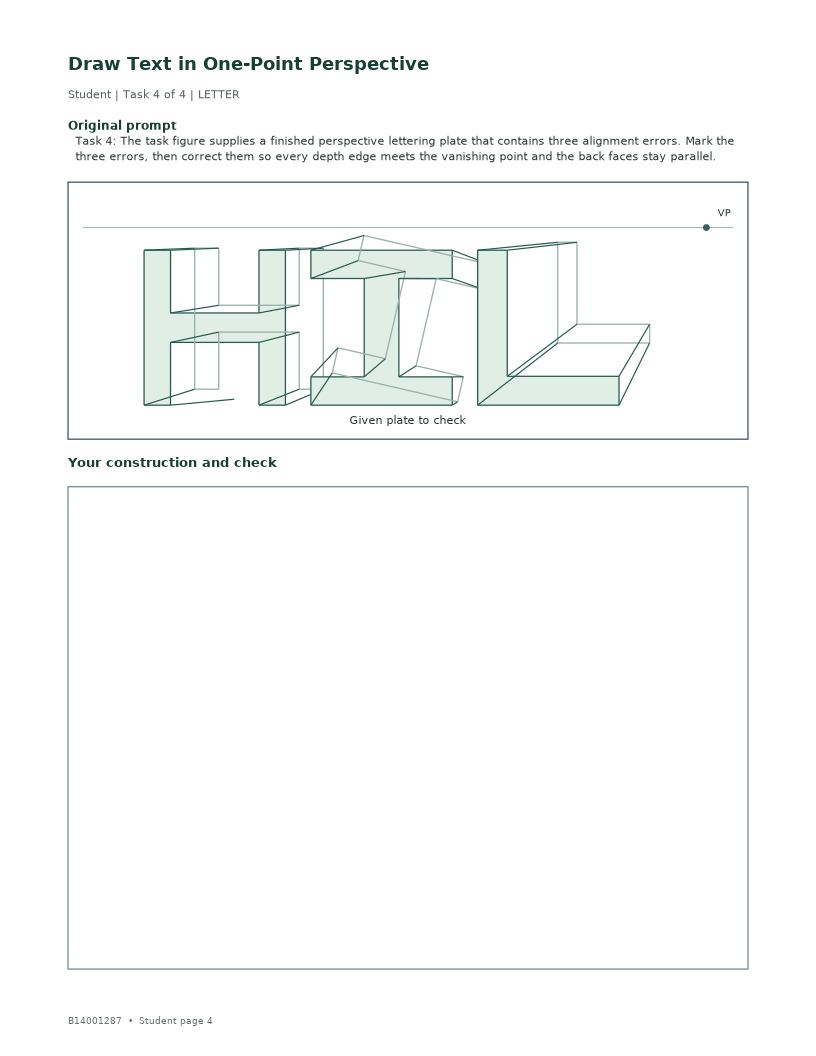
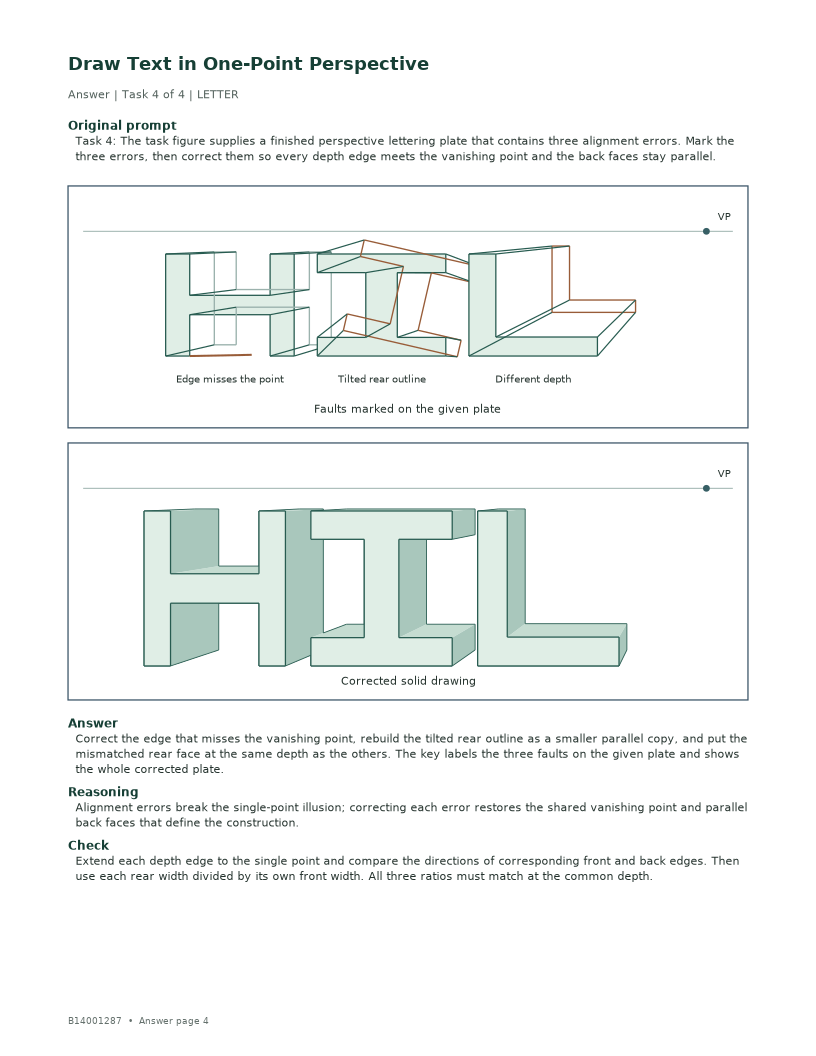
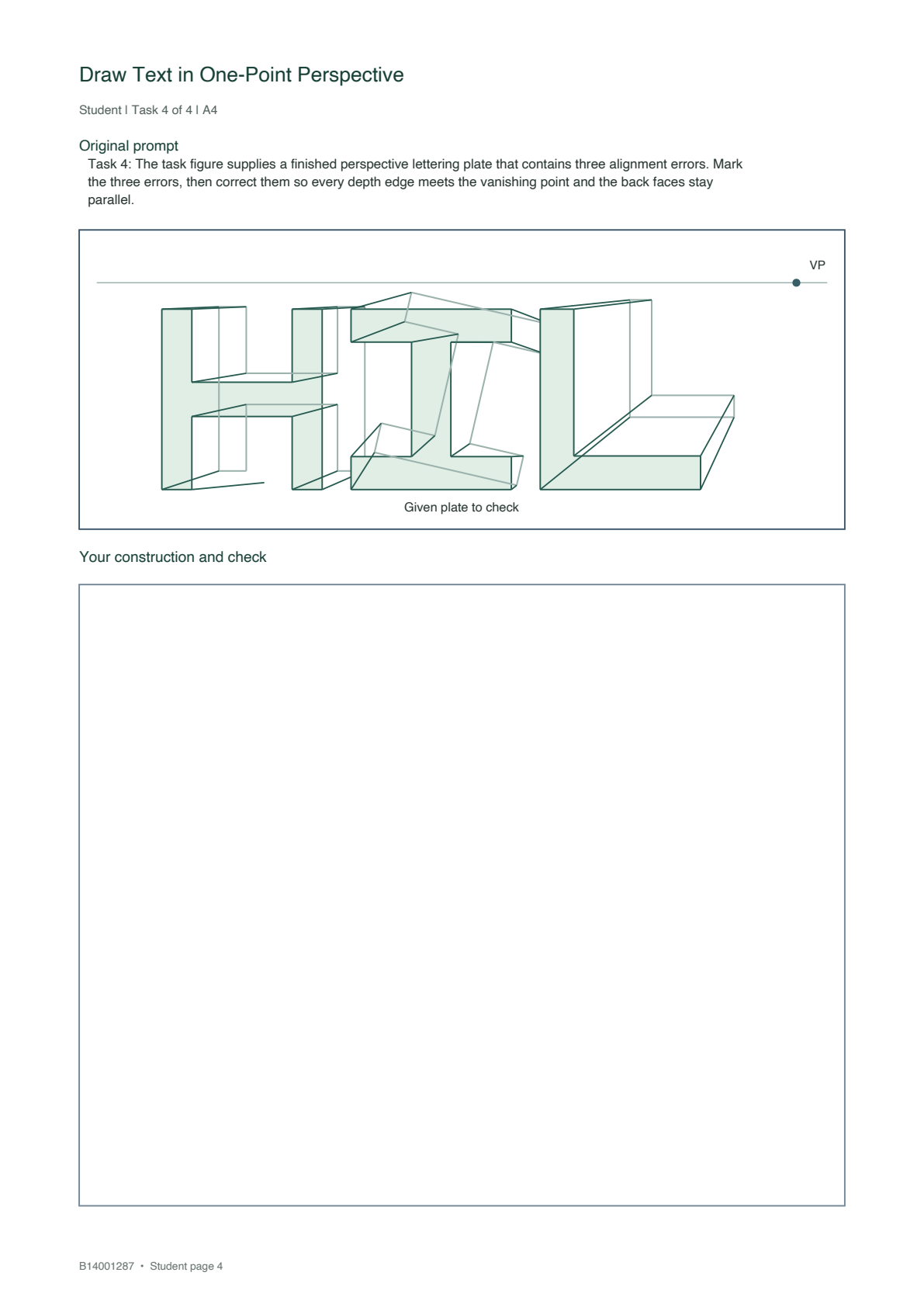
Task 4: The task figure supplies a finished perspective lettering plate that contains three alignment errors. Mark the three errors, then correct them so every depth edge meets the vanishing point and the back faces stay parallel.
Show answer 4
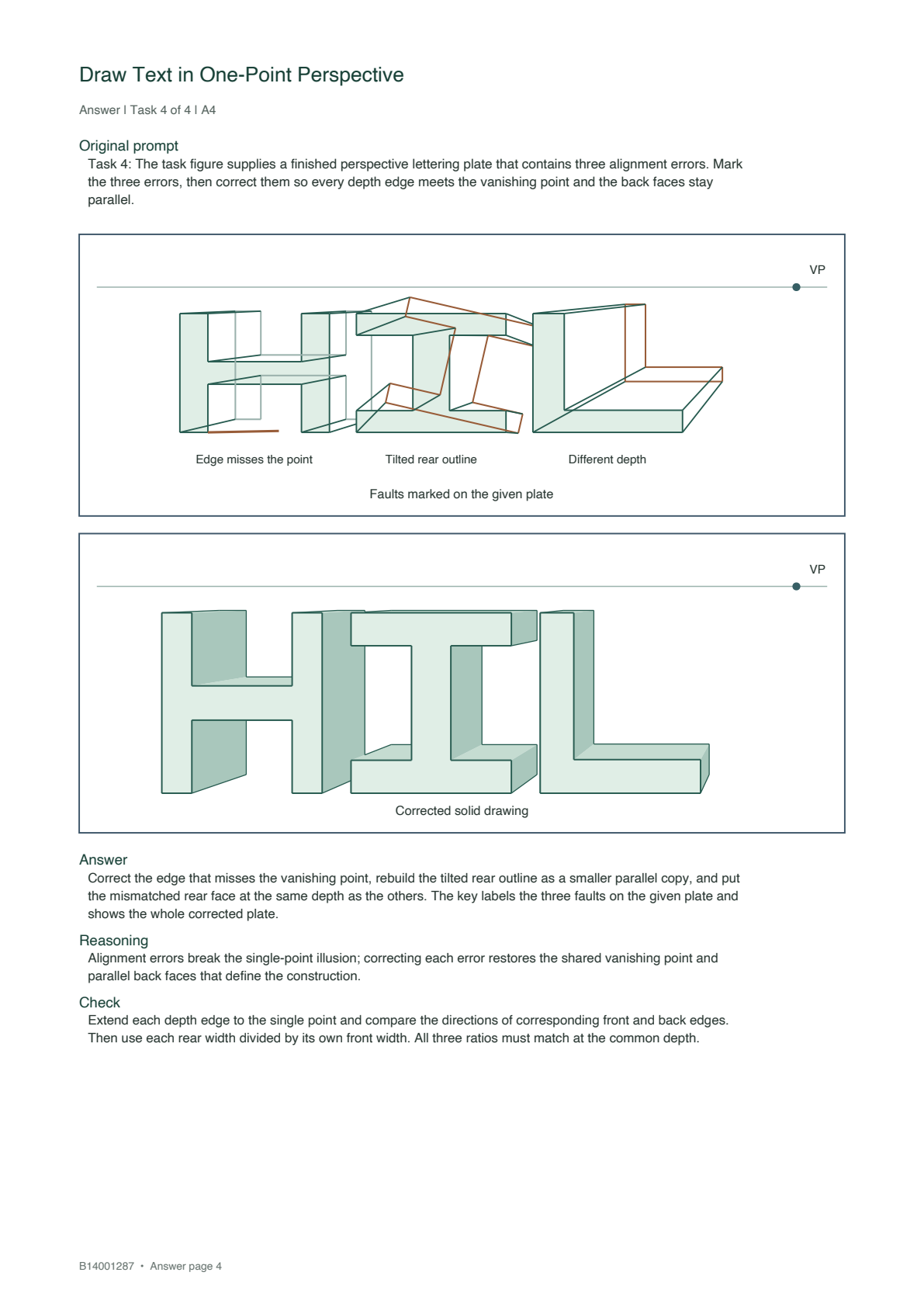
Correct the edge that misses the vanishing point, rebuild the tilted rear outline as a smaller parallel copy, and put the mismatched rear face at the same depth as the others. The key labels the three faults on the given plate and shows the whole corrected plate.
Alignment errors break the single-point illusion; correcting each error restores the shared vanishing point and parallel back faces that define the construction.
Check: Extend each depth edge to the single point and compare the directions of corresponding front and back edges. Then use each rear width divided by its own front width. All three ratios must match at the common depth.
Useful checks
- Aiming depth edges at different points instead of one vanishing point. Re-aim every depth edge so a straight edge passes through the single marked vanishing point.
- Drawing back faces tilted instead of parallel to the front face. Rebuild the back face by connecting equal-depth cuts so it stays parallel to the front face.
- Using inconsistent depth distances across letters. From each front corner, mark the same fraction of its ray toward the vanishing point.
Questions about this resource
Do I need measurements?
No fixed lengths are required. Choose a fraction for the whole form and check alignment by extending the depth edges with a straightedge.
Can I use more than one vanishing point?
This lesson is one-point perspective, so all depth edges aim at a single vanishing point on the horizon.