Free original lessons
Castle Perspective Drawing
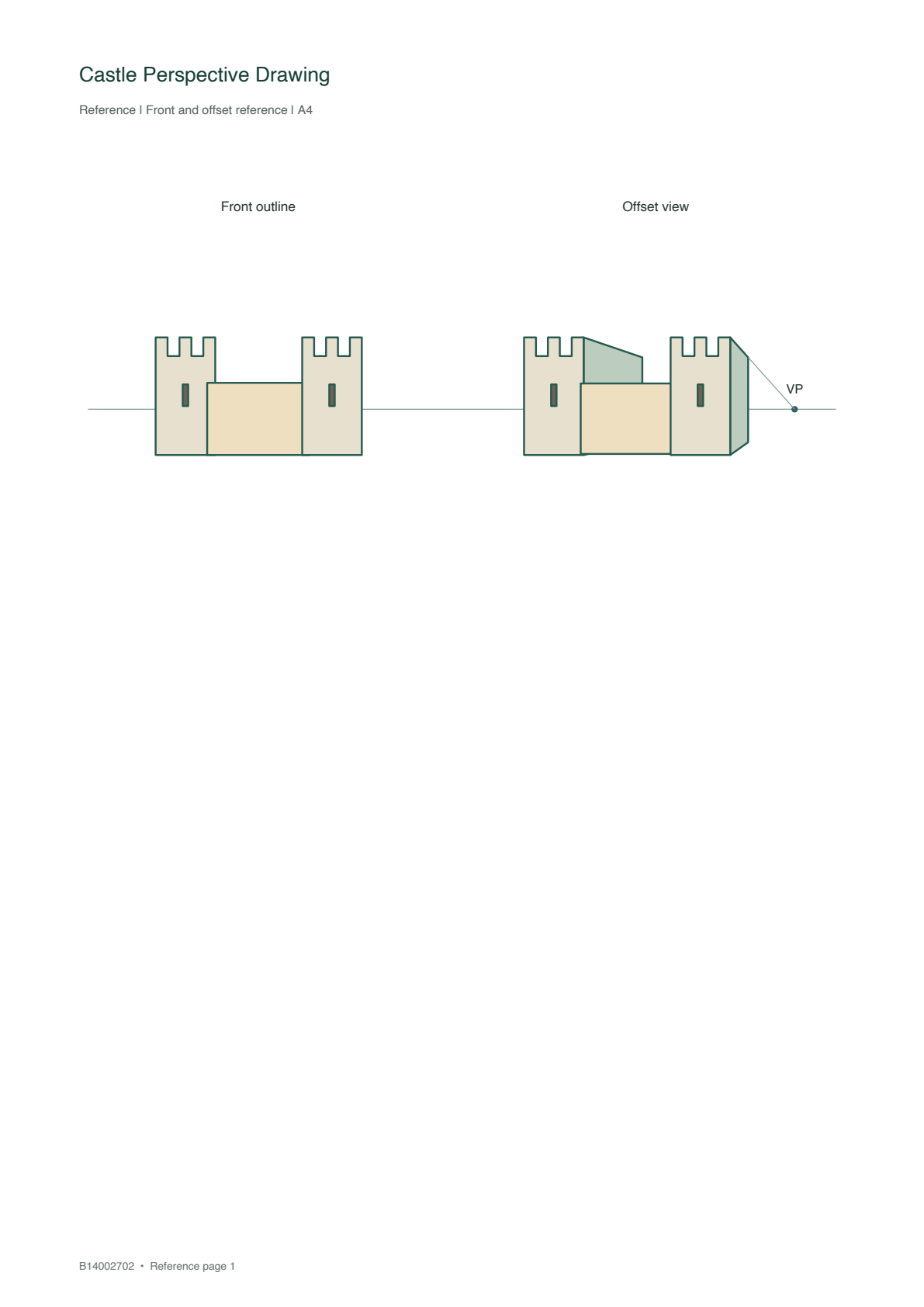
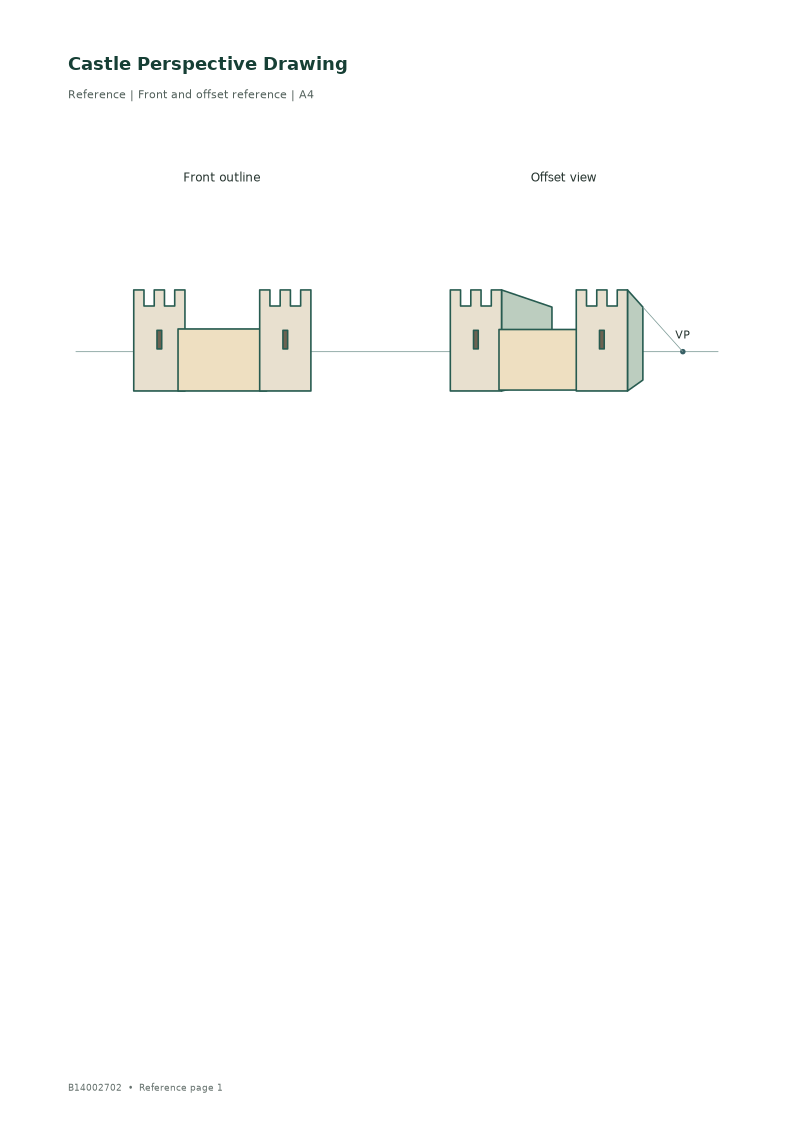
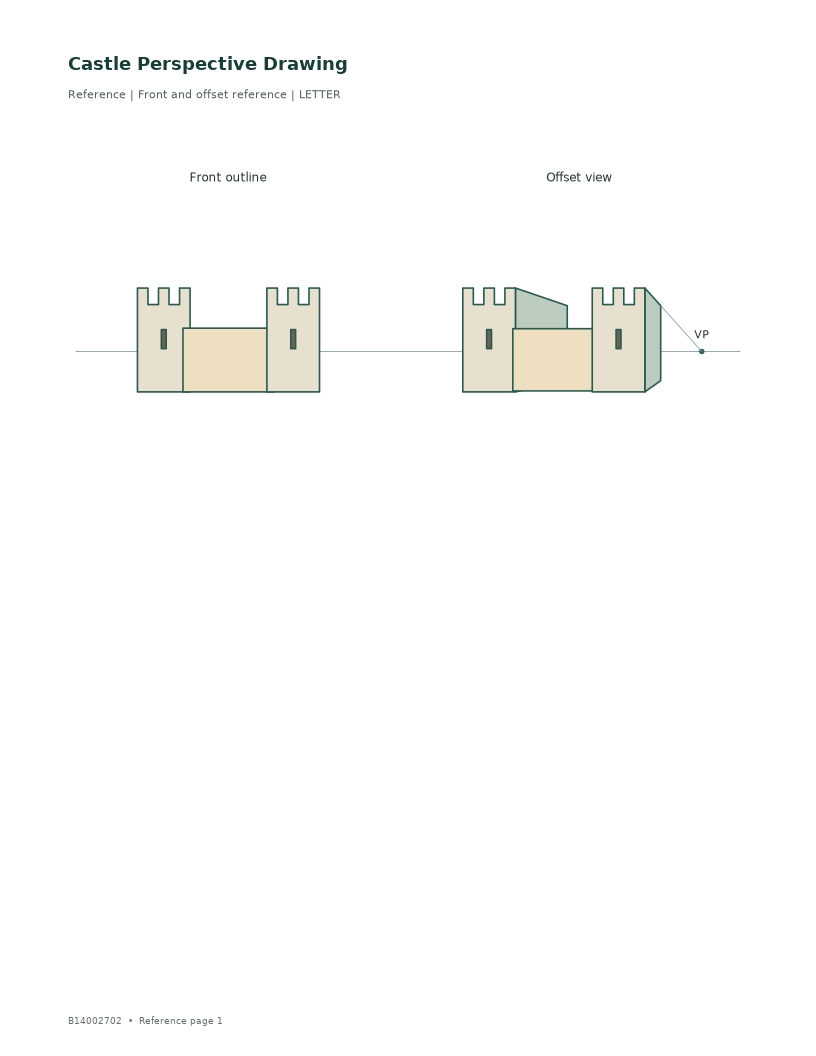
This pack compares a straight-on front view with a side-revealing one-point view of the same simple castle. Keep the castle facing the same direction. For the second drawing, shift the viewpoint to the right so its right side wall appears; keep the front wall square to the page. Both views use one level horizon and the same vanishing point for the depth direction.
Letter & A4
PDF & SVG
What the comparison shows
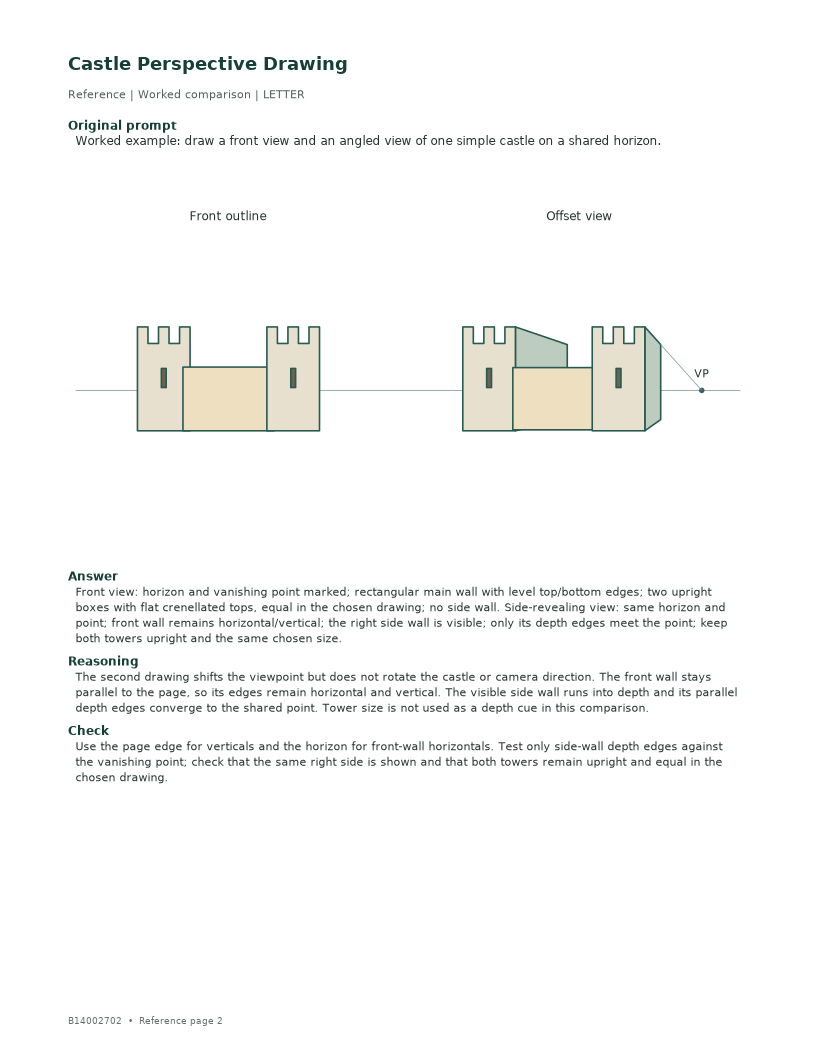
In the front view, the main wall is a flat rectangle and the two towers are upright; side walls are hidden. For the side-revealing view, shift the viewpoint laterally without rotating the castle. The same front wall stays level and upright while the right side wall becomes visible.
Both views share one level horizon and the same vanishing point. Front-wall horizontal edges stay parallel to the horizon and vertical edges stay upright in both drawings. Only lines running into depth converge to that point; yawing the castle would create another horizontal direction and is outside this one-point comparison.
Building the front view
Draw a horizon line and mark one vanishing point on it. Block the main wall as a rectangle sitting on the ground line, with its top and bottom edges parallel to the horizon.
Add two towers as upright boxes at the wall ends, each with a flat top and a simple crenellated crown. Keep every vertical edge truly vertical and every horizontal edge parallel to the horizon.
Shifting the view to reveal a side
Keep the front wall parallel to the picture plane and move the viewpoint to the castle’s right without rotating it. Draw the right side wall so it is visible. Leave the front wall’s top and bottom edges horizontal; aim only the side-wall depth edges toward the shared vanishing point.
Keep all tower sides vertical and draw both towers at the same chosen size. The visible right side wall supplies the depth cue: its top and bottom depth edges converge to the shared point, while the front wall remains square to the page.
Checking the plate
Check that both views share one horizon and one vanishing point; the front-wall horizontal edges stay horizontal and all verticals stay vertical in both. Only the side/depth edges of the second view slope toward the vanishing point.
Check that the second view shows the right side wall while keeping the front wall square to the page. The two views should read as the same castle, not as a yawed two-point view.
Download the complete resource pack
All individual SVG pages (20)
- A4 reference page 1
- A4 reference page 2
- A4 student page 1
- A4 student page 2
- A4 student page 3
- A4 student page 4
- A4 answer page 1
- A4 answer page 2
- A4 answer page 3
- A4 answer page 4
- LETTER reference page 1
- LETTER reference page 2
- LETTER student page 1
- LETTER student page 2
- LETTER student page 3
- LETTER student page 4
- LETTER answer page 1
- LETTER answer page 2
- LETTER answer page 3
- LETTER answer page 4
Print at 100% / actual size. Use the stated scale on any schematic diagram; physical cutting templates are identified separately. A4 and US Letter are separate files. Free access, no signup; CC BY 4.0.
How to use these pages
- What the comparison shows
- Building the front view
- Shifting the view to reveal a side
- Checking the plate
Worked example
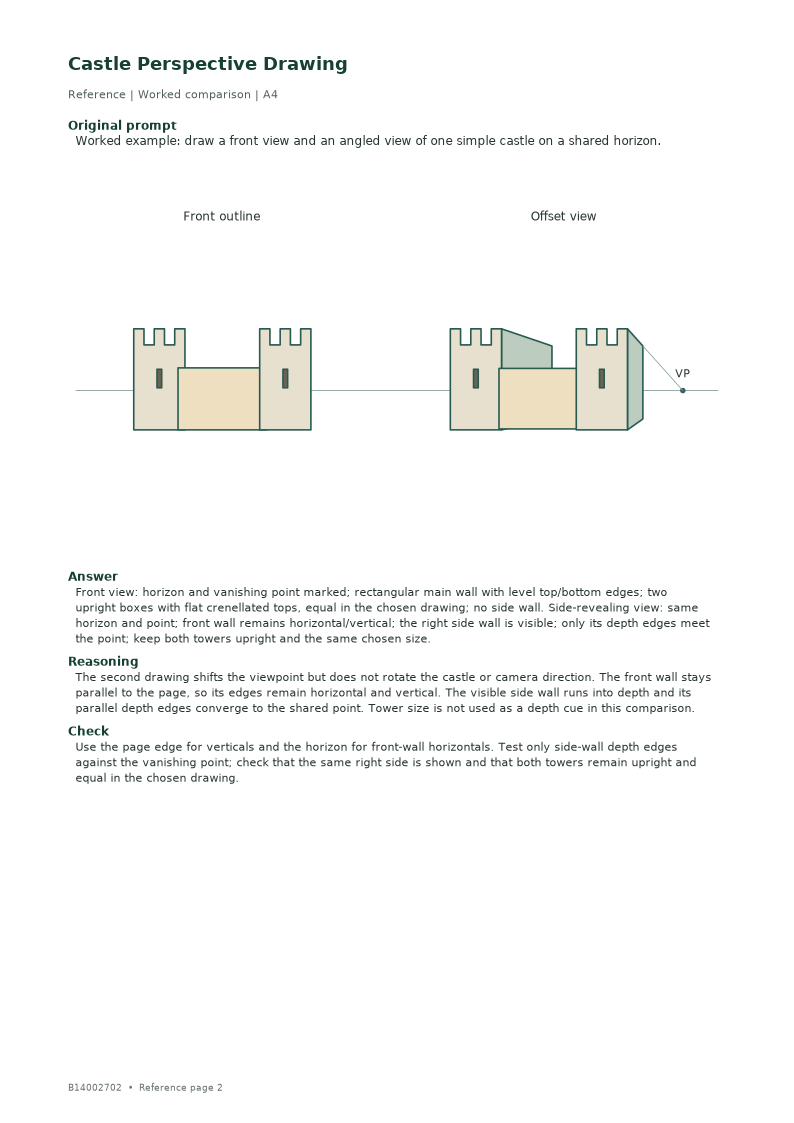
Example: Worked example: draw a front view and an angled view of one simple castle on a shared horizon.
Answer: Front view: horizon and vanishing point marked; rectangular main wall with level top/bottom edges; two upright boxes with flat crenellated tops, equal in the chosen drawing; no side wall. Side-revealing view: same horizon and point; front wall remains horizontal/vertical; the right side wall is visible; only its depth edges meet the point; keep both towers upright and the same chosen size.
Reasoning: The second drawing shifts the viewpoint but does not rotate the castle or camera direction. The front wall stays parallel to the page, so its edges remain horizontal and vertical. The visible side wall runs into depth and its parallel depth edges converge to the shared point. Tower size is not used as a depth cue in this comparison.
Check: Use the page edge for verticals and the horizon for front-wall horizontals. Test only side-wall depth edges against the vanishing point; check that the same right side is shown and that both towers remain upright and equal in the chosen drawing.
Four practice tasks and complete answers
Task 1
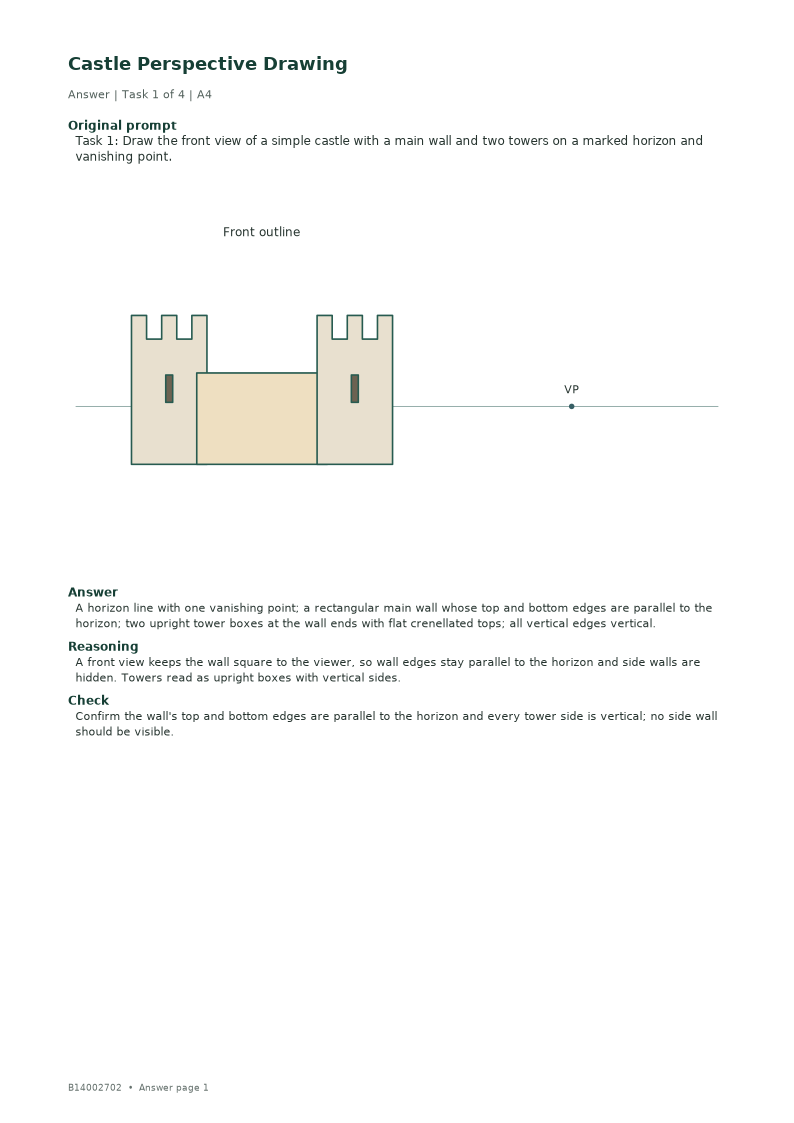
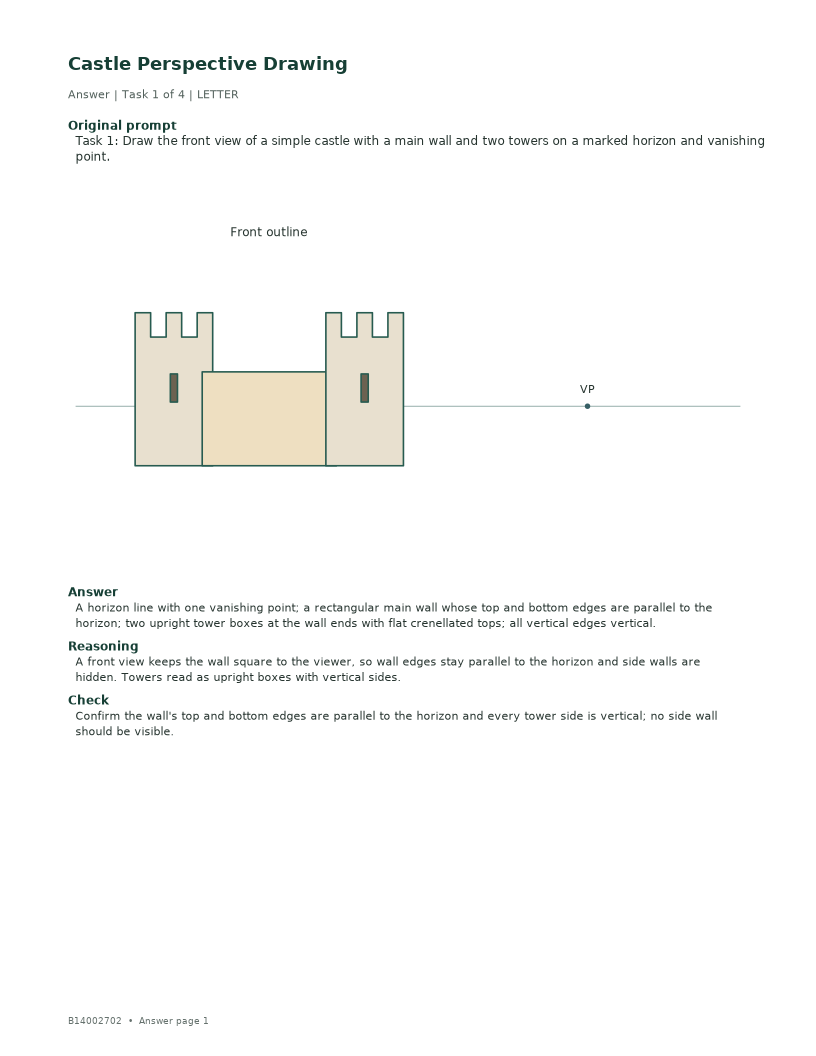
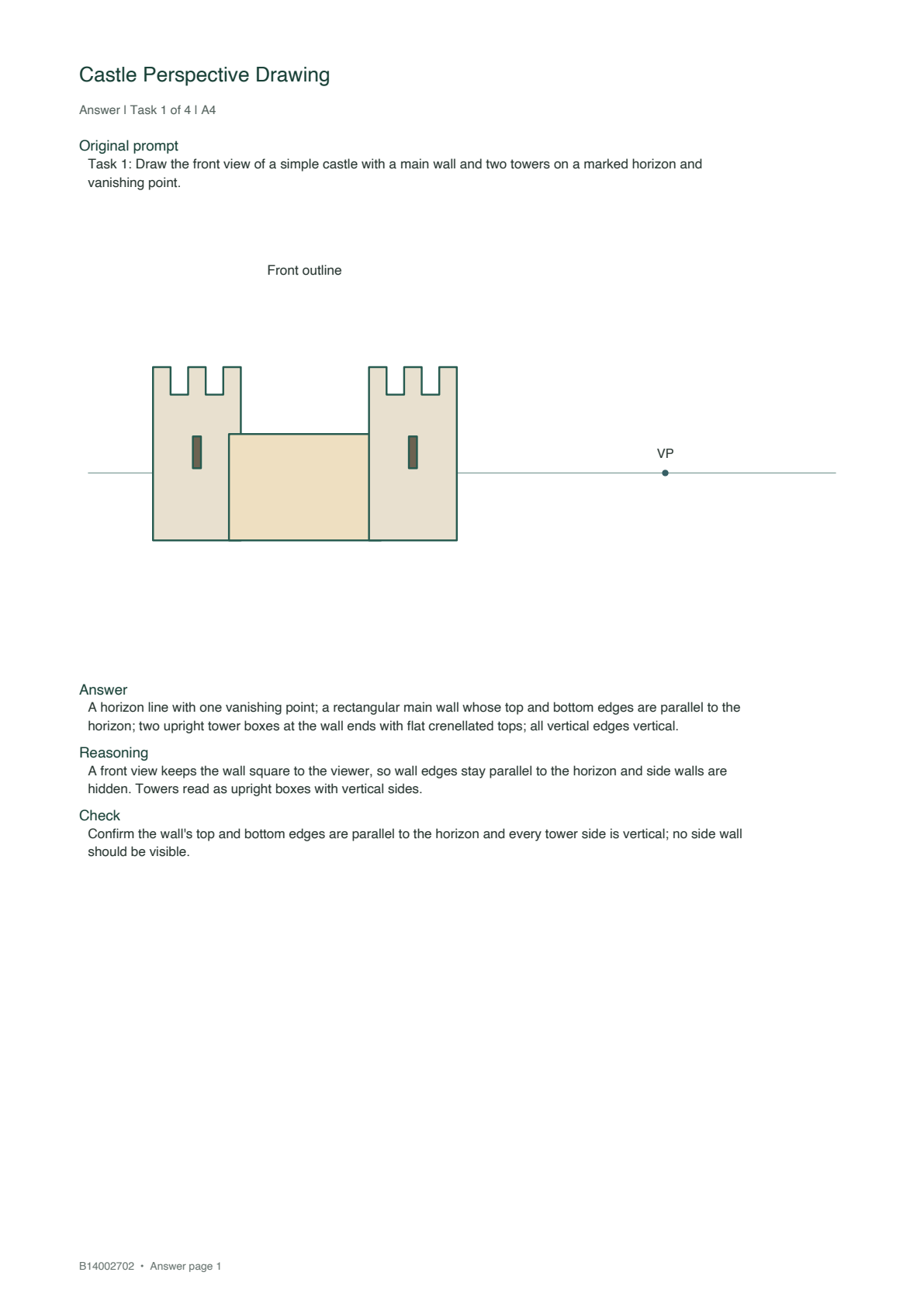
Task 1: Draw the front view of a simple castle with a main wall and two towers on a marked horizon and vanishing point.
Show answer 1
A horizon line with one vanishing point; a rectangular main wall whose top and bottom edges are parallel to the horizon; two upright tower boxes at the wall ends with flat crenellated tops; all vertical edges vertical.
A front view keeps the wall square to the viewer, so wall edges stay parallel to the horizon and side walls are hidden. Towers read as upright boxes with vertical sides.
Check: Confirm the wall's top and bottom edges are parallel to the horizon and every tower side is vertical; no side wall should be visible.
Task 2
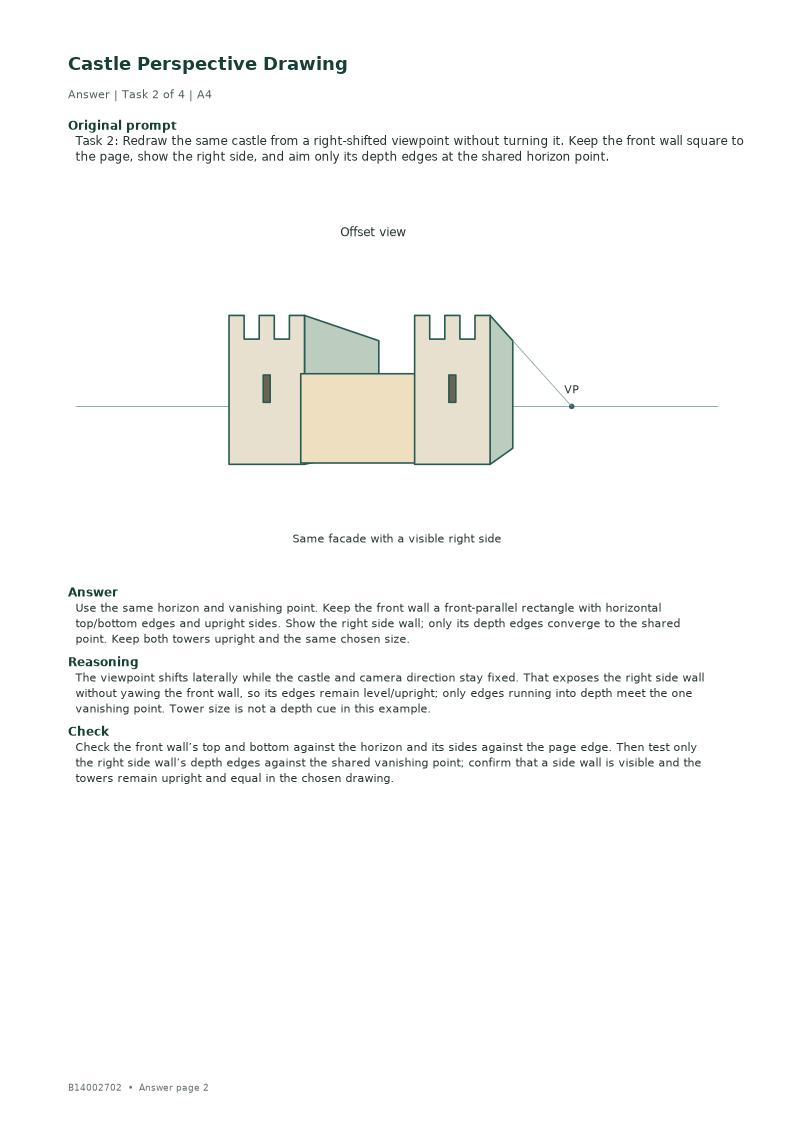
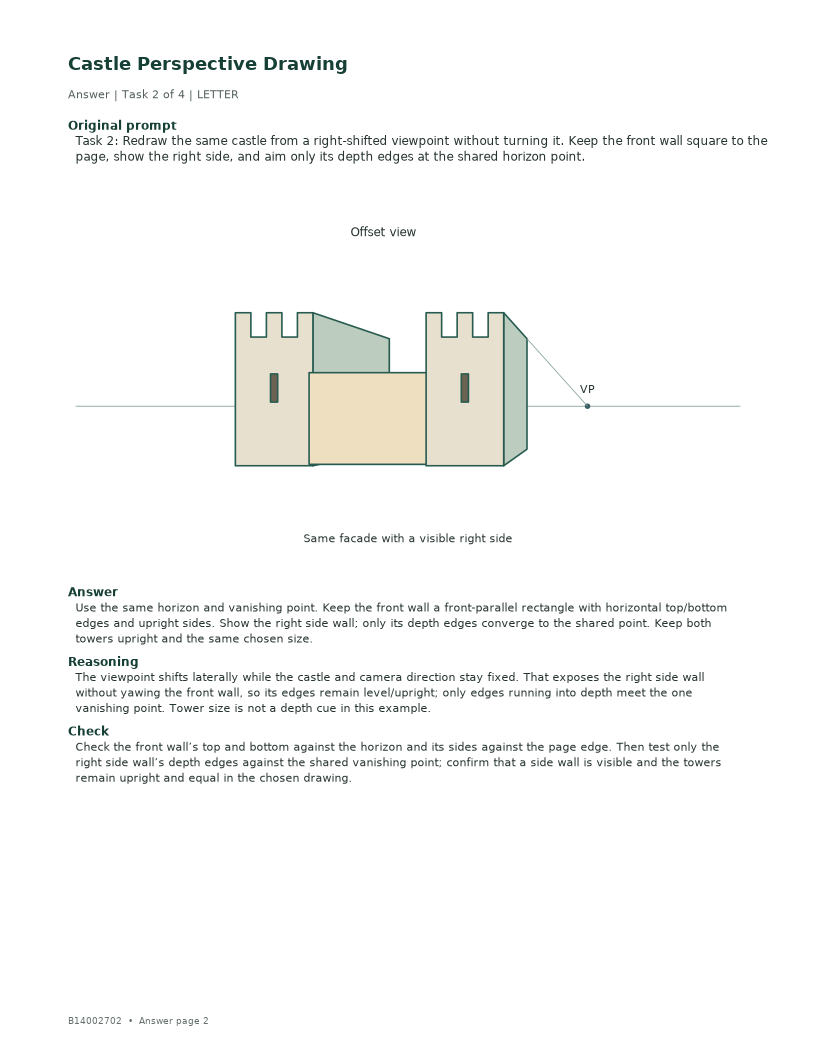
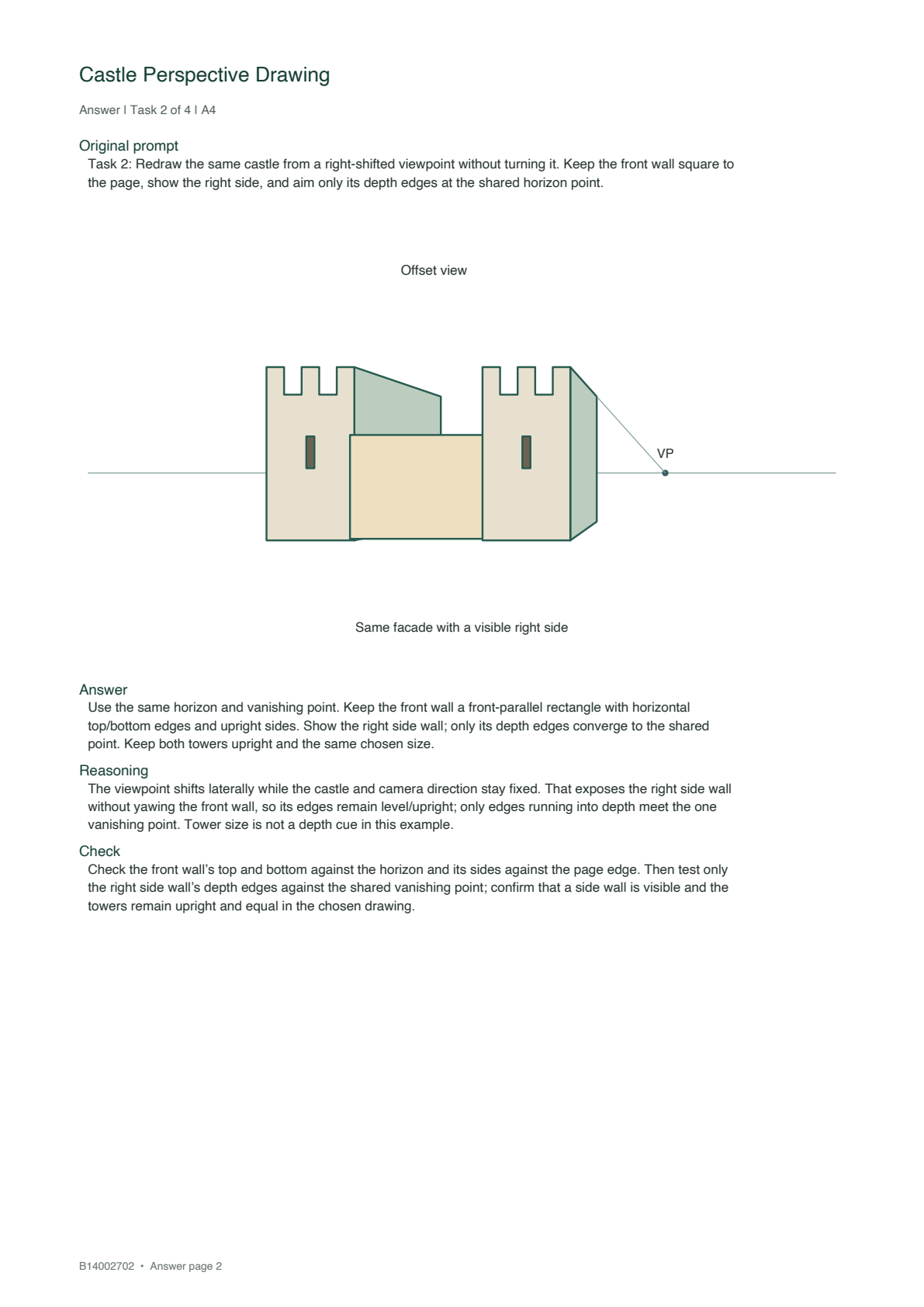
Task 2: Redraw the same castle from a right-shifted viewpoint without turning it. Keep the front wall square to the page, show the right side, and aim only its depth edges at the shared horizon point.
Show answer 2
Use the same horizon and vanishing point. Keep the front wall a front-parallel rectangle with horizontal top/bottom edges and upright sides. Show the right side wall; only its depth edges converge to the shared point. Keep both towers upright and the same chosen size.
The viewpoint shifts laterally while the castle and camera direction stay fixed. That exposes the right side wall without yawing the front wall, so its edges remain level/upright; only edges running into depth meet the one vanishing point. Tower size is not a depth cue in this example.
Check: Check the front wall’s top and bottom against the horizon and its sides against the page edge. Then test only the right side wall’s depth edges against the shared vanishing point; confirm that a side wall is visible and the towers remain upright and equal in the chosen drawing.
Task 3
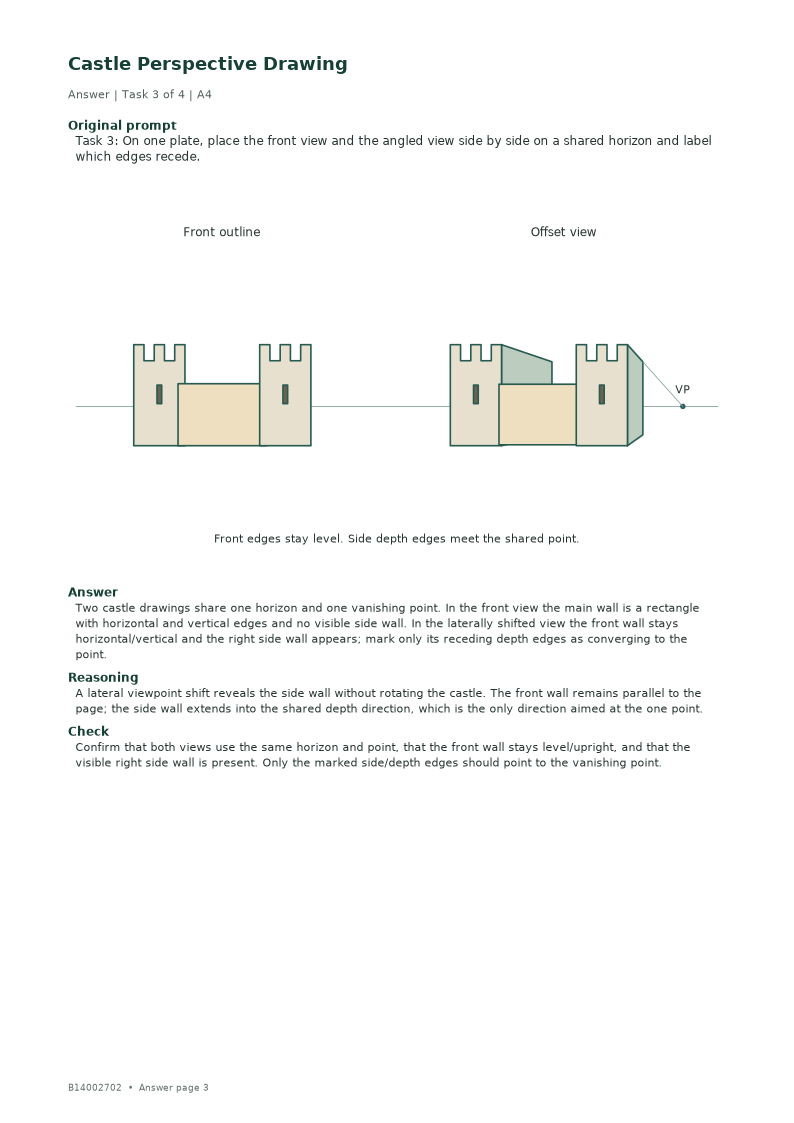
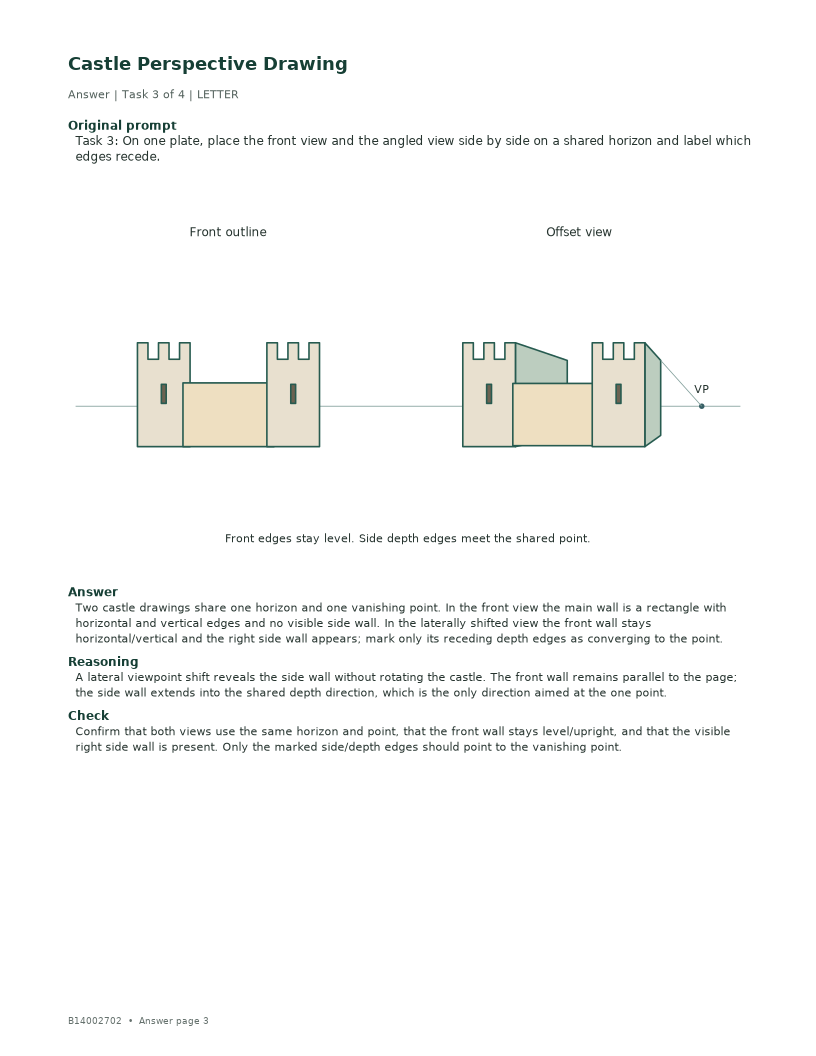
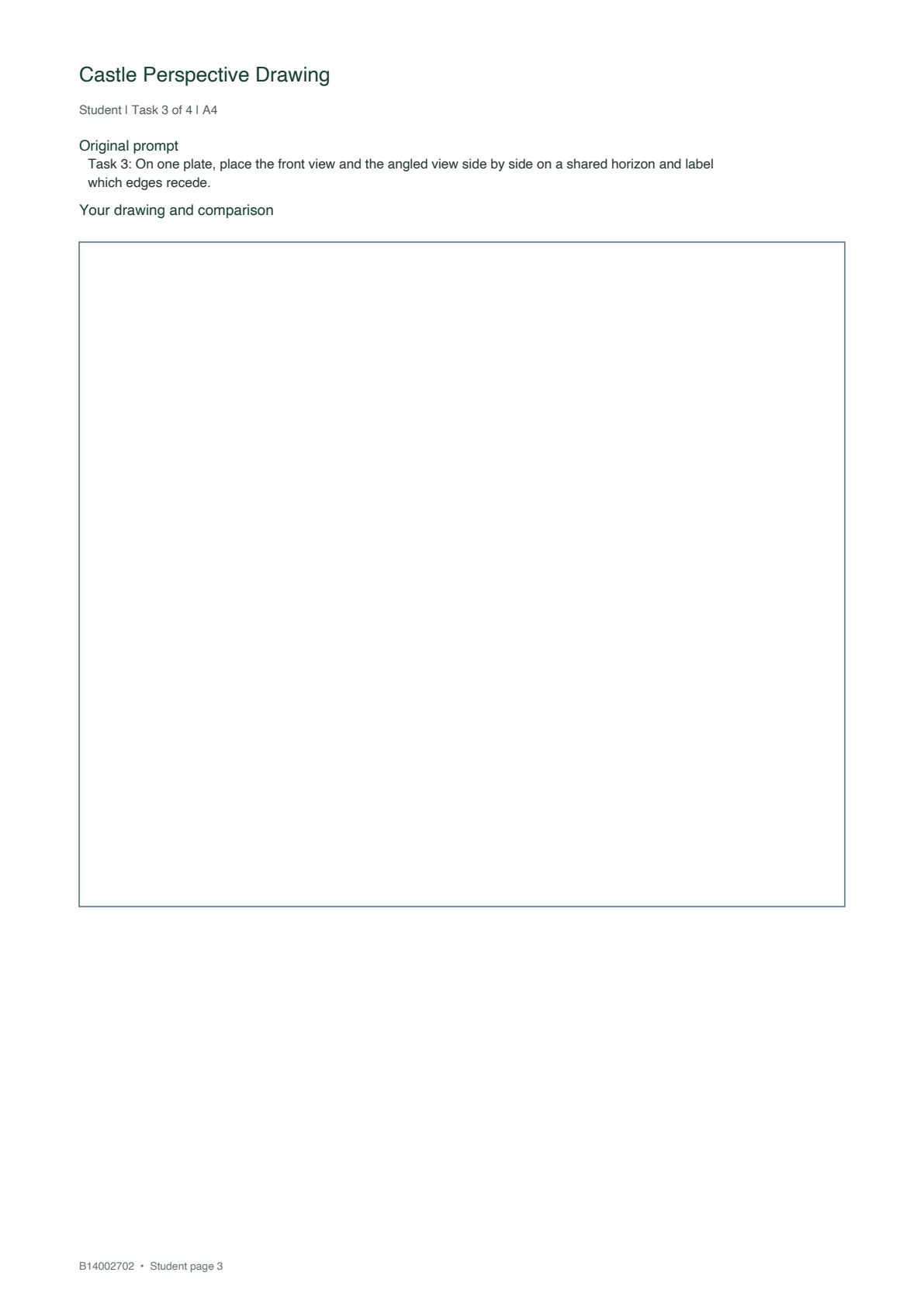
Task 3: On one plate, place the front view and the angled view side by side on a shared horizon and label which edges recede.
Show answer 3
Two castle drawings share one horizon and one vanishing point. In the front view the main wall is a rectangle with horizontal and vertical edges and no visible side wall. In the laterally shifted view the front wall stays horizontal/vertical and the right side wall appears; mark only its receding depth edges as converging to the point.
A lateral viewpoint shift reveals the side wall without rotating the castle. The front wall remains parallel to the page; the side wall extends into the shared depth direction, which is the only direction aimed at the one point.
Check: Confirm that both views use the same horizon and point, that the front wall stays level/upright, and that the visible right side wall is present. Only the marked side/depth edges should point to the vanishing point.
Task 4
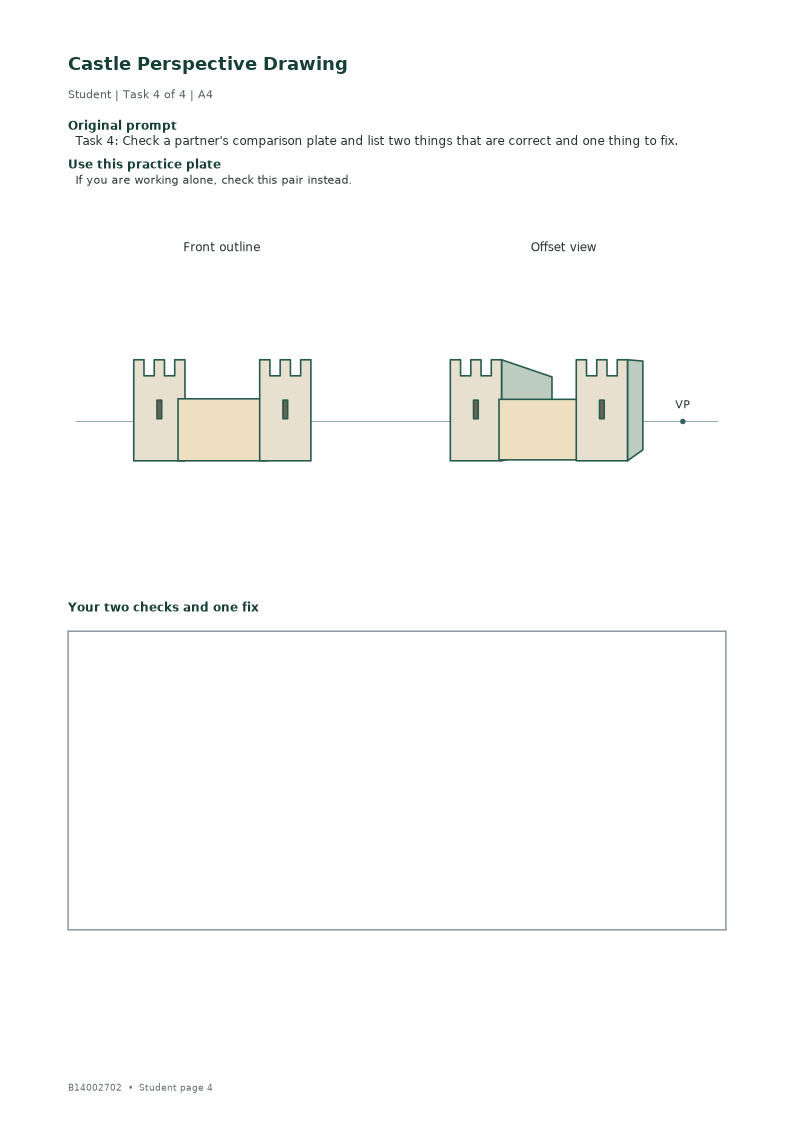
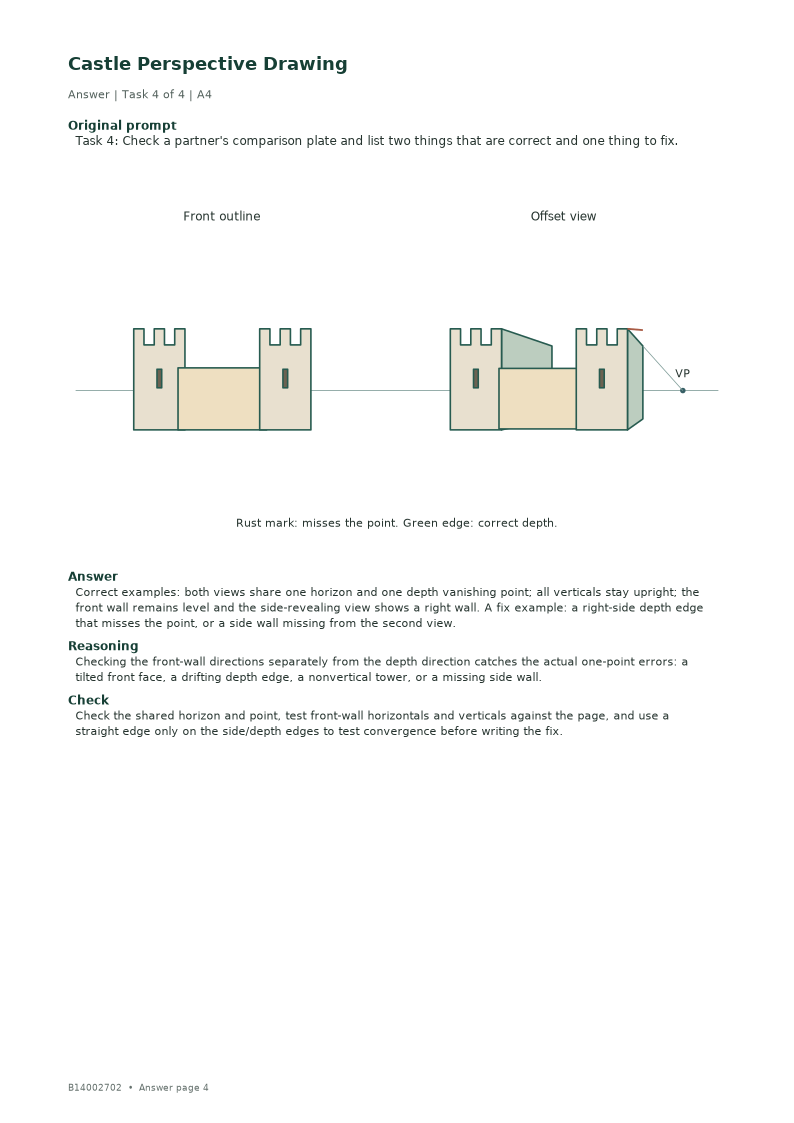
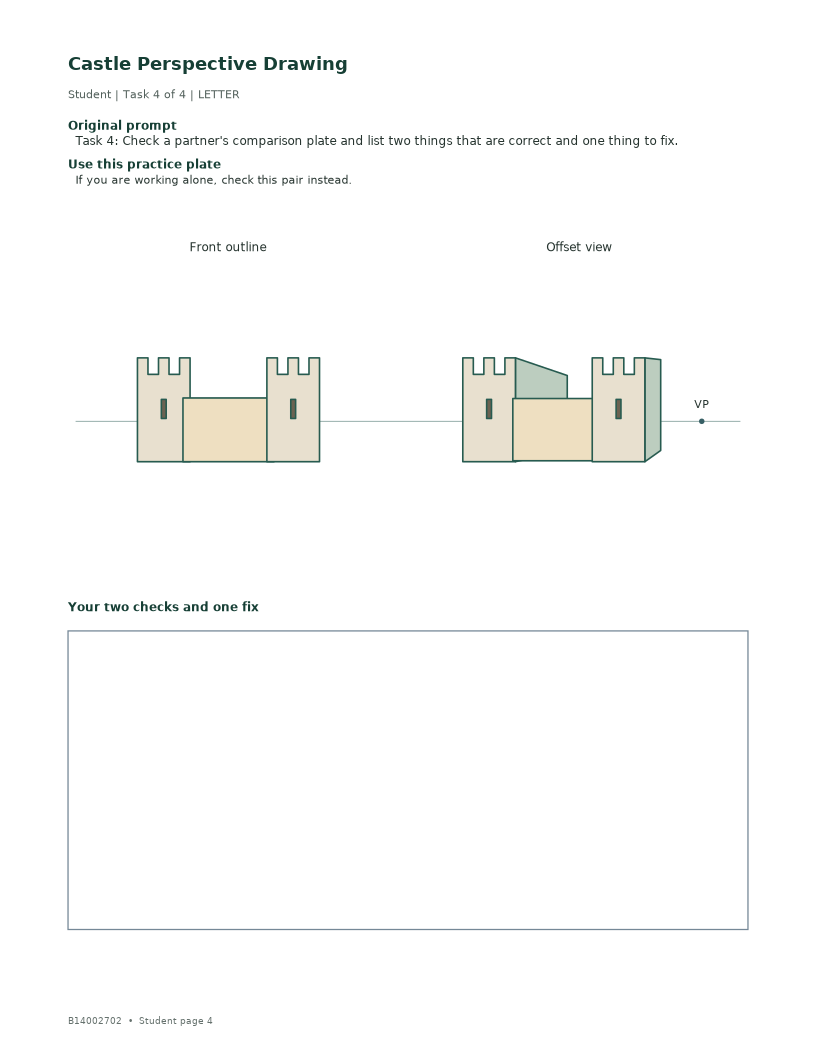
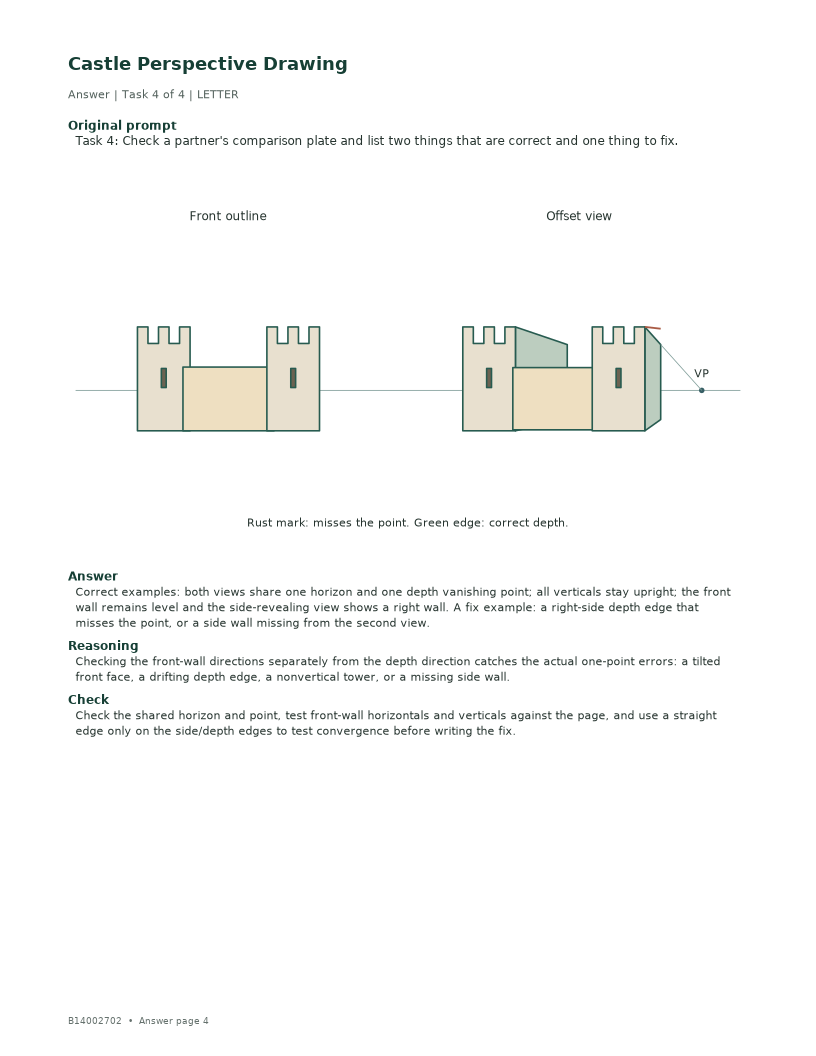
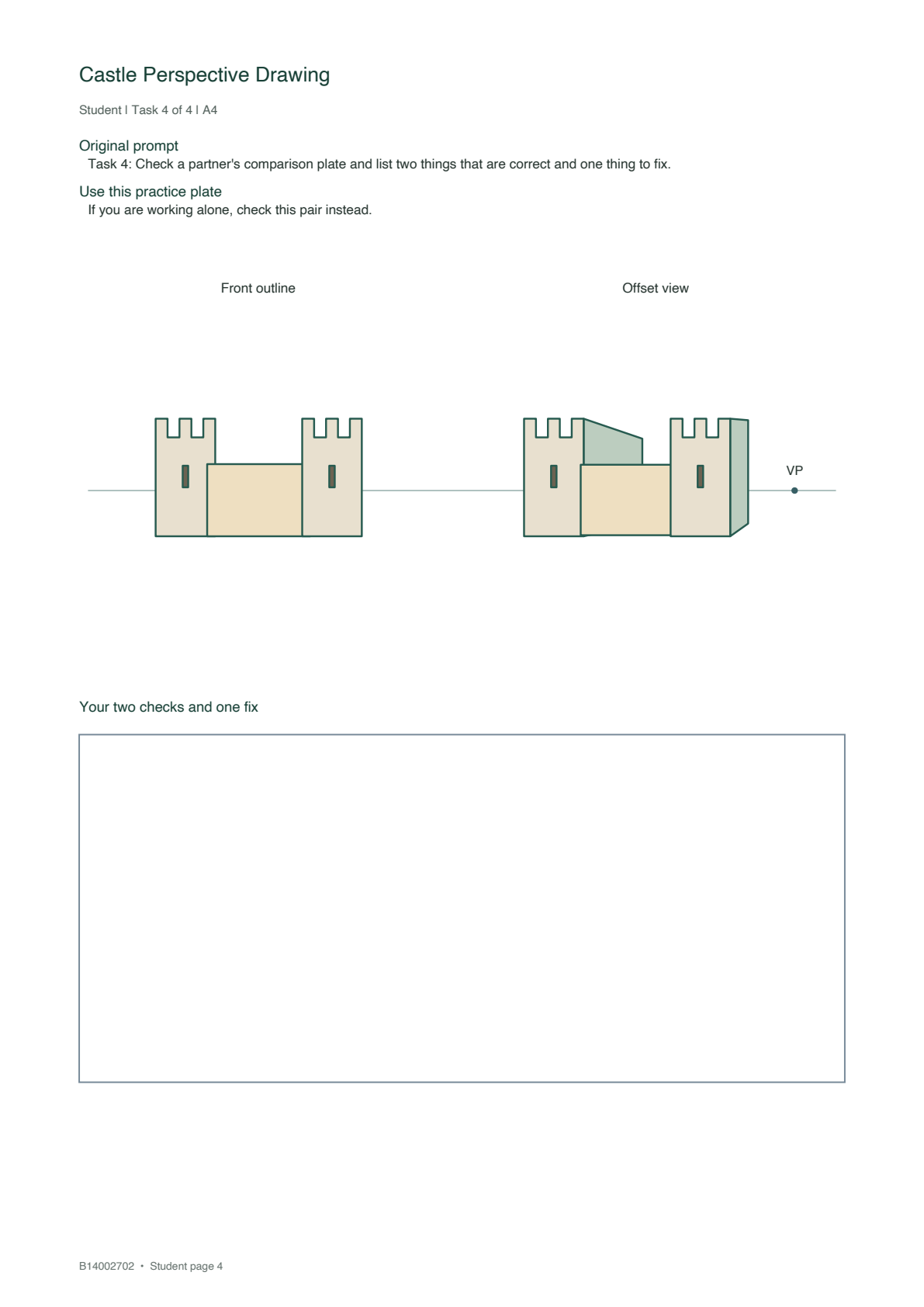
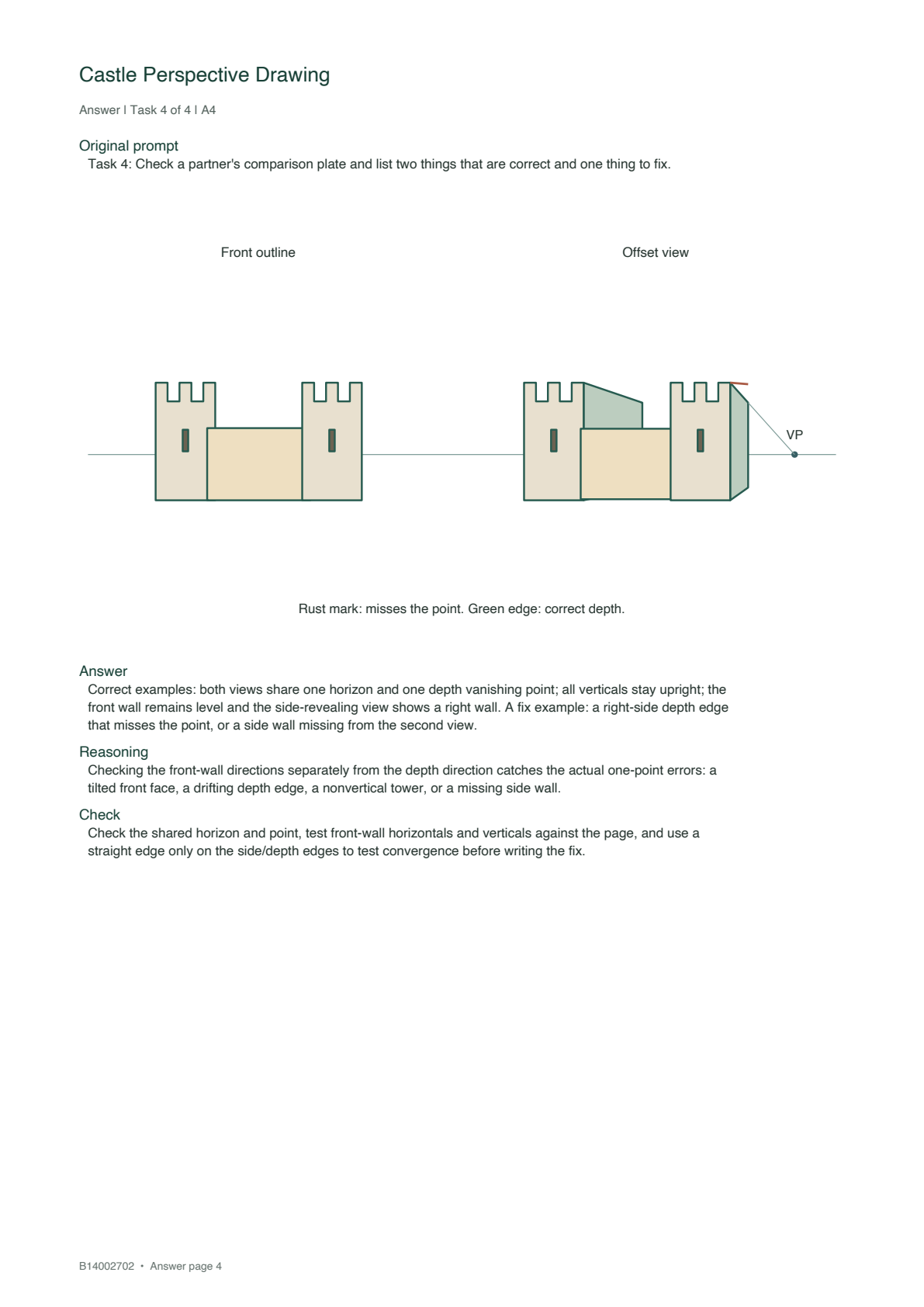
Task 4: Check a partner's comparison plate and list two things that are correct and one thing to fix.
Show answer 4
Correct examples: both views share one horizon and one depth vanishing point; all verticals stay upright; the front wall remains level and the side-revealing view shows a right wall. A fix example: a right-side depth edge that misses the point, or a side wall missing from the second view.
Checking the front-wall directions separately from the depth direction catches the actual one-point errors: a tilted front face, a drifting depth edge, a nonvertical tower, or a missing side wall.
Check: Check the shared horizon and point, test front-wall horizontals and verticals against the page, and use a straight edge only on the side/depth edges to test convergence before writing the fix.
Useful checks
- Slanting wall edges in the front view. Keep front-view wall edges parallel to the horizon. In the side-revealing view the front wall also stays horizontal and vertical; aim only lines running into depth at the vanishing point.
- Tilting tower sides away from vertical. Keep each tower side vertical in both drawings. The viewpoint shifts sideways without rotating the castle, so the front face stays level and upright while the right side wall becomes visible.
- Using a different horizon or vanishing point for each view. Mark one horizon and one vanishing point and use them for both views so the comparison holds.
Questions about this resource
Why compare a front view with an angled view?
The comparison shows a side wall appearing after the viewpoint shifts sideways. The castle and camera direction stay aligned, so front-face edges remain level and upright while the side wall’s depth edges recede to the point.
Do I need exact measurements?
No. This is a drawing exercise; keep proportions consistent between the two views and check edges against the horizon and vanishing point.